M U L H A M T R A D I N G
I N V E R S E
B L U E P R I N T
T H E
A 3 - S t e p I C T M e c h a n i c a l S t r a t e g y
f o r B e g i n n e r t o A d v a n c e d T r a d e r s
Fair Value Gap
Inverse Fair Value Gap
Singular vs Multiple
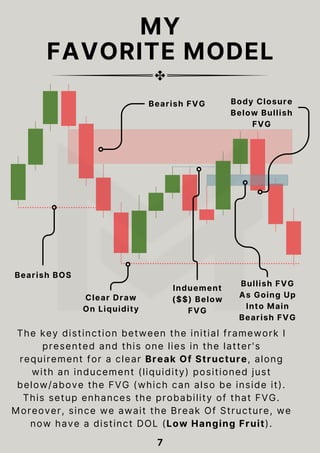
My Favorite Model
High Probability IFVG
Order Flow & Market Structure
Types
Killzones
Macros
4
Entry
Stop Loss
Breakeven
Take Profit
5
6
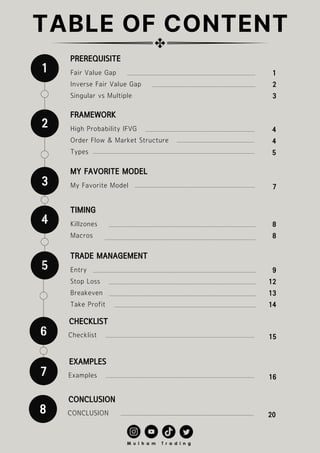
TABLE OF CONTENT
8
8
PREREQUISITE
4
4
5
7
FRAMEWORK
MY FAVORITE MODEL
TIMING
1 1
2
3
2
3
TRADE MANAGEMENT
9
12
13
14
15
CHECKLIST
Checklist
16
EXAMPLES
7 Examples
20
CONCLUSION
8 CONCLUSION
PREREQUISITE
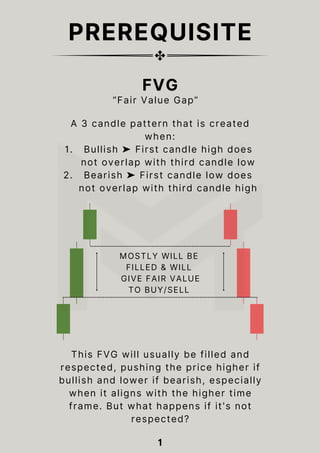
MOSTLY WILL BE
FILLED & WILL
GIVE FAIR VALUE
TO BUY/SELL
FVG
A 3 candle pattern that is created
when:
Bullish ➤ First candle high does
not overlap with third candle low
1.
Bearish ➤ First candle low does
not overlap with third candle high
2.
This FVG will usually be filled and
respected, pushing the price higher if
bullish and lower if bearish, especially
when it aligns with the higher time
frame. But what happens if it's not
respected?
“Fair Value Gap”
1
When a FVG is not respected (confirmed by a
candle closure above or below), it transforms
into an Inverse Fair Value Gap (IFVG)!
Similar to the flip between Support &
Resistance, when a support level is invalidated,
it flips to act as resistance. This holds true for
Order Blocks, which transform into Breaker
Blocks, just as Supply zones switch to Demand
zones and vice versa when breached.
In simpler terms, when any of these levels or
zones are disregarded, they typically shift from
bullish to bearish, or vice versa. Our focus will
center on understanding this transition between
bullish and bearish trends using FVG & IFVG!
2
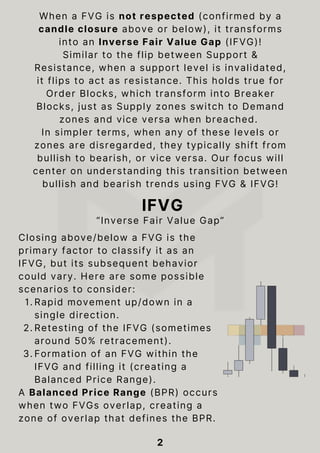
IFVG
“Inverse Fair Value Gap”
Closing above/below a FVG is the
primary factor to classify it as an
IFVG, but its subsequent behavior
could vary. Here are some possible
scenarios to consider:
Rapid movement up/down in a
single direction.
1.
Retesting of the IFVG (sometimes
around 50% retracement).
2.
Formation of an FVG within the
IFVG and filling it (creating a
Balanced Price Range).
3.
A Balanced Price Range (BPR) occurs
when two FVGs overlap, creating a
zone of overlap that defines the BPR.
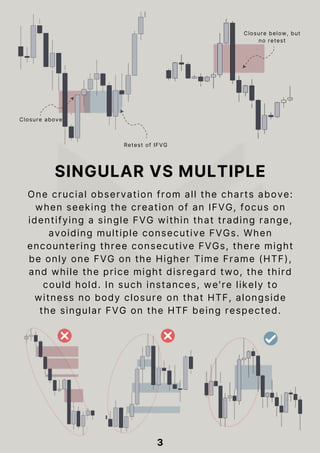
Closure above
Retest of IFVG
Closure below, but
no retest
3
SINGULAR VS MULTIPLE
One crucial observation from all the charts above:
when seeking the creation of an IFVG, focus on
identifying a single FVG within that trading range,
avoiding multiple consecutive FVGs. When
encountering three consecutive FVGs, there might
be only one FVG on the Higher Time Frame (HTF),
and while the price might disregard two, the third
could hold. In such instances, we're likely to
witness no body closure on that HTF, alongside
the singular FVG on the HTF being respected.
FRAMEWORK
HIGH PROBABILITY IFVG
Yes! Our strategy revolves around the
IFVG. However, we won't be executing
trades for every IFVG we encounter.
Instead, we'll concentrate solely on
particular IFVGs generated after price hits
specific levels, within specific time slots.
4
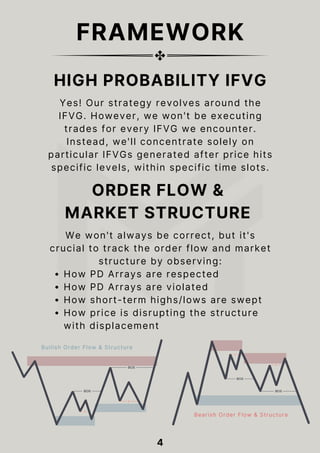
ORDER FLOW &
MARKET STRUCTURE
We won't always be correct, but it's
crucial to track the order flow and market
structure by observing:
How PD Arrays are respected
How PD Arrays are violated
How short-term highs/lows are swept
How price is disrupting the structure
with displacement
X
X
BOS
BOS
X
X
BOS
BOS
Bearish Order Flow & Structure
Bullish Order Flow & Structure
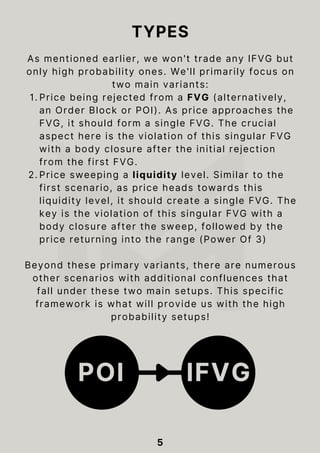
As mentioned earlier, we won't trade any IFVG but
only high probability ones. We'll primarily focus on
two main variants:
Price being rejected from a FVG (alternatively,
an Order Block or POI). As price approaches the
FVG, it should form a single FVG. The crucial
aspect here is the violation of this singular FVG
with a body closure after the initial rejection
from the first FVG.
1.
Price sweeping a liquidity level. Similar to the
first scenario, as price heads towards this
liquidity level, it should create a single FVG. The
key is the violation of this singular FVG with a
body closure after the sweep, followed by the
price returning into the range (Power Of 3)
2.
Beyond these primary variants, there are numerous
other scenarios with additional confluences that
fall under these two main setups. This specific
framework is what will provide us with the high
probability setups!
5
TYPES
POI IFVG
6
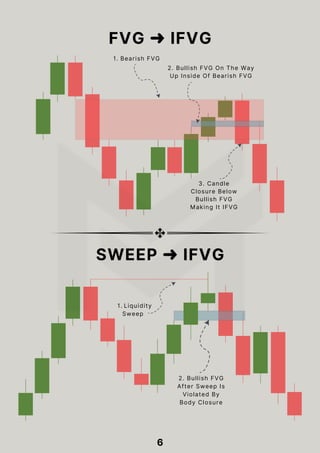
SWEEP ➜ IFVG
FVG ➜ IFVG
Bearish FVG
1.
2. Bullish FVG On The Way
Up Inside Of Bearish FVG
3. Candle
Closure Below
Bullish FVG
Making It IFVG
Liquidity
1.
Sweep
2. Bullish FVG
After Sweep Is
Violated By
Body Closure
MY
FAVORITE MODEL
7
The key distinction between the initial framework I
presented and this one lies in the latter's
requirement for a clear Break Of Structure, along
with an inducement (liquidity) positioned just
below/above the FVG (which can also be inside it).
This setup enhances the probability of that FVG.
Moreover, since we await the Break Of Structure, we
now have a distinct DOL (Low Hanging Fruit).
Bearish BOS
Induement
($$) Below
FVG
Bearish FVG
Bullish FVG
As Going Up
Into Main
Bearish FVG
Body Closure
Below Bullish
FVG
Clear Draw
On Liquidity
KILLZONE TIME
ASIAN 20:00-00:00
LONDON 2:00-5:00
NEW YORK 7:00-10:00
TIMING
KILLZONES
8
MACROS
A Macro is a period in which the algorithm seeks
out buy side or sell side liquidity, or endeavors to
rebalance the price at a point of interest between
the opening and closing times of the Macro
ALL TIMES ARE IN NEW YORK TIME ZONE
Accumulation
[Creates Liquidity]
distribution
[Expansion]
Manipulation
[Liquidity Sweep]
London NY AM NY PM
2:33-3:00 8:50-9:10 11:50-12:10
4:03-4:30 9:50-10:10 13:10-13:40
- 10:50-11:10 15:15-15:45
Trade This!
TRADE
MANAGEMENT
9
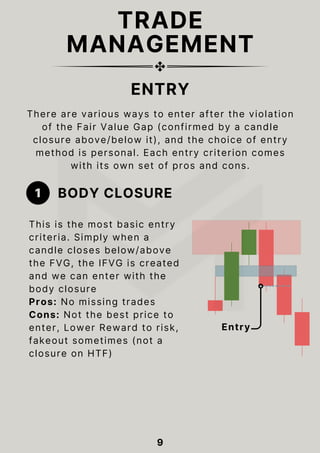
ENTRY
There are various ways to enter after the violation
of the Fair Value Gap (confirmed by a candle
closure above/below it), and the choice of entry
method is personal. Each entry criterion comes
with its own set of pros and cons.
1 BODY CLOSURE
Entry
This is the most basic entry
criteria. Simply when a
candle closes below/above
the FVG, the IFVG is created
and we can enter with the
body closure
Pros: No missing trades
Cons: Not the best price to
enter, Lower Reward to risk,
fakeout sometimes (not a
closure on HTF)
10
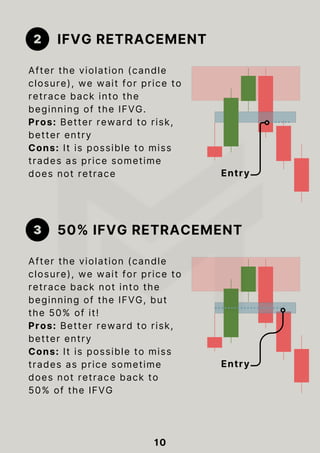
2 IFVG RETRACEMENT
Entry
After the violation (candle
closure), we wait for price to
retrace back into the
beginning of the IFVG.
Pros: Better reward to risk,
better entry
Cons: It is possible to miss
trades as price sometime
does not retrace
3 50% IFVG RETRACEMENT
Entry
After the violation (candle
closure), we wait for price to
retrace back not into the
beginning of the IFVG, but
the 50% of it!
Pros: Better reward to risk,
better entry
Cons: It is possible to miss
trades as price sometime
does not retrace back to
50% of the IFVG
11
4 FVG + FVG [BPR]
This is a very high
probability entry. We are
looking for price to violate
the FVG with a FVG. Entry
can be at:
➤ Beginning of the FVG
➤ 50% of the FVG
➤ Beginning or 50% of
Balanced Price Range [BPR]
which is the overlapped
zone of two FVGs.
Pros: Very high in
probability entry, better
entry & Reward to Risk
Cons: Missing trades
Entry
All entry types are effective! You simply need to
adapt one based on an understanding of its pros
and cons, finding the approach that aligns with
your personality, account, and risk management.
You'll delve deeper into this in the next chapter!
12
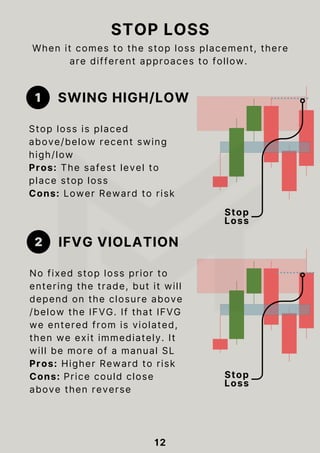
STOP LOSS
When it comes to the stop loss placement, there
are different approaces to follow.
1 SWING HIGH/LOW
Stop
Loss
Stop loss is placed
above/below recent swing
high/low
Pros: The safest level to
place stop loss
Cons: Lower Reward to risk
2 IFVG VIOLATION
Stop
Loss
No fixed stop loss prior to
entering the trade, but it will
depend on the closure above
/below the IFVG. If that IFVG
we entered from is violated,
then we exit immediately. It
will be more of a manual SL
Pros: Higher Reward to risk
Cons: Price could close
above then reverse
13
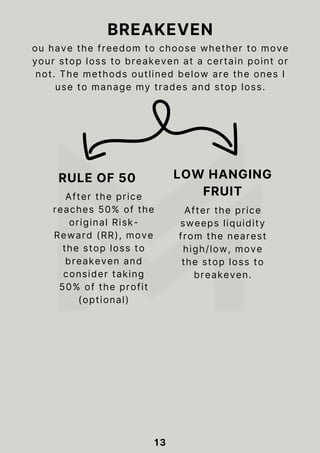
BREAKEVEN
ou have the freedom to choose whether to move
your stop loss to breakeven at a certain point or
not. The methods outlined below are the ones I
use to manage my trades and stop loss.
RULE OF 50 LOW HANGING
FRUIT
After the price
reaches 50% of the
original Risk-
Reward (RR), move
the stop loss to
breakeven and
consider taking
50% of the profit
(optional)
After the price
sweeps liquidity
from the nearest
high/low, move
the stop loss to
breakeven.
14
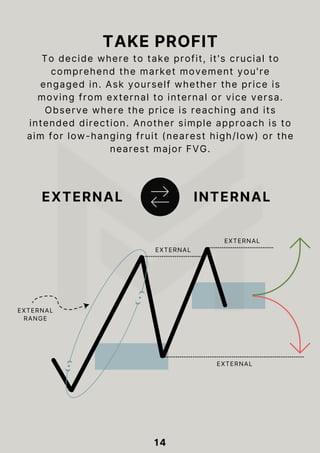
EXTERNAL INTERNAL
EXTERNAL
EXTERNAL
RANGE
EXTERNAL
EXTERNAL
TAKE PROFIT
To decide where to take profit, it's crucial to
comprehend the market movement you're
engaged in. Ask yourself whether the price is
moving from external to internal or vice versa.
Observe where the price is reaching and its
intended direction. Another simple approach is to
aim for low-hanging fruit (nearest high/low) or the
nearest major FVG.
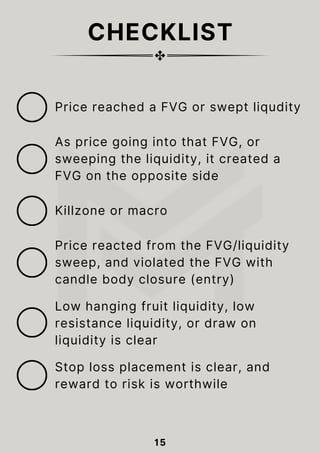
CHECKLIST
15
Price reached a FVG or swept liqudity
As price going into that FVG, or
sweeping the liquidity, it created a
FVG on the opposite side
Killzone or macro
Price reacted from the FVG/liquidity
sweep, and violated the FVG with
candle body closure (entry)
Low hanging fruit liquidity, low
resistance liquidity, or draw on
liquidity is clear
Stop loss placement is clear, and
reward to risk is worthwile
16
17
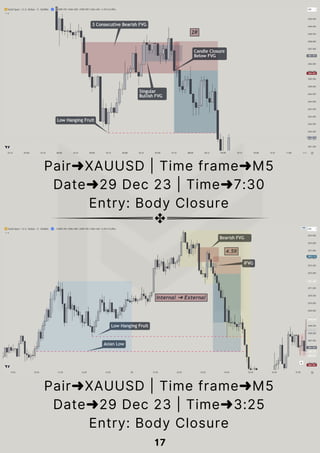
Pair➜XAUUSD | Time frame➜M5
Date➜29 Dec 23 | Time➜7:30
Entry: Body Closure
Pair➜XAUUSD | Time frame➜M5
Date➜29 Dec 23 | Time➜3:25
Entry: Body Closure
18
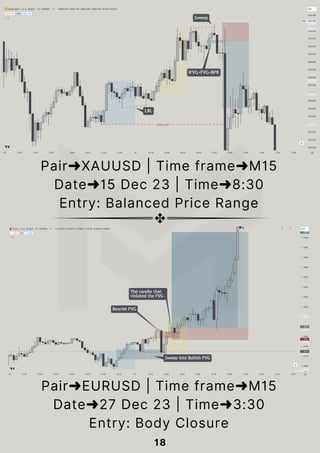
Pair➜XAUUSD | Time frame➜M15
Date➜15 Dec 23 | Time➜8:30
Entry: Balanced Price Range
Pair➜EURUSD | Time frame➜M15
Date➜27 Dec 23 | Time➜3:30
Entry: Body Closure
19
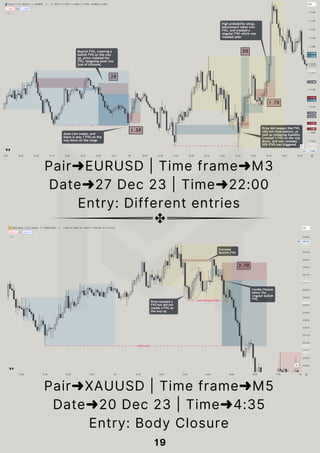
Pair➜EURUSD | Time frame➜M3
Date➜27 Dec 23 | Time➜22:00
Entry: Different entries
Pair➜XAUUSD | Time frame➜M5
Date➜20 Dec 23 | Time➜4:35
Entry: Body Closure
SUMMARY
20
At the conclusion of this mini-book, you
now possess a clear and systematic trading
plan that is adaptable across various
timeframes and currency pairs, relying
solely on Fair Value Gaps (FVG) and Inverse
Fair Value Gaps (IFVG).
Remember, practicing and backtesting are
non-negotiable if you aim to excel.
Experience is the ace up your sleeve,
enabling you to identify high-probability
setups before making a move.
Finally, a word from someone who spent
years navigating unprofitable trading
waters: halt the search for a mythical 100%
strategy. Instead, embrace simplicity and
commit to mastering it. Avoid the allure of
shiny object syndrome; it's a bottomless pit
leading away from profitability.

ICT - Full Trading Plan - Mulham Trading.pdf

  • 1.
    M U LH A M T R A D I N G I N V E R S E B L U E P R I N T T H E A 3 - S t e p I C T M e c h a n i c a l S t r a t e g y f o r B e g i n n e r t o A d v a n c e d T r a d e r s
  • 2.
    Fair Value Gap InverseFair Value Gap Singular vs Multiple My Favorite Model High Probability IFVG Order Flow & Market Structure Types Killzones Macros 4 Entry Stop Loss Breakeven Take Profit 5 6 TABLE OF CONTENT 8 8 PREREQUISITE 4 4 5 7 FRAMEWORK MY FAVORITE MODEL TIMING 1 1 2 3 2 3 TRADE MANAGEMENT 9 12 13 14 15 CHECKLIST Checklist 16 EXAMPLES 7 Examples 20 CONCLUSION 8 CONCLUSION
  • 3.
    PREREQUISITE MOSTLY WILL BE FILLED& WILL GIVE FAIR VALUE TO BUY/SELL FVG A 3 candle pattern that is created when: Bullish ➤ First candle high does not overlap with third candle low 1. Bearish ➤ First candle low does not overlap with third candle high 2. This FVG will usually be filled and respected, pushing the price higher if bullish and lower if bearish, especially when it aligns with the higher time frame. But what happens if it's not respected? “Fair Value Gap” 1
  • 4.
    When a FVGis not respected (confirmed by a candle closure above or below), it transforms into an Inverse Fair Value Gap (IFVG)! Similar to the flip between Support & Resistance, when a support level is invalidated, it flips to act as resistance. This holds true for Order Blocks, which transform into Breaker Blocks, just as Supply zones switch to Demand zones and vice versa when breached. In simpler terms, when any of these levels or zones are disregarded, they typically shift from bullish to bearish, or vice versa. Our focus will center on understanding this transition between bullish and bearish trends using FVG & IFVG! 2 IFVG “Inverse Fair Value Gap” Closing above/below a FVG is the primary factor to classify it as an IFVG, but its subsequent behavior could vary. Here are some possible scenarios to consider: Rapid movement up/down in a single direction. 1. Retesting of the IFVG (sometimes around 50% retracement). 2. Formation of an FVG within the IFVG and filling it (creating a Balanced Price Range). 3. A Balanced Price Range (BPR) occurs when two FVGs overlap, creating a zone of overlap that defines the BPR.
  • 5.
    Closure above Retest ofIFVG Closure below, but no retest 3 SINGULAR VS MULTIPLE One crucial observation from all the charts above: when seeking the creation of an IFVG, focus on identifying a single FVG within that trading range, avoiding multiple consecutive FVGs. When encountering three consecutive FVGs, there might be only one FVG on the Higher Time Frame (HTF), and while the price might disregard two, the third could hold. In such instances, we're likely to witness no body closure on that HTF, alongside the singular FVG on the HTF being respected.
  • 6.
    FRAMEWORK HIGH PROBABILITY IFVG Yes!Our strategy revolves around the IFVG. However, we won't be executing trades for every IFVG we encounter. Instead, we'll concentrate solely on particular IFVGs generated after price hits specific levels, within specific time slots. 4 ORDER FLOW & MARKET STRUCTURE We won't always be correct, but it's crucial to track the order flow and market structure by observing: How PD Arrays are respected How PD Arrays are violated How short-term highs/lows are swept How price is disrupting the structure with displacement X X BOS BOS X X BOS BOS Bearish Order Flow & Structure Bullish Order Flow & Structure
  • 7.
    As mentioned earlier,we won't trade any IFVG but only high probability ones. We'll primarily focus on two main variants: Price being rejected from a FVG (alternatively, an Order Block or POI). As price approaches the FVG, it should form a single FVG. The crucial aspect here is the violation of this singular FVG with a body closure after the initial rejection from the first FVG. 1. Price sweeping a liquidity level. Similar to the first scenario, as price heads towards this liquidity level, it should create a single FVG. The key is the violation of this singular FVG with a body closure after the sweep, followed by the price returning into the range (Power Of 3) 2. Beyond these primary variants, there are numerous other scenarios with additional confluences that fall under these two main setups. This specific framework is what will provide us with the high probability setups! 5 TYPES POI IFVG
  • 8.
    6 SWEEP ➜ IFVG FVG➜ IFVG Bearish FVG 1. 2. Bullish FVG On The Way Up Inside Of Bearish FVG 3. Candle Closure Below Bullish FVG Making It IFVG Liquidity 1. Sweep 2. Bullish FVG After Sweep Is Violated By Body Closure
  • 9.
    MY FAVORITE MODEL 7 The keydistinction between the initial framework I presented and this one lies in the latter's requirement for a clear Break Of Structure, along with an inducement (liquidity) positioned just below/above the FVG (which can also be inside it). This setup enhances the probability of that FVG. Moreover, since we await the Break Of Structure, we now have a distinct DOL (Low Hanging Fruit). Bearish BOS Induement ($$) Below FVG Bearish FVG Bullish FVG As Going Up Into Main Bearish FVG Body Closure Below Bullish FVG Clear Draw On Liquidity
  • 10.
    KILLZONE TIME ASIAN 20:00-00:00 LONDON2:00-5:00 NEW YORK 7:00-10:00 TIMING KILLZONES 8 MACROS A Macro is a period in which the algorithm seeks out buy side or sell side liquidity, or endeavors to rebalance the price at a point of interest between the opening and closing times of the Macro ALL TIMES ARE IN NEW YORK TIME ZONE Accumulation [Creates Liquidity] distribution [Expansion] Manipulation [Liquidity Sweep] London NY AM NY PM 2:33-3:00 8:50-9:10 11:50-12:10 4:03-4:30 9:50-10:10 13:10-13:40 - 10:50-11:10 15:15-15:45 Trade This!
  • 11.
    TRADE MANAGEMENT 9 ENTRY There are variousways to enter after the violation of the Fair Value Gap (confirmed by a candle closure above/below it), and the choice of entry method is personal. Each entry criterion comes with its own set of pros and cons. 1 BODY CLOSURE Entry This is the most basic entry criteria. Simply when a candle closes below/above the FVG, the IFVG is created and we can enter with the body closure Pros: No missing trades Cons: Not the best price to enter, Lower Reward to risk, fakeout sometimes (not a closure on HTF)
  • 12.
    10 2 IFVG RETRACEMENT Entry Afterthe violation (candle closure), we wait for price to retrace back into the beginning of the IFVG. Pros: Better reward to risk, better entry Cons: It is possible to miss trades as price sometime does not retrace 3 50% IFVG RETRACEMENT Entry After the violation (candle closure), we wait for price to retrace back not into the beginning of the IFVG, but the 50% of it! Pros: Better reward to risk, better entry Cons: It is possible to miss trades as price sometime does not retrace back to 50% of the IFVG
  • 13.
    11 4 FVG +FVG [BPR] This is a very high probability entry. We are looking for price to violate the FVG with a FVG. Entry can be at: ➤ Beginning of the FVG ➤ 50% of the FVG ➤ Beginning or 50% of Balanced Price Range [BPR] which is the overlapped zone of two FVGs. Pros: Very high in probability entry, better entry & Reward to Risk Cons: Missing trades Entry All entry types are effective! You simply need to adapt one based on an understanding of its pros and cons, finding the approach that aligns with your personality, account, and risk management. You'll delve deeper into this in the next chapter!
  • 14.
    12 STOP LOSS When itcomes to the stop loss placement, there are different approaces to follow. 1 SWING HIGH/LOW Stop Loss Stop loss is placed above/below recent swing high/low Pros: The safest level to place stop loss Cons: Lower Reward to risk 2 IFVG VIOLATION Stop Loss No fixed stop loss prior to entering the trade, but it will depend on the closure above /below the IFVG. If that IFVG we entered from is violated, then we exit immediately. It will be more of a manual SL Pros: Higher Reward to risk Cons: Price could close above then reverse
  • 15.
    13 BREAKEVEN ou have thefreedom to choose whether to move your stop loss to breakeven at a certain point or not. The methods outlined below are the ones I use to manage my trades and stop loss. RULE OF 50 LOW HANGING FRUIT After the price reaches 50% of the original Risk- Reward (RR), move the stop loss to breakeven and consider taking 50% of the profit (optional) After the price sweeps liquidity from the nearest high/low, move the stop loss to breakeven.
  • 16.
    14 EXTERNAL INTERNAL EXTERNAL EXTERNAL RANGE EXTERNAL EXTERNAL TAKE PROFIT Todecide where to take profit, it's crucial to comprehend the market movement you're engaged in. Ask yourself whether the price is moving from external to internal or vice versa. Observe where the price is reaching and its intended direction. Another simple approach is to aim for low-hanging fruit (nearest high/low) or the nearest major FVG.
  • 17.
    CHECKLIST 15 Price reached aFVG or swept liqudity As price going into that FVG, or sweeping the liquidity, it created a FVG on the opposite side Killzone or macro Price reacted from the FVG/liquidity sweep, and violated the FVG with candle body closure (entry) Low hanging fruit liquidity, low resistance liquidity, or draw on liquidity is clear Stop loss placement is clear, and reward to risk is worthwile
  • 18.
  • 19.
    17 Pair➜XAUUSD | Timeframe➜M5 Date➜29 Dec 23 | Time➜7:30 Entry: Body Closure Pair➜XAUUSD | Time frame➜M5 Date➜29 Dec 23 | Time➜3:25 Entry: Body Closure
  • 20.
    18 Pair➜XAUUSD | Timeframe➜M15 Date➜15 Dec 23 | Time➜8:30 Entry: Balanced Price Range Pair➜EURUSD | Time frame➜M15 Date➜27 Dec 23 | Time➜3:30 Entry: Body Closure
  • 21.
    19 Pair➜EURUSD | Timeframe➜M3 Date➜27 Dec 23 | Time➜22:00 Entry: Different entries Pair➜XAUUSD | Time frame➜M5 Date➜20 Dec 23 | Time➜4:35 Entry: Body Closure
  • 22.
    SUMMARY 20 At the conclusionof this mini-book, you now possess a clear and systematic trading plan that is adaptable across various timeframes and currency pairs, relying solely on Fair Value Gaps (FVG) and Inverse Fair Value Gaps (IFVG). Remember, practicing and backtesting are non-negotiable if you aim to excel. Experience is the ace up your sleeve, enabling you to identify high-probability setups before making a move. Finally, a word from someone who spent years navigating unprofitable trading waters: halt the search for a mythical 100% strategy. Instead, embrace simplicity and commit to mastering it. Avoid the allure of shiny object syndrome; it's a bottomless pit leading away from profitability.