24/11/20161
Chapter 3
Essential Elements of Valid Contract
ESSENTIAL OF A VALID CONTRACT
AGREEMENT
24/11/2016
2
 A person makes a proposal (Offer). When it is
accepted by other, it becomes a promise
(Acceptance).
 Thus, Offer + Acceptance = Promise
 Only a mutual promise forming consideration
for each other is ‘agreement’. Thus, Promise +
Consideration = Agreement
CONTRACT
= AGREEMENT + ENFORCEABILITY
24/11/2016
3
 “An agreement enforceable by law” is
Contract. - Section 2(h)
 There must be legal relationship.
 Agreements of social or domestic nature are not
contracts.
 Examples:
 Invitation to a Birthday party
 Invitation to a Dinner etc
Promisor & Promisee
24/11/2016
4
 The promisee is the person receiving the
promise from the Promisor. The promisee is
the person who has been promised
something, as opposed to the Promisor who
makes the promise to someone.
ESSENTIAL OF A VALID
CONTRACT
24/11/2016
5
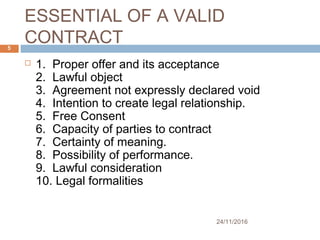
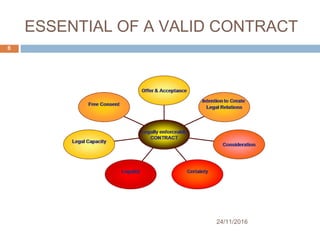
 1.  Proper offer and its acceptance
2.  Lawful object
3.  Agreement not expressly declared void
4.  Intention to create legal relationship.
5.  Free Consent
6.  Capacity of parties to contract
7.  Certainty of meaning.
8.  Possibility of performance.
9.  Lawful consideration
10. Legal formalities
ESSENTIAL OF A VALID CONTRACT
24/11/2016
6
24/11/2016
7
ESSENTIAL OF A
VALID CONTRACT
Offer and acceptance
24/11/2016
8
In order to create a valid contract, there must be
a 'lawful offer' by one party and 'lawful
acceptance' of the same by the other party.
Intention to Create Legal Relations
 Agreements which create legal relations or are capable of
creating legal relations are contracts, for example, an
invitation to a dinner does not create any legal relation and
therefore is not a contract.
 Husband & Wife Agreements
The courts consider domestic arrangements between
husband and wife to be social agreements and not legally
enforceable: Balfour v Balfour.
CONSIDERATION =SOMETHING IN
RETURN
10
 When, at the desire of the promisor, the
promisee or any other person
 has done or abstained from doing (PAST), or
 does or abstains from doing (PRESENT), or
 promises to do or to abstain from doing, something
(FUTURE),
 such act or abstinence or promise is called a
consideration for the promise. -Section 2 (d)
 A promise without consideration is not
‘agreement’
24/11/2016
11
Capacity of parties
 The parties to an agreement must be
competent to contract. If either of the
parties does not have the capacity to
contract, the contract is not valid.
According the following persons are
incompetent to contract.
(a) Minors,          
(b) Persons of unsound mind, and
(c) persons disqualified by law to which
they are subject.
Free consent
24/11/2016
12
 Two or more persons are said to
consent when they agree upon the
same thing in the same sense. (Section
13) 
Free consent
24/11/2016
13
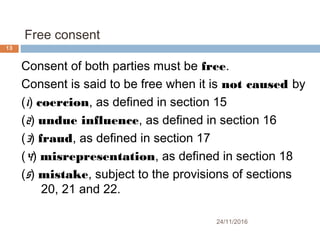
Consent of both parties must be free.
Consent is said to be free when it is not caused by
(1) coercion, as defined in section 15
(2) undue influence, as defined in section 16
(3) fraud, as defined in section 17
(4) misrepresentation, as defined in section 18
(5) mistake, subject to the provisions of sections
20, 21 and 22.
Lawful object
24/11/2016
14
The object for which the contract has been
entered into must not be fraudulent or illegal or
immoral or opposed to public policies.
Possibility of performance. 
24/11/2016
15
If the act is impossible in itself, physically
or legally, if cannot be enforced at law.
For example, Mr. A agrees with B to
discover treasure by magic. Such
Agreements is not enforceable.
Certainty of Terms
The terms of a contract should be clear.
In other words, the contract must not be
vague. Contracts which are vague
cannot be enforced.
AGREEMENTS NOT DECLARED EXPRESSLY
VOID
24/11/2016
17
There are Certain agreements which
have been expressly declared void by
the law. Thus an agreement made by
parties should not fall in this category.
 Legal Formalities
24/11/2016
18
Oral contract is a valid contact. However the
contract must be in writing and registered, if so
required by any law, for example, gift,
mortgage, sale, lease under the Transfer of
Property Act 1882, Memorandum and Articles
of Association of a Company under the Indian
Companies Act
Thank You
19

Chapter 3

  • 1.
  • 2.
    ESSENTIAL OF AVALID CONTRACT AGREEMENT 24/11/2016 2  A person makes a proposal (Offer). When it is accepted by other, it becomes a promise (Acceptance).  Thus, Offer + Acceptance = Promise  Only a mutual promise forming consideration for each other is ‘agreement’. Thus, Promise + Consideration = Agreement
  • 3.
    CONTRACT = AGREEMENT +ENFORCEABILITY 24/11/2016 3  “An agreement enforceable by law” is Contract. - Section 2(h)  There must be legal relationship.  Agreements of social or domestic nature are not contracts.  Examples:  Invitation to a Birthday party  Invitation to a Dinner etc
  • 4.
    Promisor & Promisee 24/11/2016 4 The promisee is the person receiving the promise from the Promisor. The promisee is the person who has been promised something, as opposed to the Promisor who makes the promise to someone.
  • 5.
    ESSENTIAL OF AVALID CONTRACT 24/11/2016 5  1.  Proper offer and its acceptance 2.  Lawful object 3.  Agreement not expressly declared void 4.  Intention to create legal relationship. 5.  Free Consent 6.  Capacity of parties to contract 7.  Certainty of meaning. 8.  Possibility of performance. 9.  Lawful consideration 10. Legal formalities
  • 6.
    ESSENTIAL OF AVALID CONTRACT 24/11/2016 6
  • 7.
  • 8.
    Offer and acceptance 24/11/2016 8 Inorder to create a valid contract, there must be a 'lawful offer' by one party and 'lawful acceptance' of the same by the other party.
  • 9.
    Intention to CreateLegal Relations  Agreements which create legal relations or are capable of creating legal relations are contracts, for example, an invitation to a dinner does not create any legal relation and therefore is not a contract.  Husband & Wife Agreements The courts consider domestic arrangements between husband and wife to be social agreements and not legally enforceable: Balfour v Balfour.
  • 10.
    CONSIDERATION =SOMETHING IN RETURN 10 When, at the desire of the promisor, the promisee or any other person  has done or abstained from doing (PAST), or  does or abstains from doing (PRESENT), or  promises to do or to abstain from doing, something (FUTURE),  such act or abstinence or promise is called a consideration for the promise. -Section 2 (d)  A promise without consideration is not ‘agreement’
  • 11.
    24/11/2016 11 Capacity of parties The parties to an agreement must be competent to contract. If either of the parties does not have the capacity to contract, the contract is not valid. According the following persons are incompetent to contract. (a) Minors,           (b) Persons of unsound mind, and (c) persons disqualified by law to which they are subject.
  • 12.
    Free consent 24/11/2016 12  Twoor more persons are said to consent when they agree upon the same thing in the same sense. (Section 13) 
  • 13.
    Free consent 24/11/2016 13 Consent ofboth parties must be free. Consent is said to be free when it is not caused by (1) coercion, as defined in section 15 (2) undue influence, as defined in section 16 (3) fraud, as defined in section 17 (4) misrepresentation, as defined in section 18 (5) mistake, subject to the provisions of sections 20, 21 and 22.
  • 14.
    Lawful object 24/11/2016 14 The objectfor which the contract has been entered into must not be fraudulent or illegal or immoral or opposed to public policies.
  • 15.
    Possibility of performance.  24/11/2016 15 Ifthe act is impossible in itself, physically or legally, if cannot be enforced at law. For example, Mr. A agrees with B to discover treasure by magic. Such Agreements is not enforceable.
  • 16.
    Certainty of Terms Theterms of a contract should be clear. In other words, the contract must not be vague. Contracts which are vague cannot be enforced.
  • 17.
    AGREEMENTS NOT DECLAREDEXPRESSLY VOID 24/11/2016 17 There are Certain agreements which have been expressly declared void by the law. Thus an agreement made by parties should not fall in this category.
  • 18.
     Legal Formalities 24/11/2016 18 Oral contractis a valid contact. However the contract must be in writing and registered, if so required by any law, for example, gift, mortgage, sale, lease under the Transfer of Property Act 1882, Memorandum and Articles of Association of a Company under the Indian Companies Act
  • 19.