
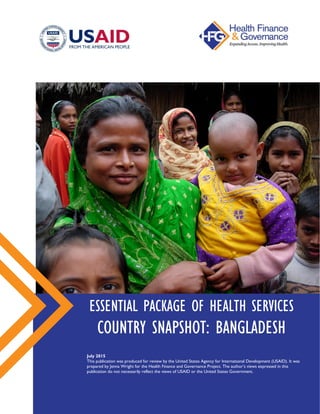
Essential Package of Health Services Country Snapshot: Bangladesh

Resource Type: Brief Authors: Jenna Wright Published: July 2015 Resource Description: An Essential Package of Health Services (EPHS) can be defined as the package of services that the government is providing or is aspiring to provide to its citizens in an equitable manner. Essential packages are often expected to achieve multiple goals: improved efficiency, equity, political empowerment, accountability, and altogether more effective care. There is no universal essential package of health services that applies to every country in the world. This country snapshot is one in a series of 24 snapshots as part of an activity looking at the Governance Dimensions of Essential Packages of Health Services in the Ending Preventable Child and Maternal Death priority countries. The snapshot explores several important dimensions of the EPHS in the country, such as how government policies contribute to the service coverage, population coverage, and financial coverage of the package. Each country snapshot includes annexes that contain further information about the EPHS. The government of Bangladesh first defined an “Essential Service Package” in 1998, then updated it in 2003 and renamed it the “Essential Service Delivery” Package. This package is defined at a high level, and includes: child health care, safe motherhood, family planning, menstrual regulation, post-abortion care, and management of sexually transmitted infections; communicable diseases (including tuberculosis, malaria, others); emerging noncommunicable diseases (diabetes, mental health conditions, cardiovascular diseases); limited curative care and behavior change communication; and nutrition.

Recommended
Recommended
More Related Content
What's hot
What's hot (20)
Viewers also liked
Viewers also liked (20)
Similar to Essential Package of Health Services Country Snapshot: Bangladesh
Similar to Essential Package of Health Services Country Snapshot: Bangladesh (20)
More from HFG Project
More from HFG Project (20)
Recently uploaded
Recently uploaded (20)
Essential Package of Health Services Country Snapshot: Bangladesh
- 1. ESSENTIAL PACKAGE OF HEALTH SERVICES COUNTRY SNAPSHOT: BANGLADESH July 2015 This publication was produced for review by the United States Agency for International Development (USAID). It was prepared by Jenna Wright for the Health Finance and Governance Project. The author’s views expressed in this publication do not necessarily reflect the views of USAID or the United States Government.
- 2. The Health Finance and Governance Project USAID’s Health Finance and Governance (HFG) project helps to improve health in developing countries by expanding people’s access to health care. Led by Abt Associates, the project team works with partner countries to increase their domestic resources for health, manage those precious resources more effectively, and make wise purchasing decisions. As a result, this five-year, $209 million global project increases the use of both primary and priority health services, including HIV/AIDS, tuberculosis, malaria, and reproductive health services. Designed to fundamentally strengthen health systems, HFG supports countries as they navigate the economic transitions needed to achieve universal health care. July 2015 Cooperative Agreement No: AID-OAA-A-12-00080 Submitted to: Scott Stewart, AOR Jodi Charles, Senior Health Systems Advisor Office of Health Systems Bureau for Global Health Recommended Citation: Wright, J., Health Finance & Governance Project. July 2015. Essential Package of Health Services Country Snapshot: Bangladesh. Bethesda, MD: Health Finance & Governance Project, Abt Associates Inc. Photo Credit: Hirshini von Kalm Dec 2005 Abt Associates Inc. | 4550 Montgomery Avenue, Suite 800 North | Bethesda, Maryland 20814 T: 301.347.5000 | F: 301.652.3916 | www.abtassociates.com Avenir Health | Broad Branch Associates | Development Alternatives Inc. (DAI) | | Johns Hopkins Bloomberg School of Public Health (JHSPH) | Results for Development Institute (R4D) | RTI International | Training Resources Group, Inc. (TRG)
- 3. CONTENTS Acronyms................................................................................................................... i About the Essential Package of Health Services Country Snapshot Series ... 1 The Essential Package of Health Services in Bangladesh.................................. 2 Priority Reproductive, Maternal, Newborn and Child Health Interventions..............3 Use of Selected Priority Services..............................................................................................4 How the Health System Delivers the EPHS..........................................................................4 Delivering the EPHS to Different Population Groups........................................................5 Providing Financial Protection for the EPHS.........................................................................5 Sources...................................................................................................................... 6 Annex A. Bangladesh's EPHS ................................................................................ 7 Annex B. Comparison between the EPHS and the Priority RMNCH Services...................................................................................................15 Annex C: Bangladesh Health Equity Profile ...................................................... 21 ACRONYMS EPHS Essential Package of Health Services ESD Essential Service Delivery package RMNCH Reproductive, maternal, newborn and child health
- 5. ABOUT THE ESSENTIAL PACKAGE OF HEALTH SERVICES COUNTRY SNAPSHOT SERIES An Essential Package of Health Services (EPHS) can be defined as the package of services that the government is providing or is aspiring to provide to its citizens in an equitable manner. Essential packages are often expected to achieve multiple goals: improved efficiency, equity, political empowerment, accountability, and altogether more effective care. There is no universal essential package of health services that applies to every country in the world, nor is it expected that all health expenditures in any given country be directed toward provision of that package. Countries vary with respect to disease burden, level of poverty and inequality, moral code, social preferences, operational challenges, financial challenges, and more, and a country’s EPHS should reflect those factors. This country snapshot is one in a series of 24 snapshots produced by the Health Finance & Governance Project as part of an activity looking at the Governance Dimensions of Essential Package of Health Services in the Ending Preventable Child and Maternal Death priority countries. The snapshot explores several important dimensions of the EPHS in the country, such as how government policies contribute to the service coverage, population coverage, and financial coverage of the package. The information presented in this country snapshot feeds into a larger cross-country comparative analysis undertaken by the Health Finance & Governance Project to identify broader themes related to how countries use an EPHS and related policies and programs to improve health service delivery and health outcomes. Each country snapshot includes annexes that contain further information about the EPHS. When available, this includes the country’s most recently published package; a comparison of the country’s package to the list of priority reproductive, maternal, newborn and child health interventions developed by the Partnership for Maternal, Newborn and Child Health in 2011 (PMNCH 2011), and a profile of health equity in the country. 1
- 6. THE ESSENTIAL PACKAGE OF HEALTH SERVICES IN BANGLADESH The government of Bangladesh first defined an “Essential Service Package” in 1998, then updated it in 2003 and renamed it the “Essential Service Delivery” Package. This package is defined at a high level, and includes: Child health care, safe motherhood, family planning, menstrual regulation,1 post-abortion care, and management of sexually transmitted infections Communicable diseases (including tuberculosis, malaria, others) Emerging noncommunicable diseases (diabetes, mental health conditions, cardiovascular diseases) Limited curative care and behavior change communication Nutrition Note, the third and current sector-wide approach document, called the Strategic Plan for Health, Population and Nutrition Sector Development Program 2011–2016, mentions the intention to update the ESD package. However, we did not identify an updated package when reviewing the literature for this report. The government of Bangladesh implements the Strategic Plan for Health, Population and Nutrition Sector Development Program 2011–2016 through 32 separate Operational Plans. “Essential Services Delivery” is one of these plans, and includes the following components: 1. Support Services & Coordination 2. Limited Curative Care 3. Urban Health Services 4. Medical Waste Management 5. Mental Health and Autism 6. Tribal Health 7. Strengthening Upazila2 Health System & Referral System 1 Menstrual regulation means abortion before the 11th week of pregnancy (World Bank 2011). 2 See section “How the Health System Delivers the EPHS in Bangladesh” for information about the Upazila Health System. 2
- 7. Several additional Operational Plans specify the government’s strategy for delivering primary health care services: “Maternal, Neonatal and Child Health Care Operational Plan”; “Community-Based Health Care Operational Plan;” and the “National Nutrition Services Operational Plan.” Additionally, during implementation of the second sector-wide approach, the Ministry of Health and Family Welfare stewarded the formulation of National Neonatal Health Strategy and Technical Guidelines for Bangladesh (2009) in response to disappointing progress on improvement in maternal and neonatal health outcomes. Based on our analysis we believe that the priority services specified across the 32 Operational Plans, plus the services specified in the National Neonatal Health Strategy and Technical Guidelines for Bangladesh (2009), encompass Bangladesh’s EPHS. For the complete list of services, see Annex A. There we summarized the priority services identified across these documents. Priority Reproductive, Maternal, Newborn and Child Health Interventions To see a comparison of Bangladesh’s EPHS and the priority reproductive, maternal, newborn and child health (RMNCH) interventions (PMNCH 2011), refer to Annex B. Status of Service in EPHS Status Definition # of Services Included The literature on the essential package specifically mentioned that this service was included. 39 Explicitly Excluded The literature on the essential package specifically mentioned that this service was not included. 6 Implicitly Excluded This service was not specifically mentioned, and is not clinically relevant to one of the high-level groups of services included in the essential package. 0 Unspecified The literature on the essential package did not specifically mention this service, but this service is clinically relevant to one of the high-level groups of services included in the essential package. 15 The following six priority RMNCH interventions are excluded from Bangladesh's EPHS: Explicitly excluded: Prevention and management of sexually transmitted infections and HIV, including with antiretroviral medicines Screen for and manage HIV (if not already tested) Screen for and initiate or continue antiretroviral therapy for HIV Initiate prophylactic antiretroviral therapy for babies exposed to HIV Routine immunization plus H. influenzae, meningococcal, pneumococcal, and rotavirus vaccines Comprehensive care of children infected with, or exposed to, HIV 3
- 8. Use of Selected Priority Services The table below presents the country’s data on common indicators. Empty cells signify that these data are not available. Indicator Year Value Urban Value Rural Value Pregnant women sleeping under insecticide- treated nets (%) Births attended by skilled health personnel (in the five years preceding the survey) (%) 2011 49.9 21.3 BCG immunization coverage among one- year-olds (%) 2013 99 Diphtheria tetanus toxoid and pertussis (DTP3) immunization coverage among one- year-olds (%) 2013 97 Median availability of selected generic medicines (%)—private Median availability of selected generic medicines (%)—public Source: Global Health Observatory, World Health Organization. How the Health System Delivers the EPHS RMNCH services from the EPHS are delivered through: government-sponsored community health workers public sector primary care facilities public sector referral facilities The EPHS in Bangladesh is delivered through the Upazila Health System, which consists of a subdistrict Hospital, Health Centers (with or without beds), and Community Clinics. The Upazila health system refers to district or national hospitals for tertiary and specialty care services. Community Clinics are small facilities established in remote and hard-to-reach areas. Community health workers (called community health care providers) are stationed in the Community Clinics, and provide health education, health promotion, treatment of minor ailments, and referral services to higher facilities. The Clinics are intended to be a one-stop service center for primary health care with emphasis on maternal and neonatal health (Ministry of Health and Family Welfare 2010). One objective of the Strategic Plan for Health, Population and Nutrition Sector Development Program 2011–2016 is to recruit at least one community health care provider per Community Clinic. 4
- 9. Delivering the EPHS to Different Population Groups The government’s strategy for implementing the EPHS includes specific activities to improve equity of access for specific populations; these include: women, adolescents, the indigent, and rural populations. See Annex C for the World Health Organization’s full health equity profile of Bangladesh based on data from a 2011 Demographic and Health Survey. Key findings from the health equity profile include: Coverage of maternal health services is strongly associated with wealth, education level of the mother, and rural versus urban place of residence, suggesting inequity in service coverage. Coverage of at least one antenatal care visit is 49 percent among women with rural residence, compared to 74 percent among women with urban residence. Coverage of reproductive health services and childhood immunization services is not strongly associated with wealth, education level of the mother, and rural versus urban place of residence, suggesting more equality in service coverage for these types of services. The Strategic Plan for Health, Population and Nutrition Sector Development Program 2011–2016 and its Operational Plans include specific strategies to improve care provision for the following subpopulations: hard to reach populations (rural), disadvantaged or poor populations, urban populations, newborns, children, adolescents, women, people with disabilities, the elderly, and HIV and AIDS patients. Providing Financial Protection for the EPHS Community-based insurance is available in parts or all of the country. All services included in the EPHS are legally exempt from user fees on a national scale. In Bangladesh, primary health care services from the EPD are officially free in the Upazila Health System. There is a nominal fee for services at tertiary and specialized hospitals. However, according to studies such as the Bangladesh Service Delivery Survey of 2003, 80 percent of the respondents reported paying for services, with 20 percent making direct payments to service providers (Bangladesh Health Watch 2012). The government of Bangladesh also implements a program called the demand-side financing scheme, which provides vouchers to pregnant women in order to increase use of safe motherhood services. The scheme is supposed to cover the poor, but many poor families are not reached, and there is rampant mis-targeting of people eligible for benefits (Bangladesh Health Watch 2012). Some health insurance schemes exist in the country, but are not sponsored by the government. Several not-for-profit nongovernmental development organizations provide health services through micro health insurance; this is mainly financed by development partners. The private health insurance market is in nascent stages in Bangladesh. Social health insurance schemes do not currently exist. 5
- 10. SOURCES Bangladesh: Equity Profile - Reproductive, Maternal, Newborn and Child Health Services. World Health Organization. Accessed April 2015 at http://www.who.int/gho/health_equity/countries/en/ Directorate General of Health Services, Ministry of Health and Family Welfare, Government of Bangladesh. 2010. Health, Population and Nutrition Sector Development Program 2011–2016 Operational Plan: Community-Based Health Care. Dhaka. Directorate General of Health Services, Ministry of Health and Family Welfare, Government of Bangladesh. 2010. Health, Population and Nutrition Sector Development Program 2011–2016 Operational Plan: Essential Service Delivery. Dhaka. Directorate General of Health Services, Ministry of Health and Family Welfare, Government of Bangladesh. 2010. Health, Population and Nutrition Sector Development Program 2011–2016 Operational Plan: Family Planning Field Services Delivery Program. Dhaka. Directorate General of Health Services, Ministry of Health and Family Welfare, Government of Bangladesh. 2010. Health, Population and Nutrition Sector Development Program 2011–2016 Operational Plan: Maternal, Child, Reproductive and Adolescent Health. Dhaka. Directorate General of Health Services, Ministry of Health and Family Welfare, Government of Bangladesh. 2010. Health, Population and Nutrition Sector Development Program 2011–2016 Operational Plan: Maternal Neonatal Child and Adolescent Health. Dhaka. Directorate General of Health Services, Ministry of Health and Family Welfare, Government of Bangladesh. 2010. Health, Population and Nutrition Sector Development Program 2011–2016 Operational Plan: National Nutrition Services. Dhaka. Ministry of Health and Family Welfare, Government of Bangladesh. 2010. Strategic Plan for Health, Population and Nutrition Sector Development Program 2011–2016. Dhaka. Ministry of Health and Family Welfare, Government of Bangladesh. 2009. National Neonatal Health Strategy & Technical Guidelines for Bangladesh. Dhaka. Partnership for Maternal, Newborn & Child Health. 2011. A Global Review of the Key Interventions Related to Reproductive, Maternal, Newborn and Child Health (RMNCH). Geneva, Switzerland: PMNCH. World Bank. April 2011. Reproductive Health at a Glance: Bangladesh. Accessed in May 2014 at http://siteresources.worldbank.org/INTPRH/Resources/376374-1303736328719/Bangladesh42111web.pdf. 6
- 11. ANNEX A. BANGLADESH'S EPHS Essential Service Delivery (ESD) Program Package Child health care, safe motherhood, family planning, menstrual regulation,3 post abortion care, and management of sexually transmitted infections; Communicable diseases (including tuberculosis, malaria, others); Emerging noncommunicable diseases (diabetes, mental health, cardio-vascular diseases); Limited curative care and behavior change communication; Nutrition Source: Strategic Plan for Health, Population and Nutrition Sector Development Program 2011-2016 (Ministry of Health and Family Welfare) Components of the Essential Service Delivery Program Support Services & Coordination Limited Curative Care Urban Health Services, Medical Waste Management, Mental Health and autism Tribal Health, and Strengthening Upazila4 Health System & Referral System. Source: Health, Population and Nutrition Sector Development Program 2011-2016 Operational Plan: Essential Service Delivery (Directorate General of Health Services) Specified Services from Other Operational Plans The community level will be the focus of all area based Community Nutrition activities/ interventions. At the community level, nutrition services will be delivered by Health Assistants (HA), Family Welfare Assistants (FWAs) and Community Health Care Provider (CHCP) in addition to their usual duties. These activities will be supervised by their respective supervisors and will be carried out through group counseling; one-to-one counseling during home visits to pregnant women, new mothers, growth falters (that is, pregnant women, infants and young children). The HAs, FWAs and CHCPs will receive supervision and guidance from Health/Family Planning Inspectors and Family Welfare Visitors to carry out nutrition services along with other health and family planning responsibilities. In addition, services of Community Group & Community Support Group will be achieved wherever they are available and whenever necessary. 3 Menstrual regulation means abortion before the 11th week of pregnancy (World Bank, 2011). 4 The Upazila Health System consists of a Hospital, Health Centers (with or without beds) and Community Clinics. 7
- 12. The Community Clinic is a one stop service center for primary health care in rural areas. The major services provided are: Maternal and neonatal health care services • IYCF: Counseling to all women with children who come to outpatient department and community for exclusive breast feeding until 6 months of age including positioning and attachment, supporting for trouble-shooting for any breastfeeding problem, proper complementary foods and advice on adequate nutrition after six months of age, weight and height measurements. Management of Acute Malnutrition: Screening for malnutrition (MUAC, growth monitoring), nutrition advice for all children, classification and categorization of referred children by level of malnutrition, treatment of uncomplicated cases of moderate malnutrition, referral for complicated cases to primary level care facility, follow-up of referrals from the community and monitor follow-up visits to children under treatment. Integrated Management of Childhood illness Reproductive health and family planning services Expanded Program on Immunization, acute respiratory infection, communicable disease detection Registration of newly married couple, pregnant women, birth & death, preservation of EDD Nutritional education and micro-nutrient supplements: provide advice, guidance to households on iodine, iron, and vitamin A, advocacy and monitoring, follow-up and compliance of use of iron folic acid by pregnant women; provision of zinc in addition to oral rehydration salts during treatment of diarrhea, provision of de-worming medication, iron-folic acid supplements, post-partum vitamin A supplementation. Health and family planning education & counseling: in addition to BCC messages on IYCF nutrition education and counseling will be provided to adolescents, pregnant and lactating women on topics such as, personal hygiene and cleanliness especially during preparation of food and feeding of infants and young children, general nutrition, health and nutritional importance of de-worming and consumption of micronutrient supplements (Vitamin A, Iron, Folate etc.). Identifications of other severe illnesses like tuberculosis, malaria, pneumonia, life threatening influenza, obstetrical emergencies and refer to higher facilities Identification of emerging and reemerging diseases & refer to higher facilities. Other services as identified by Government of Bangladesh under HPNSDP to be provided Treatment of minor ailments Establishing effective referral linkage with higher facilities Source: Health, Population and Nutrition Sector Development Program 2011-2016 Operational Plan: Community-based Health Care (Directorate General of Health Services) 8
- 13. Priority Interventions and Activities of the National Nutrition Services Growth Monitoring and Promotion Behavior Change Communication to Promote Good Nutritional Practices Micronutrient supplementation: • Vitamin A supplementation • Iron folate supplementation • Iron Supplementation and Deworming of Adolescent Girls • Zinc Supplementation during Treatment of Diarrhea • Vitamin D, Calcium Supplementation (advocate for consumption of calcium rich food and calcium supplementation during pregnancy and after 40 years of age) Control of Iodine Deficiency Disorder and Salt Iodization Program Management of Severe Acute Malnutrition and Community Management of Acute Malnutrition Community based nutrition services • Regular growth monitoring for children under 2 years of age. • Nutrition education for mothers, adolescent girls, newlywed women • Individual counseling of parents for concerning child growth & development, child care, immunization etc. • Pregnant women counseling for self-care, well-being and healthy factors, food etc. • Improved supplementary food (Pushti Packet) for selective and targeted population groups. • Micronutrient supplementation (Vit.A, IronFolate) • Deworming for children and adolescent girl • Referral for severe acute malnutrition and other illness of children and pregnant women antenatal care, postnatal care. Source: Health, Population and Nutrition Sector Development Program 2011-2016 Operational Plan: National Nutrition Services (Directorate General of Health Services) 9
- 14. Expanded Program on Immunization: EPI Priority Activity includes introducing new vaccines: Pneumococcal vaccine, Rota Vaccine, Birth dose of Hepatitis B vaccine, dT vaccine, Rubella vaccine Integrated Management of Childhood Illness Management of pneumonia at 1st level facilities Community and social mobilization through engaging community stakeholders, revitalization of Community Clinic Management Groups and Community Support Group, active involvement of local government bodies for promoting healthy behavior and practices and effective demand generation for MNCH services. Scale up proven interventions and best practices on reduction of maternal mortalities such as AMTSL practice at facility, use of Misoprostol for postpartum hemorrhage, if oxytocin is not available and use of Magnesium Sulphate for prevention of pre-eclampsia, and post-partum family planning. Scale up evidence based protocols for newborn resuscitation (Helping Babies Breathe) and newborn sepsis Community based management of childhood priority illness, i.e. pneumonia, diarrhea, neonatal sepsis and first aid of common injuries by trained CHCPs/BHWs/CHWs Community based management of neonatal sepsis, birth asphyxia (with bag & mask) and Low birth weight by the C-SBAs/BHWs/CHCPs/CHWs, identification and referral of sick newborns to UHC/DH and proper management. Source: Health, Population and Nutrition Sector Development Program 2011-2016 Operational Plan: Maternal Neonatal Child and Adolescent Health (Directorate General of Health Services) 10
- 15. Maternal Health Services: Registration of all pregnant mothers; Increase birth planning and antenatal care (ANC); Safe delivery by trained service providers at home and at facilities (MCWCs and Upgraded UH&FWCs) with active management of 3rd.stage of labor. Ensure24/7 EOC services in all MCWCs and selected UH&FWCs. Use of Tab. Misoprostol at field level to prevent PPH Use of Mg.Sulph. to prevent Eclampsia. Postnatal care (PNC) Performance based financing for the service providers; DSF for the service providers and clients; and Community mobilization activities; Reproductive Health Care services: Reduction of unsafe abortion through safe MR services and Post Abortion Care; Syndromes management of RTI/STI through diagnosis and treatment; Counseling on RTI/STD, HIV/AIDS and Condom promotion; Provide health education for adopting preventive measures against RTI/STTDs with especial emphasis on condom promotion; Prevention of unwanted pregnancies through Emergency Contraceptive Pill. Early detection of Cervical cancer through Visual Inspection of Cervix with Acetic acid (VIA) and screening for Breast cancer. Fertility care services and treatment of infertility. Adolescent Health Care Services: Implementation of adolescent health strategies action plans; Promotional activities on delayed marriage; Counseling and developing awareness of adolescents on personnel hygienic practices, nutrition, puberty, anemia, RTI/STI, unprotected sexual activities, night wets, drug addiction, accident, violence and sexual abuse; Train adolescents on SRH through peer groups; Management for minor gynecological problems i.e. dysmenorrhea, and menorrhagia etc.; Syndromes management of RTI/STDs, awareness creation on HIV/AIDS and condom promotion for married adolescents; Providing consultation and treatment for some reproductive health related problems of adolescents; Full immunization of adolescent girls with five dose tetanus toxoid vaccination in coordination with EPI Program; Initiation for making all service centers adolescent friendly in phases. 11
- 16. Newborn & Child Health Care Service Promoting integrated approach to address sick Child through IMCI including acute respiratory infection/pneumonia, diarrhea, malnutrition, fevers etc. Growth monitoring Providing medication of Deforming Routine immunization in coordination with EPI Program and Vitamin-A supplementation Ensuring management of drowning, injuries and accident Limited curative care for Eye, Ear, Skin infection/worm infestation etc. New born care : • Health education for mothers on cleanliness, nutrition, danger signs of both mother and baby, Umbilical cord care, Breast feeding, Thermal control, EPI etc. • Management of birth asphyxia • Routine eye care, and • Special care of pre-term and low birth weight baby Source: Health, Population and Nutrition Sector Development Program 2011-2016 Operational Plan: Maternal, Child, Reproductive and Adolescent Health (Directorate General of Health Services) Priority interventions to improve Population and Family Planning services will include: Promoting delay in marriage and childbearing, use of post-partum Family Planning, post abortion Family Planning and Family Planning for appropriate segments of the population Strengthening Family Planning awareness building efforts through mass communication and IEC activities and considering local specificities. Using different service delivery approaches for different geographical regions and segments of the population Maintaining focus on commodity security and ensuring uninterrupted availability of quality family planning services closer to the people (at the Community Center level). Registering eligible couples with particular emphasis on urban areas to establish effective communication and counseling Compensating for lost wages (reimbursement for opportunity costs) for long acting and permanent method contraceptive performance. Strengthening Family Planning services especially post-partum and post abortion family planning and demand generation through effective coordination of services with DGHS utilizing appropriate opportunities. Source: Health, Population and Nutrition Sector Development Program 2011-2016 Operational Plan: Family Planning Field Services Delivery Program (Directorate General of Health Services) 12
- 17. Guidelines for Maternal Care 1.1 Broad Strategic Actions by Level of Care 1.2 Guidelines for Interventions during Pre-pregnancy, Pregnancy, Childbirth and Postnatal Period 1.2.1 Guidelines for Pre-pregnancy Interventions 1.2.2 Guidelines for Interventions during Delivery 1.2.3 Basic ANC: Components by Visits 1.2.4 Components of Birth, Neonate and Emergency Preparedness 1.2.5 Danger Signs in Mother and Neonate 1.3 Guidelines for Interventions during Childbirth 1.3.1 Six Principles of Clean Delivery 1.3.2 Proposed Elements of Clean Delivery and Neonatal Kit 1.3.3 Neonatal Caregiver at Community Level 1.3.4 Essential Newborn Care 1.4 Guidelines for Interventions after Delivery Guidelines for Healthy Newborn Care 2.1 Broad Strategic Actions by Level of Care 2.2 Guidelines for Healthy Newborn Interventions Guidelines for Birth Asphyxia 3.1 Broad Strategic Actions by Level of Care 3.2 Guidelines for Birth Asphyxia Interventions 3.3 Management of Birth Asphyxia 3.4 Algorithm for Birth Asphyxia Management Guidelines for Low Birth Weight Neonates 4.1 Broad Strategic Actions by Level of Care 4.2 Guidelines for Low Birth Weight interventions 4.3 Guidelines by Level of care for Low Birth Weight Neonates 4.4 Algorithm for Follow Up of LBW Babies at Home Guidelines and Interventions for Neonatal Sepsis 5.1 Broad Strategic Actions by Level of Care 5.2 Guidelines for Neonatal Sepsis interventions 5.3 Management of Neonatal Sepsis 5.4 Identification of Neonatal Sepsis: Danger Signs Source: National Neonatal Health Strategy & Guidelines (Ministry of Health and Family Welfare, 2009) 13
- 19. ANNEX B. COMPARISON BETWEEN THE EPHS AND THE PRIORITY RMNCH SERVICES RMNCH Essential Interventions Service Included in EPHS Source and Additional Notes Adolescence and pre- pregnancy Level: Community Primary Referral Family planning (advice, hormonal and barrier methods) Yes Source: Operational Plan: Family Planning Field Services Delivery Program Prevent and manage sexually transmitted infections, HIV Yes Source: Operational Plan: Maternal, Child, Reproductive and Adolescent Health Folic acid fortification/supplementation to prevent neural tube defects Unspecified This service was not specified in reviewed documents Level: Primary and Referral Family planning (hormonal, barrier and selected surgical methods) Yes Source: Operational Plan: Family Planning Field Services Delivery Program Level: Referral Family planning (surgical methods) Yes Source: Operational Plan: Family Planning Field Services Delivery Program Pregnancy (antenatal) Level: Community Primary Referral Iron and folic acid supplementation Yes Source: Operational Plan: Community-based Health Care Tetanus vaccination Yes Source: Operational Plan: Maternal, Child, Reproductive and Adolescent Health Prevention and management of malaria with insecticide treated nets and antimalarial medicines Yes Source: National Neonatal Health Strategy & Guidelines Prevention and management of sexually transmitted infections and HIV, including with antiretroviral medicines No Source: Operational Plan: National AIDS/STI Program states that ART is provisioned through GFATM funds and delivered through NGOs, not through public health facilities. It is explicitly excluded. Calcium supplementation to prevent hypertension (high blood pressure) Yes Source: National Neonatal Health Strategy & Guidelines Interventions for cessation of smoking Unspecified This service was not specified in reviewed documents Level: Primary and Referral Screening for and treatment of syphilis Yes Source: National Neonatal Health Strategy & Guidelines Low-dose aspirin to prevent pre-eclampsia Unspecified This service was not specified in reviewed documents 15
- 20. RMNCH Essential Interventions Service Included in EPHS Source and Additional Notes Anti-hypertensive drugs (to treat high blood pressure) Unspecified This service was not specified in reviewed documents Magnesium sulphate for eclampsia Yes Source: National Neonatal Health Strategy & Guidelines Antibiotics for preterm prelabour rupture of membranes Yes Source: National Neonatal Health Strategy & Guidelines Corticosteroids to prevent respiratory distress syndrome in preterm babies Yes Source: National Neonatal Health Strategy & Guidelines Safe abortion Yes Source: Strategic Plan for Health, Population and Nutrition Sector Development Program 2011-2016 Post abortion care Yes Source: Strategic Plan for Health, Population and Nutrition Sector Development Program 2011-2016 Level: Referral Reduce malpresentation at term with External Cephalic Version Yes Source: National Neonatal Health Strategy & Guidelines Induction of labour to manage prelabour rupture of membranes at term (initiate labour) Unspecified This service was not specified in reviewed documents Childbirth Level: Community Primary Referral Prophylactic uterotonics to prevent postpartum haemorrhage (excessive bleeding after birth) Yes Source: National Neonatal Health Strategy & Guidelines Manage postpartum haemorrhage using uterine massage and uterotonics Unspecified This service was not specified in reviewed documents Social support during childbirth Unspecified This service was not specified in reviewed documents Level: Primary and Referral Active management of third stage of labour (to deliver the placenta) to prevent postpartum haemorrhage (as above plus controlled cord traction) Yes Source: Operational Plan: Maternal Neonatal Child and Adolescent Health Management of postpartum haemorrhage (as above plus manual removal of placenta) Unspecified This service was not specified in reviewed documents Screen and manage HIV (if not already tested) No Source: Operational Plan: National AIDS/STI Program states that ART is provisioned through GFATM funds and delivered through NGOs, not through public health facilities. It is explicitly excluded. 16
- 21. RMNCH Essential Interventions Service Included in EPHS Source and Additional Notes Level: Referral Caesarean section for maternal/foetal indication (to save the life of the mother/baby) Unspecified This service was not specified in reviewed documents Prophylactic antibiotic for caesarean section Unspecified This service was not specified in reviewed documents Induction of labour for prolonged pregnancy (initiate labour) Yes Source: National Neonatal Health Strategy & Guidelines Management of postpartum haemorrhage (as above plus surgical procedures) Unspecified This service was not specified in reviewed documents Postnatal (Mother) Level: Community Primary Referral Family planning advice and contraceptives Yes Source: Operational Plan: Family Planning Field Services Delivery Program Nutrition counselling Yes Source: National Neonatal Health Strategy & Guidelines Level: Primary and Referral Screen for and initiate or continue antiretroviral therapy for HIV No Source: Operational Plan: National AIDS/STI Program states that ART is provisioned through GFATM funds and delivered through NGOs, not through public health facilities. It is explicitly excluded. Treat maternal anemia Unspecified This service was not specified in reviewed documents Level: Referral Detect and manage postpartum sepsis (serious infections after birth) Yes Source: Operational Plan: Maternal Neonatal Child and Adolescent Health Postnatal (Newborn) Level: Community Primary Referral Immediate thermal care (to keep the baby warm) Yes Source: National Neonatal Health Strategy & Guidelines Initiation of early breastfeeding (within the first hour) Yes Source: National Neonatal Health Strategy & Guidelines Hygienic cord and skin care Yes Source: National Neonatal Health Strategy & Guidelines Level: Primary and Referral Neonatal resuscitation with bag and mask (by professional health workers for babies who do not breathe at birth) Yes Source: Operational Plan: Maternal Neonatal Child and Adolescent Health 17
- 22. RMNCH Essential Interventions Service Included in EPHS Source and Additional Notes Kangaroo mother care for preterm (premature) and for less than 2000g babies Yes Source: National Neonatal Health Strategy & Guidelines Extra support for feeding small and preterm babies Yes Source: National Neonatal Health Strategy & Guidelines Management of newborns with jaundice (“yellow” newborns) Yes Source: National Neonatal Health Strategy & Guidelines Initiate prophylactic antiretroviral therapy for babies exposed to HIV No Source: Operational Plan: National AIDS/STI Program states that ART is provisioned through GFATM funds and delivered through NGOs, not through public health facilities. It is explicitly excluded. Level: Referral Presumptive antibiotic therapy for newborns at risk of bacterial infection Yes Source: National Neonatal Health Strategy & Guidelines Use of surfactant (respiratory medication) to prevent respiratory distress syndrome in preterm babies Unspecified This service was not specified in reviewed documents Continuous positive airway pressure (CPAP) to manage babies with respiratory distress syndrome Unspecified This service was not specified in reviewed documents Case management of neonatal sepsis, meningitis and pneumonia Yes Source: Operational Plan: Maternal Neonatal Child and Adolescent Health Infancy and Childhood Level: Community Primary Referral Exclusive breastfeeding for 6 months Yes Source: Operational Plan: National Nutrition Services Continued breastfeeding and complementary feeding from 6 months Yes Source: Operational Plan: National Nutrition Services Prevention and case management of childhood malaria Yes Source: Operational Plan: Community-based Health Care Vitamin A supplementation from 6 months of age Yes Source: Operational Plan: National Nutrition Services Routine immunization plus H. influenzae, meningococcal, pneumococcal and rotavirus vaccines No Source: Operational Plan: Maternal Neonatal Child and Adolescent Health explicitly states that rota virus, and pneumococcal vaccines are not yet included. Management of severe acute malnutrition Yes Source: Operational Plan: National Nutrition Services Case management of childhood pneumonia Yes Source: Operational Plan: Maternal Neonatal Child and Adolescent Health 18
- 23. RMNCH Essential Interventions Service Included in EPHS Source and Additional Notes Case management of diarrhoea Yes Source: Operational Plan: Maternal Neonatal Child and Adolescent Health Level: Primary and Referral Comprehensive care of children infected with, or exposed to, HIV No Source: Operational Plan: National AIDS/STI Program states that ART is provisioned through GFATM funds and delivered through NGOs, not through public health facilities. It is explicitly excluded. Level: Referral Case management of meningitis Unspecified This service was not specified in reviewed documents Across the continuum of care Level: Community Strategies Home visits for women and children across the continuum of care Yes Source: Operational Plan: Community-based Health Care Women’s groups Yes Source: Operational Plan: Community-based Health Care 19
- 25. ANNEX C: BANGLADESH HEALTH EQUITY PROFILE 21
- 26. 22