Enterprise Social Media’s effect on social interaction in the workplace
By Alexander Klaver
An essay in the form of a presentation for the application of IE Business School
How do you imagine social interaction within 10 years, taking into consideration the impact of technology on
human relations?
ESM’s effect on social interaction in the workplace 2
Enterprise Social Media (ESM)
Introduction
Because a large part of human social interaction takes place in the workplace and because I
think that communication between employees at this moment is already subject to some big
changes, I’m going to focus on interaction between people within organizations. For my Thesis
last year I’ve conducted research on the growing importance of Enterprise Social Media (ESM)
within companies.
A growing number of businesses adopts or has adopted an ESM platform. ESM solutions can be
compared to traditional social media such as Facebook but are only used within an
organization. They have networking, chatting, community and collaboration functionalities that
are similar to traditional social media and because of that ESM platforms have the potential to
become valuable communication and collaboration tools for employees within an organization.
As businesses are becoming more global and working environments are becoming more flexible
and less location bound, the need for simple, quick online interaction is growing rapidly. With
the use of ESM employees can easily find and contact colleagues all over the world, make
communities and share knowledge, or collaborate via working on documents in real time.
However because this is a relative new technology, businesses are struggling to facilitate this
type of employee communication successfully. Therefore it is becoming increasingly important
to understand the difficulties associated with online communication and how to overcome any
problems associated with them.
I
II
III
IV
3
Benefits
• Collaboration - allowing
people to work more
effectively with each other
and within groups and
communities across
organizational boundaries
• Communication – stimulates
the use of communities and
allows employees to
communicate either one on
one, to a specific group or
the whole organization
• Knowledge sharing -
Knowledge can be shared
and found more easily
• These three pillars should
stimulate co-creation and
increase employees’
productivity
ESM Adoption & Drivers
• Collaboration between
employees becomes
increasingly important for
gaining a competitive
advantage
• More than 90% of the
Fortune 500 companies have
implemented an ESM tool
and the supply of such tools
are increasing rapidly
• Companies struggle with
implementing ESM
technologies in an effective
manner
Key challenges
• Design and implementation
of an efficient, user-friendly
configured ESM application
• Providing information at the
right place at the right time,
avoiding a ‘big spaghetti’
causing an information
overload and thereby risking
user adoption and inefficient
use of the solutions
• Stimulate a new way of
working and removing user
adoption barriers such as
privacy fears
• Effective user adoption
strategies, enabling a critical
mass of people and ensuring
continuity of users
The rise of ESM in the workplace can create major benefits for
employees but also generates some key challenges for organizations
Benefits and challenges of Enterprise Social Media
ESM’s effect on social interaction in the workplace
4
How the coming next ten years organizations will try to keep up with
the technological evolution of human interaction
Conclusion
The current trend of more online social interaction between employees, will go on. I expect that
over ten years the majority of employee communication will go via online platforms similar to
ESM and that it will even have driven out the use of e-mail. ESM tools will make communication
and collaboration much easier for people working flexibly at home or in a global environment
and the platforms are much more convenient than ever lasting e-mail conversations.
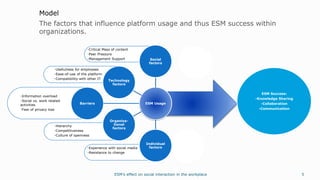
However as shown in the previous slide there are some key challenges that need to be
considered. In the coming years businesses will need to realize what are the most important
factors that affect ESM platform use and they will have to focus on overcoming the barriers of
ESM adoption by employees. The most important factors and barriers are grouped together in a
model on the last slide. They range from social factors such as pressure from peers to use the
ESM platform, to an individuals personal experience with social media in general.
The force of these factors will determine how big an impact online platforms such as ESM tools
will have on the social interaction in the coming years. Nevertheless, in the end social
interaction via online social platforms will become increasingly more important.
ESM’s effect on social interaction in the workplace
I
II
III
-Information overload
-Social vs. work related
activities
-Fear of privacy loss
ESM Usage
Social
factors
Leadership &
Governance
Barriers
Individual
factors
Organiza-
tional
factors
Technology
factors
-Experience with social media
-Resistance to change
-Usefulness for employees
-Ease-of-use of the platform
-Compatibility with other IT
-Hierarchy
-Competitiveness
-Culture of openness
ESM Success:
-Knowledge Sharing
-Collaboration
-Communication
Barriers
-Critical Mass of content
-Peer Pressure
-Management Support
The factors that influence platform usage and thus ESM success within
organizations.
Model
5ESM’s effect on social interaction in the workplace

Essay 2 IE Business School

  • 1.
    Enterprise Social Media’seffect on social interaction in the workplace By Alexander Klaver An essay in the form of a presentation for the application of IE Business School How do you imagine social interaction within 10 years, taking into consideration the impact of technology on human relations?
  • 2.
    ESM’s effect onsocial interaction in the workplace 2 Enterprise Social Media (ESM) Introduction Because a large part of human social interaction takes place in the workplace and because I think that communication between employees at this moment is already subject to some big changes, I’m going to focus on interaction between people within organizations. For my Thesis last year I’ve conducted research on the growing importance of Enterprise Social Media (ESM) within companies. A growing number of businesses adopts or has adopted an ESM platform. ESM solutions can be compared to traditional social media such as Facebook but are only used within an organization. They have networking, chatting, community and collaboration functionalities that are similar to traditional social media and because of that ESM platforms have the potential to become valuable communication and collaboration tools for employees within an organization. As businesses are becoming more global and working environments are becoming more flexible and less location bound, the need for simple, quick online interaction is growing rapidly. With the use of ESM employees can easily find and contact colleagues all over the world, make communities and share knowledge, or collaborate via working on documents in real time. However because this is a relative new technology, businesses are struggling to facilitate this type of employee communication successfully. Therefore it is becoming increasingly important to understand the difficulties associated with online communication and how to overcome any problems associated with them. I II III IV
  • 3.
    3 Benefits • Collaboration -allowing people to work more effectively with each other and within groups and communities across organizational boundaries • Communication – stimulates the use of communities and allows employees to communicate either one on one, to a specific group or the whole organization • Knowledge sharing - Knowledge can be shared and found more easily • These three pillars should stimulate co-creation and increase employees’ productivity ESM Adoption & Drivers • Collaboration between employees becomes increasingly important for gaining a competitive advantage • More than 90% of the Fortune 500 companies have implemented an ESM tool and the supply of such tools are increasing rapidly • Companies struggle with implementing ESM technologies in an effective manner Key challenges • Design and implementation of an efficient, user-friendly configured ESM application • Providing information at the right place at the right time, avoiding a ‘big spaghetti’ causing an information overload and thereby risking user adoption and inefficient use of the solutions • Stimulate a new way of working and removing user adoption barriers such as privacy fears • Effective user adoption strategies, enabling a critical mass of people and ensuring continuity of users The rise of ESM in the workplace can create major benefits for employees but also generates some key challenges for organizations Benefits and challenges of Enterprise Social Media ESM’s effect on social interaction in the workplace
  • 4.
    4 How the comingnext ten years organizations will try to keep up with the technological evolution of human interaction Conclusion The current trend of more online social interaction between employees, will go on. I expect that over ten years the majority of employee communication will go via online platforms similar to ESM and that it will even have driven out the use of e-mail. ESM tools will make communication and collaboration much easier for people working flexibly at home or in a global environment and the platforms are much more convenient than ever lasting e-mail conversations. However as shown in the previous slide there are some key challenges that need to be considered. In the coming years businesses will need to realize what are the most important factors that affect ESM platform use and they will have to focus on overcoming the barriers of ESM adoption by employees. The most important factors and barriers are grouped together in a model on the last slide. They range from social factors such as pressure from peers to use the ESM platform, to an individuals personal experience with social media in general. The force of these factors will determine how big an impact online platforms such as ESM tools will have on the social interaction in the coming years. Nevertheless, in the end social interaction via online social platforms will become increasingly more important. ESM’s effect on social interaction in the workplace I II III
  • 5.
    -Information overload -Social vs.work related activities -Fear of privacy loss ESM Usage Social factors Leadership & Governance Barriers Individual factors Organiza- tional factors Technology factors -Experience with social media -Resistance to change -Usefulness for employees -Ease-of-use of the platform -Compatibility with other IT -Hierarchy -Competitiveness -Culture of openness ESM Success: -Knowledge Sharing -Collaboration -Communication Barriers -Critical Mass of content -Peer Pressure -Management Support The factors that influence platform usage and thus ESM success within organizations. Model 5ESM’s effect on social interaction in the workplace