Social Networking in the Workplace October, 2009
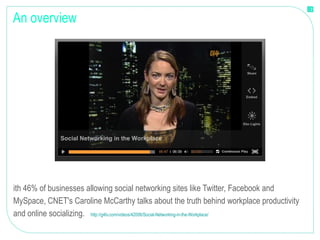
An overview With 46% of businesses allowing social networking sites like Twitter, Facebook and MySpace, CNET's Caroline McCarthy talks about the truth behind workplace productivity and online socializing.  http://g4tv.com/videos/42006/Social-Networking-in-the-Workplace/
69% of Businesses Allow Social Media Usage Up from 37% in 2007 63% are using social media to build and promote their brand 61% are using it to improve communication and collaboration  58% are using it to increase consumer engagement Robert Half Technology said 46% of companies allow access to social networking sites Source: Enterprise adoption of Web 2.0 technologies, by Awareness, Inc.  http://www.readwriteweb.com/archives/report_businesses_social_media_usage.php
Social Media Endorsements "Organizations, from the top-down, must be open to recognizing that there are better ways of doing things. Twitter and other social media have benefits to internal communications that haven't been explored. In fact, some of them surpass e-mail in efficiency and ease of communication…We are evolving. Going from Web 1.0 to Web 2.0 is kind of like going from radio to color TV; it's a quantum leap.“ Steve Prentice, Industrial Psychologist "These (Social Media) tools are proving valuable in areas such as recruitment, public affairs, and quality of life for our military personnel, as well as sharing information with allies, coalition partners and military families.“ William Lynn, US Deputy Secretary of Defense
Top Company Fears Loss of productivity (65.7 percent) Lack of security (45.7 percent) Fear of having inappropriate content posted (42.9 percent) Source: Enterprise adoption of Web 2.0 technologies, by Awareness, Inc.  http://www.readwriteweb.com/archives/report_businesses_social_media_usage.php
Productivity Fear “ Employees who use the internet for personal reasons at work are 9% more productive than those who don’t .” "workplace Internet leisure browsing," or WILB, helped to sharpened workers' concentration. "People need to zone out for a bit to get back their concentration” "Short and unobtrusive breaks, such as a quick surf of the Internet, enables the mind to rest itself, leading to a higher total net concentration for a days' work, and as a result, increased productivity,"  Social media tools can offer a highly advanced and efficient communication option Source: University of Melbourne study  http://uk.reuters.com/article/idUKTRE5313G220090402
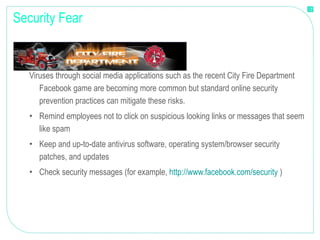
Security Fear Viruses through social media applications such as the recent City Fire Department Facebook game are becoming more common but standard online security prevention practices can mitigate these risks. Remind employees not to click on suspicious looking links or messages that seem like spam Keep and up-to-date antivirus software, operating system/browser security patches, and updates Check security messages (for example,  http://www.facebook.com/security  )
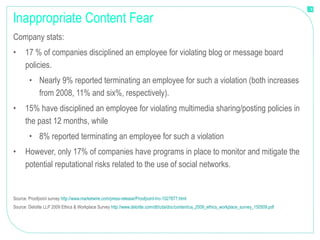
Inappropriate Content Fear Company stats: 17 % of companies disciplined an employee for violating blog or message board policies.  Nearly 9% reported terminating an employee for such a violation (both increases from 2008, 11% and six%, respectively). 15% have disciplined an employee for violating multimedia sharing/posting policies in the past 12 months, while  8% reported terminating an employee for such a violation However, only 17% of companies have programs in place to monitor and mitigate the potential reputational risks related to the use of social networks. Source: Proofpoint survey  http://www.marketwire.com/press-release/Proofpoint-Inc-1027877.html Source: Deloitte LLP 2009 Ethics & Workplace Survey  http://www.deloitte.com/dtt/cda/doc/content/us_2009_ethics_workplace_survey_150509.pdf
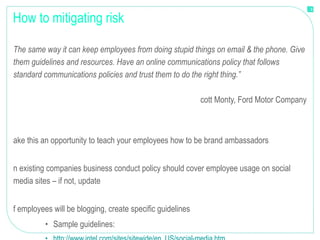
How to mitigating risk “ The same way it can keep employees from doing stupid things on email & the phone. Give them guidelines and resources. Have an online communications policy that follows standard communications policies and trust them to do the right thing.”  Scott Monty, Ford Motor Company Make this an opportunity to teach your employees how to be brand ambassadors An existing companies business conduct policy should cover employee usage on social media sites – if not, update If employees will be blogging, create specific guidelines Sample guidelines: http://www.intel.com/sites/sitewide/en_US/social-media.htm http://www.ibm.com/blogs/zz/en/guidelines.html http://jaffeassociates.com/uploads/userfiles/file/Social.pdf
Final thought Companies and brands are now or will soon be launching campaigns and communications that leverage social media. In many cases, regular employees will need to be the catalysts of these efforts. Contact: Dane Hartzell Twitter @itsDane [email_address] www.BolinDigital.com

Social Networking In The Workplace Public Version

  • 1.
    Social Networking inthe Workplace October, 2009
  • 2.
    An overview With46% of businesses allowing social networking sites like Twitter, Facebook and MySpace, CNET's Caroline McCarthy talks about the truth behind workplace productivity and online socializing. http://g4tv.com/videos/42006/Social-Networking-in-the-Workplace/
  • 3.
    69% of BusinessesAllow Social Media Usage Up from 37% in 2007 63% are using social media to build and promote their brand 61% are using it to improve communication and collaboration 58% are using it to increase consumer engagement Robert Half Technology said 46% of companies allow access to social networking sites Source: Enterprise adoption of Web 2.0 technologies, by Awareness, Inc. http://www.readwriteweb.com/archives/report_businesses_social_media_usage.php
  • 4.
    Social Media Endorsements"Organizations, from the top-down, must be open to recognizing that there are better ways of doing things. Twitter and other social media have benefits to internal communications that haven't been explored. In fact, some of them surpass e-mail in efficiency and ease of communication…We are evolving. Going from Web 1.0 to Web 2.0 is kind of like going from radio to color TV; it's a quantum leap.“ Steve Prentice, Industrial Psychologist "These (Social Media) tools are proving valuable in areas such as recruitment, public affairs, and quality of life for our military personnel, as well as sharing information with allies, coalition partners and military families.“ William Lynn, US Deputy Secretary of Defense
  • 5.
    Top Company FearsLoss of productivity (65.7 percent) Lack of security (45.7 percent) Fear of having inappropriate content posted (42.9 percent) Source: Enterprise adoption of Web 2.0 technologies, by Awareness, Inc. http://www.readwriteweb.com/archives/report_businesses_social_media_usage.php
  • 6.
    Productivity Fear “Employees who use the internet for personal reasons at work are 9% more productive than those who don’t .” "workplace Internet leisure browsing," or WILB, helped to sharpened workers' concentration. "People need to zone out for a bit to get back their concentration” "Short and unobtrusive breaks, such as a quick surf of the Internet, enables the mind to rest itself, leading to a higher total net concentration for a days' work, and as a result, increased productivity," Social media tools can offer a highly advanced and efficient communication option Source: University of Melbourne study http://uk.reuters.com/article/idUKTRE5313G220090402
  • 7.
    Security Fear Virusesthrough social media applications such as the recent City Fire Department Facebook game are becoming more common but standard online security prevention practices can mitigate these risks. Remind employees not to click on suspicious looking links or messages that seem like spam Keep and up-to-date antivirus software, operating system/browser security patches, and updates Check security messages (for example, http://www.facebook.com/security )
  • 8.
    Inappropriate Content FearCompany stats: 17 % of companies disciplined an employee for violating blog or message board policies. Nearly 9% reported terminating an employee for such a violation (both increases from 2008, 11% and six%, respectively). 15% have disciplined an employee for violating multimedia sharing/posting policies in the past 12 months, while 8% reported terminating an employee for such a violation However, only 17% of companies have programs in place to monitor and mitigate the potential reputational risks related to the use of social networks. Source: Proofpoint survey http://www.marketwire.com/press-release/Proofpoint-Inc-1027877.html Source: Deloitte LLP 2009 Ethics & Workplace Survey http://www.deloitte.com/dtt/cda/doc/content/us_2009_ethics_workplace_survey_150509.pdf
  • 9.
    How to mitigatingrisk “ The same way it can keep employees from doing stupid things on email & the phone. Give them guidelines and resources. Have an online communications policy that follows standard communications policies and trust them to do the right thing.” Scott Monty, Ford Motor Company Make this an opportunity to teach your employees how to be brand ambassadors An existing companies business conduct policy should cover employee usage on social media sites – if not, update If employees will be blogging, create specific guidelines Sample guidelines: http://www.intel.com/sites/sitewide/en_US/social-media.htm http://www.ibm.com/blogs/zz/en/guidelines.html http://jaffeassociates.com/uploads/userfiles/file/Social.pdf
  • 10.
    Final thought Companiesand brands are now or will soon be launching campaigns and communications that leverage social media. In many cases, regular employees will need to be the catalysts of these efforts. Contact: Dane Hartzell Twitter @itsDane [email_address] www.BolinDigital.com

Editor's Notes

  • #3 http://g4tv.com/videos/42006/Social-Networking-in-the-Workplace/