What are verb tenses?
• Verb tenses show the time that an action takes place
• Verb Tenses Include :
• Simple Past
• Past Perfect
• Past Continuous
• Past Perfect Continuous
• Present Simple
• Present Continuous
• Present Perfect
• Present Perfect Continuous
• Simple Future
• Future Perfect
• Future Continuous
• Future Perfect Continuous
Past Simple Tense
We use the simple past tense for both short and long past actions that have ended
(actions we have finished that took either a long or short amount of time).
• For Example:
• I watched a movie yesterday. (This could be a long action as it takes a few
hours to watch a movie)
• I ate dinner. (this is probably a short action as it can take just a few minutes to
eat dinner)
• I was busy last week. (this could be either short or long )
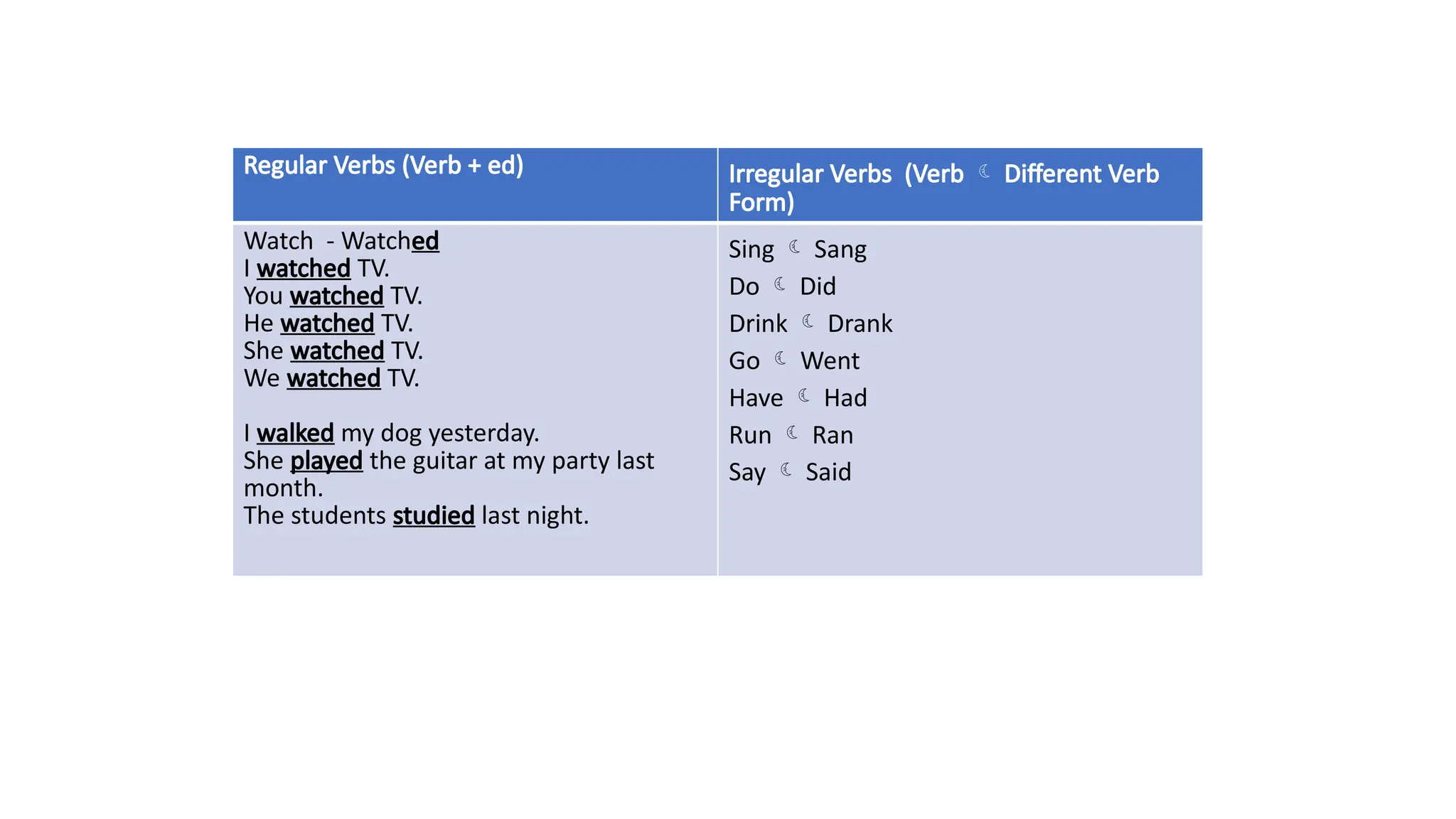
Regular Verbs (Verb + ed) Irregular Verbs (Verb  Different Verb
Form)
Watch - Watched
I watched TV.
You watched TV.
He watched TV.
She watched TV.
We watched TV.
I walked my dog yesterday.
She played the guitar at my party last
month.
The students studied last night.
Sing  Sang
Do  Did
Drink  Drank
Go  Went
Have  Had
Run  Ran
Say  Said
• Most of the time the verb form is the same for all subjects. It doesn’t
matter if it is singular of pleural. One or many.
• For example Eat  Ate
• I ate pizza.
• You ate pizza.
• He ate pizza.
• She ate pizza.
• We ate pizza.
• They ate pizza.
• The students ate pizza.
• The student ate pizza.
Complete the Past Simple Sentences
• They_____ pizza last night. (eat)
• I ______ coffee yesterday morning. (drink)
• He ______ the guitar yesterday. (play)
• She ______ TV last night. (watch)
• We _____ to Paris eight years ago. (go)
• The student _____ tired after class. (be)
The one exception to the rule
• Be is the only simple past verb that changes forms for different
subjects.
• The two simple past forms of be is was or were.
• Examples:
• I was tired.
• You were tired.
• He was tired.
• She was tired.
• We were tired.
• They were tired.
• Think of your subject. (I, He,
She, You, They, Them, The
man, The dog, The cat.)
• Think of what the subject
did. (What Past Tense Verb)
• Think of the time and place.
(Yesterday, Last Week, Last
Month, Last year. At school,
home, outside, inside, on
the moon, under the sea.)
Past Continuous
The past tense verb form used for an action that someone was doing or an event that was happening at a
particular time or an extended length of time.
for example
“I talked to my friend last night” is simple past but “ I was talking to my friend last night” is past continuous as
it emphasises a longer period of time.
How to form a sentence
• In order to make a sentence in the Past Continuous Tense we use:
the past tense of be (was or were) + -ing verb
I was walking to school.
He was walking to school.
She was walking to school.
They were walking to school.
You were walking to school.
Subject + was/were + -ing verb
• Some more examples couple be:
• They were waiting for me.
• The student was taking a test.
• The students were eating lunch.
• We use to past continuous tense to either show when a short past action interrupts a long
past action.
• The time marker tends to be when
• For example :
• I was watching TV when the power went out last night
• The children were doing a science experiment when the fire alarm rang.
• It started to rain as she was walking to school
• Or we can use the past continuous tense to show two long past actions that happen at the
same time
• The time marker tends to be while (this means at the same time as)
• For example:
• I was watching TV while you were studying
• Lewis was playing the guitar while Cynthia was singing
• While the teacher was writing on the board, the students were talking.
Independent and dependant clauses
• Most of the past continuous tense sentences are made up of an
independent clause. (a part of the sentence that can be said by itself
and still make sense) and a dependant clause (a part of the sentence
that does not make sense without the information from the
independent clause)
• For example
• The students were talking while the teacher was writing on the board.
• The independent clause is green, the dependant clause is red.
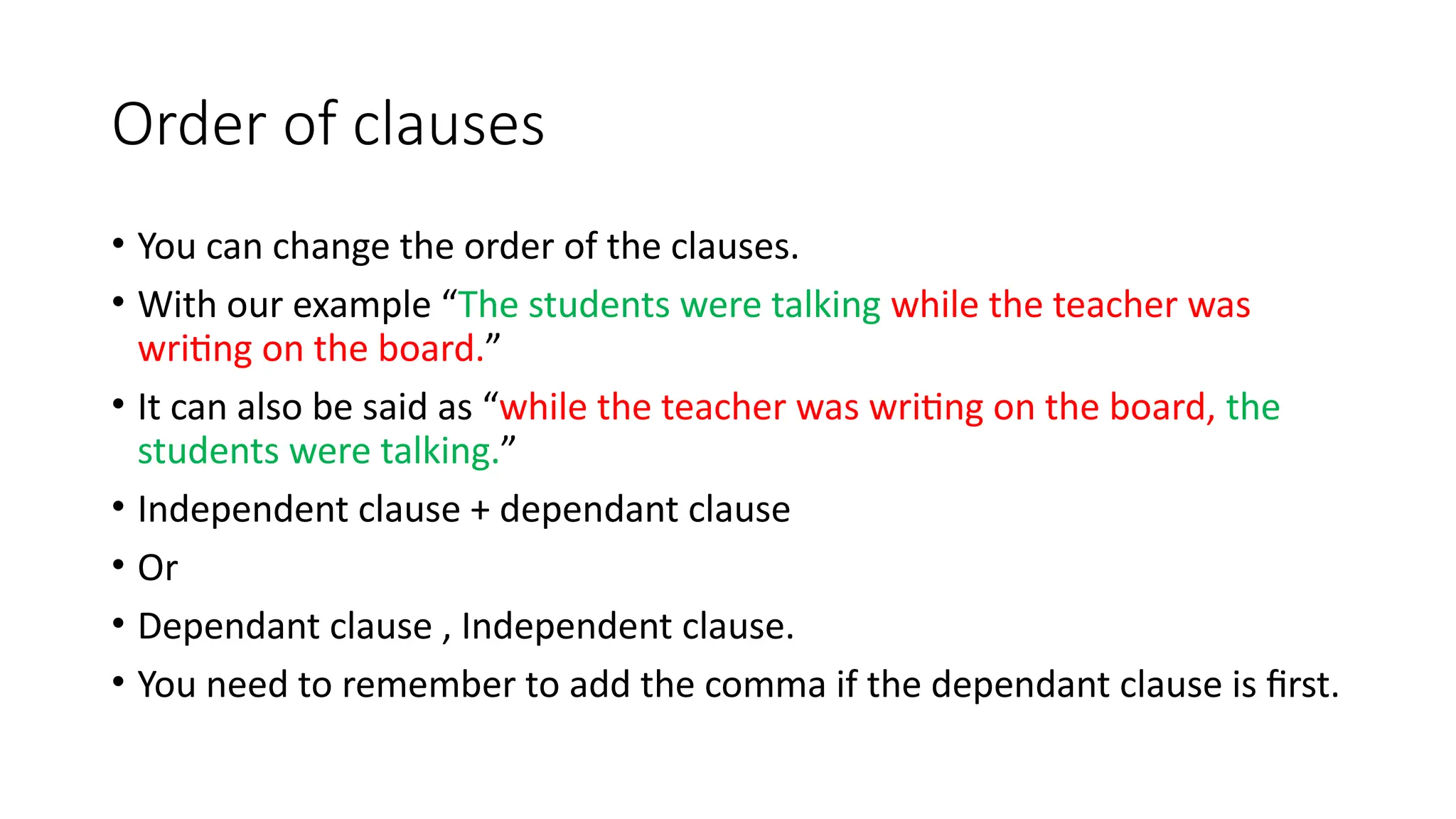
Order of clauses
• You can change the order of the clauses.
• With our example “The students were talking while the teacher was
writing on the board.”
• It can also be said as “while the teacher was writing on the board, the
students were talking.”
• Independent clause + dependant clause
• Or
• Dependant clause , Independent clause.
• You need to remember to add the comma if the dependant clause is first.
What part of the sentence is the independent clause and what part
is the dependant clause?
How would you change the clause order?
They were singing in the car while he drove.
While her parents slept, she was watching a movie.
We were walking when it started to rain.
When the phone rang last night, I was making dinner.
While my sister was studying, my brother was watching TV.
Write a short paragraph about what you did
last weekend
• At least 3 sentences long.
• Tell me what you did, what you felt. Did you have fun?
• A basic paragraph has three parts: 1) a topic sentence (what you did), 2)
supporting sentences (any extra information about what you did?),
and 3) a concluding sentence(what did you think or feel about what you did).
• You can use both simple past tense and continuous past tense sentences.
• For example: I went to work last weekend. I was teaching older children on Sunday while
on Saturday, the children I taught were a lot younger. I enjoyed teaching both groups
very much and look forward to teaching them again soon.
Simple Present Tense
we use the simple present tense for repeated actions. Repeated actions
are actions that happen over and over again.
Examples
• I eat breakfast every day.
• I read in bed every night.
• I always study after school.
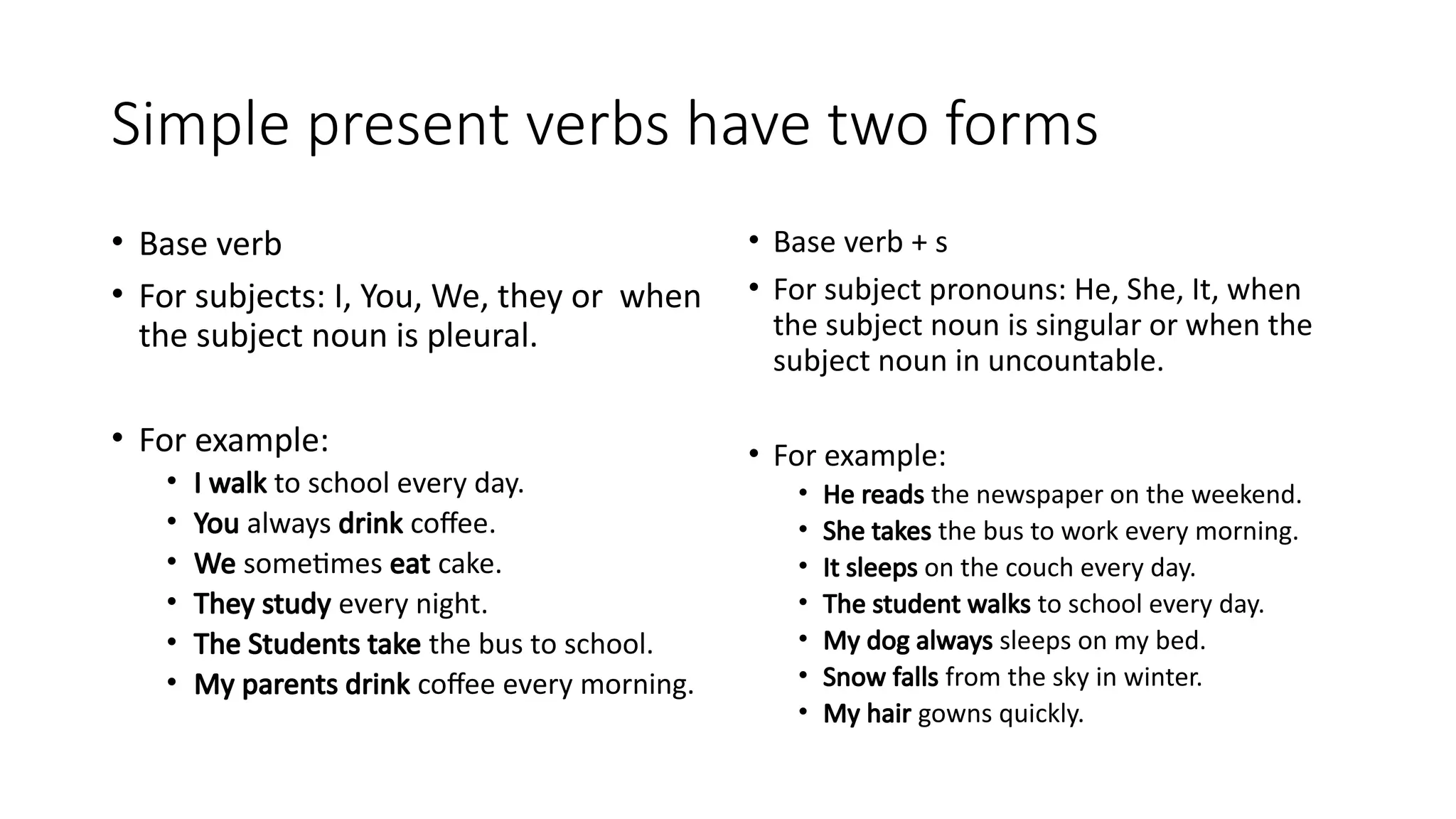
Simple present verbs have two forms
• Base verb
• For subjects: I, You, We, they or when
the subject noun is pleural.
• For example:
• I walk to school every day.
• You always drink coffee.
• We sometimes eat cake.
• They study every night.
• The Students take the bus to school.
• My parents drink coffee every morning.
• Base verb + s
• For subject pronouns: He, She, It, when
the subject noun is singular or when the
subject noun in uncountable.
• For example:
• He reads the newspaper on the weekend.
• She takes the bus to work every morning.
• It sleeps on the couch every day.
• The student walks to school every day.
• My dog always sleeps on my bed.
• Snow falls from the sky in winter.
• My hair gowns quickly.
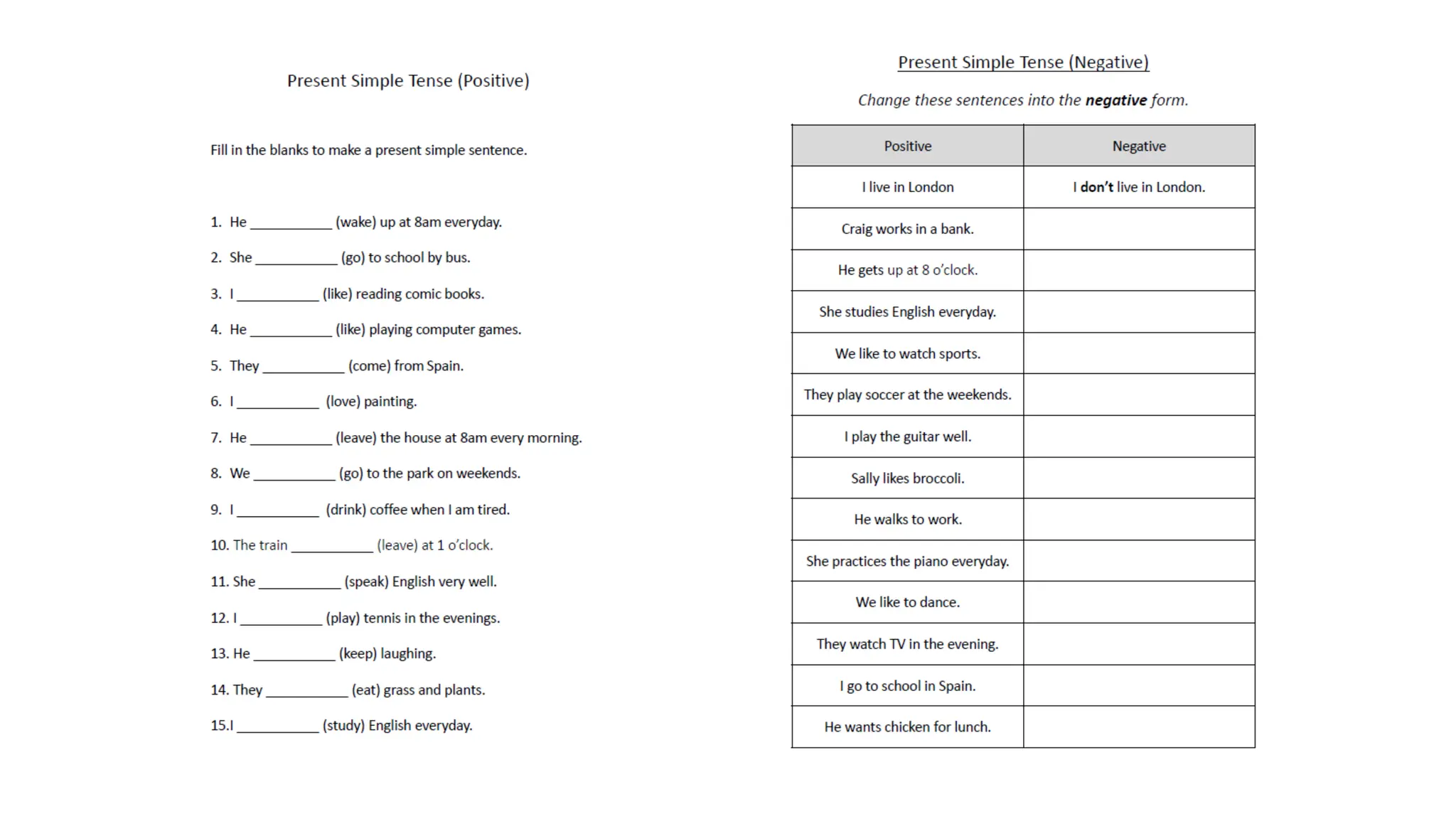
Lets practice
• She _____ coffee every day. (drink)
• I ____ the bus every day. (take)
• He always ____ breakfast. (eat)
• They ____ to the park on the weekend. (walk)
• The student ______ a book every morning. (read)
• The students _____ after school. (study)
The present simple forms of “be”
am
• For subjects: I
• Examples:
• I am a teacher.
• I am hungry.
are
• For subjects: We, They,
Plural nouns.
• Examples:
• We are happy.
• We are hungry.
• They are from China
• They are loud.
• The students are inside.
• The parents are
outside.
is
• For subjects: He,
She, It, uncountable
nouns.
• Examples:
• He is silly.
• She is quiet.
• It is smelly.
• The snow is on the
ground.
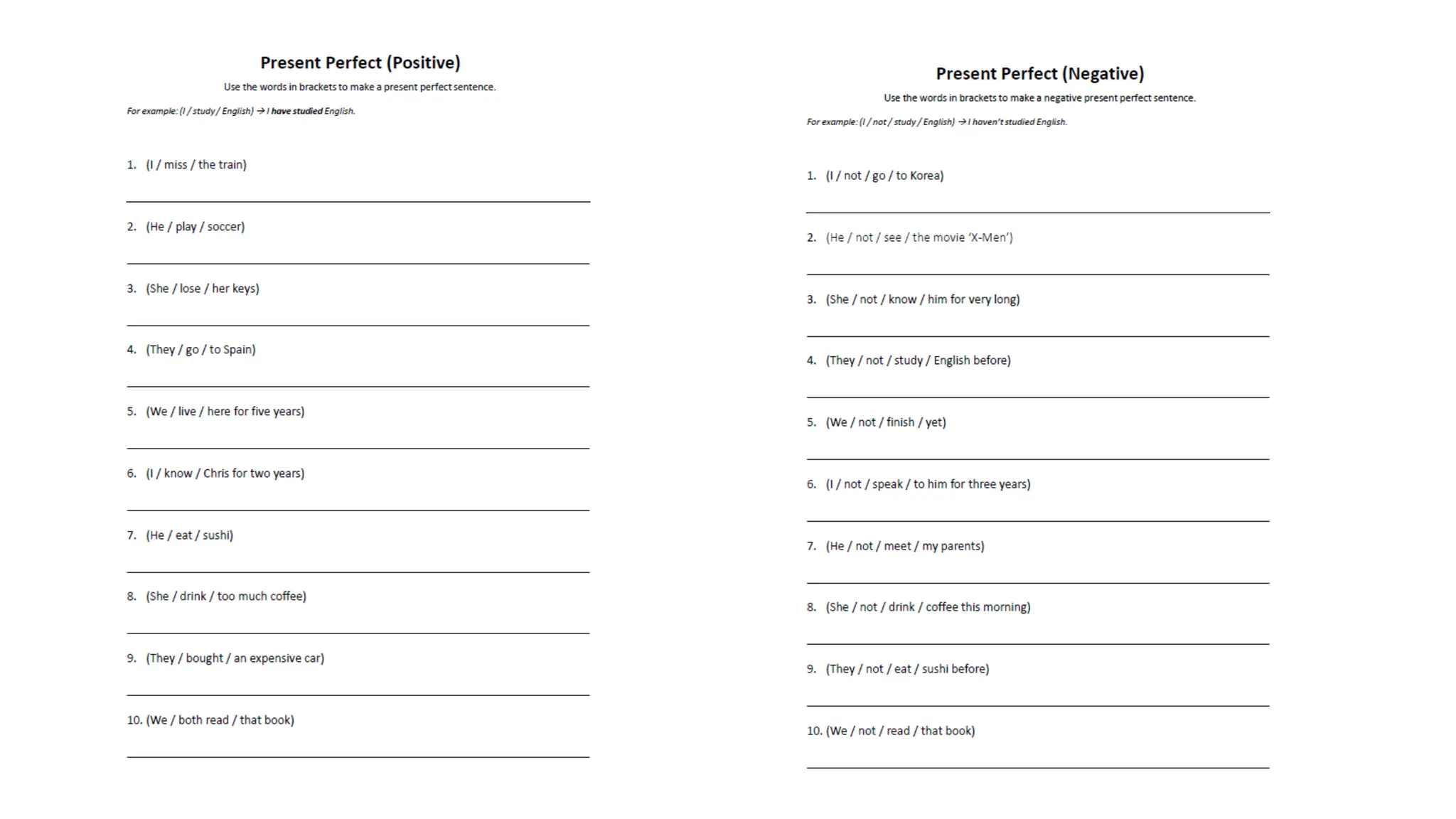
Present Perfect
When do we use it?
We use the present perfect tense for two reasons. Either
• To show a finished past action
but not tell us when the action
takes place. E.g. I have been to
Australia.
• To show a continuing action that
started in the past but continues
to the present. This action may
also continue into the future.
E.g. I have lived in China for 3
weeks.
Present perfect verb form
Subject + have/has + Past participial
Past participial is a verb that indicates an action completed in the past. (past tense verb)
• The subject pronouns that use
have are I, you, we, they and
pleural nouns.
• Examples:
• I have graduated.
• You have graduated.
• We have graduated.
• The students have graduated.
• The subject pronouns that use
has are he, she and singular
nouns. Also uncountable nouns.
• Examples:
• He has graduated.
• She has graduated.
• The student has graduated.
• The snow has fallen.
Forming the past participial verbs
Regular Verbs (Verb + ed) Irregular Verbs (Verb  Different Verb
Form)
Watch - Watched
I have watched TV.
You have watched TV.
He has watched TV.
She has watched TV.
We have watched TV.
eat  eaten
be been
do  done
drink  drunk
go  gone
have  had
run  run
say  said
sleep  slept
write  written
He has eaten breakfast.
We have had a dog for eight years.
My best friend has moved to another city.
Lets practice
• I ___________ my homework. (finish)
• She ____________ at this office for 12 years. (work)
• My Friends ____________ that movie. (see)
• I ________ in China all my life. (live)
• He __________ a dog for five years. (have)
• We ___________ to another country. (move)
• She___________ to Hong Kong. (be)
• They ___________ an entire pizza. (eat)
• The student ___________the test. (finish)
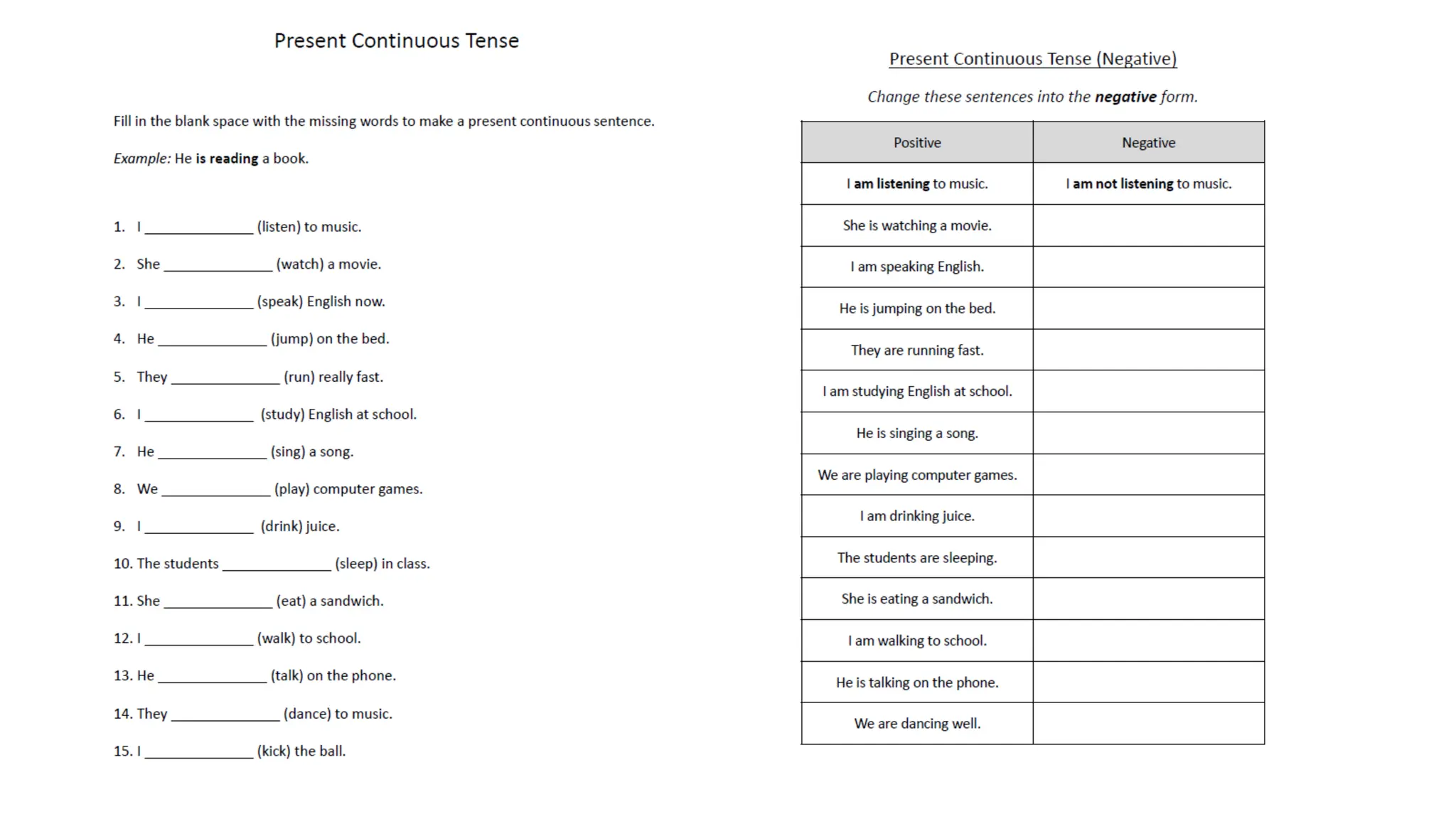
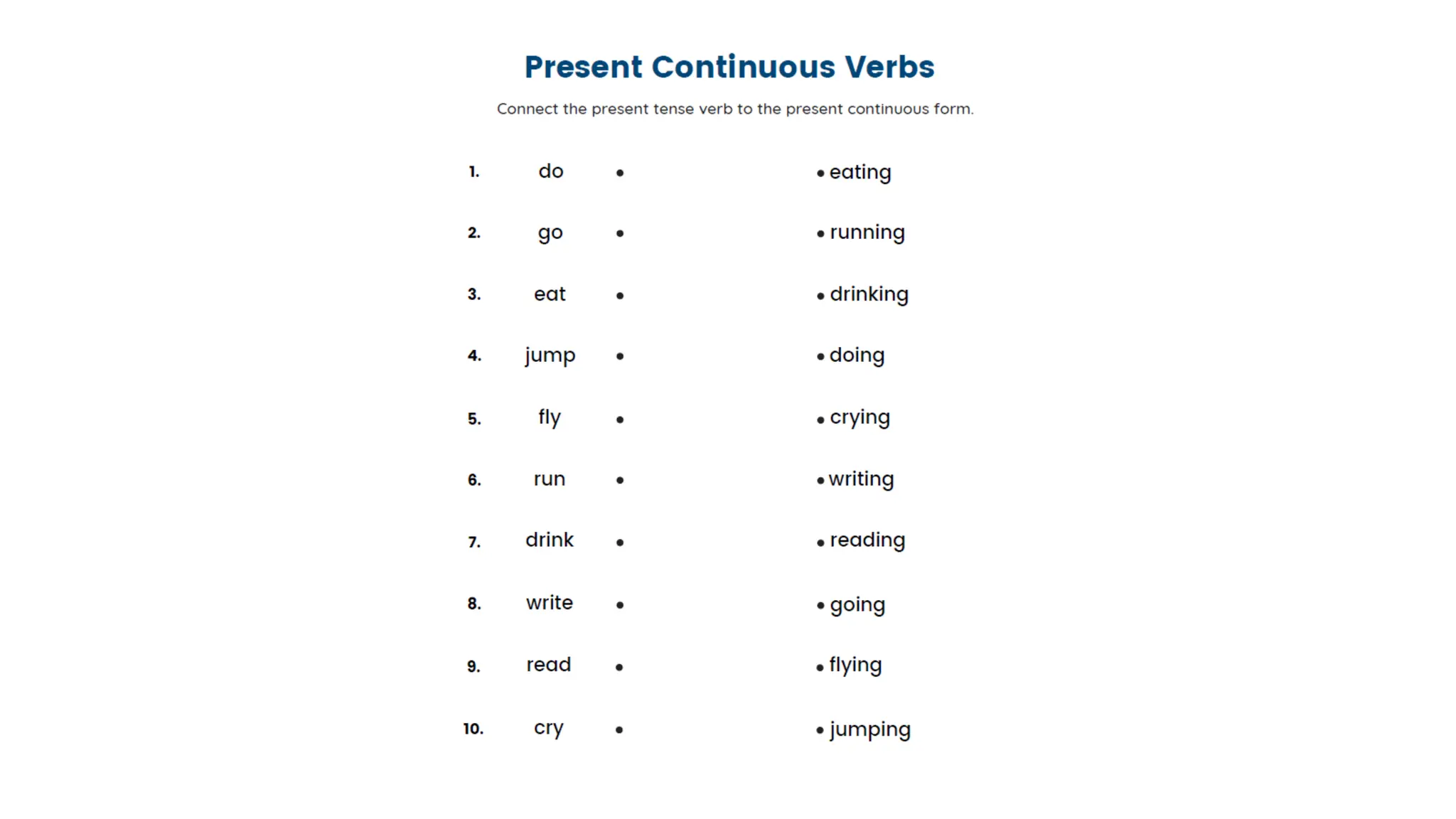
Present Continuous
We use the present continuous tense for an action that is happening
now. A present continuous verb is a continuing action.
Examples
• I am eating dinner.
• I am playing basketball now.
• I am texting my friend now.
Present progressive verb form- Be +-ing verb
Remember the present forms of be for:
The form of “be” used for the pronoun “I” is “am”
The form of “be” used for the pronouns “We”, “They” and Plural nouns are “are”
The form of “be” used for the pronouns “He”, “She”, “It” and singular and uncountable nouns are “is”
• Examples:
• I am eating pizza.
• You are sleeping.
• He is making dinner right now.
• She is riding a bike.
• It is raining today.
• We are watching TV now.
• They are playing basketball.
• The students are doing their
homework now.
• My parents are driving to work.
• The student is walking to school
now.
• My dog is sleeping on my bed.
• Water is dripping from the faucet.
• The ice-cream is melting.
Lets practice
• You ________ dinner. (eat)
• I __________ tea. (drink)
• She _________ TV. (watch)
• They_____________ down the street. (walk)
The child ___________ a bike. (ride)
• The dogs_____________ on the bed. (sleep)
Present Perfect Continuous
We use the present perfect continuous tense for actions that started in the pas,
that continues to the present and that are continuing into the future.
Examples
• I have been working at this company for eight years.
• I have been living in France since 2015.
• I have been watching TV for three hours.
How is it formed?
• Subject + Have/has + been + -ing verb
Reminder – Have or Has
Subject + have/has + Past participial
Past participial is a verb that indicates an action completed in the past. (past tense verb)
• The subject pronouns that use
have are I, you, we, they and
pleural nouns.
• Examples:
• I have graduated.
• You have graduated.
• We have graduated.
• The students have graduated.
• The subject pronouns that use
has are he, she and singular
nouns. Also uncountable nouns.
• Examples:
• He has graduated.
• She has graduated.
• The student has graduated.
• The snow has fallen.
Examples
• I have been studying.
• You have been studying.
• He has been studying.
• She has been studying.
• We have been studying.
• They have been studying.
• The student has been studying.
• The students have been studying.
Lets Practice
• You ___________ English for eight years. (learn)
• She ____________ all day. (sleep)
• Snow ___________ all night. (Fall)
• We _____________ tennis all afternoon. (play)
• You ____________ all afternoon. (sleep)
• They ___________ at the airport for an hour. (wait)
• I _______________ Tv since noon. (watch)
• She _____________ Australia for seven years. (live)
• My teacher ___________________ all morning. (talk)
Simple Future
Actions that will happen at a future time
Simple future tense forms
Will + verb
• Decide on a future
action at that
moment.
• Example
• I will call you
tomorrow.
Be going to + verb
• Existing future plans
• Example
• I am going to read a
book after school.
Be going to + verb
• Existing future plans
• Example
• I am giving a
presentation next
Monday.
Forming simple future with will
• Will is a modal word and is always soled with a base verb which means a verb
with no s, ed, or ing at the end.
• The verb form is the same for all subjects.
• I will watch tv.
• You will watch tv.
• He will watch tv.
• She will watch tv.
• We will watch tv.
• I will text you after class
• He will walk his dog tomorrow morning.
• The students will go to school on monday
Lets practice
• You _________ nest Wednesday. (busy)
• She __________ a presentation in two weeks. (give)
• They __________ to work tomorrow. (drive)
Use of contractions
• A contraction is a word that can be shorted for example the contraction of will is ‘ll
• Contractions can be used with only pronouns ( I , he, she, we, they) not with
simple nouns.
• For example
• I’ll watch tv.
• You’ll watch tv.
• He’ll watch tv
• She’ll watch tv.
• We’ll watch tv.
• They’ll watch tv.
• The students will watch tv.
• The student will watch tv.
Lets practice
• He ________breakfast tomorrow morning. (cook)
• We_________ to school tomorrow. (go)
• I____________ you in two days. (call)
• They__________ on the weekend. (study)
• She_________ her dog after class. (walk)
• You _____busy next weekend. (be)
Forming simple future with be going too

ESL Teaching Tool - Verb Tenses - Past present and Future

  • 1.
    What are verbtenses? • Verb tenses show the time that an action takes place • Verb Tenses Include : • Simple Past • Past Perfect • Past Continuous • Past Perfect Continuous • Present Simple • Present Continuous • Present Perfect • Present Perfect Continuous • Simple Future • Future Perfect • Future Continuous • Future Perfect Continuous
  • 2.
  • 3.
    We use thesimple past tense for both short and long past actions that have ended (actions we have finished that took either a long or short amount of time). • For Example: • I watched a movie yesterday. (This could be a long action as it takes a few hours to watch a movie) • I ate dinner. (this is probably a short action as it can take just a few minutes to eat dinner) • I was busy last week. (this could be either short or long )
  • 4.
    Regular Verbs (Verb+ ed) Irregular Verbs (Verb  Different Verb Form) Watch - Watched I watched TV. You watched TV. He watched TV. She watched TV. We watched TV. I walked my dog yesterday. She played the guitar at my party last month. The students studied last night. Sing  Sang Do  Did Drink  Drank Go  Went Have  Had Run  Ran Say  Said
  • 5.
    • Most ofthe time the verb form is the same for all subjects. It doesn’t matter if it is singular of pleural. One or many. • For example Eat  Ate • I ate pizza. • You ate pizza. • He ate pizza. • She ate pizza. • We ate pizza. • They ate pizza. • The students ate pizza. • The student ate pizza.
  • 6.
    Complete the PastSimple Sentences • They_____ pizza last night. (eat) • I ______ coffee yesterday morning. (drink) • He ______ the guitar yesterday. (play) • She ______ TV last night. (watch) • We _____ to Paris eight years ago. (go) • The student _____ tired after class. (be)
  • 7.
    The one exceptionto the rule • Be is the only simple past verb that changes forms for different subjects. • The two simple past forms of be is was or were. • Examples: • I was tired. • You were tired. • He was tired. • She was tired. • We were tired. • They were tired.
  • 8.
    • Think ofyour subject. (I, He, She, You, They, Them, The man, The dog, The cat.) • Think of what the subject did. (What Past Tense Verb) • Think of the time and place. (Yesterday, Last Week, Last Month, Last year. At school, home, outside, inside, on the moon, under the sea.)
  • 10.
    Past Continuous The pasttense verb form used for an action that someone was doing or an event that was happening at a particular time or an extended length of time. for example “I talked to my friend last night” is simple past but “ I was talking to my friend last night” is past continuous as it emphasises a longer period of time.
  • 11.
    How to forma sentence • In order to make a sentence in the Past Continuous Tense we use: the past tense of be (was or were) + -ing verb I was walking to school. He was walking to school. She was walking to school. They were walking to school. You were walking to school. Subject + was/were + -ing verb
  • 12.
    • Some moreexamples couple be: • They were waiting for me. • The student was taking a test. • The students were eating lunch.
  • 14.
    • We useto past continuous tense to either show when a short past action interrupts a long past action. • The time marker tends to be when • For example : • I was watching TV when the power went out last night • The children were doing a science experiment when the fire alarm rang. • It started to rain as she was walking to school • Or we can use the past continuous tense to show two long past actions that happen at the same time • The time marker tends to be while (this means at the same time as) • For example: • I was watching TV while you were studying • Lewis was playing the guitar while Cynthia was singing • While the teacher was writing on the board, the students were talking.
  • 15.
    Independent and dependantclauses • Most of the past continuous tense sentences are made up of an independent clause. (a part of the sentence that can be said by itself and still make sense) and a dependant clause (a part of the sentence that does not make sense without the information from the independent clause) • For example • The students were talking while the teacher was writing on the board. • The independent clause is green, the dependant clause is red.
  • 16.
    Order of clauses •You can change the order of the clauses. • With our example “The students were talking while the teacher was writing on the board.” • It can also be said as “while the teacher was writing on the board, the students were talking.” • Independent clause + dependant clause • Or • Dependant clause , Independent clause. • You need to remember to add the comma if the dependant clause is first.
  • 17.
    What part ofthe sentence is the independent clause and what part is the dependant clause? How would you change the clause order? They were singing in the car while he drove. While her parents slept, she was watching a movie. We were walking when it started to rain. When the phone rang last night, I was making dinner. While my sister was studying, my brother was watching TV.
  • 19.
    Write a shortparagraph about what you did last weekend • At least 3 sentences long. • Tell me what you did, what you felt. Did you have fun? • A basic paragraph has three parts: 1) a topic sentence (what you did), 2) supporting sentences (any extra information about what you did?), and 3) a concluding sentence(what did you think or feel about what you did). • You can use both simple past tense and continuous past tense sentences. • For example: I went to work last weekend. I was teaching older children on Sunday while on Saturday, the children I taught were a lot younger. I enjoyed teaching both groups very much and look forward to teaching them again soon.
  • 20.
    Simple Present Tense weuse the simple present tense for repeated actions. Repeated actions are actions that happen over and over again.
  • 21.
    Examples • I eatbreakfast every day. • I read in bed every night. • I always study after school.
  • 22.
    Simple present verbshave two forms • Base verb • For subjects: I, You, We, they or when the subject noun is pleural. • For example: • I walk to school every day. • You always drink coffee. • We sometimes eat cake. • They study every night. • The Students take the bus to school. • My parents drink coffee every morning. • Base verb + s • For subject pronouns: He, She, It, when the subject noun is singular or when the subject noun in uncountable. • For example: • He reads the newspaper on the weekend. • She takes the bus to work every morning. • It sleeps on the couch every day. • The student walks to school every day. • My dog always sleeps on my bed. • Snow falls from the sky in winter. • My hair gowns quickly.
  • 23.
    Lets practice • She_____ coffee every day. (drink) • I ____ the bus every day. (take) • He always ____ breakfast. (eat) • They ____ to the park on the weekend. (walk) • The student ______ a book every morning. (read) • The students _____ after school. (study)
  • 25.
    The present simpleforms of “be” am • For subjects: I • Examples: • I am a teacher. • I am hungry. are • For subjects: We, They, Plural nouns. • Examples: • We are happy. • We are hungry. • They are from China • They are loud. • The students are inside. • The parents are outside. is • For subjects: He, She, It, uncountable nouns. • Examples: • He is silly. • She is quiet. • It is smelly. • The snow is on the ground.
  • 27.
  • 28.
    When do weuse it? We use the present perfect tense for two reasons. Either • To show a finished past action but not tell us when the action takes place. E.g. I have been to Australia. • To show a continuing action that started in the past but continues to the present. This action may also continue into the future. E.g. I have lived in China for 3 weeks.
  • 29.
    Present perfect verbform Subject + have/has + Past participial Past participial is a verb that indicates an action completed in the past. (past tense verb) • The subject pronouns that use have are I, you, we, they and pleural nouns. • Examples: • I have graduated. • You have graduated. • We have graduated. • The students have graduated. • The subject pronouns that use has are he, she and singular nouns. Also uncountable nouns. • Examples: • He has graduated. • She has graduated. • The student has graduated. • The snow has fallen.
  • 31.
    Forming the pastparticipial verbs Regular Verbs (Verb + ed) Irregular Verbs (Verb  Different Verb Form) Watch - Watched I have watched TV. You have watched TV. He has watched TV. She has watched TV. We have watched TV. eat  eaten be been do  done drink  drunk go  gone have  had run  run say  said sleep  slept write  written He has eaten breakfast. We have had a dog for eight years. My best friend has moved to another city.
  • 32.
    Lets practice • I___________ my homework. (finish) • She ____________ at this office for 12 years. (work) • My Friends ____________ that movie. (see) • I ________ in China all my life. (live) • He __________ a dog for five years. (have) • We ___________ to another country. (move) • She___________ to Hong Kong. (be) • They ___________ an entire pizza. (eat) • The student ___________the test. (finish)
  • 35.
    Present Continuous We usethe present continuous tense for an action that is happening now. A present continuous verb is a continuing action.
  • 36.
    Examples • I ameating dinner. • I am playing basketball now. • I am texting my friend now.
  • 38.
    Present progressive verbform- Be +-ing verb Remember the present forms of be for: The form of “be” used for the pronoun “I” is “am” The form of “be” used for the pronouns “We”, “They” and Plural nouns are “are” The form of “be” used for the pronouns “He”, “She”, “It” and singular and uncountable nouns are “is” • Examples: • I am eating pizza. • You are sleeping. • He is making dinner right now. • She is riding a bike. • It is raining today. • We are watching TV now. • They are playing basketball. • The students are doing their homework now. • My parents are driving to work. • The student is walking to school now. • My dog is sleeping on my bed. • Water is dripping from the faucet. • The ice-cream is melting.
  • 39.
    Lets practice • You________ dinner. (eat) • I __________ tea. (drink) • She _________ TV. (watch) • They_____________ down the street. (walk) The child ___________ a bike. (ride) • The dogs_____________ on the bed. (sleep)
  • 42.
    Present Perfect Continuous Weuse the present perfect continuous tense for actions that started in the pas, that continues to the present and that are continuing into the future.
  • 43.
    Examples • I havebeen working at this company for eight years. • I have been living in France since 2015. • I have been watching TV for three hours.
  • 44.
    How is itformed? • Subject + Have/has + been + -ing verb
  • 45.
    Reminder – Haveor Has Subject + have/has + Past participial Past participial is a verb that indicates an action completed in the past. (past tense verb) • The subject pronouns that use have are I, you, we, they and pleural nouns. • Examples: • I have graduated. • You have graduated. • We have graduated. • The students have graduated. • The subject pronouns that use has are he, she and singular nouns. Also uncountable nouns. • Examples: • He has graduated. • She has graduated. • The student has graduated. • The snow has fallen.
  • 46.
    Examples • I havebeen studying. • You have been studying. • He has been studying. • She has been studying. • We have been studying. • They have been studying. • The student has been studying. • The students have been studying.
  • 47.
    Lets Practice • You___________ English for eight years. (learn) • She ____________ all day. (sleep) • Snow ___________ all night. (Fall) • We _____________ tennis all afternoon. (play) • You ____________ all afternoon. (sleep) • They ___________ at the airport for an hour. (wait) • I _______________ Tv since noon. (watch) • She _____________ Australia for seven years. (live) • My teacher ___________________ all morning. (talk)
  • 48.
    Simple Future Actions thatwill happen at a future time
  • 49.
    Simple future tenseforms Will + verb • Decide on a future action at that moment. • Example • I will call you tomorrow. Be going to + verb • Existing future plans • Example • I am going to read a book after school. Be going to + verb • Existing future plans • Example • I am giving a presentation next Monday.
  • 50.
    Forming simple futurewith will • Will is a modal word and is always soled with a base verb which means a verb with no s, ed, or ing at the end. • The verb form is the same for all subjects. • I will watch tv. • You will watch tv. • He will watch tv. • She will watch tv. • We will watch tv. • I will text you after class • He will walk his dog tomorrow morning. • The students will go to school on monday
  • 51.
    Lets practice • You_________ nest Wednesday. (busy) • She __________ a presentation in two weeks. (give) • They __________ to work tomorrow. (drive)
  • 52.
    Use of contractions •A contraction is a word that can be shorted for example the contraction of will is ‘ll • Contractions can be used with only pronouns ( I , he, she, we, they) not with simple nouns. • For example • I’ll watch tv. • You’ll watch tv. • He’ll watch tv • She’ll watch tv. • We’ll watch tv. • They’ll watch tv. • The students will watch tv. • The student will watch tv.
  • 53.
    Lets practice • He________breakfast tomorrow morning. (cook) • We_________ to school tomorrow. (go) • I____________ you in two days. (call) • They__________ on the weekend. (study) • She_________ her dog after class. (walk) • You _____busy next weekend. (be)
  • 54.
    Forming simple futurewith be going too