Beyond The City of Ember
Creating an Audio Production
with a Team of Students
Kurt Sherman – ksherman@ccsuvt.org
Dave Davidson – ddavidson@ccsuvt.org
Where did the idea come from?
•Connection to Everyday Mathematics
•Connection to language arts
Project with decimals, percents, fractions
Writing a chapter as a language assignment
Project Inspirations
• VT Fest Workshop
• Connect the Dots
course project
• Smaller projects
• Professional
examples
•Radio Lab
•PHC
• Technology well-
matched to the need
Why an
Audio
Production?
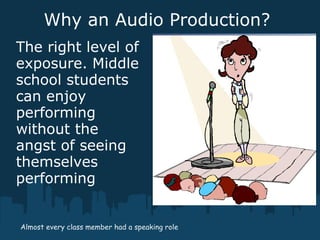
Why an Audio Production?
The right level of
exposure. Middle
school students
can enjoy
performing
without the
angst of seeing
themselves
performing
Almost every class member had a speaking role
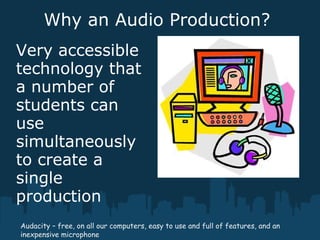
Why an Audio Production?
Very accessible
technology that
a number of
students can
use
simultaneously
to create a
single
production
Audacity – free, on all our computers, easy to use and full of features, and an
inexpensive microphone
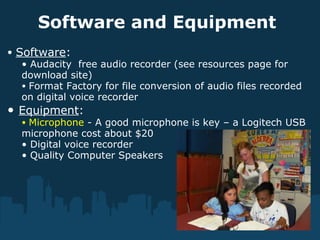
Software and Equipment
• Software:
• Audacity free audio recorder (see resources page for
download site)
• Format Factory for file conversion of audio files recorded
on digital voice recorder
• Equipment:
• Microphone - A good microphone is key – a Logitech USB
microphone cost about $20
• Digital voice recorder
• Quality Computer Speakers
Why an Audio Production?
Easier to create a
high quality audio
production than a
comparable video
production. We
can’t match the
level of quality of a
commercially
produced video.
This project followed watching a commercially produced feature film.
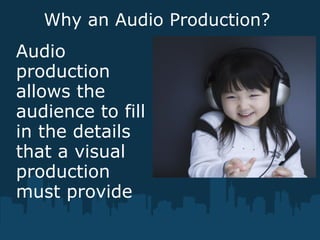
Why an Audio Production?
Audio
production
allows the
audience to fill
in the details
that a visual
production
must provide
Why an Audio Production?
Fewer
permission and
copyright issues
than other
media. Made
almost entirely
of “home
grown” content.
Our own script, narration, most of the sound effects and discussed creating our own
music
National Educational Technology
Standards for Students
1. Creativity and Innovation - Students demonstrate
creative thinking, construct knowledge, and develop
innovative products and processes using technology.
2. Communication and Collaboration - Students use
digital media and environments to communicate and work
collaboratively, including at a distance, to support
individual learning and contribute to the learning of
others.
3. Critical Thinking, Problem Solving, and Decision
Making - Students use critical thinking skills to plan and
conduct research, manage projects, solve problems, and
make informed decisions using appropriate digital tools
and resources.
4. Digital Citizenship - Students understand human,
cultural, and societal issues related to technology and
practice legal and ethical behavior.
Creating the Project
Steps to Follow
– Starting with entire class for discussion
– Individual teams on “search and finds”
– Reporting back to class with choices
– voting to make choices
– “insertion” teams
– Class reviews of rough drafts
– Effects applications
Main Steps Toward Creation
• Students wrote a “next chapter” for the story.
• Class voted on which chapter would be used.
• Groups created script from chapter
• Auditions for character reads
• Recording of dialogue, sound effects, music
• Rough drafting Audacity
• Refining audio tracks
• Public relations steps to promote product
Creating a Script
•The importance of class meetings in starting
•Scripting teams by paragraphs
•Blending for voice
•Final cuts to create a product
Organize your recording system!
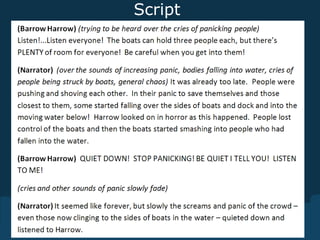
Script
Auditioning for Podcast Roles
• What do I want to do for this project?
• Which roles will I audition for?
• Class decision-making
• Second, third and fourth auditions
• Roles for the others
Class discussion/thinking time using a tier system blind votes creating roles for others
to promote full class participation
Sound Effects: Web-based Searches
• Brainstorming with scripts before starting
• Surfing websites for possibilities
• Bringing back ideas for class meetings
• Democracy in action
• The rented warehouse approach
Class read-through using a brainstorming approach assigning teams for research playback
voting drop and go saving
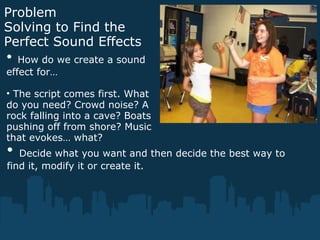
Problem
Solving to Find the
Perfect Sound Effects
• How do we create a sound
effect for…
• The script comes first. What
do you need? Crowd noise? A
rock falling into a cave? Boats
pushing off from shore? Music
that evokes… what?
• Decide what you want and then decide the best way to
find it, modify it or create it.
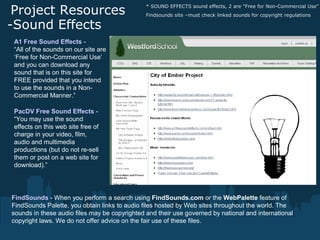
Project Resources
-Sound Effects
* SOUND EFFECTS sound effects, 2 are "Free for Non-Commercial Use”
Findsounds site –must check linked sounds for copyright regulations
A1 Free Sound Effects -
“All of the sounds on our site are
‘Free for Non-Commercial Use’
and you can download any
sound that is on this site for
FREE provided that you intend
to use the sounds in a Non-
Commercial Manner.”
PacDV Free Sound Effects -
“You may use the sound
effects on this web site free of
charge in your video, film,
audio and multimedia
productions (but do not re-sell
them or post on a web site for
download).”
FindSounds - When you perform a search using FindSounds.com or the WebPalette feature of
FindSounds Palette, you obtain links to audio files hosted by Web sites throughout the world. The
sounds in these audio files may be copyrighted and their use governed by national and international
copyright laws. We do not offer advice on the fair use of these files.
Choosing Music Clips from the Web
• Mood choice ideas from script review
• Team searches from music websites
• Bringing back sound bites for review
• Democracy in action
• The rented warehouse…again!
Read through brainstorming searching by committee voting for choices drop and go
saving
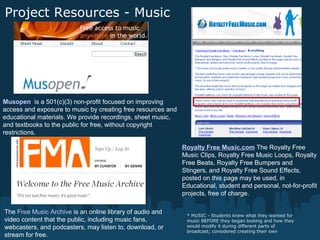
Project Resources - Music
* MUSIC - Students knew what they wanted for
music BEFORE they began looking and how they
would modify it during different parts of
broadcast; considered creating their own
Royalty Free Music.com The Royalty Free
Music Clips, Royalty Free Music Loops, Royalty
Free Beats, Royalty Free Bumpers and
Stingers, and Royalty Free Sound Effects,
posted on this page may be used, in
Educational, student and personal, not-for-profit
projects, free of charge.
Musopen is a 501(c)(3) non-profit focused on improving
access and exposure to music by creating free resources and
educational materials. We provide recordings, sheet music,
and textbooks to the public for free, without copyright
restrictions.
The Free Music Archive is an online library of audio and
video content that the public, including music fans,
webcasters, and podcasters, may listen to, download, or
stream for free.
Where’s the Warehouse? (Audacity)
• Getting beyond the “GULP!”
• Audacity is like your bedroom when you were 12
• Starting to clean things up
• Exploring tools
• Condensing tracks
• Class meetings, playbacks and being “thick-
skinned”
Selecting for initial success how not to panic with file overload condensing tracks sound effects for
quality being critical friends
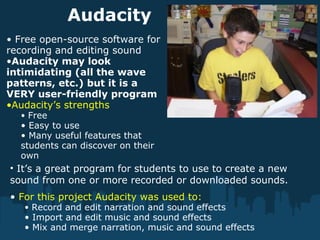
Audacity
• Free open-source software for
recording and editing sound
•Audacity may look
intimidating (all the wave
patterns, etc.) but it is a
VERY user-friendly program
•Audacity’s strengths
• Free
• Easy to use
• Many useful features that
students can discover on their
own
• For this project Audacity was used to:
• Record and edit narration and sound effects
• Import and edit music and sound effects
• Mix and merge narration, music and sound effects
• It’s a great program for students to use to create a new
sound from one or more recorded or downloaded sounds.
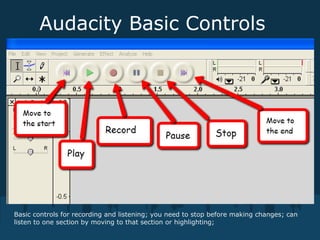
Audacity Basic Controls
Basic controls for recording and listening; you need to stop before making changes; can
listen to one section by moving to that section or highlighting;
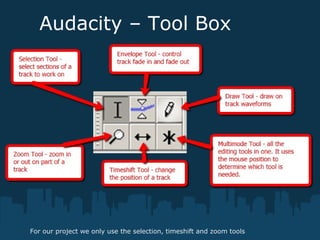
Audacity – Tool Box
For our project we only use the selection, timeshift and zoom tools
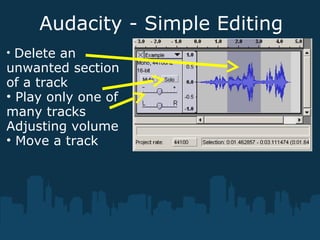
Audacity - Simple Editing
• Delete an
unwanted section
of a track
• Play only one of
many tracks
Adjusting volume
• Move a track
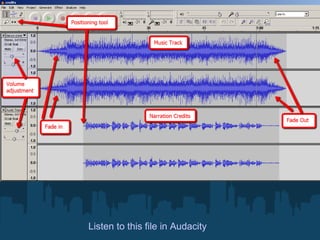
Listen to this file in Audacity
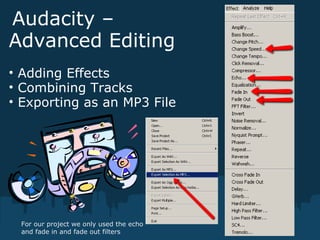
Audacity –
Advanced Editing
• Adding Effects
• Combining Tracks
• Exporting as an MP3 File
For our project we only used the echo
and fade in and fade out filters
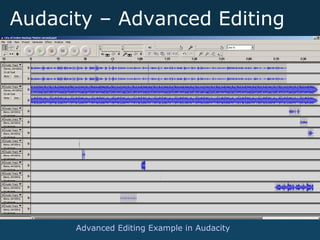
Audacity – Advanced Editing
Advanced Editing Example in Audacity
 
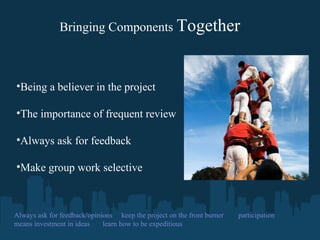
Bringing Components Together
•Being a believer in the project
•The importance of frequent review
•Always ask for feedback
•Make group work selective
Always ask for feedback/opinions keep the project on the front burner participation
means investment in ideas learn how to be expeditious
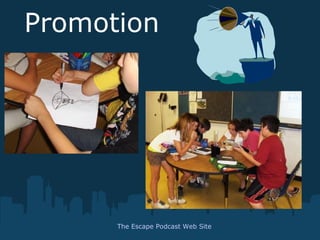
Promotion
The Escape Podcast Web Site
Promotion
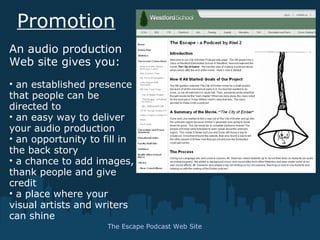
The Escape Podcast Web Site
An audio production
Web site gives you:
• an established presence
that people can be
directed to
• an easy way to deliver
your audio production
• an opportunity to fill in
the back story
• a chance to add images,
thank people and give
credit
• a place where your
visual artists and writers
can shine
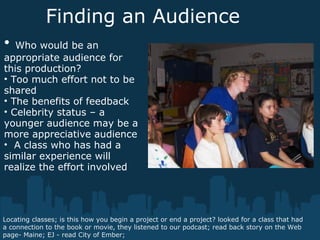
Finding an Audience
Locating classes; is this how you begin a project or end a project? looked for a class that had
a connection to the book or movie, they listened to our podcast; read back story on the Web
page- Maine; EJ - read City of Ember;
• Who would be an
appropriate audience for
this production?
• Too much effort not to be
shared
• The benefits of feedback
• Celebrity status – a
younger audience may be a
more appreciative audience
• A class who has had a
similar experience will
realize the effort involved
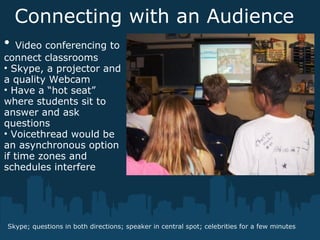
Connecting with an Audience
Skype; questions in both directions; speaker in central spot; celebrities for a few minutes
• Video conferencing to
connect classrooms
• Skype, a projector and
a quality Webcam
• Have a “hot seat”
where students sit to
answer and ask
questions
• Voicethread would be
an asynchronous option
if time zones and
schedules interfere
Resources
• Our Podcast Page
• Our Resources Page
• Audacity Tutorials
• Audacity Manual
• Another Excellent Audacity Manual
• Audacity Training Videos
• Software
• Audacity Audio Editing program
• LAME Encoder mp3 encoding software
• Format Factory file conversion program
• Equipment
• Logitech USB Microphone from B and H
• Sony MP3 - Digital Recorder from B and H
• Bose Computer Speakers
Escape from Ember
Escape from Ember

Escape from Ember

  • 1.
    Beyond The Cityof Ember Creating an Audio Production with a Team of Students Kurt Sherman – ksherman@ccsuvt.org Dave Davidson – ddavidson@ccsuvt.org
  • 3.
    Where did theidea come from? •Connection to Everyday Mathematics •Connection to language arts Project with decimals, percents, fractions Writing a chapter as a language assignment
  • 4.
    Project Inspirations • VTFest Workshop • Connect the Dots course project • Smaller projects • Professional examples •Radio Lab •PHC • Technology well- matched to the need
  • 5.
  • 6.
    Why an AudioProduction? The right level of exposure. Middle school students can enjoy performing without the angst of seeing themselves performing Almost every class member had a speaking role
  • 7.
    Why an AudioProduction? Very accessible technology that a number of students can use simultaneously to create a single production Audacity – free, on all our computers, easy to use and full of features, and an inexpensive microphone
  • 8.
    Software and Equipment •Software: • Audacity free audio recorder (see resources page for download site) • Format Factory for file conversion of audio files recorded on digital voice recorder • Equipment: • Microphone - A good microphone is key – a Logitech USB microphone cost about $20 • Digital voice recorder • Quality Computer Speakers
  • 9.
    Why an AudioProduction? Easier to create a high quality audio production than a comparable video production. We can’t match the level of quality of a commercially produced video. This project followed watching a commercially produced feature film.
  • 10.
    Why an AudioProduction? Audio production allows the audience to fill in the details that a visual production must provide
  • 11.
    Why an AudioProduction? Fewer permission and copyright issues than other media. Made almost entirely of “home grown” content. Our own script, narration, most of the sound effects and discussed creating our own music
  • 12.
    National Educational Technology Standardsfor Students 1. Creativity and Innovation - Students demonstrate creative thinking, construct knowledge, and develop innovative products and processes using technology. 2. Communication and Collaboration - Students use digital media and environments to communicate and work collaboratively, including at a distance, to support individual learning and contribute to the learning of others. 3. Critical Thinking, Problem Solving, and Decision Making - Students use critical thinking skills to plan and conduct research, manage projects, solve problems, and make informed decisions using appropriate digital tools and resources. 4. Digital Citizenship - Students understand human, cultural, and societal issues related to technology and practice legal and ethical behavior.
  • 13.
    Creating the Project Stepsto Follow – Starting with entire class for discussion – Individual teams on “search and finds” – Reporting back to class with choices – voting to make choices – “insertion” teams – Class reviews of rough drafts – Effects applications
  • 14.
    Main Steps TowardCreation • Students wrote a “next chapter” for the story. • Class voted on which chapter would be used. • Groups created script from chapter • Auditions for character reads • Recording of dialogue, sound effects, music • Rough drafting Audacity • Refining audio tracks • Public relations steps to promote product
  • 15.
    Creating a Script •Theimportance of class meetings in starting •Scripting teams by paragraphs •Blending for voice •Final cuts to create a product Organize your recording system!
  • 16.
  • 18.
    Auditioning for PodcastRoles • What do I want to do for this project? • Which roles will I audition for? • Class decision-making • Second, third and fourth auditions • Roles for the others Class discussion/thinking time using a tier system blind votes creating roles for others to promote full class participation
  • 19.
    Sound Effects: Web-basedSearches • Brainstorming with scripts before starting • Surfing websites for possibilities • Bringing back ideas for class meetings • Democracy in action • The rented warehouse approach Class read-through using a brainstorming approach assigning teams for research playback voting drop and go saving
  • 20.
    Problem Solving to Findthe Perfect Sound Effects • How do we create a sound effect for… • The script comes first. What do you need? Crowd noise? A rock falling into a cave? Boats pushing off from shore? Music that evokes… what? • Decide what you want and then decide the best way to find it, modify it or create it.
  • 21.
    Project Resources -Sound Effects *SOUND EFFECTS sound effects, 2 are "Free for Non-Commercial Use” Findsounds site –must check linked sounds for copyright regulations A1 Free Sound Effects - “All of the sounds on our site are ‘Free for Non-Commercial Use’ and you can download any sound that is on this site for FREE provided that you intend to use the sounds in a Non- Commercial Manner.” PacDV Free Sound Effects - “You may use the sound effects on this web site free of charge in your video, film, audio and multimedia productions (but do not re-sell them or post on a web site for download).” FindSounds - When you perform a search using FindSounds.com or the WebPalette feature of FindSounds Palette, you obtain links to audio files hosted by Web sites throughout the world. The sounds in these audio files may be copyrighted and their use governed by national and international copyright laws. We do not offer advice on the fair use of these files.
  • 22.
    Choosing Music Clipsfrom the Web • Mood choice ideas from script review • Team searches from music websites • Bringing back sound bites for review • Democracy in action • The rented warehouse…again! Read through brainstorming searching by committee voting for choices drop and go saving
  • 23.
    Project Resources -Music * MUSIC - Students knew what they wanted for music BEFORE they began looking and how they would modify it during different parts of broadcast; considered creating their own Royalty Free Music.com The Royalty Free Music Clips, Royalty Free Music Loops, Royalty Free Beats, Royalty Free Bumpers and Stingers, and Royalty Free Sound Effects, posted on this page may be used, in Educational, student and personal, not-for-profit projects, free of charge. Musopen is a 501(c)(3) non-profit focused on improving access and exposure to music by creating free resources and educational materials. We provide recordings, sheet music, and textbooks to the public for free, without copyright restrictions. The Free Music Archive is an online library of audio and video content that the public, including music fans, webcasters, and podcasters, may listen to, download, or stream for free.
  • 24.
    Where’s the Warehouse?(Audacity) • Getting beyond the “GULP!” • Audacity is like your bedroom when you were 12 • Starting to clean things up • Exploring tools • Condensing tracks • Class meetings, playbacks and being “thick- skinned” Selecting for initial success how not to panic with file overload condensing tracks sound effects for quality being critical friends
  • 25.
    Audacity • Free open-sourcesoftware for recording and editing sound •Audacity may look intimidating (all the wave patterns, etc.) but it is a VERY user-friendly program •Audacity’s strengths • Free • Easy to use • Many useful features that students can discover on their own • For this project Audacity was used to: • Record and edit narration and sound effects • Import and edit music and sound effects • Mix and merge narration, music and sound effects • It’s a great program for students to use to create a new sound from one or more recorded or downloaded sounds.
  • 26.
    Audacity Basic Controls Basiccontrols for recording and listening; you need to stop before making changes; can listen to one section by moving to that section or highlighting;
  • 27.
    Audacity – ToolBox For our project we only use the selection, timeshift and zoom tools
  • 28.
    Audacity - SimpleEditing • Delete an unwanted section of a track • Play only one of many tracks Adjusting volume • Move a track
  • 29.
    Listen to thisfile in Audacity
  • 30.
    Audacity – Advanced Editing •Adding Effects • Combining Tracks • Exporting as an MP3 File For our project we only used the echo and fade in and fade out filters
  • 31.
    Audacity – AdvancedEditing Advanced Editing Example in Audacity
  • 32.
      Bringing Components Together •Beinga believer in the project •The importance of frequent review •Always ask for feedback •Make group work selective Always ask for feedback/opinions keep the project on the front burner participation means investment in ideas learn how to be expeditious
  • 33.
  • 34.
    Promotion The Escape PodcastWeb Site An audio production Web site gives you: • an established presence that people can be directed to • an easy way to deliver your audio production • an opportunity to fill in the back story • a chance to add images, thank people and give credit • a place where your visual artists and writers can shine
  • 35.
    Finding an Audience Locatingclasses; is this how you begin a project or end a project? looked for a class that had a connection to the book or movie, they listened to our podcast; read back story on the Web page- Maine; EJ - read City of Ember; • Who would be an appropriate audience for this production? • Too much effort not to be shared • The benefits of feedback • Celebrity status – a younger audience may be a more appreciative audience • A class who has had a similar experience will realize the effort involved
  • 36.
    Connecting with anAudience Skype; questions in both directions; speaker in central spot; celebrities for a few minutes • Video conferencing to connect classrooms • Skype, a projector and a quality Webcam • Have a “hot seat” where students sit to answer and ask questions • Voicethread would be an asynchronous option if time zones and schedules interfere
  • 37.
    Resources • Our PodcastPage • Our Resources Page • Audacity Tutorials • Audacity Manual • Another Excellent Audacity Manual • Audacity Training Videos • Software • Audacity Audio Editing program • LAME Encoder mp3 encoding software • Format Factory file conversion program • Equipment • Logitech USB Microphone from B and H • Sony MP3 - Digital Recorder from B and H • Bose Computer Speakers