Department of ECE
PRESENTATION
Presented by:- Mohd Asif Ikbal
Outline of The Presentation….
1
2
Why Electronics & Communication
Engineering??
Why ECE from JIT??
• Imagine a world without Electronics!!
• Job opportunities.
• Research scope.
• Curriculum-Based on the new trends
and possibilities.
Why Electronics & Communication Engineering??
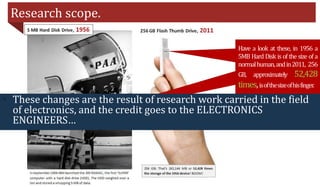
Research scope.
Have a look at these, in 1956 a
5MB Hard Disk is of the size of a
normalhuman,andin2011, 256
GB, approximately 52,428
times,isofthesizeofhisfinger.
• These changes are the result of research work carried in the field
of electronics, and the credit goes to the ELECTRONICS
ENGINEERS…
Curriculum-Based on the new trends and possibilities.
EMAILS
Lets talk about one very important
aspect of over life.
Curriculum-Based on the new trends and possibilities.
Have you ever wonder how these things
are possible in this tiny device!!!
We are making it possible..we the
ELECTRONICS ENGINEER…lets see,
how we do this….
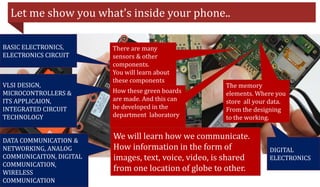
Let me show you what's inside your phone..
There are many
sensors & other
components.
You will learn about
these components
How these green boards
are made. And this can
be developed in the
department laboratory
We will learn how we communicate.
How information in the form of
images, text, voice, video, is shared
from one location of globe to other.
BASIC ELECTRONICS,
ELECTRONICS CIRCUIT
VLSI DESIGN,
MICROCONTROLLERS &
ITS APPLICAION,
INTEGRATED CIRCUIT
TECHNOLOGY
DATA COMMUNICATION &
NETWORKING, ANALOG
COMMUNICAITON, DIGITAL
COMMUNICATION,
WIRELESS
COMMUNICATION
The memory
elements. Where you
store all your data.
From the designing
to the working.
DIGITAL
ELECTRONICS
Why ECE in JIT??
1
2
Our Product.
Our Current students
Our Resource group
Helping future Entrepreneur
3
4
And many more…..
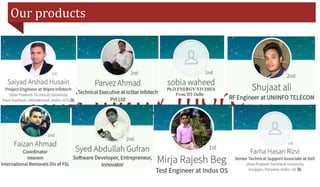
Our products
Our Current students
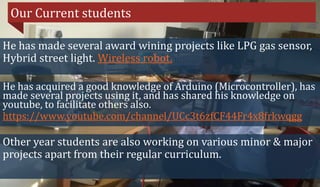
He has made several award wining projects like LPG gas sensor,
Hybrid street light. Wireless robot.
He has acquired a good knowledge of Arduino (Microcontroller), has
made several projects using it, and has shared his knowledge on
youtube, to facilitate others also.
https://www.youtube.com/channel/UCc3t6zfCF44Fr4x8frkwqgg
Other year students are also working on various minor & major
projects apart from their regular curriculum.
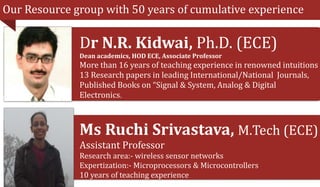
Our Resource group with 50 years of cumulative experience
Dr N.R. Kidwai, Ph.D. (ECE)
Dean academics, HOD ECE, Associate Professor
More than 16 years of teaching experience in renowned intuitions
13 Research papers in leading International/National Journals,
Published Books on “Signal & System, Analog & Digital
Electronics.
Ms Ruchi Srivastava, M.Tech (ECE)
Assistant Professor
Research area:- wireless sensor networks
Expertization:- Microprocessors & Microcontrollers
10 years of teaching experience
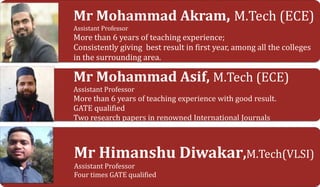
Mr Mohammad Akram, M.Tech (ECE)
Assistant Professor
More than 6 years of teaching experience;
Consistently giving best result in first year, among all the colleges
in the surrounding area.
Mr Mohammad Asif, M.Tech (ECE)
Assistant Professor
More than 6 years of teaching experience with good result.
GATE qualified
Two research papers in renowned International Journals
Mr Himanshu Diwakar,M.Tech(VLSI)
Assistant Professor
Four times GATE qualified
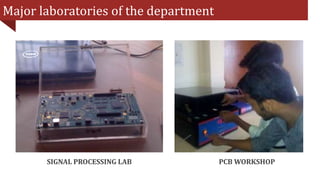
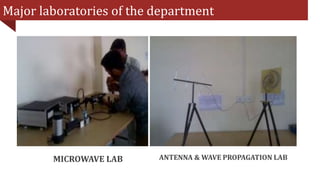
Major laboratories of the department
SIGNAL PROCESSING LAB PCB WORKSHOP
Major laboratories of the department
MICROWAVE LAB ANTENNA & WAVE PROPAGATION LAB
Helping future Entrepreneur
CONCLUSION
So if you want to become a
successful ECE engineer you
are welcome at JIT…..
JAHANGIRABAD FORT: JAHANGIRABAD, BARABANKI, U.P. 225203
TEL:05248-243352, 243373, 320800, +91-969539684
EMAIL: Info@jit.edu.in – www.jit.edu.in
THANK YOU!

JIT_ECE2017

  • 1.
  • 2.
    Outline of ThePresentation…. 1 2 Why Electronics & Communication Engineering?? Why ECE from JIT??
  • 3.
    • Imagine aworld without Electronics!! • Job opportunities. • Research scope. • Curriculum-Based on the new trends and possibilities. Why Electronics & Communication Engineering??
  • 5.
    Research scope. Have alook at these, in 1956 a 5MB Hard Disk is of the size of a normalhuman,andin2011, 256 GB, approximately 52,428 times,isofthesizeofhisfinger. • These changes are the result of research work carried in the field of electronics, and the credit goes to the ELECTRONICS ENGINEERS…
  • 6.
    Curriculum-Based on thenew trends and possibilities. EMAILS Lets talk about one very important aspect of over life.
  • 7.
    Curriculum-Based on thenew trends and possibilities. Have you ever wonder how these things are possible in this tiny device!!! We are making it possible..we the ELECTRONICS ENGINEER…lets see, how we do this….
  • 8.
    Let me showyou what's inside your phone.. There are many sensors & other components. You will learn about these components How these green boards are made. And this can be developed in the department laboratory We will learn how we communicate. How information in the form of images, text, voice, video, is shared from one location of globe to other. BASIC ELECTRONICS, ELECTRONICS CIRCUIT VLSI DESIGN, MICROCONTROLLERS & ITS APPLICAION, INTEGRATED CIRCUIT TECHNOLOGY DATA COMMUNICATION & NETWORKING, ANALOG COMMUNICAITON, DIGITAL COMMUNICATION, WIRELESS COMMUNICATION The memory elements. Where you store all your data. From the designing to the working. DIGITAL ELECTRONICS
  • 9.
    Why ECE inJIT?? 1 2 Our Product. Our Current students Our Resource group Helping future Entrepreneur 3 4
  • 10.
  • 11.
    Our Current students Hehas made several award wining projects like LPG gas sensor, Hybrid street light. Wireless robot. He has acquired a good knowledge of Arduino (Microcontroller), has made several projects using it, and has shared his knowledge on youtube, to facilitate others also. https://www.youtube.com/channel/UCc3t6zfCF44Fr4x8frkwqgg Other year students are also working on various minor & major projects apart from their regular curriculum.
  • 12.
    Our Resource groupwith 50 years of cumulative experience Dr N.R. Kidwai, Ph.D. (ECE) Dean academics, HOD ECE, Associate Professor More than 16 years of teaching experience in renowned intuitions 13 Research papers in leading International/National Journals, Published Books on “Signal & System, Analog & Digital Electronics. Ms Ruchi Srivastava, M.Tech (ECE) Assistant Professor Research area:- wireless sensor networks Expertization:- Microprocessors & Microcontrollers 10 years of teaching experience
  • 13.
    Mr Mohammad Akram,M.Tech (ECE) Assistant Professor More than 6 years of teaching experience; Consistently giving best result in first year, among all the colleges in the surrounding area. Mr Mohammad Asif, M.Tech (ECE) Assistant Professor More than 6 years of teaching experience with good result. GATE qualified Two research papers in renowned International Journals Mr Himanshu Diwakar,M.Tech(VLSI) Assistant Professor Four times GATE qualified
  • 14.
    Major laboratories ofthe department SIGNAL PROCESSING LAB PCB WORKSHOP
  • 15.
    Major laboratories ofthe department MICROWAVE LAB ANTENNA & WAVE PROPAGATION LAB
  • 16.
  • 17.
    CONCLUSION So if youwant to become a successful ECE engineer you are welcome at JIT….. JAHANGIRABAD FORT: JAHANGIRABAD, BARABANKI, U.P. 225203 TEL:05248-243352, 243373, 320800, +91-969539684 EMAIL: Info@jit.edu.in – www.jit.edu.in
  • 18.

Editor's Notes

  • #4 The system identification is an approach to model an unknown system. In this configuration the unknown system is in parallel with an adaptive filter, and both are excited with the same signal. When the output MSE(Mean square error) is minimized the filter represents the desired model. The structure used for adaptive system identification is illustrated in figure 1, where P(z) is an unknown system to be identified by an adaptive filter W(z). The signal x(n) excites P(z) and W(z), the desired signal d(n) is the unknown system output, minimizing the difference of output signals y(n) and d(n), the characteristics of P(z) can be determined. So in This work we have tried to optimize the parameter (step size) for an adaptive Filter…so that we can reduce MSE.
  • #6 The system identification is an approach to model an unknown system. In this configuration the unknown system is in parallel with an adaptive filter, and both are excited with the same signal. When the output MSE(Mean square error) is minimized the filter represents the desired model. The structure used for adaptive system identification is illustrated in figure 1, where P(z) is an unknown system to be identified by an adaptive filter W(z). The signal x(n) excites P(z) and W(z), the desired signal d(n) is the unknown system output, minimizing the difference of output signals y(n) and d(n), the characteristics of P(z) can be determined. So in This work we have tried to optimize the parameter (step size) for an adaptive Filter…so that we can reduce MSE.
  • #7 The system identification is an approach to model an unknown system. In this configuration the unknown system is in parallel with an adaptive filter, and both are excited with the same signal. When the output MSE(Mean square error) is minimized the filter represents the desired model. The structure used for adaptive system identification is illustrated in figure 1, where P(z) is an unknown system to be identified by an adaptive filter W(z). The signal x(n) excites P(z) and W(z), the desired signal d(n) is the unknown system output, minimizing the difference of output signals y(n) and d(n), the characteristics of P(z) can be determined. So in This work we have tried to optimize the parameter (step size) for an adaptive Filter…so that we can reduce MSE.
  • #8 The system identification is an approach to model an unknown system. In this configuration the unknown system is in parallel with an adaptive filter, and both are excited with the same signal. When the output MSE(Mean square error) is minimized the filter represents the desired model. The structure used for adaptive system identification is illustrated in figure 1, where P(z) is an unknown system to be identified by an adaptive filter W(z). The signal x(n) excites P(z) and W(z), the desired signal d(n) is the unknown system output, minimizing the difference of output signals y(n) and d(n), the characteristics of P(z) can be determined. So in This work we have tried to optimize the parameter (step size) for an adaptive Filter…so that we can reduce MSE.
  • #13 The system identification is an approach to model an unknown system. In this configuration the unknown system is in parallel with an adaptive filter, and both are excited with the same signal. When the output MSE(Mean square error) is minimized the filter represents the desired model. The structure used for adaptive system identification is illustrated in figure 1, where P(z) is an unknown system to be identified by an adaptive filter W(z). The signal x(n) excites P(z) and W(z), the desired signal d(n) is the unknown system output, minimizing the difference of output signals y(n) and d(n), the characteristics of P(z) can be determined. So in This work we have tried to optimize the parameter (step size) for an adaptive Filter…so that we can reduce MSE.
  • #14 The system identification is an approach to model an unknown system. In this configuration the unknown system is in parallel with an adaptive filter, and both are excited with the same signal. When the output MSE(Mean square error) is minimized the filter represents the desired model. The structure used for adaptive system identification is illustrated in figure 1, where P(z) is an unknown system to be identified by an adaptive filter W(z). The signal x(n) excites P(z) and W(z), the desired signal d(n) is the unknown system output, minimizing the difference of output signals y(n) and d(n), the characteristics of P(z) can be determined. So in This work we have tried to optimize the parameter (step size) for an adaptive Filter…so that we can reduce MSE.