J.ARTHY,
Assistant Professor,
SRMIST,
Ramapuram
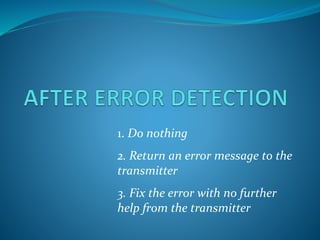
1. Do nothing
2. Return an error message to the
transmitter
3. Fix the error with no further
help from the transmitter
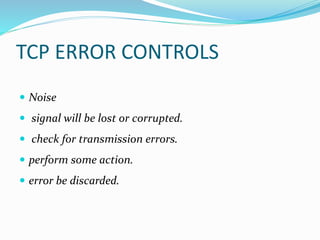
TCP ERROR CONTROLS
 Noise
 signal will be lost or corrupted.
 check for transmission errors.
 perform some action.
 error be discarded.
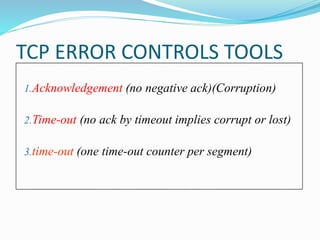
TCP ERROR CONTROLS TOOLS
1.Acknowledgement (no negative ack)(Corruption)
2.Time-out (no ack by timeout implies corrupt or lost)
3.time-out (one time-out counter per segment)
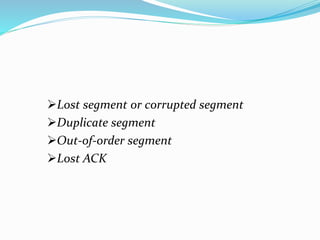
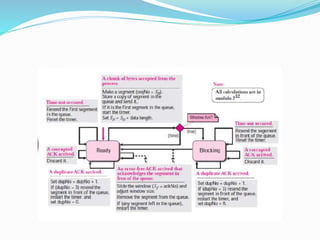
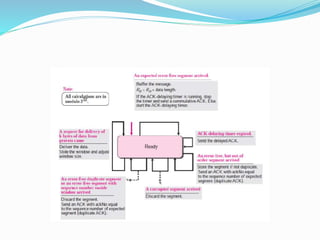
Lost segment or corrupted segment
Duplicate segment
Out-of-order segment
Lost ACK
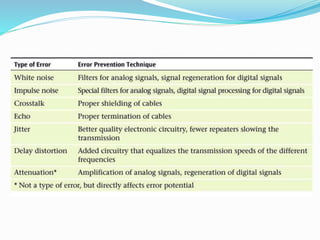
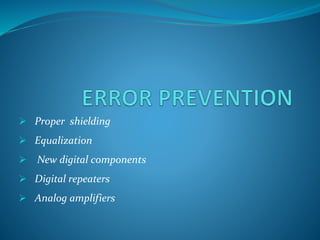
 Proper shielding
 Equalization
 New digital components
 Digital repeaters
 Analog amplifiers
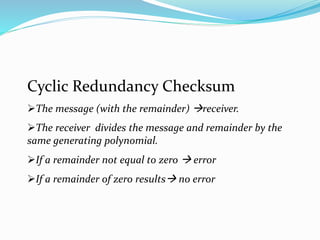
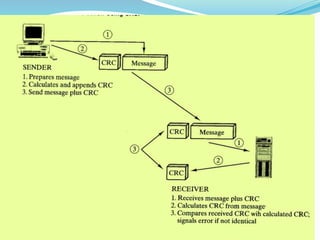
Cyclic Redundancy Checksum
The message (with the remainder) receiver.
The receiver divides the message and remainder by the
same generating polynomial.
If a remainder not equal to zero  error
If a remainder of zero results no error
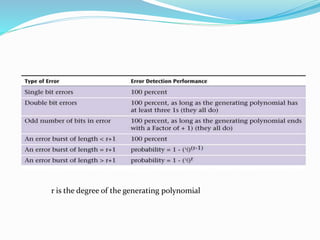
r is the degree of the generating polynomial
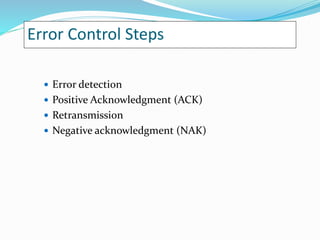
Error Control Steps
 Error detection
 Positive Acknowledgment (ACK)
 Retransmission
 Negative acknowledgment (NAK)
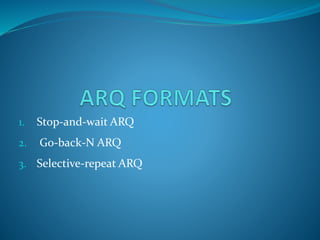
1. Stop-and-wait ARQ
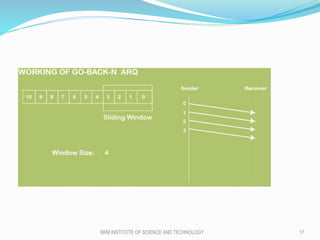
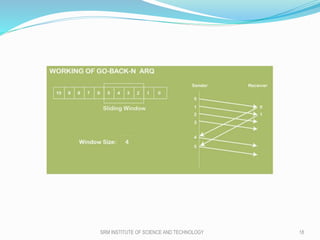
2. Go-back-N ARQ
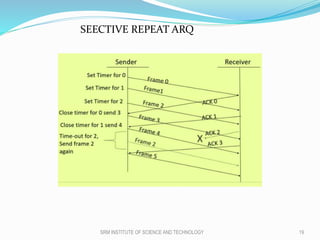
3. Selective-repeat ARQ
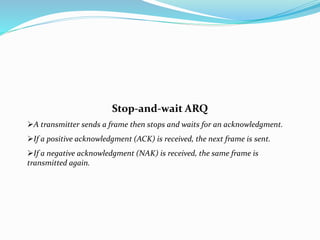
Stop-and-wait ARQ
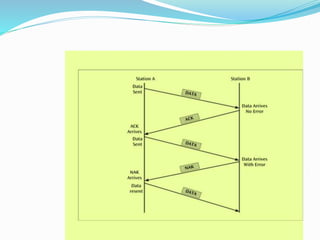
A transmitter sends a frame then stops and waits for an acknowledgment.
If a positive acknowledgment (ACK) is received, the next frame is sent.
If a negative acknowledgment (NAK) is received, the same frame is
transmitted again.
SRM INSTITUTE OF SCIENCE AND TECHNOLOGY 17
SRM INSTITUTE OF SCIENCE AND TECHNOLOGY 18
SRM INSTITUTE OF SCIENCE AND TECHNOLOGY 19
SEECTIVE REPEAT ARQ

error controls.pptx

  • 1.
  • 2.
    1. Do nothing 2.Return an error message to the transmitter 3. Fix the error with no further help from the transmitter
  • 3.
    TCP ERROR CONTROLS Noise  signal will be lost or corrupted.  check for transmission errors.  perform some action.  error be discarded.
  • 5.
    TCP ERROR CONTROLSTOOLS 1.Acknowledgement (no negative ack)(Corruption) 2.Time-out (no ack by timeout implies corrupt or lost) 3.time-out (one time-out counter per segment)
  • 6.
    Lost segment orcorrupted segment Duplicate segment Out-of-order segment Lost ACK
  • 9.
     Proper shielding Equalization  New digital components  Digital repeaters  Analog amplifiers
  • 10.
    Cyclic Redundancy Checksum Themessage (with the remainder) receiver. The receiver divides the message and remainder by the same generating polynomial. If a remainder not equal to zero  error If a remainder of zero results no error
  • 11.
    r is thedegree of the generating polynomial
  • 13.
    Error Control Steps Error detection  Positive Acknowledgment (ACK)  Retransmission  Negative acknowledgment (NAK)
  • 14.
    1. Stop-and-wait ARQ 2.Go-back-N ARQ 3. Selective-repeat ARQ
  • 15.
    Stop-and-wait ARQ A transmittersends a frame then stops and waits for an acknowledgment. If a positive acknowledgment (ACK) is received, the next frame is sent. If a negative acknowledgment (NAK) is received, the same frame is transmitted again.
  • 17.
    SRM INSTITUTE OFSCIENCE AND TECHNOLOGY 17
  • 18.
    SRM INSTITUTE OFSCIENCE AND TECHNOLOGY 18
  • 19.
    SRM INSTITUTE OFSCIENCE AND TECHNOLOGY 19 SEECTIVE REPEAT ARQ