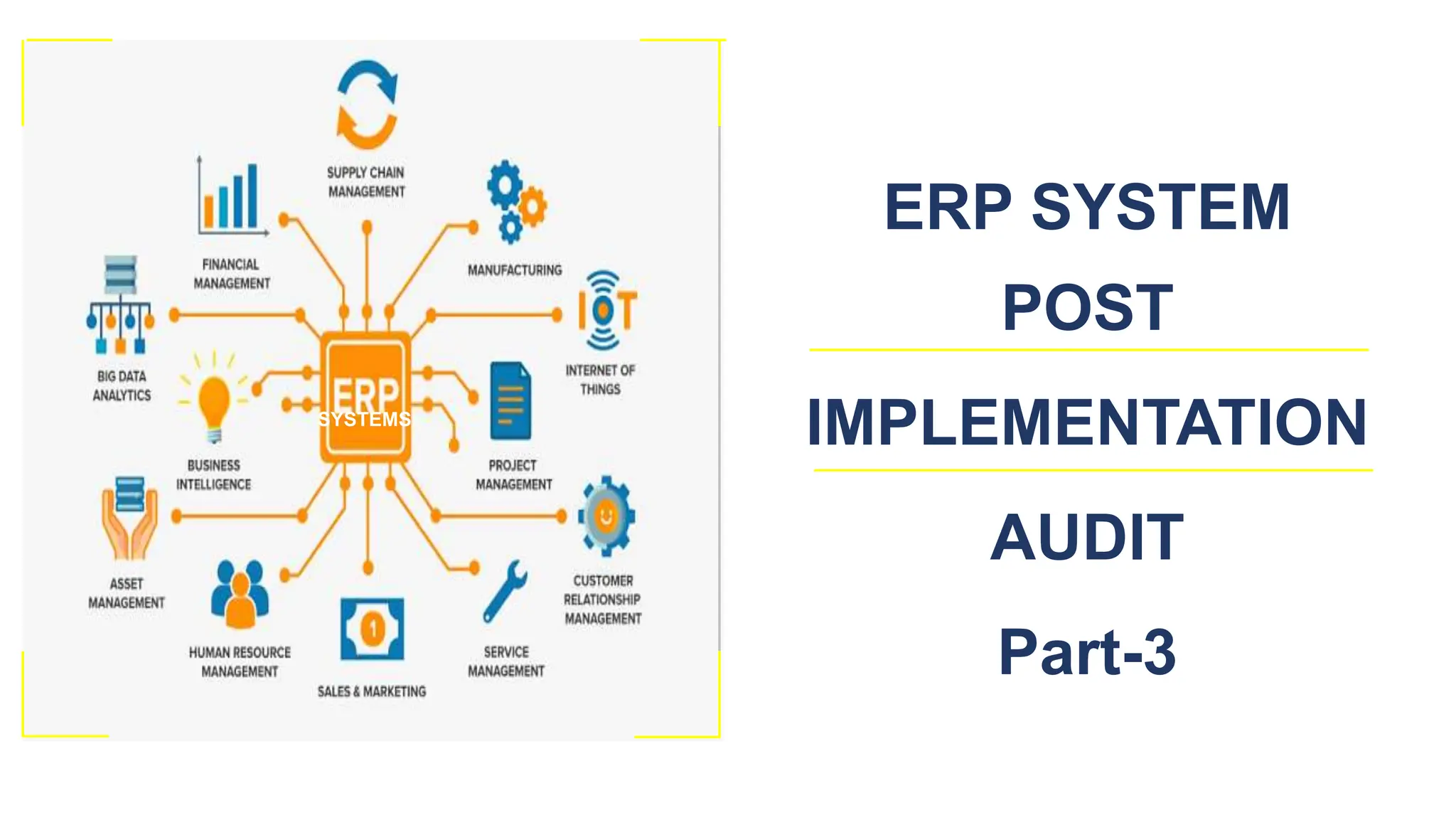
ERP SYSTEM
POST
IMPLEMENTATION
AUDIT
Part-3
SYSTEMS
2
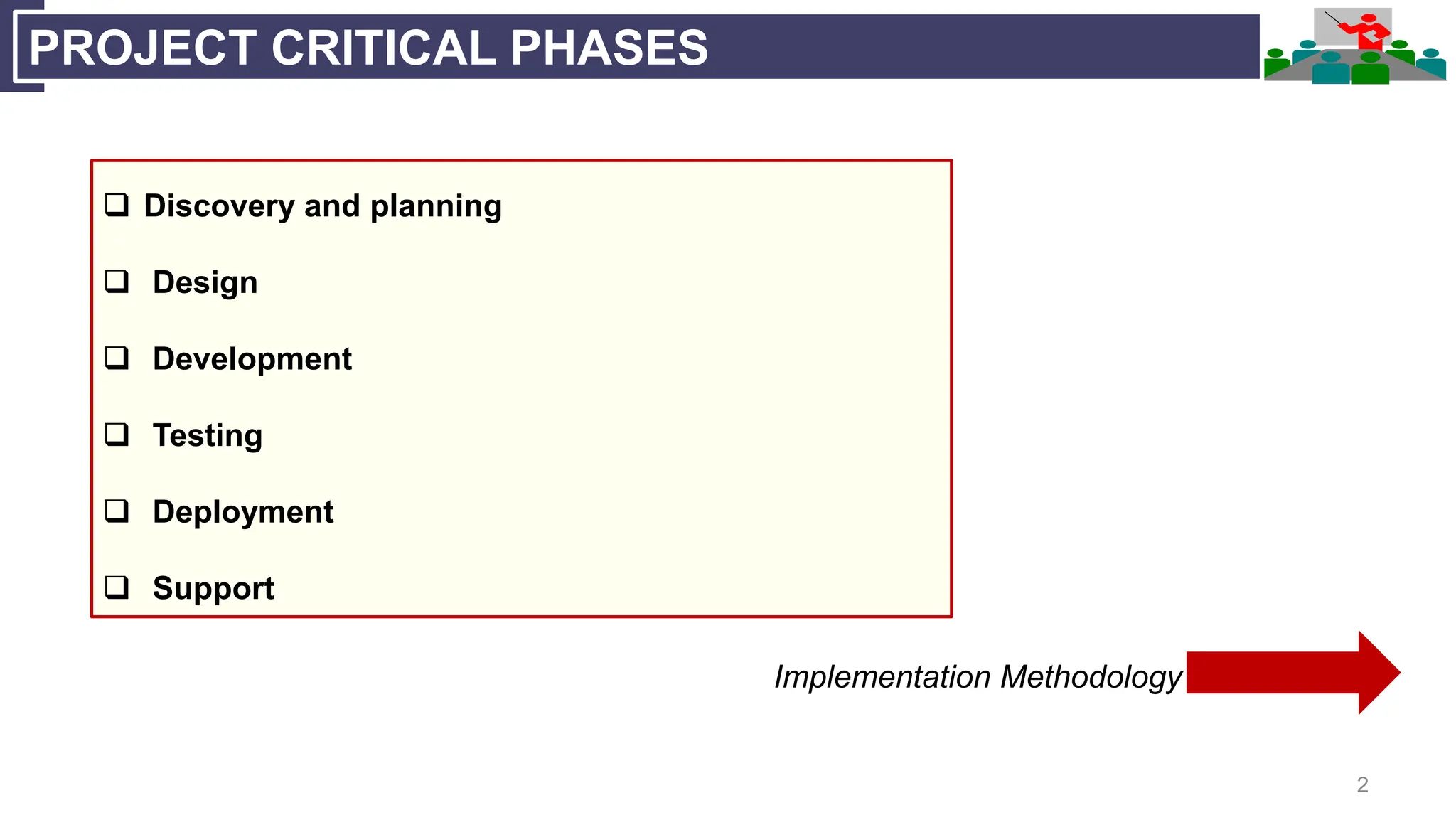
PROJECT CRITICAL PHASES
 Discovery and planning
 Design
 Development
 Testing
 Deployment
 Support
Implementation Methodology
3
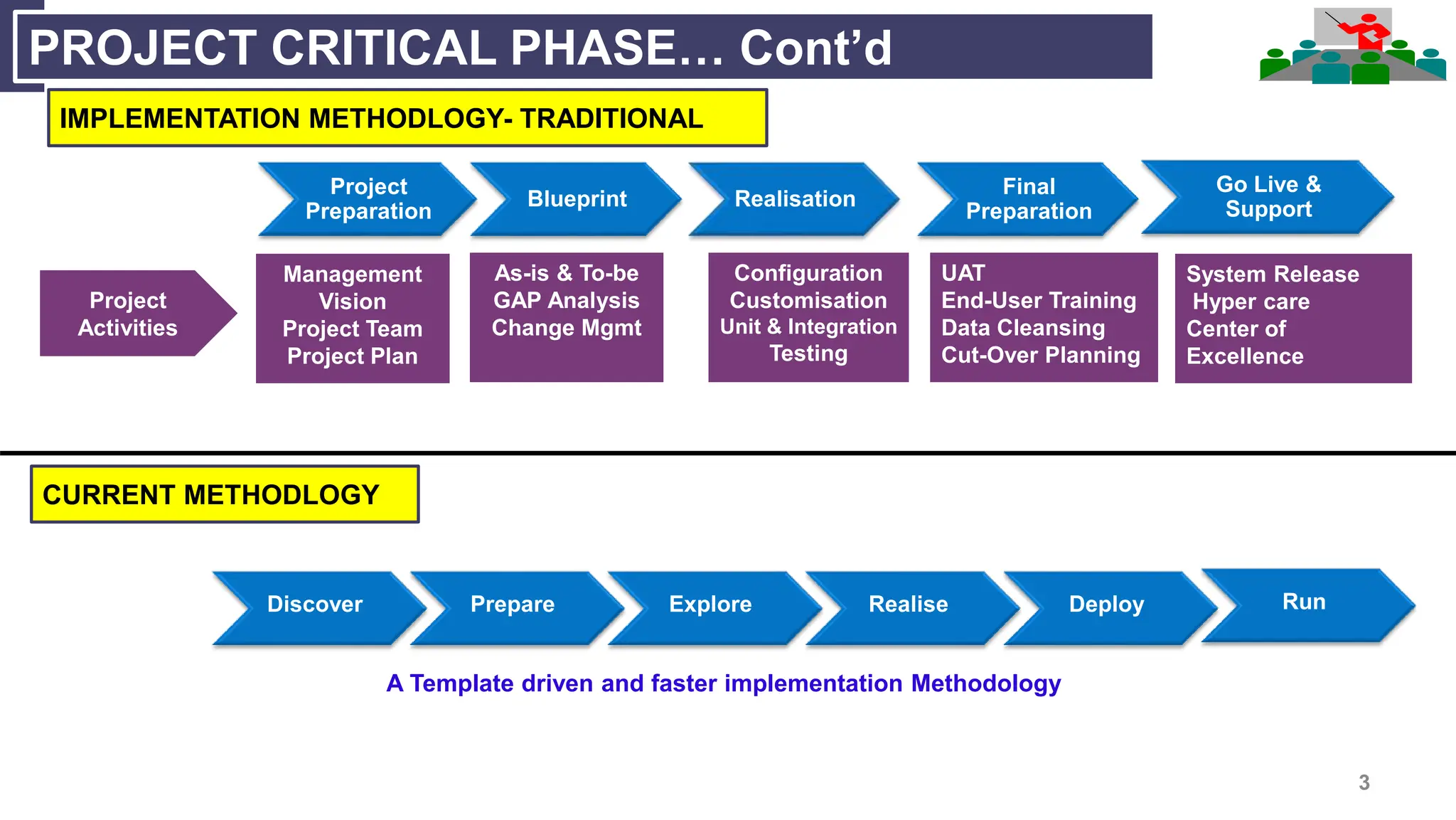
PROJECT CRITICAL PHASE… Cont’d
Project
Preparation
Blueprint Realisation
IMPLEMENTATION METHODLOGY- TRADITIONAL
Final
Preparation
Go Live &
Support
Management
Vision
Project Team
Project Plan
Project
Activities
As-is & To-be
GAP Analysis
Change Mgmt
Configuration
Customisation
Unit & Integration
Testing
UAT
End-User Training
Data Cleansing
Cut-Over Planning
System Release
Hyper care
Center of
Excellence
CURRENT METHODLOGY
Discover Prepare Explore Realise Deploy Run
A Template driven and faster implementation Methodology
4
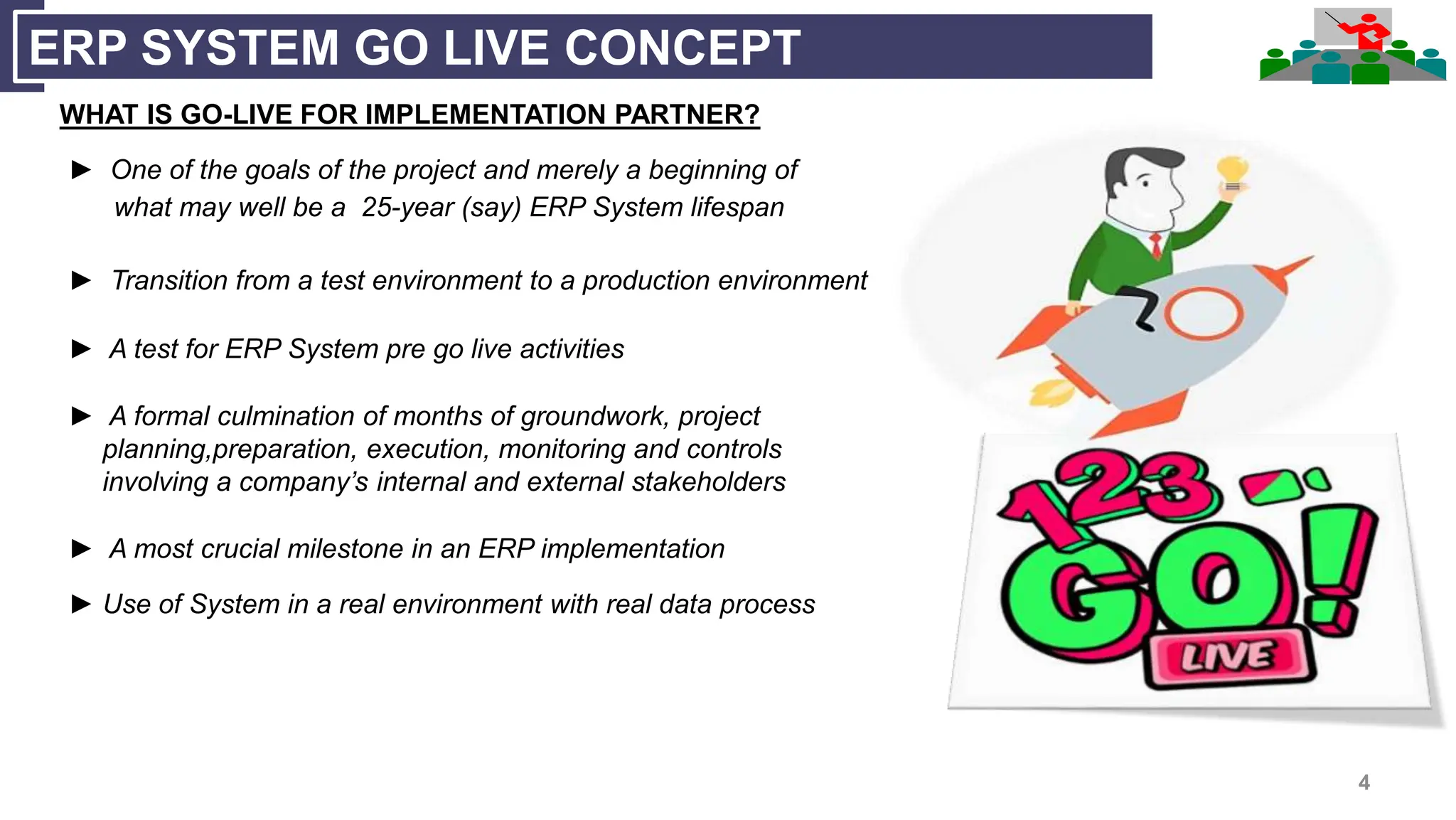
ERP SYSTEM GO LIVE CONCEPT
WHAT IS GO-LIVE FOR IMPLEMENTATION PARTNER?
► One of the goals of the project and merely a beginning of
what may well be a 25-year (say) ERP System lifespan
► Transition from a test environment to a production environment
► A test for ERP System pre go live activities
► A formal culmination of months of groundwork, project
planning,preparation, execution, monitoring and controls
involving a company’s internal and external stakeholders
► A most crucial milestone in an ERP implementation
► Use of System in a real environment with real data process
5
ERP SYSTEM POST GO LIVE CONCEPT…cont’d
 An automated environment designed to address Organisation’s Objectives
 A live system to drive the business operations on a day to day basis
 A change from legacy way of working
 An opportunity for sunsetting legacy systems
 A step towards business enhancements
 Bringing in efficiency and transparency in business processes
 An Initiation for system ownership transfer
The __________ team is the owner of the application &
___________ team is the owner of the data.
IT/
BUSINESS
WHAT IS GO-LIVE FOR AN ORGANISATION
6
ERP SYSTEM POST GO LIVE OPTIMISATION
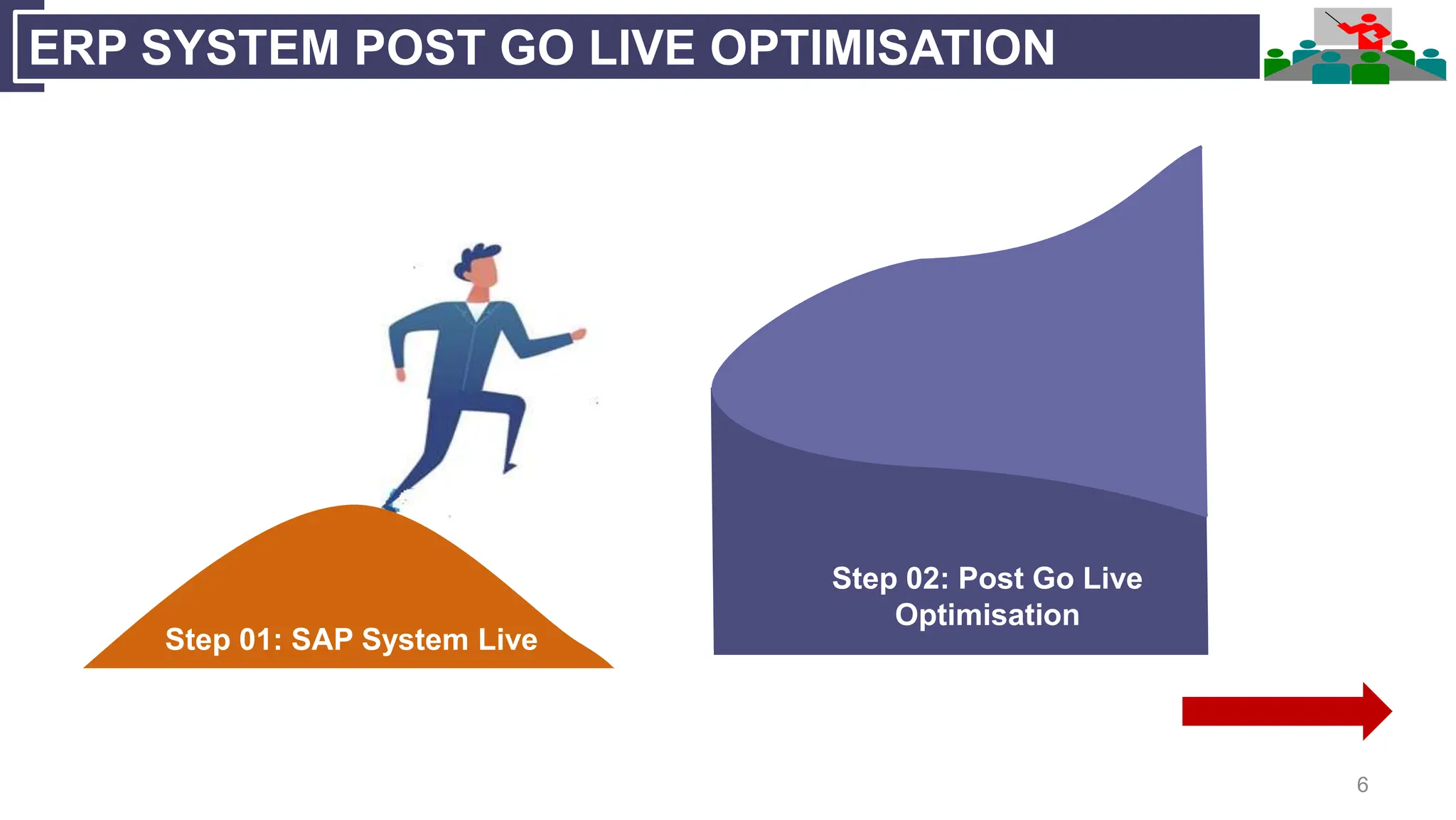
Step 01: SAP System Live
Step 02: Post Go Live
Optimisation
7
ERP SYSTEM POST GO LIVE OPTIMISATION
A CRITICAL PHASE (often overlooked)
 Key to System stabilisation
 Vital for User acceptance
 Significant for data reliability
 Important for meaningful analysis of data
 Central for System Management (In-house/External)
 Crucial for System Ownership (IT to Users) transfer
 Imperative for Management decisions
8
ERP SYSTEM POST GO LIVE OPTIMISATION..Cont’d
KEY ACTIVITIES
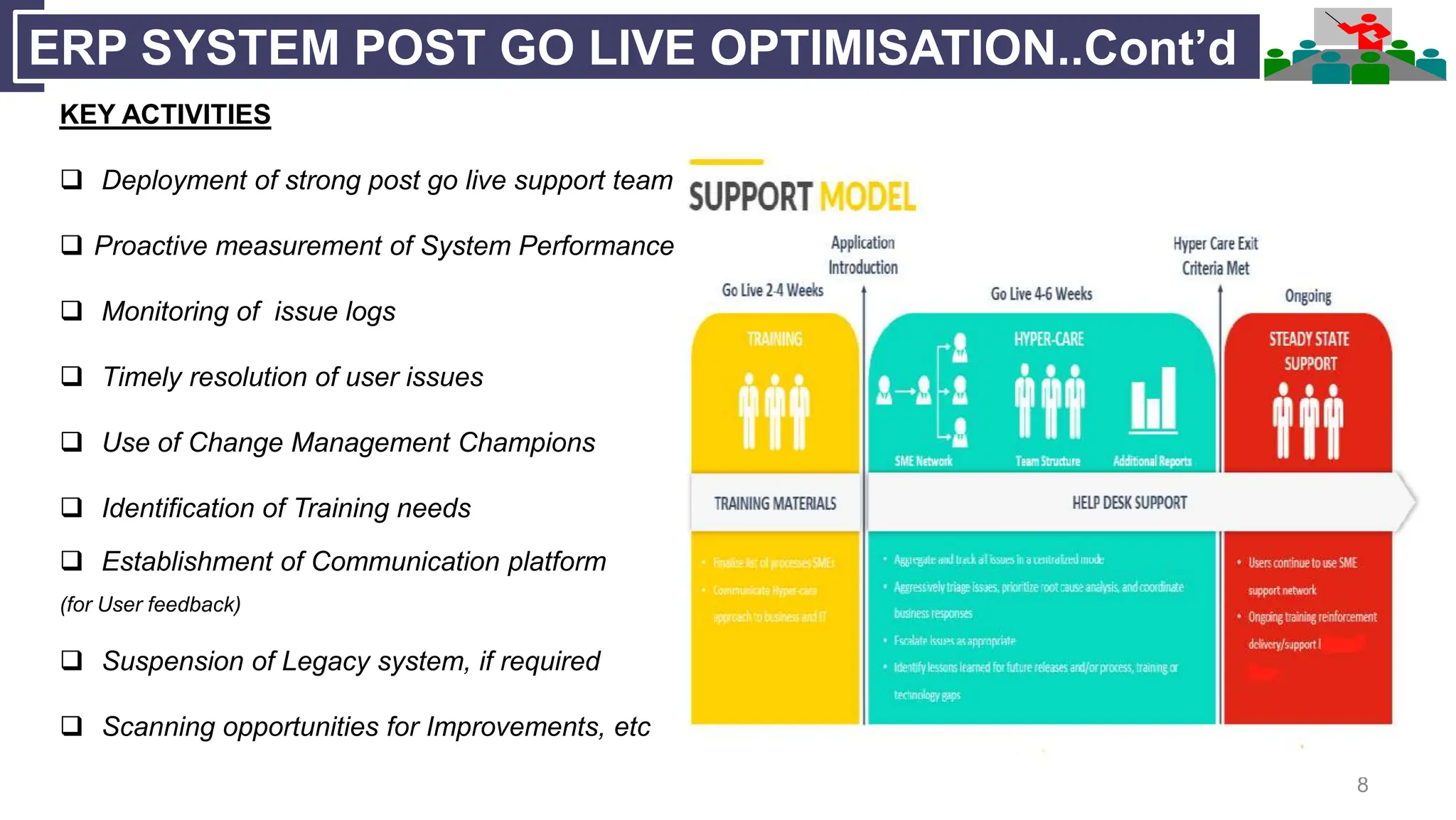
 Deployment of strong post go live support team
 Proactive measurement of System Performance
 Monitoring of issue logs
 Timely resolution of user issues
 Use of Change Management Champions
 Identification of Training needs
 Establishment of Communication platform
(for User feedback)
 Suspension of Legacy system, if required
 Scanning opportunities for Improvements, etc
ERP SYSTEM POST GO LIVE OPTIMISATION….Cont’d
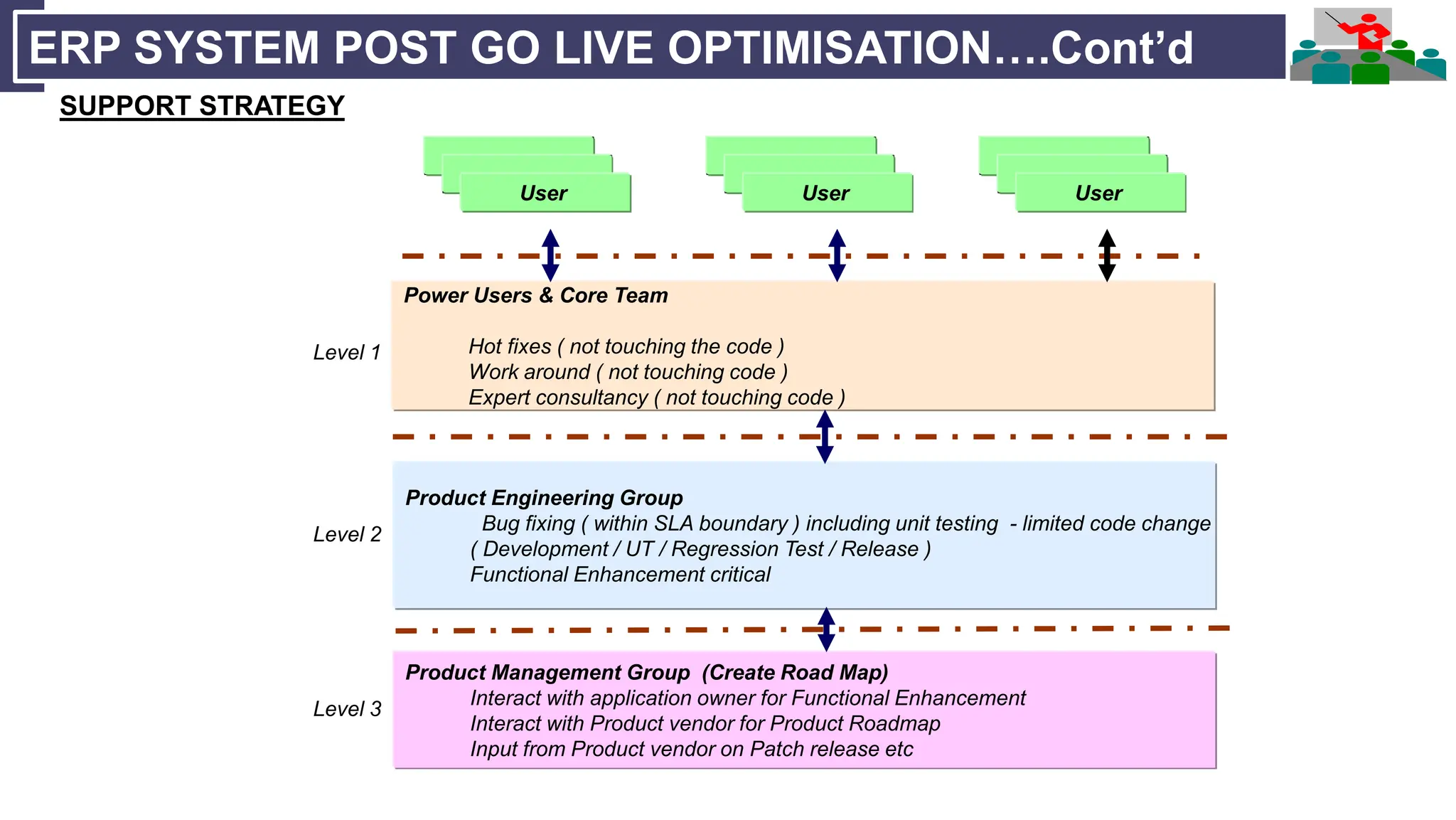
SUPPORT STRATEGY
Power Users & Core Team
Hot fixes ( not touching the code )
Work around ( not touching code )
Expert consultancy ( not touching code )
Product Engineering Group
Bug fixing ( within SLA boundary ) including unit testing - limited code change
( Development / UT / Regression Test / Release )
Functional Enhancement critical
Product Management Group (Create Road Map)
Interact with application owner for Functional Enhancement
Interact with Product vendor for Product Roadmap
Input from Product vendor on Patch release etc
User User User
User User User
Level 1
Level 2
Level 3
10
ERP SYSTEM POST GO LIVE OPTIMISATION..Cont’d
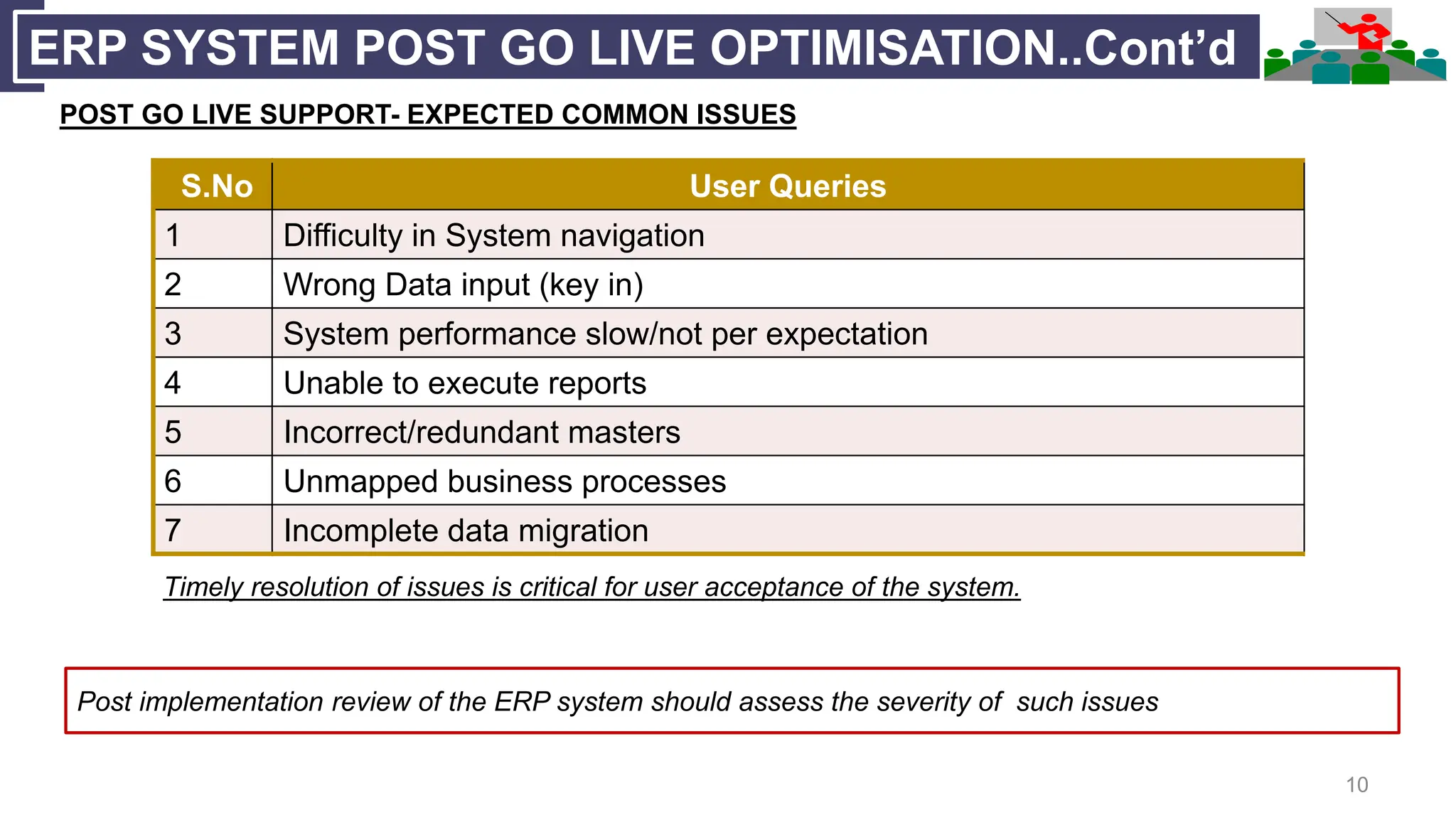
POST GO LIVE SUPPORT- EXPECTED COMMON ISSUES
S.No User Queries
1 Difficulty in System navigation
2 Wrong Data input (key in)
3 System performance slow/not per expectation
4 Unable to execute reports
5 Incorrect/redundant masters
6 Unmapped business processes
7 Incomplete data migration
Timely resolution of issues is critical for user acceptance of the system.
Post implementation review of the ERP system should assess the severity of such issues
11
ERP SYSTEM POST GO LIVE OPTIMISATION..Cont’d
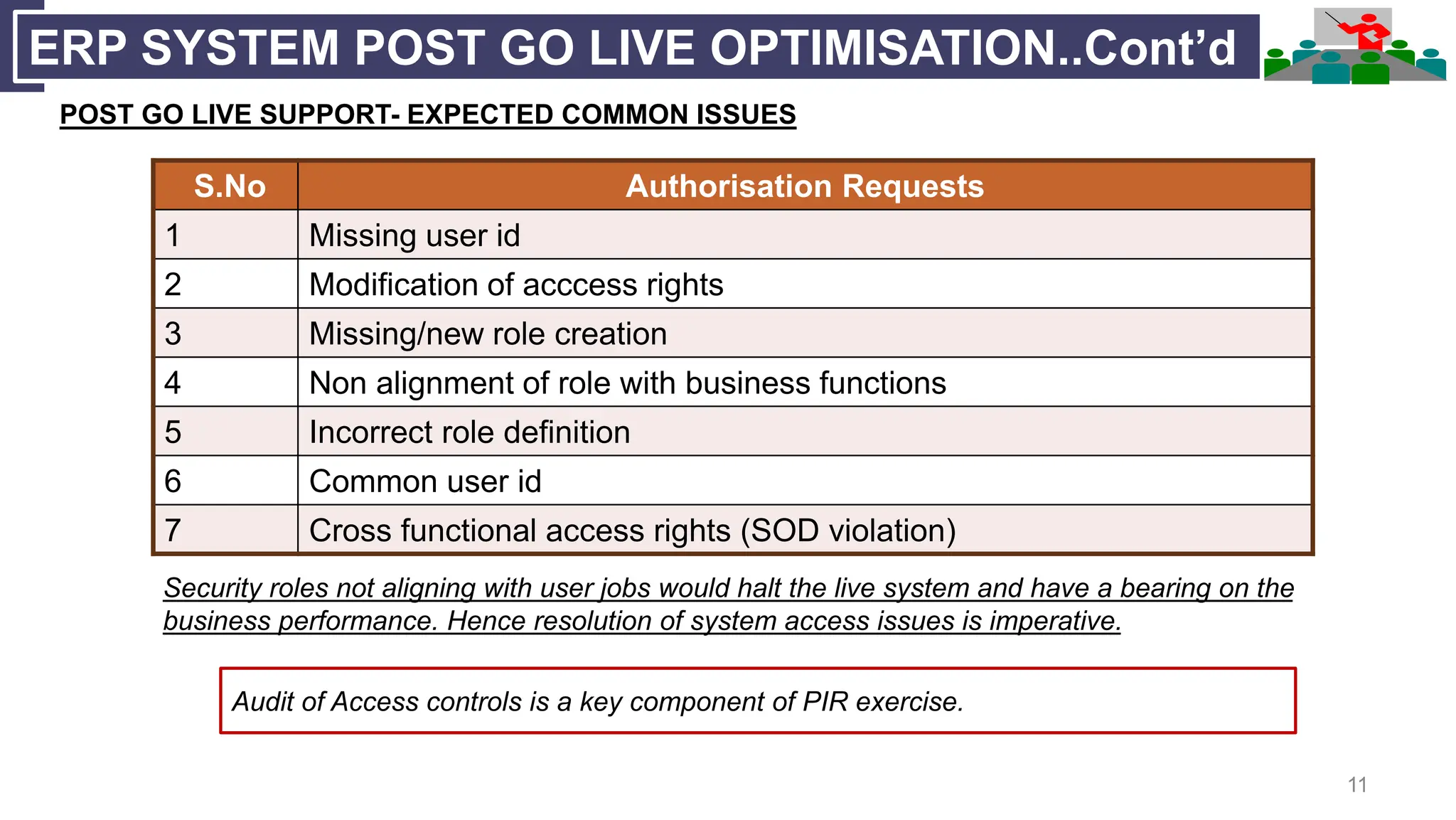
POST GO LIVE SUPPORT- EXPECTED COMMON ISSUES
S.No Authorisation Requests
1 Missing user id
2 Modification of acccess rights
3 Missing/new role creation
4 Non alignment of role with business functions
5 Incorrect role definition
6 Common user id
7 Cross functional access rights (SOD violation)
Security roles not aligning with user jobs would halt the live system and have a bearing on the
business performance. Hence resolution of system access issues is imperative.
Audit of Access controls is a key component of PIR exercise.
12
ERP SYSTEM POST GO LIVE OPTIMISATION..Cont’d
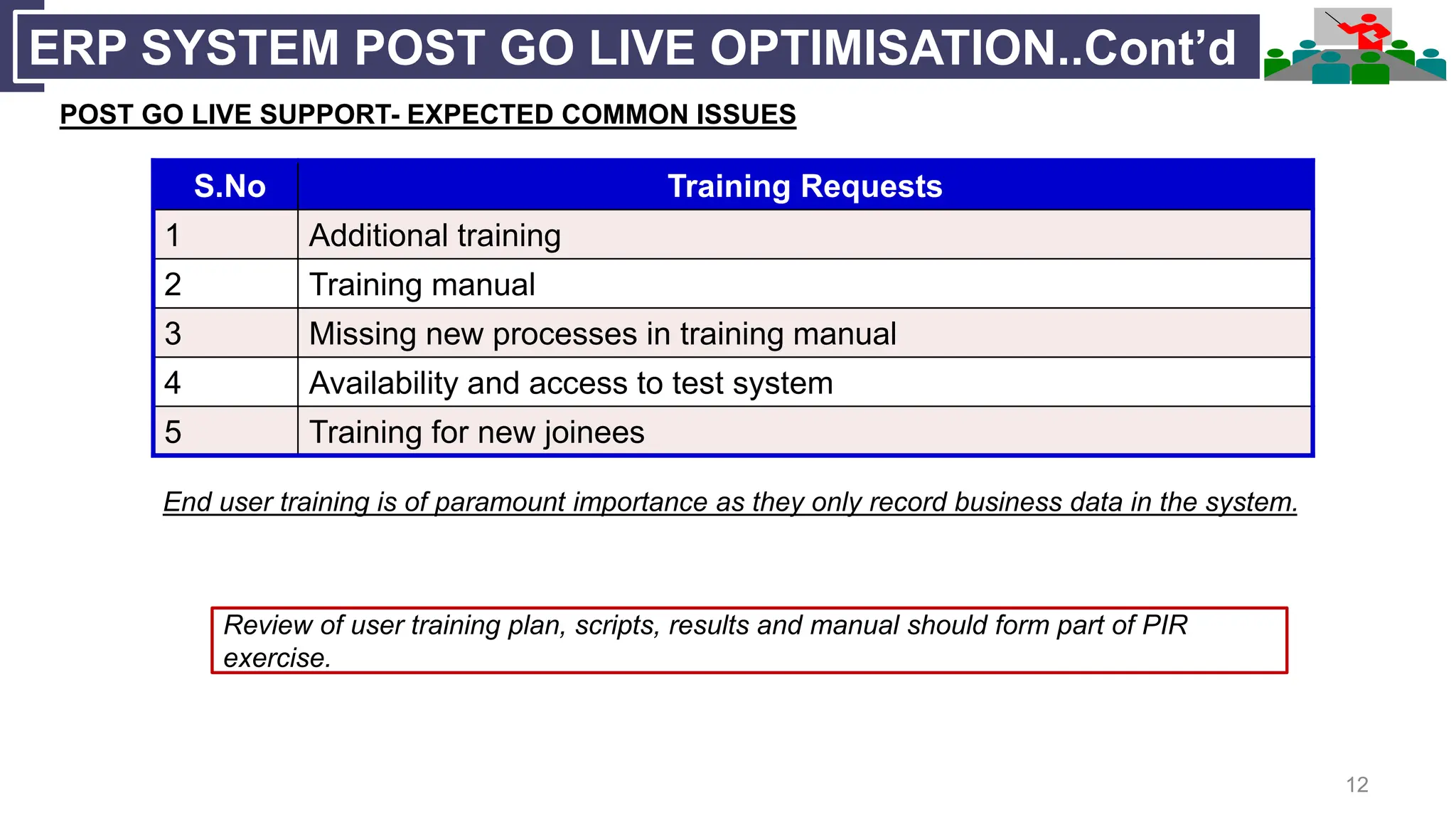
POST GO LIVE SUPPORT- EXPECTED COMMON ISSUES
S.No Training Requests
1 Additional training
2 Training manual
3 Missing new processes in training manual
4 Availability and access to test system
5 Training for new joinees
End user training is of paramount importance as they only record business data in the system.
Review of user training plan, scripts, results and manual should form part of PIR
exercise.
13
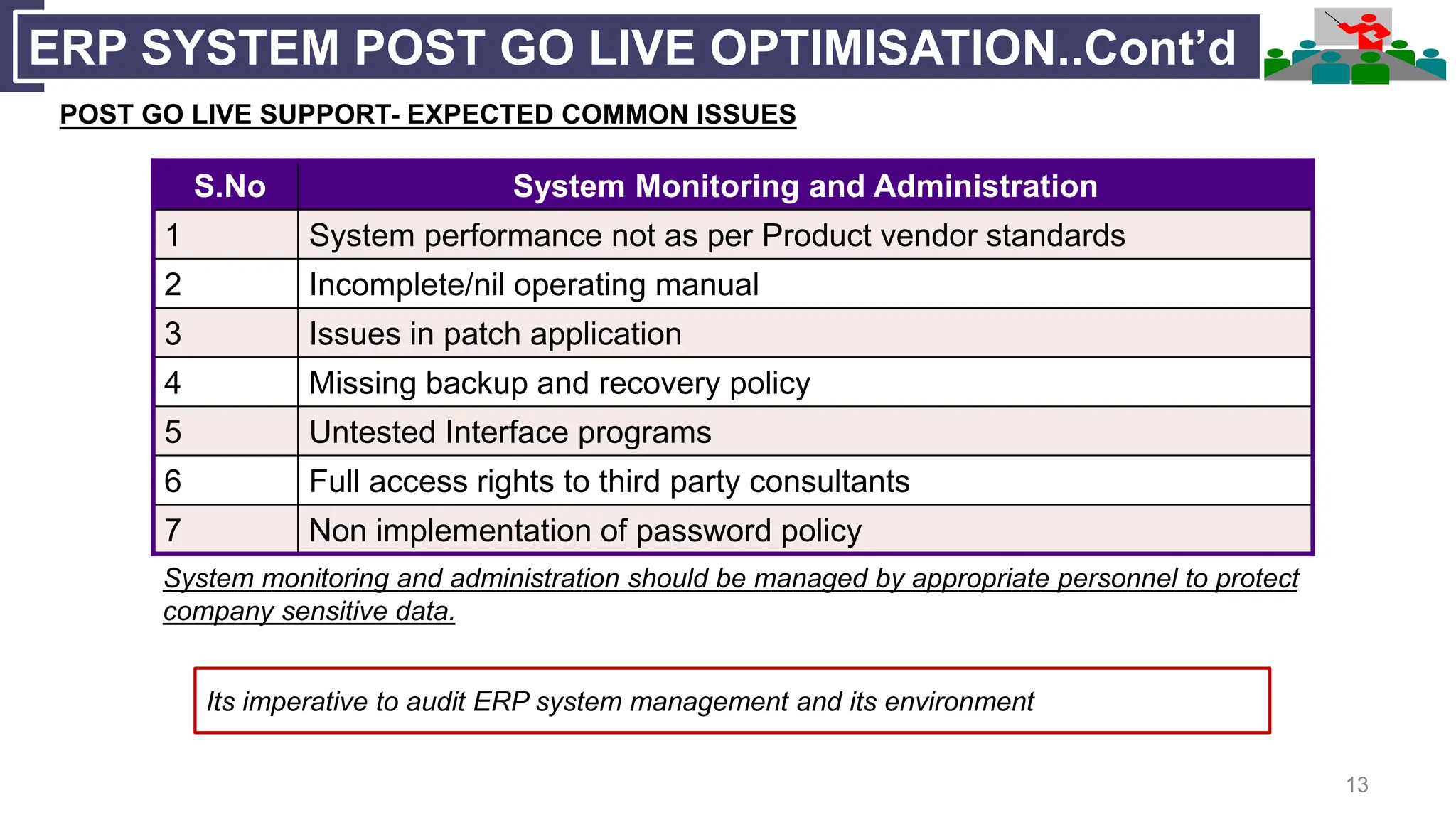
ERP SYSTEM POST GO LIVE OPTIMISATION..Cont’d
POST GO LIVE SUPPORT- EXPECTED COMMON ISSUES
S.No System Monitoring and Administration
1 System performance not as per Product vendor standards
2 Incomplete/nil operating manual
3 Issues in patch application
4 Missing backup and recovery policy
5 Untested Interface programs
6 Full access rights to third party consultants
7 Non implementation of password policy
System monitoring and administration should be managed by appropriate personnel to protect
company sensitive data.
Its imperative to audit ERP system management and its environment
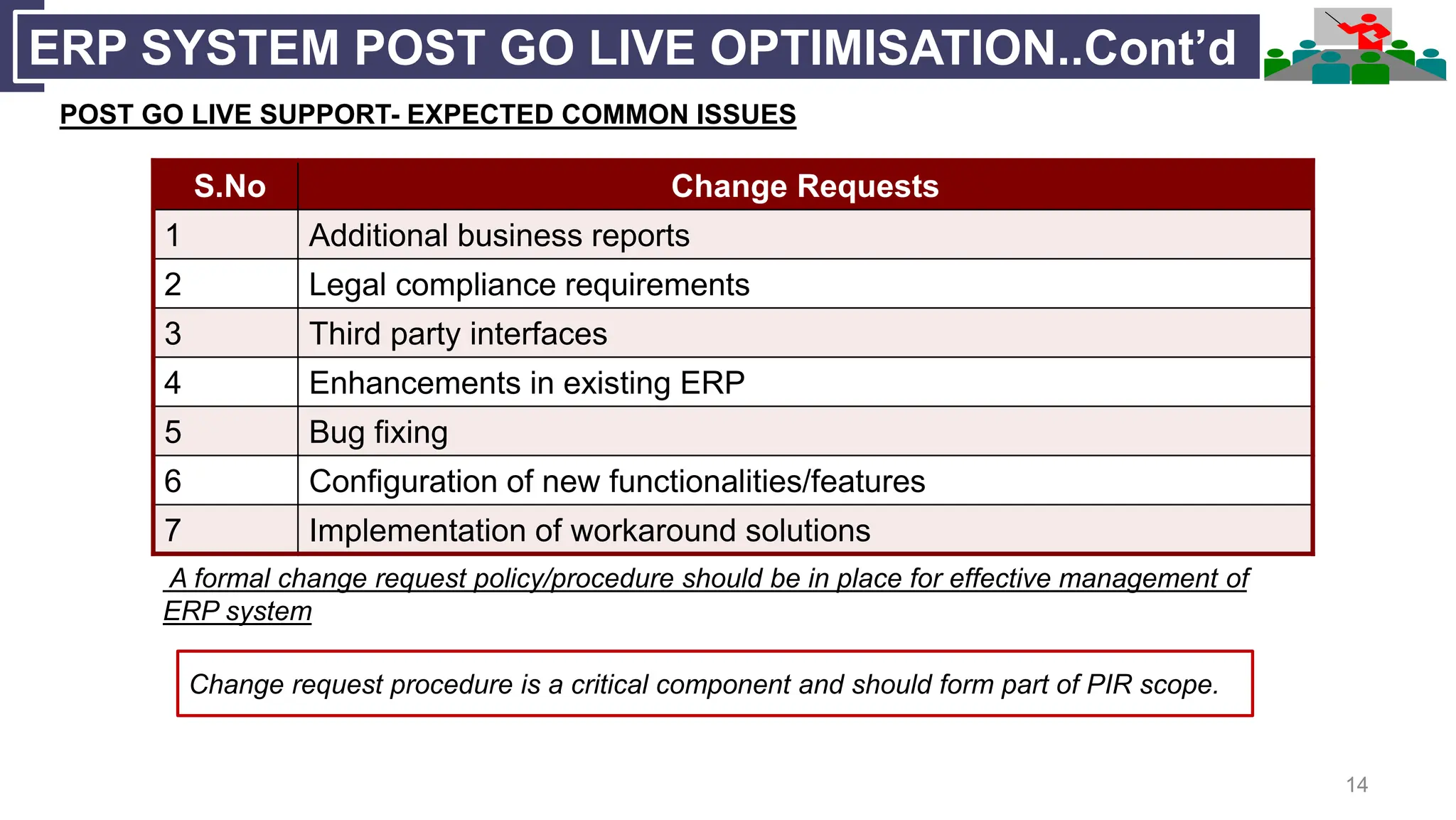
14
ERP SYSTEM POST GO LIVE OPTIMISATION..Cont’d
POST GO LIVE SUPPORT- EXPECTED COMMON ISSUES
S.No Change Requests
1 Additional business reports
2 Legal compliance requirements
3 Third party interfaces
4 Enhancements in existing ERP
5 Bug fixing
6 Configuration of new functionalities/features
7 Implementation of workaround solutions
A formal change request policy/procedure should be in place for effective management of
ERP system
Change request procedure is a critical component and should form part of PIR scope.
SAP POST GO LIVE REVIEW (PIR)
Contd…Part-
4

ERP SYSTEM POST IMPLEMENTATION AUDIT_TRNG_May,2023 - Part-3.pptx

  • 1.
  • 2.
    2 PROJECT CRITICAL PHASES Discovery and planning  Design  Development  Testing  Deployment  Support Implementation Methodology
  • 3.
    3 PROJECT CRITICAL PHASE…Cont’d Project Preparation Blueprint Realisation IMPLEMENTATION METHODLOGY- TRADITIONAL Final Preparation Go Live & Support Management Vision Project Team Project Plan Project Activities As-is & To-be GAP Analysis Change Mgmt Configuration Customisation Unit & Integration Testing UAT End-User Training Data Cleansing Cut-Over Planning System Release Hyper care Center of Excellence CURRENT METHODLOGY Discover Prepare Explore Realise Deploy Run A Template driven and faster implementation Methodology
  • 4.
    4 ERP SYSTEM GOLIVE CONCEPT WHAT IS GO-LIVE FOR IMPLEMENTATION PARTNER? ► One of the goals of the project and merely a beginning of what may well be a 25-year (say) ERP System lifespan ► Transition from a test environment to a production environment ► A test for ERP System pre go live activities ► A formal culmination of months of groundwork, project planning,preparation, execution, monitoring and controls involving a company’s internal and external stakeholders ► A most crucial milestone in an ERP implementation ► Use of System in a real environment with real data process
  • 5.
    5 ERP SYSTEM POSTGO LIVE CONCEPT…cont’d  An automated environment designed to address Organisation’s Objectives  A live system to drive the business operations on a day to day basis  A change from legacy way of working  An opportunity for sunsetting legacy systems  A step towards business enhancements  Bringing in efficiency and transparency in business processes  An Initiation for system ownership transfer The __________ team is the owner of the application & ___________ team is the owner of the data. IT/ BUSINESS WHAT IS GO-LIVE FOR AN ORGANISATION
  • 6.
    6 ERP SYSTEM POSTGO LIVE OPTIMISATION Step 01: SAP System Live Step 02: Post Go Live Optimisation
  • 7.
    7 ERP SYSTEM POSTGO LIVE OPTIMISATION A CRITICAL PHASE (often overlooked)  Key to System stabilisation  Vital for User acceptance  Significant for data reliability  Important for meaningful analysis of data  Central for System Management (In-house/External)  Crucial for System Ownership (IT to Users) transfer  Imperative for Management decisions
  • 8.
    8 ERP SYSTEM POSTGO LIVE OPTIMISATION..Cont’d KEY ACTIVITIES  Deployment of strong post go live support team  Proactive measurement of System Performance  Monitoring of issue logs  Timely resolution of user issues  Use of Change Management Champions  Identification of Training needs  Establishment of Communication platform (for User feedback)  Suspension of Legacy system, if required  Scanning opportunities for Improvements, etc
  • 9.
    ERP SYSTEM POSTGO LIVE OPTIMISATION….Cont’d SUPPORT STRATEGY Power Users & Core Team Hot fixes ( not touching the code ) Work around ( not touching code ) Expert consultancy ( not touching code ) Product Engineering Group Bug fixing ( within SLA boundary ) including unit testing - limited code change ( Development / UT / Regression Test / Release ) Functional Enhancement critical Product Management Group (Create Road Map) Interact with application owner for Functional Enhancement Interact with Product vendor for Product Roadmap Input from Product vendor on Patch release etc User User User User User User Level 1 Level 2 Level 3
  • 10.
    10 ERP SYSTEM POSTGO LIVE OPTIMISATION..Cont’d POST GO LIVE SUPPORT- EXPECTED COMMON ISSUES S.No User Queries 1 Difficulty in System navigation 2 Wrong Data input (key in) 3 System performance slow/not per expectation 4 Unable to execute reports 5 Incorrect/redundant masters 6 Unmapped business processes 7 Incomplete data migration Timely resolution of issues is critical for user acceptance of the system. Post implementation review of the ERP system should assess the severity of such issues
  • 11.
    11 ERP SYSTEM POSTGO LIVE OPTIMISATION..Cont’d POST GO LIVE SUPPORT- EXPECTED COMMON ISSUES S.No Authorisation Requests 1 Missing user id 2 Modification of acccess rights 3 Missing/new role creation 4 Non alignment of role with business functions 5 Incorrect role definition 6 Common user id 7 Cross functional access rights (SOD violation) Security roles not aligning with user jobs would halt the live system and have a bearing on the business performance. Hence resolution of system access issues is imperative. Audit of Access controls is a key component of PIR exercise.
  • 12.
    12 ERP SYSTEM POSTGO LIVE OPTIMISATION..Cont’d POST GO LIVE SUPPORT- EXPECTED COMMON ISSUES S.No Training Requests 1 Additional training 2 Training manual 3 Missing new processes in training manual 4 Availability and access to test system 5 Training for new joinees End user training is of paramount importance as they only record business data in the system. Review of user training plan, scripts, results and manual should form part of PIR exercise.
  • 13.
    13 ERP SYSTEM POSTGO LIVE OPTIMISATION..Cont’d POST GO LIVE SUPPORT- EXPECTED COMMON ISSUES S.No System Monitoring and Administration 1 System performance not as per Product vendor standards 2 Incomplete/nil operating manual 3 Issues in patch application 4 Missing backup and recovery policy 5 Untested Interface programs 6 Full access rights to third party consultants 7 Non implementation of password policy System monitoring and administration should be managed by appropriate personnel to protect company sensitive data. Its imperative to audit ERP system management and its environment
  • 14.
    14 ERP SYSTEM POSTGO LIVE OPTIMISATION..Cont’d POST GO LIVE SUPPORT- EXPECTED COMMON ISSUES S.No Change Requests 1 Additional business reports 2 Legal compliance requirements 3 Third party interfaces 4 Enhancements in existing ERP 5 Bug fixing 6 Configuration of new functionalities/features 7 Implementation of workaround solutions A formal change request policy/procedure should be in place for effective management of ERP system Change request procedure is a critical component and should form part of PIR scope.
  • 15.
    SAP POST GOLIVE REVIEW (PIR) Contd…Part- 4

Editor's Notes

  • #5 Go live in simple terms is release of live system to end users.
  • #10 9
  • #16 Logging on to the SAP R/3 system.