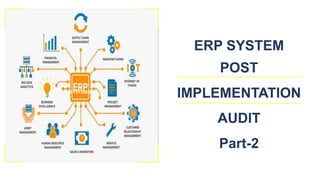
ERP SYSTEM
POST
IMPLEMENTATION
AUDIT
Part-2
SYSTEMS
2
ERP SYSTEM IMPLEMENTATON…cont’d
IMPLEMENTATION STEPS
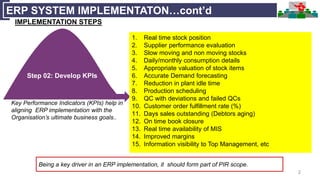
Step 02: Develop KPIs
Key Performance Indicators (KPIs) help in
aligning ERP implementation with the
Organisation’s ultimate business goals..
1. Real time stock position
2. Supplier performance evaluation
3. Slow moving and non moving stocks
4. Daily/monthly consumption details
5. Appropriate valuation of stock items
6. Accurate Demand forecasting
7. Reduction in plant idle time
8. Production scheduling
9. QC with deviations and failed QCs
10. Customer order fulfillment rate (%)
11. Days sales outstanding (Debtors aging)
12. On time book closure
13. Real time availability of MIS
14. Improved margins
15. Information visibility to Top Management, etc
Being a key driver in an ERP implementation, it should form part of PIR scope.
3
ERP SYSTEM IMPLEMENTATON…cont’d
IMPLEMENTATION STEPS
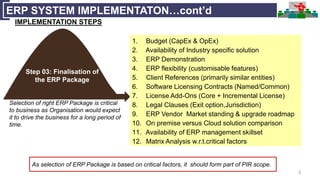
Step 03: Finalisation of
the ERP Package
Selection of right ERP Package is critical
to business as Organisation would expect
it to drive the business for a long period of
time.
1. Budget (CapEx & OpEx)
2. Availability of Industry specific solution
3. ERP Demonstration
4. ERP flexibility (customisable features)
5. Client References (primarily similar entities)
6. Software Licensing Contracts (Named/Common)
7. License Add-Ons (Core + Incremental License)
8. Legal Clauses (Exit option,Jurisdiction)
9. ERP Vendor Market standing & upgrade roadmap
10. On premise versus Cloud solution comparison
11. Availability of ERP management skillset
12. Matrix Analysis w.r.t.critical factors
As selection of ERP Package is based on critical factors, it should form part of PIR scope.
4
ERP SYSTEM IMPLEMENTATON…cont’d
IMPLEMENTATION STEPS
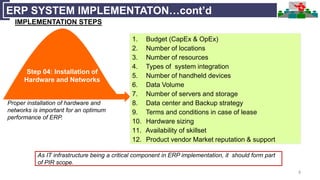
Step 04: Installation of
Hardware and Networks
Proper installation of hardware and
networks is important for an optimum
performance of ERP.
1. Budget (CapEx & OpEx)
2. Number of locations
3. Number of resources
4. Types of system integration
5. Number of handheld devices
6. Data Volume
7. Number of servers and storage
8. Data center and Backup strategy
9. Terms and conditions in case of lease
10. Hardware sizing
11. Availability of skillset
12. Product vendor Market reputation & support
As IT infrastructure being a critical component in ERP implementation, it should form part
of PIR scope.
5
ERP SYSTEM IMPLEMENTATON…cont’d
IMPLEMENTATION STEPS
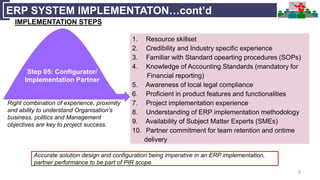
Step 05: Configurator/
Implementation Partner
Right combination of experience, proximity
and ability to understand Organisation’s
business, politics and Management
objectives are key to project success.
1. Resource skillset
2. Credibility and Industry specific experience
3. Familiar with Standard opearting procedures (SOPs)
4. Knowledge of Accounting Standards (mandatory for
Financial reporting)
5. Awareness of local legal compliance
6. Proficient in product features and functionalities
7. Project implementation experience
8. Understanding of ERP implementation methodology
9. Availability of Subject Matter Experts (SMEs)
10. Partner commitment for team retention and ontime
delivery
Accurate solution design and configuration being imperative in an ERP implementation,
partner performance to be part of PIR scope.
6
ERP SYSTEM IMPLEMENTATON…cont’d
IMPLEMENTATION STEPS
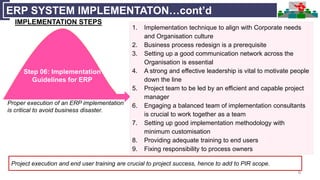
Step 06: Implementation
Guidelines for ERP
Proper execution of an ERP implementation
is critical to avoid business disaster.
1. Implementation technique to align with Corporate needs
and Organisation culture
2. Business process redesign is a prerequisite
3. Setting up a good communication network across the
Organisation is essential
4. A strong and effective leadership is vital to motivate people
down the line
5. Project team to be led by an efficient and capable project
manager
6. Engaging a balanced team of implementation consultants
is crucial to work together as a team
7. Setting up good implementation methodology with
minimum customisation
8. Providing adequate training to end users
9. Fixing responsibility to process owners
Project execution and end user training are crucial to project success, hence to add to PIR scope.
7
ERP SYSTEM IMPLEMENTATON…cont’d
IMPLEMENTATION STEPS
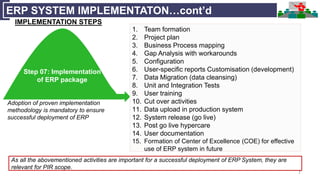
Step 07: Implementation
of ERP package
Adoption of proven implementation
methodology is mandatory to ensure
successful deployment of ERP
1. Team formation
2. Project plan
3. Business Process mapping
4. Gap Analysis with workarounds
5. Configuration
6. User-specific reports Customisation (development)
7. Data Migration (data cleansing)
8. Unit and Integration Tests
9. User training
10. Cut over activities
11. Data upload in production system
12. System release (go live)
13. Post go live hypercare
14. User documentation
15. Formation of Center of Excellence (COE) for effective
use of ERP system in future
As all the abovementioned activities are important for a successful deployment of ERP System, they are
relevant for PIR scope.
8
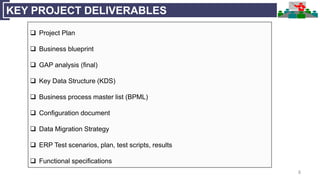
KEY PROJECT DELIVERABLES
 Project Plan
 Business blueprint
 GAP analysis (final)
 Key Data Structure (KDS)
 Business process master list (BPML)
 Configuration document
 Data Migration Strategy
 ERP Test scenarios, plan, test scripts, results
 Functional specifications
9
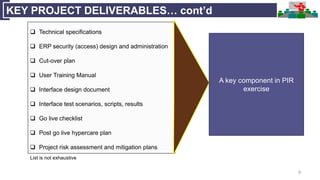
KEY PROJECT DELIVERABLES… cont’d
 Technical specifications
 ERP security (access) design and administration
 Cut-over plan
 User Training Manual
 Interface design document
 Interface test scenarios, scripts, results
 Go live checklist
 Post go live hypercare plan
 Project risk assessment and mitigation plans
List is not exhaustive
A key component in PIR
exercise
10
KEY PROJECT DELIVERABLES….cont’d
► A roadmap in an ERP project
► Represents project milestones
► Helps in tracking the project path
► Aids in remedial action in case of project blips
► Signals cut-off of a project milestone
► Bridges the gap between Management expectations and reality
► Identifies individual project goals along the way to go live
In short, deliverables determine the quality of project outcome and success.
:
SIGNIFICANCE OF PROJECT DELIVERABLES
SAP POST GO LIVE REVIEW (PIR)
Contd….Part
-3

ERP SYSTEM POST IMPLEMENTATION AUDIT_TRNG_May,2023 - Part-2.pptx

  • 1.
  • 2.
    2 ERP SYSTEM IMPLEMENTATON…cont’d IMPLEMENTATIONSTEPS Step 02: Develop KPIs Key Performance Indicators (KPIs) help in aligning ERP implementation with the Organisation’s ultimate business goals.. 1. Real time stock position 2. Supplier performance evaluation 3. Slow moving and non moving stocks 4. Daily/monthly consumption details 5. Appropriate valuation of stock items 6. Accurate Demand forecasting 7. Reduction in plant idle time 8. Production scheduling 9. QC with deviations and failed QCs 10. Customer order fulfillment rate (%) 11. Days sales outstanding (Debtors aging) 12. On time book closure 13. Real time availability of MIS 14. Improved margins 15. Information visibility to Top Management, etc Being a key driver in an ERP implementation, it should form part of PIR scope.
  • 3.
    3 ERP SYSTEM IMPLEMENTATON…cont’d IMPLEMENTATIONSTEPS Step 03: Finalisation of the ERP Package Selection of right ERP Package is critical to business as Organisation would expect it to drive the business for a long period of time. 1. Budget (CapEx & OpEx) 2. Availability of Industry specific solution 3. ERP Demonstration 4. ERP flexibility (customisable features) 5. Client References (primarily similar entities) 6. Software Licensing Contracts (Named/Common) 7. License Add-Ons (Core + Incremental License) 8. Legal Clauses (Exit option,Jurisdiction) 9. ERP Vendor Market standing & upgrade roadmap 10. On premise versus Cloud solution comparison 11. Availability of ERP management skillset 12. Matrix Analysis w.r.t.critical factors As selection of ERP Package is based on critical factors, it should form part of PIR scope.
  • 4.
    4 ERP SYSTEM IMPLEMENTATON…cont’d IMPLEMENTATIONSTEPS Step 04: Installation of Hardware and Networks Proper installation of hardware and networks is important for an optimum performance of ERP. 1. Budget (CapEx & OpEx) 2. Number of locations 3. Number of resources 4. Types of system integration 5. Number of handheld devices 6. Data Volume 7. Number of servers and storage 8. Data center and Backup strategy 9. Terms and conditions in case of lease 10. Hardware sizing 11. Availability of skillset 12. Product vendor Market reputation & support As IT infrastructure being a critical component in ERP implementation, it should form part of PIR scope.
  • 5.
    5 ERP SYSTEM IMPLEMENTATON…cont’d IMPLEMENTATIONSTEPS Step 05: Configurator/ Implementation Partner Right combination of experience, proximity and ability to understand Organisation’s business, politics and Management objectives are key to project success. 1. Resource skillset 2. Credibility and Industry specific experience 3. Familiar with Standard opearting procedures (SOPs) 4. Knowledge of Accounting Standards (mandatory for Financial reporting) 5. Awareness of local legal compliance 6. Proficient in product features and functionalities 7. Project implementation experience 8. Understanding of ERP implementation methodology 9. Availability of Subject Matter Experts (SMEs) 10. Partner commitment for team retention and ontime delivery Accurate solution design and configuration being imperative in an ERP implementation, partner performance to be part of PIR scope.
  • 6.
    6 ERP SYSTEM IMPLEMENTATON…cont’d IMPLEMENTATIONSTEPS Step 06: Implementation Guidelines for ERP Proper execution of an ERP implementation is critical to avoid business disaster. 1. Implementation technique to align with Corporate needs and Organisation culture 2. Business process redesign is a prerequisite 3. Setting up a good communication network across the Organisation is essential 4. A strong and effective leadership is vital to motivate people down the line 5. Project team to be led by an efficient and capable project manager 6. Engaging a balanced team of implementation consultants is crucial to work together as a team 7. Setting up good implementation methodology with minimum customisation 8. Providing adequate training to end users 9. Fixing responsibility to process owners Project execution and end user training are crucial to project success, hence to add to PIR scope.
  • 7.
    7 ERP SYSTEM IMPLEMENTATON…cont’d IMPLEMENTATIONSTEPS Step 07: Implementation of ERP package Adoption of proven implementation methodology is mandatory to ensure successful deployment of ERP 1. Team formation 2. Project plan 3. Business Process mapping 4. Gap Analysis with workarounds 5. Configuration 6. User-specific reports Customisation (development) 7. Data Migration (data cleansing) 8. Unit and Integration Tests 9. User training 10. Cut over activities 11. Data upload in production system 12. System release (go live) 13. Post go live hypercare 14. User documentation 15. Formation of Center of Excellence (COE) for effective use of ERP system in future As all the abovementioned activities are important for a successful deployment of ERP System, they are relevant for PIR scope.
  • 8.
    8 KEY PROJECT DELIVERABLES Project Plan  Business blueprint  GAP analysis (final)  Key Data Structure (KDS)  Business process master list (BPML)  Configuration document  Data Migration Strategy  ERP Test scenarios, plan, test scripts, results  Functional specifications
  • 9.
    9 KEY PROJECT DELIVERABLES…cont’d  Technical specifications  ERP security (access) design and administration  Cut-over plan  User Training Manual  Interface design document  Interface test scenarios, scripts, results  Go live checklist  Post go live hypercare plan  Project risk assessment and mitigation plans List is not exhaustive A key component in PIR exercise
  • 10.
    10 KEY PROJECT DELIVERABLES….cont’d ►A roadmap in an ERP project ► Represents project milestones ► Helps in tracking the project path ► Aids in remedial action in case of project blips ► Signals cut-off of a project milestone ► Bridges the gap between Management expectations and reality ► Identifies individual project goals along the way to go live In short, deliverables determine the quality of project outcome and success. : SIGNIFICANCE OF PROJECT DELIVERABLES
  • 11.
    SAP POST GOLIVE REVIEW (PIR) Contd….Part -3

Editor's Notes

  • #4 ERP Package not flexible, not robust, no presence in company’s domicile, etc would increase the risk of ERP project derailment.
  • #12 Logging on to the SAP R/3 system.