MBA(Evening)                                                                                                 lefttopWARISASIMAHMED   Project of Information TechnologyMuhammad WarisAhmad ArbabMuhammad Asim SiddiqueTalal KhalidTALALMW <br />“IN THE NAME OF ALLAH <br />THE MOST GRACIOUS THE MOST MERCIFUL”<br />Project on Information Technology:<br />Topic:<br />Report Prepared by:<br />STARGROUP <br />STAR Group:<br />Members:
Muhammad Waris
Muhammad Asim Siddique
Ahmad Arbab
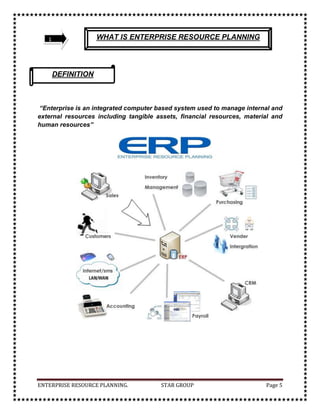
Talal KhalidContents:<br />Topics name                                                       Page #<br />1:What is ERP ? and ERP Terminology:              5 to 6<br />E-Enterprise
R-Resource
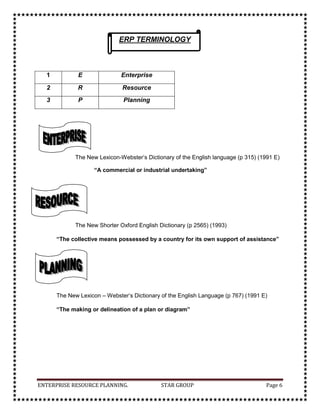
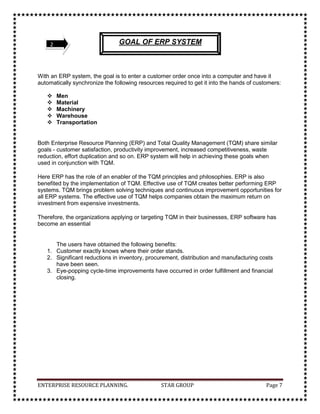
P-Planning                             2:Goal of ERP System:                              <br />3:Evolution of ERP                    <br />4:Famous Players of ERP System <br />5: Integrated ERP System<br />6: Advantages of ERP                                                           <br />7:How can ERP improve a company’s business performance?<br />8:Disadvantages of ERP<br />9: Configuration of ERP software<br />10:Tributes to ERP<br />1WHAT IS ENTERPRISE RESOURCE PLANNING<br />DEFINITION<br /> “Enterprise is an integrated computer based system used to manage internal and external resources including tangible assets, financial resources, material and human resources”<br />ERP TERMINOLOGY<br />1EEnterprise2RResource3PPlanning<br />The New Lexicon-Webster’s Dictionary of the English language (p 315) (1991 E) <br />“A commercial or industrial undertaking”<br />The New Shorter Oxford English Dictionary (p 2565) (1993)<br />“The collective means possessed by a country for its own support of assistance”<br />The New Lexicon – Webster’s Dictionary of the English Language (p 767) (1991 E) <br />“The making or delineation of a plan or diagram”<br />2GOAL OF ERP SYSTEM<br />With an ERP system, the goal is to enter a customer order once into a computer and have it automatically synchronize the following resources required to get it into the hands of customers:<br />Men
Material
Machinery
Warehouse
TransportationBoth Enterprise Resource Planning (ERP) and Total Quality Management (TQM) share similar goals - customer satisfaction, productivity improvement, increased competitiveness, waste reduction, effort duplication and so on. ERP system will help in achieving these goals when used in conjunction with TQM. <br />Here ERP has the role of an enabler of the TQM principles and philosophies. ERP is also benefited by the implementation of TQM. Effective use of TQM creates better performing ERP systems. TQM brings problem solving techniques and continuous improvement opportunities for all ERP systems. The effective use of TQM helps companies obtain the maximum return on investment from expensive investments. <br />Therefore, the organizations applying or targeting TQM in their businesses, ERP software has become an essential <br />The users have obtained the following benefits:
Customer exactly knows where their order stands.
Significant reductions in inventory, procurement, distribution and manufacturing costs have been seen.
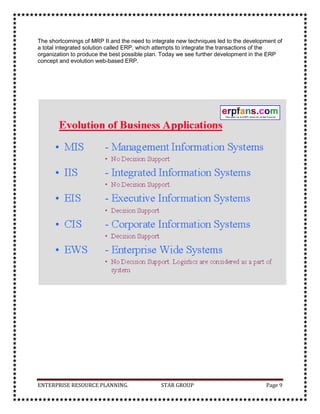
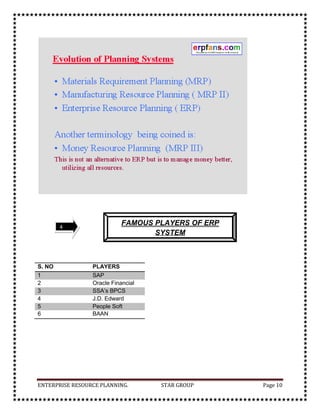
Eye-popping cycle-time improvements have occurred in order fulfillment and financial closing.3EVOLUTION OF ERP<br />ERP is an outcome of 40 years of trial and error. It has evolved as a strategic tool because of continuous improvement in the available techniques to manage business and the fast growth of information technology. <br />Prior to 1960s, business had to rely on the traditional ways of inventory management to ensure smooth functioning of the organization. These theories are called classical inventory management of scientific inventory control methods. The most popularly known amongst them is EOQ (Economic Order Quantity). <br />In this method, each item in the stock is analyzed for its ordering cost and the inventory carrying cost. A trade off is established on a phased out expected demand of one year, and this way the most economic ordering quantity can be decided. This technique in principle is a deterministic way of managing inventory. <br />Along with EOQ, we find various inventory models such as fixed order quantity, periodic order method, optional replenishment method, etc., which were in practice earlier. These theories were very popular in pre-MRP era. <br />In 1960s, a new technique of Material Requirements Planning, popularly known as MRP, was evolved. This was a proactive manner of inventory management. This technique fundamentally explodes the end product demand obtained from the Master Production Schedule (MPS) for a specified product structure (which is taken from Bill of Material) into a detailed schedule of purchase orders or production orders, taking into account the inventory on hand. MRP is a simple logic but the magnitude of data involved in a realistic situation makes it computationally cumbersome. If undertaken manually, the entire process is highly time-consuming. <br />MRP successfully demonstrated its effectiveness in reduction of inventory, production, and delivery lead times by improving coordination and avoiding delays, thus making commitments more realistic. MRP proved to be a very good technique for managing inventory, but it did not take into account other resources of an organization. In 1970s, this gave birth to a modified MRP logic, popularly known as closed loop MRP. In this technique, the capacity of the organization to produce a particular product is also taken into account by incorporating a module called capacity requirements planning (CRP). <br />In 1980s, the need was felt to integrate the financial resource with the manufacturing activities. From this evolved an integrated manufacturing management system called Manufacturing Resource Planning (MRP II). <br />Transition from MRPII to ERP happened during 1980-90. The basic MRP II system design was suffering from a few inherent drawbacks such as limited focus to manufacturing activities, assumption of the mass or repetitive production set ups, and poor budgetary and costing controls. <br />The shortcomings of MRP II and the need to integrate new techniques led to the development of a total integrated solution called ERP, which attempts to integrate the transactions of the organization to produce the best possible plan. Today we see further development in the ERP concept and evolution web-based ERP. <br />4FAMOUS PLAYERS OF ERP SYSTEM<br />S. NOPLAYERS1SAP2Oracle Financial3SSA’s BPCS4J.D. Edward5People Soft6BAAN<br />History:<br />SAP was established in 1972 and is today as the world’s 5th largest software company. SAP is the name of the company and the name of computer system. SAP is a German Company. It operates globally with 28 subsidiaries and affiliates and six partner companies maintaining offices in 40 countries. <br />Approach:<br />It provides an opportunity to replace large numbers of independent systems that have been developed and implemented in established organizations with one single modular system. Each module performs difference function. <br />Market Served:<br />SAP markets its products globally to almost every industry, Government, educational institutions, hospitals, etc.<br />SAP R/3 Applications:<br />Scope of applications includes the following:<br />Financials
Product Data Management (PDM)
Materials Management
Human Resources Management5INTEGRATED OF ERP SYSTEM<br />Verticent's back-office, Enterprise Resource Planning (ERP) solutions help streamline your manufacturing, distribution and financial operations. With Verticent ERP software solutions, your back-office moves in sync with up-to-date product, shipping, customer account and billing data distributed to all users.  <br />Classic ERP solutions tie manufacturing, distribution and finance together to work in an integrated manner. Typically, sales force automation (SFA) and customer relationship management (CRM) applications are provided by 3rd party partners via some sort of interface. Verticent's ERP systems are different. Our manufacturing, distribution and financials modules are seamlessly integrated with Verticent CRM solutions - empowering your entire company with accurate enterprise information.  <br />6ADVANTAGES OF ERP <br />ERP solutions tie the whole enterprise together by capturing and moving data harmoniously in a real-time or near real-time manner. Transactional activity is very efficient because it can be entered once and used in many different ways throughout the ERP system and the departments in your organization. The key benefit is that it puts everybody on the same page, improving operational efficiency. <br />To take advantage of what an ERP software solution delivers, data needs to be transformed into information. This can be accomplished in many ways. In fact, many organizations have benefited from business intelligence reporting solutions to help them with deployment of metrics to monitor their business and properly execute in their supply chain. <br />Some more benefits:<br />Lower inventory
Lower ordering
Lower production
Reduced fulfillment times
Reduced number of stock-outs

Erp project

  • 1.
    MBA(Evening) lefttopWARISASIMAHMED Project of Information TechnologyMuhammad WarisAhmad ArbabMuhammad Asim SiddiqueTalal KhalidTALALMW <br />“IN THE NAME OF ALLAH <br />THE MOST GRACIOUS THE MOST MERCIFUL”<br />Project on Information Technology:<br />Topic:<br />Report Prepared by:<br />STARGROUP <br />STAR Group:<br />Members:
  • 2.
  • 3.
  • 4.
  • 5.
    Talal KhalidContents:<br />Topicsname Page #<br />1:What is ERP ? and ERP Terminology: 5 to 6<br />E-Enterprise
  • 6.
  • 7.
    P-Planning 2:Goal of ERP System: <br />3:Evolution of ERP <br />4:Famous Players of ERP System <br />5: Integrated ERP System<br />6: Advantages of ERP <br />7:How can ERP improve a company’s business performance?<br />8:Disadvantages of ERP<br />9: Configuration of ERP software<br />10:Tributes to ERP<br />1WHAT IS ENTERPRISE RESOURCE PLANNING<br />DEFINITION<br /> “Enterprise is an integrated computer based system used to manage internal and external resources including tangible assets, financial resources, material and human resources”<br />ERP TERMINOLOGY<br />1EEnterprise2RResource3PPlanning<br />The New Lexicon-Webster’s Dictionary of the English language (p 315) (1991 E) <br />“A commercial or industrial undertaking”<br />The New Shorter Oxford English Dictionary (p 2565) (1993)<br />“The collective means possessed by a country for its own support of assistance”<br />The New Lexicon – Webster’s Dictionary of the English Language (p 767) (1991 E) <br />“The making or delineation of a plan or diagram”<br />2GOAL OF ERP SYSTEM<br />With an ERP system, the goal is to enter a customer order once into a computer and have it automatically synchronize the following resources required to get it into the hands of customers:<br />Men
  • 8.
  • 9.
  • 10.
  • 11.
    TransportationBoth Enterprise ResourcePlanning (ERP) and Total Quality Management (TQM) share similar goals - customer satisfaction, productivity improvement, increased competitiveness, waste reduction, effort duplication and so on. ERP system will help in achieving these goals when used in conjunction with TQM. <br />Here ERP has the role of an enabler of the TQM principles and philosophies. ERP is also benefited by the implementation of TQM. Effective use of TQM creates better performing ERP systems. TQM brings problem solving techniques and continuous improvement opportunities for all ERP systems. The effective use of TQM helps companies obtain the maximum return on investment from expensive investments. <br />Therefore, the organizations applying or targeting TQM in their businesses, ERP software has become an essential <br />The users have obtained the following benefits:
  • 12.
    Customer exactly knowswhere their order stands.
  • 13.
    Significant reductions ininventory, procurement, distribution and manufacturing costs have been seen.
  • 14.
    Eye-popping cycle-time improvementshave occurred in order fulfillment and financial closing.3EVOLUTION OF ERP<br />ERP is an outcome of 40 years of trial and error. It has evolved as a strategic tool because of continuous improvement in the available techniques to manage business and the fast growth of information technology. <br />Prior to 1960s, business had to rely on the traditional ways of inventory management to ensure smooth functioning of the organization. These theories are called classical inventory management of scientific inventory control methods. The most popularly known amongst them is EOQ (Economic Order Quantity). <br />In this method, each item in the stock is analyzed for its ordering cost and the inventory carrying cost. A trade off is established on a phased out expected demand of one year, and this way the most economic ordering quantity can be decided. This technique in principle is a deterministic way of managing inventory. <br />Along with EOQ, we find various inventory models such as fixed order quantity, periodic order method, optional replenishment method, etc., which were in practice earlier. These theories were very popular in pre-MRP era. <br />In 1960s, a new technique of Material Requirements Planning, popularly known as MRP, was evolved. This was a proactive manner of inventory management. This technique fundamentally explodes the end product demand obtained from the Master Production Schedule (MPS) for a specified product structure (which is taken from Bill of Material) into a detailed schedule of purchase orders or production orders, taking into account the inventory on hand. MRP is a simple logic but the magnitude of data involved in a realistic situation makes it computationally cumbersome. If undertaken manually, the entire process is highly time-consuming. <br />MRP successfully demonstrated its effectiveness in reduction of inventory, production, and delivery lead times by improving coordination and avoiding delays, thus making commitments more realistic. MRP proved to be a very good technique for managing inventory, but it did not take into account other resources of an organization. In 1970s, this gave birth to a modified MRP logic, popularly known as closed loop MRP. In this technique, the capacity of the organization to produce a particular product is also taken into account by incorporating a module called capacity requirements planning (CRP). <br />In 1980s, the need was felt to integrate the financial resource with the manufacturing activities. From this evolved an integrated manufacturing management system called Manufacturing Resource Planning (MRP II). <br />Transition from MRPII to ERP happened during 1980-90. The basic MRP II system design was suffering from a few inherent drawbacks such as limited focus to manufacturing activities, assumption of the mass or repetitive production set ups, and poor budgetary and costing controls. <br />The shortcomings of MRP II and the need to integrate new techniques led to the development of a total integrated solution called ERP, which attempts to integrate the transactions of the organization to produce the best possible plan. Today we see further development in the ERP concept and evolution web-based ERP. <br />4FAMOUS PLAYERS OF ERP SYSTEM<br />S. NOPLAYERS1SAP2Oracle Financial3SSA’s BPCS4J.D. Edward5People Soft6BAAN<br />History:<br />SAP was established in 1972 and is today as the world’s 5th largest software company. SAP is the name of the company and the name of computer system. SAP is a German Company. It operates globally with 28 subsidiaries and affiliates and six partner companies maintaining offices in 40 countries. <br />Approach:<br />It provides an opportunity to replace large numbers of independent systems that have been developed and implemented in established organizations with one single modular system. Each module performs difference function. <br />Market Served:<br />SAP markets its products globally to almost every industry, Government, educational institutions, hospitals, etc.<br />SAP R/3 Applications:<br />Scope of applications includes the following:<br />Financials
  • 15.
  • 16.
  • 17.
    Human Resources Management5INTEGRATEDOF ERP SYSTEM<br />Verticent's back-office, Enterprise Resource Planning (ERP) solutions help streamline your manufacturing, distribution and financial operations. With Verticent ERP software solutions, your back-office moves in sync with up-to-date product, shipping, customer account and billing data distributed to all users.  <br />Classic ERP solutions tie manufacturing, distribution and finance together to work in an integrated manner. Typically, sales force automation (SFA) and customer relationship management (CRM) applications are provided by 3rd party partners via some sort of interface. Verticent's ERP systems are different. Our manufacturing, distribution and financials modules are seamlessly integrated with Verticent CRM solutions - empowering your entire company with accurate enterprise information.  <br />6ADVANTAGES OF ERP <br />ERP solutions tie the whole enterprise together by capturing and moving data harmoniously in a real-time or near real-time manner. Transactional activity is very efficient because it can be entered once and used in many different ways throughout the ERP system and the departments in your organization. The key benefit is that it puts everybody on the same page, improving operational efficiency. <br />To take advantage of what an ERP software solution delivers, data needs to be transformed into information. This can be accomplished in many ways. In fact, many organizations have benefited from business intelligence reporting solutions to help them with deployment of metrics to monitor their business and properly execute in their supply chain. <br />Some more benefits:<br />Lower inventory
  • 18.
  • 19.
  • 20.
  • 21.