An ERP Overview:
Business Functions
& Business Processes
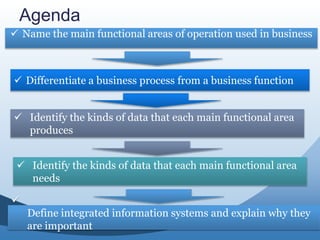
Agenda
 Identify the kinds of data that each main functional area
needs
 Name the main functional areas of operation used in business
 Differentiate a business process from a business function
 Identify the kinds of data that each main functional area
produces

Define integrated information systems and explain why they
are important
3
Introduction
Enterprise Resource Planning (ERP) programs:
• Core software used by companies to coordinate
information in every area of business
• Help manage companywide business processes
• Use common database and shared management
reporting tools
Business process: Collection of activities that
takes some input and creates an output that is of
value to the customer
Functional Areas and Business Processes
To understand ERP, you must understand
• How a business works
• Functional areas of operation
• Business processes
4
5
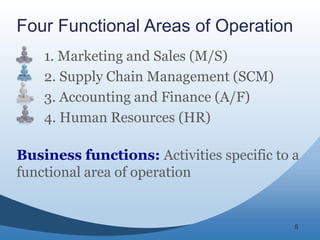
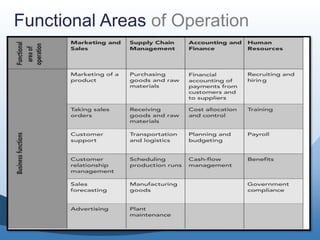
Four Functional Areas of Operation
1. Marketing and Sales (M/S)
2. Supply Chain Management (SCM)
3. Accounting and Finance (A/F)
4. Human Resources (HR)
Business functions: Activities specific to a
functional area of operation
Functional Areas of Operation
7
Functional Areas of Operation
• Functional areas are interdependent
Each requires data from the others
• Better integration of functional areas leads to
improvements in communication, workflow,
and success of company
Information system (IS): Computers,
people, procedures, and software that store,
organize, and deliver information
8
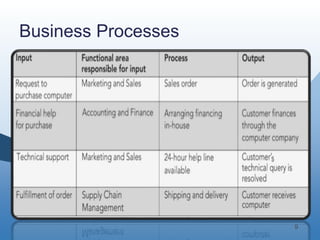
Business Processes
Collection of activities that takes one or more
kinds of input and creates an output that is of
value to customer
• Customer can be traditional external
customer or internal customer
• Thinking in terms of business processes
helps managers to look at their
organization from the customer’s
perspective
9
Business Processes
10
Business Processes
• Businesses must always consider customer’s
viewpoint in any transaction
Successful customer interaction
• Customer (either internal or external) is not
required to interact with each business function
involved in the process
Successful business managers view
business operations from the perspective of
a satisfied customer
11
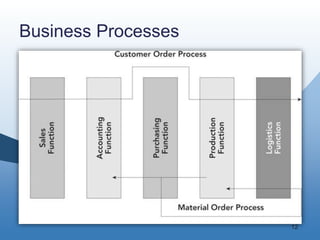
Business Processes
Sharing data effectively and efficiently between
and within functional areas leads to more efficient
business processes
Integrated information systems:
Systems in which functional areas share data
12
Business Processes
13
Business Processes
• Businesses take inputs (resources)
and transform these inputs into
goods and services for customers
Inputs: Material, people, equipment
• Managing inputs and business
processes effectively requires
accurate and up-to-date information
14
Marketing and Sales
Functions of Marketing and Sales
• Developing products
• Determining pricing
• Promoting products to customers
• Taking customers’ orders
• Helping create a sales forecast
15
Marketing and Sales
• Need to keep track of customers
• Product development
• Good repeat customers allowed to
charge purchases—up to a point
• Records must show how much each
customer owes and his or her
available credit
16
Supply Chain Management
Functions within Supply Chain Management
• Making stuff (manufacturing/production)
• Buying raw materials (purchasing)
• Production planning requires sales forecasts from
M/S functional area
Sales forecasts: Analyses that attempt to predict
the future sales of a product
17
Supply Chain Management
• Production plans are used to develop
requirements for raw materials and packaging
• Raw materials: Bottled spring water, fresh
lemons, artificial sweetener, raw sugar
• Packaging: Cups, straws, napkins
• SCM and M/S must choose a recipe for each
product sold
18
Accounting and Finance
Functions within Accounting and Finance
• Recording raw data about transactions
(including sales), raw material purchases,
payroll, and receipt of cash from customers
Raw data: Numbers collected from those
operations, without any manipulation,
calculation, or arrangement for presentation
19
Accounting and Finance
Data from Accounting and Finance used by
Marketing and Sales and Supply Chain
Management
20
Human Resources
Functions of Human Resources
• Recruit, train, evaluate, and compensate
employees
• HR uses sales forecasts developed by the
individual departments to plan personnel
needs
• Systems integrated using ERP software
provide the data sharing necessary
between functional areas
21
Functional Area Information Systems
• Potential inputs and outputs for each functional
area described next
• Note the kinds of data needed by each area and
how people use the data
• Information systems maintain relationships
between all functional areas and processes
22
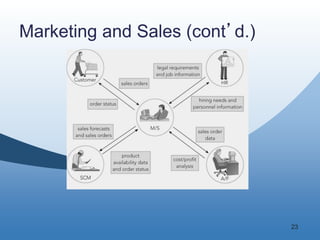
Marketing and Sales
• Needs information from all other functional
areas
• Customers communicate orders to M/S in
person or by telephone, e-mail, fax, the Web, etc.
• M/S has a role in determining product prices
• Pricing might be determined based on a
product’s unit cost, plus some percentage
markup
• Requires information from Accounting and
Finance, and Supply Chain Management data
23
Marketing and Sales (cont’d.)
24
Marketing and Sales
M/S needs to interact with Human Resources to
exchange information on hiring needs, legal
requirements, etc.
Inputs for M/S
• Customer data
• Order data
• Sales trend data
• Per-unit cost
• Travel expense company policy
25
Marketing and Sales
Outputs for M/S
• Sales strategies
• Product pricing
• Employment needs
26
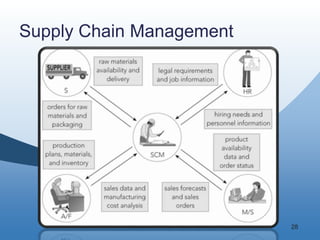
Supply Chain Management
Needs information from various functional areas
Production plans based on information about product sales
(actual and projected) that comes from Marketing and
Sales
With accurate data about required production levels:
Raw material and packaging can be ordered as needed
Inventory levels can be kept low, saving money
27
Supply Chain Management
Supply Chain Management data and records can:
• Provide data needed by Accounting and Finance
to determine how much of each resource was
used
• Support the M/S function by providing
information about what has been produced and
shipped
• Supply Chain Management interacts in some
ways with Human Resources
28
Supply Chain Management
29
Supply Chain Management
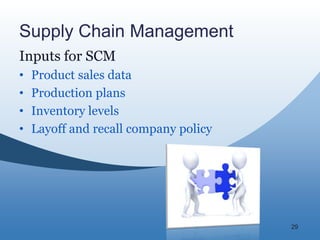
Inputs for SCM
• Product sales data
• Production plans
• Inventory levels
• Layoff and recall company policy
30
Supply Chain Management
Outputs for SCM
• Raw material orders
• Packaging orders
• Resource expenditure data
• Production and inventory reports
• Hiring information
31
Accounting and Finance
Needs information from all other functional areas
A/F personnel:
• Record company’s transactions in the books of
account
• Record accounts payable when raw materials are
purchased and cash outflows when they pay for
materials
• Summarize transaction data to prepare reports
about company’s financial position and
profitability
32
Accounting and Finance
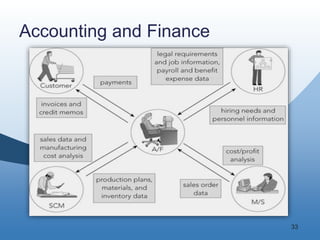
• People in other functional areas provide data to A/F
• M/S provides sales data
• SCM provides production and inventory data
• HR provides payroll and benefit expense data
• M/S personnel require data from A/F to evaluate
customer credit
33
Accounting and Finance
34
Accounting and Finance
Inputs for A/F
• Payments from customers
• Accounts receivable data
• Accounts payable data
• Sales data
• Production and inventory data
• Payroll and expense data
35
Accounting and Finance
Outputs for A/F
• Payments to suppliers
• Financial reports
• Customer credit data
36
Human Resources
HR needs information from the other
departments
• Tasks related to employee hiring, benefits, training,
and government compliance are all responsibilities
of HR
• HR needs accurate forecasts of personnel needs
from all functional units
• HR needs to know what skills are needed to
perform a particular job and how much the
company can afford to pay employees
37
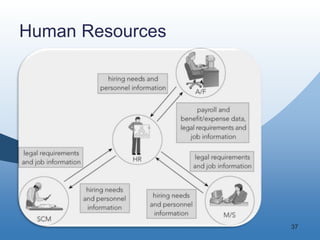
Human Resources
38
Human Resources
Observing governmental regulations in
recruiting, training, compensating,
promoting, and terminating employees
Inputs for HR
• Personnel forecasts
• Skills data
39
Human Resources
Outputs for HR
• Regulation compliance
• Employee training and
certification
• Skills database
• Employee evaluation and
compensation
40
Human Resources
Significant amount of data is maintained by and
shared among the functional areas
• Timeliness and accuracy of these data critical to
each area’s success and to company’s ability to
make a profit and generate future growth
• ERP software allows all functional areas to share
a common database
• Allows accurate, real-time information to be
available
41
Summary
• Basic functional areas: Marketing and Sales,
Supply Chain Management, Accounting and
Finance, and Human Resources
• Marketing and Sales: Sets product prices, promotes
products through advertising and marketing, takes
customer orders, supports customers, and creates sales
forecasts
• Supply Chain Management: Develops production
plans, orders raw materials from suppliers, receives raw
material, manufactures products, maintains facilities,
and ships products to customers
42
Summary (cont’d.)
• Accounting and Finance: Financial accounting to
provide summaries of operational data in managerial
reports, controlling accounts, planning and budgeting,
and cash-flow management
• Human Resources: Recruits, hires, trains, and
compensates employees, ensures compliance with
government regulations, and oversees the evaluation of
employees
• Information systems capture, process, and store data to
provide information needed for decision making
43
Summary
• Employees working in one functional area need
data from employees in other functional areas
• Functional area information systems should be
integrated, so shared data are accurate and
timely
• Managers think in terms of business processes
that integrate the functional areas
• Need to share information between functions
and functional areas
• ERP software provides this capability by means
of a single common database
Please contact us:
Info.dionov.com
Questions?
More Information?
Implementing ERP in your company ?

ERP Presentation

  • 1.
    An ERP Overview: BusinessFunctions & Business Processes
  • 2.
    Agenda  Identify thekinds of data that each main functional area needs  Name the main functional areas of operation used in business  Differentiate a business process from a business function  Identify the kinds of data that each main functional area produces  Define integrated information systems and explain why they are important
  • 3.
    3 Introduction Enterprise Resource Planning(ERP) programs: • Core software used by companies to coordinate information in every area of business • Help manage companywide business processes • Use common database and shared management reporting tools Business process: Collection of activities that takes some input and creates an output that is of value to the customer
  • 4.
    Functional Areas andBusiness Processes To understand ERP, you must understand • How a business works • Functional areas of operation • Business processes 4
  • 5.
    5 Four Functional Areasof Operation 1. Marketing and Sales (M/S) 2. Supply Chain Management (SCM) 3. Accounting and Finance (A/F) 4. Human Resources (HR) Business functions: Activities specific to a functional area of operation
  • 6.
  • 7.
    7 Functional Areas ofOperation • Functional areas are interdependent Each requires data from the others • Better integration of functional areas leads to improvements in communication, workflow, and success of company Information system (IS): Computers, people, procedures, and software that store, organize, and deliver information
  • 8.
    8 Business Processes Collection ofactivities that takes one or more kinds of input and creates an output that is of value to customer • Customer can be traditional external customer or internal customer • Thinking in terms of business processes helps managers to look at their organization from the customer’s perspective
  • 9.
  • 10.
    10 Business Processes • Businessesmust always consider customer’s viewpoint in any transaction Successful customer interaction • Customer (either internal or external) is not required to interact with each business function involved in the process Successful business managers view business operations from the perspective of a satisfied customer
  • 11.
    11 Business Processes Sharing dataeffectively and efficiently between and within functional areas leads to more efficient business processes Integrated information systems: Systems in which functional areas share data
  • 12.
  • 13.
    13 Business Processes • Businessestake inputs (resources) and transform these inputs into goods and services for customers Inputs: Material, people, equipment • Managing inputs and business processes effectively requires accurate and up-to-date information
  • 14.
    14 Marketing and Sales Functionsof Marketing and Sales • Developing products • Determining pricing • Promoting products to customers • Taking customers’ orders • Helping create a sales forecast
  • 15.
    15 Marketing and Sales •Need to keep track of customers • Product development • Good repeat customers allowed to charge purchases—up to a point • Records must show how much each customer owes and his or her available credit
  • 16.
    16 Supply Chain Management Functionswithin Supply Chain Management • Making stuff (manufacturing/production) • Buying raw materials (purchasing) • Production planning requires sales forecasts from M/S functional area Sales forecasts: Analyses that attempt to predict the future sales of a product
  • 17.
    17 Supply Chain Management •Production plans are used to develop requirements for raw materials and packaging • Raw materials: Bottled spring water, fresh lemons, artificial sweetener, raw sugar • Packaging: Cups, straws, napkins • SCM and M/S must choose a recipe for each product sold
  • 18.
    18 Accounting and Finance Functionswithin Accounting and Finance • Recording raw data about transactions (including sales), raw material purchases, payroll, and receipt of cash from customers Raw data: Numbers collected from those operations, without any manipulation, calculation, or arrangement for presentation
  • 19.
    19 Accounting and Finance Datafrom Accounting and Finance used by Marketing and Sales and Supply Chain Management
  • 20.
    20 Human Resources Functions ofHuman Resources • Recruit, train, evaluate, and compensate employees • HR uses sales forecasts developed by the individual departments to plan personnel needs • Systems integrated using ERP software provide the data sharing necessary between functional areas
  • 21.
    21 Functional Area InformationSystems • Potential inputs and outputs for each functional area described next • Note the kinds of data needed by each area and how people use the data • Information systems maintain relationships between all functional areas and processes
  • 22.
    22 Marketing and Sales •Needs information from all other functional areas • Customers communicate orders to M/S in person or by telephone, e-mail, fax, the Web, etc. • M/S has a role in determining product prices • Pricing might be determined based on a product’s unit cost, plus some percentage markup • Requires information from Accounting and Finance, and Supply Chain Management data
  • 23.
  • 24.
    24 Marketing and Sales M/Sneeds to interact with Human Resources to exchange information on hiring needs, legal requirements, etc. Inputs for M/S • Customer data • Order data • Sales trend data • Per-unit cost • Travel expense company policy
  • 25.
    25 Marketing and Sales Outputsfor M/S • Sales strategies • Product pricing • Employment needs
  • 26.
    26 Supply Chain Management Needsinformation from various functional areas Production plans based on information about product sales (actual and projected) that comes from Marketing and Sales With accurate data about required production levels: Raw material and packaging can be ordered as needed Inventory levels can be kept low, saving money
  • 27.
    27 Supply Chain Management SupplyChain Management data and records can: • Provide data needed by Accounting and Finance to determine how much of each resource was used • Support the M/S function by providing information about what has been produced and shipped • Supply Chain Management interacts in some ways with Human Resources
  • 28.
  • 29.
    29 Supply Chain Management Inputsfor SCM • Product sales data • Production plans • Inventory levels • Layoff and recall company policy
  • 30.
    30 Supply Chain Management Outputsfor SCM • Raw material orders • Packaging orders • Resource expenditure data • Production and inventory reports • Hiring information
  • 31.
    31 Accounting and Finance Needsinformation from all other functional areas A/F personnel: • Record company’s transactions in the books of account • Record accounts payable when raw materials are purchased and cash outflows when they pay for materials • Summarize transaction data to prepare reports about company’s financial position and profitability
  • 32.
    32 Accounting and Finance •People in other functional areas provide data to A/F • M/S provides sales data • SCM provides production and inventory data • HR provides payroll and benefit expense data • M/S personnel require data from A/F to evaluate customer credit
  • 33.
  • 34.
    34 Accounting and Finance Inputsfor A/F • Payments from customers • Accounts receivable data • Accounts payable data • Sales data • Production and inventory data • Payroll and expense data
  • 35.
    35 Accounting and Finance Outputsfor A/F • Payments to suppliers • Financial reports • Customer credit data
  • 36.
    36 Human Resources HR needsinformation from the other departments • Tasks related to employee hiring, benefits, training, and government compliance are all responsibilities of HR • HR needs accurate forecasts of personnel needs from all functional units • HR needs to know what skills are needed to perform a particular job and how much the company can afford to pay employees
  • 37.
  • 38.
    38 Human Resources Observing governmentalregulations in recruiting, training, compensating, promoting, and terminating employees Inputs for HR • Personnel forecasts • Skills data
  • 39.
    39 Human Resources Outputs forHR • Regulation compliance • Employee training and certification • Skills database • Employee evaluation and compensation
  • 40.
    40 Human Resources Significant amountof data is maintained by and shared among the functional areas • Timeliness and accuracy of these data critical to each area’s success and to company’s ability to make a profit and generate future growth • ERP software allows all functional areas to share a common database • Allows accurate, real-time information to be available
  • 41.
    41 Summary • Basic functionalareas: Marketing and Sales, Supply Chain Management, Accounting and Finance, and Human Resources • Marketing and Sales: Sets product prices, promotes products through advertising and marketing, takes customer orders, supports customers, and creates sales forecasts • Supply Chain Management: Develops production plans, orders raw materials from suppliers, receives raw material, manufactures products, maintains facilities, and ships products to customers
  • 42.
    42 Summary (cont’d.) • Accountingand Finance: Financial accounting to provide summaries of operational data in managerial reports, controlling accounts, planning and budgeting, and cash-flow management • Human Resources: Recruits, hires, trains, and compensates employees, ensures compliance with government regulations, and oversees the evaluation of employees • Information systems capture, process, and store data to provide information needed for decision making
  • 43.
    43 Summary • Employees workingin one functional area need data from employees in other functional areas • Functional area information systems should be integrated, so shared data are accurate and timely • Managers think in terms of business processes that integrate the functional areas • Need to share information between functions and functional areas • ERP software provides this capability by means of a single common database
  • 44.
    Please contact us: Info.dionov.com Questions? MoreInformation? Implementing ERP in your company ?