SAFA Seminar 2012
75
Common Myth of ERP in Nepal Market
Before the introduction of ERP, firms were run manually. So, do we need ERP
in order to succeed? If a firm is very small in size, caters to the small market,
and has very limited scope, then it may thrive without ERP. But today business
is operating in more complex environments with sophistications in products/
services and technologies. Also, a country like Nepal, a single group does not
necessarily build the different components of products; Nepal is in the era of
multi-site, distributed production, where different groups situated in different
parts of the world develop the components of a system. Here, managing the
activities of a firm is a daunting task for entrepreneurs. Appropriate control
mechanisms and procedures need to be implemented so that the business
processes do get out of hand.
There are a lot of myths that surrounds the concept, implementation and
practice of Nepal. Very often businesses in Nepal are reluctant to initiate
ERP because of wrong notions. Some of the common myths about ERP are
as follows:
Myth 1: ERP means more work and procedures
Properly implementing and managing an ERP system is a challenging task.
The transition period from the manual processing to ERP is challenging as new
skills have to be learned; new procedures and processes have to be followed,
and so on. Many employees believe that ERP will add more work, make the
work more difficult and will force unnecessary procedures. However, if the
management and the implementation team do their job properly, ensuring
that the employees are told what to expect and given proper training, then
the transition can be smooth. It’s about making employee getting used to
the new system that allow employees to understand the potential benefits
and the effort saved through automation of talks and jobs. New ERP tools
automate many of the repetitive and tedious procedures/tasks/processes,
making business process easier for employees.
Myth 2: ERP is high-priced. Only multi-national corporations can
afford to it.
It is true that sophisticated high-end ERP solutions with large functionalities
are very expensive. Thanks to the technological advancements and local
software developers in Nepal, ERP can be easily available in all sizes and
shapes. Many local companies provide customized ERP package to companies
based on their business knowledge and industry experience.
Myth 3: ERP is just for Manufacturing Organizations
This assumption is basically due to the way in which ERP was historically
adopted in Nepal by manufacturing firms. In the manufacturing, MRP (material
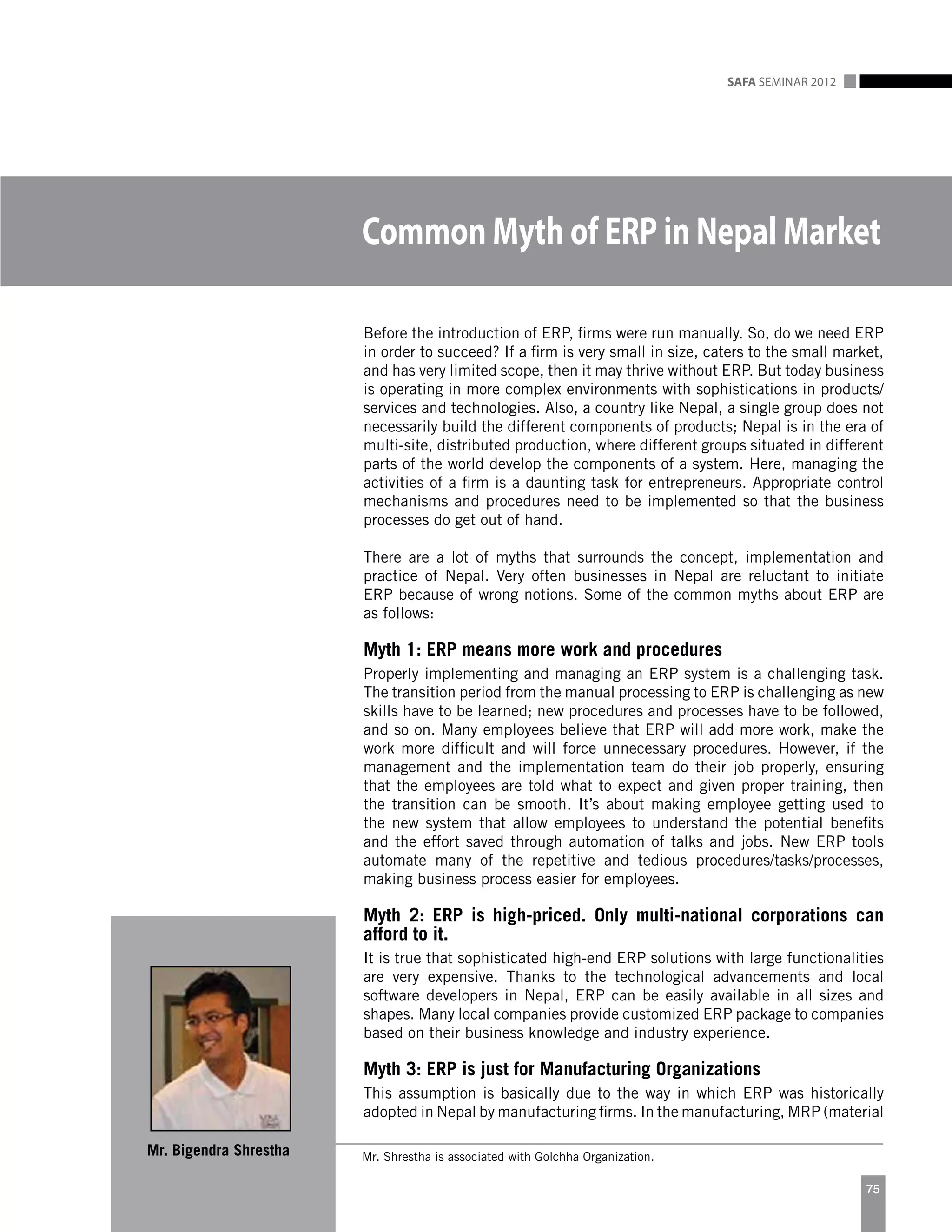
Mr. Bigendra Shrestha Mr. Shrestha is associated with Golchha Organization.
SAFA Seminar 2012
76
requirement planning) became the fundamental
concept of production management and control. This
concept unfolded from inventory management of
materials, personnel planning, distribution planning
which in turn became MRP. New MRP incorporated
financial planning, human resources management,
distribution management as well as management
accounting. The latter editions of MRP cover all areas
of enterprise mainstay business and eventually came to
be called ERP; that’s why in reality the concept of ERP
is not limited to any particular segment of industry.
MYTH 4: Comparing ERP functionality lists is a
good practice for initial screening of vendors for
your project.
Features and functionality lists are of nominal value in
the selection of ERP package. A single line in a list
may represent a world of functionality in one software
packages and very little in another. Even if the desired
functionality is fully supported in the software, actually
making it work for your specific needs may make
implementation complex and cost prohibitive. Referrals
in your industry are a much better benchmark. As
the implementation team is just as important as the
software in terms of successful projects, referrals from
industry representatives regarding the implementation
team are the second most valuable indicator.
MYTH 5: ERP will be live in just a few months
It is more likely that the financial part of the ERP will
go live in a few months rather than the whole ERP
system. Financials are fairly simple to implement and
in most firms the financials are already under control.
ERP major value addition is not in the accounting, but
rather in other parts of the operation and perhaps in
tying those other parts into the financials. Modeling and
effectively managing operations in an integrated ERP
system may take years to implement. In fact, it is a
continuous improvement process. Ultimately, the ERP
must be flexible enough to accommodate operational
changes indefinitely.
There is no debate that ERP plays a major role in
success of business. The choice of ERP packages
should boil down to common sense, not common myth.
Particularly when the economy is challenging and it
is essential to invest properly without sacrificing the
benefits of transparency.
Comment from Major local ERP developer to
major industries
“For almost a decade we have had business ask for
demonstration copies of our ERP software, so they
may play with it at their leisure. For years we have
said no and we’ve done so with good reason. An ERP
package is an advanced system. It isn’t Microsoft
Office and it isn’t an iPhone. You can’t simply turn it
on and expect it to run without training.”

ERP article

  • 1.
    SAFA Seminar 2012 75 CommonMyth of ERP in Nepal Market Before the introduction of ERP, firms were run manually. So, do we need ERP in order to succeed? If a firm is very small in size, caters to the small market, and has very limited scope, then it may thrive without ERP. But today business is operating in more complex environments with sophistications in products/ services and technologies. Also, a country like Nepal, a single group does not necessarily build the different components of products; Nepal is in the era of multi-site, distributed production, where different groups situated in different parts of the world develop the components of a system. Here, managing the activities of a firm is a daunting task for entrepreneurs. Appropriate control mechanisms and procedures need to be implemented so that the business processes do get out of hand. There are a lot of myths that surrounds the concept, implementation and practice of Nepal. Very often businesses in Nepal are reluctant to initiate ERP because of wrong notions. Some of the common myths about ERP are as follows: Myth 1: ERP means more work and procedures Properly implementing and managing an ERP system is a challenging task. The transition period from the manual processing to ERP is challenging as new skills have to be learned; new procedures and processes have to be followed, and so on. Many employees believe that ERP will add more work, make the work more difficult and will force unnecessary procedures. However, if the management and the implementation team do their job properly, ensuring that the employees are told what to expect and given proper training, then the transition can be smooth. It’s about making employee getting used to the new system that allow employees to understand the potential benefits and the effort saved through automation of talks and jobs. New ERP tools automate many of the repetitive and tedious procedures/tasks/processes, making business process easier for employees. Myth 2: ERP is high-priced. Only multi-national corporations can afford to it. It is true that sophisticated high-end ERP solutions with large functionalities are very expensive. Thanks to the technological advancements and local software developers in Nepal, ERP can be easily available in all sizes and shapes. Many local companies provide customized ERP package to companies based on their business knowledge and industry experience. Myth 3: ERP is just for Manufacturing Organizations This assumption is basically due to the way in which ERP was historically adopted in Nepal by manufacturing firms. In the manufacturing, MRP (material Mr. Bigendra Shrestha Mr. Shrestha is associated with Golchha Organization.
  • 2.
    SAFA Seminar 2012 76 requirementplanning) became the fundamental concept of production management and control. This concept unfolded from inventory management of materials, personnel planning, distribution planning which in turn became MRP. New MRP incorporated financial planning, human resources management, distribution management as well as management accounting. The latter editions of MRP cover all areas of enterprise mainstay business and eventually came to be called ERP; that’s why in reality the concept of ERP is not limited to any particular segment of industry. MYTH 4: Comparing ERP functionality lists is a good practice for initial screening of vendors for your project. Features and functionality lists are of nominal value in the selection of ERP package. A single line in a list may represent a world of functionality in one software packages and very little in another. Even if the desired functionality is fully supported in the software, actually making it work for your specific needs may make implementation complex and cost prohibitive. Referrals in your industry are a much better benchmark. As the implementation team is just as important as the software in terms of successful projects, referrals from industry representatives regarding the implementation team are the second most valuable indicator. MYTH 5: ERP will be live in just a few months It is more likely that the financial part of the ERP will go live in a few months rather than the whole ERP system. Financials are fairly simple to implement and in most firms the financials are already under control. ERP major value addition is not in the accounting, but rather in other parts of the operation and perhaps in tying those other parts into the financials. Modeling and effectively managing operations in an integrated ERP system may take years to implement. In fact, it is a continuous improvement process. Ultimately, the ERP must be flexible enough to accommodate operational changes indefinitely. There is no debate that ERP plays a major role in success of business. The choice of ERP packages should boil down to common sense, not common myth. Particularly when the economy is challenging and it is essential to invest properly without sacrificing the benefits of transparency. Comment from Major local ERP developer to major industries “For almost a decade we have had business ask for demonstration copies of our ERP software, so they may play with it at their leisure. For years we have said no and we’ve done so with good reason. An ERP package is an advanced system. It isn’t Microsoft Office and it isn’t an iPhone. You can’t simply turn it on and expect it to run without training.”