SRI LANKA EXPORTER | JUL - SEP 2015 www.nce.lk34
IFS Reach is a specially designed
ERP proposition by IFS, for the
Small and Medium Enterprise
segment in Sri Lanka. Could you
briefly explain what IFS Reach is?
IFS Reach is an initiative taken by IFS
to provide a rapid startup for SME or-
ganizations who are on a growth tra-
jectory. It is intended to allow an SME
to afford an internationally recognized
and accepted Enterprise Resource
Planning system such as IFS. In our
18 year operations in Sri Lanka we
have identified that the SME market
is a growing and vibrant one with a
very unique set of needs. IFS Reach is
a proposition we have designed taking
those needs in to account.
IFS Reach package, consists of
a set of standard modules and com-
ponents essential for a SME to run
a growing business. The solution is
embedded with tried and tested best
business practices, resulting in less
complex installations, thereby reduc-
ing risk of failure. Therefore, support
and life cycle maintenance is less
complex and efficient due to reduced
complexity. Furthermore, IFS Reach
implementation methodology known
as “IFS Rapid implementation” is to
be applied in the implementation pro-
cess which will assist organizations to
easily adopt to an ERP environment
with minimum implementation ef-
fort and cost. Faster implementation
leads to a faster payoff. This tailor
made package comes at a special price
which is within reach of a typical mid-
scale SME.
What is the key benefit of IFS
Reach as you see it ?
SME’s will benefit from IFS’s Com-
ponent based software architecture.
IFS software is designed in a way
which allows an SME to purchase
only a few essential modules initially
and keep adding the extra modules as
time passes, eventually owning a fully
fledged enterprise solution. Basically,
you do not need to invest in a fully
fledged ERP overnight. An SME can
do this at their own pace and capacity.
This scalability is unique to IFS and it
serves well for SME’s unique needs.
Many SME businesses find that a
world class ERP is too expensive or
too complex for their organization.
What are your views on this?
I find this to be true. ERP software’s
are expensive simply because they are
proven effective at reducing business
costs, improving efficiency and in-
creasing turn over for leading organi-
zations.
Owing to the cost of an ERP and
the complexity of implementing one,
an ERP implementation is a long term
-one time investment for most com-
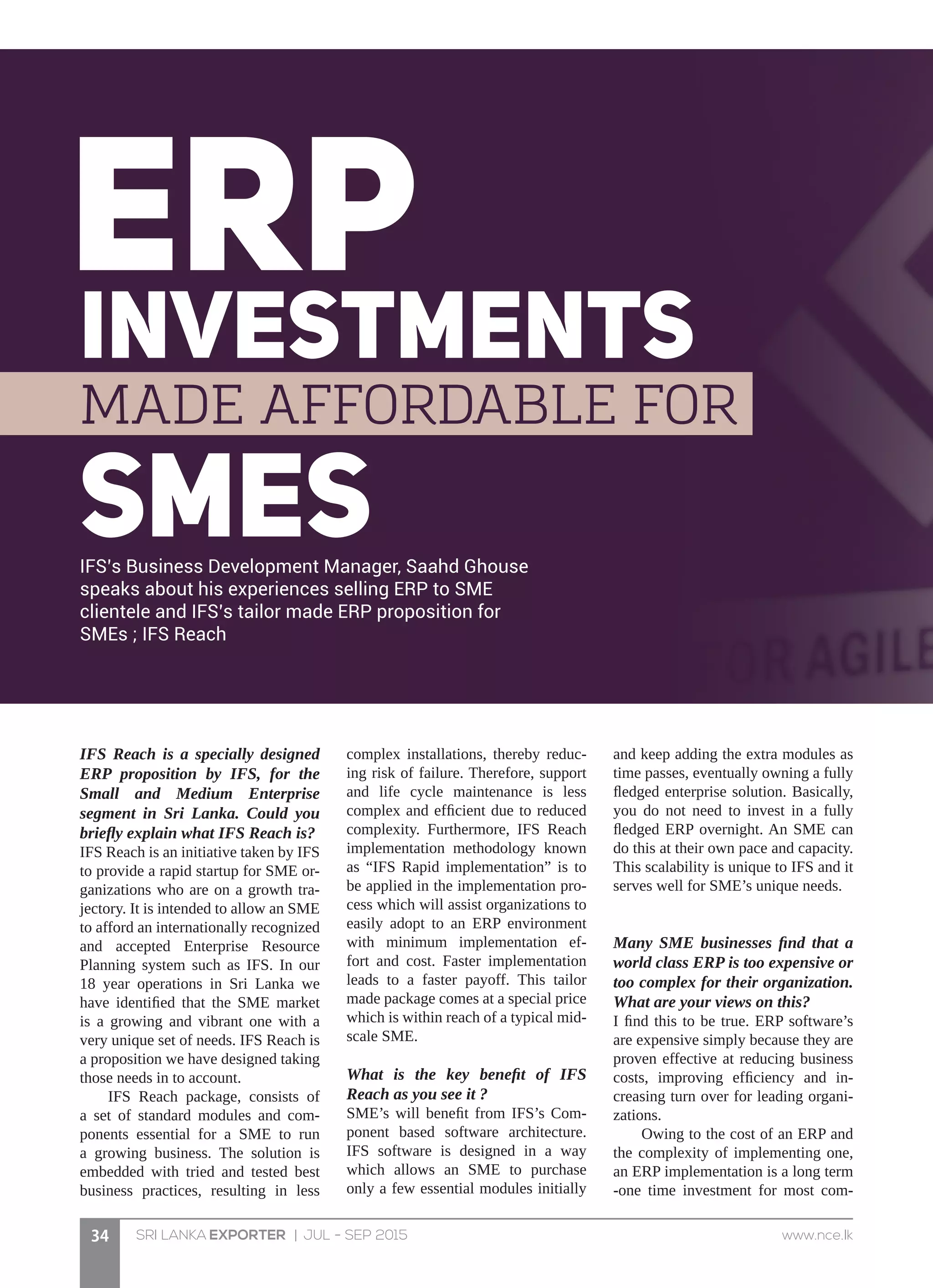
IFS’s Business Development Manager, Saahd Ghouse
speaks about his experiences selling ERP to SME
clientele and IFS’s tailor made ERP proposition for
SMEs ; IFS Reach
JUL - SEP 2015 | SRI LANKA EXPORTERwww.nce.lk 35
panies. Therefore, it is important that
organizations do not compromise on
the quality of the ERP system, repu-
tation and experience of the ERP ven-
dor. Therefore I always advice clients
to view ERP as an investment rather
than a cost. There are ERP solutions
such as IFS Reach which is affordable
and flexible with regard to its offering.
Furthermore, IFS is also hoping to in-
troduce flexible repayment facilities
with the help of financial institutions
in the near future. This we hope will
give SMEs an incentive to invest in
world class ERP.
Based on your experience selling
IFS ERP solutions to SME
companies, what are some of the
common business pain points your
SME clients speak to you about?
Most companies are unable to provide
a consolidated picture of sales, inven-
tory and receivables. This is a result of
the poor data flow owing to separate
excel based systems used in the orga-
nizations and data inconsistency and
inaccuracy due to high level of manu-
al data entry. Information for decision
making is the most basic need of an
organization and if it is not met, the
organization cannot reach its full po-
tential.
SME’s also deal with issues in
quality & supply chain especially
when catering to the international
market. This is mostly as SME’s strug-
gle with creating world class process-
es in their organization to support the
quality and supply chain excellence
demands placed on them.
Fraud is also a huge issue in SME
establishments, and one which silently
drives profitability down. I would like
to note that there have been instances
where post ERP implementation, the
organization has detected frauds, the
value of which off sets the cost of the
ERP solution they purchase. Such is
the power of a good ERP. And finally,
exponential growth and diversification
in operations is common in the SME
segment. Basic software systems do
not provide the flexibility and features
that support company diversification
in to several industries
Post ERP implementation and
life time support is an area of concern
for many businesses. What level of
support does IFS provide Sri Lankan
Companies
Post implementation is support is
important but I would like to empha-
size that modern ERP systems such as
IFS , have made the software extreme-
ly simple and easy to administer and
use. ERP is no longer as complex as
many believe it to be. In this light post
implementation support while import-
ant is sometimes even not necessary.
In the case it is necessary, IFS
provides the most extensive support
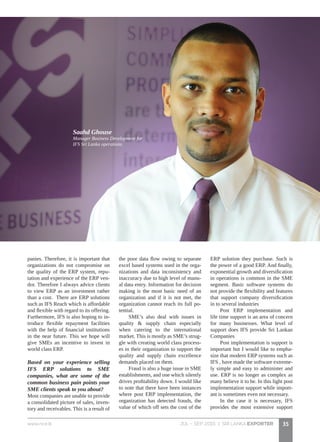
Saahd Ghouse
Manager Business Development for
IFS Sri Lanka operations.
SRI LANKA EXPORTER | JUL - SEP 2015 www.nce.lk36
you could receive in Sri Lanka. We
have developed four levels of support.
Firstly, extensive support training is
provided for in-house IT teams at each
client location. This serves as the first
line of support. There is a second level
of support from IFS’s own dedicated
support team located in Colombo 06.
Third level of support is provided by
the IFS ERP Consulting team which
is also located in Colombo. The fourth
level of support is provided by IFS R
& D specialists who are also based in
Colombo.
The ability to provide all lines of
support locally is unique to IFS Sri
Lanka operations. IFS operates its
Sales, consulting and R &D opera-
tions in Sri Lanka, currently employ-
ing over 700 staff. This enables us to
provide extensive support for local cli-
ents. This is a level of support none of
our competitors can match.
What are the key benefits a small
and medium scale organizations
will receive by investing in an ERP/
Why is it important that SMEs
consider investing in to ERP?
Reduced operational costs is one of
the immediate benefits from imple-
menting an ERP. Centralized man-
agement control over all operations
also follows this once the required re-
ports and dash boards are developed.
From a longer term perspective, the
company processes get automatically
re-engineered to be in line with ‘best
global practices’embedded in the ERP
solution. Needless to say the company
therefore automatically starts operat-
ing in a world class manner. As can
be expected this becomes apparent to
global suppliers and customers as they
engage and work with these compa-
nies thus greatly increasing the stature
of the company.
What is your advice for any SME
considering investment in to ERP?
how should they prepare themselves
for vendor selection, evaluation and
implementation phases.
Selecting an ERP is a long-term com-
mitment. It is however not a complex
process or a decision to make if the
right groundwork is done by the com
pany. Before looking at technology,
I urge companies to look at business
requirements and, most importantly
identify their business problems and
try defining them.
I often experience prospects mak-
ing the mistake of equating an enter-
prise software to just IT. Choosing an
ERP package is a business decision,
not an IT decision. IT does play a sup-
porting role, however the leader of the
process must have a deep understand-
ing and knowledge of the business op-
erations and industry, and most impor-
tantly must have the authority to bring
about change.
On a more operational level, im-
plementing an ERP system requires
preparation prior to commencing
implementation. Data needs to be
cleansed, roles need to be assigned,
processes need to be reviewed, and
much more.
I advise companies evaluating
ERP vendors to consider the ERP
vendor’s Credibility, Stability and
Future Growth. Making customer ref-
erence visits and obtaining first hand
feedback is also important. The capa-
bilities of supporting multi-currency,
multi-site, multi language situations
is a must especially for exporters and
therefore it should be on every export-
ers checklist. It is important to consid-
er what systems competitors in your
industry is using and it is absolutely
necessary to assess the level of post
implementation support provided by
selected ERP vendor.
Saahd Ghouse is Manager Business
Development for IFS Sri Lanka
operations. He possesses over 6 years
experience in Enterprise Software
Sales and was responsible for
bringing several well-known SMEs
on to the IFS ERP platform. He has
a Bsc Hons in Business IT from
University of Staffordshire-UK and
is a Microsoft Certified Professional.
For more in depth information
on tailor made ERP solutions for
an SME he maybe contacted on
saahd.Ghouse@ifsworld.com and
0773561718
I find this to
be true. ERP
software’s
are expensive
simply because
they are proven
effective at
reducing
business costs,
improving
efficiency and
increasing turn
over for leading
organizations.

IFS Article - Exporter 90

  • 1.
    SRI LANKA EXPORTER| JUL - SEP 2015 www.nce.lk34 IFS Reach is a specially designed ERP proposition by IFS, for the Small and Medium Enterprise segment in Sri Lanka. Could you briefly explain what IFS Reach is? IFS Reach is an initiative taken by IFS to provide a rapid startup for SME or- ganizations who are on a growth tra- jectory. It is intended to allow an SME to afford an internationally recognized and accepted Enterprise Resource Planning system such as IFS. In our 18 year operations in Sri Lanka we have identified that the SME market is a growing and vibrant one with a very unique set of needs. IFS Reach is a proposition we have designed taking those needs in to account. IFS Reach package, consists of a set of standard modules and com- ponents essential for a SME to run a growing business. The solution is embedded with tried and tested best business practices, resulting in less complex installations, thereby reduc- ing risk of failure. Therefore, support and life cycle maintenance is less complex and efficient due to reduced complexity. Furthermore, IFS Reach implementation methodology known as “IFS Rapid implementation” is to be applied in the implementation pro- cess which will assist organizations to easily adopt to an ERP environment with minimum implementation ef- fort and cost. Faster implementation leads to a faster payoff. This tailor made package comes at a special price which is within reach of a typical mid- scale SME. What is the key benefit of IFS Reach as you see it ? SME’s will benefit from IFS’s Com- ponent based software architecture. IFS software is designed in a way which allows an SME to purchase only a few essential modules initially and keep adding the extra modules as time passes, eventually owning a fully fledged enterprise solution. Basically, you do not need to invest in a fully fledged ERP overnight. An SME can do this at their own pace and capacity. This scalability is unique to IFS and it serves well for SME’s unique needs. Many SME businesses find that a world class ERP is too expensive or too complex for their organization. What are your views on this? I find this to be true. ERP software’s are expensive simply because they are proven effective at reducing business costs, improving efficiency and in- creasing turn over for leading organi- zations. Owing to the cost of an ERP and the complexity of implementing one, an ERP implementation is a long term -one time investment for most com- IFS’s Business Development Manager, Saahd Ghouse speaks about his experiences selling ERP to SME clientele and IFS’s tailor made ERP proposition for SMEs ; IFS Reach
  • 2.
    JUL - SEP2015 | SRI LANKA EXPORTERwww.nce.lk 35 panies. Therefore, it is important that organizations do not compromise on the quality of the ERP system, repu- tation and experience of the ERP ven- dor. Therefore I always advice clients to view ERP as an investment rather than a cost. There are ERP solutions such as IFS Reach which is affordable and flexible with regard to its offering. Furthermore, IFS is also hoping to in- troduce flexible repayment facilities with the help of financial institutions in the near future. This we hope will give SMEs an incentive to invest in world class ERP. Based on your experience selling IFS ERP solutions to SME companies, what are some of the common business pain points your SME clients speak to you about? Most companies are unable to provide a consolidated picture of sales, inven- tory and receivables. This is a result of the poor data flow owing to separate excel based systems used in the orga- nizations and data inconsistency and inaccuracy due to high level of manu- al data entry. Information for decision making is the most basic need of an organization and if it is not met, the organization cannot reach its full po- tential. SME’s also deal with issues in quality & supply chain especially when catering to the international market. This is mostly as SME’s strug- gle with creating world class process- es in their organization to support the quality and supply chain excellence demands placed on them. Fraud is also a huge issue in SME establishments, and one which silently drives profitability down. I would like to note that there have been instances where post ERP implementation, the organization has detected frauds, the value of which off sets the cost of the ERP solution they purchase. Such is the power of a good ERP. And finally, exponential growth and diversification in operations is common in the SME segment. Basic software systems do not provide the flexibility and features that support company diversification in to several industries Post ERP implementation and life time support is an area of concern for many businesses. What level of support does IFS provide Sri Lankan Companies Post implementation is support is important but I would like to empha- size that modern ERP systems such as IFS , have made the software extreme- ly simple and easy to administer and use. ERP is no longer as complex as many believe it to be. In this light post implementation support while import- ant is sometimes even not necessary. In the case it is necessary, IFS provides the most extensive support Saahd Ghouse Manager Business Development for IFS Sri Lanka operations.
  • 3.
    SRI LANKA EXPORTER| JUL - SEP 2015 www.nce.lk36 you could receive in Sri Lanka. We have developed four levels of support. Firstly, extensive support training is provided for in-house IT teams at each client location. This serves as the first line of support. There is a second level of support from IFS’s own dedicated support team located in Colombo 06. Third level of support is provided by the IFS ERP Consulting team which is also located in Colombo. The fourth level of support is provided by IFS R & D specialists who are also based in Colombo. The ability to provide all lines of support locally is unique to IFS Sri Lanka operations. IFS operates its Sales, consulting and R &D opera- tions in Sri Lanka, currently employ- ing over 700 staff. This enables us to provide extensive support for local cli- ents. This is a level of support none of our competitors can match. What are the key benefits a small and medium scale organizations will receive by investing in an ERP/ Why is it important that SMEs consider investing in to ERP? Reduced operational costs is one of the immediate benefits from imple- menting an ERP. Centralized man- agement control over all operations also follows this once the required re- ports and dash boards are developed. From a longer term perspective, the company processes get automatically re-engineered to be in line with ‘best global practices’embedded in the ERP solution. Needless to say the company therefore automatically starts operat- ing in a world class manner. As can be expected this becomes apparent to global suppliers and customers as they engage and work with these compa- nies thus greatly increasing the stature of the company. What is your advice for any SME considering investment in to ERP? how should they prepare themselves for vendor selection, evaluation and implementation phases. Selecting an ERP is a long-term com- mitment. It is however not a complex process or a decision to make if the right groundwork is done by the com pany. Before looking at technology, I urge companies to look at business requirements and, most importantly identify their business problems and try defining them. I often experience prospects mak- ing the mistake of equating an enter- prise software to just IT. Choosing an ERP package is a business decision, not an IT decision. IT does play a sup- porting role, however the leader of the process must have a deep understand- ing and knowledge of the business op- erations and industry, and most impor- tantly must have the authority to bring about change. On a more operational level, im- plementing an ERP system requires preparation prior to commencing implementation. Data needs to be cleansed, roles need to be assigned, processes need to be reviewed, and much more. I advise companies evaluating ERP vendors to consider the ERP vendor’s Credibility, Stability and Future Growth. Making customer ref- erence visits and obtaining first hand feedback is also important. The capa- bilities of supporting multi-currency, multi-site, multi language situations is a must especially for exporters and therefore it should be on every export- ers checklist. It is important to consid- er what systems competitors in your industry is using and it is absolutely necessary to assess the level of post implementation support provided by selected ERP vendor. Saahd Ghouse is Manager Business Development for IFS Sri Lanka operations. He possesses over 6 years experience in Enterprise Software Sales and was responsible for bringing several well-known SMEs on to the IFS ERP platform. He has a Bsc Hons in Business IT from University of Staffordshire-UK and is a Microsoft Certified Professional. For more in depth information on tailor made ERP solutions for an SME he maybe contacted on saahd.Ghouse@ifsworld.com and 0773561718 I find this to be true. ERP software’s are expensive simply because they are proven effective at reducing business costs, improving efficiency and increasing turn over for leading organizations.