1. Identify the eight (8) stages of human
development by Erik Erikson;
2.Determine the psycho-social crisis,
maladaptation, malignancy, and virtue of
each stage;
3.Suggest ways on how Erikson’s theory can
be useful to future teachers.
2
A world famous psychoanalyst,
anthropologist, psychohistorian,
and a medical school professor;
yet, he had no college degree of
any kind
3
 The term psycho-social is derived from the words
psycho (mind, brain or personality) and social
(external relationship and environment).
4
 Erikson’s eight-stage theory was largely influenced
by Sigmund Freud. But, he extended the theory and
incorporated the impact of social experience
across the whole life span.

5
 This theory is a tremendously powerful model
because it is relevant to modern life, from several
different perspectives for understanding and
explaining how personality and behavior develop
in people.
 Growth takes place according to epigenetic
principle, which states that a person’s development
is predetermined.
6
“This principle says that we develop through a
predetermined unfolding of our personalities in eight
stages. Our progress through each stage is in part
determined by our success, or lack of success, in all the
previous stages. A little like the unfolding of a rose bud,
each petal opens up a certain time, in a certain order,
which nature, through its genetics, has determined. If
we interfere in the natural order of development by
pulling a petal forward prematurely or out of order, we
ruin the development of the entire flower.”
7
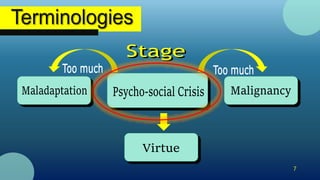
8
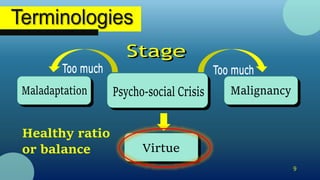
9
Healthy ratio
or balance
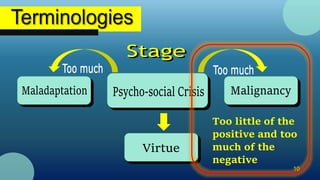
10
Too little of the
positive and too
much of the
negative
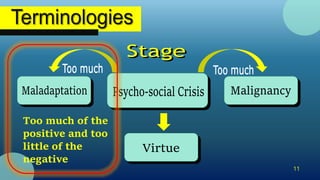
11
Too much of the
positive and too
little of the
negative
So, what are
Erikson’s Eight
Stages of
Psycho-social
Development?
12
13
14
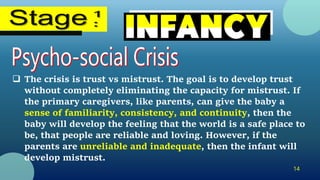
 The crisis is trust vs mistrust. The goal is to develop trust
without completely eliminating the capacity for mistrust. If
the primary caregivers, like parents, can give the baby a
sense of familiarity, consistency, and continuity, then the
baby will develop the feeling that the world is a safe place to
be, that people are reliable and loving. However, if the
parents are unreliable and inadequate, then the infant will
develop mistrust.
15
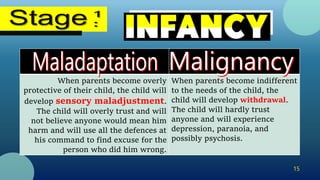
When parents become overly
protective of their child, the child will
develop sensory maladjustment.
The child will overly trust and will
not believe anyone would mean him
harm and will use all the defences at
his command to find excuse for the
person who did him wrong.
When parents become indifferent
to the needs of the child, the
child will develop withdrawal.
The child will hardly trust
anyone and will experience
depression, paranoia, and
possibly psychosis.
16
 If the proper balance is achieved, the
child will develop the virtue of
hope, the strong belief that, even when
things are not going well, they will work
out well in the end. This is the same
ability that, in later life, gets us through
disappointments in love, our careers,
and many other domains of life.
17
18
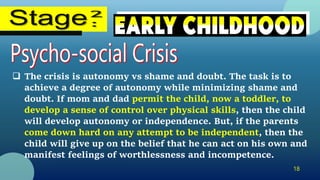
 The crisis is autonomy vs shame and doubt. The task is to
achieve a degree of autonomy while minimizing shame and
doubt. If mom and dad permit the child, now a toddler, to
develop a sense of control over physical skills, then the child
will develop autonomy or independence. But, if the parents
come down hard on any attempt to be independent, then the
child will give up on the belief that he can act on his own and
manifest feelings of worthlessness and incompetence.
19
With too much autonomy, the child
will develop impulsiveness. The
child will be shamelessly willful,
and this will lead him, in later
stages of his life, to jump into things
without proper consideration of his
abilities.
Too much shame and doubt will
develop in the child
compulsiveness. The child will
always be ashamed and will
always doubt himself. He will feel
pressured to do thing perfectly.
20
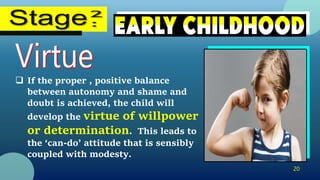
 If the proper , positive balance
between autonomy and shame and
doubt is achieved, the child will
develop the virtue of willpower
or determination. This leads to
the ‘can-do’ attitude that is sensibly
coupled with modesty.
21
22
 The crisis is initiative vs guilt. The task is to learn initiative
without too much guilt. The child now begins to try out his
ideas and explore his social and physical worlds to
discover what he can do. If the child is allowed to do
these, then he develops initiative. However, if the child’s
families are harsh, unaccepting of ideas, and too
temperamental, then the child will feel guilty about his
actions.
23
Too much initiative and too little
guilt leads to ruthlessness. The
child will take the initiative alright,
and will not care who he steps on to
achieve his goals. The goals are the
only things that matter and guilty
feelings are only signs of weakness.
Too much guilt leads to
inhibition. The child will not try
things because he believes in
“nothing ventured, nothing lost.”
This way, he has nothing to feel
guilty about. He inhibits himself
because he is afraid of being
blamed.
24
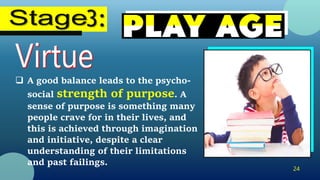
 A good balance leads to the psycho-
social strength of purpose. A
sense of purpose is something many
people crave for in their lives, and
this is achieved through imagination
and initiative, despite a clear
understanding of their limitations
and past failings.
25
26
 The crisis is industry vs inferiority. The task is to develop a
capacity for industry while avoiding an excessive sense of
inferiority. The child develops industry by taming his
imagination and dedicating himself to education and to
learning social skills with the help of his family, teachers,
and peers. He learns the pleasure of bringing a plan to
completion. If the child is allowed to little success because of
harsh teachers or rejecting peers, he develops inferiority or
incompetence instead.
27
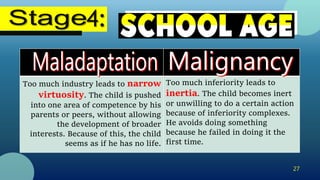
Too much industry leads to narrow
virtuosity. The child is pushed
into one area of competence by his
parents or peers, without allowing
the development of broader
interests. Because of this, the child
seems as if he has no life.
Too much inferiority leads to
inertia. The child becomes inert
or unwilling to do a certain action
because of inferiority complexes.
He avoids doing something
because he failed in doing it the
first time.
28
 A happier thing is to develop the
right balance of industry and
inferiority. When this takes place, the
child will develop the virtue of
competency. This is mostly industry
with just a touch of inferiority to
keep us sensibly humble.
29
30
 The crisis is identity vs role confusion. The task during
adolescence is to achieve ego identity and avoid role
confusion. To develop identity, there should be a mainstream
adult culture that is worthy of the adolescent’s respect. The
society should also provide clear rite of passage, certain
accomplishments and rituals that help to distinguish the
adult from the child. Without these things, role confusion,
which means uncertainty about one’s place in society, is
likely to be developed.
31
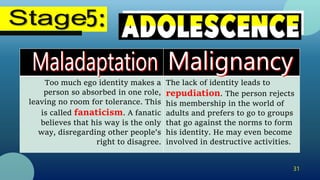
Too much ego identity makes a
person so absorbed in one role,
leaving no room for tolerance. This
is called fanaticism. A fanatic
believes that his way is the only
way, disregarding other people’s
right to disagree.
The lack of identity leads to
repudiation. The person rejects
his membership in the world of
adults and prefers to go to groups
that go against the norms to form
his identity. He may even become
involved in destructive activities.
32
 If this stage is successfully negotiated,
the person will have the virtue of
fidelity. The person will have the
ability to live by the society’s standards
despite his imperfections and
incompleteness and inconsistencies. He
will find a place in the community, a
place that will allow him to contribute.
33
34
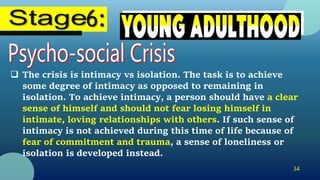
 The crisis is intimacy vs isolation. The task is to achieve
some degree of intimacy as opposed to remaining in
isolation. To achieve intimacy, a person should have a clear
sense of himself and should not fear losing himself in
intimate, loving relationships with others. If such sense of
intimacy is not achieved during this time of life because of
fear of commitment and trauma, a sense of loneliness or
isolation is developed instead.
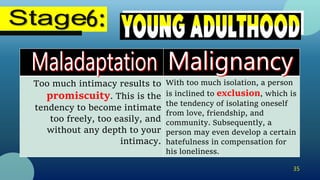
35
Too much intimacy results to
promiscuity. This is the
tendency to become intimate
too freely, too easily, and
without any depth to your
intimacy.
With too much isolation, a person
is inclined to exclusion, which is
the tendency of isolating oneself
from love, friendship, and
community. Subsequently, a
person may even develop a certain
hatefulness in compensation for
his loneliness.
36
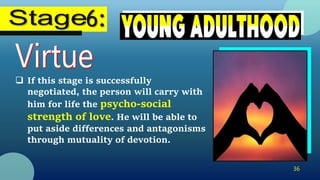
 If this stage is successfully
negotiated, the person will carry with
him for life the psycho-social
strength of love. He will be able to
put aside differences and antagonisms
through mutuality of devotion.
37
38
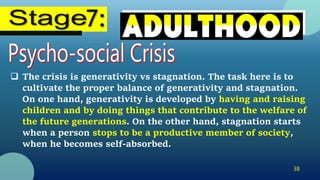
 The crisis is generativity vs stagnation. The task here is to
cultivate the proper balance of generativity and stagnation.
On one hand, generativity is developed by having and raising
children and by doing things that contribute to the welfare of
the future generations. On the other hand, stagnation starts
when a person stops to be a productive member of society,
when he becomes self-absorbed.
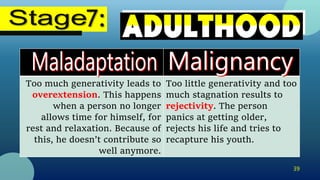
39
Too much generativity leads to
overextension. This happens
when a person no longer
allows time for himself, for
rest and relaxation. Because of
this, he doesn’t contribute so
well anymore.
Too little generativity and too
much stagnation results to
rejectivity. The person
panics at getting older,
rejects his life and tries to
recapture his youth.
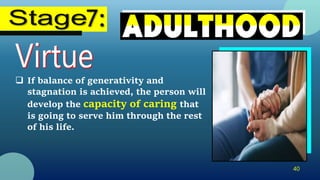
40
 If balance of generativity and
stagnation is achieved, the person will
develop the capacity of caring that
is going to serve him through the rest
of his life.
41
42
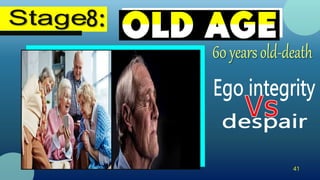
 The crisis is ego integrity vs despair. The task here is to
develop ego integrity with a minimal amount of despair. Ego
integrity is developed by coming to terms with your life,
accepting the course of events and the choices made in the
past, and thinking that everything that happened makes who
you are now. However, if you become preoccupied with the
past, your failures, the bad decisions you made and the
regrets, you are likely to develop despair.
43
Too much ego integrity
develops presumption. This is
what happens when a person
in old age believes that he
alone is right and does not
respect the ideas and views of
the young.
Too much despair leads to
disdain. This means a
contempt of life. The person
in old age becomes very
negative and appears to hate
life.
44
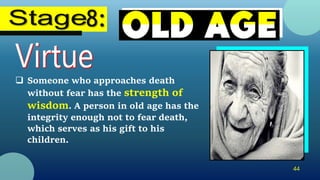
 Someone who approaches death
without fear has the strength of
wisdom. A person in old age has the
integrity enough not to fear death,
which serves as his gift to his
children.
49
A. DIRECTIONS: Identify what is asked in each
statement below.
1. This stage number is known as the adolescence stage.
2. This stage of life takes place when the person is 6-11
years old.
3. It is the stage where the virtue of hope can be
developed.
4. This stage of life is demonstrated when a person tries to
tie his own shoelaces.
5. This is the stage where a child begins exploring his
environment.
2
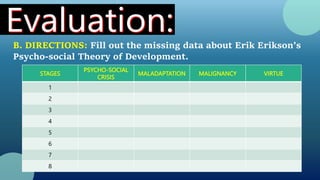
B. DIRECTIONS: Fill out the missing data about Erik Erikson’s
Psycho-social Theory of Development.
STAGES
PSYCHO-SOCIAL
CRISIS
MALADAPTATION MALIGNANCY VIRTUE
1
2
3
4
5
6
7
8
51
• Corpuz, B. et. al. (2018). Child and Adolescent Learners and
Learning Principles. Quezon City. Lorimar Publishing Inc.
• Javier, R. et. al. (2015). Child and Adolescent Development.
Chapter 5: Social and Emotional Development of Adolescence, pp 94.
• Erik Erikson’s Psycho-social Stages of Development retrieved from
http://www.ppt.net/deyanaflores/eriksons-stages-of-psychosocial-development-
16062653
ERIK ERIKSON'S THEORY.pptx

ERIK ERIKSON'S THEORY.pptx

  • 3.
    1. Identify theeight (8) stages of human development by Erik Erikson; 2.Determine the psycho-social crisis, maladaptation, malignancy, and virtue of each stage; 3.Suggest ways on how Erikson’s theory can be useful to future teachers. 2
  • 4.
    A world famouspsychoanalyst, anthropologist, psychohistorian, and a medical school professor; yet, he had no college degree of any kind 3
  • 5.
     The termpsycho-social is derived from the words psycho (mind, brain or personality) and social (external relationship and environment). 4  Erikson’s eight-stage theory was largely influenced by Sigmund Freud. But, he extended the theory and incorporated the impact of social experience across the whole life span.
  • 6.
    5  This theoryis a tremendously powerful model because it is relevant to modern life, from several different perspectives for understanding and explaining how personality and behavior develop in people.  Growth takes place according to epigenetic principle, which states that a person’s development is predetermined.
  • 7.
    6 “This principle saysthat we develop through a predetermined unfolding of our personalities in eight stages. Our progress through each stage is in part determined by our success, or lack of success, in all the previous stages. A little like the unfolding of a rose bud, each petal opens up a certain time, in a certain order, which nature, through its genetics, has determined. If we interfere in the natural order of development by pulling a petal forward prematurely or out of order, we ruin the development of the entire flower.”
  • 8.
  • 9.
  • 10.
  • 11.
    10 Too little ofthe positive and too much of the negative
  • 12.
    11 Too much ofthe positive and too little of the negative
  • 13.
    So, what are Erikson’sEight Stages of Psycho-social Development? 12
  • 14.
  • 15.
    14  The crisisis trust vs mistrust. The goal is to develop trust without completely eliminating the capacity for mistrust. If the primary caregivers, like parents, can give the baby a sense of familiarity, consistency, and continuity, then the baby will develop the feeling that the world is a safe place to be, that people are reliable and loving. However, if the parents are unreliable and inadequate, then the infant will develop mistrust.
  • 16.
    15 When parents becomeoverly protective of their child, the child will develop sensory maladjustment. The child will overly trust and will not believe anyone would mean him harm and will use all the defences at his command to find excuse for the person who did him wrong. When parents become indifferent to the needs of the child, the child will develop withdrawal. The child will hardly trust anyone and will experience depression, paranoia, and possibly psychosis.
  • 17.
    16  If theproper balance is achieved, the child will develop the virtue of hope, the strong belief that, even when things are not going well, they will work out well in the end. This is the same ability that, in later life, gets us through disappointments in love, our careers, and many other domains of life.
  • 18.
  • 19.
    18  The crisisis autonomy vs shame and doubt. The task is to achieve a degree of autonomy while minimizing shame and doubt. If mom and dad permit the child, now a toddler, to develop a sense of control over physical skills, then the child will develop autonomy or independence. But, if the parents come down hard on any attempt to be independent, then the child will give up on the belief that he can act on his own and manifest feelings of worthlessness and incompetence.
  • 20.
    19 With too muchautonomy, the child will develop impulsiveness. The child will be shamelessly willful, and this will lead him, in later stages of his life, to jump into things without proper consideration of his abilities. Too much shame and doubt will develop in the child compulsiveness. The child will always be ashamed and will always doubt himself. He will feel pressured to do thing perfectly.
  • 21.
    20  If theproper , positive balance between autonomy and shame and doubt is achieved, the child will develop the virtue of willpower or determination. This leads to the ‘can-do’ attitude that is sensibly coupled with modesty.
  • 22.
  • 23.
    22  The crisisis initiative vs guilt. The task is to learn initiative without too much guilt. The child now begins to try out his ideas and explore his social and physical worlds to discover what he can do. If the child is allowed to do these, then he develops initiative. However, if the child’s families are harsh, unaccepting of ideas, and too temperamental, then the child will feel guilty about his actions.
  • 24.
    23 Too much initiativeand too little guilt leads to ruthlessness. The child will take the initiative alright, and will not care who he steps on to achieve his goals. The goals are the only things that matter and guilty feelings are only signs of weakness. Too much guilt leads to inhibition. The child will not try things because he believes in “nothing ventured, nothing lost.” This way, he has nothing to feel guilty about. He inhibits himself because he is afraid of being blamed.
  • 25.
    24  A goodbalance leads to the psycho- social strength of purpose. A sense of purpose is something many people crave for in their lives, and this is achieved through imagination and initiative, despite a clear understanding of their limitations and past failings.
  • 26.
  • 27.
    26  The crisisis industry vs inferiority. The task is to develop a capacity for industry while avoiding an excessive sense of inferiority. The child develops industry by taming his imagination and dedicating himself to education and to learning social skills with the help of his family, teachers, and peers. He learns the pleasure of bringing a plan to completion. If the child is allowed to little success because of harsh teachers or rejecting peers, he develops inferiority or incompetence instead.
  • 28.
    27 Too much industryleads to narrow virtuosity. The child is pushed into one area of competence by his parents or peers, without allowing the development of broader interests. Because of this, the child seems as if he has no life. Too much inferiority leads to inertia. The child becomes inert or unwilling to do a certain action because of inferiority complexes. He avoids doing something because he failed in doing it the first time.
  • 29.
    28  A happierthing is to develop the right balance of industry and inferiority. When this takes place, the child will develop the virtue of competency. This is mostly industry with just a touch of inferiority to keep us sensibly humble.
  • 30.
  • 31.
    30  The crisisis identity vs role confusion. The task during adolescence is to achieve ego identity and avoid role confusion. To develop identity, there should be a mainstream adult culture that is worthy of the adolescent’s respect. The society should also provide clear rite of passage, certain accomplishments and rituals that help to distinguish the adult from the child. Without these things, role confusion, which means uncertainty about one’s place in society, is likely to be developed.
  • 32.
    31 Too much egoidentity makes a person so absorbed in one role, leaving no room for tolerance. This is called fanaticism. A fanatic believes that his way is the only way, disregarding other people’s right to disagree. The lack of identity leads to repudiation. The person rejects his membership in the world of adults and prefers to go to groups that go against the norms to form his identity. He may even become involved in destructive activities.
  • 33.
    32  If thisstage is successfully negotiated, the person will have the virtue of fidelity. The person will have the ability to live by the society’s standards despite his imperfections and incompleteness and inconsistencies. He will find a place in the community, a place that will allow him to contribute.
  • 34.
  • 35.
    34  The crisisis intimacy vs isolation. The task is to achieve some degree of intimacy as opposed to remaining in isolation. To achieve intimacy, a person should have a clear sense of himself and should not fear losing himself in intimate, loving relationships with others. If such sense of intimacy is not achieved during this time of life because of fear of commitment and trauma, a sense of loneliness or isolation is developed instead.
  • 36.
    35 Too much intimacyresults to promiscuity. This is the tendency to become intimate too freely, too easily, and without any depth to your intimacy. With too much isolation, a person is inclined to exclusion, which is the tendency of isolating oneself from love, friendship, and community. Subsequently, a person may even develop a certain hatefulness in compensation for his loneliness.
  • 37.
    36  If thisstage is successfully negotiated, the person will carry with him for life the psycho-social strength of love. He will be able to put aside differences and antagonisms through mutuality of devotion.
  • 38.
  • 39.
    38  The crisisis generativity vs stagnation. The task here is to cultivate the proper balance of generativity and stagnation. On one hand, generativity is developed by having and raising children and by doing things that contribute to the welfare of the future generations. On the other hand, stagnation starts when a person stops to be a productive member of society, when he becomes self-absorbed.
  • 40.
    39 Too much generativityleads to overextension. This happens when a person no longer allows time for himself, for rest and relaxation. Because of this, he doesn’t contribute so well anymore. Too little generativity and too much stagnation results to rejectivity. The person panics at getting older, rejects his life and tries to recapture his youth.
  • 41.
    40  If balanceof generativity and stagnation is achieved, the person will develop the capacity of caring that is going to serve him through the rest of his life.
  • 42.
  • 43.
    42  The crisisis ego integrity vs despair. The task here is to develop ego integrity with a minimal amount of despair. Ego integrity is developed by coming to terms with your life, accepting the course of events and the choices made in the past, and thinking that everything that happened makes who you are now. However, if you become preoccupied with the past, your failures, the bad decisions you made and the regrets, you are likely to develop despair.
  • 44.
    43 Too much egointegrity develops presumption. This is what happens when a person in old age believes that he alone is right and does not respect the ideas and views of the young. Too much despair leads to disdain. This means a contempt of life. The person in old age becomes very negative and appears to hate life.
  • 45.
    44  Someone whoapproaches death without fear has the strength of wisdom. A person in old age has the integrity enough not to fear death, which serves as his gift to his children.
  • 46.
    49 A. DIRECTIONS: Identifywhat is asked in each statement below. 1. This stage number is known as the adolescence stage. 2. This stage of life takes place when the person is 6-11 years old. 3. It is the stage where the virtue of hope can be developed. 4. This stage of life is demonstrated when a person tries to tie his own shoelaces. 5. This is the stage where a child begins exploring his environment.
  • 47.
    2 B. DIRECTIONS: Fillout the missing data about Erik Erikson’s Psycho-social Theory of Development. STAGES PSYCHO-SOCIAL CRISIS MALADAPTATION MALIGNANCY VIRTUE 1 2 3 4 5 6 7 8
  • 48.
    51 • Corpuz, B.et. al. (2018). Child and Adolescent Learners and Learning Principles. Quezon City. Lorimar Publishing Inc. • Javier, R. et. al. (2015). Child and Adolescent Development. Chapter 5: Social and Emotional Development of Adolescence, pp 94. • Erik Erikson’s Psycho-social Stages of Development retrieved from http://www.ppt.net/deyanaflores/eriksons-stages-of-psychosocial-development- 16062653