ERGONOMICS IN
DENTISTRY
Dr. Sushmita Rane
MDS III
Seminar 11
17/1/2024
CONTENTS:
Introduction
Definition
Ergonomic Design Goals
Musculoskeletal Disorders
Application of ergonomics in dentistry
Four handed Dentistry
Conclusion
References
INTRODUCTION

"Look after your body Jim Rohn says, "It's the only place
where you reside”.
Dental professionals are susceptible to a variety of occupational
diseases and disorders, the most frequent of which being
Musculoskeletal Disorders (MSDs), which can cause longterm
harm.
The most prevalent injuries are to the wrists, elbows, shoulders,
neck, and back and spine, according to research.
Ergonomics is derived from two Greek words: Ergon, which means
"labour," and Nomo’s, which means "principles or laws”.
It is a method of working smarter by providing tools, equipment, and
workstations that allow practitioners to operate as efficiently and
safely as possible. Ergonomic design improves productivity, reduces
injuries, and increases worker happiness.
The International Ergonomics Association (IEA) defines ergonomics
(or human factors) as “the scientific discipline concerned with the
understanding of the interactions among humans and other elements
of a system, and the profession that applies theoretical principles,
data and methods to design, in order to optimize human well-being
and overall system performance.”
WHAT BAD POSTURE CAN CAUSE ?
The potential to develop
musculoskeletal disorders is
higher when one disregards
good ergonomic principles. In
doing so, dentists are at risk of
compromising their technical
expertise during procedures.
This can lead to a limitation
of certain procedures,
potential career shortening,
and, in the worst case, possible
career-ending injuries.
The surveys below show that the main complaints are neck and lower
back pain. It has also been noted that female dentists appear to have a
higher incidence of upper body complaints than their male
counterparts.
ERGONOMIC DESIGN GOALS
Improve job process by
eliminating unnecessary
tasks, steps and efforts
Reduce potential for
overexertion injury
Minimize
mental/physical fatigue
potential
Leverage worker’s
skill/knowledge of their
jobs to increase their
satisfaction, comfort
and fulfillment
CONSEQUENCES OF POOR DESIGN
Discomfort Chronic pain
Accidents Injuries
Fatigue Increased Errors
Work related Musculoskeletal Disorders:
-Lower back pain
-Tendinitis
-Epicondylitis
-Carpel tunnel syndrome
MUSCULOSKELETAL DISORDERS (MSDS)–
DESCRIPTION AND WIDESPREAD
“Work-related musculoskeletal illnesses with a chronic
progressive development involves ligaments, spinal discs,
muscles, cartilage, nerves, joints and tendons
 known as Repetitive Motion Injuries/RMI or
Cumulative Trauma Disorders/CTD.
 World’s 2nd
leading cause of disability
WHY WE SHOULD CARE?
As per an audit of the worldwide dental writing,
around 65% of dental specialists experience outer
muscle manifestations like agony, uneasiness,
practical hindrance, and expanded labour duration.
According to a Bureau of Labour analysis,
dental hygienists scored first among all
professions in terms of the number of
instances of carpel tunnel syndrome per
1,000 employees.
RISK FACTORS
1)Long periods of
difficult postures
2) If procedure
performed repeatedly
and over a lengthy
period of time
3) Poor lighting
when the back is bent or twisted
Exercising for long periods of time above
shoulder height
when sitting in a forwardly bent and rotated
position
Risk Factors for MSDs Dental Procedures
Repititive motions Scaling and polishing
Awkward Posture Handling of Objects with the back bent/ twisted
Static Posture Static neck, back and shoulders
Forceful exertions Tooth extraction
Duration Grasping small instruments for prolonged periods
Contact Stresses Repeated contacts with hard or sharp objects
Vibration Prolonged use of vibrating hand tools
STATIC POSTURES
Researchers have found that even 30 degrees
of forward shoulder flexion or abduction
can cause a significant impairment in blood
circulation within the shoulder / neck region
Static gripping for durations exceeding 20
minutes was also noted during
instrumentation tasks within dental practice.
FORCE
Researchers have suggested that excessive use of a pinch
gripping is the greatest contributing risk factor in the
development of MSDs among dental practitioners.
REPETITIVE MOVEMENTS
Highly repetitive tasks like endodontic procedures can lead to
fatigue, tissue damage and discomfort.
CLINICAL FEATURES OF MUSCULOSKELETAL DISORDERS
Signs Symptoms
1.
• Range of motion is reduced
2.
• Deprived normal sensation
3.
• Abnormal grip strength
4.
• Loss of normal Locomotion
5.
• Deprived co-ordination.
1.
• Hypersensitivity in hands and
fingers
2.
• Excessive fatigue in shoulder
and neck
3.
• Tingling and burning
sensations in hand
4.
• Weak grip, cramping of hands
5.
• Numbness in fingers and
hands
Classification of MSDs
Neural diseases Ulnar neuropathy, Carpal tunnel syndrome.
Diseases of the neck Cervical Spondylosis, Tension Neck Syndrome,
cervical disc disease, Brachial plexus compression.
Diseases of the
shoulder
Trapezius myalgia, Rotator cuff tendonitis,
Rotator cuff tears, and adhesive capsulitis.
Diseases of the
Forearm, Elbow and
Wrist
De Quervains disease, Tendonitis,
Tenosynovitis, Epicondylitis.
Hand-Arm vibration
syndrome
Reynaud’s disease
Diseases of the back Lower Back Pain (LBP), Upper back pain.
WRIST
The safest position for the wrist is a straight or neutral position. Special
care should be used to avoid bending the wrist downwards (flexion) or
outwards (ulnar deviation).
Carpel Tunnel Syndrome ( CTS)
CTS occurs when the median nerve, which runs from the forearm
into the hand, becomes pressed or squeezed at the wrist.
Researchers have highlighted that one of the predictors for the
high prevalence of Carpel Tunnel Syndrome among dentists was
their longer clinical period of repetitive movements
Tendonitis of the Wrist
 Tendonitis of the wrist is accompanied by pain, swelling and
inflammation on the thumb side of the wrist, and is made worse
with grasping and twisting activities .
 People with this disorder have often noted an occasional
“catching” or snapping when moving their thumb.
Guyon’s Syndrome
The Compression occurs in this space at
the base of the palm. It is commonly
caused by repetitive wrist flexing or
excessive pressure on palm.
It is characterized by pain, weakness,
numbness, tingling & burning in the
little finger and part of the ring finger.
DeQuervain’s Tenosynovitis
This disorder is characterized by pain
and swelling in the thumb and wrist area
when grasping, pinching, twisting, and a
decreased range of motion of thumb with
pain.
This include synovial sheath swelling,
thickening of tendons at base of thumb
Causes- repeated trauma or twisting
hand/wrist motions.
Epicondylitis
These Injuries typically occur at either the inside of the elbow,
referred to as Medial Epicondylitis (golfer’s elbow), or outside of the
elbow, known as Lateral Epicondylitis (tennis elbow).
 SHOULDERS
Rounding the shoulders can compress
nerves, arteries, and veins that supply
the arm and hand, leading to upper
extremity symptoms.
Poor thoracic
alignment
Slouching
forward
compresses the
chest cavity
Fatigue & loss of
concentration.
Trapezius myalgia
Trapezius myalgia (TM) is the complaint of pain,
stiffness, and tightness of the upper trapezius
muscle. It is characterised by acute or persistent
neck-shoulder pain.
trapezius myalgia is caused by static, prolonged
elevation of the shoulders, mental stress, infrequent
breaks, and poor head posture.
Rotator Cuff Tear
The rotator cuff (RC) is a group of 4 muscles;
supraspinatus, infraspinatus, teres minor and
subscapularis.
 The Rotator cuff muscle assists with both gross
and fine motor control of the arm.
Research has shown that clinicians who work
without properly fitted loupes lean their neck
forward in an unsupported position 85% of the
time, creating tremendous stress on the neck and
shoulder musculature.
Neck
Pain and discomfort are the most common complaints reported in the
neck/shoulder region amongst dental professionals.
The slight inward curve of the neck balances the head on the spine.
Holding the head forward disturbs this balance, straining the joints and
the muscles of the neck and upper back.
This posture also causes compression of the nerves and blood vessels as
they exit the neck, leading to symptoms in the arm and hand.
Cervical Spondylosis
This disorder is characterized by intermittent/chronic neck and
shoulder pain or stiffness, headaches, hand and arm pain, numbness,
tingling, and clumsiness.
 Possible causes include age-related spinal disc degeneration leading to
nerve compression and spinal cord damage, arthritis, and time spent
with the neck in sustained awkward postures.
The main risk factors associated with dental work are the sustained
awkward postures and poor seating.
 Most individuals with low back pain do not simply injure their back in
one incident but rather gradually over time.
Disc Problems
In a seated posture the pressure in the lumbar discs
increases by 50%
During bending (forward flexion) and twisting
(rotation) motions of the spine, the pressure on the
lumbar discs increases by 200%.
Sciatica
It is characterized by pain in the lower
back radiating to legs, causing leg
weakness, numbness, or tingling.
 It is commonly caused by bulging,
prolapsed or herniated discs
compressing a spinal nerve root and is
worsened with prolonged sitting or
excessive bending and lifting.
INTERVENTION AND PREVENTION
Maintaining a proper posture and symmetry requires a strong connection
between the dentist and the intraoral working zone.
 Ergonomics should be considered while building instruments and
planning workspaces, as well as in clinical practise.
 It is always recommended to leave 35–40 cm between the working field
and the dentist’s eyes
Posture
Instrument
selection
Magnification
and lighting
Dentist
micro
breaks
Scheduling
Dental
personnel
training
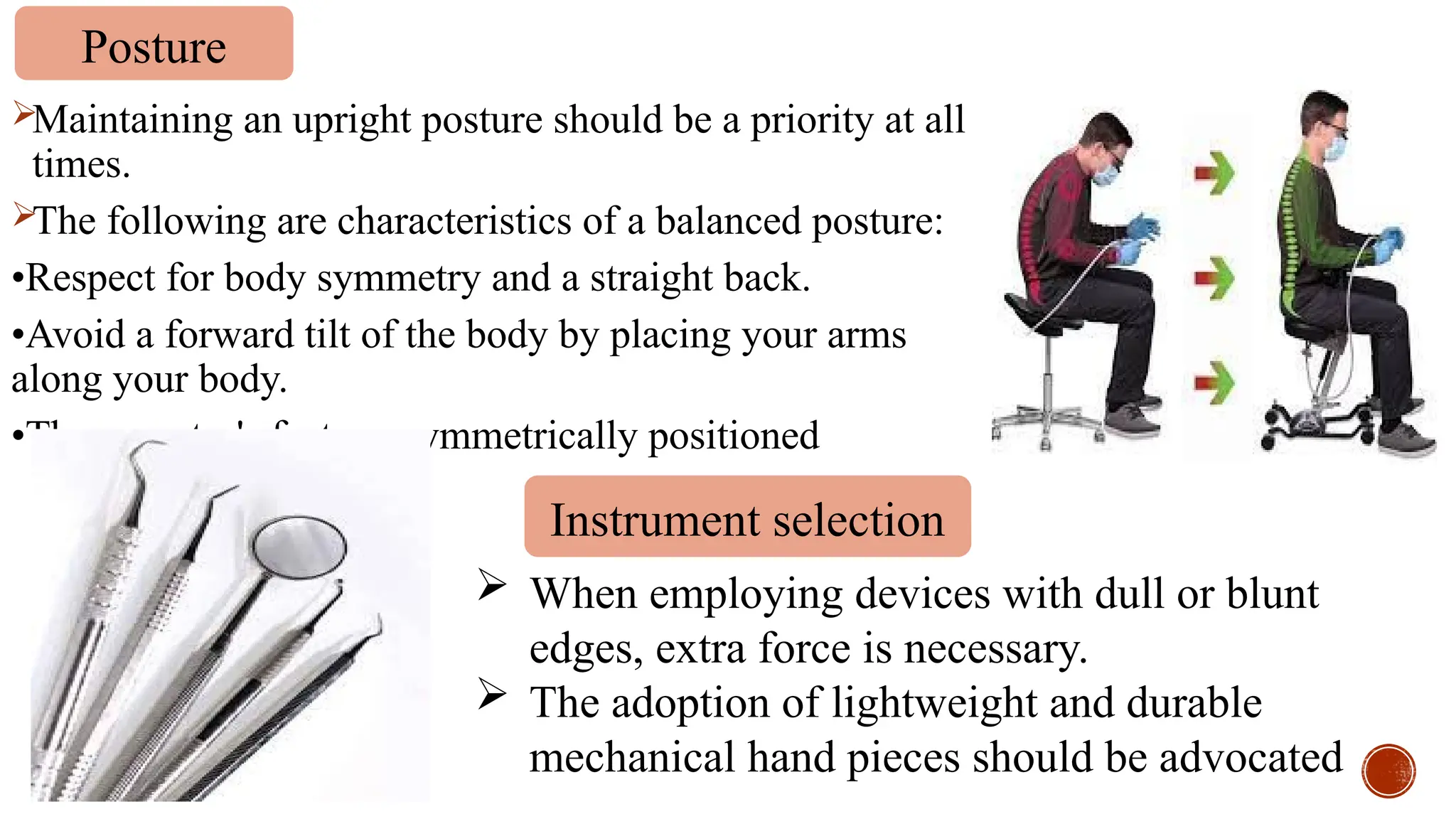
Maintaining an upright posture should be a priority at all
times.
The following are characteristics of a balanced posture:
•Respect for body symmetry and a straight back.
•Avoid a forward tilt of the body by placing your arms
along your body.
•The operator's feet are symmetrically positioned
Posture
Instrument selection
 When employing devices with dull or blunt
edges, extra force is necessary.
 The adoption of lightweight and durable
mechanical hand pieces should be advocated
Shadow-free illumination is
provided by the parallel alignment of
the light beam in the observing
direction, which improves job quality
Magnification and lighting
Dentist micro breaks
Moving the muscular workload from one location
to another should be done on a regular basis.
A dentist can take a break on the chair side and
stretch.
to allow for adequate recovery time and to
avoid muscular fatigue.
Develop a patient difficulty rating scale to
ensure difficult treatment
Scheduling
 It ensures that personnel are well
informed about workplace hazards and
are able to selfvolunteer in identifying
and minimising potential hazards
Dental personnel
training
SOME ASPECTS OF A FAULTY WORK STATION SET-UP
The dentist’s seat is either excessively high or excessively low.
There is no proper support in a dentist's chair.
The equipment table is incorrectly positioned.
The lighting is inadequate for the work.
Table/work surface edges are sharp and uncomfortable.
The workplace is damp and cold.
Ventilation makes workspace cold.
APPLICATIONS OF ERGONOMICS IN DENTISTRY
Work posture
Posture and
vision
Instruments
Dentist
position
Assistant
position
Patient
position Lighting &
magnification
Examination
and control
instruments
Direct &
Indirect
Working
instruments
PATIENT CHAIR
Positioning the oral cavity above heart level will increase the rate of shoulder fatigue.
Positioning the oral cavity below the recommended height will result in non-neutral
working postures including over declination of the head, forward and/or lateral bending
of the torso, and inability of the clinician to access free movement in the clock positions.
OPERATOR CHAIR
Saddle stool -provides optimal
seating allowing for proper
positioning of the spine and the
pelvis.
The angle of seat allows for proper balance of core
muscles and allows for the maintenance of normal
curvature without the use of a backrest and without
placing stress on the lower spine
IDEAL POSTURE OF ORAL HEALTH PROFESSIONAL
THE HEAD
 To be inclined slightly forward, oriented
over the shoulders.
 The interpupillary line is aligned
horizontally not more than 15 to 20
degrees.
TORSO
 The longitudinal axis of the torso is
upright. It promotes the natural curves of
the spine.
7’o clock position
Torso Position : Sit facing the patient with your hip in line with the
patient’s upper arm.
Leg Position : Your thighs should rest against the side of the patient
chair.
9’o Clock Position
Torso Position. Sit facing the side of the
patient’s head. The midline of your torso
is even with the patient’s mouth.
Leg Position. Your legs may be in either
of two acceptable positions: (1) straddling
the patient chair or (2) underneath the
headrest of the patient chair.
11’O CLOCK POSITION
Torso Position. Sit at the top right corner of the
headrest; the midline of your torso is even with the
temple region of the patient’s head.
Leg Position. Your legs should straddle the corner
of the headrest.
DIRECT REAR POSITION
Here the dentist sits directly behind the patient
and looks down over the patient’s head
This position is mainly used only working on
lingual surfaces of the mandibular anterior
teeth, lingual surfaces of maxillary anterior
teeth
UPPER ARMS, ELBOWS and SHOULDERS
 Arms relaxed at one’s side due to the force of
gravity. The elbows close to the side and the
forearm is in front of the body parallel to the
floor.
WRISTS
 Should be kept in a neutral position with the
wrists straight.
THE FINGERTIPS
 Should be held at the treatment point, at a
height that is comfortable and affords a clear
view of the procedure being performed.
SEATED POSTURE
Seating height at knee height; hips slightly higher than
the knees;
tilt the operator stool slightly downward.
THE FEET
To be flat on the floor. The lower legs are in a vertical
position.
Consider comfortable shoes and clothing to ease body
movement.
RHEOSTAT POSITIONING
Place it close to the operator so that the knee is at about
a 90 to 100 degree angle.
POSITION OF THE PATIENT
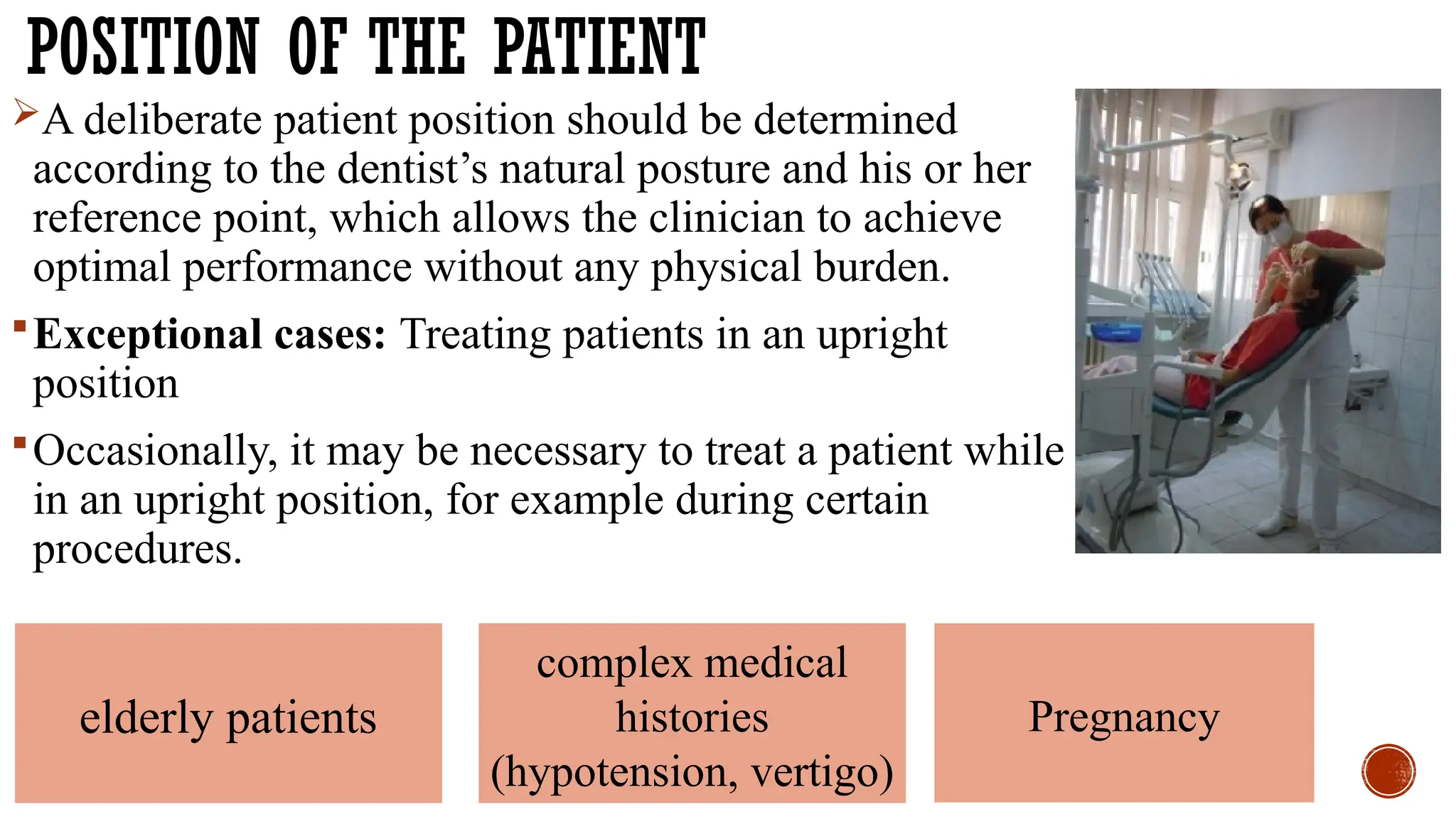
A deliberate patient position should be determined
according to the dentist’s natural posture and his or her
reference point, which allows the clinician to achieve
optimal performance without any physical burden.
Exceptional cases: Treating patients in an upright
position
Occasionally, it may be necessary to treat a patient while
in an upright position, for example during certain
procedures.
elderly patients
complex medical
histories
(hypotension, vertigo)
Pregnancy
Patient’s position for Maxillary Arch
Feet
even with or slightly
higher than the tip of
his/her nose
Chair back
nearly parallel to
the floor
Patient’s Head
even with the upper
edge of the headrest.
headrest
the patient’s
head is in
chin up
position
Patient’s position for Mandibular Arch
Feet
even with or
slightly higher
than the tip of
his/her nose
Chair back
slightly raised at a 15-
20°angle to the floor
Patient’s Head
even with the upper
edge of the headrest
Headrest
Raised slightly
that the patient’s
head is in a chin
down position
DIRECT AND INDIRECT VISUALIZATION
In order to maintain a properly balanced, upright posture, it is important to
balance direct visualization with indirect visualization using the dental mirror.
 In order to widen the view without compromising good posture, the dentist
should ask the patient to place the head on the headrest and adjust it accordingly
to allow easier access, depending on which surface they are working.
HARMONIZING POSTURE AND VISION
MIRROR
A systematic mirror technique is necessary because practitioners tend to
assume unnatural and improper posture when trying to check difficult-to-see
and impossible-to-see regions.
LIGHTING
The light beam of the operating light must be perpendicular to the working
mandibular plane or to the working maxilla plane to be fully effective.
Dental handpieces with an integrated light source are ideal for illumination
PRINCIPLES OF MAGNIFYING LOUPES TO BE USED
AS INTERVENTION FOR MSDS
In terms of ergonomics it is allowing the
dentist to work in comfort zone with
proper posture, reducing the eye strain
and reducing the chair side time as well
Steps used in magnification are as follows:
Field of View
Depth of
Field
Declination
(viewing)
angle
With increase in magnification, the field of view
gets decreased.
Normally magnification of 2x–2.5x is used in
dental practice and also recommended for new
users.
Field of view
The depth of field refers to the
ability of the loupes to focus on both
near and far field of interest without
changing the position of the dentist.
Depth of view
Declination (Viewing) Angle
 The lesser the viewing angle, greater the need for the dentist to tilt
the neck and view the object.
 It is ergonomically important to make sure that this angle is correct
for the dentist in order to minimize strain on the neck, back and
shoulders.
ERGONOMICS BENEFITS OF LOUPES IN MSDS
Burton and Bridgeman in their study focused on the working distance
between the clinician and field of interest and implemented that by using
loupes the working distance can be kept at a comfortable constant position
securing up right posture of the dentist throughout the working life of the
dental practitioner
An Australian survey suggested that dental hygienists who wear loupes
are less likely to have any neck and shoulder, wrist/hand, or upper back
pain than those not wearing loupes.
Using magnifying loupes, the field of vision becomes so clear that
gripping of the instruments for longer period of time is avoidable
Plessas A (2018) systematic review where the role of
ergonomic saddle seats and magnification loupes in
preventing MSDs are analyzed in which four studies on
loupes as intervention are mentioned, improving the
quality of dental care professionals and dental students
in terms of working posture, pace of work that
ultimately results in accuracy of diagnosis and
detection.
MAGNIFICATION BY LOUPES AND MICROSCOPE
While using either loupes or a microscope, there should be an optimal
distance from the dentist’s eyes to the patient’s mouth to ensure clear
vision, good focus and ideal posture.
CHOICE OF INSTRUMENTS
EXAMINATION AND CONTROL INSTRUMENTS
Instruments with a large diameter (10 mm), textured
handle, and a light weight (15 grams) require the least
amount of muscle load and pinch force.
Consider alternating tools with different diameter sizes to
reduce the duration of prolonged pinch gripping.
 Silicone instrument handles
 A round handle, compared to a
hexagon handle will reduce
muscle force and compression.
 Favor gloves of proper size and
fit
FINGER RESTS
Instruments should be held in a light, pen-like grip, using a fulcrum (finger
rest) either intra-orally or extra-orally.
The use of 2-finger rests has shown musculoskeletal advantages when
performing scaling procedures.
When researchers examined three different finger positions (no rest, 1-
finger rest, and 2-finger rests) they found significant reductions in thumb
pinch forces and muscle activity when using rests.
EQUIPMENT LAYOUT
Dental equipment should be located in a manner which allows
you to maintain a neutral working posture.
 Frequently used items such as the syringe, hand piece, saliva
ejector and high volume evacuator should be positioned so they
are within a normal horizontal reach which is the arc created
while sweeping the forearm
AMBIDEXTERITY
The majority of people prefer the use of their
dominant hand when performing manual
operations.
It is recommended that individuals attempt to use
alternate hands throughout the workday, whenever
possible.
 Although this may not be practical for certain
precision tasks, it is possible to alternate hands
when performing accessory tasks, such as reaching
for tools or supplies.
ERGONOMICS IN DENTISTRY: ADVANCES AND
STRATEGIES
FOUR-HANDED DENTISTRY
 It is a method in which the dentist and
subordinate work together to execute
procedures that are designed with the
patient's best interests in mind.
 In a four-handed dentistry arrangement,
proper use of a dental auxiliary's extra pair of
hands is widely recognised as an optimum
manner of providing dental services.
The following requirements must be completed in order to practise proper
four-handed dentistry
1.
• All equipment must be developed with ergonomics in mind.
2.
• Surgical team and the patient must be seated in ergonomically
designed equipment.
3.
• the dentist should assign all legally delegable duties to
qualified auxiliaries based on the state’s guidelines.
4.
• Treatment for the patient should be planned ahead of time and
arranged in a logical manner.
5.
• Preset trays should be utilized
Zones of activity:
The work area surrounding the patient is divided into 4 "activity-zones“
To detect activity zones, the patient's face is utilised to simulate the face of a
clock.
The four activity zones are
Operator’s zone
Assistant’s zone
Static zone
Transfer zone
STRATEGIES TO ENSURE EFFECTIVE FOUR HANDED
DENTISTRY
TEAMWORK
To effectively implement the concepts of true four handed dentistry
each member of the dental team must assume individual as well as
team responsibilities.
The team must be aware of each other’s needs, recognize the needs
to reposition the patient and operating team.
STRATEGIES FOR THE OPERATOR
The dentist/ Operator should develop standardized routine for basic dental
procedures
Develop a non verbal signal denoting a need to exchange an instrument.
When necessary give advance distinct verbal direction to communicate a need
for a different instrument or material.
The dentist/ operator must be willing to accept input from the assistant when it
is noted that chair positions need to be adjusted.
Avoid twisting and turning to reach instruments
When in practice the dental assistant should
change burs in the handpiece and maintain a ready
position for delivery of the handpiece
Remove debris from the instruments before
returning them to the preset tray.
Maintain a clean work area at all times.
Communication between the operator and the
assistant is vital to successfully implement the
concepts of four handed Dentistry
STRATEGIES FOR THE ASSISTANT
Develop a thorough understanding of the procedure.
Recognize the patient’s needs.
Anticipate the operator’s needs and recognize any change in the
procedure.
Be seated as close to the patient as possible with legs parallel to the long
axis of the patient’s body.
All these principles allow the practisioner to work smarter and not
harder.
When practiced properly, four-handed dentistry results in less
fatigue, less burnout, fewer physical challenges, greater
productivity, and greater job satisfaction for both dentists and
assistants.
Patients also appreciate receiving the undivided attention of a
well-coordinated dental team and have a much more comfortable
clinical experience when treated by a team, rather than by an
individual.
STRETCHING
Frequent stretch breaks can prevent detrimental physiological changes
that can develop while working in static or awkward postures.
 In an attempt to prevent injury from occurring to muscles and other
tissues, dental professionals should allow for rest periods to replenish and
nourish stressed structures.
If breaks are too far apart, the rate of damage could exceed the rate of
repair and eventually lead to the breakdown of tissue.
Researchers suggest that dental professionals try to lean back on their
stool at least four times during each treatment session as well as spend
three to five minutes stretching for every patient seen throughout the
day
Also, Take a break from activities and focus eyes at a distance for
20 seconds to relieve eyestrain caused by focusing hard on one
depth of vision for extended periods of time.
If there is neck stiffness, rotate your head in a comfortable range of
motion from forward and backward, right and left.
Shoulder rolling can help stretch fatigued shoulder muscles from
holding an oral evacuator, tools,
CONCLUSION
High productivity, injury prevention, and greater patient
satisfaction are all benefits of successful ergonomics in the
dental operatory.
 MSDs can be avoided by following some fundamental
principles and maintaining a healthy posture.
Regular continuing dental education seminars and lectures
should be promoted to raise awareness among dental
practitioners.
 Four-handed dentistry should be used on a regular basis to
promote efficiency and convenience.
REFERENCES
ERGONOMICS AND POSTURE GUIDELINES FOR ORAL
HEALTH PROFESSIONALS Content developed by Health and Safety
Task Team (T. Caruso, D. Ilhan, M. Ishida, J.M. Laffont) ©2021 FDI
World Dental Federation.
Gupta A, Bhat M, Mohammed T, Bansal N, Gupta G. Ergonomics in
dentistry. Int J Clin Pediatr Dent. 2014 Jan;7(1):30-4. doi: 10.5005/jp-
journals-10005-1229. Epub 2014 Apr 26. PMID: 25206234; PMCID:
PMC4144062.
Dushyant Datkar, Akash Sibal, Bhairavi Kale, Ergonomics in Dentistry:
A Review, J Res Med Dent Sci, 2022, 10 (7): 087-091.
Sachdeva A, Bhateja S, Arora G. Ergonomics in dentistry: A
comprehensive review. J Dent Res 2020;7:32-5.
Harpreet Kaur ,Vandana A. Pant ,Vandana Gupta “Magnification in
Dental Ergonomics – A Comprehensive Review” Advances in
Bioscience and Clinical Medicine Volume: 10 Issue: 1 January 31,
2022.
ERGONOMICS IN DENTAL PRACTICE Shah A.F. et al., Int J Dent Health
Sci 2014; 1(1): 68-78.
Rajvanshi, et al.: A Review on Ergonomics in Dentistry: International
Journal of Scientific Study | September 2015 | Vol 3 | Issue 6
Shipra Gupta. Ergonomic applications to dental practice. Indian
Journal of Dental Research,22(6),2011
THANKYOU

*****ERGONOMICS IN DENTISTRY. pptx******

  • 1.
    ERGONOMICS IN DENTISTRY Dr. SushmitaRane MDS III Seminar 11 17/1/2024
  • 2.
    CONTENTS: Introduction Definition Ergonomic Design Goals MusculoskeletalDisorders Application of ergonomics in dentistry Four handed Dentistry Conclusion References
  • 3.
    INTRODUCTION  "Look after yourbody Jim Rohn says, "It's the only place where you reside”. Dental professionals are susceptible to a variety of occupational diseases and disorders, the most frequent of which being Musculoskeletal Disorders (MSDs), which can cause longterm harm. The most prevalent injuries are to the wrists, elbows, shoulders, neck, and back and spine, according to research.
  • 5.
    Ergonomics is derivedfrom two Greek words: Ergon, which means "labour," and Nomo’s, which means "principles or laws”. It is a method of working smarter by providing tools, equipment, and workstations that allow practitioners to operate as efficiently and safely as possible. Ergonomic design improves productivity, reduces injuries, and increases worker happiness. The International Ergonomics Association (IEA) defines ergonomics (or human factors) as “the scientific discipline concerned with the understanding of the interactions among humans and other elements of a system, and the profession that applies theoretical principles, data and methods to design, in order to optimize human well-being and overall system performance.”
  • 6.
    WHAT BAD POSTURECAN CAUSE ? The potential to develop musculoskeletal disorders is higher when one disregards good ergonomic principles. In doing so, dentists are at risk of compromising their technical expertise during procedures. This can lead to a limitation of certain procedures, potential career shortening, and, in the worst case, possible career-ending injuries.
  • 7.
    The surveys belowshow that the main complaints are neck and lower back pain. It has also been noted that female dentists appear to have a higher incidence of upper body complaints than their male counterparts.
  • 8.
    ERGONOMIC DESIGN GOALS Improvejob process by eliminating unnecessary tasks, steps and efforts Reduce potential for overexertion injury Minimize mental/physical fatigue potential Leverage worker’s skill/knowledge of their jobs to increase their satisfaction, comfort and fulfillment
  • 9.
    CONSEQUENCES OF POORDESIGN Discomfort Chronic pain Accidents Injuries Fatigue Increased Errors Work related Musculoskeletal Disorders: -Lower back pain -Tendinitis -Epicondylitis -Carpel tunnel syndrome
  • 11.
    MUSCULOSKELETAL DISORDERS (MSDS)– DESCRIPTIONAND WIDESPREAD “Work-related musculoskeletal illnesses with a chronic progressive development involves ligaments, spinal discs, muscles, cartilage, nerves, joints and tendons  known as Repetitive Motion Injuries/RMI or Cumulative Trauma Disorders/CTD.  World’s 2nd leading cause of disability
  • 12.
    WHY WE SHOULDCARE? As per an audit of the worldwide dental writing, around 65% of dental specialists experience outer muscle manifestations like agony, uneasiness, practical hindrance, and expanded labour duration. According to a Bureau of Labour analysis, dental hygienists scored first among all professions in terms of the number of instances of carpel tunnel syndrome per 1,000 employees.
  • 13.
    RISK FACTORS 1)Long periodsof difficult postures 2) If procedure performed repeatedly and over a lengthy period of time 3) Poor lighting when the back is bent or twisted Exercising for long periods of time above shoulder height when sitting in a forwardly bent and rotated position
  • 14.
    Risk Factors forMSDs Dental Procedures Repititive motions Scaling and polishing Awkward Posture Handling of Objects with the back bent/ twisted Static Posture Static neck, back and shoulders Forceful exertions Tooth extraction Duration Grasping small instruments for prolonged periods Contact Stresses Repeated contacts with hard or sharp objects Vibration Prolonged use of vibrating hand tools
  • 15.
    STATIC POSTURES Researchers havefound that even 30 degrees of forward shoulder flexion or abduction can cause a significant impairment in blood circulation within the shoulder / neck region Static gripping for durations exceeding 20 minutes was also noted during instrumentation tasks within dental practice.
  • 16.
    FORCE Researchers have suggestedthat excessive use of a pinch gripping is the greatest contributing risk factor in the development of MSDs among dental practitioners. REPETITIVE MOVEMENTS Highly repetitive tasks like endodontic procedures can lead to fatigue, tissue damage and discomfort.
  • 17.
    CLINICAL FEATURES OFMUSCULOSKELETAL DISORDERS Signs Symptoms 1. • Range of motion is reduced 2. • Deprived normal sensation 3. • Abnormal grip strength 4. • Loss of normal Locomotion 5. • Deprived co-ordination. 1. • Hypersensitivity in hands and fingers 2. • Excessive fatigue in shoulder and neck 3. • Tingling and burning sensations in hand 4. • Weak grip, cramping of hands 5. • Numbness in fingers and hands
  • 18.
    Classification of MSDs Neuraldiseases Ulnar neuropathy, Carpal tunnel syndrome. Diseases of the neck Cervical Spondylosis, Tension Neck Syndrome, cervical disc disease, Brachial plexus compression. Diseases of the shoulder Trapezius myalgia, Rotator cuff tendonitis, Rotator cuff tears, and adhesive capsulitis. Diseases of the Forearm, Elbow and Wrist De Quervains disease, Tendonitis, Tenosynovitis, Epicondylitis. Hand-Arm vibration syndrome Reynaud’s disease Diseases of the back Lower Back Pain (LBP), Upper back pain.
  • 19.
    WRIST The safest positionfor the wrist is a straight or neutral position. Special care should be used to avoid bending the wrist downwards (flexion) or outwards (ulnar deviation).
  • 20.
    Carpel Tunnel Syndrome( CTS) CTS occurs when the median nerve, which runs from the forearm into the hand, becomes pressed or squeezed at the wrist.
  • 21.
    Researchers have highlightedthat one of the predictors for the high prevalence of Carpel Tunnel Syndrome among dentists was their longer clinical period of repetitive movements Tendonitis of the Wrist  Tendonitis of the wrist is accompanied by pain, swelling and inflammation on the thumb side of the wrist, and is made worse with grasping and twisting activities .  People with this disorder have often noted an occasional “catching” or snapping when moving their thumb.
  • 22.
    Guyon’s Syndrome The Compressionoccurs in this space at the base of the palm. It is commonly caused by repetitive wrist flexing or excessive pressure on palm. It is characterized by pain, weakness, numbness, tingling & burning in the little finger and part of the ring finger.
  • 23.
    DeQuervain’s Tenosynovitis This disorderis characterized by pain and swelling in the thumb and wrist area when grasping, pinching, twisting, and a decreased range of motion of thumb with pain. This include synovial sheath swelling, thickening of tendons at base of thumb Causes- repeated trauma or twisting hand/wrist motions.
  • 24.
    Epicondylitis These Injuries typicallyoccur at either the inside of the elbow, referred to as Medial Epicondylitis (golfer’s elbow), or outside of the elbow, known as Lateral Epicondylitis (tennis elbow).
  • 25.
     SHOULDERS Rounding theshoulders can compress nerves, arteries, and veins that supply the arm and hand, leading to upper extremity symptoms. Poor thoracic alignment Slouching forward compresses the chest cavity Fatigue & loss of concentration.
  • 26.
    Trapezius myalgia Trapezius myalgia(TM) is the complaint of pain, stiffness, and tightness of the upper trapezius muscle. It is characterised by acute or persistent neck-shoulder pain. trapezius myalgia is caused by static, prolonged elevation of the shoulders, mental stress, infrequent breaks, and poor head posture.
  • 27.
    Rotator Cuff Tear Therotator cuff (RC) is a group of 4 muscles; supraspinatus, infraspinatus, teres minor and subscapularis.  The Rotator cuff muscle assists with both gross and fine motor control of the arm. Research has shown that clinicians who work without properly fitted loupes lean their neck forward in an unsupported position 85% of the time, creating tremendous stress on the neck and shoulder musculature.
  • 28.
    Neck Pain and discomfortare the most common complaints reported in the neck/shoulder region amongst dental professionals. The slight inward curve of the neck balances the head on the spine. Holding the head forward disturbs this balance, straining the joints and the muscles of the neck and upper back. This posture also causes compression of the nerves and blood vessels as they exit the neck, leading to symptoms in the arm and hand.
  • 29.
    Cervical Spondylosis This disorderis characterized by intermittent/chronic neck and shoulder pain or stiffness, headaches, hand and arm pain, numbness, tingling, and clumsiness.  Possible causes include age-related spinal disc degeneration leading to nerve compression and spinal cord damage, arthritis, and time spent with the neck in sustained awkward postures.
  • 30.
    The main riskfactors associated with dental work are the sustained awkward postures and poor seating.  Most individuals with low back pain do not simply injure their back in one incident but rather gradually over time.
  • 31.
    Disc Problems In aseated posture the pressure in the lumbar discs increases by 50% During bending (forward flexion) and twisting (rotation) motions of the spine, the pressure on the lumbar discs increases by 200%.
  • 32.
    Sciatica It is characterizedby pain in the lower back radiating to legs, causing leg weakness, numbness, or tingling.  It is commonly caused by bulging, prolapsed or herniated discs compressing a spinal nerve root and is worsened with prolonged sitting or excessive bending and lifting.
  • 33.
    INTERVENTION AND PREVENTION Maintaininga proper posture and symmetry requires a strong connection between the dentist and the intraoral working zone.  Ergonomics should be considered while building instruments and planning workspaces, as well as in clinical practise.  It is always recommended to leave 35–40 cm between the working field and the dentist’s eyes Posture Instrument selection Magnification and lighting Dentist micro breaks Scheduling Dental personnel training
  • 34.
    Maintaining an uprightposture should be a priority at all times. The following are characteristics of a balanced posture: •Respect for body symmetry and a straight back. •Avoid a forward tilt of the body by placing your arms along your body. •The operator's feet are symmetrically positioned Posture Instrument selection  When employing devices with dull or blunt edges, extra force is necessary.  The adoption of lightweight and durable mechanical hand pieces should be advocated
  • 35.
    Shadow-free illumination is providedby the parallel alignment of the light beam in the observing direction, which improves job quality Magnification and lighting Dentist micro breaks Moving the muscular workload from one location to another should be done on a regular basis. A dentist can take a break on the chair side and stretch.
  • 36.
    to allow foradequate recovery time and to avoid muscular fatigue. Develop a patient difficulty rating scale to ensure difficult treatment Scheduling  It ensures that personnel are well informed about workplace hazards and are able to selfvolunteer in identifying and minimising potential hazards Dental personnel training
  • 37.
    SOME ASPECTS OFA FAULTY WORK STATION SET-UP The dentist’s seat is either excessively high or excessively low. There is no proper support in a dentist's chair. The equipment table is incorrectly positioned. The lighting is inadequate for the work. Table/work surface edges are sharp and uncomfortable. The workplace is damp and cold. Ventilation makes workspace cold.
  • 38.
    APPLICATIONS OF ERGONOMICSIN DENTISTRY Work posture Posture and vision Instruments Dentist position Assistant position Patient position Lighting & magnification Examination and control instruments Direct & Indirect Working instruments
  • 39.
    PATIENT CHAIR Positioning theoral cavity above heart level will increase the rate of shoulder fatigue. Positioning the oral cavity below the recommended height will result in non-neutral working postures including over declination of the head, forward and/or lateral bending of the torso, and inability of the clinician to access free movement in the clock positions.
  • 40.
    OPERATOR CHAIR Saddle stool-provides optimal seating allowing for proper positioning of the spine and the pelvis. The angle of seat allows for proper balance of core muscles and allows for the maintenance of normal curvature without the use of a backrest and without placing stress on the lower spine
  • 41.
    IDEAL POSTURE OFORAL HEALTH PROFESSIONAL THE HEAD  To be inclined slightly forward, oriented over the shoulders.  The interpupillary line is aligned horizontally not more than 15 to 20 degrees. TORSO  The longitudinal axis of the torso is upright. It promotes the natural curves of the spine.
  • 42.
    7’o clock position TorsoPosition : Sit facing the patient with your hip in line with the patient’s upper arm. Leg Position : Your thighs should rest against the side of the patient chair.
  • 43.
    9’o Clock Position TorsoPosition. Sit facing the side of the patient’s head. The midline of your torso is even with the patient’s mouth. Leg Position. Your legs may be in either of two acceptable positions: (1) straddling the patient chair or (2) underneath the headrest of the patient chair.
  • 44.
    11’O CLOCK POSITION TorsoPosition. Sit at the top right corner of the headrest; the midline of your torso is even with the temple region of the patient’s head. Leg Position. Your legs should straddle the corner of the headrest.
  • 45.
    DIRECT REAR POSITION Herethe dentist sits directly behind the patient and looks down over the patient’s head This position is mainly used only working on lingual surfaces of the mandibular anterior teeth, lingual surfaces of maxillary anterior teeth
  • 46.
    UPPER ARMS, ELBOWSand SHOULDERS  Arms relaxed at one’s side due to the force of gravity. The elbows close to the side and the forearm is in front of the body parallel to the floor. WRISTS  Should be kept in a neutral position with the wrists straight. THE FINGERTIPS  Should be held at the treatment point, at a height that is comfortable and affords a clear view of the procedure being performed.
  • 47.
    SEATED POSTURE Seating heightat knee height; hips slightly higher than the knees; tilt the operator stool slightly downward. THE FEET To be flat on the floor. The lower legs are in a vertical position. Consider comfortable shoes and clothing to ease body movement. RHEOSTAT POSITIONING Place it close to the operator so that the knee is at about a 90 to 100 degree angle.
  • 48.
    POSITION OF THEPATIENT A deliberate patient position should be determined according to the dentist’s natural posture and his or her reference point, which allows the clinician to achieve optimal performance without any physical burden. Exceptional cases: Treating patients in an upright position Occasionally, it may be necessary to treat a patient while in an upright position, for example during certain procedures. elderly patients complex medical histories (hypotension, vertigo) Pregnancy
  • 49.
    Patient’s position forMaxillary Arch Feet even with or slightly higher than the tip of his/her nose Chair back nearly parallel to the floor Patient’s Head even with the upper edge of the headrest. headrest the patient’s head is in chin up position
  • 50.
    Patient’s position forMandibular Arch Feet even with or slightly higher than the tip of his/her nose Chair back slightly raised at a 15- 20°angle to the floor Patient’s Head even with the upper edge of the headrest Headrest Raised slightly that the patient’s head is in a chin down position
  • 51.
    DIRECT AND INDIRECTVISUALIZATION In order to maintain a properly balanced, upright posture, it is important to balance direct visualization with indirect visualization using the dental mirror.  In order to widen the view without compromising good posture, the dentist should ask the patient to place the head on the headrest and adjust it accordingly to allow easier access, depending on which surface they are working. HARMONIZING POSTURE AND VISION
  • 52.
    MIRROR A systematic mirrortechnique is necessary because practitioners tend to assume unnatural and improper posture when trying to check difficult-to-see and impossible-to-see regions. LIGHTING The light beam of the operating light must be perpendicular to the working mandibular plane or to the working maxilla plane to be fully effective. Dental handpieces with an integrated light source are ideal for illumination
  • 53.
    PRINCIPLES OF MAGNIFYINGLOUPES TO BE USED AS INTERVENTION FOR MSDS In terms of ergonomics it is allowing the dentist to work in comfort zone with proper posture, reducing the eye strain and reducing the chair side time as well Steps used in magnification are as follows: Field of View Depth of Field Declination (viewing) angle
  • 54.
    With increase inmagnification, the field of view gets decreased. Normally magnification of 2x–2.5x is used in dental practice and also recommended for new users. Field of view The depth of field refers to the ability of the loupes to focus on both near and far field of interest without changing the position of the dentist. Depth of view
  • 55.
    Declination (Viewing) Angle The lesser the viewing angle, greater the need for the dentist to tilt the neck and view the object.  It is ergonomically important to make sure that this angle is correct for the dentist in order to minimize strain on the neck, back and shoulders.
  • 56.
    ERGONOMICS BENEFITS OFLOUPES IN MSDS Burton and Bridgeman in their study focused on the working distance between the clinician and field of interest and implemented that by using loupes the working distance can be kept at a comfortable constant position securing up right posture of the dentist throughout the working life of the dental practitioner An Australian survey suggested that dental hygienists who wear loupes are less likely to have any neck and shoulder, wrist/hand, or upper back pain than those not wearing loupes. Using magnifying loupes, the field of vision becomes so clear that gripping of the instruments for longer period of time is avoidable
  • 57.
    Plessas A (2018)systematic review where the role of ergonomic saddle seats and magnification loupes in preventing MSDs are analyzed in which four studies on loupes as intervention are mentioned, improving the quality of dental care professionals and dental students in terms of working posture, pace of work that ultimately results in accuracy of diagnosis and detection.
  • 58.
    MAGNIFICATION BY LOUPESAND MICROSCOPE While using either loupes or a microscope, there should be an optimal distance from the dentist’s eyes to the patient’s mouth to ensure clear vision, good focus and ideal posture.
  • 59.
    CHOICE OF INSTRUMENTS EXAMINATIONAND CONTROL INSTRUMENTS Instruments with a large diameter (10 mm), textured handle, and a light weight (15 grams) require the least amount of muscle load and pinch force. Consider alternating tools with different diameter sizes to reduce the duration of prolonged pinch gripping.  Silicone instrument handles  A round handle, compared to a hexagon handle will reduce muscle force and compression.  Favor gloves of proper size and fit
  • 60.
    FINGER RESTS Instruments shouldbe held in a light, pen-like grip, using a fulcrum (finger rest) either intra-orally or extra-orally. The use of 2-finger rests has shown musculoskeletal advantages when performing scaling procedures. When researchers examined three different finger positions (no rest, 1- finger rest, and 2-finger rests) they found significant reductions in thumb pinch forces and muscle activity when using rests.
  • 61.
    EQUIPMENT LAYOUT Dental equipmentshould be located in a manner which allows you to maintain a neutral working posture.  Frequently used items such as the syringe, hand piece, saliva ejector and high volume evacuator should be positioned so they are within a normal horizontal reach which is the arc created while sweeping the forearm
  • 62.
    AMBIDEXTERITY The majority ofpeople prefer the use of their dominant hand when performing manual operations. It is recommended that individuals attempt to use alternate hands throughout the workday, whenever possible.  Although this may not be practical for certain precision tasks, it is possible to alternate hands when performing accessory tasks, such as reaching for tools or supplies.
  • 63.
    ERGONOMICS IN DENTISTRY:ADVANCES AND STRATEGIES FOUR-HANDED DENTISTRY  It is a method in which the dentist and subordinate work together to execute procedures that are designed with the patient's best interests in mind.  In a four-handed dentistry arrangement, proper use of a dental auxiliary's extra pair of hands is widely recognised as an optimum manner of providing dental services.
  • 64.
    The following requirementsmust be completed in order to practise proper four-handed dentistry 1. • All equipment must be developed with ergonomics in mind. 2. • Surgical team and the patient must be seated in ergonomically designed equipment. 3. • the dentist should assign all legally delegable duties to qualified auxiliaries based on the state’s guidelines. 4. • Treatment for the patient should be planned ahead of time and arranged in a logical manner. 5. • Preset trays should be utilized
  • 65.
    Zones of activity: Thework area surrounding the patient is divided into 4 "activity-zones“ To detect activity zones, the patient's face is utilised to simulate the face of a clock. The four activity zones are Operator’s zone Assistant’s zone Static zone Transfer zone
  • 67.
    STRATEGIES TO ENSUREEFFECTIVE FOUR HANDED DENTISTRY TEAMWORK To effectively implement the concepts of true four handed dentistry each member of the dental team must assume individual as well as team responsibilities. The team must be aware of each other’s needs, recognize the needs to reposition the patient and operating team.
  • 68.
    STRATEGIES FOR THEOPERATOR The dentist/ Operator should develop standardized routine for basic dental procedures Develop a non verbal signal denoting a need to exchange an instrument. When necessary give advance distinct verbal direction to communicate a need for a different instrument or material. The dentist/ operator must be willing to accept input from the assistant when it is noted that chair positions need to be adjusted. Avoid twisting and turning to reach instruments
  • 69.
    When in practicethe dental assistant should change burs in the handpiece and maintain a ready position for delivery of the handpiece Remove debris from the instruments before returning them to the preset tray. Maintain a clean work area at all times. Communication between the operator and the assistant is vital to successfully implement the concepts of four handed Dentistry
  • 70.
    STRATEGIES FOR THEASSISTANT Develop a thorough understanding of the procedure. Recognize the patient’s needs. Anticipate the operator’s needs and recognize any change in the procedure. Be seated as close to the patient as possible with legs parallel to the long axis of the patient’s body.
  • 71.
    All these principlesallow the practisioner to work smarter and not harder. When practiced properly, four-handed dentistry results in less fatigue, less burnout, fewer physical challenges, greater productivity, and greater job satisfaction for both dentists and assistants. Patients also appreciate receiving the undivided attention of a well-coordinated dental team and have a much more comfortable clinical experience when treated by a team, rather than by an individual.
  • 72.
    STRETCHING Frequent stretch breakscan prevent detrimental physiological changes that can develop while working in static or awkward postures.  In an attempt to prevent injury from occurring to muscles and other tissues, dental professionals should allow for rest periods to replenish and nourish stressed structures. If breaks are too far apart, the rate of damage could exceed the rate of repair and eventually lead to the breakdown of tissue.
  • 73.
    Researchers suggest thatdental professionals try to lean back on their stool at least four times during each treatment session as well as spend three to five minutes stretching for every patient seen throughout the day
  • 74.
    Also, Take abreak from activities and focus eyes at a distance for 20 seconds to relieve eyestrain caused by focusing hard on one depth of vision for extended periods of time. If there is neck stiffness, rotate your head in a comfortable range of motion from forward and backward, right and left. Shoulder rolling can help stretch fatigued shoulder muscles from holding an oral evacuator, tools,
  • 75.
    CONCLUSION High productivity, injuryprevention, and greater patient satisfaction are all benefits of successful ergonomics in the dental operatory.  MSDs can be avoided by following some fundamental principles and maintaining a healthy posture. Regular continuing dental education seminars and lectures should be promoted to raise awareness among dental practitioners.  Four-handed dentistry should be used on a regular basis to promote efficiency and convenience.
  • 76.
    REFERENCES ERGONOMICS AND POSTUREGUIDELINES FOR ORAL HEALTH PROFESSIONALS Content developed by Health and Safety Task Team (T. Caruso, D. Ilhan, M. Ishida, J.M. Laffont) ©2021 FDI World Dental Federation. Gupta A, Bhat M, Mohammed T, Bansal N, Gupta G. Ergonomics in dentistry. Int J Clin Pediatr Dent. 2014 Jan;7(1):30-4. doi: 10.5005/jp- journals-10005-1229. Epub 2014 Apr 26. PMID: 25206234; PMCID: PMC4144062. Dushyant Datkar, Akash Sibal, Bhairavi Kale, Ergonomics in Dentistry: A Review, J Res Med Dent Sci, 2022, 10 (7): 087-091. Sachdeva A, Bhateja S, Arora G. Ergonomics in dentistry: A comprehensive review. J Dent Res 2020;7:32-5.
  • 77.
    Harpreet Kaur ,VandanaA. Pant ,Vandana Gupta “Magnification in Dental Ergonomics – A Comprehensive Review” Advances in Bioscience and Clinical Medicine Volume: 10 Issue: 1 January 31, 2022. ERGONOMICS IN DENTAL PRACTICE Shah A.F. et al., Int J Dent Health Sci 2014; 1(1): 68-78. Rajvanshi, et al.: A Review on Ergonomics in Dentistry: International Journal of Scientific Study | September 2015 | Vol 3 | Issue 6 Shipra Gupta. Ergonomic applications to dental practice. Indian Journal of Dental Research,22(6),2011
  • 78.

Editor's Notes

  • #3 After 1st point….To save great structure, capacity, and wellbeing, each dental specialist should keep up with ideal stance and shape. Dental work necessitates a high level of physical and mental concentration, and long work hours can lead to poor posture. Due to limited access and restricted perspective, dentists are believed to be the most sensitive to postural disorders, making them subject to occupational. To stay away from redundant strain wounds, which can prompt long haul inadequacy, effective intuitive design should be prioritised. Ergonomic principles are intended to provide practitioners with a generally safe and healthy working environment, resulting in increased productivity
  • #4 Dental personnel and dentists are increasingly commonly connected to various health effects Carpal tunnel syndrome is a common condition that causes numbness, tingling, and pain in the hand and forearm. The condition occurs when one of the major nerves to the hand — the median nerve — is squeezed or compressed as it travels through the wrist. In most patients, carpal tunnel syndrome gets worse over time. TENSION NECK SYNDROME.- which refers to the neck pain that develops when the muscles in the neck cannot relax which can lead to soreness, muscle spasm and headaches Tendinitis- inflammation of tendons that impedes smooth movements. I will discuss in brief each one of it. later
  • #5 As a result, it is vital for prospective dentists to practise dentistry with appropriate ergonomic design. Several musculoskeletal ailments are discussed.The dental profession need highly precise and controlled dental preparations. Muscles utilised for this reason are at danger of becoming exhausted, causing the dentist discomfort.
  • #6 1st point..The dark and narrow space in the oral cavity can cause oral health professionals (OHPs) to adopt an unnatural posture during dental treatment, which can lead to serious physical impact and repetitive strain injuries.
  • #7 1st point……The surveys below show that the main complaints are neck and lower back pain. These issues develop over a number of years and worsen with a heavy workload.
  • #10 37%Muskuloskeletal disorders, 26%cardiovascular disease, 20% neurotic symptoms, 9%tumors… also 8% others like eyestrain & hearing loss ( handpiece noise )
  • #12 they are rapidly becoming a global healthcare issue.
  • #13 The following are some of the risk factors for MSDs among dental workers: Long periods of difficult postures: Dentists adopt uncomfortable attitudes in order to gain a good view of the patient's teeth and to keep the dentist and assistant in rhythm. when the back is bent or twisted,the spinal discs are put under higher tension. Exercising for long periods of time above shoulder height might also be stressful. Furthermore, when sitting in a forwardly bent and rotated position, disc pressure rises quickly. • If procedure performed repeatedly and over a lengthy period of time, repetitive actions can cause fatigue and muscle strain. • Poor lighting: Inadequate illumination at the workplace may unintentionally contribute to improper postures.
  • #14 This table shows some of the risk factors for specific procedures performed in routine dental practice. few more that contribute to MSDs, such as stress, lack of flexibility, inadequate breaks, and poor equipment adjustment [4]. According to 2016 survey, 44 percent of dentists have Repetitive Motion Injury.
  • #15 •before 1st point……Static postures are defined by those which are held for a long period of time and may result in fatigue and injury. After 1st point….During this posture…Oxygen is delivered to the muscles and joints by blood. After Last point….which lead to fatigue
  • #16 Force refers to the amount of effort created by the muscles as well as the amount of pressure placed upon a body part.
  • #17 It was discovered in a 2018 study of ergonomic postures that none of the operators had the optimal neck position. Consistent flexion and augmentation activities of the hand and wrist with no rest produce mechanical weight on the nerves.So MSDs can be avoided by working in an ergonomically designed environment
  • #18 Classification of MSD’s
  • #19 1st point….So now will see what all health effects can be seen in Musculoskeletal disorders. AS we knowThe wrist is in constant demand, often sustaining excessive and repeated stresses and strains. The following diagram shows the reduction in strength which occurs as the wrist deviates further away from its neutral posture
  • #20 Carpal tunnel syndrome is a common condition that causes numbness, tingling, and pain in the hand and forearm. The condition occurs when one of the major nerves to the hand — the median nerve — is squeezed or compressed as it travels through the wrist. In most patients, carpal tunnel syndrome gets worse over time.
  • #21 Researchers have highlighted that one of the predictors for the high prevalence of Carpel Tunnel Syndrome among dentists was their longer clinical period of repetitive movements when work was done on parts of the mouth that were difficult to access and required precise movement and control Tendonitis is an inflammation of tendons, which are the structures that attach muscle to bone.
  • #22 Guyon's canal is a space at the wrist between the pisiform ulnar border and the hamate bone through which the ulnar artery and the ulnar nerve travel into the hand.
  • #24 Before 1st point…There are forearm flexors which are attached at the inside portion of the elbow. Whereas the forearm extensors,are used to open the hand are attached at the outside of the elbow can be affected. After 1st point….This occurs due to repetitive stress which causes interstitial tearing, inflammation and swelling
  • #25 Poor thoracic alignment also limits oxygen intake. .. Slouching forward compresses the chest cavity, preventing the diaphragm muscle from completely filling the lungs with air. When oxygen is diminished, the body experiences fatigue and loss of concentration.
  • #27 Clinicians who don't use magnification frequently position the patient too high just to be able to see. In the vain attempt to improve visual acuity, their arms splay out from their torso, creating aawkward posture
  • #28 Also Studies have shown that female dentists reported neck symptoms 1.4 times more often than male dentists.
  • #29 It is caused by abnormal wear and tear of the discs and joints of the neck which leads to neck pain radiating upto both the hands
  • #30  Repeated stresses from over the years begin to add up and slowly cause degeneration of various parts of the spine, resulting in low back pain.
  • #31 This type of pressure on the disc can lead to a bulge or herniation, causing compression on a spinal nerve
  • #33 Before 1st point….Prevention is preferable to cure." Any sickness can be prevented, which saves time, money, and pain. Musculoskeletal disorders (MSDs) are a common condition (disease) among dentists, and Ergonomics is the solution to the problem. After last point…..The following changes can aid in the implementation of ergonomic principles like posture, instrument selection, magnification and lighting, dentist microbreaks, scheduling and dental personnel training… i will explain each of the aspects in detail in further slides
  • #34 Posture: Improper postural alignment exerts pressure on nerves and blood vessels, producing unnecessary muscular strain and wear and tear in the joints The operator's feet are symmetrically positioned beneath his or her hands. Instrument selection: When the working edges are not blunt, the device does the majority of the work, requiring less force. When employing devices with dull or blunt edges, extra force is necessary. Furthermore, instead of manual hand instruments, the adoption of lightweight and durable mechanical hand pieces should be advocated.
  • #35 Magnification and lighting Shadow-free illumination is provided by the parallel alignment of the light beam in the observing direction, which improves job quality . Dental loupes and a microscope with multiple magnification levels allow for a more upright posture, reducing back and neck pain. Dentist micro breaks Take frequent rests to relax your body parts.
  • #36 Scheduling Appointments should be scheduled to allow for adequate recovery time and to avoid muscular fatigue. Develop a patient difficulty rating scale to ensure difficult treatment With buffer intervals in between, alternate easy and challenging situations should be tackled. Dental personnel training Every health-care situation requires training.
  • #38 Under work posture comes…
  • #39 1st point…. When seating a patient, optimal results will be achieved when their oral cavity is positioned at a height equal to the seated height of the clinician’s heart.
  • #40 the Saddle stool pre-positions you into an anterior pelvic tilt.
  • #41 TORSO The longitudinal axis of the torso is upright. It promotes the natural curves of the spine. If needed, the back rest of the chair can be positioned to provide lumbar support.
  • #42 When working from clock positions 9-12:00, feet spread apart so that your legs and the chair base form a tripod which creates a stable position :
  • #43 Neutral position is best achieved by straddling the chair; however, you should use the alternative position if you find straddling uncomfortable.
  • #45 This position has limited application.
  • #47 After 1st point….Studies have shown that the seat moves almost every minute throughout a typical treatment session, as the clinician is continually adjusting their positioning to improve visual access and accommodate patient movement. RHEOSTAT POSITIONING Place it close to the operator so that the knee is at about a 90 to 100 degree angle. hence low back pain. Consider using alternating sides However, Movement throughout the day is key: staying too long in one position can cause fatigue and increase the risk of musculoskeletal problems
  • #48 BEFORE 1ST POINT…Supine positioning of the patient in the chair is usually the most effective way to help to maintain neutral posture. The chair should be raised so the operator’s thighs can freely turn beneath the patient’s chair. Clearance around the patient’s head should be at least allow unimpeded operator access from the 7 to 12:00 o’clock position, for right-handed operators. AFTER 2ND POINT….Occasionally, it may be necessary to treat a patient while in an upright position, for example during certain procedures or when treating elderly patients or those with complex medical histories (hypotension, vertigo). In this case the back rest should be vertical to provide lumbar support to the patient. OHPs may find it more comfortable to stand during these appointments. During pregnancy, a patient may experience postural hypotension, which can lead to fainting. Pregnant patients can be encouraged to lie on their side or be treated in a more upright position.
  • #49 How should be the patient’s position while treating teeth in maxillary arch……….Body- the patient’s feet should be even with or slightly higher than the tip of his/her nose Chair back- should be nearly parallel to the floor for maxillary treatment areas Head- the top of the patient’s head should be even with the upper edge of the headrest. Headrest- Adjust the headrest so that the patient’s head is in chin up position with the patient’s nose and chin level
  • #50 How should be the patient’s position while treating teeth in mandibular archThe patient’s feet should be even with or slightly higher than the tip of his or her nose Chair back- should be slightly raised above the parallel position at a 15- 20 degree angle to the floor The top of patient’s head should be even with upper edge of the headrest. If necessary, ask the patient to slide up in the chair to assume this position Headrest- Raise the headrest slightly so that the patient’s head is in a chin down position…..with the patient’s chin lower than the nose
  • #51 The dentist may ask the patient to open the mouth wider or close it slightly when working buccally. This image shows patient’s position.
  • #52 MIRROR A systematic mirror technique is necessary because practitioners tend to assume unnatural and improper posture when trying to check difficult-to-see and impossible-to-see regions. The mirror technique should also coincide with adequate illumination of the oral cavity. LIGHTING Enough light from the overhead dental light is essential to adequately illuminate the inside of the patient’s mouth. The light beam of the operating light must be perpendicular to the working mandibular plane or to the working maxilla plane to be fully effective. Dental handpieces with an integrated light source are ideal for illumination The goal of overhead lighting is to produce even, shadowfree, color-corrected illumination that is concentrated on the operating field. In general, the intensity ratio between task lighting (the dental operating light) and ambient room lighting should be no greater than 3 to 1.6. Furthermore, the light source should be in the patient’s mid-sagittal plane; directly above and slightly behind the patient’s oral cavity, and 5° toward the head of the operator in the 12 o’clock position. Once the patient and operator are properly positioned, the light source can be left far above the heads of both the operator and assistant because the correct position will require no adjustment during the procedure
  • #53 As we all are aware that in the field of dentistry high level of visual acuity, especially for near vision plays an important attribute to the clinician work, this gets improved by the use of magnification devices such as magnifying loupes that helps the clinicians to have precision in their diagnosis and treatment approach. In terms of ergonomics it is allowing the dentist to work in comfort zone with proper posture, reducing the eye strain and reducing the chair side time as well
  • #54 Field of view …With increase in magnification, the field of view gets decreased. Too high magnifications are unsuitable for routine procedure, but at times it is helpful to perform any specific surgical procedure. Normally magnification of 2x–2.5x is used in dental practice and also recommended for new users. Depth of view…Thereby with the increase in magnification, the depth of field decreases and mainly focus on to the defined area of work and rest everything is out of focus. At high magnification, slight movements of the clinician or the patient will lead to loss of focus of area under treatment, and will make the work more difficult.
  • #55 This declination angle is formed by Horizontal sight line and loupe sight line
  • #56 After 1st point…...which will help them to work without bending or tilting their head and neck and thereby preventing MSDs After last point….. , instrument is well adapted as per the need of the clinician with proper strokes that will prevent the resultant carpal tunnel syndrome.
  • #57 A systematic review by Plessas A where…….. Therefore, beneficial ergonomic aspect of magnification may be the most influential factors in its adoption by the dental profession at large scale.
  • #58 To ensure a more accurate view,.
  • #59 Sensations and perceptions are different for everyone. These general recommendations can help OHPs find the dental instruments that suit them best. After 1st point….. Diameters larger than 10 mm have no additional benefit; instruments lighter than 15 g may require even less pinch force AFTER 3RD POINT…..Silicone instrument handles are further found to improve hand comfort, reduce hand fatigue, and improve grip and pinch strength. GLOVES Favor gloves of proper size and fit. If they are too large and get wet, ill-fitting gloves require the practitioner to squeeze tighter to maintain the grip on the instrument. If they are too tight, the gloves may constrict the neurovascular structures of the fingers and hand.
  • #60 1st point….Instruments should be held in a light, pen-like grip, using a fulcrum (finger rest) either intra-orally or extra-orally. This plays an important role in stabilizing the clinician’s hands during treatment, increasing the precise control needed and reducing muscle load and fatigue. After last point…As a general rule, the greater the force applied during a task, the greater the requirement for hand stability. Through the use of finger rests, dental practitioners can increase stability while also reducing muscular loading. The closer one can position their finger rest to the target area, the greater the level of micro-control will be achieved.
  • #61 After 1st point….Frequently used items should be kept within a “comfortable distance” (22–26 inches for most people) and not above shoulder height or below waist height.
  • #62 1st point…..The majority of people prefer the use of their dominant hand when performing manual operations. While this can improve efficiency, it can also result in muscular overload of the dominant hand/arm.
  • #63 1st point….A skilled chair side assistant during any dental treatment performed in a dental practise supports the dentist in performing the technical procedure
  • #66 A represents for right handed operator and B is for left handed
  • #67 After last point…. as necessary to reduce strain, improve access and visibility and reduce unnecessary movements by transferring instruments only within the tranfer zone
  • #68 AFTER 4TH POINT…. The operator should maintain a working position within the operator’s zone Confine hand and arm movement within transfer zone After last point…..Avoid twisting and turning to reach instruments by relying on the assistant to change burs and to transfer needed instruments. Maintain the order of both the instruments and dental materials according to their sequence of use.
  • #70 Be alert to changes in position of the dentist and determine a nonverbal signal to indicate him or her that chair positioning needs to be improved
  • #71 Dentists today cannot imagine working without an assistant, and they are well aware that if they were trying to provide only two-handed dentistry, clinical results and operative quality would suffer greatly.
  • #72 So as weknow…. Exercise, stretching, and relaxation practises (meditation, biofeedback, and yoga) can help you avoid injuries and reduce stress, so improving your quality of life.
  • #74 After 2nd point…Head rotation entails turning the head in a comfortable range of motion from forward and backward, right and left.