Teaching the Digital Humanities
through Virtual Research
Environments
eResearch Australasia, 2011
1http://www.versi.edu.au/
Dr Craig Bellamy
Analyst Digital Humanities, VeRSI
Secretary: Australasian Association for Digital Humanities
a) The Digital Humanities Landscape
b) Virtual Research Environments (VREs)
c) VREs in teaching and research
http://www.versi.edu.au/ 2
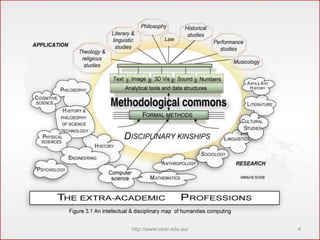
The DH Landscape...
• The Digital Humanities (growing energy in
the field; Australia and Internationally)
• Largely a focus on methods in humanities
research
• Challenges: utilisation of vast amount of
digital resources being created in a
meaningful, scholarly way
http://www.versi.edu.au/ 3
http://www.versi.edu.au/ 4
VREs
“...the humanities need to consider the
multiple opportunities associated with
cyberinfrastucture, whilst maintaining
epistemic integrity and avoiding modelling
new infrastructure uncritically after existing
models” (Patrik Svensson, DHQ, Winter 2011)
http://www.versi.edu.au/ 5
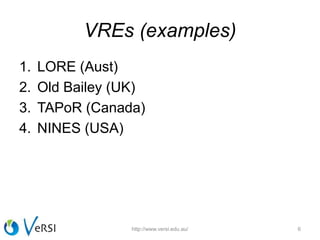
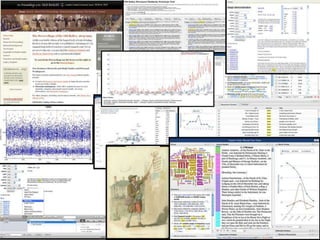
VREs (examples)
1. LORE (Aust)
2. Old Bailey (UK)
3. TAPoR (Canada)
4. NINES (USA)
6http://www.versi.edu.au/
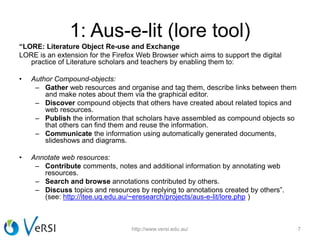
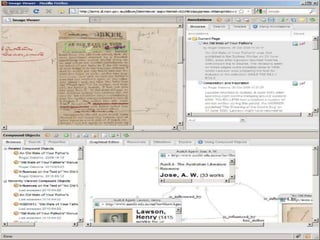
1: Aus-e-lit (lore tool)
“LORE: Literature Object Re-use and Exchange
LORE is an extension for the Firefox Web Browser which aims to support the digital
practice of Literature scholars and teachers by enabling them to:
• Author Compound-objects:
– Gather web resources and organise and tag them, describe links between them
and make notes about them via the graphical editor.
– Discover compound objects that others have created about related topics and
web resources.
– Publish the information that scholars have assembled as compound objects so
that others can find them and reuse the information.
– Communicate the information using automatically generated documents,
slideshows and diagrams.
• Annotate web resources:
– Contribute comments, notes and additional information by annotating web
resources.
– Search and browse annotations contributed by others.
– Discuss topics and resources by replying to annotations created by others”.
(see: http://itee.uq.edu.au/~eresearch/projects/aus-e-lit/lore.php )
http://www.versi.edu.au/ 7
(pic aus-lit)
http://www.versi.edu.au/ 8
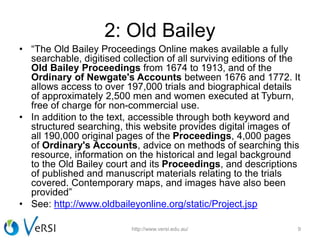
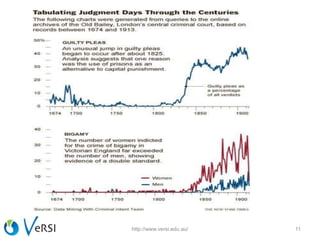
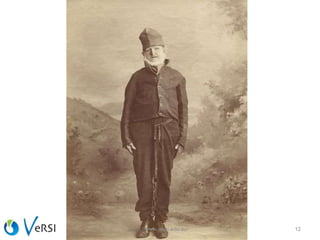
2: Old Bailey
• “The Old Bailey Proceedings Online makes available a fully
searchable, digitised collection of all surviving editions of the
Old Bailey Proceedings from 1674 to 1913, and of the
Ordinary of Newgate's Accounts between 1676 and 1772. It
allows access to over 197,000 trials and biographical details
of approximately 2,500 men and women executed at Tyburn,
free of charge for non-commercial use.
• In addition to the text, accessible through both keyword and
structured searching, this website provides digital images of
all 190,000 original pages of the Proceedings, 4,000 pages
of Ordinary's Accounts, advice on methods of searching this
resource, information on the historical and legal background
to the Old Bailey court and its Proceedings, and descriptions
of published and manuscript materials relating to the trials
covered. Contemporary maps, and images have also been
provided”
• See: http://www.oldbaileyonline.org/static/Project.jsp
http://www.versi.edu.au/ 9
Pic/old bailey
http://www.versi.edu.au/ 10
http://www.versi.edu.au/ 11
http://www.versi.edu.au/ 12
3: TAPoR
• Launched in 2003
• Text Analysis Portal for Research
• Network of six leading humanities computing centres in
Canada
TAPoR is a portal for:
• Collecting texts - TAPoR lets you keep a library of references
with links to original documents on the web or elsewhere
• Analysing texts - You can then pass these texts to tools that
analyse the text and then store the results
• Tools on TAPoR are web services not on the TAPoR server
• TAPoR provides a common interface for tools
http://www.versi.edu.au/ 13
Picture TAPoR
http://www.versi.edu.au/ 14
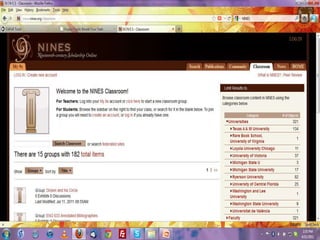
4: NINES
Networked Infrastructure for Nineteenth-Century Electronic Scholarship
Goals:
• to serve as a peer-reviewing body for digital work in the long 19th-
century (1770-1920), British and American;
• peer-reviewing and legitimating digital literary editing, to support
scholars’ priorities and best practices in the creation of digital
research materials;
• to develop software tools for new and traditional forms of research
and critical analysis.
It provides scholars with access to a federated digital environment and
a suite of computerised analytic and interpretive tools.
• NINES is currently aggregating 670,373 peer reviewed digital
objects from 96 federated sites.
http://www.versi.edu.au/ 15
http://www.versi.edu.au/ 16
VRE in the classroom (Heuristic)
1.”serving to indicate or point out; stimulating
interest as a means of furthering
investigation.
2.encouraging a person to learn, discover,
understand, or solve problems on his or her
own, as by experimenting, evaluating
possible answers or solutions, or by trial and
error: a heuristic teaching method.
3.of, pertaining to, or based on
experimentation, evaluation, or trial-and-error
methods”...(dictionary definition)
http://www.versi.edu.au/ 17
VRE in the classroom
• Computing in the humanities is a set of
humanities questions to achieve a set of
humanities interpretations.
• Provide technical architectures that open-up
critical interpretations of digital objects (within
assessable tasks) to broader audiences of
students
• Information retrieval and analysis skills
become more important through the increase
of social/cultural data (ie. Zetoro, Lore,
Tapor)
http://www.versi.edu.au/ 18
19http://www.versi.edu.au/

eResearch-Oz-Bellamy

  • 1.
    Teaching the DigitalHumanities through Virtual Research Environments eResearch Australasia, 2011 1http://www.versi.edu.au/ Dr Craig Bellamy Analyst Digital Humanities, VeRSI Secretary: Australasian Association for Digital Humanities
  • 2.
    a) The DigitalHumanities Landscape b) Virtual Research Environments (VREs) c) VREs in teaching and research http://www.versi.edu.au/ 2
  • 3.
    The DH Landscape... •The Digital Humanities (growing energy in the field; Australia and Internationally) • Largely a focus on methods in humanities research • Challenges: utilisation of vast amount of digital resources being created in a meaningful, scholarly way http://www.versi.edu.au/ 3
  • 4.
  • 5.
    VREs “...the humanities needto consider the multiple opportunities associated with cyberinfrastucture, whilst maintaining epistemic integrity and avoiding modelling new infrastructure uncritically after existing models” (Patrik Svensson, DHQ, Winter 2011) http://www.versi.edu.au/ 5
  • 6.
    VREs (examples) 1. LORE(Aust) 2. Old Bailey (UK) 3. TAPoR (Canada) 4. NINES (USA) 6http://www.versi.edu.au/
  • 7.
    1: Aus-e-lit (loretool) “LORE: Literature Object Re-use and Exchange LORE is an extension for the Firefox Web Browser which aims to support the digital practice of Literature scholars and teachers by enabling them to: • Author Compound-objects: – Gather web resources and organise and tag them, describe links between them and make notes about them via the graphical editor. – Discover compound objects that others have created about related topics and web resources. – Publish the information that scholars have assembled as compound objects so that others can find them and reuse the information. – Communicate the information using automatically generated documents, slideshows and diagrams. • Annotate web resources: – Contribute comments, notes and additional information by annotating web resources. – Search and browse annotations contributed by others. – Discuss topics and resources by replying to annotations created by others”. (see: http://itee.uq.edu.au/~eresearch/projects/aus-e-lit/lore.php ) http://www.versi.edu.au/ 7
  • 8.
  • 9.
    2: Old Bailey •“The Old Bailey Proceedings Online makes available a fully searchable, digitised collection of all surviving editions of the Old Bailey Proceedings from 1674 to 1913, and of the Ordinary of Newgate's Accounts between 1676 and 1772. It allows access to over 197,000 trials and biographical details of approximately 2,500 men and women executed at Tyburn, free of charge for non-commercial use. • In addition to the text, accessible through both keyword and structured searching, this website provides digital images of all 190,000 original pages of the Proceedings, 4,000 pages of Ordinary's Accounts, advice on methods of searching this resource, information on the historical and legal background to the Old Bailey court and its Proceedings, and descriptions of published and manuscript materials relating to the trials covered. Contemporary maps, and images have also been provided” • See: http://www.oldbaileyonline.org/static/Project.jsp http://www.versi.edu.au/ 9
  • 10.
  • 11.
  • 12.
  • 13.
    3: TAPoR • Launchedin 2003 • Text Analysis Portal for Research • Network of six leading humanities computing centres in Canada TAPoR is a portal for: • Collecting texts - TAPoR lets you keep a library of references with links to original documents on the web or elsewhere • Analysing texts - You can then pass these texts to tools that analyse the text and then store the results • Tools on TAPoR are web services not on the TAPoR server • TAPoR provides a common interface for tools http://www.versi.edu.au/ 13
  • 14.
  • 15.
    4: NINES Networked Infrastructurefor Nineteenth-Century Electronic Scholarship Goals: • to serve as a peer-reviewing body for digital work in the long 19th- century (1770-1920), British and American; • peer-reviewing and legitimating digital literary editing, to support scholars’ priorities and best practices in the creation of digital research materials; • to develop software tools for new and traditional forms of research and critical analysis. It provides scholars with access to a federated digital environment and a suite of computerised analytic and interpretive tools. • NINES is currently aggregating 670,373 peer reviewed digital objects from 96 federated sites. http://www.versi.edu.au/ 15
  • 16.
  • 17.
    VRE in theclassroom (Heuristic) 1.”serving to indicate or point out; stimulating interest as a means of furthering investigation. 2.encouraging a person to learn, discover, understand, or solve problems on his or her own, as by experimenting, evaluating possible answers or solutions, or by trial and error: a heuristic teaching method. 3.of, pertaining to, or based on experimentation, evaluation, or trial-and-error methods”...(dictionary definition) http://www.versi.edu.au/ 17
  • 18.
    VRE in theclassroom • Computing in the humanities is a set of humanities questions to achieve a set of humanities interpretations. • Provide technical architectures that open-up critical interpretations of digital objects (within assessable tasks) to broader audiences of students • Information retrieval and analysis skills become more important through the increase of social/cultural data (ie. Zetoro, Lore, Tapor) http://www.versi.edu.au/ 18
  • 19.