Death and the Internet:
digital legacies
Dr Craig Bellamy, DHA2016
Hobart, June 2016
Key issues
A. Online memorials
B. Property and privacy
C. Personal digital archives
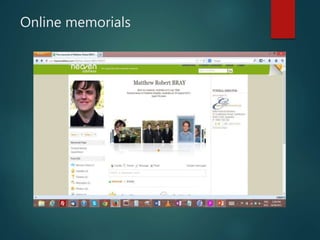
Online memorials
Social media & memorialisation
• When a user passes away, their account is “memorialised”
• Only confirmed “friends” can see the timeline
• “friends” can leave posts in remembrance
• Also prevents anyone from logging into the account
B: Privacy and Property
1. What do I actually own?
2. Should I delete it?
3. Or should I give It away?
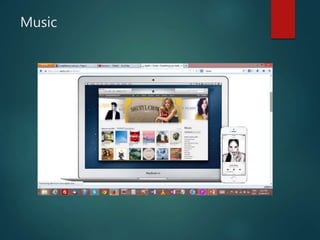
Music
Music
Images
Images
YouTube
eBooks
email
 You agree that your Yahoo! account is non-
transferable and any rights to your Yahoo! ID or
contents within your account terminate upon
your death
Mobile accounts and texts
C: Personal Digital Archives
1. How do I manage my legacy?
2. What services are available?
3. Can it be repurposed?
Download!
 Facebook (can download almost everything)
 Twitter (can download entire twitter archive)
 YouTube (can download everything in original format)
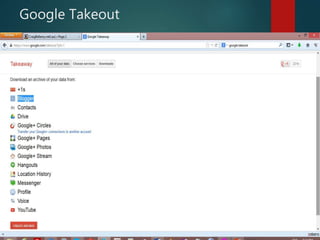
 Google Takeout
Google Takeout
Google inactive account manager (or
‘death manager’)
 Time period (6-12 months)
 Notify contacts and share data (up to 10 people)
 Delete everything!
Personal digital archives
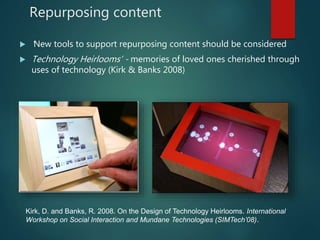
Repurposing content
 ‘New tools to support repurposing content should be considered
 Technology Heirlooms’ - memories of loved ones cherished through
uses of technology (Kirk & Banks 2008)
Kirk, D. and Banks, R. 2008. On the Design of Technology Heirlooms. International
Workshop on Social Interaction and Mundane Technologies (SIMTech’08).
Digital Register
 Creating a digital register
http://www.digitalheritage.net.au/planning/
Pending issues
 There are significant inconsistencies and ad-hoc
arrangements on institutions deal with death
and the internet
 The importance of creating personal digital
archives is not well established in the popular
imagination (nor products for re-purposing
content)
 Protocols and practices of bequeathing digital
assets (ie. digital wills) not well established

Bellamy_death_DHA2016

  • 1.
    Death and theInternet: digital legacies Dr Craig Bellamy, DHA2016 Hobart, June 2016
  • 2.
    Key issues A. Onlinememorials B. Property and privacy C. Personal digital archives
  • 3.
  • 4.
    Social media &memorialisation • When a user passes away, their account is “memorialised” • Only confirmed “friends” can see the timeline • “friends” can leave posts in remembrance • Also prevents anyone from logging into the account
  • 7.
    B: Privacy andProperty 1. What do I actually own? 2. Should I delete it? 3. Or should I give It away?
  • 8.
  • 9.
  • 10.
  • 11.
  • 12.
  • 13.
  • 14.
    email  You agreethat your Yahoo! account is non- transferable and any rights to your Yahoo! ID or contents within your account terminate upon your death
  • 15.
  • 16.
    C: Personal DigitalArchives 1. How do I manage my legacy? 2. What services are available? 3. Can it be repurposed?
  • 17.
    Download!  Facebook (candownload almost everything)  Twitter (can download entire twitter archive)  YouTube (can download everything in original format)  Google Takeout
  • 18.
  • 19.
    Google inactive accountmanager (or ‘death manager’)  Time period (6-12 months)  Notify contacts and share data (up to 10 people)  Delete everything!
  • 20.
  • 21.
    Repurposing content  ‘Newtools to support repurposing content should be considered  Technology Heirlooms’ - memories of loved ones cherished through uses of technology (Kirk & Banks 2008) Kirk, D. and Banks, R. 2008. On the Design of Technology Heirlooms. International Workshop on Social Interaction and Mundane Technologies (SIMTech’08).
  • 22.
    Digital Register  Creatinga digital register http://www.digitalheritage.net.au/planning/
  • 23.
    Pending issues  Thereare significant inconsistencies and ad-hoc arrangements on institutions deal with death and the internet  The importance of creating personal digital archives is not well established in the popular imagination (nor products for re-purposing content)  Protocols and practices of bequeathing digital assets (ie. digital wills) not well established