Canal Paving Equipment
Trimmers, Liners, and Finish & Cure Jumbos
Highway & Airport
Paving Equipment
Concrete Batching
& Mixing Plants
Canal Construction
Equipment
Trenching
Equipment
No two canals are alike. Canals can range in size from
small concrete lined irrigation ditches to massive main
canals where the top width is as wide as a football field
Consequently, canal equipment is custom designed to fi
your present and anticipated future needs.
Where there are long lengths of canals to be built or where
there will be an ongoing program of canal construction
in your market area, high production, mechanized canal
equipment make economic sense for the following reasons:
• Minimize costly concrete losses
• Insure the quality of the concrete lining and the integrity
of the subgrade under the lining
• Reduce the number of people required to build the canal.
• Dramatically reduce the time required to trim and
concrete line the canal as compared to any other method.
Once it is determined that mechanized canal construction
machinery makes sense for your project, the project
constraints will dictate what type of specialized canal
equipment should be selected and the best method of
concrete feed and trimmer spoils disposal. Consideration
must be given to the following:
• The aximum concrete production rate and number of
concrete delivery trucks available
• The ype of soil to be encountered along the canal
alignment and whether it is suitable for trimming or if it
must be over-excavated, backfill d, and compacted prior
to trimming and lining.
• The vailable room next to the canal available for the
canal equipment as well as trimmer spoils and concrete
delivery trucks
Guntert and Zimmerman has been providing mechanized
canal construction equipment solutions to contractors
since 1947. Thisbrochure is intended to illustrate the many
mechanized canal construction options that GZ can make
available for your project.
Introduction
Gunt ert  Zimmerman has been th e
most trust ed nam e in mechani zed
canal equi pment Sin ce 1947.
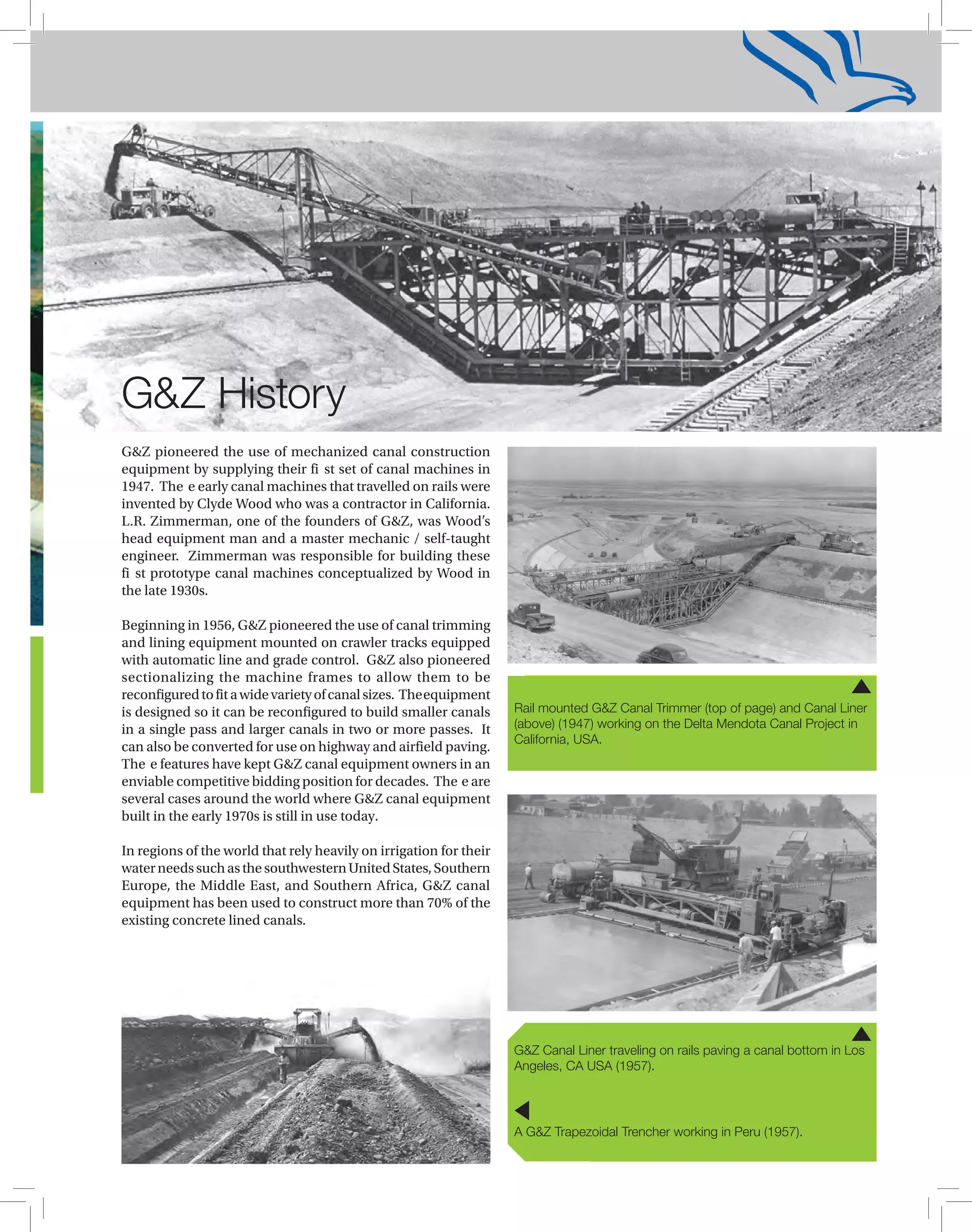
GZ pioneered the use of mechanized canal construction
equipment by supplying their fi st set of canal machines in
1947. The e early canal machines that travelled on rails were
invented by Clyde Wood who was a contractor in California.
L.R. Zimmerman, one of the founders of GZ, was Wood’s
head equipment man and a master mechanic / self-taught
engineer. Zimmerman was responsible for building these
fi st prototype canal machines conceptualized by Wood in
the late 1930s.
Beginning in 1956, GZ pioneered the use of canal trimming
and lining equipment mounted on crawler tracks equipped
with automatic line and grade control. GZ also pioneered
sectionalizing the machine frames to allow them to be
reconfiguredtofit awidevarietyofcanalsizes. Theequipment
is designed so it can be reconfigured to build smaller canals
in a single pass and larger canals in two or more passes. It
can also be converted for use on highway and airfield paving.
The e features have kept GZ canal equipment owners in an
enviable competitive bidding position for decades. The e are
several cases around the world where GZ canal equipment
built in the early 1970s is still in use today.
In regions of the world that rely heavily on irrigation for their
waterneedssuchasthesouthwesternUnitedStates,Southern
Europe, the Middle East, and Southern Africa, GZ canal
equipment has been used to construct more than 70% of the
existing concrete lined canals.
GZ History
Rail mounted GZ Canal Trimmer (top of page) and Canal Liner
(above) (1947) working on the Delta Mendota Canal Project in
California, USA.
GZ Canal Liner traveling on rails paving a canal bottom in Los
Angeles, CA USA (1957).
A GZ Trapezoidal Trencher working in Peru (1957).
Contractors worldwide depend on GZ to tackle complex
canal equipment challenges. GZ’s in house canal
construction experts are available to work with your team
during the design or bidding stages of a project to advise
on feasibility of the proposed canal design and to suggest
changes to better lend the canal design to mechanization.
With your complete information on the canal project
scope and cross sections, GZ can provide estimated
costs and production rates on complete mechanized canal
construction equipment solutions.
GZ’s worldwide experience, multi-disciplined engineering
staff and factory fle ibility ensures the highest quality custom
machinery. Once the canal equipment is completed, GZ’s
experienced service team is available to commission your
equipment in the field and train your people in the proper
maintenance and operation of the equipment as well as how
to achieve the highest and best use.
In 1996, GZ was hired by a consortium of international
contractors to design and build a set of canal construction
machines for the huge Ghazi Barotha Power Channel Project
on the Indus River in Northwestern Pakistan. The power
channel was over 104m (341 ft.) across the top and 11m
(36 ft.) deep. Theproject was made even more challenging
because there was a structure almost every kilometer along
the 52 km (31 mile) long power channel. This equipment
was the largest of its kind built anywhere in the world and
because of its size and the number of structures each piece
was designed to be self-moving.
Half Span Canal equipment spread operating in the Ghazi
Barotha Power Channel in North Western Pakistan.
GZ Capabilities
GZ Canal Liner being fed concrete by an agitator in North
Western Pakistan.
Each of these custom pieces of the equipment borrowed
heavily on GZ’s extensive canal construction experience
and technology and required many innovative new ideas to
achieve the design goals. Thisproject won the Engineering
News Record (ENR) Top Project Designation in December
1999. GZ offe s a full range of canal excavators/trimmers,
liners and finishi g / curing jumbos.
Generally large canals cover everything from large power
channels and main canals to small distributary and
secondary canals that run as small as approx. 2.5m (8 ft.)
deep and 2.5m (8 ft.) bottom width. Depending on the size
of the canal, the canal can be trimmed and lined in a single
pass (Full Span) or in one or more passes (Half Span or a
combination of Half Span and Flat Configuration). Whether
a canal should be paved Full Span or Half Span depends
on many factors such as canal bottom width, ground
conditions, schedule, embankment width available at the
top of the canal, etc. GZ can help guide you on the best
way to build the canal depending on your jobsite situation.
Dependingonyourmaximumpresentandfuturemaximum
anticipated canal sizes, the canal equipment power
requirements, frame size and undercarriage components
are specifi d and selected. Versatility is incorporated in all
GZ canal equipment designs to allow the equipment to be
reconfigured to fit a wide variety of canal sections you may
encounter in the future.
Large Canal Equipment
The e are several major reasons why GZ Canal
Construction Equipment is so highly versatile, reliable
and capable of producing high quality trimmed surfaces
and concrete linings at the lowest cost per square yard
(meter) even after many years of use:
• GZ’s proven canal trimming and lining technology
such has the bucket line and concrete conveying system
designs have been time tested under a wide variety of
configurations and adverse field conditions ver many
decades.
• GZ’s canal equipment uses the same state of the art
elevation and alignment control systems used on GZ’s
world famous highway and airfield aving equipment
which requires very exacting tolerances.
• GZ canal equipment utilizes proven components
from GZ’s broad range of popular highway, airfield
paving, and trenching equipment such as power units,
hydraulic circuits, jacking columns, crawler tracks and
operator controls.
The GZ canal trimmer is available in a two, three, or
four track configuration. The hydraulic jacking columns,
crawler tracks, truss frame, power unit, and conveyor
widths can be designed and sized to handle a wide range of
canal sizes and / or target production rates in keeping with
the type of soils to be encountered and to stay ahead of the
concrete lining operation.
Since 1947, GZ has built both bucketline and auger
trimmers. Through this long experience, GZ has
determined that the bucketline system, although initially
more expensive to purchase, is the least costly to operate,
can handle a wider variety of soil conditions, and allows
the trimmer to be reconfigured for almost any conceivable
canal cross section. Thus the trimmer can be reconfigured
to handle trapezoidal shaped canals in the half span and
full span or varying slope angles or flat configuration as
well as parabolic and half round canal cross sections. So no
matter what canal you run into in the future your trimmer
can be reconfigured to handle it.
The other key feature of a GZ bucketline trimmer and why
it is the most efficient / productive trimming system in the
world is that once the material is trimmed, it is carried to
the top of the canal and deposited directly onto a conveying
system. This conveying system can be designed to handle
any number of canal construction scenarios:
• Depositing the trimmer spoils in a windrow away from
the side of the canal that can be used for fill to avoid
rehandling.
• Depositing the trimmer spoils directly into hauling
trucks to haul away from cuts and to avoid rehandling.
• Depositing the trimmer spoils into other conveyors to
discharge spoils on the opposite side of the canal or
further away from the edge of the canal.
Large Canals
Canal Trimmer
Consult with the Guntert  Zimmerman factory about
your project’s specific challenges.
Trimming Applications
Configuratio Full Span—1 1/2:1 Slope
Location Southern California, USA
Project Coachella Canal
Configuratio Half Span—2:1 Slope
Location Pakistan
Project Ghazi Barotha Power Channel
Configuratio Parabolic
Location Spain
Project Fuensenta Canal
Configuratio Half Round
Location Spain
Project Unknown
Configuratio Flat Configuratio
Location Pakistan
Project Ghazi Barotha Power Channel
Configuratio Half Span—1 1/2:1 Slope
Location Tucson, Arizona, USA
Project Tuscon Aqueduct
Buckets shown trimming up the slope. An average of 9”
(228mm) on the canal slope and 6” (150mm) on the bottom
should be left for the trimmer to remove with no high spots over
18” (457mm).
Individual buckets are supported at all four corners by time
tested bucket support roller design that runs in the trimmer
frame track. Replaceable digging teeth are found on the front of
the bucket and adjustable smoothing cutting edge on the rear.
Trimmer Features
The trimmer is provided with an adjustable moldboard with reversible
and adjustable cutting edge to help leave a clean, trimmed surface
and to minimize hand shoveling prior to concrete lining.
Continuous bucketline system depositing trimmed material
directly on to a conveyor system located at the top of the
canal.
Different conveyor system configurations / schemes may be
employed to put trimmed material where you want it the first
time.
Proven and durable crawler track rail / chain is used to
connect the buckets into a continuous bucketline. For
higher production rates more buckets can easily added.
The continuous bucketline design allows the trimmer to be
reconfigured for different canal sections and slopes.
Canal Liner
The ingenuity and success of the GZ Canal Liner over the
years is its ability to be adapted to a wide variety of concrete
pavingandbaselayingapplications. Thisversatilemachine
can be used for reservoir lining, large and small canals,
power channels, drainage canals, highways and airfield
paving, and even concrete racetracks.
The Liner is available in a two, three, or four track
configuration. The hydraulic jacking columns, crawler
tracks, truss frame with slipform pan, power unit, and
conveyor widths can be designed and sized to handle a
wide range of canal sizes and / or target concrete or base
production rates.
Concrete can be distributed along the front of the liner in
a number of ways. Historically, GZ has used concrete
dump skips, drag chains, and wiper conveyors. The
best method is typically determined by your intended
concrete production rate or intended type of hauling
trucks. Concrete production rates from 60 to 600 cyh (45
to 470m3/hr) are achievable with the limitation typically
being:
• Concrete plant’s practical productive output
• Type and number of concrete delivery trucks
• Joint forming and the concrete finishing operation.
Of all the different means of distributing concrete,
experience has shown that the most flexible and productive
of the different solutions is the wiper conveyor especially
on canals with long slopes.
To keep the concrete or base material on the slopes, the
Liner is provided with a liquification hopper located just
ahead of the slipform pan. The hopper is divided into
compartments approximately 36” (1M) wide. The concrete
(or in some cases base) in the hopper is vibrated by a high
frequency vibrating bar or individual poker vibrators
located along the front of the slipform pan.
Large Canals
Consult with the Guntert  Zimmerman factory about
your project’s specific challenges.
L ining Applications
Configuratio Full Span—1 1/2:1 Slope
Location Southern California, USA
Project Coachella Canal
Configuratio Half Span—2:1 Slope
Location Pakistan
Project Ghazi Barotha Power Channel
Configuratio Parabolic
Location Spain
Project Fuensenta Canal
Configuratio Full Span—1:1 Slope
Location Spain
Project Unknown
Configuratio Flat Configuratio
Location Pakistan
Project Ghazi Barotha Power Channel
Configuratio Half Span—Variable Slope
Location Germany
Project Isar Canal
Special L ining Applications
Special Application Relining with Compactor Beams
Configuratio Full Span—1 1/2:1 Slope
Location Algeria
Project Mina Project
Special Application Slope Lining in Two Passes
Configuratio Half Span—4.5:1 Slope
Location Southern California USA
Project Quail Canal
Special Application Gravel Blanket Lining
Configuratio Half Span—2:1 Slope
Location Oroville, California USA
Project Oroville Dam
Special Application Placing Select Backfil
Configuratio Half Span—2 1/2:1 Slope
Location Kirkuk, Iraq
Project Kirkuk Dam Canal
Special Application Racetrack Base Laying
Configuratio Slope Liner
Location Nashville, Tennessee USA
Project Nashville International Speedway
Special Application Concrete Lining Old Canal
Configuratio Half Span—Variable Slope
Location Germany
Project Isar Canal
Concrete Vibration
Although a tube vibrators can work effectively,
individual high frequency poker vibrators are the
preferred vibration solution. One poker vibrator is
provided in each liquification hopper compartment
between baffles.
L iner Features
Transverse and Longitudinal Joint Cutting
The rear of the Liner is equipped with a rear access
walkway and as an option a “guillotine” for cutting
transverse contraction joints in the concrete lining.
To form the longitudinal contraction joint the Liner
can be equipped with “keel bars” which mount to the
underside of the slipform pan. Hand finishing of the
joint is required.
Concrete Liquification Hopper
The liquification hopper is mounted off the front of the
Liner slipform pan. Baffles are provided on approx.
36” (1M) centers to keep the concrete from running
down the slope. The liquification hopper is arranged
for good visibility and so it allows the operator
uniformly run out of concrete at the end of the day.
Concrete Belt with Wiper Car
GZ’s concrete distributing belt system with wiper
car and winch allows the liner operator to put the
concrete precisely where it is needed along the
liner periphery. This conveyor can be reconfigured
for flat configurations. With modification, the
conveyor system can also be converted to a full span
configuration.
L iner Material Feeding Schemes
Two trucks discharge in a wiper conveyor. Single truck discharging into a concrete distributing car.
Agitator truck discharging into a charging conveyor.
Semi Belly Dump Trailer discharging into a crawler track
mounted Drive Over Unloader.
Tandem Belly Dump Trailers discharging from a crawler track
mounted Drive Over Unloader.
Semi-end Dump Trailer feeding a Concrete Placer.
L iner Accessories
Subgrade guidance ski for elevation and steering control.
Self-propelled / self-moving auxiliary downhill feed conveyor to
convey concrete into the canal bottom.
Automatic longitudinal joint inserters for inserting PVC cruciform
shaped water stop (blue material on reels).
Back spreading device so bottom crawler track does not need
to walk on the previously poured lining.
Night lighting system illuminates not only the GZ Canal Liner
but much of the surrounding area.
Hydraulically controlled curb forming module is available in any
curb configuration needed.
As long as Canal lining has been around, there has been a
need for a separate workbridge (or Jumbo) for finishi g
concrete and applying curing compound on the concrete
surface. In addition to this, separate Jumbos are used for
inserting preformed PVC transverse contraction joints and
to assist in laying prefabricated reinforcing steel mats.
Although Jumbos are available with rubber tires, they are
typically furnished with two, three, or four crawler tracks.
Jumbostypicallyarenotrequiredtohaveautomaticelevation
control, but manual hydraulic jacking columns are available
to help maintain the working platform or cure spray hood at
a fi ed height above the canal lining and to adjust for varying
canal depths.
Thecrawler tracks, truss frame, and power unit are designed
andsizedtomatchyourminimumandmaximumanticipated
canal cross sections. The Jumbo frame and access walkway
/ stairs easily reconfigure to full span, half span of varying
slope angles, or flat configuration and can be adapted to
parabolic and half round canal sections.
GZ provides a heavy duty truss frame to handle repeated
moving and handling of the Jumbo over its life. GZ also
provides a wide access walkway, typically off the front and
rear of the Jumbo truss frame for workers to easily and safely
access the concrete surface for hand finishi g and applying
cure to the concrete surface
Inmostcases,onlyoneJumboisrequiredbehindtheconcrete
Liner. Concrete finishi g is done off the front of the Jumbo
and application of curing compound is done off the ear.
In high production concrete lining operations, a separate
curing jumbo is required in order to keep up with the lining
operation. In high production, unreinforced concrete lining
operations,automationofthetransversejointingoperationis
also required to keep up with the concrete lining operation.
Large Canals
Canal Finish  Cure Jumbo
Consult with the Guntert  Zimmerman factory about
your project’s specific challenges.
Finisher  Cure Jumbo Applications
Configuratio Full Span—1 1/2:1 Slope
Location Iraq
Project Diyala Project
Configuratio Half Span—2:1 Slope
Location Pakistan
Project Ghazi Barotha Power Channel
Configuratio Half Span—2:1 Slope
Location Pakistan
Project Ghazi Barotha Power Channel
Configuratio Half Span—1 1/2:1 Slope
Location Tucson, AZ
Project Tucson Aqueduct
Configuratio Parabolic
Location Spain
Project Unknown
Configuratio Half Span—Variable Slope
Location Germany
Project Isar Canal
Over the last 40 years, GZ has been involved in working
with contractors on the development and improvement of
the techniques used today for high production installation
of both preformed, cruciform shaped PVC transverse and
longitudinal waterstops.
On large, high production, non-reinforced concrete lining
projects, the Transverse Joint Inserter Jumbo makes
economic sense to automate the transverse jointing and
finishi g operation for several reasons:
• The oint forming operation in the plastic concrete and
subsequent finishi g operation become the constraint in
the Liner’s forward progress
• Due to the difficulty in controlling the transverse joint
cross section during forming operation in the plastic
concrete, joint sealant losses become high.
• Modern, preformed, polyvinyl chloride (PVC) transverse
joint material (combination crack inducer / waterstop)
have performed exceedingly well over many decades in
preventing canal water seepage.
Transverse Joint Inserter Jumbos (TJIJ) include a vibrating
transverse joint inserter mechanism (mounted on the front)
andaseparaterollerfinishertube(claryfinisher)mechanism
(mounted on the rear) to finish over the top of the inserted
transverse joint. In the half span and flat configuration, one
joint inserter and one clary finisher mechanism is required.
In the full span configuration, one joint inserter mechanism
and one clary finishi g mechanism is required for each
slope.
Transverse Joint Inserter Jumbos are typically furnished
with two or four crawler tracks. The TJIJ requires manual
hydraulic jacking columns to help maintain the inserter and
clary mechanism at a fi ed height above the concrete surface
and to accomodate canals which vary in depth. A TJIJ can be
designed and built for just about any size canal.
Large Canals
Transverse Joint
Inserter Jumbo
Consult with the Guntert  Zimmerman factory about
your project’s specific challenges.
Transverse Joint Inserter Jumbo
In a full span lining operation, one inserter cart
mechanism is required on each slope for inserting
PVC joint material. Joint material must be inserted up
the slope.
Joint inserter cart vibrates the PVC joint material into
the concrete lining while traveling up the slope.
The Clary Mechanism finishes the concrete over the
tranverse joint at the rear of the jumbo
Half Span
Full Span
One Clary Finishing Mechanism is required for each
joint inserter in a ful span lining operation.
Large Canals
Moving Considerations
If your project has numerous structures or siphons which
require large mobile cranes to be present, moving canal
machines with these cranes is the quickest method and
requires less hand paving and special earth works for moving
compared with canal machines equipped with self-moving
features.
Other considerations in the crane vs. self-moving equipment
debate is the width of the canal bottom and whether you are
working full span or half span, the size of the equipment
and whether the canal section is in cut or fill. Consult with
Guntert  Zimmerman on your application.
Full Span Trimmer being lifted by a 250T crawler track
mounted crane around a structure.
Two large cranes moving a full span canal liner over a
structure in the canal alignment.
Special heavy load trailer modified for moving trimmer
and liner long distances.
Trimmer is built in module fashion so components can
be removed to reduce the weight of the trimmer and
liner for lifting and transport in keeping with the available
cranes and trailers available.
Crane Applications
Depending on the canal configuration, an experienced crew can relocate the entire spread of canal equipment with
self-moving features from one side of the canal to the other in less than one shift needing only a small crane to remove
relatively light weight attachments such as the Trimmer stacker conveyor and the Liner charging conveyor. Consultation
with the canal experts at GZ will help you determine which method of moving is most suitable for your present and
future needs.
Self-Moving Applications
Half Span Liner walking up the slope under its own
power.
Approximately 12m (39 ft) of room must be left on
either side of a structure for the canal equipment to
walk up or down the slope.
Half Span Liner in the canal bottom after counter-
rotation. Patented Anti-torsion control protects the
Liner latticework frame for potentially destructive
torsional forces while walking over uneven ground.
Half Span Liner in 90 degree steering mode walking
and steering along the canal bottom passing a
structure under construction.
Half Span Trimmer walking up the slope under its own
power if traction is available. In soft ground conditions a
dozer may be required to assist.
Half Span Trimmer walking and steering in along the
canal bottom in the 90 degree steering mode under its
own power.
Generally, small canals cover everything from concrete lined
irrigation ditches with bottom widths (BW) as narrow as
30cm (12 in.) up to branch / distributary or even small main
canals up to a maximum size of approximately 2.43m (8 ft.)
deep and 2.0m (7 ft.) bottom width. Typically canals of this
size range are built on a prepared and compacted fill berm)
built with conventional earth moving equipment. Canals
of this size are built full section / span in a single pass and
typically have side slopes of 1:1, 1 ¼:1 and 1 ½:1.
Small canal cross sections are excavated /
trimmed in one of three ways:
• Using a conventional excavator / backhoe with a
trapezoidal bucket matching the canal cross section
and carefully digging the canal cross section with laser
guidance. Thefine grading is done by a digging chain
attachment to the front of the concrete lining machine.
This is a l w production solution.
• Themost effici t / high production means to excavate
and trim a canal cross section is by using a special
trapezoidal trencher where the canal cross section can
be excavated and trimmed in a single pass.
• On the upper end of the small canal sizes it may be
possible to use a bucketline trimmer configured into a
small cross section.
Small Canal Equipment
• A subgrade guided, “towed boat” concrete liner:
Generally the smaller “towed boats” are towed by a grader
or front end loader required on the site anyway. Th y are
light enough that they can be easily moved and quickly
lifted out of the canal using towing equipment such as a
front end loader. No automatic line or grade control is
required as the towed boat is subgrade guided.
• A subgrade guided, “towed boat” concrete liner:
Generally the larger “towed boats” have their own power
unit and winch rather than being towed by a grader or front
end loader. Larger towed boats are heavy enough where
a crane is needed to lift it out of the canal and around
structures. A larger towed boat liner is typically supplied
with a concrete distribution system including a charging
conveyor to evenly distribute concrete across the front of
the machine.
• A small self-propelled canal liner equipped with a canal
mold: Depending on the canal size the liner will either
be mounted on three or four crawler tracks. The separate
canal mold is typically removed for moving and transport.
It is also equipped with an automatic line and grade control
system in reference to a single grade wire. A single charge
conveyor is used to feed concrete to the concrete mold.
Small canals up to 1.2m (4 ft. deep) are machine lined using one of two means:
Small canals ranging 1.2m to 2.4m (4 ft. to 8 ft.) deep are machine lined using one of two means:
• A larger self-propelled canal liner: This full span canal
liner is mounted on either two crawler tracks or four. It is
also equipped with an automatic line and grade control
system in reference to a single grade wire. A larger canal
liner is typically supplied with a concrete distribution
system including a charging conveyor to evenly distribute
concrete across the front of the liner.
GZ built its fi st trapezoidal trencher more than 60 years
ago and from trial and error determined that trapezoidal
trenchers are the most suitable equipment for excavating
and trimming smaller canals and will build them in the most
effici t and productive manner.
Trapezoidal trenchers work on a prepared and compacted
earthen fill or embankment. TheGZ Trapezoidal Trencher
excavates and trims the specifi d cross section in a single
pass behind its two crawler tracks. The advantage of having
thiscombinationexcavatorandtrimmeristhatyoueliminate
the need to use a conventional excavator for the initial rough
excavation in preparation for trimming. Therate at which it
can progress forward is limited by the canal cross section to
be removed, the horsepower on the digging wheel, and the
toughness of the soil. Based on your soil conditions, your
maximum canal cross section, and your intended forward
production rates, the trencher’s engine, undercarriage
components, and drives are sized accordingly.
TovarythecanalcrosssectioncutbytheTrapezoidalTrencher,
spacers can be added or removed from the crumbshoe or the
moldboard, buckets, and rotaries changed.
In tangent sections, the Trapezoidal Trencher can take its
grade and alignment reference off a single string line or from
a laser reference. In limited radius curves, string line must
be used.
Small Canals
Trapezoidal
Trenchers
Consult with the Guntert  Zimmerman factory about
your project’s specific challenges.
Trapezoidal Trencher Applications
Configuratio Full Section—1:1 Slope
Location Southern California USA
Project Imperial Valley
Configuratio Full Section—1:1 Slope
Location Southern California USA
Project Imperial Valley
Configuratio Full Section—1 1/2:1 Slope
Location Iraq
Project Suwaira Project
Configuratio Full Section—1 1/2:1 Slope
Location Iraq
Project Suwaira Project
Configuratio Full Section—1:1 Slope
Location Southern California USA
Project Unknown
Configuratio Full Section—1 1/2:1 Slope
Location Southern California USA
Project Unknown
As a low cost and practical option for concrete lining
watercoursesizecanalsaSubgradeGuidedTowedBoatLiner
can be used. The towed boat takes its grade and alignment
(steering) reference from the trimmed canal subgrade
prepared by trapezoidal trencher. Because the towed boat
traces the trimmed grade a towed boat liner is very eff ctive
for keeping concrete losses to the absolute minimum.
Small Towed Boat Liners for canals under approximately
1.1m (42”) deep are typically towed by a front end loader or
motor grader. Th y are small and light enough to be lifted
by a boom truck crane or a front end loader in and out of the
canal. Generally, the higher concrete slump used on canals
does not require vibration; however, if vibration is required
a separate power unit can be provided on the towed boat
liner. On a smaller towed boat liner, a concrete distribution
system is not required. Ideally on one side of the canal, the
embankment / fill should be wide enough for truck mixers to
pass the towed boat and discharge directly into its hopper.
Larger Towed Boat Liners for canals ranging 1.1m (42”)
to 2.13m (7 ft.) deep require a diesel engine powered, cable
winch which is mounted low and in the front of the towed
boat liner to supply the towing power required to move
the unit. A ‘dead man’ needs to be supplied (typically a
tractor or front end loader required on site) for the winch to
pull against. The diesel power unit is also required for the
concrete distribution system on larger towed boats. And like
the smaller towed boat, if vibration is required the power
unit supplies power for the vibrators.
If the embankment is too small for the concrete trucks to
discharge concrete directly into the hopper of the towed boat
thenanoptionalconcretechargingconveyorcanbesupplied
to deliver the concrete to the towed boat.
Small Canals
Towed Boat Liner
Small Canals
Self Propelled Canal Liner
GZ offe s full span Canal Liners for small canals such as
watercourses, distributary, and small main canals. The e
liners are made of the same proven components as GZ’s
highway and airport slipform paver models. A tractor
includes the main structure or tractor frame (sometimes
telescopic), the supporting end bolsters, power unit and
controls, jacking columns, and two or four crawler tracks.
The Canal Liner comes equipped with vibration either by
tube vibrators or as an option poker vibrators and a concrete
distribution system. For larger sized small canals a charging
conveyor along with a drag chain or wiper conveyor is used
to evenly distribute concrete across the front of the liner in
the liquifi ation hopper. The e small liners can be fed with
either truck mixers or if a concrete placer is used by end
dump trucks.
To vary the canal cross sections you encounter on your
project, the small Canal Liners are arranged so they may be
resectionalized to adjust for changing canal bottom widths
(BW), depths (D) and slopes. The canal mold includes a
liquifi ation hopper with baffle off the front to help hold
the concrete on the slope, vibration, the slipform frame /
pan and a walkway off the rear with or without an optional
transverse joint cutter (“guillotine”).
The Canal Liners can either take its grade and alignment
reference off the trimmed subgrade or off a single stringline
to minimize concrete losses; however, the concrete losses
using a Canal Liner will be greater than if a subgrade guided
towed boat was used.
The e smaller canal machines can be arranged to be self-
moving e.g. so they do not require a crane to move around
obstructions in the canal. The self-moving feature is
important because these highly productive machines can
do a kilometer of small canal in a day and if they cannot
be moved quickly, one could spend more days moving the
equipment than working. Consult with the GZ factory on
diffe ent options available to reduce you moving time and
increase your canal lining time.
Consult with the Guntert  Zimmerman factory about
your project’s specific challenges.
Small Canal L iner Applications
Configuratio Full Span—1 1/2:1 Slope
Location Iraq
Project Suwaira Project
Configuratio Full Span—1 1/2:1 Slope
Location Iraq
Project Suwaira Project
Configuratio Full Span—1 1/2:1 Slope
Location Iraq
Project K-2 Khalis Project
Configuratio Full Span—1 1/2:1 Slope
Location Iraq
Project K-2 Khalis Project
Configuratio Full Span—1 1/2:1 Slope
Location Algiers, Africa
Project Mina Canal
Configuratio Full Span—1 1/2:1 Slope
Location Algiers, Africa
Project Mina Canal
Manuf actur ed under one or more of the follo wing U.S. or For eign Patent s: 4,433,936; 4,483,584; 0051885; 6,390,727; 6,390,726; 6,176,643B1; 5,135.333 and 117323 and Patent s Pending. Some
itemsshownmaybeoptional. GuntertZimmermanConst.Div.,Inc.willcustombuildanymachineoraccessorytosuityourparticularjobrequirement. GZreservestherighttomakeimprovements
in design, material, and/or changes in specifications at a y time without notice and without incurring any obligation related to such changes.	 Printed in U.S.A. 06/09 GZ Order #400P100
Guntert  Zimmerman Const. Div., Inc.
222 E. Fourth St. Ripon, CA 95366 U.S.A.
Phone	 209-599-0066	 Fax	 209-599-2021
Toll Free	 800-733-2912
Email: gz@guntert.com Web: www.guntert.com

Equipos para construir canales de concreto:

  • 1.
    Canal Paving Equipment Trimmers,Liners, and Finish & Cure Jumbos Highway & Airport Paving Equipment Concrete Batching & Mixing Plants Canal Construction Equipment Trenching Equipment
  • 2.
    No two canalsare alike. Canals can range in size from small concrete lined irrigation ditches to massive main canals where the top width is as wide as a football field Consequently, canal equipment is custom designed to fi your present and anticipated future needs. Where there are long lengths of canals to be built or where there will be an ongoing program of canal construction in your market area, high production, mechanized canal equipment make economic sense for the following reasons: • Minimize costly concrete losses • Insure the quality of the concrete lining and the integrity of the subgrade under the lining • Reduce the number of people required to build the canal. • Dramatically reduce the time required to trim and concrete line the canal as compared to any other method. Once it is determined that mechanized canal construction machinery makes sense for your project, the project constraints will dictate what type of specialized canal equipment should be selected and the best method of concrete feed and trimmer spoils disposal. Consideration must be given to the following: • The aximum concrete production rate and number of concrete delivery trucks available • The ype of soil to be encountered along the canal alignment and whether it is suitable for trimming or if it must be over-excavated, backfill d, and compacted prior to trimming and lining. • The vailable room next to the canal available for the canal equipment as well as trimmer spoils and concrete delivery trucks Guntert and Zimmerman has been providing mechanized canal construction equipment solutions to contractors since 1947. Thisbrochure is intended to illustrate the many mechanized canal construction options that GZ can make available for your project. Introduction Gunt ert Zimmerman has been th e most trust ed nam e in mechani zed canal equi pment Sin ce 1947.
  • 3.
    GZ pioneered theuse of mechanized canal construction equipment by supplying their fi st set of canal machines in 1947. The e early canal machines that travelled on rails were invented by Clyde Wood who was a contractor in California. L.R. Zimmerman, one of the founders of GZ, was Wood’s head equipment man and a master mechanic / self-taught engineer. Zimmerman was responsible for building these fi st prototype canal machines conceptualized by Wood in the late 1930s. Beginning in 1956, GZ pioneered the use of canal trimming and lining equipment mounted on crawler tracks equipped with automatic line and grade control. GZ also pioneered sectionalizing the machine frames to allow them to be reconfiguredtofit awidevarietyofcanalsizes. Theequipment is designed so it can be reconfigured to build smaller canals in a single pass and larger canals in two or more passes. It can also be converted for use on highway and airfield paving. The e features have kept GZ canal equipment owners in an enviable competitive bidding position for decades. The e are several cases around the world where GZ canal equipment built in the early 1970s is still in use today. In regions of the world that rely heavily on irrigation for their waterneedssuchasthesouthwesternUnitedStates,Southern Europe, the Middle East, and Southern Africa, GZ canal equipment has been used to construct more than 70% of the existing concrete lined canals. GZ History Rail mounted GZ Canal Trimmer (top of page) and Canal Liner (above) (1947) working on the Delta Mendota Canal Project in California, USA. GZ Canal Liner traveling on rails paving a canal bottom in Los Angeles, CA USA (1957). A GZ Trapezoidal Trencher working in Peru (1957).
  • 4.
    Contractors worldwide dependon GZ to tackle complex canal equipment challenges. GZ’s in house canal construction experts are available to work with your team during the design or bidding stages of a project to advise on feasibility of the proposed canal design and to suggest changes to better lend the canal design to mechanization. With your complete information on the canal project scope and cross sections, GZ can provide estimated costs and production rates on complete mechanized canal construction equipment solutions. GZ’s worldwide experience, multi-disciplined engineering staff and factory fle ibility ensures the highest quality custom machinery. Once the canal equipment is completed, GZ’s experienced service team is available to commission your equipment in the field and train your people in the proper maintenance and operation of the equipment as well as how to achieve the highest and best use. In 1996, GZ was hired by a consortium of international contractors to design and build a set of canal construction machines for the huge Ghazi Barotha Power Channel Project on the Indus River in Northwestern Pakistan. The power channel was over 104m (341 ft.) across the top and 11m (36 ft.) deep. Theproject was made even more challenging because there was a structure almost every kilometer along the 52 km (31 mile) long power channel. This equipment was the largest of its kind built anywhere in the world and because of its size and the number of structures each piece was designed to be self-moving. Half Span Canal equipment spread operating in the Ghazi Barotha Power Channel in North Western Pakistan. GZ Capabilities GZ Canal Liner being fed concrete by an agitator in North Western Pakistan. Each of these custom pieces of the equipment borrowed heavily on GZ’s extensive canal construction experience and technology and required many innovative new ideas to achieve the design goals. Thisproject won the Engineering News Record (ENR) Top Project Designation in December 1999. GZ offe s a full range of canal excavators/trimmers, liners and finishi g / curing jumbos.
  • 5.
    Generally large canalscover everything from large power channels and main canals to small distributary and secondary canals that run as small as approx. 2.5m (8 ft.) deep and 2.5m (8 ft.) bottom width. Depending on the size of the canal, the canal can be trimmed and lined in a single pass (Full Span) or in one or more passes (Half Span or a combination of Half Span and Flat Configuration). Whether a canal should be paved Full Span or Half Span depends on many factors such as canal bottom width, ground conditions, schedule, embankment width available at the top of the canal, etc. GZ can help guide you on the best way to build the canal depending on your jobsite situation. Dependingonyourmaximumpresentandfuturemaximum anticipated canal sizes, the canal equipment power requirements, frame size and undercarriage components are specifi d and selected. Versatility is incorporated in all GZ canal equipment designs to allow the equipment to be reconfigured to fit a wide variety of canal sections you may encounter in the future. Large Canal Equipment The e are several major reasons why GZ Canal Construction Equipment is so highly versatile, reliable and capable of producing high quality trimmed surfaces and concrete linings at the lowest cost per square yard (meter) even after many years of use: • GZ’s proven canal trimming and lining technology such has the bucket line and concrete conveying system designs have been time tested under a wide variety of configurations and adverse field conditions ver many decades. • GZ’s canal equipment uses the same state of the art elevation and alignment control systems used on GZ’s world famous highway and airfield aving equipment which requires very exacting tolerances. • GZ canal equipment utilizes proven components from GZ’s broad range of popular highway, airfield paving, and trenching equipment such as power units, hydraulic circuits, jacking columns, crawler tracks and operator controls.
  • 6.
    The GZ canaltrimmer is available in a two, three, or four track configuration. The hydraulic jacking columns, crawler tracks, truss frame, power unit, and conveyor widths can be designed and sized to handle a wide range of canal sizes and / or target production rates in keeping with the type of soils to be encountered and to stay ahead of the concrete lining operation. Since 1947, GZ has built both bucketline and auger trimmers. Through this long experience, GZ has determined that the bucketline system, although initially more expensive to purchase, is the least costly to operate, can handle a wider variety of soil conditions, and allows the trimmer to be reconfigured for almost any conceivable canal cross section. Thus the trimmer can be reconfigured to handle trapezoidal shaped canals in the half span and full span or varying slope angles or flat configuration as well as parabolic and half round canal cross sections. So no matter what canal you run into in the future your trimmer can be reconfigured to handle it. The other key feature of a GZ bucketline trimmer and why it is the most efficient / productive trimming system in the world is that once the material is trimmed, it is carried to the top of the canal and deposited directly onto a conveying system. This conveying system can be designed to handle any number of canal construction scenarios: • Depositing the trimmer spoils in a windrow away from the side of the canal that can be used for fill to avoid rehandling. • Depositing the trimmer spoils directly into hauling trucks to haul away from cuts and to avoid rehandling. • Depositing the trimmer spoils into other conveyors to discharge spoils on the opposite side of the canal or further away from the edge of the canal. Large Canals Canal Trimmer Consult with the Guntert Zimmerman factory about your project’s specific challenges.
  • 7.
    Trimming Applications Configuratio FullSpan—1 1/2:1 Slope Location Southern California, USA Project Coachella Canal Configuratio Half Span—2:1 Slope Location Pakistan Project Ghazi Barotha Power Channel Configuratio Parabolic Location Spain Project Fuensenta Canal Configuratio Half Round Location Spain Project Unknown Configuratio Flat Configuratio Location Pakistan Project Ghazi Barotha Power Channel Configuratio Half Span—1 1/2:1 Slope Location Tucson, Arizona, USA Project Tuscon Aqueduct
  • 8.
    Buckets shown trimmingup the slope. An average of 9” (228mm) on the canal slope and 6” (150mm) on the bottom should be left for the trimmer to remove with no high spots over 18” (457mm). Individual buckets are supported at all four corners by time tested bucket support roller design that runs in the trimmer frame track. Replaceable digging teeth are found on the front of the bucket and adjustable smoothing cutting edge on the rear. Trimmer Features The trimmer is provided with an adjustable moldboard with reversible and adjustable cutting edge to help leave a clean, trimmed surface and to minimize hand shoveling prior to concrete lining. Continuous bucketline system depositing trimmed material directly on to a conveyor system located at the top of the canal. Different conveyor system configurations / schemes may be employed to put trimmed material where you want it the first time. Proven and durable crawler track rail / chain is used to connect the buckets into a continuous bucketline. For higher production rates more buckets can easily added. The continuous bucketline design allows the trimmer to be reconfigured for different canal sections and slopes.
  • 9.
    Canal Liner The ingenuityand success of the GZ Canal Liner over the years is its ability to be adapted to a wide variety of concrete pavingandbaselayingapplications. Thisversatilemachine can be used for reservoir lining, large and small canals, power channels, drainage canals, highways and airfield paving, and even concrete racetracks. The Liner is available in a two, three, or four track configuration. The hydraulic jacking columns, crawler tracks, truss frame with slipform pan, power unit, and conveyor widths can be designed and sized to handle a wide range of canal sizes and / or target concrete or base production rates. Concrete can be distributed along the front of the liner in a number of ways. Historically, GZ has used concrete dump skips, drag chains, and wiper conveyors. The best method is typically determined by your intended concrete production rate or intended type of hauling trucks. Concrete production rates from 60 to 600 cyh (45 to 470m3/hr) are achievable with the limitation typically being: • Concrete plant’s practical productive output • Type and number of concrete delivery trucks • Joint forming and the concrete finishing operation. Of all the different means of distributing concrete, experience has shown that the most flexible and productive of the different solutions is the wiper conveyor especially on canals with long slopes. To keep the concrete or base material on the slopes, the Liner is provided with a liquification hopper located just ahead of the slipform pan. The hopper is divided into compartments approximately 36” (1M) wide. The concrete (or in some cases base) in the hopper is vibrated by a high frequency vibrating bar or individual poker vibrators located along the front of the slipform pan. Large Canals Consult with the Guntert Zimmerman factory about your project’s specific challenges.
  • 10.
    L ining Applications ConfiguratioFull Span—1 1/2:1 Slope Location Southern California, USA Project Coachella Canal Configuratio Half Span—2:1 Slope Location Pakistan Project Ghazi Barotha Power Channel Configuratio Parabolic Location Spain Project Fuensenta Canal Configuratio Full Span—1:1 Slope Location Spain Project Unknown Configuratio Flat Configuratio Location Pakistan Project Ghazi Barotha Power Channel Configuratio Half Span—Variable Slope Location Germany Project Isar Canal
  • 11.
    Special L iningApplications Special Application Relining with Compactor Beams Configuratio Full Span—1 1/2:1 Slope Location Algeria Project Mina Project Special Application Slope Lining in Two Passes Configuratio Half Span—4.5:1 Slope Location Southern California USA Project Quail Canal Special Application Gravel Blanket Lining Configuratio Half Span—2:1 Slope Location Oroville, California USA Project Oroville Dam Special Application Placing Select Backfil Configuratio Half Span—2 1/2:1 Slope Location Kirkuk, Iraq Project Kirkuk Dam Canal Special Application Racetrack Base Laying Configuratio Slope Liner Location Nashville, Tennessee USA Project Nashville International Speedway Special Application Concrete Lining Old Canal Configuratio Half Span—Variable Slope Location Germany Project Isar Canal
  • 12.
    Concrete Vibration Although atube vibrators can work effectively, individual high frequency poker vibrators are the preferred vibration solution. One poker vibrator is provided in each liquification hopper compartment between baffles. L iner Features Transverse and Longitudinal Joint Cutting The rear of the Liner is equipped with a rear access walkway and as an option a “guillotine” for cutting transverse contraction joints in the concrete lining. To form the longitudinal contraction joint the Liner can be equipped with “keel bars” which mount to the underside of the slipform pan. Hand finishing of the joint is required. Concrete Liquification Hopper The liquification hopper is mounted off the front of the Liner slipform pan. Baffles are provided on approx. 36” (1M) centers to keep the concrete from running down the slope. The liquification hopper is arranged for good visibility and so it allows the operator uniformly run out of concrete at the end of the day. Concrete Belt with Wiper Car GZ’s concrete distributing belt system with wiper car and winch allows the liner operator to put the concrete precisely where it is needed along the liner periphery. This conveyor can be reconfigured for flat configurations. With modification, the conveyor system can also be converted to a full span configuration.
  • 13.
    L iner MaterialFeeding Schemes Two trucks discharge in a wiper conveyor. Single truck discharging into a concrete distributing car. Agitator truck discharging into a charging conveyor. Semi Belly Dump Trailer discharging into a crawler track mounted Drive Over Unloader. Tandem Belly Dump Trailers discharging from a crawler track mounted Drive Over Unloader. Semi-end Dump Trailer feeding a Concrete Placer.
  • 14.
    L iner Accessories Subgradeguidance ski for elevation and steering control. Self-propelled / self-moving auxiliary downhill feed conveyor to convey concrete into the canal bottom. Automatic longitudinal joint inserters for inserting PVC cruciform shaped water stop (blue material on reels). Back spreading device so bottom crawler track does not need to walk on the previously poured lining. Night lighting system illuminates not only the GZ Canal Liner but much of the surrounding area. Hydraulically controlled curb forming module is available in any curb configuration needed.
  • 15.
    As long asCanal lining has been around, there has been a need for a separate workbridge (or Jumbo) for finishi g concrete and applying curing compound on the concrete surface. In addition to this, separate Jumbos are used for inserting preformed PVC transverse contraction joints and to assist in laying prefabricated reinforcing steel mats. Although Jumbos are available with rubber tires, they are typically furnished with two, three, or four crawler tracks. Jumbostypicallyarenotrequiredtohaveautomaticelevation control, but manual hydraulic jacking columns are available to help maintain the working platform or cure spray hood at a fi ed height above the canal lining and to adjust for varying canal depths. Thecrawler tracks, truss frame, and power unit are designed andsizedtomatchyourminimumandmaximumanticipated canal cross sections. The Jumbo frame and access walkway / stairs easily reconfigure to full span, half span of varying slope angles, or flat configuration and can be adapted to parabolic and half round canal sections. GZ provides a heavy duty truss frame to handle repeated moving and handling of the Jumbo over its life. GZ also provides a wide access walkway, typically off the front and rear of the Jumbo truss frame for workers to easily and safely access the concrete surface for hand finishi g and applying cure to the concrete surface Inmostcases,onlyoneJumboisrequiredbehindtheconcrete Liner. Concrete finishi g is done off the front of the Jumbo and application of curing compound is done off the ear. In high production concrete lining operations, a separate curing jumbo is required in order to keep up with the lining operation. In high production, unreinforced concrete lining operations,automationofthetransversejointingoperationis also required to keep up with the concrete lining operation. Large Canals Canal Finish Cure Jumbo Consult with the Guntert Zimmerman factory about your project’s specific challenges.
  • 16.
    Finisher CureJumbo Applications Configuratio Full Span—1 1/2:1 Slope Location Iraq Project Diyala Project Configuratio Half Span—2:1 Slope Location Pakistan Project Ghazi Barotha Power Channel Configuratio Half Span—2:1 Slope Location Pakistan Project Ghazi Barotha Power Channel Configuratio Half Span—1 1/2:1 Slope Location Tucson, AZ Project Tucson Aqueduct Configuratio Parabolic Location Spain Project Unknown Configuratio Half Span—Variable Slope Location Germany Project Isar Canal
  • 17.
    Over the last40 years, GZ has been involved in working with contractors on the development and improvement of the techniques used today for high production installation of both preformed, cruciform shaped PVC transverse and longitudinal waterstops. On large, high production, non-reinforced concrete lining projects, the Transverse Joint Inserter Jumbo makes economic sense to automate the transverse jointing and finishi g operation for several reasons: • The oint forming operation in the plastic concrete and subsequent finishi g operation become the constraint in the Liner’s forward progress • Due to the difficulty in controlling the transverse joint cross section during forming operation in the plastic concrete, joint sealant losses become high. • Modern, preformed, polyvinyl chloride (PVC) transverse joint material (combination crack inducer / waterstop) have performed exceedingly well over many decades in preventing canal water seepage. Transverse Joint Inserter Jumbos (TJIJ) include a vibrating transverse joint inserter mechanism (mounted on the front) andaseparaterollerfinishertube(claryfinisher)mechanism (mounted on the rear) to finish over the top of the inserted transverse joint. In the half span and flat configuration, one joint inserter and one clary finisher mechanism is required. In the full span configuration, one joint inserter mechanism and one clary finishi g mechanism is required for each slope. Transverse Joint Inserter Jumbos are typically furnished with two or four crawler tracks. The TJIJ requires manual hydraulic jacking columns to help maintain the inserter and clary mechanism at a fi ed height above the concrete surface and to accomodate canals which vary in depth. A TJIJ can be designed and built for just about any size canal. Large Canals Transverse Joint Inserter Jumbo Consult with the Guntert Zimmerman factory about your project’s specific challenges.
  • 18.
    Transverse Joint InserterJumbo In a full span lining operation, one inserter cart mechanism is required on each slope for inserting PVC joint material. Joint material must be inserted up the slope. Joint inserter cart vibrates the PVC joint material into the concrete lining while traveling up the slope. The Clary Mechanism finishes the concrete over the tranverse joint at the rear of the jumbo Half Span Full Span One Clary Finishing Mechanism is required for each joint inserter in a ful span lining operation.
  • 19.
    Large Canals Moving Considerations Ifyour project has numerous structures or siphons which require large mobile cranes to be present, moving canal machines with these cranes is the quickest method and requires less hand paving and special earth works for moving compared with canal machines equipped with self-moving features. Other considerations in the crane vs. self-moving equipment debate is the width of the canal bottom and whether you are working full span or half span, the size of the equipment and whether the canal section is in cut or fill. Consult with Guntert Zimmerman on your application. Full Span Trimmer being lifted by a 250T crawler track mounted crane around a structure. Two large cranes moving a full span canal liner over a structure in the canal alignment. Special heavy load trailer modified for moving trimmer and liner long distances. Trimmer is built in module fashion so components can be removed to reduce the weight of the trimmer and liner for lifting and transport in keeping with the available cranes and trailers available. Crane Applications
  • 20.
    Depending on thecanal configuration, an experienced crew can relocate the entire spread of canal equipment with self-moving features from one side of the canal to the other in less than one shift needing only a small crane to remove relatively light weight attachments such as the Trimmer stacker conveyor and the Liner charging conveyor. Consultation with the canal experts at GZ will help you determine which method of moving is most suitable for your present and future needs. Self-Moving Applications Half Span Liner walking up the slope under its own power. Approximately 12m (39 ft) of room must be left on either side of a structure for the canal equipment to walk up or down the slope. Half Span Liner in the canal bottom after counter- rotation. Patented Anti-torsion control protects the Liner latticework frame for potentially destructive torsional forces while walking over uneven ground. Half Span Liner in 90 degree steering mode walking and steering along the canal bottom passing a structure under construction. Half Span Trimmer walking up the slope under its own power if traction is available. In soft ground conditions a dozer may be required to assist. Half Span Trimmer walking and steering in along the canal bottom in the 90 degree steering mode under its own power.
  • 21.
    Generally, small canalscover everything from concrete lined irrigation ditches with bottom widths (BW) as narrow as 30cm (12 in.) up to branch / distributary or even small main canals up to a maximum size of approximately 2.43m (8 ft.) deep and 2.0m (7 ft.) bottom width. Typically canals of this size range are built on a prepared and compacted fill berm) built with conventional earth moving equipment. Canals of this size are built full section / span in a single pass and typically have side slopes of 1:1, 1 ¼:1 and 1 ½:1. Small canal cross sections are excavated / trimmed in one of three ways: • Using a conventional excavator / backhoe with a trapezoidal bucket matching the canal cross section and carefully digging the canal cross section with laser guidance. Thefine grading is done by a digging chain attachment to the front of the concrete lining machine. This is a l w production solution. • Themost effici t / high production means to excavate and trim a canal cross section is by using a special trapezoidal trencher where the canal cross section can be excavated and trimmed in a single pass. • On the upper end of the small canal sizes it may be possible to use a bucketline trimmer configured into a small cross section. Small Canal Equipment
  • 22.
    • A subgradeguided, “towed boat” concrete liner: Generally the smaller “towed boats” are towed by a grader or front end loader required on the site anyway. Th y are light enough that they can be easily moved and quickly lifted out of the canal using towing equipment such as a front end loader. No automatic line or grade control is required as the towed boat is subgrade guided. • A subgrade guided, “towed boat” concrete liner: Generally the larger “towed boats” have their own power unit and winch rather than being towed by a grader or front end loader. Larger towed boats are heavy enough where a crane is needed to lift it out of the canal and around structures. A larger towed boat liner is typically supplied with a concrete distribution system including a charging conveyor to evenly distribute concrete across the front of the machine. • A small self-propelled canal liner equipped with a canal mold: Depending on the canal size the liner will either be mounted on three or four crawler tracks. The separate canal mold is typically removed for moving and transport. It is also equipped with an automatic line and grade control system in reference to a single grade wire. A single charge conveyor is used to feed concrete to the concrete mold. Small canals up to 1.2m (4 ft. deep) are machine lined using one of two means: Small canals ranging 1.2m to 2.4m (4 ft. to 8 ft.) deep are machine lined using one of two means: • A larger self-propelled canal liner: This full span canal liner is mounted on either two crawler tracks or four. It is also equipped with an automatic line and grade control system in reference to a single grade wire. A larger canal liner is typically supplied with a concrete distribution system including a charging conveyor to evenly distribute concrete across the front of the liner.
  • 23.
    GZ built itsfi st trapezoidal trencher more than 60 years ago and from trial and error determined that trapezoidal trenchers are the most suitable equipment for excavating and trimming smaller canals and will build them in the most effici t and productive manner. Trapezoidal trenchers work on a prepared and compacted earthen fill or embankment. TheGZ Trapezoidal Trencher excavates and trims the specifi d cross section in a single pass behind its two crawler tracks. The advantage of having thiscombinationexcavatorandtrimmeristhatyoueliminate the need to use a conventional excavator for the initial rough excavation in preparation for trimming. Therate at which it can progress forward is limited by the canal cross section to be removed, the horsepower on the digging wheel, and the toughness of the soil. Based on your soil conditions, your maximum canal cross section, and your intended forward production rates, the trencher’s engine, undercarriage components, and drives are sized accordingly. TovarythecanalcrosssectioncutbytheTrapezoidalTrencher, spacers can be added or removed from the crumbshoe or the moldboard, buckets, and rotaries changed. In tangent sections, the Trapezoidal Trencher can take its grade and alignment reference off a single string line or from a laser reference. In limited radius curves, string line must be used. Small Canals Trapezoidal Trenchers Consult with the Guntert Zimmerman factory about your project’s specific challenges.
  • 24.
    Trapezoidal Trencher Applications ConfiguratioFull Section—1:1 Slope Location Southern California USA Project Imperial Valley Configuratio Full Section—1:1 Slope Location Southern California USA Project Imperial Valley Configuratio Full Section—1 1/2:1 Slope Location Iraq Project Suwaira Project Configuratio Full Section—1 1/2:1 Slope Location Iraq Project Suwaira Project Configuratio Full Section—1:1 Slope Location Southern California USA Project Unknown Configuratio Full Section—1 1/2:1 Slope Location Southern California USA Project Unknown
  • 25.
    As a lowcost and practical option for concrete lining watercoursesizecanalsaSubgradeGuidedTowedBoatLiner can be used. The towed boat takes its grade and alignment (steering) reference from the trimmed canal subgrade prepared by trapezoidal trencher. Because the towed boat traces the trimmed grade a towed boat liner is very eff ctive for keeping concrete losses to the absolute minimum. Small Towed Boat Liners for canals under approximately 1.1m (42”) deep are typically towed by a front end loader or motor grader. Th y are small and light enough to be lifted by a boom truck crane or a front end loader in and out of the canal. Generally, the higher concrete slump used on canals does not require vibration; however, if vibration is required a separate power unit can be provided on the towed boat liner. On a smaller towed boat liner, a concrete distribution system is not required. Ideally on one side of the canal, the embankment / fill should be wide enough for truck mixers to pass the towed boat and discharge directly into its hopper. Larger Towed Boat Liners for canals ranging 1.1m (42”) to 2.13m (7 ft.) deep require a diesel engine powered, cable winch which is mounted low and in the front of the towed boat liner to supply the towing power required to move the unit. A ‘dead man’ needs to be supplied (typically a tractor or front end loader required on site) for the winch to pull against. The diesel power unit is also required for the concrete distribution system on larger towed boats. And like the smaller towed boat, if vibration is required the power unit supplies power for the vibrators. If the embankment is too small for the concrete trucks to discharge concrete directly into the hopper of the towed boat thenanoptionalconcretechargingconveyorcanbesupplied to deliver the concrete to the towed boat. Small Canals Towed Boat Liner
  • 26.
    Small Canals Self PropelledCanal Liner GZ offe s full span Canal Liners for small canals such as watercourses, distributary, and small main canals. The e liners are made of the same proven components as GZ’s highway and airport slipform paver models. A tractor includes the main structure or tractor frame (sometimes telescopic), the supporting end bolsters, power unit and controls, jacking columns, and two or four crawler tracks. The Canal Liner comes equipped with vibration either by tube vibrators or as an option poker vibrators and a concrete distribution system. For larger sized small canals a charging conveyor along with a drag chain or wiper conveyor is used to evenly distribute concrete across the front of the liner in the liquifi ation hopper. The e small liners can be fed with either truck mixers or if a concrete placer is used by end dump trucks. To vary the canal cross sections you encounter on your project, the small Canal Liners are arranged so they may be resectionalized to adjust for changing canal bottom widths (BW), depths (D) and slopes. The canal mold includes a liquifi ation hopper with baffle off the front to help hold the concrete on the slope, vibration, the slipform frame / pan and a walkway off the rear with or without an optional transverse joint cutter (“guillotine”). The Canal Liners can either take its grade and alignment reference off the trimmed subgrade or off a single stringline to minimize concrete losses; however, the concrete losses using a Canal Liner will be greater than if a subgrade guided towed boat was used. The e smaller canal machines can be arranged to be self- moving e.g. so they do not require a crane to move around obstructions in the canal. The self-moving feature is important because these highly productive machines can do a kilometer of small canal in a day and if they cannot be moved quickly, one could spend more days moving the equipment than working. Consult with the GZ factory on diffe ent options available to reduce you moving time and increase your canal lining time. Consult with the Guntert Zimmerman factory about your project’s specific challenges.
  • 27.
    Small Canal Liner Applications Configuratio Full Span—1 1/2:1 Slope Location Iraq Project Suwaira Project Configuratio Full Span—1 1/2:1 Slope Location Iraq Project Suwaira Project Configuratio Full Span—1 1/2:1 Slope Location Iraq Project K-2 Khalis Project Configuratio Full Span—1 1/2:1 Slope Location Iraq Project K-2 Khalis Project Configuratio Full Span—1 1/2:1 Slope Location Algiers, Africa Project Mina Canal Configuratio Full Span—1 1/2:1 Slope Location Algiers, Africa Project Mina Canal
  • 28.
    Manuf actur edunder one or more of the follo wing U.S. or For eign Patent s: 4,433,936; 4,483,584; 0051885; 6,390,727; 6,390,726; 6,176,643B1; 5,135.333 and 117323 and Patent s Pending. Some itemsshownmaybeoptional. GuntertZimmermanConst.Div.,Inc.willcustombuildanymachineoraccessorytosuityourparticularjobrequirement. GZreservestherighttomakeimprovements in design, material, and/or changes in specifications at a y time without notice and without incurring any obligation related to such changes. Printed in U.S.A. 06/09 GZ Order #400P100 Guntert Zimmerman Const. Div., Inc. 222 E. Fourth St. Ripon, CA 95366 U.S.A. Phone 209-599-0066 Fax 209-599-2021 Toll Free 800-733-2912 Email: gz@guntert.com Web: www.guntert.com