Justification Nick Davin, Ross Buchan, and Grant Simens
Justification through JTB For many centuries, philosophers accepted Plato's theory of knowledge - the view that knowledge is justified true belief. JTB states in order to know that a given proposition is true, one must not only believe the relevant true proposition, but one must also have justification for doing so.  The official statement for JTB: P is true, S believes that P is true, and S is justified in believing that P is true. For something to be true, and for you to have knowledge that it is true, you must have factual evidence to justify it.
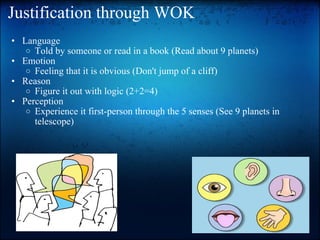
Justification through WOK Language Told by someone or read in a book (Read about 9 planets) Emotion Feeling that it is obvious (Don't jump of a cliff) Reason Figure it out with logic (2+2=4) Perception Experience it first-person through the 5 senses (See 9 planets in telescope)
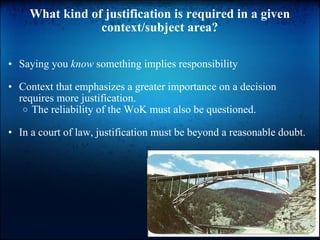
Justification - Reliability and Context Reliability  - The key thing that distinguishes acceptable from unacceptable justifications Perception is generally reliable Telepathy is not Whether or not you are justified in saying that you  know  something also depends on  context. Example - being sure of something if the future of the world depended on you being correct You have to make judgment about when doubt is appropriate and inappropriate. When you say you  know  something you are, in a sense, taking responsibility for it being true. Bridge example
What kind of justification is required in a given context/subject area? Saying you  know  something implies responsibility Context that emphasizes a greater importance on a decision requires more justification. The reliability of the WoK must also be questioned. In a court of law, justification must be beyond a reasonable doubt.
Conclusion Justification is confirming or proving one's belief to be right, by the 4 WOK: language, emotion, reason, and perception.  However, two other factors also contribute to justification. First, acceptable from unacceptable justifications are determined by evaluating how reliable a source of knowledge is.  Second, the situation one is in (one's context) affects justification.
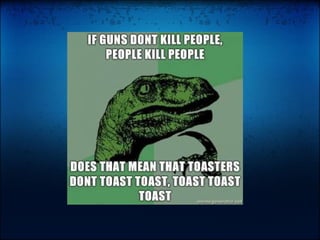
Examples  
 
 
Au revoir! Fin

Justification ppt grant_nick_ross

  • 1.
    Justification Nick Davin,Ross Buchan, and Grant Simens
  • 2.
    Justification through JTBFor many centuries, philosophers accepted Plato's theory of knowledge - the view that knowledge is justified true belief. JTB states in order to know that a given proposition is true, one must not only believe the relevant true proposition, but one must also have justification for doing so.  The official statement for JTB: P is true, S believes that P is true, and S is justified in believing that P is true. For something to be true, and for you to have knowledge that it is true, you must have factual evidence to justify it.
  • 3.
    Justification through WOKLanguage Told by someone or read in a book (Read about 9 planets) Emotion Feeling that it is obvious (Don't jump of a cliff) Reason Figure it out with logic (2+2=4) Perception Experience it first-person through the 5 senses (See 9 planets in telescope)
  • 4.
    Justification - Reliabilityand Context Reliability - The key thing that distinguishes acceptable from unacceptable justifications Perception is generally reliable Telepathy is not Whether or not you are justified in saying that you  know something also depends on context. Example - being sure of something if the future of the world depended on you being correct You have to make judgment about when doubt is appropriate and inappropriate. When you say you  know  something you are, in a sense, taking responsibility for it being true. Bridge example
  • 5.
    What kind ofjustification is required in a given context/subject area? Saying you  know something implies responsibility Context that emphasizes a greater importance on a decision requires more justification. The reliability of the WoK must also be questioned. In a court of law, justification must be beyond a reasonable doubt.
  • 6.
    Conclusion Justification isconfirming or proving one's belief to be right, by the 4 WOK: language, emotion, reason, and perception.  However, two other factors also contribute to justification. First, acceptable from unacceptable justifications are determined by evaluating how reliable a source of knowledge is.  Second, the situation one is in (one's context) affects justification.
  • 7.
  • 8.
  • 9.
  • 10.