Care of At-Risk /
High Risk and Sick
Mother and Child
NCM 109
LEARNING OUTCOMES
• Assess with the client (individual, family, population groups, and/or
community), one’s health status/competence
• Formulate with the client a plan of care to address the health
conditions, needs, problems, and issues based on priorities.
• Implement safe and quality interventions with the client to address
the health needs, problems, and issues.
• Provide health education using selected planning models to targeted
clientele (individuals, family, population group, or community.
• Evaluate with the client the health status/competence and / or
expected outcomes of nurse-client working relationship
COURSE CONTENTS
• Nursing care of the Pregnant Client
• Nursing Care of the client during Labor
and delivery
• Nursing care of the Postpartum Client
• Nursing care of Male and Female Clients
with General and Specific Problems in
Reproduction and sexuality
• Nursing care of at Risk/ High Risk/ Sick
Client
1. Newborn
2. Infant and Young Infant
3. Toddler
4. Preschool
5. School age
6. Adolescent
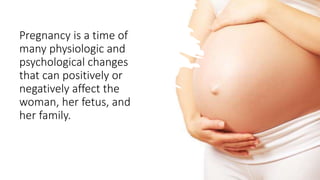
Pregnancy is a time of
many physiologic and
psychological changes
that can positively or
negatively affect the
woman, her fetus, and
her family.
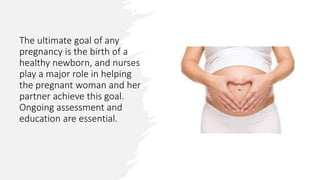
The ultimate goal of any
pregnancy is the birth of a
healthy newborn, and nurses
play a major role in helping
the pregnant woman and her
partner achieve this goal.
Ongoing assessment and
education are essential.
HIGH-RISK PREGNANCY
• Is one which a concurrent
disorder, pregnancy –
related complication or
external factor jeopardizes
the health of the woman ,
fetus or both
High Risk Pregnancy
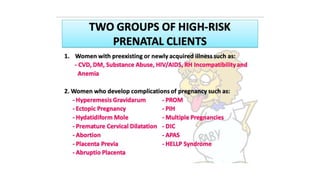
High Risk
Pregnancy
Areas to be assessed for high-risk factors
include obstetrical history, medical history,
current obstetric status and social-personal
characteristics.
Obstetrical
History
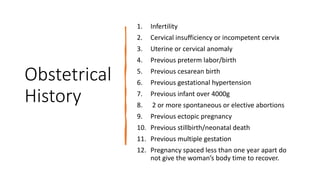
1. Infertility
2. Cervical insufficiency or incompetent cervix
3. Uterine or cervical anomaly
4. Previous preterm labor/birth
5. Previous cesarean birth
6. Previous gestational hypertension
7. Previous infant over 4000g
8. 2 or more spontaneous or elective abortions
9. Previous ectopic pregnancy
10. Previous stillbirth/neonatal death
11. Previous multiple gestation
12. Pregnancy spaced less than one year apart do
not give the woman’s body time to recover.
Medical
History
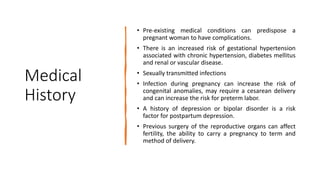
• Pre-existing medical conditions can predispose a
pregnant woman to have complications.
• There is an increased risk of gestational hypertension
associated with chronic hypertension, diabetes mellitus
and renal or vascular disease.
• Sexually transmitted infections
• Infection during pregnancy can increase the risk of
congenital anomalies, may require a cesarean delivery
and can increase the risk for preterm labor.
• A history of depression or bipolar disorder is a risk
factor for postpartum depression.
• Previous surgery of the reproductive organs can affect
fertility, the ability to carry a pregnancy to term and
method of delivery.
Social-Personal Characteristics
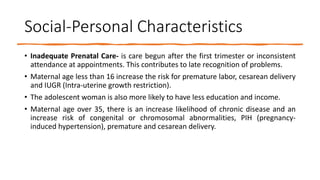
• Inadequate Prenatal Care- is care begun after the first trimester or inconsistent
attendance at appointments. This contributes to late recognition of problems.
• Maternal age less than 16 increase the risk for premature labor, cesarean delivery
and IUGR (Intra-uterine growth restriction).
• The adolescent woman is also more likely to have less education and income.
• Maternal age over 35, there is an increase likelihood of chronic disease and an
increase risk of congenital or chromosomal abnormalities, PIH (pregnancy-
induced hypertension), premature and cesarean delivery.
Social-Personal Characteristics
• Primagravidas have an increased risk of PIH, prolonged labor and cesarean
delivery.
• A history of multiparity greater than 3 and increases the risk for antepartum or
postpartum hemorrhage.
• Socio-economic factors such as low education, low income, being unmarried and
being nonwhite are associated with increase incidence of gestational
hypertension, inadequate prenatal care, preterm birth and Intra Uterine Growth
Retardation.
• Being underweight at conception increases the risk of anemia, prolonged labor,
and IUGR; being overweight at conception increases the risk for gestational
hypertension, diabetes, cesarean delivery and macrosomia.
Social-Personal Characteristics
• Smoking contributes to IUGR and preterm labor or birth.
• Drug addiction or alcohol abuse increases the risk of preterm labor,
IUGR, inadequate maternal nutrition and abnormal fetal
development.
• Family violence leading to physical abuse increases the rate of
spontaneous abortion, preterm birth and stillbirths. The women who
experiences violence is more prone to anxiety, depression, alcohol or
drug use, and is more likely to have inadequate prenatal care.
Current Obstetrical Status
• A total weight gain of 10 pounds or a weight loss of more than 5 pounds has
serious implications for fetal growth and indicates the need for dietary
intervention.
• Excessive weight gain can result from edema associated with gestational
hypertension or caloric intake above the recommended amount.
• Indications for IUGR should be evaluated for limited circulation to the placenta.
• A fetus that is large for gestational age is often associated with gestational
diabetes and increases maternal risk for instrument–assisted birth or cesarean
delivery and fetal risk for birth injury.
Current Obstetrical Status
• When fetal surveillances tests are abnormal, additional assessments for
chromosomal abnormalities, congenital defects and placental functioning are
performed at the physician’s direction
• An abnormal fetal presentation such as breech or transverse lie requires a
cesarean delivery.
• Hydramnios or increased amount of amniotic fluid is associated with certain
conditions such as Rh sensitization, diabetes and fetal neurological or
gastrointestinal defects
• Oligohydramnios or a diminished amount of fluid is found with post maturity,
IUGR and fetal abnormalities.
Current Obstetrical Status
• Maternal anemia can be an indication of inadequate iron intake or of a
hemoglobinopathy such as sickle cell anemia.
• Obstetrical complications during a pregnancy place the woman at significant risk.
• Vomiting associated with hyperemesis gravidarum has an impact on nutritional
status.
• Gestational hypertension results in constriction of maternal blood vessels that
can cause decreased placental perfusion. Leading to low birth weight and fetal
distress.
• Maternal risks from gestational hypertension include cerebral, renal,
cardiovascular or hepatic problems
Current Obstetrical Status
• Placental problems such as previa or abruption can interfere with
circulation to the fetus, lead to maternal hemorrhage and require
cesarean delivery.
• Rh sensitization causes destruction of fetal red blood cells that can
lead to fetal or neonatal complications.
• Preterm labor affects maternal physical and emotional well-being,
and if it progresses to preterm labor are premature rupture of
membranes, multiple gestation and maternal infections.
• Postdate pregnancy, a pregnancy continuing more than 2 weeks after
due date can lead to complications in the fetus or newborn.
FACTORS THAT
CATEGORIZES
A PREGNANCY
AS HIGH RISK
•Psychological
•Social
•Physical
Pre-pregnancy
Psychological
Factors
• History of drug dependence ( including
alcohol)
• History of intimate partner abuse
• History of mental illness
• History of poor coping mechanisms
• Cognitively challenged
• Survivor of childhood sexual abuse
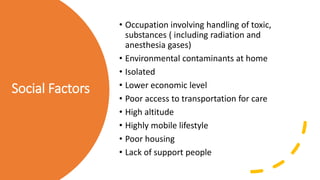
Social Factors
• Occupation involving handling of toxic,
substances ( including radiation and
anesthesia gases)
• Environmental contaminants at home
• Isolated
• Lower economic level
• Poor access to transportation for care
• High altitude
• Highly mobile lifestyle
• Poor housing
• Lack of support people
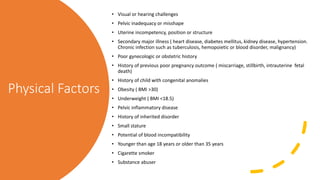
Physical Factors
• Visual or hearing challenges
• Pelvic inadequacy or misshape
• Uterine incompetency, position or structure
• Secondary major illness ( heart disease, diabetes mellitus, kidney disease, hypertension.
Chronic infection such as tuberculosis, hemopoietic or blood disorder, malignancy)
• Poor gynecologic or obstetric history
• History of previous poor pregnancy outcome ( miscarriage, stillbirth, intrauterine fetal
death)
• History of child with congenital anomalies
• Obesity ( BMI >30)
• Underweight ( BMI <18.5)
• Pelvic inflammatory disease
• History of inherited disorder
• Small stature
• Potential of blood incompatibility
• Younger than age 18 years or older than 35 years
• Cigarette smoker
• Substance abuser
During Pregnancy
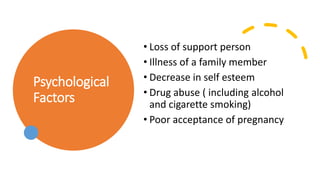
Psychological
Factors
• Loss of support person
• Illness of a family member
• Decrease in self esteem
• Drug abuse ( including alcohol
and cigarette smoking)
• Poor acceptance of pregnancy
Social
Factors
• Refusal of or neglected prenatal care
• Exposure to environmental teratogens
• Disruptive family incident
• Conception less than 1 year after last
pregnancy
Physical
Factors
• Subject to trauma
• Fluid or electrolyte imbalance
• Intake of teratogen such as a drug
• Multiple gestation
• A bleeding disruption
• Poor placental formation or position
• Gestational diabetes
• Nutritional deficiency of iron, folic acid, or protein
• Poor weight gain
• Pregnancy-induced hypertension
• Infection
• Amniotic fluid abnormality
• Post maturity
Labor and Birth
Psychological
Factors
• Severely frightened by labor and birth
experience
• Inability to participate because of
anesthesia
• Separation of infant at birth
• Lack of separation for labor
• Birth of infant who is disappointing in
some way ( such as sex, appearance, or
congenital anomalies)
• Illness in newborn
Social
Factors
• Lack of support person
• Inadequate home for infant care
• Unplanned cesarean birth
• Lack of access to continued health care
• Lack of access to emergency personnel or
equipment
Physical Factors
Hemorrhage Infection Fluid and electrolyte
imbalance
VULNERABLE
GROUPS OF
PREGNANT
WOMEN:
• Adolescent
• Mentally ill
• 18 y/o and below
• Women over 40 y/o
• Physically and cognitively challenge
• Woman who is a substance dependent
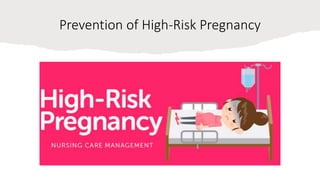
Prevention of High-Risk Pregnancy
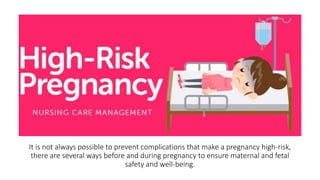
It is not always possible to prevent complications that make a pregnancy high-risk,
there are several ways before and during pregnancy to ensure maternal and fetal
safety and well-being.
Prevention
Before
Pregnancy
Taking the time to treat or manage
them before conceiving is the best
way to significantly reduce the risk
of complications.
During Pregnancy
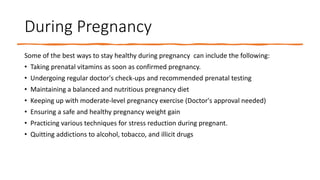
Some of the best ways to stay healthy during pregnancy can include the following:
• Taking prenatal vitamins as soon as confirmed pregnancy.
• Undergoing regular doctor's check-ups and recommended prenatal testing
• Maintaining a balanced and nutritious pregnancy diet
• Keeping up with moderate-level pregnancy exercise (Doctor's approval needed)
• Ensuring a safe and healthy pregnancy weight gain
• Practicing various techniques for stress reduction during pregnant.
• Quitting addictions to alcohol, tobacco, and illicit drugs
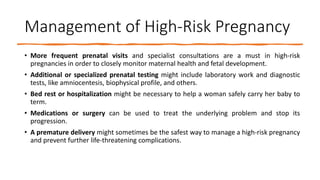
Management of High-Risk Pregnancy
• More frequent prenatal visits and specialist consultations are a must in high-risk
pregnancies in order to closely monitor maternal health and fetal development.
• Additional or specialized prenatal testing might include laboratory work and diagnostic
tests, like amniocentesis, biophysical profile, and others.
• Bed rest or hospitalization might be necessary to help a woman safely carry her baby to
term.
• Medications or surgery can be used to treat the underlying problem and stop its
progression.
• A premature delivery might sometimes be the safest way to manage a high-risk pregnancy
and prevent further life-threatening complications.
END

High Risk Pregnancy part1 (1).pptx

  • 1.
    Care of At-Risk/ High Risk and Sick Mother and Child NCM 109
  • 2.
    LEARNING OUTCOMES • Assesswith the client (individual, family, population groups, and/or community), one’s health status/competence • Formulate with the client a plan of care to address the health conditions, needs, problems, and issues based on priorities. • Implement safe and quality interventions with the client to address the health needs, problems, and issues. • Provide health education using selected planning models to targeted clientele (individuals, family, population group, or community. • Evaluate with the client the health status/competence and / or expected outcomes of nurse-client working relationship
  • 3.
    COURSE CONTENTS • Nursingcare of the Pregnant Client • Nursing Care of the client during Labor and delivery • Nursing care of the Postpartum Client • Nursing care of Male and Female Clients with General and Specific Problems in Reproduction and sexuality • Nursing care of at Risk/ High Risk/ Sick Client 1. Newborn 2. Infant and Young Infant 3. Toddler 4. Preschool 5. School age 6. Adolescent
  • 4.
    Pregnancy is atime of many physiologic and psychological changes that can positively or negatively affect the woman, her fetus, and her family.
  • 5.
    The ultimate goalof any pregnancy is the birth of a healthy newborn, and nurses play a major role in helping the pregnant woman and her partner achieve this goal. Ongoing assessment and education are essential.
  • 6.
    HIGH-RISK PREGNANCY • Isone which a concurrent disorder, pregnancy – related complication or external factor jeopardizes the health of the woman , fetus or both
  • 7.
  • 9.
    High Risk Pregnancy Areas tobe assessed for high-risk factors include obstetrical history, medical history, current obstetric status and social-personal characteristics.
  • 10.
    Obstetrical History 1. Infertility 2. Cervicalinsufficiency or incompetent cervix 3. Uterine or cervical anomaly 4. Previous preterm labor/birth 5. Previous cesarean birth 6. Previous gestational hypertension 7. Previous infant over 4000g 8. 2 or more spontaneous or elective abortions 9. Previous ectopic pregnancy 10. Previous stillbirth/neonatal death 11. Previous multiple gestation 12. Pregnancy spaced less than one year apart do not give the woman’s body time to recover.
  • 11.
    Medical History • Pre-existing medicalconditions can predispose a pregnant woman to have complications. • There is an increased risk of gestational hypertension associated with chronic hypertension, diabetes mellitus and renal or vascular disease. • Sexually transmitted infections • Infection during pregnancy can increase the risk of congenital anomalies, may require a cesarean delivery and can increase the risk for preterm labor. • A history of depression or bipolar disorder is a risk factor for postpartum depression. • Previous surgery of the reproductive organs can affect fertility, the ability to carry a pregnancy to term and method of delivery.
  • 12.
    Social-Personal Characteristics • InadequatePrenatal Care- is care begun after the first trimester or inconsistent attendance at appointments. This contributes to late recognition of problems. • Maternal age less than 16 increase the risk for premature labor, cesarean delivery and IUGR (Intra-uterine growth restriction). • The adolescent woman is also more likely to have less education and income. • Maternal age over 35, there is an increase likelihood of chronic disease and an increase risk of congenital or chromosomal abnormalities, PIH (pregnancy- induced hypertension), premature and cesarean delivery.
  • 13.
    Social-Personal Characteristics • Primagravidashave an increased risk of PIH, prolonged labor and cesarean delivery. • A history of multiparity greater than 3 and increases the risk for antepartum or postpartum hemorrhage. • Socio-economic factors such as low education, low income, being unmarried and being nonwhite are associated with increase incidence of gestational hypertension, inadequate prenatal care, preterm birth and Intra Uterine Growth Retardation. • Being underweight at conception increases the risk of anemia, prolonged labor, and IUGR; being overweight at conception increases the risk for gestational hypertension, diabetes, cesarean delivery and macrosomia.
  • 14.
    Social-Personal Characteristics • Smokingcontributes to IUGR and preterm labor or birth. • Drug addiction or alcohol abuse increases the risk of preterm labor, IUGR, inadequate maternal nutrition and abnormal fetal development. • Family violence leading to physical abuse increases the rate of spontaneous abortion, preterm birth and stillbirths. The women who experiences violence is more prone to anxiety, depression, alcohol or drug use, and is more likely to have inadequate prenatal care.
  • 15.

    Current Obstetrical Status •A total weight gain of 10 pounds or a weight loss of more than 5 pounds has serious implications for fetal growth and indicates the need for dietary intervention. • Excessive weight gain can result from edema associated with gestational hypertension or caloric intake above the recommended amount. • Indications for IUGR should be evaluated for limited circulation to the placenta. • A fetus that is large for gestational age is often associated with gestational diabetes and increases maternal risk for instrument–assisted birth or cesarean delivery and fetal risk for birth injury.
  • 16.
    Current Obstetrical Status •When fetal surveillances tests are abnormal, additional assessments for chromosomal abnormalities, congenital defects and placental functioning are performed at the physician’s direction • An abnormal fetal presentation such as breech or transverse lie requires a cesarean delivery. • Hydramnios or increased amount of amniotic fluid is associated with certain conditions such as Rh sensitization, diabetes and fetal neurological or gastrointestinal defects • Oligohydramnios or a diminished amount of fluid is found with post maturity, IUGR and fetal abnormalities.
  • 17.
    Current Obstetrical Status •Maternal anemia can be an indication of inadequate iron intake or of a hemoglobinopathy such as sickle cell anemia. • Obstetrical complications during a pregnancy place the woman at significant risk. • Vomiting associated with hyperemesis gravidarum has an impact on nutritional status. • Gestational hypertension results in constriction of maternal blood vessels that can cause decreased placental perfusion. Leading to low birth weight and fetal distress. • Maternal risks from gestational hypertension include cerebral, renal, cardiovascular or hepatic problems
  • 18.
    Current Obstetrical Status •Placental problems such as previa or abruption can interfere with circulation to the fetus, lead to maternal hemorrhage and require cesarean delivery. • Rh sensitization causes destruction of fetal red blood cells that can lead to fetal or neonatal complications. • Preterm labor affects maternal physical and emotional well-being, and if it progresses to preterm labor are premature rupture of membranes, multiple gestation and maternal infections. • Postdate pregnancy, a pregnancy continuing more than 2 weeks after due date can lead to complications in the fetus or newborn.
  • 19.
    FACTORS THAT CATEGORIZES A PREGNANCY ASHIGH RISK •Psychological •Social •Physical
  • 20.
  • 21.
    Psychological Factors • History ofdrug dependence ( including alcohol) • History of intimate partner abuse • History of mental illness • History of poor coping mechanisms • Cognitively challenged • Survivor of childhood sexual abuse
  • 22.
    Social Factors • Occupationinvolving handling of toxic, substances ( including radiation and anesthesia gases) • Environmental contaminants at home • Isolated • Lower economic level • Poor access to transportation for care • High altitude • Highly mobile lifestyle • Poor housing • Lack of support people
  • 23.
    Physical Factors • Visualor hearing challenges • Pelvic inadequacy or misshape • Uterine incompetency, position or structure • Secondary major illness ( heart disease, diabetes mellitus, kidney disease, hypertension. Chronic infection such as tuberculosis, hemopoietic or blood disorder, malignancy) • Poor gynecologic or obstetric history • History of previous poor pregnancy outcome ( miscarriage, stillbirth, intrauterine fetal death) • History of child with congenital anomalies • Obesity ( BMI >30) • Underweight ( BMI <18.5) • Pelvic inflammatory disease • History of inherited disorder • Small stature • Potential of blood incompatibility • Younger than age 18 years or older than 35 years • Cigarette smoker • Substance abuser
  • 24.
  • 25.
    Psychological Factors • Loss ofsupport person • Illness of a family member • Decrease in self esteem • Drug abuse ( including alcohol and cigarette smoking) • Poor acceptance of pregnancy
  • 26.
    Social Factors • Refusal ofor neglected prenatal care • Exposure to environmental teratogens • Disruptive family incident • Conception less than 1 year after last pregnancy
  • 27.
    Physical Factors • Subject totrauma • Fluid or electrolyte imbalance • Intake of teratogen such as a drug • Multiple gestation • A bleeding disruption • Poor placental formation or position • Gestational diabetes • Nutritional deficiency of iron, folic acid, or protein • Poor weight gain • Pregnancy-induced hypertension • Infection • Amniotic fluid abnormality • Post maturity
  • 28.
  • 29.
    Psychological Factors • Severely frightenedby labor and birth experience • Inability to participate because of anesthesia • Separation of infant at birth • Lack of separation for labor • Birth of infant who is disappointing in some way ( such as sex, appearance, or congenital anomalies) • Illness in newborn
  • 30.
    Social Factors • Lack ofsupport person • Inadequate home for infant care • Unplanned cesarean birth • Lack of access to continued health care • Lack of access to emergency personnel or equipment
  • 31.
    Physical Factors Hemorrhage InfectionFluid and electrolyte imbalance
  • 32.
    VULNERABLE GROUPS OF PREGNANT WOMEN: • Adolescent •Mentally ill • 18 y/o and below • Women over 40 y/o • Physically and cognitively challenge • Woman who is a substance dependent
  • 33.
  • 34.
    It is notalways possible to prevent complications that make a pregnancy high-risk, there are several ways before and during pregnancy to ensure maternal and fetal safety and well-being.
  • 35.
    Prevention Before Pregnancy Taking the timeto treat or manage them before conceiving is the best way to significantly reduce the risk of complications.
  • 36.
    During Pregnancy Some ofthe best ways to stay healthy during pregnancy can include the following: • Taking prenatal vitamins as soon as confirmed pregnancy. • Undergoing regular doctor's check-ups and recommended prenatal testing • Maintaining a balanced and nutritious pregnancy diet • Keeping up with moderate-level pregnancy exercise (Doctor's approval needed) • Ensuring a safe and healthy pregnancy weight gain • Practicing various techniques for stress reduction during pregnant. • Quitting addictions to alcohol, tobacco, and illicit drugs
  • 37.
    Management of High-RiskPregnancy • More frequent prenatal visits and specialist consultations are a must in high-risk pregnancies in order to closely monitor maternal health and fetal development. • Additional or specialized prenatal testing might include laboratory work and diagnostic tests, like amniocentesis, biophysical profile, and others. • Bed rest or hospitalization might be necessary to help a woman safely carry her baby to term. • Medications or surgery can be used to treat the underlying problem and stop its progression. • A premature delivery might sometimes be the safest way to manage a high-risk pregnancy and prevent further life-threatening complications.
  • 38.