Epidemic and
Pandemic
Disease Outbreaks
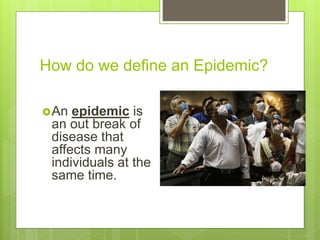
How do we define an Epidemic?
An epidemic is
an out break of
disease that
affects many
individuals at the
same time.
What is an Epidemic?
An epidemic is any illness or health-
related issue that is showing up in more
cases then would normally be expected.
It occurs when an infections disease
spreads rapidly to many people.
In 2003, the severe acute respiratory
syndrome(SARS) epidemic took the
lives of nearly 800 people.
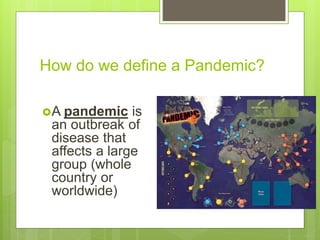
How do we define a Pandemic?
A pandemic is
an outbreak of
disease that
affects a large
group (whole
country or
worldwide)
What is the difference between
Epidemic and Pandemic?
 Pandemic normally is used to indicate a far
higher number of people affected than an
epidemic.
 Pandemic also refers to a much larger region
being affected.
 In the most extreme case, the entire global
population would be affected by a pandemic.
What is the difference between
Epidemic and Pandemic?
It is not unusual for a new virus to spread
worldwide because if people have not been
exposed to the virus their immune system are
not ready to fight it off. This causes more
people to become infected.
Swine flu stated in Mexico City where it was
feared to lead to epidemic proportions in North
America, now that the flu has been found in
New Zealand, Israel, Scotland and many other
countries it is a pandemic.
What is the difference between
Epidemic and Pandemic?
 The 1918 Spanish flu and the Black Plague are
extreme examples of pandemics.
 Pandemic doesn’t mean millions of deaths, it
means a geographically widespread.
 http://www.learn360.com/ShowVideo.aspx?Searc
hText=1918+Spanish+Flu+Pandemic&lid=185658
51&ID=366550
 http://www.learn360.com/ShowVideo.aspx?Searc
hText=Black+Plague&lid=18565851&ID=348288
Extras
 Antibiotics are used to treat Bacteria not Viruses.
 If you use too many antibiotics you can become
antibiotic resistant.
 Vaccines are used to prevent the spread of viruses
not all viruses have a vaccine to help prevent.
 The flu virus can mutate from year to year
therefore doctors suggest you get a flu vaccine
each year.

Epidemic and Pandemic.pptx

  • 1.
  • 2.
    How do wedefine an Epidemic? An epidemic is an out break of disease that affects many individuals at the same time.
  • 3.
    What is anEpidemic? An epidemic is any illness or health- related issue that is showing up in more cases then would normally be expected. It occurs when an infections disease spreads rapidly to many people. In 2003, the severe acute respiratory syndrome(SARS) epidemic took the lives of nearly 800 people.
  • 4.
    How do wedefine a Pandemic? A pandemic is an outbreak of disease that affects a large group (whole country or worldwide)
  • 5.
    What is thedifference between Epidemic and Pandemic?  Pandemic normally is used to indicate a far higher number of people affected than an epidemic.  Pandemic also refers to a much larger region being affected.  In the most extreme case, the entire global population would be affected by a pandemic.
  • 6.
    What is thedifference between Epidemic and Pandemic? It is not unusual for a new virus to spread worldwide because if people have not been exposed to the virus their immune system are not ready to fight it off. This causes more people to become infected. Swine flu stated in Mexico City where it was feared to lead to epidemic proportions in North America, now that the flu has been found in New Zealand, Israel, Scotland and many other countries it is a pandemic.
  • 7.
    What is thedifference between Epidemic and Pandemic?  The 1918 Spanish flu and the Black Plague are extreme examples of pandemics.  Pandemic doesn’t mean millions of deaths, it means a geographically widespread.  http://www.learn360.com/ShowVideo.aspx?Searc hText=1918+Spanish+Flu+Pandemic&lid=185658 51&ID=366550  http://www.learn360.com/ShowVideo.aspx?Searc hText=Black+Plague&lid=18565851&ID=348288
  • 8.
    Extras  Antibiotics areused to treat Bacteria not Viruses.  If you use too many antibiotics you can become antibiotic resistant.  Vaccines are used to prevent the spread of viruses not all viruses have a vaccine to help prevent.  The flu virus can mutate from year to year therefore doctors suggest you get a flu vaccine each year.