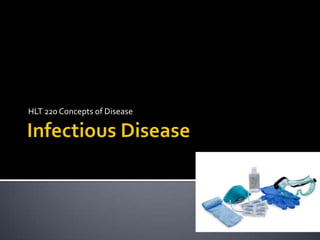
HLT 220 Concepts of Disease
   Distinguish between the terms endemic,
    epidemic and pandemic by identifying the key
    characteristics of each in a multiple choice
    question(s)
   Given a list of infectious disease scenarios,
    classify (sort) the diseases as endemic,
    epidemic, or pandemic
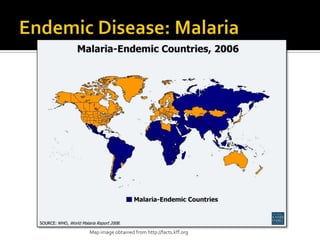
   Term used to describe a disease that always
    (generally) occurs in low levels in a population

   Examples
     Malaria
     Sexually Transmitted Diseases (STDs)
Map image obtained from http://facts.kff.org
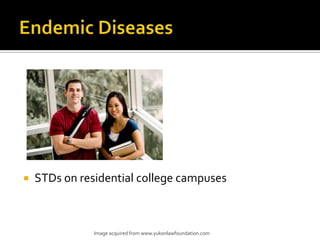
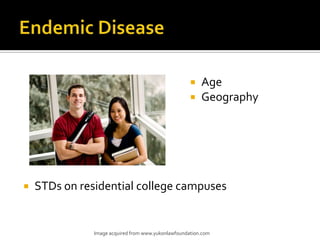
   STDs on residential college campuses


               Image acquired from www.yukonlawfoundation.com
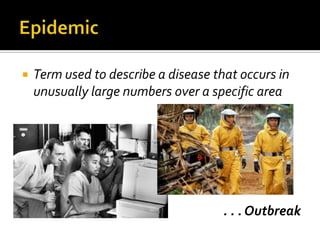
   Term used to describe a disease that occurs in
    unusually large numbers over a specific area


                                      . . . Outbreak
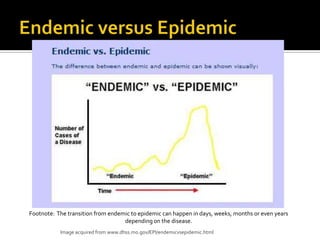
Footnote: The transition from endemic to epidemic can happen in days, weeks, months or even years
                                   depending on the disease.
           Image acquired from www.dhss.mo.gov/EPI/endemicvsepidemic.html
   Age
                                                        Geography


   STDs on residential college campuses


               Image acquired from www.yukonlawfoundation.com
Image acquired from www.yukonlawfoundation.com
   Term used to describe a disease that occurs in
    unusually large numbers over a specific area
   Examples
     One STD on one college campus
     Food-borne illnesses (Hepatitis A, salmonella)
     SARS in Asia, MRSA, Highly resistant TB
     In the early US, infection of Native Americans with
      Smallpox, measles, influenza
     Two more . . .
Graph acquired from www.waterandhealth.org
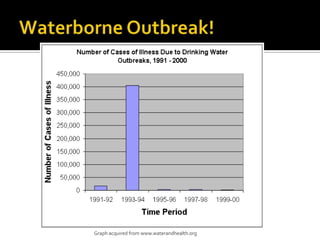
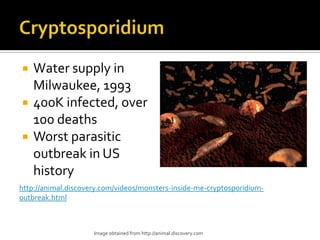
   Water supply in
    Milwaukee, 1993
   400K infected, over
    100 deaths
   Worst parasitic
    outbreak in US
    history
http://animal.discovery.com/videos/monsters-inside-me-cryptosporidium-
outbreak.html


                     Image obtained from http://animal.discovery.com
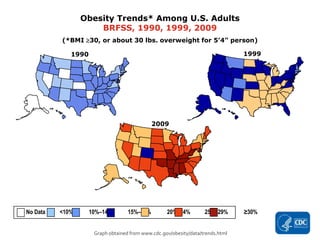
Obesity Trends* Among U.S. Adults
                     BRFSS, 1990, 1999, 2009
          (*BMI 30, or about 30 lbs. overweight for 5’4” person)

             1990                                                               1999


                                             2009


No Data   <10%      10%–14%        15%–19%         20%–24%         25%–29%      ≥30%


                     Graph obtained from www.cdc.gov/obesity/data/trends.html
   Term used to describe an epidemic that has
    spread to include several large areas worldwide

   Examples
     Spanish Flu of 1918
     Bubonic Plague or “Black Death” (1300s & 1600s)
     One current pandemic??
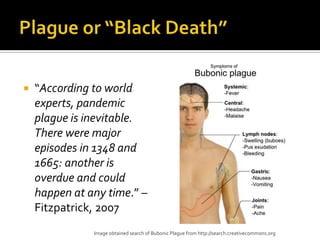
   “According to world
    experts, pandemic
    plague is inevitable.
    There were major
    episodes in 1348 and
    1665: another is
    overdue and could
    happen at any time.” –
    Fitzpatrick, 2007
               Image obtained search of Bubonic Plague from http://search.creativecommons.org
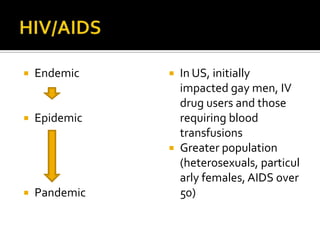
   Endemic     In US, initially
                 impacted gay men, IV
                 drug users and those
   Epidemic     requiring blood
                 transfusions
                Greater population
                 (heterosexuals, particul
                 arly females, AIDS over
   Pandemic     50)
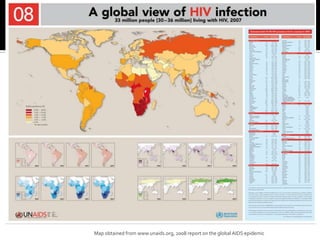
Map obtained from www.unaids.org, 2008 report on the global AIDS epidemic
   Distinguish between the terms endemic,
    epidemic and pandemic by identifying the key
    characteristics of each in a multiple choice
    question(s)
   Given a list of infectious diseases, classify
    (sort) the diseases as endemic, epidemic, or
    pandemic
   Centers for Disease Control. (2009). US obesity trends, Trends by state, 1985-
    2009. Obtained from http://www.cdc.gov/obesity/data/trends.html
   Fitzpatrick, M. (2007). Pandemic plague contingency plan. British Journal of
    General Practice, 57(534). Obtained from
    http://www.ncbi.nlm.nih.gov/pmc/articles/PMC2032711/.
   Billings, Molly (2005). The Influenza Pandemic of 1918. Obtained from
    http://virus.stanford.edu/uda/.
   UN AIDS. (2008). 2008 Report on the Global AIDS Epidemic. Obtained from
    http://www.unaids.org/en/KnowledgeCentre/HIVData/GlobalReport/2008/2008_
    Global_report.asp.
   Zelman, M., Tompary, E., Raymond, J., Holdaway, P. & Mulvihill, M. L. (2010).
    Human Diseases (7th edition). Pearson Publishers: Saddle River, New Jersey.
   Infectious disease precautions image (title page) acquired from
    http://search.creativecommons.org/
   College couple image acquired from www.yukonlawfoundation.com
   Endemic versus epidemic graph acquired from Image acquired from
    www.dhss.mo.gov/EPI/endemicvsepidemic.html
   US obesity trends map, 1985-2009. Obtained from
    http://www.cdc.gov/obesity/data/trends.html
   Endemic malaria map obtained from http://facts.kff.org
   Elder couple images acquired from http://eldercarehomefinder.com/ and
    http://www.lakewoodhomecare.com/
   Images from Outbreak acquired from http://tech.mit.edu/V115/N14/ots.14a.html and
    http://www.flmboynt.com/2010/08/just-be-tv-films-5/
   Waterborne illness map acquired from
    http://www.waterandhealth.org/newsletter/new/spring_2003/waterborne.html
   A global view of HIV infection map acquired from
    http://www.unaids.org/en/KnowledgeCentre/HIVData/GlobalReport/2008/2008_Glob
    al_report.asp.
   Bubonic Plague image from http://search.creativecommons.org

Hawkins infectious disease_slideshare_presentation

  • 1.
    HLT 220 Conceptsof Disease
  • 2.
    Distinguish between the terms endemic, epidemic and pandemic by identifying the key characteristics of each in a multiple choice question(s)  Given a list of infectious disease scenarios, classify (sort) the diseases as endemic, epidemic, or pandemic
  • 3.
    Term used to describe a disease that always (generally) occurs in low levels in a population  Examples  Malaria  Sexually Transmitted Diseases (STDs)
  • 4.
    Map image obtainedfrom http://facts.kff.org
  • 5.
    STDs on residential college campuses Image acquired from www.yukonlawfoundation.com
  • 6.
    Term used to describe a disease that occurs in unusually large numbers over a specific area . . . Outbreak
  • 7.
    Footnote: The transitionfrom endemic to epidemic can happen in days, weeks, months or even years depending on the disease. Image acquired from www.dhss.mo.gov/EPI/endemicvsepidemic.html
  • 8.
    Age  Geography  STDs on residential college campuses Image acquired from www.yukonlawfoundation.com
  • 9.
    Image acquired fromwww.yukonlawfoundation.com
  • 10.
    Term used to describe a disease that occurs in unusually large numbers over a specific area  Examples  One STD on one college campus  Food-borne illnesses (Hepatitis A, salmonella)  SARS in Asia, MRSA, Highly resistant TB  In the early US, infection of Native Americans with Smallpox, measles, influenza  Two more . . .
  • 11.
    Graph acquired fromwww.waterandhealth.org
  • 12.
    Water supply in Milwaukee, 1993  400K infected, over 100 deaths  Worst parasitic outbreak in US history http://animal.discovery.com/videos/monsters-inside-me-cryptosporidium- outbreak.html Image obtained from http://animal.discovery.com
  • 13.
    Obesity Trends* AmongU.S. Adults BRFSS, 1990, 1999, 2009 (*BMI 30, or about 30 lbs. overweight for 5’4” person) 1990 1999 2009 No Data <10% 10%–14% 15%–19% 20%–24% 25%–29% ≥30% Graph obtained from www.cdc.gov/obesity/data/trends.html
  • 14.
    Term used to describe an epidemic that has spread to include several large areas worldwide  Examples  Spanish Flu of 1918  Bubonic Plague or “Black Death” (1300s & 1600s)  One current pandemic??
  • 15.
    “According to world experts, pandemic plague is inevitable. There were major episodes in 1348 and 1665: another is overdue and could happen at any time.” – Fitzpatrick, 2007 Image obtained search of Bubonic Plague from http://search.creativecommons.org
  • 16.
    Endemic  In US, initially impacted gay men, IV drug users and those  Epidemic requiring blood transfusions  Greater population (heterosexuals, particul arly females, AIDS over  Pandemic 50)
  • 17.
    Map obtained fromwww.unaids.org, 2008 report on the global AIDS epidemic
  • 18.
    Distinguish between the terms endemic, epidemic and pandemic by identifying the key characteristics of each in a multiple choice question(s)  Given a list of infectious diseases, classify (sort) the diseases as endemic, epidemic, or pandemic
  • 19.
    Centers for Disease Control. (2009). US obesity trends, Trends by state, 1985- 2009. Obtained from http://www.cdc.gov/obesity/data/trends.html  Fitzpatrick, M. (2007). Pandemic plague contingency plan. British Journal of General Practice, 57(534). Obtained from http://www.ncbi.nlm.nih.gov/pmc/articles/PMC2032711/.  Billings, Molly (2005). The Influenza Pandemic of 1918. Obtained from http://virus.stanford.edu/uda/.  UN AIDS. (2008). 2008 Report on the Global AIDS Epidemic. Obtained from http://www.unaids.org/en/KnowledgeCentre/HIVData/GlobalReport/2008/2008_ Global_report.asp.  Zelman, M., Tompary, E., Raymond, J., Holdaway, P. & Mulvihill, M. L. (2010). Human Diseases (7th edition). Pearson Publishers: Saddle River, New Jersey.
  • 20.
    Infectious disease precautions image (title page) acquired from http://search.creativecommons.org/  College couple image acquired from www.yukonlawfoundation.com  Endemic versus epidemic graph acquired from Image acquired from www.dhss.mo.gov/EPI/endemicvsepidemic.html  US obesity trends map, 1985-2009. Obtained from http://www.cdc.gov/obesity/data/trends.html  Endemic malaria map obtained from http://facts.kff.org  Elder couple images acquired from http://eldercarehomefinder.com/ and http://www.lakewoodhomecare.com/  Images from Outbreak acquired from http://tech.mit.edu/V115/N14/ots.14a.html and http://www.flmboynt.com/2010/08/just-be-tv-films-5/  Waterborne illness map acquired from http://www.waterandhealth.org/newsletter/new/spring_2003/waterborne.html  A global view of HIV infection map acquired from http://www.unaids.org/en/KnowledgeCentre/HIVData/GlobalReport/2008/2008_Glob al_report.asp.  Bubonic Plague image from http://search.creativecommons.org