Presented by Aditya Prakash
What is an ERG & VEP?  What is an ERG?  The electroretinogram (ERG) is an eye test that evaluates the function of the retinal cells of the eye. ERG is like an ECG of an eye. The ERG test helps diagnose retinal diseases and also diseases that affect parts of the body other than the eye (ocular diseases like diabetic retinopathy). What is VEP? Visual Evoked Potentials are used to detect lesions of the optic pathway like optic nerve, or inflammation of the optic nerve.
Visual Electrophysiology Diagnosis & Recommended Tests Vascular diseases including diabetes  (Retinopathy is common complication of diabetes & is principle cause of blindness in adults. Studies has suggested that eventually up to 75% of all people with diabetes will develop retinopathy of some form):  ERG, VEP Glaucoma : (2nd leading cause of blindness; 5.8% of India population): VEP Age-Related Macular Degeneration  with light sensitivity (Senile cone degeneration):  ERG, GVF  (20% of patients 66 to 85 years of age will have findings of macular degeneration) Optic Neuropathy  (main symptom is loss of vision, with colors appearing subtly washed out in the affected eye. In many cases, only one eye is affected and patients may not be aware of the loss of color vision until the doctor asks them to cover the healthy eye):  VEP, Color, ERG Nystagmus  (is an involuntary eye movement which usually results in some degree of visual loss; In young people, a common, serious cause of acquired nystagmus is head injury from motor vehicle accidents. In older people, a common, serious cause is stroke (blood vessel blockage in the brain). Any disease of the brain (such as multiple sclerosis or brain tumors) can cause nystagmus if the areas controlling eye movements are damaged):  ERG, Color Infant with questionable vision : ERG, VEP Retinitis Pigmentosa  (is a group of genetic eye conditions that leads to incurable blindness):  ERG, GVF, DA
Visual Electrophysiology Diagnosis & Recommended Tests Retrobulbar neuritis  (is the inflammation of the optic nerve that may cause a complete or partial loss of vision; Optic neuritis typically affects young adults ranging from 18–45 years of age, with a mean age of 30–35 years. There is a strong female predominance. The annual incidence is approximately 5/100,000, with a prevalence estimated to be 115/100,000):  ERG, VEP Unexplained visual loss  (Most medical specialties encounter patients whose symptoms cannot be accounted for by detectable organic pathology. These patients present diagnostic uncertainty and management difficulties and are at risk of iatrogenic harm from inappropriate labeling and over investigation): VEP,  ERG, GVF Toxic and nutritional eye disease  (The anterior visual pathway is susceptible to damage from toxins or nutritional deficiency; In the general population, nutritional amblyopia is more common among tobacco and alcohol abusers and those who are undernourished. Toxic optic neuropathies usually are associated with exposure of employees in a workplace, ingestion of materials/foods containing toxic substances, or systemic medications):  ERG Photophobia , decreased vision (an abnormal intolerance of light, in which exposure to light produces intense discomfort of the eyes with tight contraction of the eyelids. Photophobia may be associated with migraine, measles, German measles, meningitis, iritis, or corneal injury):  ERG, GVF, DA Opaque media or trauma :  ERG, GVF
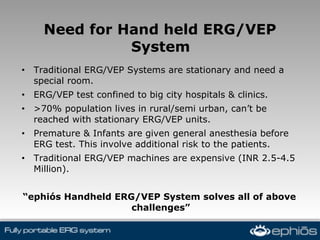
Need for Hand held ERG/VEP System Traditional ERG/VEP Systems are stationary and need a special room. ERG/VEP test confined to big city hospitals & clinics.  >70% population lives in rural/semi urban, can’t be reached with stationary ERG/VEP units. Premature & Infants are given general anesthesia before ERG test. This involve additional risk to the patients. Traditional ERG/VEP machines are expensive (INR 2.5-4.5 Million). “ ephiós Handheld ERG/VEP System solves all of above challenges”
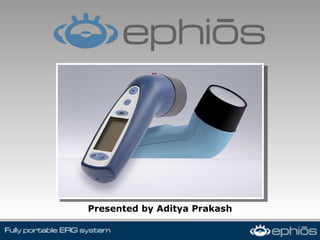
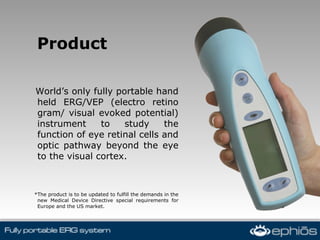
Product World’s only fully portable hand held ERG/VEP (electro retino gram/ visual evoked potential) instrument to study the function of eye retinal cells and optic pathway beyond the eye to the visual cortex. *The product is to be updated to fulfill the demands in the new Medical Device Directive special requirements for Europe and the US market.
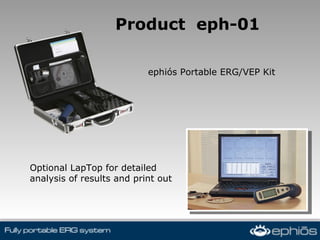
Product  eph-01 ephiós Portable ERG/VEP Kit  Optional LapTop for detailed analysis of results and print out
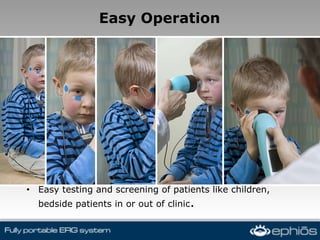
Easy Operation Easy testing and screening of patients like children, bedside patients in or out of clinic .
Key Benefits at Glance Ergonomic design for single handed operation. Quick & effective test of the retinal function in the screening or test before and after surgery.  Easy operation for ERG/VEP on premature, young children and patients in bed. Fully portable for ERG/VEP test in and outside clinic. No PC needed. Instrument display allows for direct interpretation and decision. Patient safety- No connection to the mains during operation. Battery (re-chargeable) powered fully integrated ERG/VEP System
APPLICATION AREAS For quick eye screening and effective ERG/VEP at remote locations and in Hospital OPDs, Operation Theaters, patients in bed, Infants, Premature, children at home, not communicating patients, etc. Useful for monitoring of visual functions before & after cataract & posterior segment surgery.  For screening patients of Glaucoma, AMD, diabetic retinopathy, Childhood blindness etc.  Pharmaceutical Industry (testing side effects of drugs) Teaching at Medical Schools Use in Research as well as Clinical test  Comfortable for patients of all ages
Visual Impairment & Blindness Key Facts-  Estimates Based on 2002 world population 314 million people worldwide live with low vision and blindness.  269 million have low vision.  45 million people are blind. 90% of them live in low-income countries. 80% of blindness is avoidable - i.e. readily treatable and/or preventable. Without effective, major intervention, the number of blind people worldwide has been projected to increase to 76 million by 2020. Source: 2002 Estimates by WHO 2007, IAPB, Vision 2020
Visual Impairment & Blindness Source: 2002 Estimates by WHO 2007, IAPB, Vision 2020
Market & Segments User Segment Ophthalmology – Eye (Glaucoma, AMD, diabetic retinopathy, Childhood blindness, HIV related Blindness) Neurology – Nerve system Pediatric – Children  Veterinarians  Pharmaceutical industry (testing side effects of drugs)  Medical University/Colleges (Teaching & Research) Geographic Segment SAARC Nations,  Africa, Middle-East, Nordic Countries, Europe, USA, South America, Asia pacific and rest of the world. In all places the product can be used as a screening instrument for Diffuse Eye Problems or as a diagnostic tool for Eye Diseases .
Market & Segments Potential Customers General/Specialty Hospitals ( OPD, OT, Patient wards ) Government- Tele-Ophthalmology Projects ( Patients at rural & remote places ) General Eye Clinics Diagnostic Service Providers Pharmaceutical Industry ( Testing side effects of drugs ) Medical Schools ( Teaching ) Research Labs Veterinary Hospitals
Market & Segments Existing infrastructure in India * estimated   Eye care facilities: 4900  General Hospitals (with Ophthalmology department): 11000  Medical Institutes: 300  Vision Centres under NPCB: 3000 * Proposed   Private Practicing Ophthalmologists in India: 12000  Pharma Companies & Vet Hospitals: 500  Primary/ Community Health Centres: 26500 Health care delivery shortfall in India :  ~ 50% (More than 70% of India) ( today advance tests are not available to this population, tele-ophthalmology network will prove to be an effective Delivery mechanism to address this shortfall )
Product Roadmap  ephiós Handheld Family
Competition At writing date there is no competitor that deliver fully portable ERG/VEP system (All in one hand) .  The manufacturers listed below offers stationary ERG systems.  Diagnosys (USA), Tomey (Japan), LKC (USA) , MetroVision (France), Cadwell (USA).  There are also manufacturers of electrophysiology systems for ophthalmology in Italy, Russia, Korea but all with concept of stationary systems. There has been very little product development or innovation on part stationary ERG manufactures over the past year. These manufactures generally continue to position their products as cheaper and slim-down versions.
Thank You for your time Contact: Aditya Prakash ephiós ab Website  www.ephios.com  | e-mail:  [email_address] ;  [email_address] Address Visit C/o Swedish Trade Council - Exportradet, Embassy of Sweden, Nyaya Marg, Chanakayapuri, New Delhi- 110 021 Mobile India +91 9811061885 | fax +91 11 46 06 7110

Ephios Handheld Erg&Vep

  • 1.
  • 2.
    What is anERG & VEP? What is an ERG? The electroretinogram (ERG) is an eye test that evaluates the function of the retinal cells of the eye. ERG is like an ECG of an eye. The ERG test helps diagnose retinal diseases and also diseases that affect parts of the body other than the eye (ocular diseases like diabetic retinopathy). What is VEP? Visual Evoked Potentials are used to detect lesions of the optic pathway like optic nerve, or inflammation of the optic nerve.
  • 3.
    Visual Electrophysiology Diagnosis& Recommended Tests Vascular diseases including diabetes (Retinopathy is common complication of diabetes & is principle cause of blindness in adults. Studies has suggested that eventually up to 75% of all people with diabetes will develop retinopathy of some form): ERG, VEP Glaucoma : (2nd leading cause of blindness; 5.8% of India population): VEP Age-Related Macular Degeneration with light sensitivity (Senile cone degeneration): ERG, GVF (20% of patients 66 to 85 years of age will have findings of macular degeneration) Optic Neuropathy (main symptom is loss of vision, with colors appearing subtly washed out in the affected eye. In many cases, only one eye is affected and patients may not be aware of the loss of color vision until the doctor asks them to cover the healthy eye): VEP, Color, ERG Nystagmus (is an involuntary eye movement which usually results in some degree of visual loss; In young people, a common, serious cause of acquired nystagmus is head injury from motor vehicle accidents. In older people, a common, serious cause is stroke (blood vessel blockage in the brain). Any disease of the brain (such as multiple sclerosis or brain tumors) can cause nystagmus if the areas controlling eye movements are damaged): ERG, Color Infant with questionable vision : ERG, VEP Retinitis Pigmentosa (is a group of genetic eye conditions that leads to incurable blindness): ERG, GVF, DA
  • 4.
    Visual Electrophysiology Diagnosis& Recommended Tests Retrobulbar neuritis (is the inflammation of the optic nerve that may cause a complete or partial loss of vision; Optic neuritis typically affects young adults ranging from 18–45 years of age, with a mean age of 30–35 years. There is a strong female predominance. The annual incidence is approximately 5/100,000, with a prevalence estimated to be 115/100,000): ERG, VEP Unexplained visual loss (Most medical specialties encounter patients whose symptoms cannot be accounted for by detectable organic pathology. These patients present diagnostic uncertainty and management difficulties and are at risk of iatrogenic harm from inappropriate labeling and over investigation): VEP, ERG, GVF Toxic and nutritional eye disease (The anterior visual pathway is susceptible to damage from toxins or nutritional deficiency; In the general population, nutritional amblyopia is more common among tobacco and alcohol abusers and those who are undernourished. Toxic optic neuropathies usually are associated with exposure of employees in a workplace, ingestion of materials/foods containing toxic substances, or systemic medications): ERG Photophobia , decreased vision (an abnormal intolerance of light, in which exposure to light produces intense discomfort of the eyes with tight contraction of the eyelids. Photophobia may be associated with migraine, measles, German measles, meningitis, iritis, or corneal injury): ERG, GVF, DA Opaque media or trauma : ERG, GVF
  • 5.
    Need for Handheld ERG/VEP System Traditional ERG/VEP Systems are stationary and need a special room. ERG/VEP test confined to big city hospitals & clinics. >70% population lives in rural/semi urban, can’t be reached with stationary ERG/VEP units. Premature & Infants are given general anesthesia before ERG test. This involve additional risk to the patients. Traditional ERG/VEP machines are expensive (INR 2.5-4.5 Million). “ ephiós Handheld ERG/VEP System solves all of above challenges”
  • 6.
    Product World’s onlyfully portable hand held ERG/VEP (electro retino gram/ visual evoked potential) instrument to study the function of eye retinal cells and optic pathway beyond the eye to the visual cortex. *The product is to be updated to fulfill the demands in the new Medical Device Directive special requirements for Europe and the US market.
  • 7.
    Product eph-01ephiós Portable ERG/VEP Kit Optional LapTop for detailed analysis of results and print out
  • 8.
    Easy Operation Easytesting and screening of patients like children, bedside patients in or out of clinic .
  • 9.
    Key Benefits atGlance Ergonomic design for single handed operation. Quick & effective test of the retinal function in the screening or test before and after surgery. Easy operation for ERG/VEP on premature, young children and patients in bed. Fully portable for ERG/VEP test in and outside clinic. No PC needed. Instrument display allows for direct interpretation and decision. Patient safety- No connection to the mains during operation. Battery (re-chargeable) powered fully integrated ERG/VEP System
  • 10.
    APPLICATION AREAS Forquick eye screening and effective ERG/VEP at remote locations and in Hospital OPDs, Operation Theaters, patients in bed, Infants, Premature, children at home, not communicating patients, etc. Useful for monitoring of visual functions before & after cataract & posterior segment surgery. For screening patients of Glaucoma, AMD, diabetic retinopathy, Childhood blindness etc. Pharmaceutical Industry (testing side effects of drugs) Teaching at Medical Schools Use in Research as well as Clinical test Comfortable for patients of all ages
  • 11.
    Visual Impairment &Blindness Key Facts- Estimates Based on 2002 world population 314 million people worldwide live with low vision and blindness. 269 million have low vision. 45 million people are blind. 90% of them live in low-income countries. 80% of blindness is avoidable - i.e. readily treatable and/or preventable. Without effective, major intervention, the number of blind people worldwide has been projected to increase to 76 million by 2020. Source: 2002 Estimates by WHO 2007, IAPB, Vision 2020
  • 12.
    Visual Impairment &Blindness Source: 2002 Estimates by WHO 2007, IAPB, Vision 2020
  • 13.
    Market & SegmentsUser Segment Ophthalmology – Eye (Glaucoma, AMD, diabetic retinopathy, Childhood blindness, HIV related Blindness) Neurology – Nerve system Pediatric – Children Veterinarians Pharmaceutical industry (testing side effects of drugs) Medical University/Colleges (Teaching & Research) Geographic Segment SAARC Nations, Africa, Middle-East, Nordic Countries, Europe, USA, South America, Asia pacific and rest of the world. In all places the product can be used as a screening instrument for Diffuse Eye Problems or as a diagnostic tool for Eye Diseases .
  • 14.
    Market & SegmentsPotential Customers General/Specialty Hospitals ( OPD, OT, Patient wards ) Government- Tele-Ophthalmology Projects ( Patients at rural & remote places ) General Eye Clinics Diagnostic Service Providers Pharmaceutical Industry ( Testing side effects of drugs ) Medical Schools ( Teaching ) Research Labs Veterinary Hospitals
  • 15.
    Market & SegmentsExisting infrastructure in India * estimated Eye care facilities: 4900 General Hospitals (with Ophthalmology department): 11000 Medical Institutes: 300 Vision Centres under NPCB: 3000 * Proposed Private Practicing Ophthalmologists in India: 12000 Pharma Companies & Vet Hospitals: 500 Primary/ Community Health Centres: 26500 Health care delivery shortfall in India : ~ 50% (More than 70% of India) ( today advance tests are not available to this population, tele-ophthalmology network will prove to be an effective Delivery mechanism to address this shortfall )
  • 16.
    Product Roadmap ephiós Handheld Family
  • 17.
    Competition At writingdate there is no competitor that deliver fully portable ERG/VEP system (All in one hand) . The manufacturers listed below offers stationary ERG systems. Diagnosys (USA), Tomey (Japan), LKC (USA) , MetroVision (France), Cadwell (USA). There are also manufacturers of electrophysiology systems for ophthalmology in Italy, Russia, Korea but all with concept of stationary systems. There has been very little product development or innovation on part stationary ERG manufactures over the past year. These manufactures generally continue to position their products as cheaper and slim-down versions.
  • 18.
    Thank You foryour time Contact: Aditya Prakash ephiós ab Website  www.ephios.com  | e-mail:  [email_address] ;  [email_address] Address Visit C/o Swedish Trade Council - Exportradet, Embassy of Sweden, Nyaya Marg, Chanakayapuri, New Delhi- 110 021 Mobile India +91 9811061885 | fax +91 11 46 06 7110