Industrial Stormwater
Discharges - Regulatory
Developments and Technical
Considerations
April 30, 2014
1
Panel
Ryan Janoch, PE
Mapistry
Wendy Manley, Esq.
Wendel Rosen Black & Dean
Jarrod Yoder, PG, LSP
Woodard & Curran
2
Overview
 New California Industrial General
Permit Highlights
 Draft Multi-Sector General Permit
Highlights
 Case Study #1 - Naturally Occurring
Metals in Stormwater Discharges
(MA)
 Case Study #2 - Infiltration to
Eliminate MSGP Requirements (MA)
 Case Study #3 - Source Tracking
(CA)
 Regulatory Developments/Trends
3
California Industrial General
Permit
 Adopted April 2014
 Starts July 2015
 Numeric Action Levels (NALs)
 Exceedance Response Actions (ERAs)
 Minimum BMPs
 Sampling requirements
4
Draft Multi Sector General Permit
Who is affected? Facilities operating within the 29 regulated
industrial sectors listed in the 2008 MSGP and located where the
EPA is the NPDES permitting authority.
 Streamlining the SWPPP and eliminating generic language
 Public accessibility to the SWPPP
 Reduced requirements for inspections
 Specific deadlines for taking corrective actions
 Electronic submission for the NOI, NOT,
annual report and monitoring reports
5
Draft Multi Sector General Permit
6
 Requirement for pavement wash water discharges to be treated
by control measures
 Additional notification for discharges to Federal Superfund Sites
 Inclusion of airport deicing effluent limitation guideline
 Inclusion of saltwater benchmark
values for metals and
 Additional clarity for technology
based effluent limits
Case Study #1 - Naturally Occurring
Metals in Stormwater Discharges
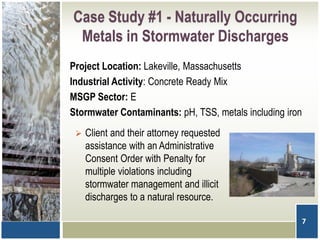
Project Location: Lakeville, Massachusetts
Industrial Activity: Concrete Ready Mix
MSGP Sector: E
Stormwater Contaminants: pH, TSS, metals including iron
7
 Client and their attorney requested
assistance with an Administrative
Consent Order with Penalty for
multiple violations including
stormwater management and illicit
discharges to a natural resource.
Case Study #1 - Naturally Occurring
Metals in Stormwater Discharges
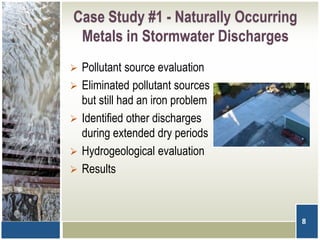
 Pollutant source evaluation
 Eliminated pollutant sources
but still had an iron problem
 Identified other discharges
during extended dry periods
 Hydrogeological evaluation
 Results
8
Case Study #2 - Infiltration to
Eliminate MSGP Requirements
 Project Location: Everett, Massachusetts
 Industrial Activity: Metal Collection Facility
 MSGP Sector: N
 Stormwater Contaminants: metals, petroleum, PCBs,
solvents, TSS
9
 Client and their attorney requested
assistance with a Settlement
Agreement with the Conservation
Law Foundation (CLF) relative to
stormwater management
 Settlement Agreement outlined a
Performance Design Standard
Case Study #2 - Infiltration to
Eliminate MSGP Requirements
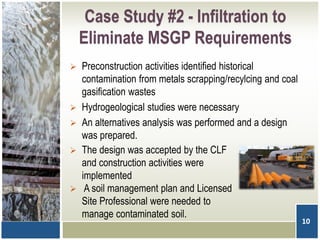
 Preconstruction activities identified historical
contamination from metals scrapping/recylcing and coal
gasification wastes
 Hydrogeological studies were necessary
 An alternatives analysis was performed and a design
was prepared.
10
 The design was accepted by the CLF
and construction activities were
implemented
 A soil management plan and Licensed
Site Professional were needed to
manage contaminated soil.
Case Study #2 - Infiltration to
Eliminate MSGP Requirements
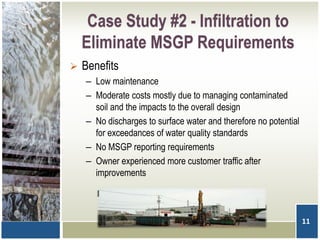
 Benefits
– Low maintenance
– Moderate costs mostly due to managing contaminated
soil and the impacts to the overall design
– No discharges to surface water and therefore no potential
for exceedances of water quality standards
– No MSGP reporting requirements
– Owner experienced more customer traffic after
improvements
11
Case Study #3 - Copper Source
Tracking
 Suisun Bay Reserve Fleet
 Background on the Problem
 Investigation
 BMPs
 Next Steps
 Applications to new CA IGP
12
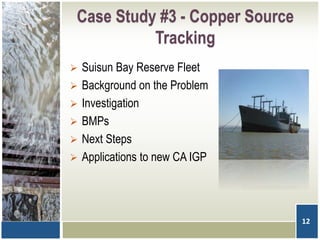
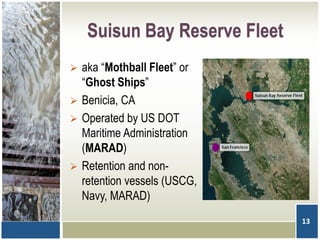
Suisun Bay Reserve Fleet
 aka “Mothball Fleet” or
“Ghost Ships”
 Benicia, CA
 Operated by US DOT
Maritime Administration
(MARAD)
 Retention and non-
retention vessels (USCG,
Navy, MARAD)
13
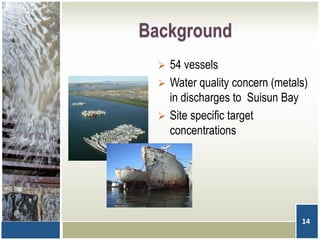
Background
 54 vessels
 Water quality concern (metals)
in discharges to Suisun Bay
 Site specific target
concentrations
14
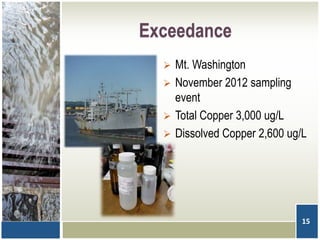
Exceedance
 Mt. Washington
 November 2012 sampling
event
 Total Copper 3,000 ug/L
 Dissolved Copper 2,600 ug/L
15
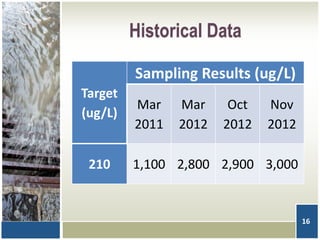
Historical Data
Target
(ug/L)
Sampling Results (ug/L)
Mar
2011
Mar
2012
Oct
2012
Nov
2012
210 1,100 2,800 2,900 3,000
16
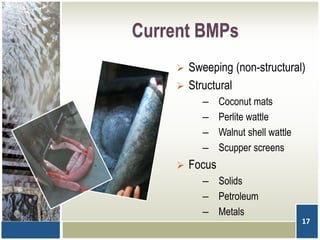
Current BMPs
 Sweeping (non-structural)
 Structural
– Coconut mats
– Perlite wattle
– Walnut shell wattle
– Scupper screens
 Focus
– Solids
– Petroleum
– Metals
17
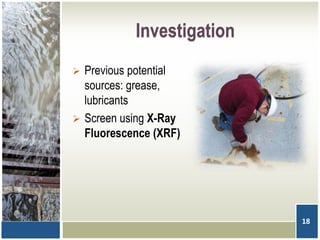
Investigation
 Previous potential
sources: grease,
lubricants
 Screen using X-Ray
Fluorescence (XRF)
18
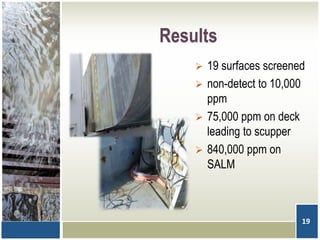
Results
 19 surfaces screened
 non-detect to 10,000
ppm
 75,000 ppm on deck
leading to scupper
 840,000 ppm on
SALM
19
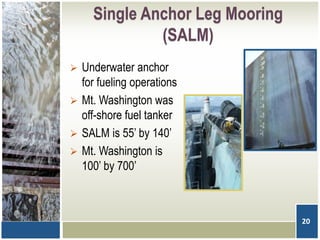
Single Anchor Leg Mooring
(SALM)
 Underwater anchor
for fueling operations
 Mt. Washington was
off-shore fuel tanker
 SALM is 55’ by 140’
 Mt. Washington is
100’ by 700’
20
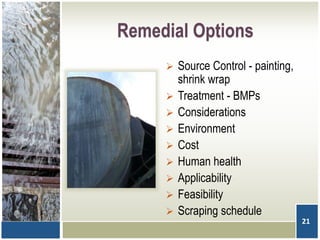
Remedial Options
 Source Control - painting,
shrink wrap
 Treatment - BMPs
 Considerations
 Environment
 Cost
 Human health
 Applicability
 Feasibility
 Scraping schedule
21
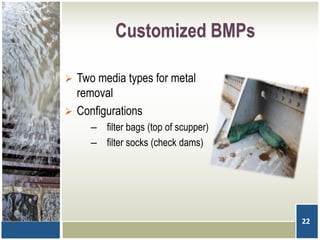
Customized BMPs
 Two media types for metal
removal
 Configurations
– filter bags (top of scupper)
– filter socks (check dams)
22
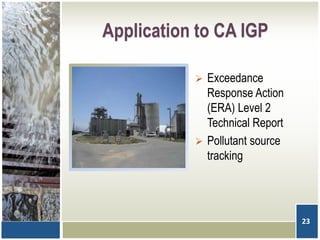
Application to CA IGP
 Exceedance
Response Action
(ERA) Level 2
Technical Report
 Pollutant source
tracking
23
Regulatory Developments
Issues/Trends
California Industrial General Permit
 Lengthy Adoption Process
 Key Issues
– Numeric Effluent Limits
– Group Monitoring
– More prescriptive requirements
24
Regulatory Developments
Issues/Trends
Ongoing California Regulatory Issues
 Numeric Effluent Limits
 TMDLs
– Implementation
– Permit Modification
 Sector-specific permits
 Receiving Water Limitations
25
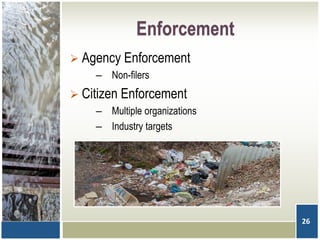
Enforcement
 Agency Enforcement
– Non-filers
 Citizen Enforcement
– Multiple organizations
– Industry targets
26
Additional Resources
 Multi-Sector General Permit
– http://cfpub.epa.gov/npdes/stormwater/msgp.cfm
– http://www.epa.gov/npdes/pubs/msgp2013_proposedshortfs.pdf
– http://www.epa.gov/npdes/pubs/industrial_swppp_guide.pdf
– http://www.epa.gov/npdes/pubs/msgp_monitoring_guide.pdf
 California’s Industrial General Permit
– http://www.waterboards.ca.gov/water_issues/programs/stormwat
er/industrial.shtml
– http://www.waterboards.ca.gov/water_issues/programs/stormwat
er/indusfaq.shtml
– http://www.waterboards.ca.gov/water_issues/programs/stormwat
er/gen_indus.shtml#indus
27
Questions
Ryan
ryan@mapistry.com
Jarrod
jyoder@woodardcurran.com
Wendy
wmanley@wendel.com
28

EPA MSGP and California IGP Presentation

  • 1.
    Industrial Stormwater Discharges -Regulatory Developments and Technical Considerations April 30, 2014 1
  • 2.
    Panel Ryan Janoch, PE Mapistry WendyManley, Esq. Wendel Rosen Black & Dean Jarrod Yoder, PG, LSP Woodard & Curran 2
  • 3.
    Overview  New CaliforniaIndustrial General Permit Highlights  Draft Multi-Sector General Permit Highlights  Case Study #1 - Naturally Occurring Metals in Stormwater Discharges (MA)  Case Study #2 - Infiltration to Eliminate MSGP Requirements (MA)  Case Study #3 - Source Tracking (CA)  Regulatory Developments/Trends 3
  • 4.
    California Industrial General Permit Adopted April 2014  Starts July 2015  Numeric Action Levels (NALs)  Exceedance Response Actions (ERAs)  Minimum BMPs  Sampling requirements 4
  • 5.
    Draft Multi SectorGeneral Permit Who is affected? Facilities operating within the 29 regulated industrial sectors listed in the 2008 MSGP and located where the EPA is the NPDES permitting authority.  Streamlining the SWPPP and eliminating generic language  Public accessibility to the SWPPP  Reduced requirements for inspections  Specific deadlines for taking corrective actions  Electronic submission for the NOI, NOT, annual report and monitoring reports 5
  • 6.
    Draft Multi SectorGeneral Permit 6  Requirement for pavement wash water discharges to be treated by control measures  Additional notification for discharges to Federal Superfund Sites  Inclusion of airport deicing effluent limitation guideline  Inclusion of saltwater benchmark values for metals and  Additional clarity for technology based effluent limits
  • 7.
    Case Study #1- Naturally Occurring Metals in Stormwater Discharges Project Location: Lakeville, Massachusetts Industrial Activity: Concrete Ready Mix MSGP Sector: E Stormwater Contaminants: pH, TSS, metals including iron 7  Client and their attorney requested assistance with an Administrative Consent Order with Penalty for multiple violations including stormwater management and illicit discharges to a natural resource.
  • 8.
    Case Study #1- Naturally Occurring Metals in Stormwater Discharges  Pollutant source evaluation  Eliminated pollutant sources but still had an iron problem  Identified other discharges during extended dry periods  Hydrogeological evaluation  Results 8
  • 9.
    Case Study #2- Infiltration to Eliminate MSGP Requirements  Project Location: Everett, Massachusetts  Industrial Activity: Metal Collection Facility  MSGP Sector: N  Stormwater Contaminants: metals, petroleum, PCBs, solvents, TSS 9  Client and their attorney requested assistance with a Settlement Agreement with the Conservation Law Foundation (CLF) relative to stormwater management  Settlement Agreement outlined a Performance Design Standard
  • 10.
    Case Study #2- Infiltration to Eliminate MSGP Requirements  Preconstruction activities identified historical contamination from metals scrapping/recylcing and coal gasification wastes  Hydrogeological studies were necessary  An alternatives analysis was performed and a design was prepared. 10  The design was accepted by the CLF and construction activities were implemented  A soil management plan and Licensed Site Professional were needed to manage contaminated soil.
  • 11.
    Case Study #2- Infiltration to Eliminate MSGP Requirements  Benefits – Low maintenance – Moderate costs mostly due to managing contaminated soil and the impacts to the overall design – No discharges to surface water and therefore no potential for exceedances of water quality standards – No MSGP reporting requirements – Owner experienced more customer traffic after improvements 11
  • 12.
    Case Study #3- Copper Source Tracking  Suisun Bay Reserve Fleet  Background on the Problem  Investigation  BMPs  Next Steps  Applications to new CA IGP 12
  • 13.
    Suisun Bay ReserveFleet  aka “Mothball Fleet” or “Ghost Ships”  Benicia, CA  Operated by US DOT Maritime Administration (MARAD)  Retention and non- retention vessels (USCG, Navy, MARAD) 13
  • 14.
    Background  54 vessels Water quality concern (metals) in discharges to Suisun Bay  Site specific target concentrations 14
  • 15.
    Exceedance  Mt. Washington November 2012 sampling event  Total Copper 3,000 ug/L  Dissolved Copper 2,600 ug/L 15
  • 16.
    Historical Data Target (ug/L) Sampling Results(ug/L) Mar 2011 Mar 2012 Oct 2012 Nov 2012 210 1,100 2,800 2,900 3,000 16
  • 17.
    Current BMPs  Sweeping(non-structural)  Structural – Coconut mats – Perlite wattle – Walnut shell wattle – Scupper screens  Focus – Solids – Petroleum – Metals 17
  • 18.
    Investigation  Previous potential sources:grease, lubricants  Screen using X-Ray Fluorescence (XRF) 18
  • 19.
    Results  19 surfacesscreened  non-detect to 10,000 ppm  75,000 ppm on deck leading to scupper  840,000 ppm on SALM 19
  • 20.
    Single Anchor LegMooring (SALM)  Underwater anchor for fueling operations  Mt. Washington was off-shore fuel tanker  SALM is 55’ by 140’  Mt. Washington is 100’ by 700’ 20
  • 21.
    Remedial Options  SourceControl - painting, shrink wrap  Treatment - BMPs  Considerations  Environment  Cost  Human health  Applicability  Feasibility  Scraping schedule 21
  • 22.
    Customized BMPs  Twomedia types for metal removal  Configurations – filter bags (top of scupper) – filter socks (check dams) 22
  • 23.
    Application to CAIGP  Exceedance Response Action (ERA) Level 2 Technical Report  Pollutant source tracking 23
  • 24.
    Regulatory Developments Issues/Trends California IndustrialGeneral Permit  Lengthy Adoption Process  Key Issues – Numeric Effluent Limits – Group Monitoring – More prescriptive requirements 24
  • 25.
    Regulatory Developments Issues/Trends Ongoing CaliforniaRegulatory Issues  Numeric Effluent Limits  TMDLs – Implementation – Permit Modification  Sector-specific permits  Receiving Water Limitations 25
  • 26.
    Enforcement  Agency Enforcement –Non-filers  Citizen Enforcement – Multiple organizations – Industry targets 26
  • 27.
    Additional Resources  Multi-SectorGeneral Permit – http://cfpub.epa.gov/npdes/stormwater/msgp.cfm – http://www.epa.gov/npdes/pubs/msgp2013_proposedshortfs.pdf – http://www.epa.gov/npdes/pubs/industrial_swppp_guide.pdf – http://www.epa.gov/npdes/pubs/msgp_monitoring_guide.pdf  California’s Industrial General Permit – http://www.waterboards.ca.gov/water_issues/programs/stormwat er/industrial.shtml – http://www.waterboards.ca.gov/water_issues/programs/stormwat er/indusfaq.shtml – http://www.waterboards.ca.gov/water_issues/programs/stormwat er/gen_indus.shtml#indus 27
  • 28.

Editor's Notes

  • #6 Thanks Ryan. I want to provide a quick summary of the proposed changes to the MSGP prior to discussing the 2 case studies applicable to the MSGP. The Draft MSGP was prepared by EPA for 29 industrial sectors where EPA is the permitting authority including: Massachusetts, New Hampshire, Idaho, and New Mexico, the District of Columbia, Puerto Rico, and all other U.S. territories with the exception of the Virgin Islands, facilities operated by the federal government in four states including Colorado, Delaware, Vermont, and Washington, most Indian Country lands, and a couple of other designated activities in specific states (e.g., oil and gas activities in Texas and Oklahoma) The draft MSGP provisions are largely the same as the 2008 provisions. The proposed changes were generally made to improve permit clarity, address errors identified in the 2008 MSGP, and make the permit more streamlined. The major highlights of the proposed MSGP include: (read slide)
  • #7  A couple of 2013 MSGP milestones include the following: The draft permit was issued on September 27, 2013 for public comment The public comment period was extended through December 26, 2013 and EPA expects to issue the final MSGP by fall 2014. For those who were covered under the 2008 permit, coverage is administratively continued until EPA issues the new permit.  EPA cited the government shutdown, the extension to the public comment period, the number of comments received, and the breadth and scope of some of the comments as the reasons for the extra delay. EPA also re-issued the memo of “no action assurance” for new facilities indicating that enforcement against new facilities which begin operating without permit coverage, will not occur until the final MSGP is promulgated.
  • #8 To provide some background on the ACOP, USEPA and MassDEP implemented an enforcement initiative between 2004 and 2008 that involved the audit and inspection of concrete and aggregate facilities. Several facilities were found in violation of multiple regulatory requirements including illicit discharges to surface water from industrial operations and improper stormwater controls. Significant fines were levied and EPA and MassDEP required these facilities to implement corrective actions within very specific deadlines.
  • #9 DON’T READ THIS SLIDE….READ THE FOLLOWING INSTEAD Pollutant sources included: discharges from washing concrete mixer trucks, process water from leaking pipes, unpaved roadways, miscellaneous leaks and spills of oil and grease from mixer trucks, uncontrolled stormwater runoff from an adjacent sand and gravel pit that flooded the subject property, and not maintaining stormwater controls. Eliminated sources by designing and installing a concrete washing station that recycles water and materials, repaired facility piping, developed BMPs and erosion controls for unpaved roads, established a BMP for responding to minor spills and leaks from mixer trucks, designed and installed berms along the property boundary to prevent runoff from the sand and gravel pit, and dredged the existing stormwater sedimentation basin. These corrective actions (and others not related to stormwater pollutant sources) were mandatory to address multiple regulatory violations that were cited in the ACOP. After these sources were controlled or eliminated, only iron exceeded the benchmark value in the discharge from the sedimentation basin. For reference, total iron concentrations prior to eliminating the potential sources ranged from 2.5 to 5 mg/L and the Sector E Benchmark value for iron is 1 mg/L. Total iron concentrations in the discharge after eliminating the potential sources ranged from 1.2 to 2.7 mg/L over the course of 6 sampling events. 3 of these sampling events were conducted during significant rain events and 3 were collected during dry periods when discharges were observed. A limited hydrogeological evaluation was conducted that included the installation of temporary monitoring wells, analytical sampling, groundwater elevation monitoring and water elevation monitoring in the sedimentation basin and wetland. The results of the hydrogeological evaluation indicated that the sedimentation basin was in contact with groundwater and that groundwater had elevated concentrations of total iron. Upon discussions with USEPA and MassDEP, no other alternatives were identified for managing stormwater at the property and the existing stormwater controls and BMPs would be sufficient to eliminate the need for Benchmark Monitoring Requirements.
  • #10 READ SLIDE FIRST THAN SAY THIS….. The resulting Performance Design Standard required a stormwater management system that would prevent runoff associated with a 100-year rainfall event (7 inches in 24 hours).
  • #11 Preconstruction activities included subsurface investigations to evaluate soil conditions relative to infiltration needs. During these investigations, contamination from existing operations at the property and coal gasification wastes were identified on a portion of the property where the stormwater management system was going to be located. The presence of contamination required further investigation under the state environmental programs but it also created a need to further assess the property to identify a suitable location for the stormwater management system. Significant limitations were identified during the supplemental investigation which included shallow groundwater elevations, potential mounding because of the presence of deeper silts and peat, the effects of a mound from an infiltration system on the fate and transport of contamination at the property, and heavy vehicle traffic across the property. These limitations were significant such that an alternatives analysis was needed. The alternatives analysis included stormwater treatment technologies as well as surface water discharge (under MSGP) and infiltration. The resulting design included a subsurface infiltration system located in 2 areas of the property and incorporated pre-treatment sediment removal systems and an engineered geo-grid system to allow heavy truck loading over the system. In addition, the site was re-graded to eliminate the potential for runoff from the property. The resulting design evaluated mounding relative to the fate and transport of contamination at the property and found that there was little to no adverse effect because the system was developed in 2 areas of the property where limited to no contamination was identified. The area with limited contamination was remediated prior to system construction under the direction of a Licensed Site Professional. Ultimately the design was accepted by the Conservation Law Foundation and construction activities were implemented and completed in 2012. To assist with compliance and maintenance of the stormwater infiltration system, a Stormwater Pollution Prevention Plan was prepared and the employees were trained with regard to maintenance and monitoring requirements.
  • #12 That concludes the case studies associated with the MSGP. I will now turn it over to Ryan to discuss the 3rd case study that provides information relative to the California Industrial General Permit…..Ryan.