Mark van de Sanden
SURFsara
EUDAT CDI Technical Coordinator
2
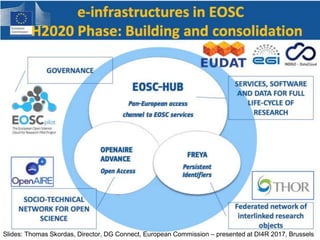
Slides: Thomas Skordas, Director, DG Connect, European Commission – presented at DI4R 2017, Brussels
EOSC-hub mobilises providers from 20
major digital infrastructures, EGI,
EUDAT CDI and INDIGO-DataCloud
jointly offering services, software and
data for advanced data-driven
research and innovation.
Slides: Tiziana Ferrari, Project Coordinator EOSC-hub, Technical Director EGI, EOSC-hub kick-off, 2018
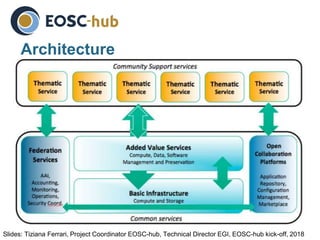
Architecture
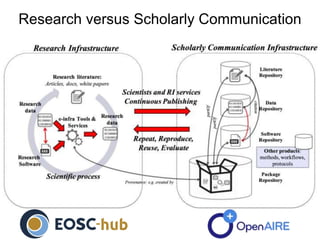
Research versus Scholarly Communication
Focus collaboration
● Explore synergies between EOSC-hub and OpenAIRE
● Enlarge support for publishing research products on their own
beyond the scientific article (research data, research software,
experiments, research objects, etc.) in a FAIR way so as to
○ Foster and facilitate sharing and reuse of all products of
science
○ Support reproducibility and evaluation of the scientific process
○ Enable fully-fledged scientific reward mechanisms
● Enlarge the interoperability by
○ Adopting common guidelines and APIs
○ Integrating services
● To lower the barriers, to make research products more findable and
accessible to enlarge the usage and re-usage with a higher
scientific impact
Areas of collaboration
• Governance and sustainability
• Outreach, Support and Training
• Services: integrated service provision
• Identify low hanging fruit for fast results
• Plan for first half of the projects and realign
• Caution to resource re-allocation
3 task forces formed to identify gaps and overlaps, and to develop
synergies towards a concrete collaboration agreement (deadline: March
2018)
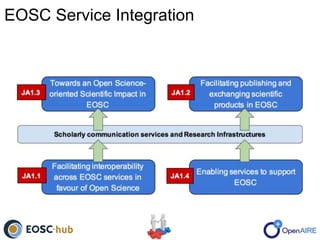
EOSC Service Integration
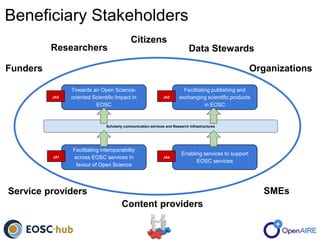
Beneficiary Stakeholders
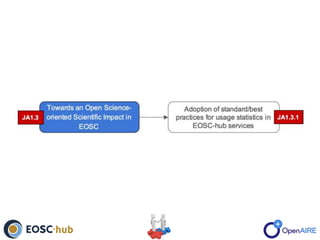
Towards an Open Science-
oriented Scientific Impact in
EOSC
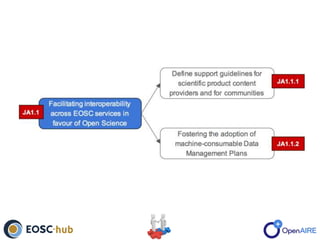
Facilitating interoperability
across EOSC services in
favour of Open Science
Facilitating publishing and
exchanging scientific products
in EOSC
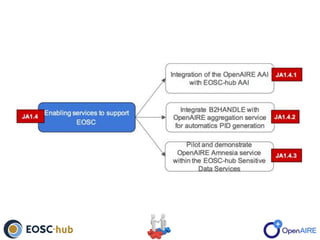
Enabling services to support
EOSC services
Scholarly communication services and Research Infrastructures
JA1
JA2JA3
JA4
Researchers
OrganizationsFunders
Service providers
Content providers
SMEs
Data Stewards
Citizens
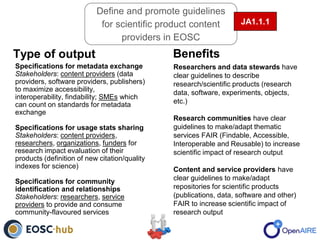
Specifications for metadata exchange
Stakeholders: content providers (data
providers, software providers, publishers)
to maximize accessibility,
interoperability, findability; SMEs which
can count on standards for metadata
exchange
Specifications for usage stats sharing
Stakeholders: content providers,
researchers, organizations, funders for
research impact evaluation of their
products (definition of new citation/quality
indexes for science)
Specifications for community
identification and relationships
Stakeholders: researchers, service
providers to provide and consume
community-flavoured services
Researchers and data stewards have
clear guidelines to describe
research/scientific products (research
data, software, experiments, objects,
etc.)
Research communities have clear
guidelines to make/adapt thematic
services FAIR (Findable, Accessible,
Interoperable and Reusable) to increase
scientific impact of research output
Content and service providers have
clear guidelines to make/adapt
repositories for scientific products
(publications, data, software and other)
FAIR to increase scientific impact of
research output
Define and promote guidelines
for scientific product content
providers in EOSC
JA1.1.1
Type of output Benefits
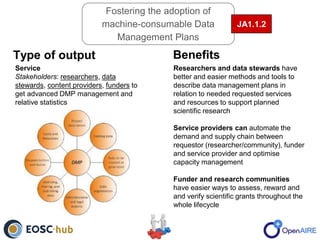
Fostering the adoption of
machine-consumable Data
Management Plans
JA1.1.2
Type of output
Service
Stakeholders: researchers, data
stewards, content providers, funders to
get advanced DMP management and
relative statistics
Researchers and data stewards have
better and easier methods and tools to
describe data management plans in
relation to needed requested services
and resources to support planned
scientific research
Service providers can automate the
demand and supply chain between
requestor (researcher/community), funder
and service provider and optimise
capacity management
Funder and research communities
have easier ways to assess, reward and
and verify scientific grants throughout the
whole lifecycle
Benefits
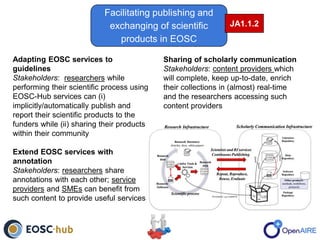
Adapting EOSC services to
guidelines
Stakeholders: researchers while
performing their scientific process using
EOSC-Hub services can (i)
implicitly/automatically publish and
report their scientific products to the
funders while (ii) sharing their products
within their community
Extend EOSC services with
annotation
Stakeholders: researchers share
annotations with each other; service
providers and SMEs can benefit from
such content to provide useful services
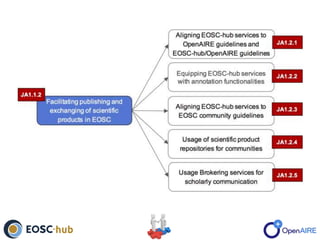
Facilitating publishing and
exchanging of scientific
products in EOSC
JA1.1.2
Sharing of scholarly communication
Stakeholders: content providers which
will complete, keep up-to-date, enrich
their collections in (almost) real-time
and the researchers accessing such
content providers
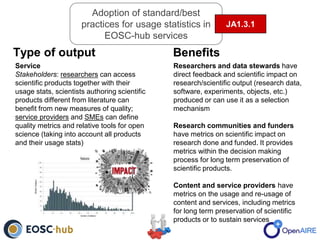
Service
Stakeholders: researchers can access
scientific products together with their
usage stats, scientists authoring scientific
products different from literature can
benefit from new measures of quality;
service providers and SMEs can define
quality metrics and relative tools for open
science (taking into account all products
and their usage stats)
Adoption of standard/best
practices for usage statistics in
EOSC-hub services
JA1.3.1
Type of output
Researchers and data stewards have
direct feedback and scientific impact on
research/scientific output (research data,
software, experiments, objects, etc.)
produced or can use it as a selection
mechanism
Research communities and funders
have metrics on scientific impact on
research done and funded. It provides
metrics within the decision making
process for long term preservation of
scientific products.
Content and service providers have
metrics on the usage and re-usage of
content and services, including metrics
for long term preservation of scientific
products or to sustain services
Benefits
Planning
Aug-Nov
● 3 task forces formed
○ Governance and sustainability
○ Outreach, Support, Training and Communications
○ Integrated service provision
● Analysis for each area of: common stakeholders, opportunities for
collaboration, gaps and overlaps
Dec
● First draft of joint work plan (joint activities of complementary grants, outputs
and timeline)
Jan
● Revision and update of draft joint work plan with project consortia
● Preparation of Collaboration Agreement articles
Feb
● Collaboration Agreement first draft for internal/external revision
March
● Signing Collaboration Agreement
Mark van de Sanden
mark.vandesanden@surfsara.nl

EOSC-hub

  • 1.
    Mark van deSanden SURFsara EUDAT CDI Technical Coordinator
  • 2.
    2 Slides: Thomas Skordas,Director, DG Connect, European Commission – presented at DI4R 2017, Brussels
  • 4.
    EOSC-hub mobilises providersfrom 20 major digital infrastructures, EGI, EUDAT CDI and INDIGO-DataCloud jointly offering services, software and data for advanced data-driven research and innovation. Slides: Tiziana Ferrari, Project Coordinator EOSC-hub, Technical Director EGI, EOSC-hub kick-off, 2018
  • 5.
    Slides: Tiziana Ferrari,Project Coordinator EOSC-hub, Technical Director EGI, EOSC-hub kick-off, 2018 Architecture
  • 7.
  • 8.
    Focus collaboration ● Exploresynergies between EOSC-hub and OpenAIRE ● Enlarge support for publishing research products on their own beyond the scientific article (research data, research software, experiments, research objects, etc.) in a FAIR way so as to ○ Foster and facilitate sharing and reuse of all products of science ○ Support reproducibility and evaluation of the scientific process ○ Enable fully-fledged scientific reward mechanisms ● Enlarge the interoperability by ○ Adopting common guidelines and APIs ○ Integrating services ● To lower the barriers, to make research products more findable and accessible to enlarge the usage and re-usage with a higher scientific impact
  • 9.
    Areas of collaboration •Governance and sustainability • Outreach, Support and Training • Services: integrated service provision • Identify low hanging fruit for fast results • Plan for first half of the projects and realign • Caution to resource re-allocation 3 task forces formed to identify gaps and overlaps, and to develop synergies towards a concrete collaboration agreement (deadline: March 2018)
  • 10.
  • 11.
    Beneficiary Stakeholders Towards anOpen Science- oriented Scientific Impact in EOSC Facilitating interoperability across EOSC services in favour of Open Science Facilitating publishing and exchanging scientific products in EOSC Enabling services to support EOSC services Scholarly communication services and Research Infrastructures JA1 JA2JA3 JA4 Researchers OrganizationsFunders Service providers Content providers SMEs Data Stewards Citizens
  • 13.
    Specifications for metadataexchange Stakeholders: content providers (data providers, software providers, publishers) to maximize accessibility, interoperability, findability; SMEs which can count on standards for metadata exchange Specifications for usage stats sharing Stakeholders: content providers, researchers, organizations, funders for research impact evaluation of their products (definition of new citation/quality indexes for science) Specifications for community identification and relationships Stakeholders: researchers, service providers to provide and consume community-flavoured services Researchers and data stewards have clear guidelines to describe research/scientific products (research data, software, experiments, objects, etc.) Research communities have clear guidelines to make/adapt thematic services FAIR (Findable, Accessible, Interoperable and Reusable) to increase scientific impact of research output Content and service providers have clear guidelines to make/adapt repositories for scientific products (publications, data, software and other) FAIR to increase scientific impact of research output Define and promote guidelines for scientific product content providers in EOSC JA1.1.1 Type of output Benefits
  • 14.
    Fostering the adoptionof machine-consumable Data Management Plans JA1.1.2 Type of output Service Stakeholders: researchers, data stewards, content providers, funders to get advanced DMP management and relative statistics Researchers and data stewards have better and easier methods and tools to describe data management plans in relation to needed requested services and resources to support planned scientific research Service providers can automate the demand and supply chain between requestor (researcher/community), funder and service provider and optimise capacity management Funder and research communities have easier ways to assess, reward and and verify scientific grants throughout the whole lifecycle Benefits
  • 16.
    Adapting EOSC servicesto guidelines Stakeholders: researchers while performing their scientific process using EOSC-Hub services can (i) implicitly/automatically publish and report their scientific products to the funders while (ii) sharing their products within their community Extend EOSC services with annotation Stakeholders: researchers share annotations with each other; service providers and SMEs can benefit from such content to provide useful services Facilitating publishing and exchanging of scientific products in EOSC JA1.1.2 Sharing of scholarly communication Stakeholders: content providers which will complete, keep up-to-date, enrich their collections in (almost) real-time and the researchers accessing such content providers
  • 18.
    Service Stakeholders: researchers canaccess scientific products together with their usage stats, scientists authoring scientific products different from literature can benefit from new measures of quality; service providers and SMEs can define quality metrics and relative tools for open science (taking into account all products and their usage stats) Adoption of standard/best practices for usage statistics in EOSC-hub services JA1.3.1 Type of output Researchers and data stewards have direct feedback and scientific impact on research/scientific output (research data, software, experiments, objects, etc.) produced or can use it as a selection mechanism Research communities and funders have metrics on scientific impact on research done and funded. It provides metrics within the decision making process for long term preservation of scientific products. Content and service providers have metrics on the usage and re-usage of content and services, including metrics for long term preservation of scientific products or to sustain services Benefits
  • 20.
    Planning Aug-Nov ● 3 taskforces formed ○ Governance and sustainability ○ Outreach, Support, Training and Communications ○ Integrated service provision ● Analysis for each area of: common stakeholders, opportunities for collaboration, gaps and overlaps Dec ● First draft of joint work plan (joint activities of complementary grants, outputs and timeline) Jan ● Revision and update of draft joint work plan with project consortia ● Preparation of Collaboration Agreement articles Feb ● Collaboration Agreement first draft for internal/external revision March ● Signing Collaboration Agreement
  • 21.
    Mark van deSanden mark.vandesanden@surfsara.nl