Services for
Research Data
Management
About
EUDAT
Services for Research Data Management
2
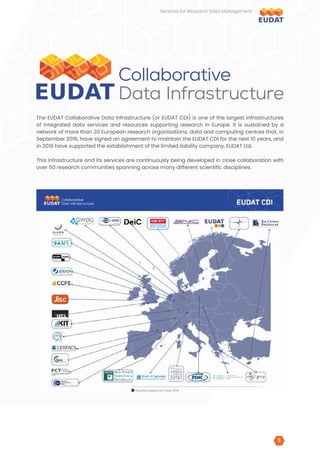
The EUDAT Collaborative Data Infrastructure (or EUDAT CDI) is one of the largest infrastructures
of integrated data services and resources supporting research in Europe. It is sustained by a
network of more than 20 European research organisations, data and computing centres that, in
September 2016, have signed an agreement to maintain the EUDAT CDI for the next 10 years, and
in 2018 have supported the establishment of the limited liability company, EUDAT Ltd.
This infrastructure and its services are continuously being developed in close collaboration with
over 50 research communities spanning across many different scientific disciplines.
Services for Research Data Management
3
3
EUDAT
Services
Services for Research Data Management
4
B2SHARE
Store and publish research data
B2SHARE
Store and Share
Research Data
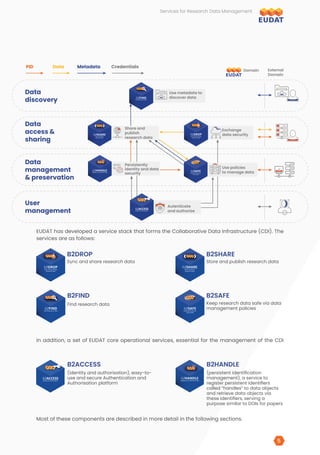
EUDAT has developed a service stack that forms the Collaborative Data Infrastructure (CDI). The
services are as follows:
Most of these components are described in more detail in the following sections.
In addition, a set of EUDAT core operational services, essential for the management of the CDI
B2ACCESS B2HANDLE
Exchange
data security
Data
discovery
PID Data Metadata Credentials
Data
access &
sharing
Data
management
& preservation
User
management
Use metadata to
discover data
Domain External
Domain
Use policies
to manage data
Share and
publish
research data
Autenticate
and authorize
Persistently
identity and data
security
B2FIND
Find Research Data
B2SHARE
Store and Share
Research Data
B2DROP
Sync and Exchange
Research Data
B2HANDLE
Register your Research Data
B2SAFE
Replicate Research
Data Safely
(identity and authorisation), easy-to-
use and secure Authentication and
Authorisation platform
(persistent identification
management), a service to
register persistent identifiers
called “handles” to data objects
and retrieve data objects via
these identifiers, serving a
purpose similar to DOIs for papers
B2HANDLE
Register your Research Data
B2SAFE
Keep research data safe via data
management policies
B2SAFE
Replicate Research
Data Safely
B2DROP
Sync and share research data
B2DROP
Sync and Exchange
Research Data
B2FIND
Find research data
B2FIND
Find Research Data
Services for Research Data Management
5
Sync and share
research data
B2DROP
Services for Research Data Management
6
B2DROP is a low-barrier, user-friendly and trustworthy storage environment which allows users to
synchronise their active data across different desktops and to easily share this data with peers.
EUDAT offers a free public basic instance for any researcher. For communities and organisations
a premium service is offered on the public instance. Communities and organisations can also
request customised instances
Default quota of 20GBs (Basic), high quotas optional (Premium)
Access via Web GUI, desktop clients and Webdav
Multiple versions of files are kept
Enabled apps: Contacts, Calendar, Tasks, Circles (social communities)
Sharing within B2DROP, across different instances (via OCM-API) and via links
Publishing of datasets to B2SHARE
Integration with CLARIN Language Resource Switchboard (Basic)
Integration with other community services optional (Premium)
Group management (Premium)
OnlyOffice (Premium)
Features
Technologies
Standards
Dependencies
•	NextCloud
•	OpenCloudMesh API for
Federated Cloud Sharing
•	B2ACCESS
Services for Research Data Management
7
The service is intended for the long-tail and still volatile data which can change and are still
subject to active research e.g. drafts of research papers. Therefore, B2DROP offers versioning of all
ingested files but does not attach persistent identifiers to them.
B2DROP is hosted at the Jülich Supercomputing Centre, which guarantees that your research
data stays in Europe. Daily backups of all files in B2DROP are taken and kept on tap. B2DROP is
based on Nextcloud. Data is encrypted on transmission through the exclusive use of the https
protocol for data transfer. Each B2DROP user is allowed 20GB of storage.
B2DROP offers an intuitive user-interface via the web. In addition to web access, users can mount
B2DROP as a drive on their desktop machines via WebDAV, or use a desktop client which also
allows offline synchronisation.
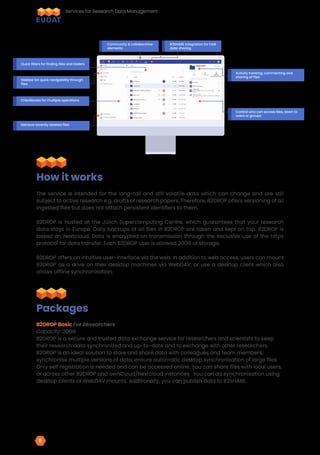
How it works
Control who can access files, down to
users or groups
Activity tracking, commenting and
sharing of files
Quick filters for finding files and folders
Sidebar for quick navigability through
files
Checkboxes for multiple operations
Retrieve recently deleted files
Community & collaborative
elements
B2SHARE Integration for FAIR
data sharing
B2DROP Basic For Researchers
Capacity: 20GB
B2DROP is a secure and trusted data exchange service for researchers and scientists to keep
their research data synchronized and up-to-date and to exchange with other researchers.
B2DROP is an ideal solution to store and share data with colleagues and team members,
synchronise multiple versions of data, ensure automatic desktop synchronisation of large files.
Only self registration is needed and can be accessed online. You can share files with local users,
or across other B2DROP and ownCloud/Nextcloud instances. You can do synchronisation using
desktop clients or WebDAV mounts. Additionally, you can publish data to B2SHARE.
Packages
Services for Research Data Management
8
B2DROP Premium For Researchers
Capacity: 100-2000GB
The basic B2DROP service has a per user quota limit of 20GB. Researchers which have a need for
higher quotas, higher storage capacity, specific requirements and/or (Nextcloud) applications
enabled can request this via the B2DROP Premium service.
B2DROP For Data Managers
Capacity: 1-10TB
Quota per user: 100-500GB
The public B2DROP service has a per user quota limit of 20GB. Communities, organisations or
principal research investigators which have a need for higher quotas, higher storage capacity,
specific requirements and/or (Nextcloud) applications enabled can submit a support request
to request this. Depending on the requirements and/or requested storage capacity the B2DROP
service is offered as a paid service. It includes all the features of the basic service except with
higher quotas.
B2DROP For Communities and Organisations
Capacity: 1-10TB
Quota per user: 100-500GB
The public B2DROP service is provided on a fair-share basis. Communities and/or organisations
with specific requirements which can not be support via the public fair-share service or or need
higher level of security or access control can request consultancy in setting up and deploying
a local B2DROP instance or can request a B2DROP instance which is hosted at one of the EUDAT
partners. Features are negotiable.
How to get access?
For researchers needing 20GB or less,
use B2DROP for free now:
For higher needs from individual researchers, data
managers and communities and organisations, contact
us to set-up your dedicated instance:
b2drop.eudat.eu eudat.eu/contact-support-request
HAND-POINT-UP
HAND-POINT-UP
B2DROP
Sync and Exchange
Research Data
Services for Research Data Management
9
Store and publish
research data
B2SHARE
Services for Research Data Management
10
Features
Support of metadata descriptions via the EUDAT metadata schema
Registers DOIs for datasets and Handle PIDs for data objects
Supports versioning
Harvested by B2FIND and OpenAIRE explorer
Direct upload from B2DROP
Accessible via a Web GUI and an API to support automatic publishing workflows
Supports community domains
Allows communities to define metadata extensions, access rules and publishing workflows
Annotate research data through the B2NOTE extension
Technologies Dependencies
Invenio B2ACCESS
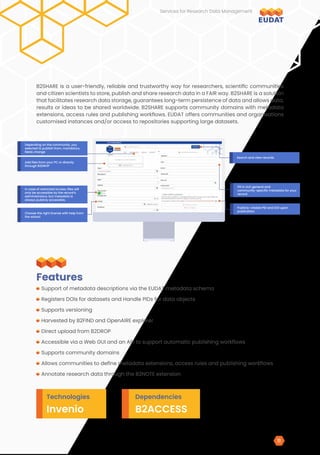
B2SHARE is a user-friendly, reliable and trustworthy way for researchers, scientific communities
and citizen scientists to store, publish and share research data in a FAIR way. B2SHARE is a solution
that facilitates research data storage, guarantees long-term persistence of data and allows data,
results or ideas to be shared worldwide. B2SHARE supports community domains with metadata
extensions, access rules and publishing workflows. EUDAT offers communities and organisations
customised instances and/or access to repositories supporting large datasets.
Search and view records
Publicly-citable PID and DOI upon
publication
Fill in rich general and
community-specific metadata for your
record
Add files from your PC or directly
through B2DROP
Choose the right license with help from
the wizard
In case of restricted access, files will
only be accessible by the record’s
administrators, but metadata is
always publicly accessible.
Depending on the community, you
selected to publish from, mandatory
fields change
Services for Research Data Management
11
B2SHARE is a service for what’s known as “long tail of data”. This is a key component of research
but is often under-exploited and even at risk when only stored on separate machines and storage
devices such as notebooks, desktops or departmental servers. Any kind of stable research data
which you want to preserve and share in a safe environment can be deposited in B2SHARE.
The research data can have various formats - papers, spreadsheets, audio-visual media, and
more. The only requirement is that the source or purpose of the data is scientific.
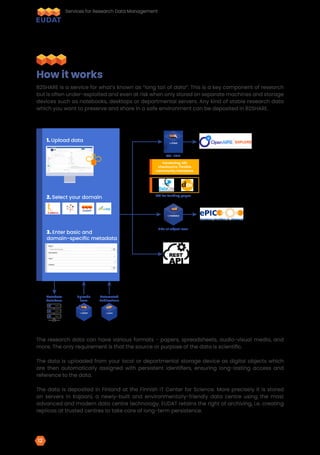
The data is uploaded from your local or departmental storage device as digital objects which
are then automatically assigned with persistent identifiers, ensuring long-lasting access and
reference to the data.
The data is deposited in Finland at the Finnish IT Center for Science. More precisely it is stored
on servers in Kajaani, a newly-built and environmentally-friendly data centre using the most
advanced and modern data centre technology. EUDAT retains the right of archiving, i.e. creating
replicas at trusted centres to take care of long-term persistence.
How it works
B2FIND
Metadata
database
Uploads
from
OAI-PMH
DOI for Landing pages
PIDs at object level
Automated
Publications
1. Upload data
2. Select your domain
3. Enter basic and
domain-specific metadata
B2SAFE
B2DROP
Versioning, MD
checksums, Flexible
community metadata
B2HANDLE
Services for Research Data Management
12
B2SHARE Basic For Researchers (free)
B2SHARE is a free-to-use public service supporting cross disciplinary research, self-registration
for any scientists and researchers, free upload of stable research data, data will receive a DOI
which can be used for citing, data objects will receive a B2HANDLE PID, access policy is defined
by the data owner, metadata in openly accessible and made discoverable via B2FIND, Direct
uploads from B2DROP, data integrity is ensured by checksums which are calculated during data
ingest.
B2SHARE Premium For Data Managers
The B2SHARE - Premium service is the same as the basic service, but provides researchers the
option to upload larger data files and datasets (>20GB) and the customization of metadata
extensions.
B2SHARE For Communities And Organisations
B2SHARE for communities and organisations offers the option for dedicated and branded
B2SHARE instances which can be customised to community and organisational needs. This
supports customisation to the metadata schemas, community domains and access rights.
B2SHARE For Large Datasets
EUDAT is a network service providers across Europe specialising in large ICT infrastructure
supporting research. To researchers and/or communities seeking to publish and/or make large
datasets accessible in a FAIR way, EUDAT can offer access to data repositories supporting large
datasets (>50TB). These repositories are made available through the EUDAT partners.
Packages
How to get access?
Use B2SHARE Basic now
For communities wanting to publish using
their own metadata scheme fields, contact us
b2share.eudat.eu eudat.eu/contact-support-request
HAND-POINT-UP HAND-POINT-UP
B2SHARE
Store and Share
Research Data
Services for Research Data Management
13
Find research data
B2FIND
Services for Research Data Management
14
B2FIND is an interdisciplinary discovery portal for research outputs that allows free term search.
Results may be narrowed down using several facets, including spatial and temporal search
options.
B2FIND is the EUDAT metadata indexing service and provides a discovery portal which allows
users to find data collections within an international and inter-disciplinary scope. It is based
on a comprehensive metadata catalogue of research data collections stored in EUDAT data
centres and community repositories. Harmonisation of the metadata descriptions collected
from heterogeneous sources enables not only the presentation in a consistent form but also the
faceted search across scientific domain boundaries. The service is geared for communities and
other providers of research data who need to publish and give visibility to their metadata and
individual researchers who need to search data from everywhere, and see data in the context
with an across community approach.
Harmonisation of the metadata descriptions via the EUDAT Core metadata schema
Harvesting of repositories via different protocols (e.g. OAI-PMH, CSW, Rest-APIs)
Faceted search via 12 facets (including geospatial, temporal search options), additional free
text search
Metadata aggregation from community repositories, multiple metadata standards are
supported
Harvested by OpenAIRE explorer
Features
Technologies
Supported harvesting
protocols
Dependencies
Supported metadata
standards:
•	CKAN
•	OAI-PMH
•	REST-API
•	CSW
•	 Dublin Core
•	Datacite
•	OpenAire
•	EUDAT Core
•	INSPIRE
•	ISO 19139/19139, FGDC
•	community specific standards
•	B2SHARE
Services for Research Data Management
15
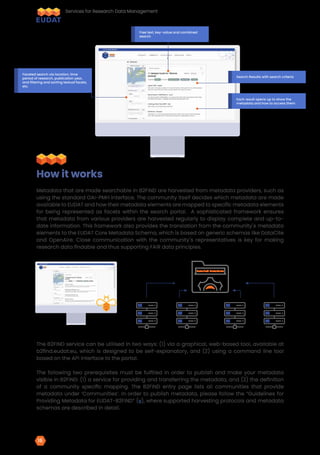
Faceted search via location, time
period of research, publication year,
and filtering and sorting textual facets,
etc.
Search Results with search criteria
Free text, key-value and combined
search
Each result opens up to show the
metadata and how to access them
Metadata that are made searchable in B2FIND are harvested from metadata providers, such as
using the standard OAI-PMH interface. The community itself decides which metadata are made
available to EUDAT and how their metadata elements are mapped to specific metadata elements
for being represented as facets within the search portal. A sophisticated framework ensures
that metadata from various providers are harvested regularly to display complete and up-to-
date information. This framework also provides the translation from the community´s metadata
elements to the EUDAT Core Metadata Schema, which is based on generic schemas like DataCite
and OpenAire. Close communication with the community´s representatives is key for making
research data findable and thus supporting FAIR data principles.
The B2FIND service can be utilised in two ways: (1) via a graphical, web-based tool, available at
b2find.eudat.eu, which is designed to be self-explanatory, and (2) using a command line tool
based on the API interface to the portal.
The following two prerequisites must be fulfilled in order to publish and make your metadata
visible in B2FIND: (1) a service for providing and transferring the metadata, and (2) the definition
of a community specific mapping. The B2FIND entry page lists all communities that provide
metadata under ‘Communities’. In order to publish metadata, please follow the “Guidelines for
Providing Metadata for EUDAT-B2FIND” (v), where supported harvesting protocols and metadata
schemas are described in detail.
How it works
Detailed Metadata
Services for Research Data Management
16
B2FIND For Researchers (Free)
B2FIND is a discovery service based on metadata steadily harvested from research data
collections from EUDAT data centres and other community repositories. The service offers
faceted browsing and it allows in particular to discover data that is stored through the B2SHARE
service.
B2FIND For Data Providers
To enlarge the discovery of existing research output, data repository owners can make their
research data collections stored in existing data repositories harvestable and discoverable
via the public B2FIND service. To ease the process of harvesting data repositories, owners can
assess the B2FIND guidelines for data providers.
How to get access?
Access and find research
through the service now
For Data Providers, request activation
through the form:
b2find.eudat.eu eudat.eu/contact-support-request
HAND-POINT-UP HAND-POINT-UP
Packages
B2FIND
Find Research Data
Services for Research Data Management
17
Keep research data safe
via data management
policies
B2SAFE
Services for Research Data Management
18
B2SAFE is a robust and highly available service which allows community and departmental
repositories to implement data management policies on their research data across multiple
administrative domains in a trustworthy manner. It offers an abstraction layer of large scale,
heterogeneous data storages, guards against data loss in long-term archiving, allows optimized
access for users (e.g. from different regions), and brings data closer to facilities for compute-
intensive analysis.
Support for data management policies (e.g. registration of PIDs, cross-site replication, data
integrity checks)
Support for policies customised to community and organisational needs
Support for less frequently used archival data, but can also support active data
Support for large scale storage resources (e.g up to PB-scale)
A single namespace across heterogeneous storages
Supports integration with different kind of storage systems (e.g. Tape based HSM, POSIX
filesystems, Object storage)
Access via GridFTP, Webdav, iRODS commands
Service offered by a network of EUDAT service providers
Features
Technologies Dependencies
iRODS B2HANDLE
Services for Research Data Management
19
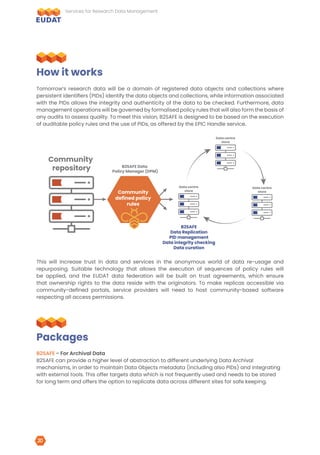
Tomorrow’s research data will be a domain of registered data objects and collections where
persistent identifiers (PIDs) identify the data objects and collections, while information associated
with the PIDs allows the integrity and authenticity of the data to be checked. Furthermore, data
management operations will be governed by formalised policy rules that will also form the basis of
any audits to assess quality. To meet this vision, B2SAFE is designed to be based on the execution
of auditable policy rules and the use of PIDs, as offered by the EPIC Handle service.
This will increase trust in data and services in the anonymous world of data re-usage and
repurposing. Suitable technology that allows the execution of sequences of policy rules will
be applied, and the EUDAT data federation will be built on trust agreements, which ensure
that ownership rights to the data reside with the originators. To make replicas accessible via
community-defined portals, service providers will need to host community-based software
respecting all access permissions.
B2SAFE - For Archival Data
B2SAFE can provide a higher level of abstraction to different underlying Data Archival
mechanisms, in order to maintain Data Objects metadata (including also PIDs) and integrating
with external tools. This offer targets data which is not frequently used and needs to be stored
for long term and offers the option to replicate data across different sites for safe keeping.
How it works
Packages
Community
repository
Data centre
store
Data centre
store
B2SAFE Data
Policy Manager (DPM)
B2SAFE
Data Replication
PID management
Data integrity checking
Data curation
Community
defined policy
rules
Data centre
store
Services for Research Data Management
20
B2SAFE
Replicate Research
Data Safely
If you are a Repository Service Provider (Thematic Service Provider) you can do the following:
Any community and departmental data repositories that have a proper repository
infrastructure supporting PIDs and metadata describing the properties and context of the
data being replicated can participate in B2SAFE. The replication service currently relies on
iRODS but also supports other federation technologies. Participating repositories can choose
to use iRODS and link it with their local repository to enable a tight integration to the EUDAT
infrastructure, or use other easy-to-integrate federation approaches and client libraries.
EUDAT will help interested community centres to set up and use this service by running
training courses, and providing support for the necessary adaptation work, including offering
a service help desk.
How to get access?
Request to use B2SAFE Join the EUDAT CDI as a provider
eudat.eu/contact-support-request eudat.eu/eudat-cdi/joining
HAND-POINT-UP HAND-POINT-UP
B2SAFE - For Active Data
As a standard default mechanism B2SAFE can allow users to simply store data directly
in the iRODS File System (iRODS FS), rather than the Object Storage or the Data Archival
(as previously described). B2SAFE can create and assign PIDs to data objects, and store
metadata associated to files and directories that have been saved to the Posix FS, on users
behalf. This offer targets active data which is frequently used.
Services for Research Data Management
21
Identity & authorisation
Services for Research Data Management
22
B2ACCESS is a federated cross-infrastructure authorisation and authentication proxy for user
identification and community-defined access control enforcement. It allows users to authenticate
themselves using a variety of credentials providing federated access and single-sign-on
to services and service providers in a trusted way. B2ACCESS offers communities and service
providers an AARC compliant AAI proxy ready to be integrated within the EOSC AAI Federation.
Compliant to the AARC Blueprint and REFEDS Sirtfi
Supports group management
Supports authorisation via group membership
Supports authentication e.g. via eduGAIN, ORCID and Social Identities
Support for EUDAT B2ACCESS local accounts and user authentication by X.509 certificates
Support for IdP and service integration via SAML, OAuth and OIDC
Features
Technologies Standards for Service
and IdP integration
•	Unity Idm
•	SAML
•	OAuth2/OIDC
Services for Research Data Management
23
B2ACCESS allows EUDAT users to authenticate themselves using a variety of credentials. The
following log-in options are supported:
The user’s home organisation has the highest level of assurance and is the preferred way of
authentication. If a user’s home organisation is not available in the EUDAT B2ACCESS system, a
social account or B2ACCESS ID are the alternatives. However, since these have a lower level of
assurance, access to the EUDAT services and resources can be limited for users authenticated
under these options.
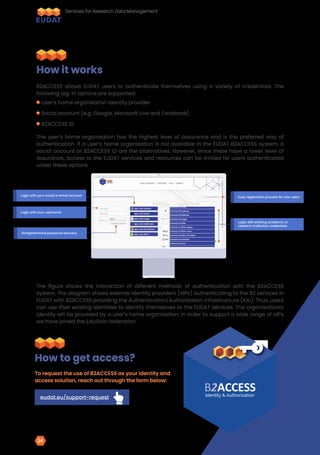
The figure shows the interaction of different methods of authentication with the B2ACCESS
system. The diagram shows external identity providers (IdPs) authenticating to the B2 services in
EUDAT with B2ACCESS providing the Authentication/Authorisation Infrastructure (AAI). Thus, users
can use their existing identities to identify themselves to the EUDAT services. The organisational
identity will be provided by a user’s home organisation. In order to support a wide range of IdPs
we have joined the EduGain federation
How it works
User’s home organisation identity provider
Social account (e.g. Google, Microsoft Live and Facebook)
B2ACCESS ID
Easy registration process for new users
Login with existing academic or
research institution credentials
Login with your social or email account
Login with your username
Straightforward password recovery
How to get access?
To request the use of B2ACCESS as your identity and
access solution, reach out through the form below:
eudat.eu/support-request
HAND-POINT-UP
Services for Research Data Management
24
Services for Research Data Management
Register your research data
with a persistent identifier
B2HANDLE
Services for Research Data Management
25
B2HANDLEisthedistributedserviceforstoring,managingandaccessingpersistentidentifiers(PIDs)
and essential metadata (PID records) as well as managing PID namespaces. The implementation
of the service relies on the DONA/Handle persistent identifier solution. B2HANDLE can be used by
middleware applications, end-user tools and other service to reliably identify data objects over
longer timespans and through changes in object location or ownership. The B2HANDLE service
encompasses management of identifier namespaces (Handle prefixes), establishment of
policies and business workflows, operation of Handle servers and technical services, and a user-
friendly Python library for general interaction with Handle servers and EUDAT-specific extensions.
B2HANDLE is mostly transparent to end-users, shielding them from the complexity of infrastructure
details. B2HANDLE supports a dedicated Handle record structure (a PID profile) for the safe data
management within an infrastructure with a given topology.
Globally resolvable identifiers via the Global Handle Network (DONA, hdl.handle.net)
Communities and organisations can obtain Handle Prefixes (ePIC, 21.######) for their own
use
PIDs can be hosted at EUDAT service providers
B2HANDLE operates as a federation of EUDAT service providers based on policies
PIDs are mirrored across multiple providers for high resolution and high availability
Handle records can be customised to community and organisational needs (for example
include checksums and timestamps to ensure authenticity of the data objects)
Support for reverse look-ups of Handle records
REST API for easy registration and minting of PIDs
Features
Technologies
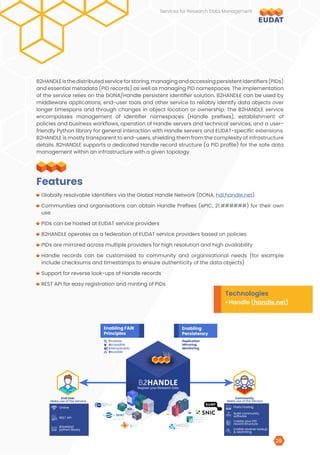
•	Handle (handle.net)
B2HANDLE
Register your Research Data
Enabling
Persistency
Enabling FAIR
Principles
Findable
Accessible
Interoperable
Reusable
Make use of the Service
Online
REST API
B2HANDLE
python library
Prefix hosting
Build community
software
Create your PID
record structure
Enable reverse-lookup
& searching
Replication
Mirroring
Monitoring
End User
Make use of the Service
Community


Services for Research Data Management
26
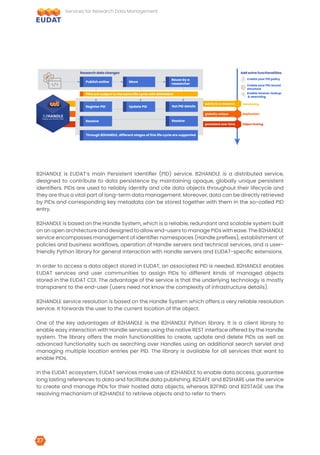
globally unique
persistent over time
Research data changes Add extra functionalities
Create your PID policy
Create your PID record
structure
Enable reverse-lookup
 searching 
Move
Reuse by a
researcher
Publish online
PIDs are subject to the same life cycle with B2HANDLE
Register PID Update PID
points to a resource Versioning
Replication
Object linking
Get PID details
Resolve Resolve
Through B2HANDLE, different stages of this life cycle are supported
B2HANDLE
Register your Research Data
B2HANDLE is EUDAT’s main Persistent Identifier (PID) service. B2HANDLE is a distributed service,
designed to contribute to data persistence by maintaining opaque, globally unique persistent
identifiers. PIDs are used to reliably identify and cite data objects throughout their lifecycle and
they are thus a vital part of long-term data management. Moreover, data can be directly retrieved
by PIDs and corresponding key metadata can be stored together with them in the so-called PID
entry.
B2HANDLE is based on the Handle System, which is a reliable, redundant and scalable system built
on an open architecture and designed to allow end-users to manage PIDs with ease. The B2HANDLE
service encompasses management of identifier namespaces (Handle prefixes), establishment of
policies and business workflows, operation of Handle servers and technical services, and a user-
friendly Python library for general interaction with Handle servers and EUDAT-specific extensions.
In order to access a data object stored in EUDAT, an associated PID is needed. B2HANDLE enables
EUDAT services and user communities to assign PIDs to different kinds of managed objects
stored in the EUDAT CDI. The advantage of the service is that the underlying technology is mostly
transparent to the end-user (users need not know the complexity of infrastructure details).
B2HANDLE service resolution is based on the Handle System which offers a very reliable resolution
service. It forwards the user to the current location of the object.
One of the key advantages of B2HANDLE is the B2HANDLE Python library. It is a client library to
enable easy interaction with Handle services using the native REST interface offered by the Handle
system. The library offers the main functionalities to create, update and delete PIDs as well as
advanced functionality such as searching over Handles using an additional search servlet and
managing multiple location entries per PID. The library is available for all services that want to
enable PIDs.
In the EUDAT ecosystem, EUDAT services make use of B2HANDLE to enable data access, guarantee
long lasting references to data and facilitate data publishing. B2SAFE and B2SHARE use the service
to create and manage PIDs for their hosted data objects, whereas B2FIND and B2STAGE use the
resolving mechanism of B2HANDLE to retrieve objects and to refer to them.
Services for Research Data Management
27
B2HANDLE For Researchers
PIDs are normally automatically minted at and within data management and data repository
systems, for example via the EUDAT B2SHARE data repository service. Therefore, researchers in
need of a Persistent Identifier for a data set can publish the data set via the B2SHARE service.
B2HANDLE For Data Managers
B2HANDLE is the distributed service for minting, storing, managing, and accessing persistent
identifiers (PIDs) and essential metadata (PID records) as well as managing PID namespaces.
The B2HANDLE service allows Data Managers and Data Providers the registration and minting
PIDs which can be integrated within Data Repositories and other Data Management platforms.
Prefix
PIDs are comparable to the ISBN numbers assigned to books. A PID consists of a Prefix and a
Suffix. The Prefix identifies the naming authority of the PIDs identified by the Prefix. The prefixes
acquired via EUDAT are ePIC Handle Prefixes and are globally resolvable via the Handle.net
Global Resolving Network. This offer does not include the PID Hosting service, the Prefixes need
to be configured in a Handle service separately. If you also require PID hosting, please select the
PID Hosting offer.
PID Hosting
B2HANDLE is the distributed service for minting, storing, managing, and accessing persistent
identifiers (PIDs) and essential metadata (PID records) as well as managing PID namespaces.
The B2HANDLE PID Hosting allows Data Managers and Data Providers the registration and
minting PIDs which can be integrated within Data Repositories and other Data Management
platforms.
Packages
How to get access?
For researchers, use B2HANDLE
though B2SHARE now!
For other packages such as for data
managers, prefixes or PID hosting:
b2share.eudat.eu eudat.eu/support-request
HAND-POINT-UP HAND-POINT-UP
B2HANDLE
Register your Research Data
Services for Research Data Management
28
For community data managers and system administrators:
There are two modes of integration with EUDAT:
1.	 “use” EUDAT: an EUDAT datacentre ingests the community data and ensures its storage and
replication. EUDAT will also expose several web-interfaces and APIs to its services, which will
allow a looser, but still feature-rich connection with EUDAT.
2.	 “join” EUDAT: the data centre/institute becomes a part of the EUDAT network. To this end it is
necessary to adopt the EUDAT Collaborative Data Infrastructure (CDI).
How to
proceed?
In both cases, the community will benefit from access to EUDAT’s primary services – B2SAFE for safe
replication, B2ACCESS for user authentication and authorisation, B2FIND, the metadata harvesting
and cataloguing service, B2SHARE for publishing, storing and sharing of smaller data sets, and
B2DROP for storing, synchronising and exchanging data with colleagues and team members.
Joining EUDAT is more demanding, but it allows to benefit from the complete set of EUDAT data
centre features such as: choice of data centres to federate with by means of B2SAFE; use of an
own PID service within the EUDAT domain; optimised data transfer within the EUDAT CDI; and tighter
control of data management policies (replication, authorisation) through direct management of
core services at a site.
Joining EUDAT requires the installation and configuration of a minimum software stack (the EUDAT
CDI). Furthermore, it requires the community to dedicate some resources (storage, compute and
man-power) to the project.
In practice, three packages are required: iRODS deployed at the site; access to a system for PIDs
(or B2HANDLE); and (optionally) deployment of the B2STAGE DSI package.
Configuration requires: access to disk space and connection to other iRODS installations in EUDAT;
monitoring configuration; user-access configuration; and connection to the metadata catalog.
For end-users: The EUDAT services B2ACCESS, B2SHARE, B2FIND and B2DROP all offer interfaces for
end users.
Ready to talk? Get in touch with us now!
eudat.eu/contact-support-request
COMMENTS
Services for Research Data Management
29
Services for Research Data Management

EUDAT Booklet Mar22 (2).pdf

  • 1.
  • 2.
  • 3.
    The EUDAT CollaborativeData Infrastructure (or EUDAT CDI) is one of the largest infrastructures of integrated data services and resources supporting research in Europe. It is sustained by a network of more than 20 European research organisations, data and computing centres that, in September 2016, have signed an agreement to maintain the EUDAT CDI for the next 10 years, and in 2018 have supported the establishment of the limited liability company, EUDAT Ltd. This infrastructure and its services are continuously being developed in close collaboration with over 50 research communities spanning across many different scientific disciplines. Services for Research Data Management 3 3
  • 4.
  • 5.
    B2SHARE Store and publishresearch data B2SHARE Store and Share Research Data EUDAT has developed a service stack that forms the Collaborative Data Infrastructure (CDI). The services are as follows: Most of these components are described in more detail in the following sections. In addition, a set of EUDAT core operational services, essential for the management of the CDI B2ACCESS B2HANDLE Exchange data security Data discovery PID Data Metadata Credentials Data access & sharing Data management & preservation User management Use metadata to discover data Domain External Domain Use policies to manage data Share and publish research data Autenticate and authorize Persistently identity and data security B2FIND Find Research Data B2SHARE Store and Share Research Data B2DROP Sync and Exchange Research Data B2HANDLE Register your Research Data B2SAFE Replicate Research Data Safely (identity and authorisation), easy-to- use and secure Authentication and Authorisation platform (persistent identification management), a service to register persistent identifiers called “handles” to data objects and retrieve data objects via these identifiers, serving a purpose similar to DOIs for papers B2HANDLE Register your Research Data B2SAFE Keep research data safe via data management policies B2SAFE Replicate Research Data Safely B2DROP Sync and share research data B2DROP Sync and Exchange Research Data B2FIND Find research data B2FIND Find Research Data Services for Research Data Management 5
  • 6.
    Sync and share researchdata B2DROP Services for Research Data Management 6
  • 7.
    B2DROP is alow-barrier, user-friendly and trustworthy storage environment which allows users to synchronise their active data across different desktops and to easily share this data with peers. EUDAT offers a free public basic instance for any researcher. For communities and organisations a premium service is offered on the public instance. Communities and organisations can also request customised instances Default quota of 20GBs (Basic), high quotas optional (Premium) Access via Web GUI, desktop clients and Webdav Multiple versions of files are kept Enabled apps: Contacts, Calendar, Tasks, Circles (social communities) Sharing within B2DROP, across different instances (via OCM-API) and via links Publishing of datasets to B2SHARE Integration with CLARIN Language Resource Switchboard (Basic) Integration with other community services optional (Premium) Group management (Premium) OnlyOffice (Premium) Features Technologies Standards Dependencies • NextCloud • OpenCloudMesh API for Federated Cloud Sharing • B2ACCESS Services for Research Data Management 7
  • 8.
    The service isintended for the long-tail and still volatile data which can change and are still subject to active research e.g. drafts of research papers. Therefore, B2DROP offers versioning of all ingested files but does not attach persistent identifiers to them. B2DROP is hosted at the Jülich Supercomputing Centre, which guarantees that your research data stays in Europe. Daily backups of all files in B2DROP are taken and kept on tap. B2DROP is based on Nextcloud. Data is encrypted on transmission through the exclusive use of the https protocol for data transfer. Each B2DROP user is allowed 20GB of storage. B2DROP offers an intuitive user-interface via the web. In addition to web access, users can mount B2DROP as a drive on their desktop machines via WebDAV, or use a desktop client which also allows offline synchronisation. How it works Control who can access files, down to users or groups Activity tracking, commenting and sharing of files Quick filters for finding files and folders Sidebar for quick navigability through files Checkboxes for multiple operations Retrieve recently deleted files Community & collaborative elements B2SHARE Integration for FAIR data sharing B2DROP Basic For Researchers Capacity: 20GB B2DROP is a secure and trusted data exchange service for researchers and scientists to keep their research data synchronized and up-to-date and to exchange with other researchers. B2DROP is an ideal solution to store and share data with colleagues and team members, synchronise multiple versions of data, ensure automatic desktop synchronisation of large files. Only self registration is needed and can be accessed online. You can share files with local users, or across other B2DROP and ownCloud/Nextcloud instances. You can do synchronisation using desktop clients or WebDAV mounts. Additionally, you can publish data to B2SHARE. Packages Services for Research Data Management 8
  • 9.
    B2DROP Premium ForResearchers Capacity: 100-2000GB The basic B2DROP service has a per user quota limit of 20GB. Researchers which have a need for higher quotas, higher storage capacity, specific requirements and/or (Nextcloud) applications enabled can request this via the B2DROP Premium service. B2DROP For Data Managers Capacity: 1-10TB Quota per user: 100-500GB The public B2DROP service has a per user quota limit of 20GB. Communities, organisations or principal research investigators which have a need for higher quotas, higher storage capacity, specific requirements and/or (Nextcloud) applications enabled can submit a support request to request this. Depending on the requirements and/or requested storage capacity the B2DROP service is offered as a paid service. It includes all the features of the basic service except with higher quotas. B2DROP For Communities and Organisations Capacity: 1-10TB Quota per user: 100-500GB The public B2DROP service is provided on a fair-share basis. Communities and/or organisations with specific requirements which can not be support via the public fair-share service or or need higher level of security or access control can request consultancy in setting up and deploying a local B2DROP instance or can request a B2DROP instance which is hosted at one of the EUDAT partners. Features are negotiable. How to get access? For researchers needing 20GB or less, use B2DROP for free now: For higher needs from individual researchers, data managers and communities and organisations, contact us to set-up your dedicated instance: b2drop.eudat.eu eudat.eu/contact-support-request HAND-POINT-UP HAND-POINT-UP B2DROP Sync and Exchange Research Data Services for Research Data Management 9
  • 10.
    Store and publish researchdata B2SHARE Services for Research Data Management 10
  • 11.
    Features Support of metadatadescriptions via the EUDAT metadata schema Registers DOIs for datasets and Handle PIDs for data objects Supports versioning Harvested by B2FIND and OpenAIRE explorer Direct upload from B2DROP Accessible via a Web GUI and an API to support automatic publishing workflows Supports community domains Allows communities to define metadata extensions, access rules and publishing workflows Annotate research data through the B2NOTE extension Technologies Dependencies Invenio B2ACCESS B2SHARE is a user-friendly, reliable and trustworthy way for researchers, scientific communities and citizen scientists to store, publish and share research data in a FAIR way. B2SHARE is a solution that facilitates research data storage, guarantees long-term persistence of data and allows data, results or ideas to be shared worldwide. B2SHARE supports community domains with metadata extensions, access rules and publishing workflows. EUDAT offers communities and organisations customised instances and/or access to repositories supporting large datasets. Search and view records Publicly-citable PID and DOI upon publication Fill in rich general and community-specific metadata for your record Add files from your PC or directly through B2DROP Choose the right license with help from the wizard In case of restricted access, files will only be accessible by the record’s administrators, but metadata is always publicly accessible. Depending on the community, you selected to publish from, mandatory fields change Services for Research Data Management 11
  • 12.
    B2SHARE is aservice for what’s known as “long tail of data”. This is a key component of research but is often under-exploited and even at risk when only stored on separate machines and storage devices such as notebooks, desktops or departmental servers. Any kind of stable research data which you want to preserve and share in a safe environment can be deposited in B2SHARE. The research data can have various formats - papers, spreadsheets, audio-visual media, and more. The only requirement is that the source or purpose of the data is scientific. The data is uploaded from your local or departmental storage device as digital objects which are then automatically assigned with persistent identifiers, ensuring long-lasting access and reference to the data. The data is deposited in Finland at the Finnish IT Center for Science. More precisely it is stored on servers in Kajaani, a newly-built and environmentally-friendly data centre using the most advanced and modern data centre technology. EUDAT retains the right of archiving, i.e. creating replicas at trusted centres to take care of long-term persistence. How it works B2FIND Metadata database Uploads from OAI-PMH DOI for Landing pages PIDs at object level Automated Publications 1. Upload data 2. Select your domain 3. Enter basic and domain-specific metadata B2SAFE B2DROP Versioning, MD checksums, Flexible community metadata B2HANDLE Services for Research Data Management 12
  • 13.
    B2SHARE Basic ForResearchers (free) B2SHARE is a free-to-use public service supporting cross disciplinary research, self-registration for any scientists and researchers, free upload of stable research data, data will receive a DOI which can be used for citing, data objects will receive a B2HANDLE PID, access policy is defined by the data owner, metadata in openly accessible and made discoverable via B2FIND, Direct uploads from B2DROP, data integrity is ensured by checksums which are calculated during data ingest. B2SHARE Premium For Data Managers The B2SHARE - Premium service is the same as the basic service, but provides researchers the option to upload larger data files and datasets (>20GB) and the customization of metadata extensions. B2SHARE For Communities And Organisations B2SHARE for communities and organisations offers the option for dedicated and branded B2SHARE instances which can be customised to community and organisational needs. This supports customisation to the metadata schemas, community domains and access rights. B2SHARE For Large Datasets EUDAT is a network service providers across Europe specialising in large ICT infrastructure supporting research. To researchers and/or communities seeking to publish and/or make large datasets accessible in a FAIR way, EUDAT can offer access to data repositories supporting large datasets (>50TB). These repositories are made available through the EUDAT partners. Packages How to get access? Use B2SHARE Basic now For communities wanting to publish using their own metadata scheme fields, contact us b2share.eudat.eu eudat.eu/contact-support-request HAND-POINT-UP HAND-POINT-UP B2SHARE Store and Share Research Data Services for Research Data Management 13
  • 14.
    Find research data B2FIND Servicesfor Research Data Management 14
  • 15.
    B2FIND is aninterdisciplinary discovery portal for research outputs that allows free term search. Results may be narrowed down using several facets, including spatial and temporal search options. B2FIND is the EUDAT metadata indexing service and provides a discovery portal which allows users to find data collections within an international and inter-disciplinary scope. It is based on a comprehensive metadata catalogue of research data collections stored in EUDAT data centres and community repositories. Harmonisation of the metadata descriptions collected from heterogeneous sources enables not only the presentation in a consistent form but also the faceted search across scientific domain boundaries. The service is geared for communities and other providers of research data who need to publish and give visibility to their metadata and individual researchers who need to search data from everywhere, and see data in the context with an across community approach. Harmonisation of the metadata descriptions via the EUDAT Core metadata schema Harvesting of repositories via different protocols (e.g. OAI-PMH, CSW, Rest-APIs) Faceted search via 12 facets (including geospatial, temporal search options), additional free text search Metadata aggregation from community repositories, multiple metadata standards are supported Harvested by OpenAIRE explorer Features Technologies Supported harvesting protocols Dependencies Supported metadata standards: • CKAN • OAI-PMH • REST-API • CSW • Dublin Core • Datacite • OpenAire • EUDAT Core • INSPIRE • ISO 19139/19139, FGDC • community specific standards • B2SHARE Services for Research Data Management 15
  • 16.
    Faceted search vialocation, time period of research, publication year, and filtering and sorting textual facets, etc. Search Results with search criteria Free text, key-value and combined search Each result opens up to show the metadata and how to access them Metadata that are made searchable in B2FIND are harvested from metadata providers, such as using the standard OAI-PMH interface. The community itself decides which metadata are made available to EUDAT and how their metadata elements are mapped to specific metadata elements for being represented as facets within the search portal. A sophisticated framework ensures that metadata from various providers are harvested regularly to display complete and up-to- date information. This framework also provides the translation from the community´s metadata elements to the EUDAT Core Metadata Schema, which is based on generic schemas like DataCite and OpenAire. Close communication with the community´s representatives is key for making research data findable and thus supporting FAIR data principles. The B2FIND service can be utilised in two ways: (1) via a graphical, web-based tool, available at b2find.eudat.eu, which is designed to be self-explanatory, and (2) using a command line tool based on the API interface to the portal. The following two prerequisites must be fulfilled in order to publish and make your metadata visible in B2FIND: (1) a service for providing and transferring the metadata, and (2) the definition of a community specific mapping. The B2FIND entry page lists all communities that provide metadata under ‘Communities’. In order to publish metadata, please follow the “Guidelines for Providing Metadata for EUDAT-B2FIND” (v), where supported harvesting protocols and metadata schemas are described in detail. How it works Detailed Metadata Services for Research Data Management 16
  • 17.
    B2FIND For Researchers(Free) B2FIND is a discovery service based on metadata steadily harvested from research data collections from EUDAT data centres and other community repositories. The service offers faceted browsing and it allows in particular to discover data that is stored through the B2SHARE service. B2FIND For Data Providers To enlarge the discovery of existing research output, data repository owners can make their research data collections stored in existing data repositories harvestable and discoverable via the public B2FIND service. To ease the process of harvesting data repositories, owners can assess the B2FIND guidelines for data providers. How to get access? Access and find research through the service now For Data Providers, request activation through the form: b2find.eudat.eu eudat.eu/contact-support-request HAND-POINT-UP HAND-POINT-UP Packages B2FIND Find Research Data Services for Research Data Management 17
  • 18.
    Keep research datasafe via data management policies B2SAFE Services for Research Data Management 18
  • 19.
    B2SAFE is arobust and highly available service which allows community and departmental repositories to implement data management policies on their research data across multiple administrative domains in a trustworthy manner. It offers an abstraction layer of large scale, heterogeneous data storages, guards against data loss in long-term archiving, allows optimized access for users (e.g. from different regions), and brings data closer to facilities for compute- intensive analysis. Support for data management policies (e.g. registration of PIDs, cross-site replication, data integrity checks) Support for policies customised to community and organisational needs Support for less frequently used archival data, but can also support active data Support for large scale storage resources (e.g up to PB-scale) A single namespace across heterogeneous storages Supports integration with different kind of storage systems (e.g. Tape based HSM, POSIX filesystems, Object storage) Access via GridFTP, Webdav, iRODS commands Service offered by a network of EUDAT service providers Features Technologies Dependencies iRODS B2HANDLE Services for Research Data Management 19
  • 20.
    Tomorrow’s research datawill be a domain of registered data objects and collections where persistent identifiers (PIDs) identify the data objects and collections, while information associated with the PIDs allows the integrity and authenticity of the data to be checked. Furthermore, data management operations will be governed by formalised policy rules that will also form the basis of any audits to assess quality. To meet this vision, B2SAFE is designed to be based on the execution of auditable policy rules and the use of PIDs, as offered by the EPIC Handle service. This will increase trust in data and services in the anonymous world of data re-usage and repurposing. Suitable technology that allows the execution of sequences of policy rules will be applied, and the EUDAT data federation will be built on trust agreements, which ensure that ownership rights to the data reside with the originators. To make replicas accessible via community-defined portals, service providers will need to host community-based software respecting all access permissions. B2SAFE - For Archival Data B2SAFE can provide a higher level of abstraction to different underlying Data Archival mechanisms, in order to maintain Data Objects metadata (including also PIDs) and integrating with external tools. This offer targets data which is not frequently used and needs to be stored for long term and offers the option to replicate data across different sites for safe keeping. How it works Packages Community repository Data centre store Data centre store B2SAFE Data Policy Manager (DPM) B2SAFE Data Replication PID management Data integrity checking Data curation Community defined policy rules Data centre store Services for Research Data Management 20
  • 21.
    B2SAFE Replicate Research Data Safely Ifyou are a Repository Service Provider (Thematic Service Provider) you can do the following: Any community and departmental data repositories that have a proper repository infrastructure supporting PIDs and metadata describing the properties and context of the data being replicated can participate in B2SAFE. The replication service currently relies on iRODS but also supports other federation technologies. Participating repositories can choose to use iRODS and link it with their local repository to enable a tight integration to the EUDAT infrastructure, or use other easy-to-integrate federation approaches and client libraries. EUDAT will help interested community centres to set up and use this service by running training courses, and providing support for the necessary adaptation work, including offering a service help desk. How to get access? Request to use B2SAFE Join the EUDAT CDI as a provider eudat.eu/contact-support-request eudat.eu/eudat-cdi/joining HAND-POINT-UP HAND-POINT-UP B2SAFE - For Active Data As a standard default mechanism B2SAFE can allow users to simply store data directly in the iRODS File System (iRODS FS), rather than the Object Storage or the Data Archival (as previously described). B2SAFE can create and assign PIDs to data objects, and store metadata associated to files and directories that have been saved to the Posix FS, on users behalf. This offer targets active data which is frequently used. Services for Research Data Management 21
  • 22.
    Identity & authorisation Servicesfor Research Data Management 22
  • 23.
    B2ACCESS is afederated cross-infrastructure authorisation and authentication proxy for user identification and community-defined access control enforcement. It allows users to authenticate themselves using a variety of credentials providing federated access and single-sign-on to services and service providers in a trusted way. B2ACCESS offers communities and service providers an AARC compliant AAI proxy ready to be integrated within the EOSC AAI Federation. Compliant to the AARC Blueprint and REFEDS Sirtfi Supports group management Supports authorisation via group membership Supports authentication e.g. via eduGAIN, ORCID and Social Identities Support for EUDAT B2ACCESS local accounts and user authentication by X.509 certificates Support for IdP and service integration via SAML, OAuth and OIDC Features Technologies Standards for Service and IdP integration • Unity Idm • SAML • OAuth2/OIDC Services for Research Data Management 23
  • 24.
    B2ACCESS allows EUDATusers to authenticate themselves using a variety of credentials. The following log-in options are supported: The user’s home organisation has the highest level of assurance and is the preferred way of authentication. If a user’s home organisation is not available in the EUDAT B2ACCESS system, a social account or B2ACCESS ID are the alternatives. However, since these have a lower level of assurance, access to the EUDAT services and resources can be limited for users authenticated under these options. The figure shows the interaction of different methods of authentication with the B2ACCESS system. The diagram shows external identity providers (IdPs) authenticating to the B2 services in EUDAT with B2ACCESS providing the Authentication/Authorisation Infrastructure (AAI). Thus, users can use their existing identities to identify themselves to the EUDAT services. The organisational identity will be provided by a user’s home organisation. In order to support a wide range of IdPs we have joined the EduGain federation How it works User’s home organisation identity provider Social account (e.g. Google, Microsoft Live and Facebook) B2ACCESS ID Easy registration process for new users Login with existing academic or research institution credentials Login with your social or email account Login with your username Straightforward password recovery How to get access? To request the use of B2ACCESS as your identity and access solution, reach out through the form below: eudat.eu/support-request HAND-POINT-UP Services for Research Data Management 24
  • 25.
    Services for ResearchData Management
  • 26.
    Register your researchdata with a persistent identifier B2HANDLE Services for Research Data Management 25
  • 27.
    B2HANDLEisthedistributedserviceforstoring,managingandaccessingpersistentidentifiers(PIDs) and essential metadata(PID records) as well as managing PID namespaces. The implementation of the service relies on the DONA/Handle persistent identifier solution. B2HANDLE can be used by middleware applications, end-user tools and other service to reliably identify data objects over longer timespans and through changes in object location or ownership. The B2HANDLE service encompasses management of identifier namespaces (Handle prefixes), establishment of policies and business workflows, operation of Handle servers and technical services, and a user- friendly Python library for general interaction with Handle servers and EUDAT-specific extensions. B2HANDLE is mostly transparent to end-users, shielding them from the complexity of infrastructure details. B2HANDLE supports a dedicated Handle record structure (a PID profile) for the safe data management within an infrastructure with a given topology. Globally resolvable identifiers via the Global Handle Network (DONA, hdl.handle.net) Communities and organisations can obtain Handle Prefixes (ePIC, 21.######) for their own use PIDs can be hosted at EUDAT service providers B2HANDLE operates as a federation of EUDAT service providers based on policies PIDs are mirrored across multiple providers for high resolution and high availability Handle records can be customised to community and organisational needs (for example include checksums and timestamps to ensure authenticity of the data objects) Support for reverse look-ups of Handle records REST API for easy registration and minting of PIDs Features Technologies • Handle (handle.net) B2HANDLE Register your Research Data Enabling Persistency Enabling FAIR Principles Findable Accessible Interoperable Reusable Make use of the Service Online REST API B2HANDLE python library Prefix hosting Build community software Create your PID record structure Enable reverse-lookup & searching Replication Mirroring Monitoring End User Make use of the Service Community Services for Research Data Management 26
  • 28.
    globally unique persistent overtime Research data changes Add extra functionalities Create your PID policy Create your PID record structure Enable reverse-lookup searching  Move Reuse by a researcher Publish online PIDs are subject to the same life cycle with B2HANDLE Register PID Update PID points to a resource Versioning Replication Object linking Get PID details Resolve Resolve Through B2HANDLE, different stages of this life cycle are supported B2HANDLE Register your Research Data B2HANDLE is EUDAT’s main Persistent Identifier (PID) service. B2HANDLE is a distributed service, designed to contribute to data persistence by maintaining opaque, globally unique persistent identifiers. PIDs are used to reliably identify and cite data objects throughout their lifecycle and they are thus a vital part of long-term data management. Moreover, data can be directly retrieved by PIDs and corresponding key metadata can be stored together with them in the so-called PID entry. B2HANDLE is based on the Handle System, which is a reliable, redundant and scalable system built on an open architecture and designed to allow end-users to manage PIDs with ease. The B2HANDLE service encompasses management of identifier namespaces (Handle prefixes), establishment of policies and business workflows, operation of Handle servers and technical services, and a user- friendly Python library for general interaction with Handle servers and EUDAT-specific extensions. In order to access a data object stored in EUDAT, an associated PID is needed. B2HANDLE enables EUDAT services and user communities to assign PIDs to different kinds of managed objects stored in the EUDAT CDI. The advantage of the service is that the underlying technology is mostly transparent to the end-user (users need not know the complexity of infrastructure details). B2HANDLE service resolution is based on the Handle System which offers a very reliable resolution service. It forwards the user to the current location of the object. One of the key advantages of B2HANDLE is the B2HANDLE Python library. It is a client library to enable easy interaction with Handle services using the native REST interface offered by the Handle system. The library offers the main functionalities to create, update and delete PIDs as well as advanced functionality such as searching over Handles using an additional search servlet and managing multiple location entries per PID. The library is available for all services that want to enable PIDs. In the EUDAT ecosystem, EUDAT services make use of B2HANDLE to enable data access, guarantee long lasting references to data and facilitate data publishing. B2SAFE and B2SHARE use the service to create and manage PIDs for their hosted data objects, whereas B2FIND and B2STAGE use the resolving mechanism of B2HANDLE to retrieve objects and to refer to them. Services for Research Data Management 27
  • 29.
    B2HANDLE For Researchers PIDsare normally automatically minted at and within data management and data repository systems, for example via the EUDAT B2SHARE data repository service. Therefore, researchers in need of a Persistent Identifier for a data set can publish the data set via the B2SHARE service. B2HANDLE For Data Managers B2HANDLE is the distributed service for minting, storing, managing, and accessing persistent identifiers (PIDs) and essential metadata (PID records) as well as managing PID namespaces. The B2HANDLE service allows Data Managers and Data Providers the registration and minting PIDs which can be integrated within Data Repositories and other Data Management platforms. Prefix PIDs are comparable to the ISBN numbers assigned to books. A PID consists of a Prefix and a Suffix. The Prefix identifies the naming authority of the PIDs identified by the Prefix. The prefixes acquired via EUDAT are ePIC Handle Prefixes and are globally resolvable via the Handle.net Global Resolving Network. This offer does not include the PID Hosting service, the Prefixes need to be configured in a Handle service separately. If you also require PID hosting, please select the PID Hosting offer. PID Hosting B2HANDLE is the distributed service for minting, storing, managing, and accessing persistent identifiers (PIDs) and essential metadata (PID records) as well as managing PID namespaces. The B2HANDLE PID Hosting allows Data Managers and Data Providers the registration and minting PIDs which can be integrated within Data Repositories and other Data Management platforms. Packages How to get access? For researchers, use B2HANDLE though B2SHARE now! For other packages such as for data managers, prefixes or PID hosting: b2share.eudat.eu eudat.eu/support-request HAND-POINT-UP HAND-POINT-UP B2HANDLE Register your Research Data Services for Research Data Management 28
  • 30.
    For community datamanagers and system administrators: There are two modes of integration with EUDAT: 1. “use” EUDAT: an EUDAT datacentre ingests the community data and ensures its storage and replication. EUDAT will also expose several web-interfaces and APIs to its services, which will allow a looser, but still feature-rich connection with EUDAT. 2. “join” EUDAT: the data centre/institute becomes a part of the EUDAT network. To this end it is necessary to adopt the EUDAT Collaborative Data Infrastructure (CDI). How to proceed? In both cases, the community will benefit from access to EUDAT’s primary services – B2SAFE for safe replication, B2ACCESS for user authentication and authorisation, B2FIND, the metadata harvesting and cataloguing service, B2SHARE for publishing, storing and sharing of smaller data sets, and B2DROP for storing, synchronising and exchanging data with colleagues and team members. Joining EUDAT is more demanding, but it allows to benefit from the complete set of EUDAT data centre features such as: choice of data centres to federate with by means of B2SAFE; use of an own PID service within the EUDAT domain; optimised data transfer within the EUDAT CDI; and tighter control of data management policies (replication, authorisation) through direct management of core services at a site. Joining EUDAT requires the installation and configuration of a minimum software stack (the EUDAT CDI). Furthermore, it requires the community to dedicate some resources (storage, compute and man-power) to the project. In practice, three packages are required: iRODS deployed at the site; access to a system for PIDs (or B2HANDLE); and (optionally) deployment of the B2STAGE DSI package. Configuration requires: access to disk space and connection to other iRODS installations in EUDAT; monitoring configuration; user-access configuration; and connection to the metadata catalog. For end-users: The EUDAT services B2ACCESS, B2SHARE, B2FIND and B2DROP all offer interfaces for end users. Ready to talk? Get in touch with us now! eudat.eu/contact-support-request COMMENTS Services for Research Data Management 29
  • 31.
    Services for ResearchData Management