Enzyme Immobilization and
its Applications
Introduction
• Enzymes are the biological catalysts that promote
chemical reactions in living organisms
• They have the ability to catalyze reactions under very
mild conditions with high degree of substrate
specificity thus decreasing the formation of byproducts
• Enzymes can catalyze reactions in different states,
individual molecules in solution, in aggregates with
other entities and as attached to surfaces
Immobilized enzymes
• “Immobilized enzyme” refers to “enzymes physically
confined or localized in a certain defined region of space
with retention of their catalytic activities, and which can be
used repeatedly and continuously” OR
• Imprisonment of enzyme in a distinct support/matrix.
• The support/matrix allows exchange of medium that
contains substrate of effecter or inhibitor molecules.
• The substrate passes over the immobilized enzyme and is
converted to products.
• Advantages
• Increased functional efficiency
• Enhanced reproducibility
• Catalyst Reuse
• Easier Reactor Operation
• Easier Product Separation
• Wider choice of Reactor
• Minimum reaction time
• Less chance of contamination in
products
• High stability
• High enzyme substrate ratio
• Enzyme-free products
• The ability to stop the reaction
rapidly by removing the enzyme
form the reaction solution
Disadvantages
• Limited industrial applications
• Loss or reduction in activity in
some enzymes
• Some enzymes become unstable
• Diffusion limitations
• Additional Cost
• High cost for isolation, purification
and recovery of active enzyme.
• Does not give required results if
one of the substrate is insoluble
• There may be diffusion problems
for the substrate to access the
enzyme under certain conditions
Application of immobilized enzymes:
1. Antibiotics Production
Immobilized enzymes are used to produce 6-aminopenicillin acid, penicillin,
cephalosporin.
Penicillin amidase immobilized by covalently binding with amberlite and
crosslinked by glutaraldehyde, or physically adsorbed to bentonite is used for
production of 6-APA (w`w6-aminopenicillanic acid), penicillin V. also ampicillin and
amoxicillin are produced from 6-APA.
Cepholosporins are produced by cephalosporins amidase. Cephalexin and
cephalosporin C can also be produced.
2. Steroid Production
Synthesis of hydrocortisone and prednisolone
3. Amino Acid Production
The production of L-aspartic acid, L-tryptophan and
L- alanine,
4. Acid Production
Acetic acid, Citric acid, L-Malic acid, 2-ketogluconic acid
5. Other organic Compounds
Coenzyme A, FAD (flavin adenine dinucleotide), pyridoxal 5 phosphate, Vitamin
B12, Proinsulin, prostaglandin, interleukin-2.
Supports/Matrix used in
immobilization
• The matrix that holds the enzyme should be:
• cheap and easily available.
• Should not react with medium and enzyme.
Three types of matrix are used:
1. Natural polymers: alginate, chitosan and chitin, collagen,
carrageenan, gelatin, cellulose, starch, pectin
2. Synthetic polymers: ion exchange resins/polymers [polyvinyl
chloride (PVC), UV activated Polyethylene glycol (PEG)]
3. Inorganic materials: ceramics, silica, glass, activated carbon,
charcoal
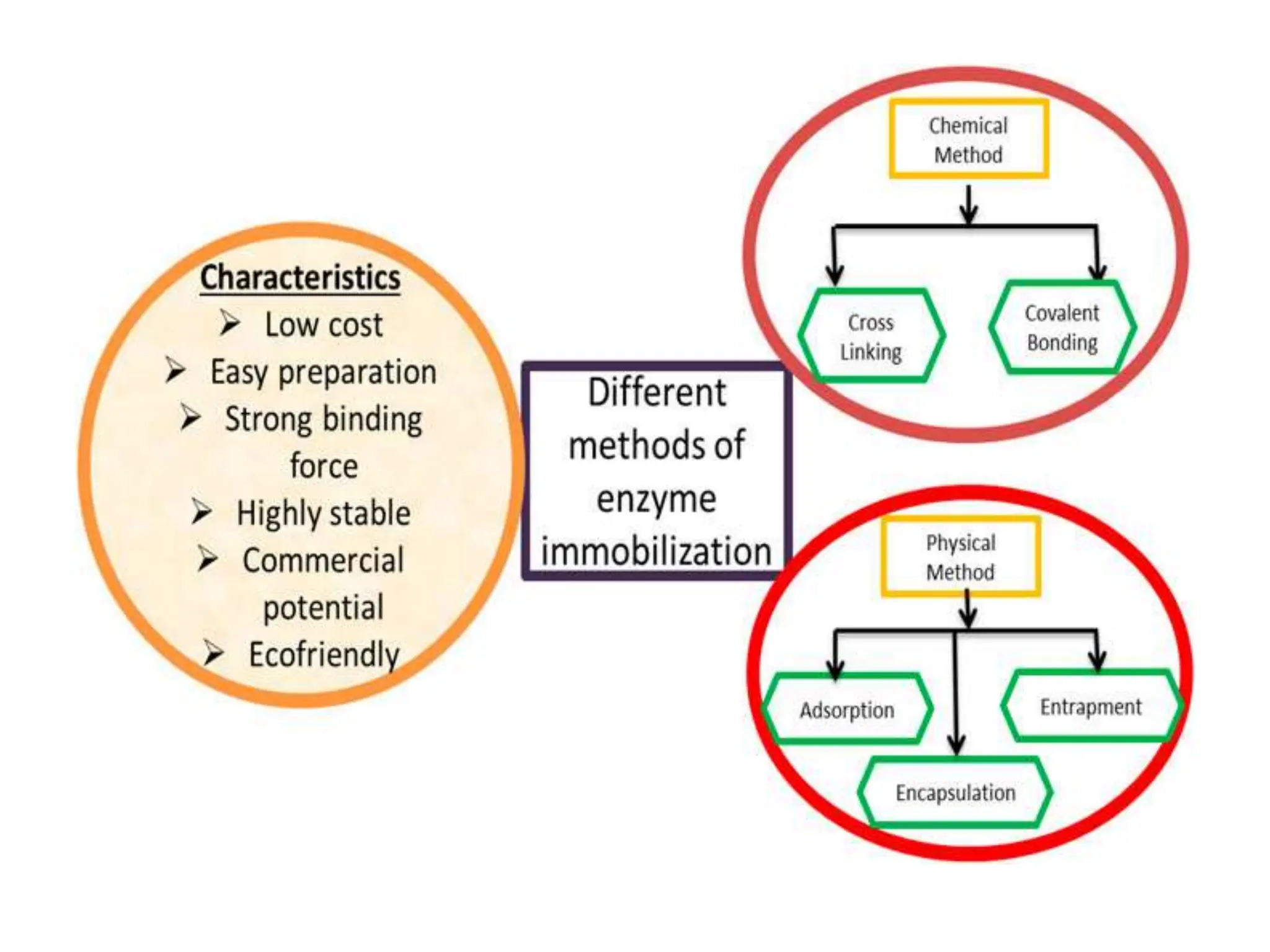
Types / methods of immobilization
1. Adsorption
2. Covalent bonding
3. Entrapment
4. Crosslinking
5. Affinity bonding
Enzyme Immobilization S-24 adadaddaa.ppt

Enzyme Immobilization S-24 adadaddaa.ppt

  • 1.
  • 2.
    Introduction • Enzymes arethe biological catalysts that promote chemical reactions in living organisms • They have the ability to catalyze reactions under very mild conditions with high degree of substrate specificity thus decreasing the formation of byproducts • Enzymes can catalyze reactions in different states, individual molecules in solution, in aggregates with other entities and as attached to surfaces
  • 3.
    Immobilized enzymes • “Immobilizedenzyme” refers to “enzymes physically confined or localized in a certain defined region of space with retention of their catalytic activities, and which can be used repeatedly and continuously” OR • Imprisonment of enzyme in a distinct support/matrix. • The support/matrix allows exchange of medium that contains substrate of effecter or inhibitor molecules. • The substrate passes over the immobilized enzyme and is converted to products.
  • 4.
    • Advantages • Increasedfunctional efficiency • Enhanced reproducibility • Catalyst Reuse • Easier Reactor Operation • Easier Product Separation • Wider choice of Reactor • Minimum reaction time • Less chance of contamination in products • High stability • High enzyme substrate ratio • Enzyme-free products • The ability to stop the reaction rapidly by removing the enzyme form the reaction solution Disadvantages • Limited industrial applications • Loss or reduction in activity in some enzymes • Some enzymes become unstable • Diffusion limitations • Additional Cost • High cost for isolation, purification and recovery of active enzyme. • Does not give required results if one of the substrate is insoluble • There may be diffusion problems for the substrate to access the enzyme under certain conditions
  • 5.
    Application of immobilizedenzymes: 1. Antibiotics Production Immobilized enzymes are used to produce 6-aminopenicillin acid, penicillin, cephalosporin. Penicillin amidase immobilized by covalently binding with amberlite and crosslinked by glutaraldehyde, or physically adsorbed to bentonite is used for production of 6-APA (w`w6-aminopenicillanic acid), penicillin V. also ampicillin and amoxicillin are produced from 6-APA. Cepholosporins are produced by cephalosporins amidase. Cephalexin and cephalosporin C can also be produced. 2. Steroid Production Synthesis of hydrocortisone and prednisolone 3. Amino Acid Production The production of L-aspartic acid, L-tryptophan and L- alanine, 4. Acid Production Acetic acid, Citric acid, L-Malic acid, 2-ketogluconic acid 5. Other organic Compounds Coenzyme A, FAD (flavin adenine dinucleotide), pyridoxal 5 phosphate, Vitamin B12, Proinsulin, prostaglandin, interleukin-2.
  • 6.
    Supports/Matrix used in immobilization •The matrix that holds the enzyme should be: • cheap and easily available. • Should not react with medium and enzyme. Three types of matrix are used: 1. Natural polymers: alginate, chitosan and chitin, collagen, carrageenan, gelatin, cellulose, starch, pectin 2. Synthetic polymers: ion exchange resins/polymers [polyvinyl chloride (PVC), UV activated Polyethylene glycol (PEG)] 3. Inorganic materials: ceramics, silica, glass, activated carbon, charcoal
  • 7.
    Types / methodsof immobilization 1. Adsorption 2. Covalent bonding 3. Entrapment 4. Crosslinking 5. Affinity bonding