Envisioning the Future
Enterprise
Platform for Mobile, Social, Big Data, Cloud, APIs,
I(I)oT, Open Source
By John Mathon
WSO2, VP Enterprise Evangelism and Product Strategy
About the Author
—  10 patents, publish / subscribe, multipath low
latency high reliability messaging, Content
management in file systems, peer to peer
messaging over WAN… others
—  founder and CTO of TIBCO
—  Twitter: @john_mathon
—  Blog: CloudRamblings johnmathon.wordpress.com
Productivity is 10-100x
just 7 years ago
—  Massive improvements in Reuse
—  Deployment – months -> hours
—  5-20x reduction in cost
Why? How?
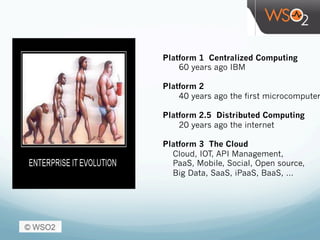
Platform 1 Centralized Computing
60 years ago IBM
Platform 2
40 years ago the first microcomputer
Platform 2.5 Distributed Computing
20 years ago the internet
Platform 3 The Cloud
Cloud, IOT, API Management,
PaaS, Mobile, Social, Open source,
Big Data, SaaS, iPaaS, BaaS, …
Platform 2 gave us:
—  delivery in year time-frames
—  writing over and over the same software
—  Low productivity development tools
—  half the time spent in deployment
—  Long iteration cycles
Cloud Companies
changed the model
—  Twitter, Google, Yahoo, Facebook, Netflix,
—  Continuous frequent deployment
—  open source development
—  Map/reduce, hadoop, Kafka, Clojure, Ruby, Chaos Monkey, API
Management
—  Chef, Puppet, Cassandra, Mongodb, OpenStack, Wso2,
Cloud Foundry, Scala, Spring, Rails, Docker, KVS,
Phonegap, html5, firefox, chrome
—  Unprecedented scale : The billion user club
—  Google 3+ billion users, Facebook 1+Billion users, Yahoo 2+billion users,
Twitter – billion messages/day, Ebay 5 billion transactions/day, Amazon cloud
division growing at 136% annually
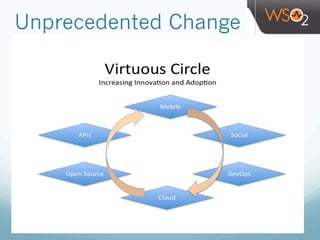
Unprecedented Change
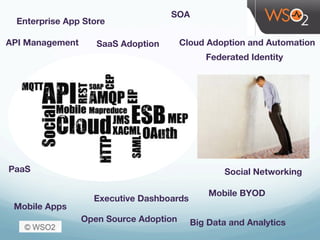
Enterprise App Store
API Management 
 SaaS Adoption
Executive Dashboards
PaaS
Mobile Apps
Open Source Adoption
SOA
Cloud Adoption and Automation
Federated Identity
Social Networking
Mobile BYOD
Big Data and Analytics
Connected is the new
Paradigm
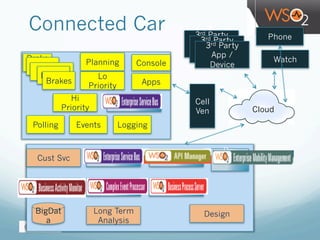
—  Connected Car
—  Connected Business
—  Internally all its employees and services
—  Externally to partners and customers
—  Connected Health
—  Connected Airlines
—  Connected Logistics
—  ….
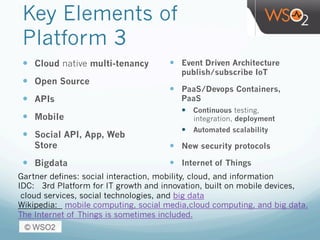
Key Elements of
Platform 3
—  Cloud native multi-tenancy
—  Open Source
—  APIs
—  Mobile
—  Social API, App, Web
Store
—  Bigdata
—  Event Driven Architecture
publish/subscribe IoT
—  PaaS/Devops Containers,
PaaS
—  Continuous testing,
integration, deployment
—  Automated scalability
—  New security protocols
—  Internet of Things
Gartner defines: social interaction, mobility, cloud, and information
IDC: 3rd Platform for IT growth and innovation, built on mobile devices,
cloud services, social technologies, and big data
Wikipedia:  mobile computing, social media,cloud computing, and big data.
The Internet of Things is sometimes included.
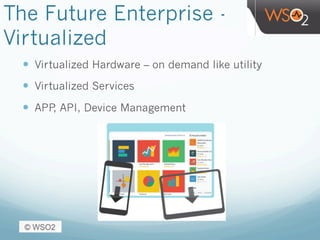
The Future Enterprise -
Virtualized
—  Virtualized Hardware – on demand like utility
—  Virtualized Services
—  APP, API, Device Management
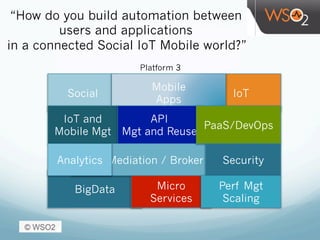
Platform 3
“How do you build automation between
users and applications
in a connected Social IoT Mobile world?”
Social IoT
Mobile
Apps
IoT and
Mobile Mgt
API
Mgt and Reuse
BigData
Mediation / Broker
Micro
Services
Analytics
PaaS/DevOps
Security
Perf Mgt
Scaling
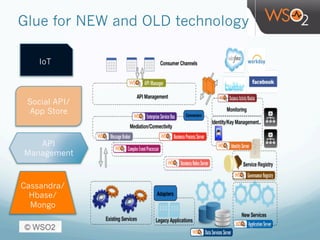
Glue for NEW and OLD technology
Cassandra/
Hbase/
Mongo
Social API/
App Store
API
Management
IoT
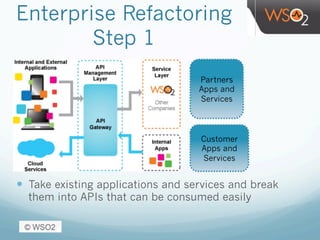
Enterprise Refactoring
Step 1
—  Take existing applications and services and break
them into APIs that can be consumed easily
Partners
Apps and
Services
Customer
Apps and
Services
First Step to Platform 3
API Management
—  Scalable API Delivery
—  API socialization and reuse
—  Lifecycle management
—  Usage Monitoring and Throttling
—  Security
—  External and/or internal services managed
Reuse pandemic
—  100 billion API calls/minute in the cloud says it all
—  APIs (microServices) are the new center of reuse
—  Apps use dozens of external services for
—  Payment, social, storage, AI, GPS, Locations,
—  Things, financial, logistics, lookups,
—  No interesting app without APIs
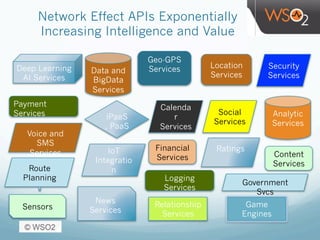
Network Effect APIs Exponentially
Increasing Intelligence and Value
Route
Planning
Voice and
SMS
Services
Ratings
Social
Services
Game
Engines
Relationship
Services
Payment
Services
Geo-GPS
Services Location
Services
Deep Learning
AI Services
Data and
BigData
Services
iPaaS
, PaaS
Calenda
r
Services
IoT
Integratio
n
Financial
Services
Security
Services
Logging
Services
Analytic
Services
Content
Services
Government
Svcs
News
ServicesSensors
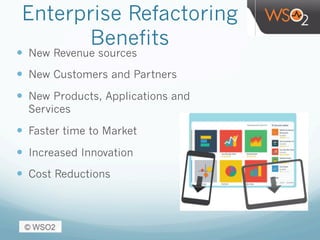
Enterprise Refactoring
Benefits
—  New Revenue sources
—  New Customers and Partners
—  New Products, Applications and
Services
—  Faster time to Market
—  Increased Innovation
—  Cost Reductions
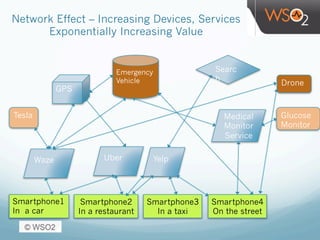
Network Effect – Increasing Devices, Services
Exponentially Increasing Value
Smartphone1
In a car
Smartphone2
In a restaurant
Waze Uber Yelp
Medical
Monitor
Service
Smartphone4
On the street
Smartphone3
In a taxi
Tesla Glucose
Monitor
Drone
GPS
Emergency
Vehicle
Searc
h
Open Source
Black Duck Survey
—  2014 80% of respondents say code quality vs proprietary why they
chose open source software
—  In 2007 80% rank cost as primary driver
—  2014 80% said access to source code important
—  2014 OSS Attracts and retains talent
—  Open Source projects doubling every 15 months
—  Companies are realizing Proprietary Enterprise License
companies are not necessarily aligned with your interests
—  Product Lifecycle tied to License Fees
—  Not amenable to open source projects (many of which are critical)
—  big upfront commitments not consistent with ‘aaS’ models
—  Not on the leading edge anymore
Open Source is the driver behind:
—  IaaS: Linux, Ubuntu, Suse,
KVM, Docker, OpenStack,
CloudStack
—  Agile Development: Eclipse,
CodeEnvy, Java
—  Build: Maven, Jenkins
—  Data: Hadoop, Cassandra,
Pentaho, MySql, Storm, WSO2
Lambda
—  Integration: WSO2, Redhat,
Mule, Kafka
—  PaaS/DevOps: Apache Stratos,
Cloud Foundry, Chef, Puppet,
Open Shift, Docker, Kubernetes
—  APIs : WSO2, Mule
—  Mobile: Android, Titanium,
PhoneGap, node.js, Mesh,
WSO2 EMM
—  IoT (Internet of Things): Z wave,
Arduino, CoAp, OpenMote,
MQTT, Thread,
—  Social: OpenSocial, wordpress,
Jamroom, Anahita, Elgg,
Buddypress, Diaspora, WSO2
Enterprise Store
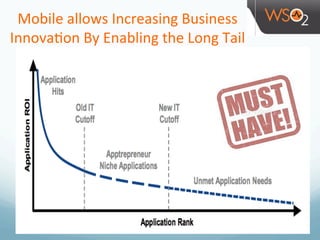
Mobile	
  allows	
  Increasing	
  Business	
  
Innova3on	
  By	
  Enabling	
  the	
  Long	
  Tail	
  
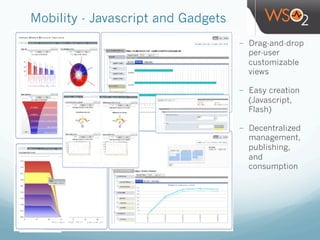
Mobility - Javascript and Gadgets
-  Drag-and-drop
per-user
customizable
views
-  Easy creation
(Javascript,
Flash)
-  Decentralized
management,
publishing,
and
consumption
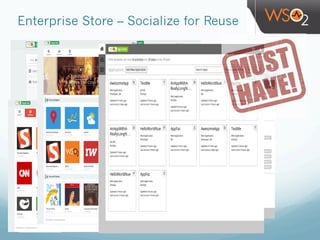
Enterprise Store – Socialize for Reuse
BigData
A big part of the new Platform
—  Information is knowledge (Google proves that)
—  You can create automation after the fact
—  Put automation in later instead of burdening real-
time processing
—  More agile
—  Learn about usage
—  Learn about your customers
—  Big Data Makes you look smart
—  Big Data gives you agility
BigData	
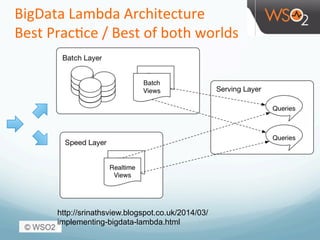
  Lambda	
  Architecture	
  
Best	
  Prac3ce	
  /	
  Best	
  of	
  both	
  worlds	
  
http://srinathsview.blogspot.co.uk/2014/03/
implementing-bigdata-lambda.html
PaaS is “aaS” for Services and Applications
Development (see blog below)
—  Low Initial Cost to Deploy
—  Incremental Cost as you use or develop more
—  Automated Deployment
—  Management Built-In
—  Best Practices baked in
—  Self-Service
—  Lifecycle Managed
—  Reuse
—  Resource Sharing
johnmathon.wordpress.com CloudRamblings – A simple guide to Cloud Computing
© WSO2 2014
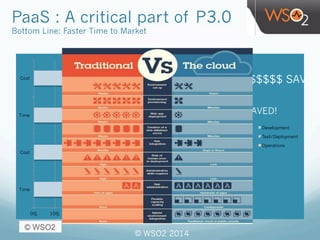
PaaS : A critical part of P3.0
Bottom Line: Faster Time to Market
Before - software
development is costly,
risky and slow process
—  Do tests on early versions of software to determine loads from customers
—  Plan demand expectation and hardware required
—  Acquire hardware and networking equipment for a time period including additional
hardware for failures and expected peak periods
—  Find space for hardware, plan network integration plan, rule changes in switches,
routers, update configuration management, outages for upgrades and changes
—  Test hardware and network with software to insure it works
—  Understand failure modes, when to scale, runbooks for different scenarios, train
people in operation and what to do in different scenarios. Write scripts to detect
scenarios and provide needed information in failures.
—  Write or acquire management tools, put in instrumentation in hardware.
—  Plan for upgrade strategies, outages and SLA measurements, backup policies.
—  Beta customers
—  Go Live
Now – cheaper, faster, less
risky
—  Choose IaaS vendor
—  Choose PaaS platform
—  Write some runbooks for different scenarios,
train people in PaaS operation
—  Deploy software
—  Beta customers
—  Go live
0% 10% 20% 30% 40% 50% 60% 70% 80% 90% 100%
Time
Cost
Time
Cost
Development
Test/Deployment
Operations
$$$$$$$$$$$$$$$$$$$$$$$ SAVED
SAVED!
Hybrid Capability is important
—  Change cloud vendors based on:
—  Security
—  Cost
—  Zone Coverage
—  Performance Problems
—  Vendor instability
—  Or any reason that may occur
—  Use Multiple Clouds
—  Have on premise hardware as well as public
—  Burst on demand
—  Run certain services in some clouds that perform better
—  Run some tenants in some regions on different clouds
—  Run production, test, demo, staging … in different clouds
Some Vendors claim Hybrid meaning: not different types of clouds. Seriously restricts choices
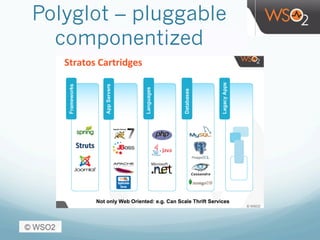
Polyglot – pluggable
componentized
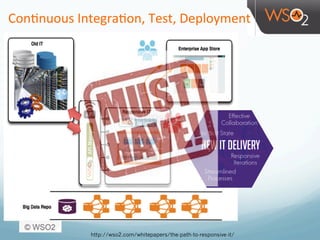
Con3nuous	
  Integra3on,	
  Test,	
  Deployment	
  
http://wso2.com/whitepapers/the-path-to-responsive-it/
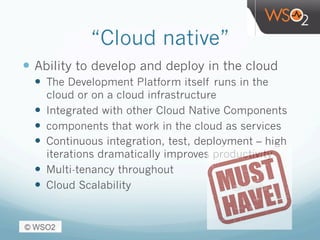
“Cloud native”
—  Ability to develop and deploy in the cloud
—  The Development Platform itself runs in the
cloud or on a cloud infrastructure
—  Integrated with other Cloud Native Components
—  components that work in the cloud as services
—  Continuous integration, test, deployment – high
iterations dramatically improves productivity
—  Multi-tenancy throughout
—  Cloud Scalability


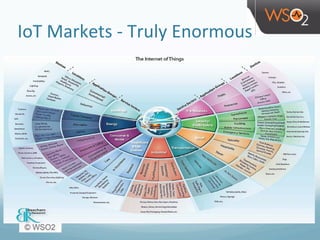
IoT
IoT	
  Markets	
  -­‐	
  Truly	
  Enormous	
  
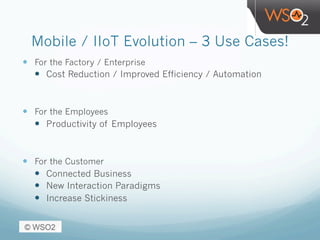
Mobile / IIoT Evolution – 3 Use Cases!
—  For the Factory / Enterprise
—  Cost Reduction / Improved Efficiency / Automation
—  For the Employees
—  Productivity of Employees
—  For the Customer
—  Connected Business
—  New Interaction Paradigms
—  Increase Stickiness
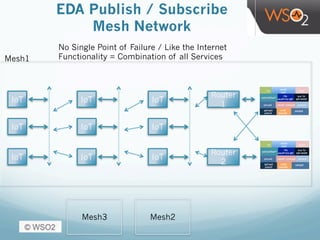
EDA Publish / Subscribe
Mesh Network
IoT
IoT
IoT
IoT
IoT
IoT
IoT
IoT
IoT
Router
1
Router
2
No Single Point of Failure / Like the Internet
Functionality = Combination of all ServicesMesh1
Mesh2Mesh3
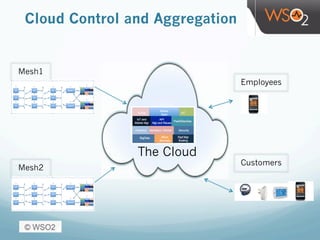
Cloud Control and Aggregation
Mesh1
The Cloud
Mesh2
Customers
Employees
UI
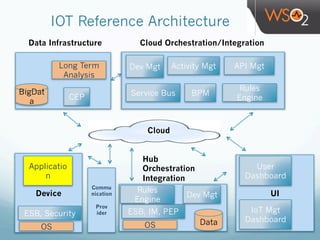
IOT Reference Architecture
Device
API MgtDev Mgt
Service Bus BPMBigDat
a
Long Term
Analysis
Activity Mgt
Cloud
CEP
Cloud Orchestration/Integration
Commu
nication
Prov
ider
OS
Applicatio
n
ESB, Security
OS
ESB, IM, PEP
Data Infrastructure
Hub
Orchestration
Integration
Rules
Engine
Data
Dev Mgt
Rules
Engine
User
Dashboard
IoT Mgt
Dashboard
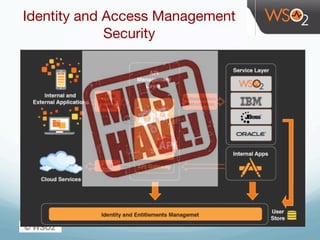
Identity and Access Management
Security
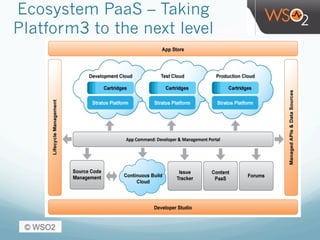
Ecosystem PaaS – Taking
Platform3 to the next level
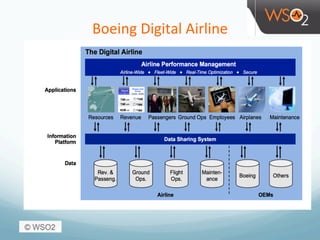
Boeing	
  Digital	
  Airline	
  
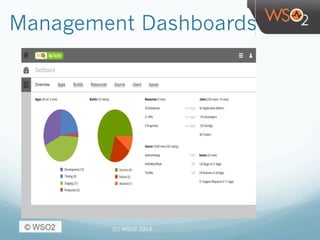
Management Dashboards
(C) WSO2 2014
This is the way you build
modern disruptive solutions
Connected Car
API Mgt
Dev
MgtCust Svc Service Bus
Design
BPM
BigDat
a
Long Term
Analysis
Activity Mgt
Service Bus
Polling LoggingEvents
Brake
sBrakes
BrakesBrakes
Console
Phone
Watch
3rd Party
App /
Device
3rd Party
App /
Device
3rd Party
App /
Device
Brakes
Hi
Priority
Planning
Lo
Priority Apps
Cell
Ven Cloud
CEP -
Service
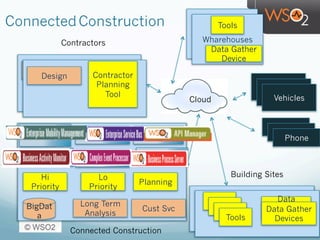
ConnectedConstruction
API MgtDev Mgt
Cust Svc
Service Bus
Design
BPM
BigDat
a
Long Term
Analysis
Activity Mgt
Phone
Vehicles
Tools
Hi
Priority
Planning
Lo
Priority
Cloud
CEP
Building Sites
Vehicles
Vehicles
Phone
Phone
Tools
Tools
Tools
Data
Gather
Device
Data Gather
Devices
Wharehouse
Wharehouses
Tools
Data Gather
Device
Contractors
Design Contractor
Planning
Tool
Connected Construction


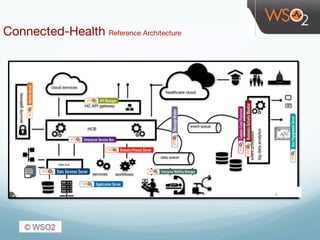
Connected-Health Reference Architecture
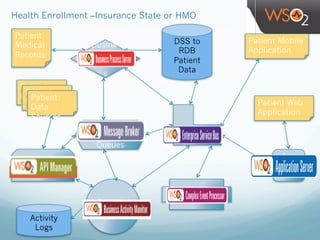
Health Enrollment –Insurance State or HMO
Mediation
/ESB
DSS to
RDB
Patient
Data
Patient Web
Application
Patient
Data
Sources
Message
Broker
Queues
Activity
Monitor
Activity
Logs
Complex Event
Processor
Patient Mobile
Application
Busine
ss
Proces
s
App
Serve
r
API
Management
Patient
Medical
Records
Patient
Data
Sources
Patient
Data
Sources
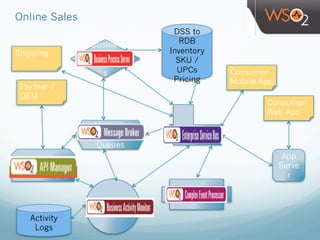
Online Sales
Mediation
/ESB
DSS to
RDB
Inventory
SKU /
UPCs
Pricing
Consumer
Web App
Partner /
OEM
Message
Broker
Queues
Activity
Monitor
Activity
Logs
Complex Event
Processor
Consumer
Mobile App
Busine
ss
Proces
s
App
Serve
r
Shipping
API
Management
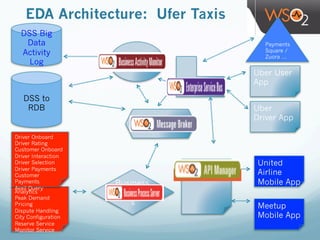
EDA Architecture: Ufer Taxis
Uber User
App
Uber
Driver App
Meetup
Mobile App
United
Airline
Mobile App
Mediation
/ESB
Business
Processe
s
DSS to
RDB
Message
Broker
Payments
Square /
Zuora …Activity
Monitor
DSS Big
Data
Activity
Log
API and
App Store
Analytics
Peak Demand
Pricing
Dispute Handling
City Configuration
Reserve Service
Monitor Service
Driver Onboard
Driver Rating
Customer Onboard
Driver Interaction
Driver Selection
Driver Payments
Customer
Payments
Avail Query
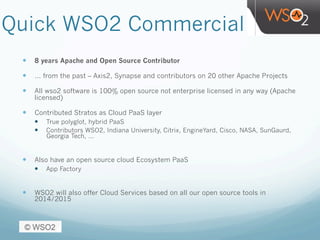
Quick WSO2 Commercial
—  8 years Apache and Open Source Contributor
—  … from the past – Axis2, Synapse and contributors on 20 other Apache Projects
—  All wso2 software is 100% open source not enterprise licensed in any way (Apache
licensed)
—  Contributed Stratos as Cloud PaaS layer
—  True polyglot, hybrid PaaS
—  Contributors WSO2, Indiana University, Citrix, EngineYard, Cisco, NASA, SunGaurd,
Georgia Tech, …
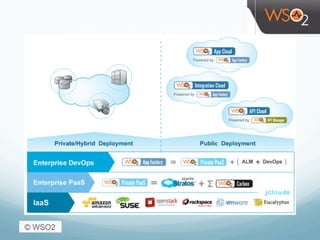
—  Also have an open source cloud Ecosystem PaaS
—  App Factory
—  WSO2 will also offer Cloud Services based on all our open source tools in
2014/2015
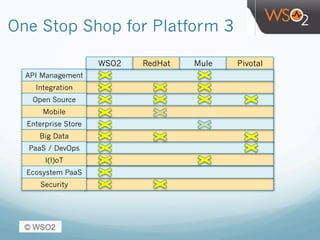
One Stop Shop for Platform 3
API Management
Integration
Open Source
Mobile
Enterprise Store
Big Data
PaaS / DevOps
I(I)oT
Ecosystem PaaS
Security
WSO2 RedHat Mule Pivotal
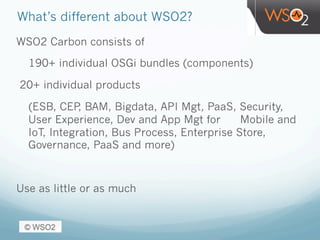
What’s different about WSO2?
WSO2 Carbon consists of
190+ individual OSGi bundles (components)
20+ individual products
(ESB, CEP, BAM, Bigdata, API Mgt, PaaS, Security,
User Experience, Dev and App Mgt for Mobile and
IoT, Integration, Bus Process, Enterprise Store,
Governance, PaaS and more)
Use as little or as much
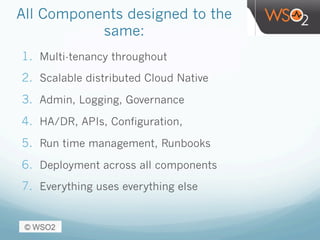
All Components designed to the
same:
1.  Multi-tenancy throughout
2.  Scalable distributed Cloud Native
3.  Admin, Logging, Governance
4.  HA/DR, APIs, Configuration,
5.  Run time management, Runbooks
6.  Deployment across all components
7.  Everything uses everything else
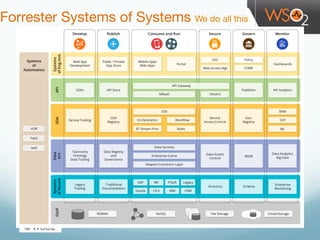
Forrester Systems of Systems We do all this 


More Information
—  John Mathon john@wso2.com
—  Twitter Feed: @john_mathon
—  Blog: johnmathon.wordpress.com
—  Cloud: wso2.com/cloud
—  Download: wso2.com
—  App Factory Signon: https://
cloudpreview.wso2.com/

Envisioning the Future Enterprise

  • 1.
    Envisioning the Future Enterprise Platformfor Mobile, Social, Big Data, Cloud, APIs, I(I)oT, Open Source By John Mathon WSO2, VP Enterprise Evangelism and Product Strategy
  • 2.
    About the Author — 10 patents, publish / subscribe, multipath low latency high reliability messaging, Content management in file systems, peer to peer messaging over WAN… others —  founder and CTO of TIBCO —  Twitter: @john_mathon —  Blog: CloudRamblings johnmathon.wordpress.com
  • 3.
    Productivity is 10-100x just7 years ago —  Massive improvements in Reuse —  Deployment – months -> hours —  5-20x reduction in cost Why? How?
  • 4.
    Platform 1 CentralizedComputing 60 years ago IBM Platform 2 40 years ago the first microcomputer Platform 2.5 Distributed Computing 20 years ago the internet Platform 3 The Cloud Cloud, IOT, API Management, PaaS, Mobile, Social, Open source, Big Data, SaaS, iPaaS, BaaS, …
  • 5.
    Platform 2 gaveus: —  delivery in year time-frames —  writing over and over the same software —  Low productivity development tools —  half the time spent in deployment —  Long iteration cycles
  • 6.
    Cloud Companies changed themodel —  Twitter, Google, Yahoo, Facebook, Netflix, —  Continuous frequent deployment —  open source development —  Map/reduce, hadoop, Kafka, Clojure, Ruby, Chaos Monkey, API Management —  Chef, Puppet, Cassandra, Mongodb, OpenStack, Wso2, Cloud Foundry, Scala, Spring, Rails, Docker, KVS, Phonegap, html5, firefox, chrome —  Unprecedented scale : The billion user club —  Google 3+ billion users, Facebook 1+Billion users, Yahoo 2+billion users, Twitter – billion messages/day, Ebay 5 billion transactions/day, Amazon cloud division growing at 136% annually
  • 7.
  • 8.
    Enterprise App Store APIManagement SaaS Adoption Executive Dashboards PaaS Mobile Apps Open Source Adoption SOA Cloud Adoption and Automation Federated Identity Social Networking Mobile BYOD Big Data and Analytics
  • 9.
    Connected is thenew Paradigm —  Connected Car —  Connected Business —  Internally all its employees and services —  Externally to partners and customers —  Connected Health —  Connected Airlines —  Connected Logistics —  ….
  • 10.
    Key Elements of Platform3 —  Cloud native multi-tenancy —  Open Source —  APIs —  Mobile —  Social API, App, Web Store —  Bigdata —  Event Driven Architecture publish/subscribe IoT —  PaaS/Devops Containers, PaaS —  Continuous testing, integration, deployment —  Automated scalability —  New security protocols —  Internet of Things Gartner defines: social interaction, mobility, cloud, and information IDC: 3rd Platform for IT growth and innovation, built on mobile devices, cloud services, social technologies, and big data Wikipedia:  mobile computing, social media,cloud computing, and big data. The Internet of Things is sometimes included.
  • 11.
    The Future Enterprise- Virtualized —  Virtualized Hardware – on demand like utility —  Virtualized Services —  APP, API, Device Management
  • 12.
    Platform 3 “How doyou build automation between users and applications in a connected Social IoT Mobile world?” Social IoT Mobile Apps IoT and Mobile Mgt API Mgt and Reuse BigData Mediation / Broker Micro Services Analytics PaaS/DevOps Security Perf Mgt Scaling
  • 13.
    Glue for NEWand OLD technology Cassandra/ Hbase/ Mongo Social API/ App Store API Management IoT
  • 14.
    Enterprise Refactoring Step 1 — Take existing applications and services and break them into APIs that can be consumed easily Partners Apps and Services Customer Apps and Services
  • 15.
    First Step toPlatform 3 API Management —  Scalable API Delivery —  API socialization and reuse —  Lifecycle management —  Usage Monitoring and Throttling —  Security —  External and/or internal services managed
  • 16.
    Reuse pandemic —  100billion API calls/minute in the cloud says it all —  APIs (microServices) are the new center of reuse —  Apps use dozens of external services for —  Payment, social, storage, AI, GPS, Locations, —  Things, financial, logistics, lookups, —  No interesting app without APIs
  • 17.
    Network Effect APIsExponentially Increasing Intelligence and Value Route Planning Voice and SMS Services Ratings Social Services Game Engines Relationship Services Payment Services Geo-GPS Services Location Services Deep Learning AI Services Data and BigData Services iPaaS , PaaS Calenda r Services IoT Integratio n Financial Services Security Services Logging Services Analytic Services Content Services Government Svcs News ServicesSensors
  • 18.
    Enterprise Refactoring Benefits —  NewRevenue sources —  New Customers and Partners —  New Products, Applications and Services —  Faster time to Market —  Increased Innovation —  Cost Reductions
  • 19.
    Network Effect –Increasing Devices, Services Exponentially Increasing Value Smartphone1 In a car Smartphone2 In a restaurant Waze Uber Yelp Medical Monitor Service Smartphone4 On the street Smartphone3 In a taxi Tesla Glucose Monitor Drone GPS Emergency Vehicle Searc h
  • 20.
    Open Source Black DuckSurvey —  2014 80% of respondents say code quality vs proprietary why they chose open source software —  In 2007 80% rank cost as primary driver —  2014 80% said access to source code important —  2014 OSS Attracts and retains talent —  Open Source projects doubling every 15 months —  Companies are realizing Proprietary Enterprise License companies are not necessarily aligned with your interests —  Product Lifecycle tied to License Fees —  Not amenable to open source projects (many of which are critical) —  big upfront commitments not consistent with ‘aaS’ models —  Not on the leading edge anymore
  • 21.
    Open Source isthe driver behind: —  IaaS: Linux, Ubuntu, Suse, KVM, Docker, OpenStack, CloudStack —  Agile Development: Eclipse, CodeEnvy, Java —  Build: Maven, Jenkins —  Data: Hadoop, Cassandra, Pentaho, MySql, Storm, WSO2 Lambda —  Integration: WSO2, Redhat, Mule, Kafka —  PaaS/DevOps: Apache Stratos, Cloud Foundry, Chef, Puppet, Open Shift, Docker, Kubernetes —  APIs : WSO2, Mule —  Mobile: Android, Titanium, PhoneGap, node.js, Mesh, WSO2 EMM —  IoT (Internet of Things): Z wave, Arduino, CoAp, OpenMote, MQTT, Thread, —  Social: OpenSocial, wordpress, Jamroom, Anahita, Elgg, Buddypress, Diaspora, WSO2 Enterprise Store
  • 22.
    Mobile  allows  Increasing  Business   Innova3on  By  Enabling  the  Long  Tail  
  • 23.
    Mobility - Javascriptand Gadgets -  Drag-and-drop per-user customizable views -  Easy creation (Javascript, Flash) -  Decentralized management, publishing, and consumption
  • 24.
    Enterprise Store –Socialize for Reuse
  • 25.
    BigData A big partof the new Platform —  Information is knowledge (Google proves that) —  You can create automation after the fact —  Put automation in later instead of burdening real- time processing —  More agile —  Learn about usage —  Learn about your customers —  Big Data Makes you look smart —  Big Data gives you agility
  • 26.
    BigData  Lambda  Architecture   Best  Prac3ce  /  Best  of  both  worlds   http://srinathsview.blogspot.co.uk/2014/03/ implementing-bigdata-lambda.html
  • 27.
    PaaS is “aaS”for Services and Applications Development (see blog below) —  Low Initial Cost to Deploy —  Incremental Cost as you use or develop more —  Automated Deployment —  Management Built-In —  Best Practices baked in —  Self-Service —  Lifecycle Managed —  Reuse —  Resource Sharing johnmathon.wordpress.com CloudRamblings – A simple guide to Cloud Computing
  • 28.
    © WSO2 2014 PaaS: A critical part of P3.0 Bottom Line: Faster Time to Market Before - software development is costly, risky and slow process —  Do tests on early versions of software to determine loads from customers —  Plan demand expectation and hardware required —  Acquire hardware and networking equipment for a time period including additional hardware for failures and expected peak periods —  Find space for hardware, plan network integration plan, rule changes in switches, routers, update configuration management, outages for upgrades and changes —  Test hardware and network with software to insure it works —  Understand failure modes, when to scale, runbooks for different scenarios, train people in operation and what to do in different scenarios. Write scripts to detect scenarios and provide needed information in failures. —  Write or acquire management tools, put in instrumentation in hardware. —  Plan for upgrade strategies, outages and SLA measurements, backup policies. —  Beta customers —  Go Live Now – cheaper, faster, less risky —  Choose IaaS vendor —  Choose PaaS platform —  Write some runbooks for different scenarios, train people in PaaS operation —  Deploy software —  Beta customers —  Go live 0% 10% 20% 30% 40% 50% 60% 70% 80% 90% 100% Time Cost Time Cost Development Test/Deployment Operations $$$$$$$$$$$$$$$$$$$$$$$ SAVED SAVED!
  • 29.
    Hybrid Capability isimportant —  Change cloud vendors based on: —  Security —  Cost —  Zone Coverage —  Performance Problems —  Vendor instability —  Or any reason that may occur —  Use Multiple Clouds —  Have on premise hardware as well as public —  Burst on demand —  Run certain services in some clouds that perform better —  Run some tenants in some regions on different clouds —  Run production, test, demo, staging … in different clouds Some Vendors claim Hybrid meaning: not different types of clouds. Seriously restricts choices
  • 30.
  • 31.
    Con3nuous  Integra3on,  Test,  Deployment   http://wso2.com/whitepapers/the-path-to-responsive-it/
  • 32.
    “Cloud native” —  Abilityto develop and deploy in the cloud —  The Development Platform itself runs in the cloud or on a cloud infrastructure —  Integrated with other Cloud Native Components —  components that work in the cloud as services —  Continuous integration, test, deployment – high iterations dramatically improves productivity —  Multi-tenancy throughout —  Cloud Scalability
  • 33.
  • 34.
  • 35.
    IoT  Markets  -­‐  Truly  Enormous  
  • 36.
    Mobile / IIoTEvolution – 3 Use Cases! —  For the Factory / Enterprise —  Cost Reduction / Improved Efficiency / Automation —  For the Employees —  Productivity of Employees —  For the Customer —  Connected Business —  New Interaction Paradigms —  Increase Stickiness
  • 37.
    EDA Publish /Subscribe Mesh Network IoT IoT IoT IoT IoT IoT IoT IoT IoT Router 1 Router 2 No Single Point of Failure / Like the Internet Functionality = Combination of all ServicesMesh1 Mesh2Mesh3
  • 38.
    Cloud Control andAggregation Mesh1 The Cloud Mesh2 Customers Employees
  • 39.
    UI IOT Reference Architecture Device APIMgtDev Mgt Service Bus BPMBigDat a Long Term Analysis Activity Mgt Cloud CEP Cloud Orchestration/Integration Commu nication Prov ider OS Applicatio n ESB, Security OS ESB, IM, PEP Data Infrastructure Hub Orchestration Integration Rules Engine Data Dev Mgt Rules Engine User Dashboard IoT Mgt Dashboard
  • 40.
    Identity and AccessManagement Security
  • 41.
    Ecosystem PaaS –Taking Platform3 to the next level
  • 42.
  • 43.
  • 44.
    This is theway you build modern disruptive solutions
  • 45.
    Connected Car API Mgt Dev MgtCustSvc Service Bus Design BPM BigDat a Long Term Analysis Activity Mgt Service Bus Polling LoggingEvents Brake sBrakes BrakesBrakes Console Phone Watch 3rd Party App / Device 3rd Party App / Device 3rd Party App / Device Brakes Hi Priority Planning Lo Priority Apps Cell Ven Cloud CEP - Service
  • 46.
    ConnectedConstruction API MgtDev Mgt CustSvc Service Bus Design BPM BigDat a Long Term Analysis Activity Mgt Phone Vehicles Tools Hi Priority Planning Lo Priority Cloud CEP Building Sites Vehicles Vehicles Phone Phone Tools Tools Tools Data Gather Device Data Gather Devices Wharehouse Wharehouses Tools Data Gather Device Contractors Design Contractor Planning Tool Connected Construction
  • 47.
  • 48.
    Health Enrollment –InsuranceState or HMO Mediation /ESB DSS to RDB Patient Data Patient Web Application Patient Data Sources Message Broker Queues Activity Monitor Activity Logs Complex Event Processor Patient Mobile Application Busine ss Proces s App Serve r API Management Patient Medical Records Patient Data Sources Patient Data Sources
  • 49.
    Online Sales Mediation /ESB DSS to RDB Inventory SKU/ UPCs Pricing Consumer Web App Partner / OEM Message Broker Queues Activity Monitor Activity Logs Complex Event Processor Consumer Mobile App Busine ss Proces s App Serve r Shipping API Management
  • 50.
    EDA Architecture: UferTaxis Uber User App Uber Driver App Meetup Mobile App United Airline Mobile App Mediation /ESB Business Processe s DSS to RDB Message Broker Payments Square / Zuora …Activity Monitor DSS Big Data Activity Log API and App Store Analytics Peak Demand Pricing Dispute Handling City Configuration Reserve Service Monitor Service Driver Onboard Driver Rating Customer Onboard Driver Interaction Driver Selection Driver Payments Customer Payments Avail Query
  • 51.
    Quick WSO2 Commercial — 8 years Apache and Open Source Contributor —  … from the past – Axis2, Synapse and contributors on 20 other Apache Projects —  All wso2 software is 100% open source not enterprise licensed in any way (Apache licensed) —  Contributed Stratos as Cloud PaaS layer —  True polyglot, hybrid PaaS —  Contributors WSO2, Indiana University, Citrix, EngineYard, Cisco, NASA, SunGaurd, Georgia Tech, … —  Also have an open source cloud Ecosystem PaaS —  App Factory —  WSO2 will also offer Cloud Services based on all our open source tools in 2014/2015
  • 52.
    One Stop Shopfor Platform 3 API Management Integration Open Source Mobile Enterprise Store Big Data PaaS / DevOps I(I)oT Ecosystem PaaS Security WSO2 RedHat Mule Pivotal
  • 53.
    What’s different aboutWSO2? WSO2 Carbon consists of 190+ individual OSGi bundles (components) 20+ individual products (ESB, CEP, BAM, Bigdata, API Mgt, PaaS, Security, User Experience, Dev and App Mgt for Mobile and IoT, Integration, Bus Process, Enterprise Store, Governance, PaaS and more) Use as little or as much
  • 54.
    All Components designedto the same: 1.  Multi-tenancy throughout 2.  Scalable distributed Cloud Native 3.  Admin, Logging, Governance 4.  HA/DR, APIs, Configuration, 5.  Run time management, Runbooks 6.  Deployment across all components 7.  Everything uses everything else
  • 55.
    Forrester Systems ofSystems We do all this 

  • 56.
    More Information —  JohnMathon john@wso2.com —  Twitter Feed: @john_mathon —  Blog: johnmathon.wordpress.com —  Cloud: wso2.com/cloud —  Download: wso2.com —  App Factory Signon: https:// cloudpreview.wso2.com/