API Introductie
De API-Koning, SETUP Utrecht, 12 April 2012
                    ,


                                              Anne Helmond

                                   www.digitalmethods.net
API introduction


An application programming interface (API) is a source
code based specification intended to be used as an
interface by software components to communicate with
each other. An API may include specifications for
routines, data structures,object classes, and variables.
(Wikipedia)
API


Application Programming Interface

“this refers to a set of tools that developers can use to
access structured data.” (boyd and Crawford)

“Machine-facing interfaces for your application”   p. 331


“software interface to your website”   p. 332


“weaving the Guardian into the fabric of the Web”    p. 331
Web API / web service

When used in the context of web development, an API
is typically a defined set of Hypertext Transfer Protocol
(HTTP) request messages, along with a definition of the
structure of response messages, which is usually in an
Extensible Markup Language (XML) or JavaScript Object
Notation (JSON) format. While "Web API" is virtually a
synonym for web service, the recent trend (so-called
Web 2.0) has been moving away from Simple Object
Access Protocol (SOAP) based services towards more
direct Representational State Transfer (REST) style
communications.[5] Web APIs allow the combination of
multiple services into new applications known as
mashups.[6] - (Wikipedia)
The web as platform


Historically, some types of software like desktop
operating systems have been called 'platforms' because
through their APIs they provide the foundation on which
other programs are built. The phrase 'web as platform'
refers to fact that as web sites start providing their own
APIs, they too are becoming a platform on which other
programs can be built. (Programmableweb)
Programmable web


Definitionally, a “platform” is a system that can be
reprogrammed and therefore customized by outside
developers—users—and in that way, adapted to
countless needs and niches that the platform’s original
developers could not have possibly contemplated, much
less had time to accommodate.

[T]he key term in the definition of platform is
‘programmed’. If you can program it, then it’s a
platform. If you can’t, then it’s not. - Marc Andreessen
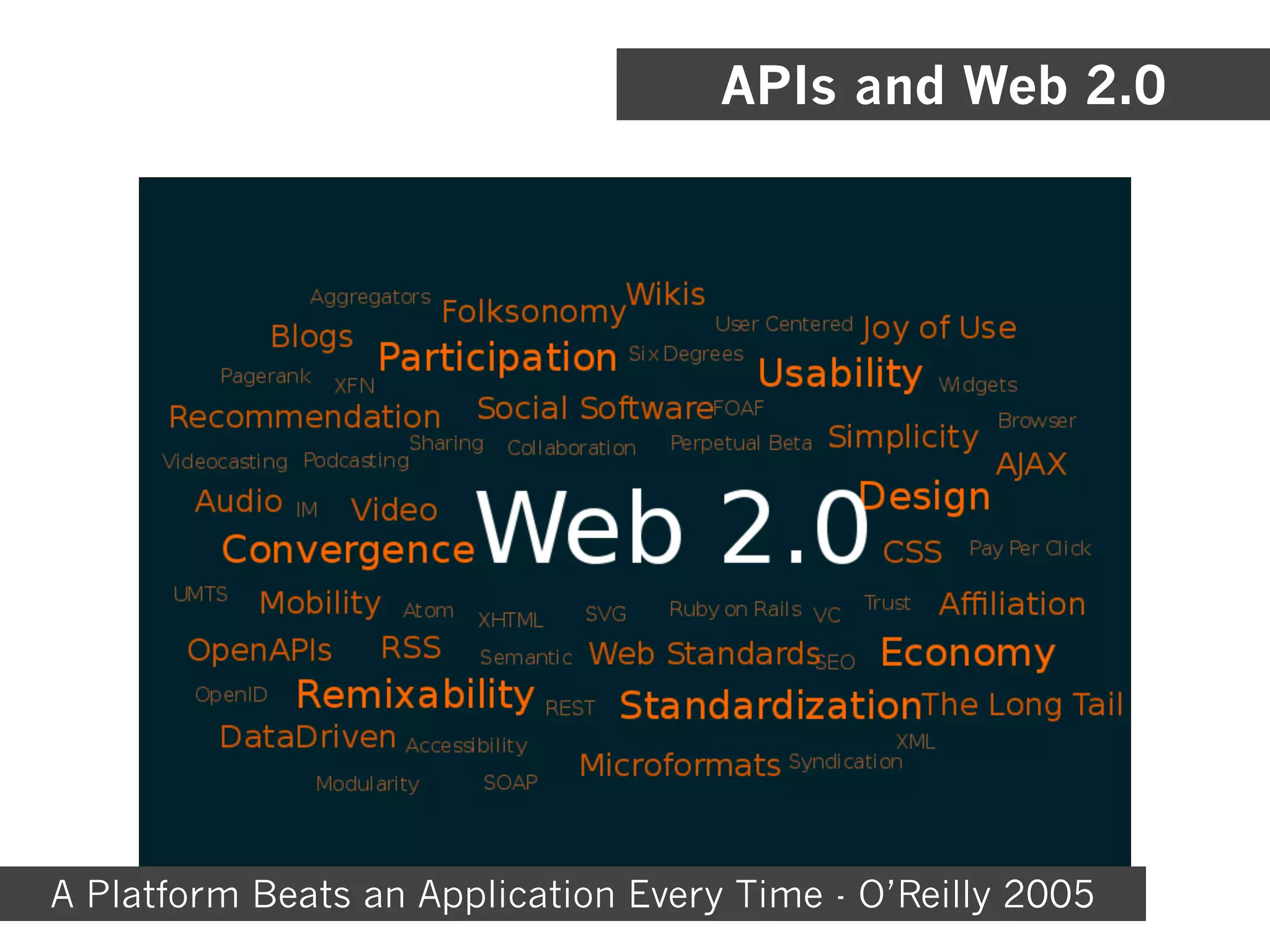
APIs and Web 2.0


A Platform Beats an Application Every Time - O’Reilly 2005
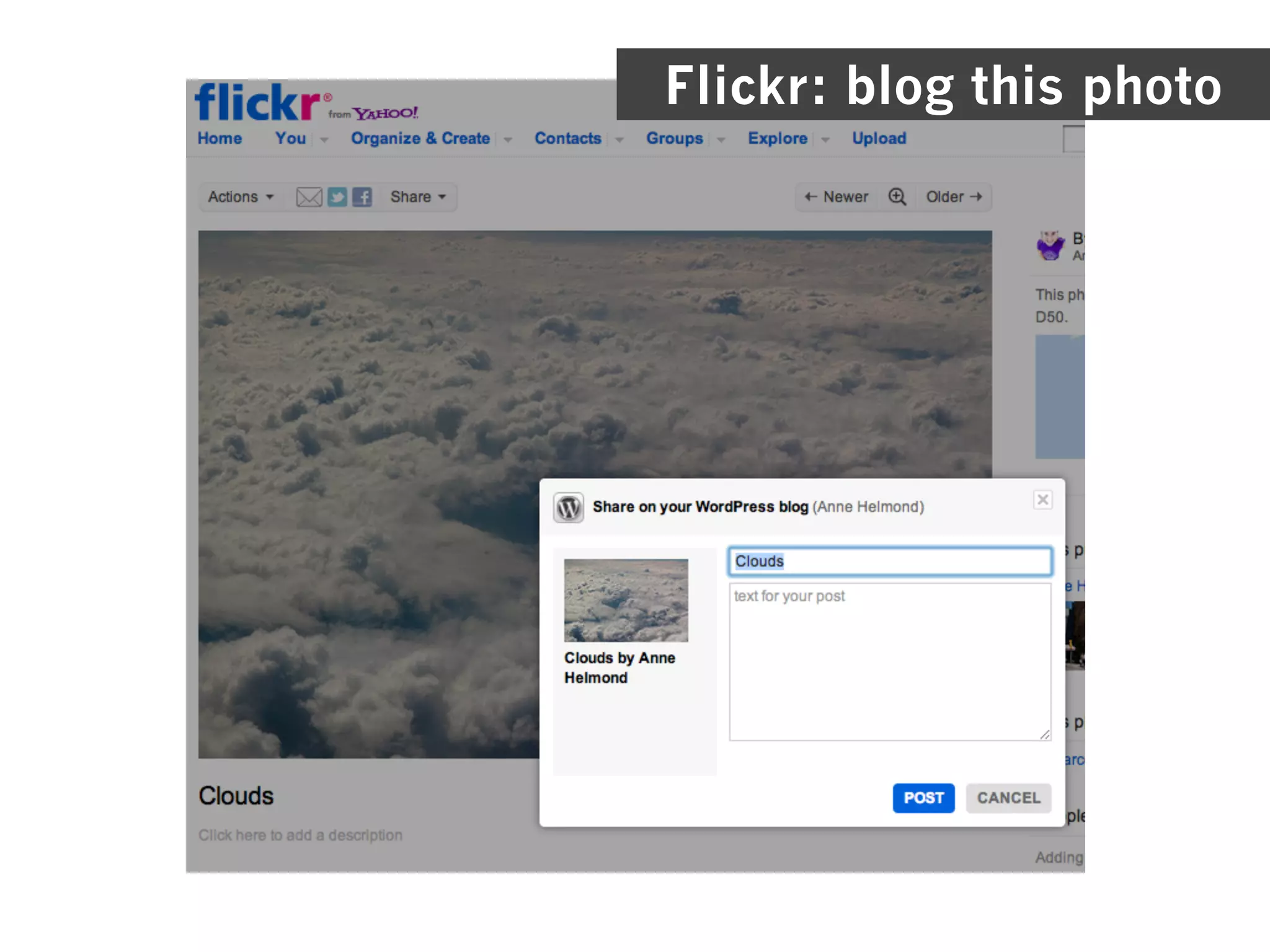
Flickr: blog this photo
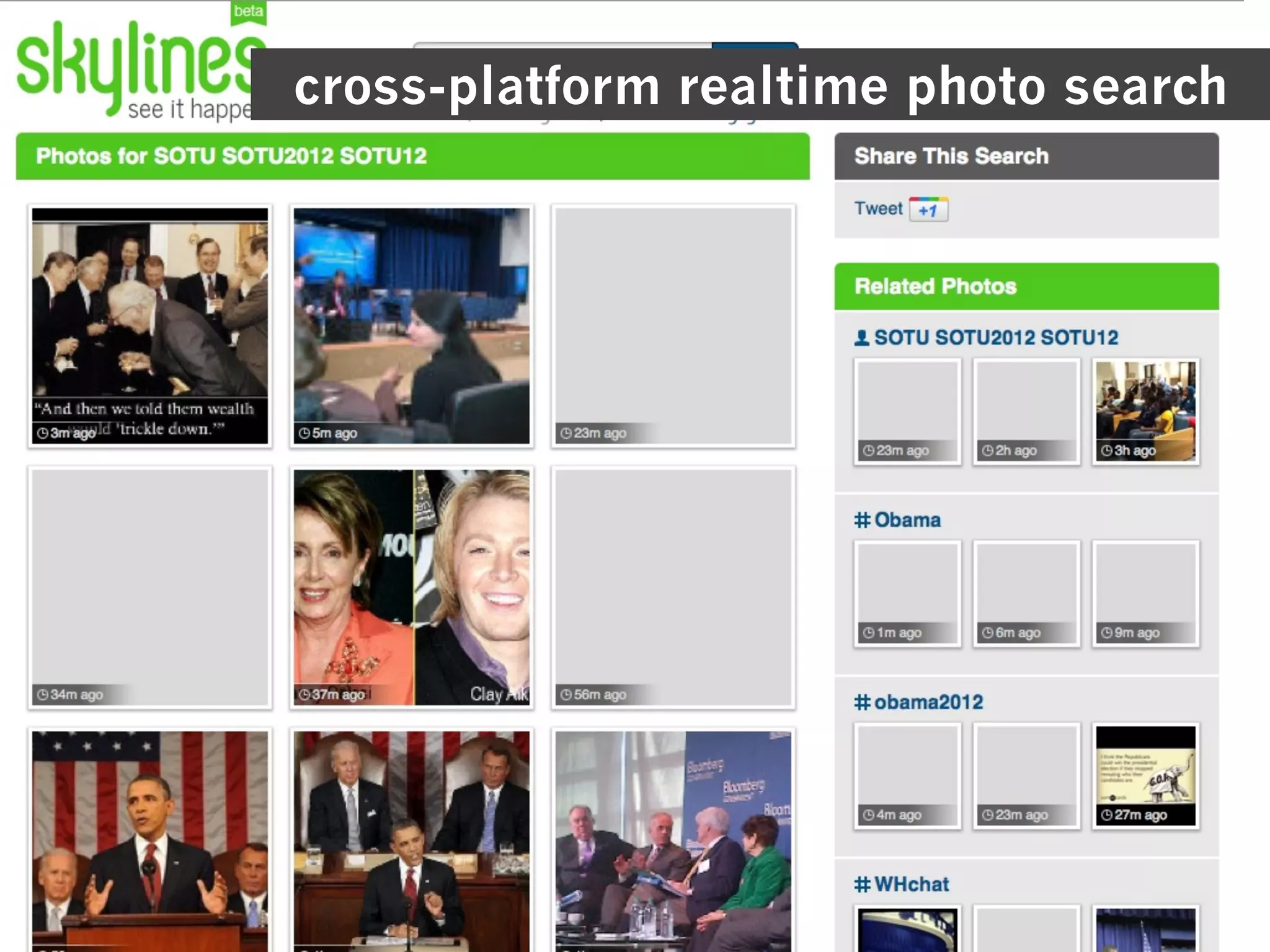
cross-platform realtime photo search
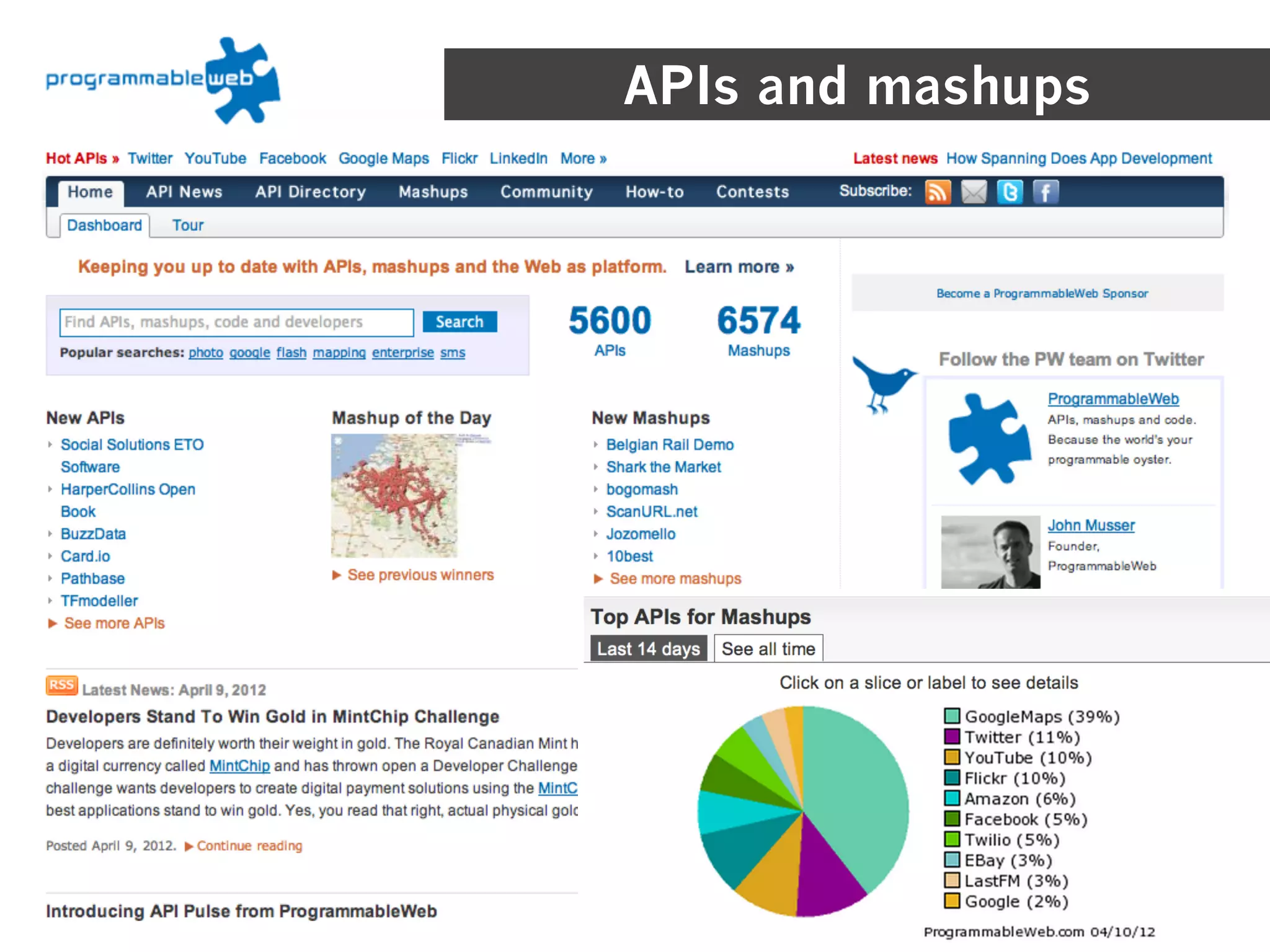
APIs and mashups
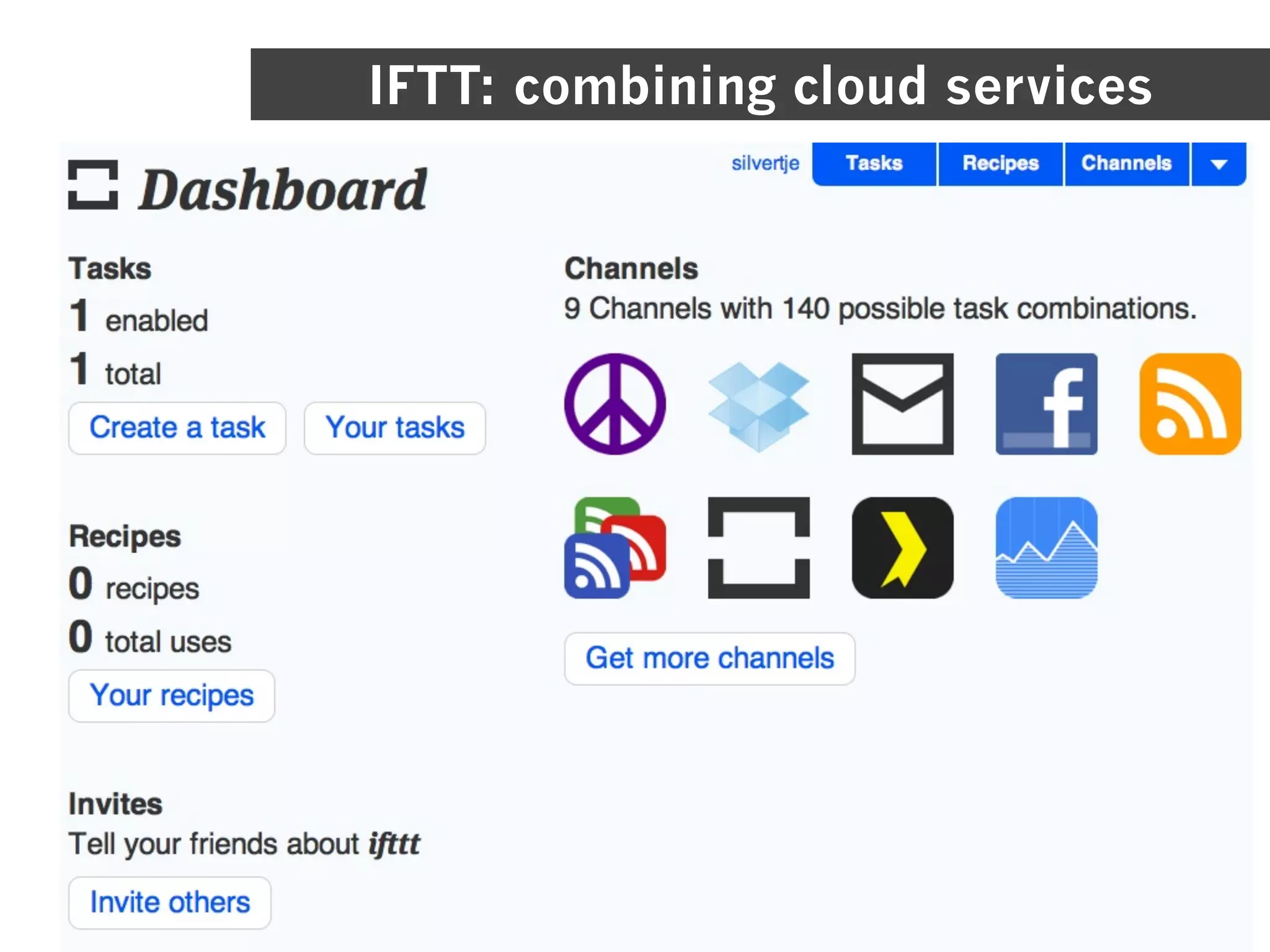
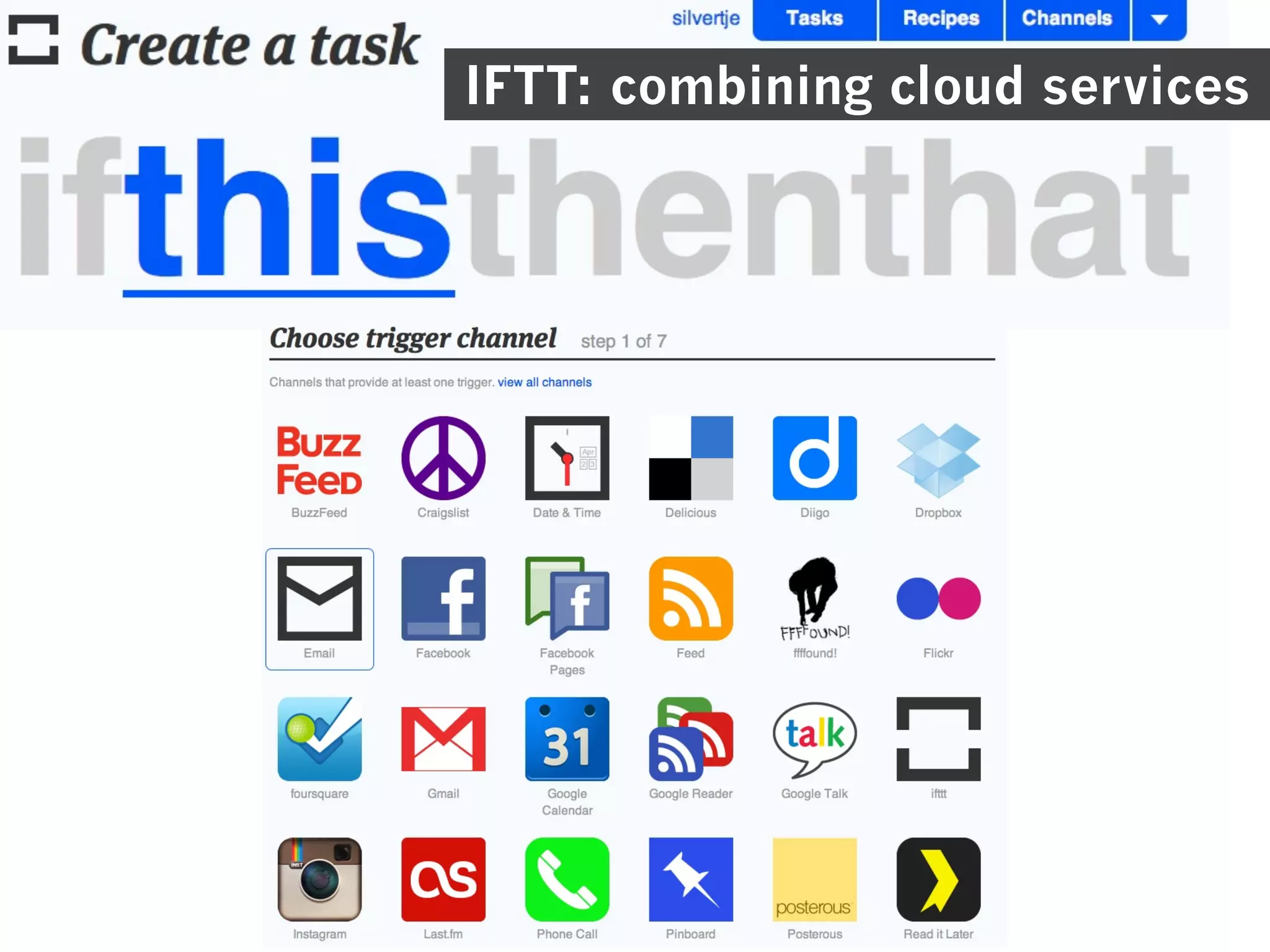
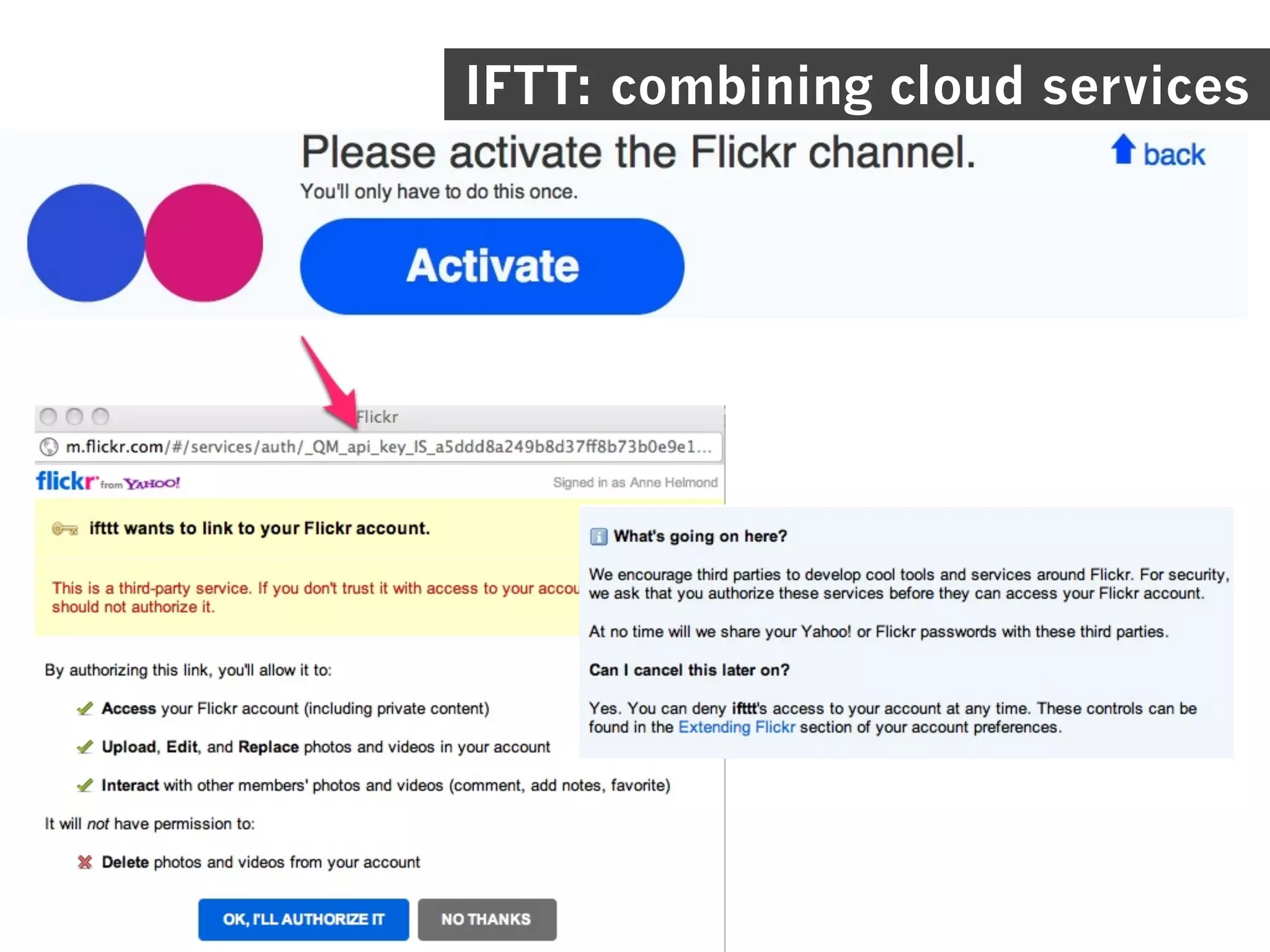
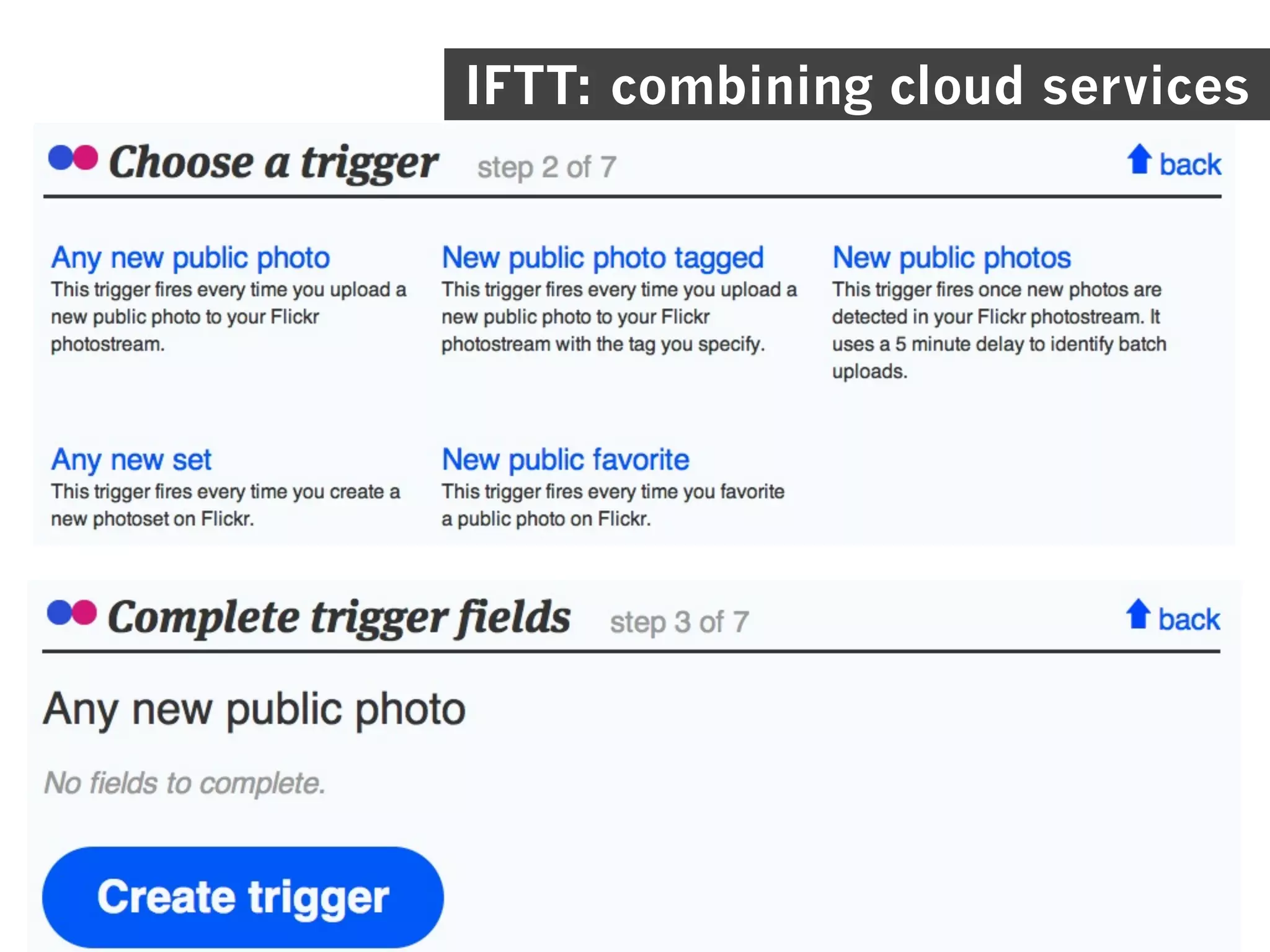
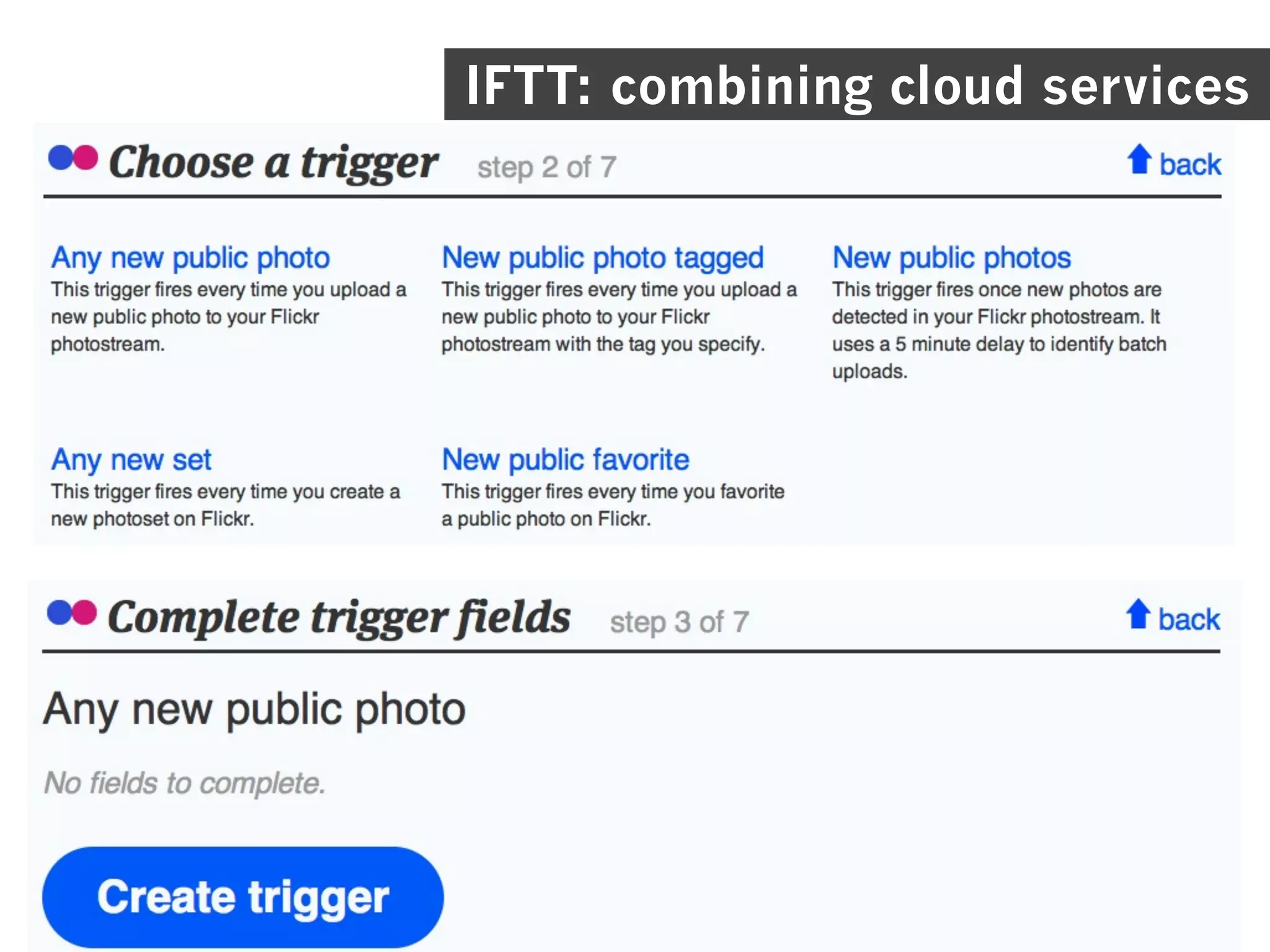
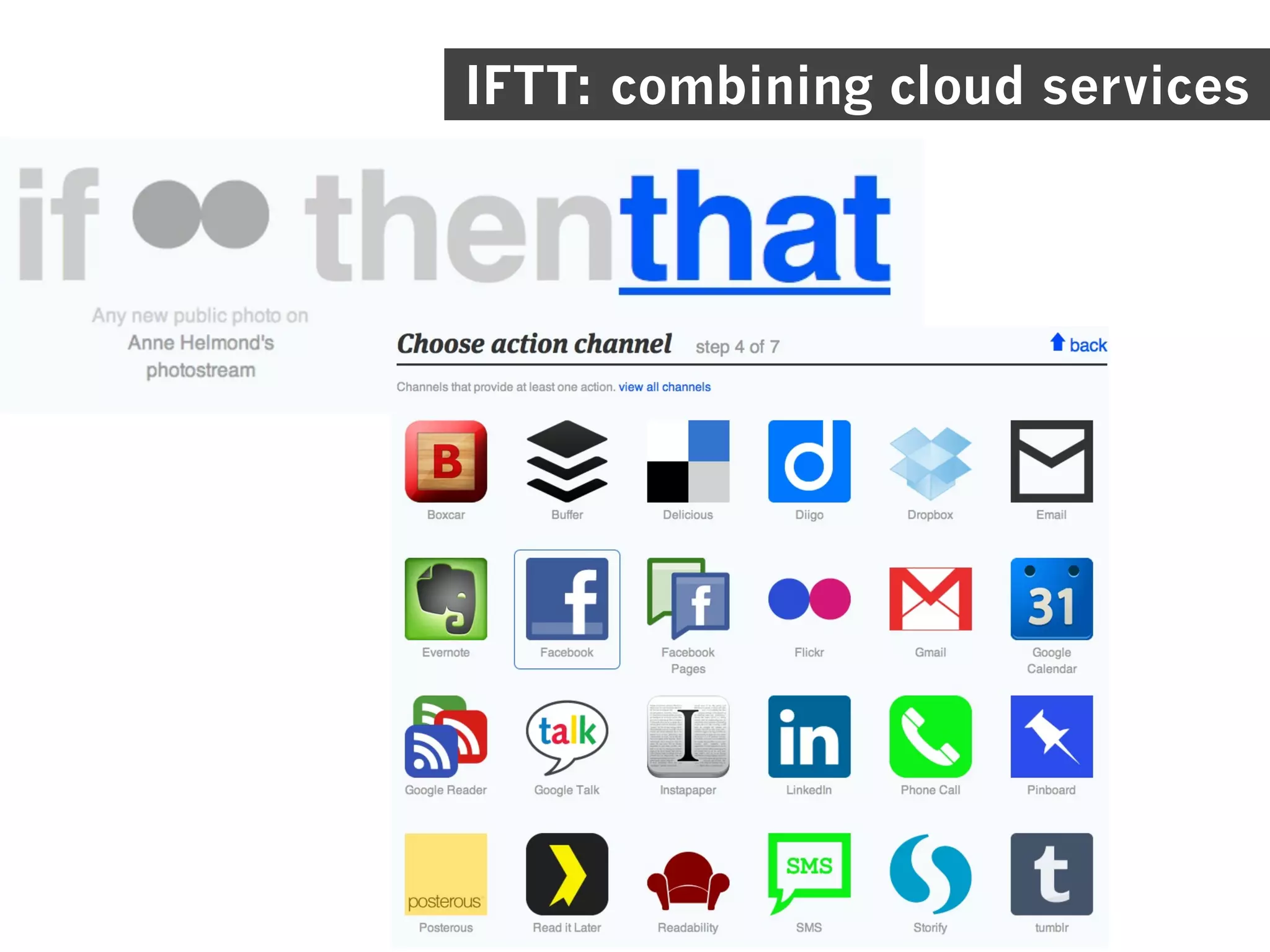
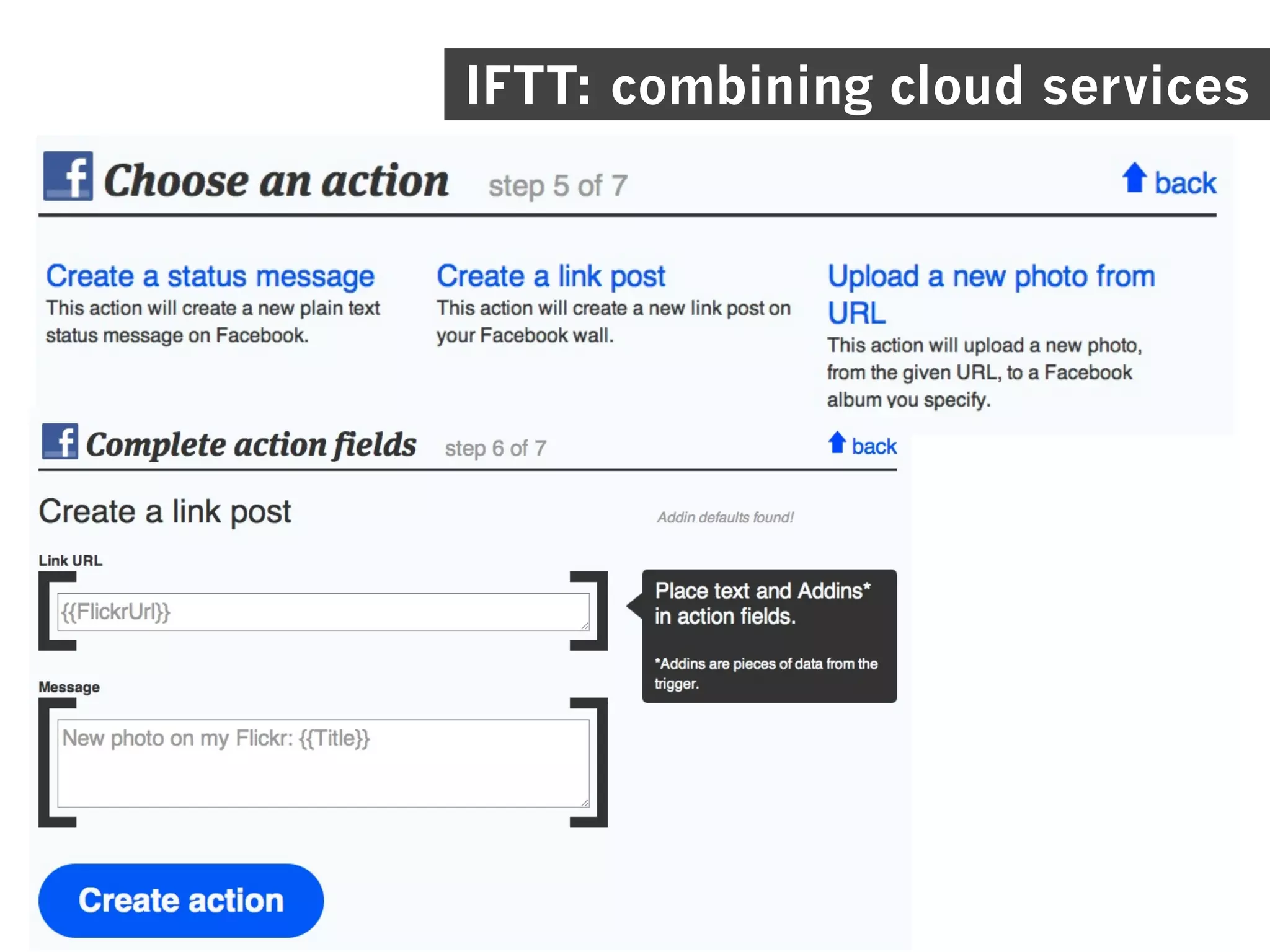
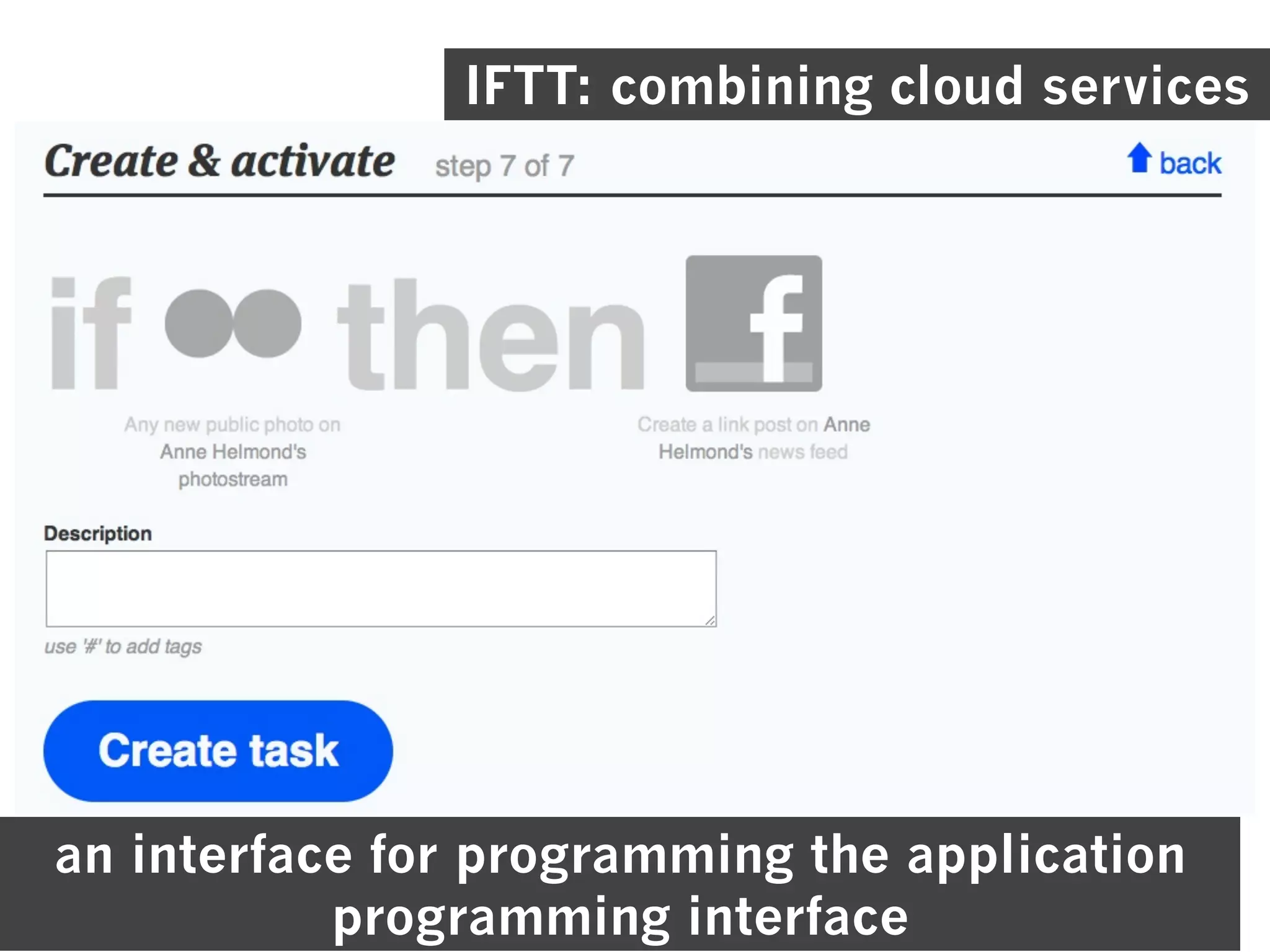
IFTT: combining cloud services


an interface for programming the application
           programming interface
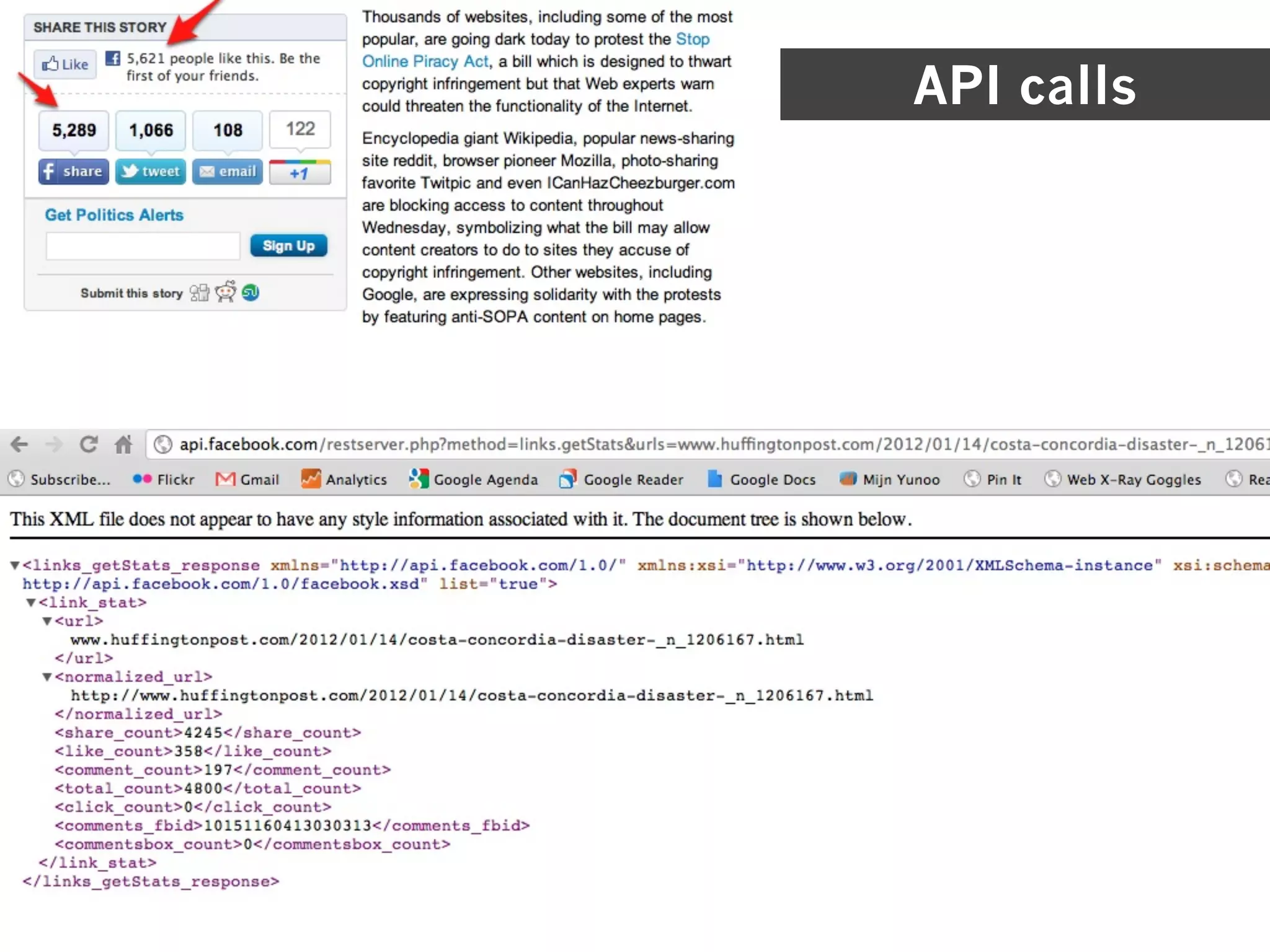
API calls
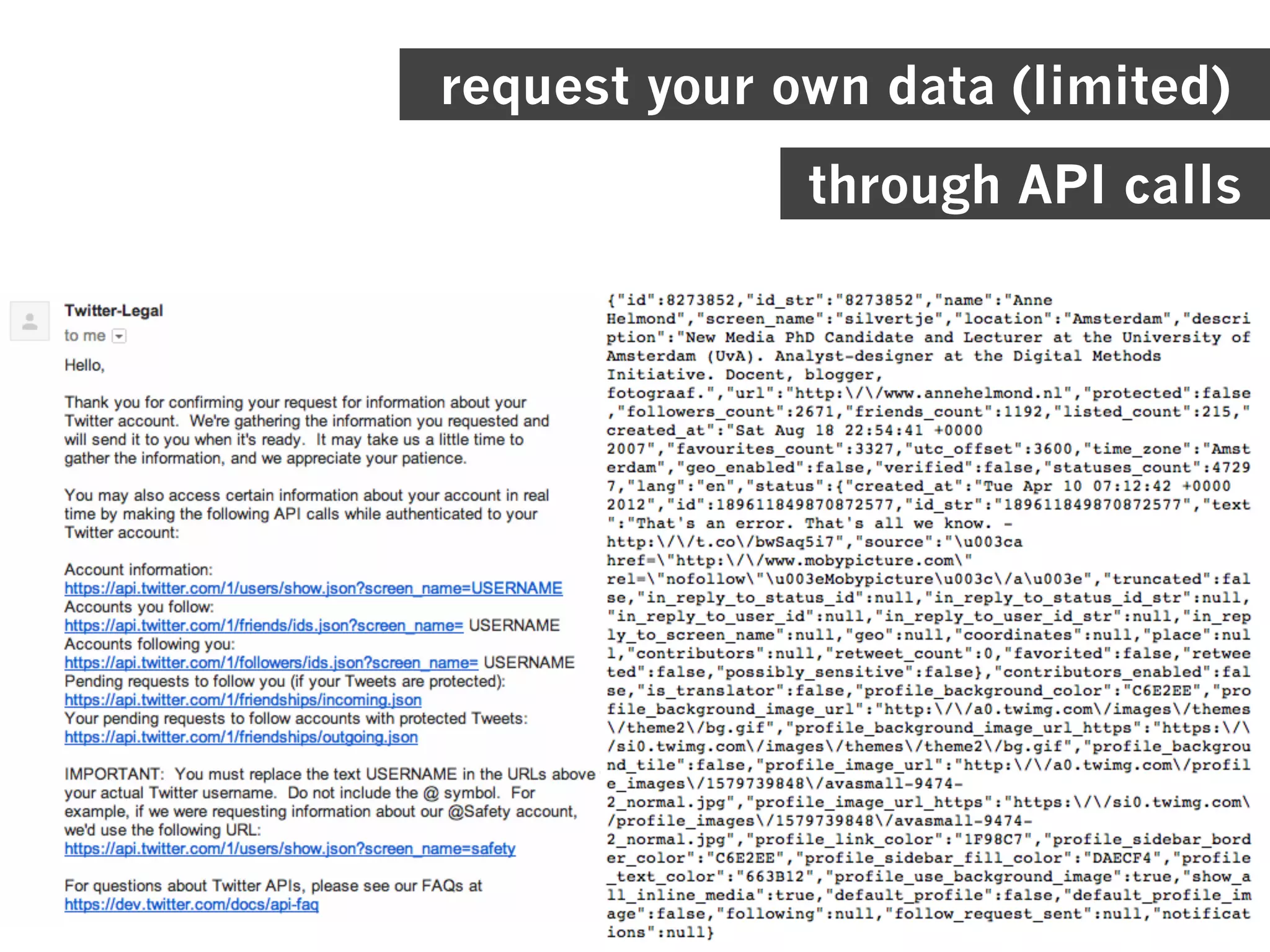
request your own data (limited)
              through API calls
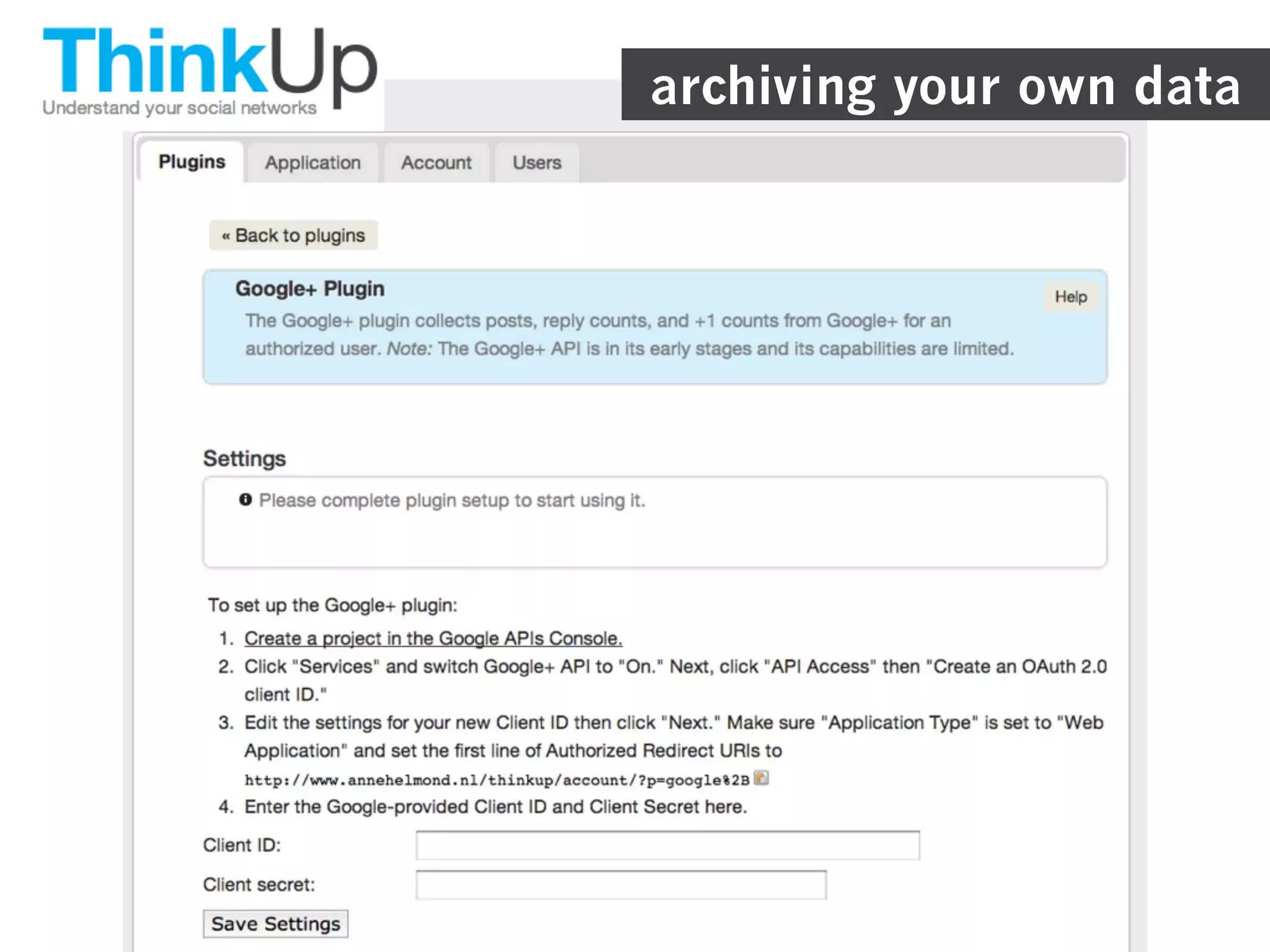
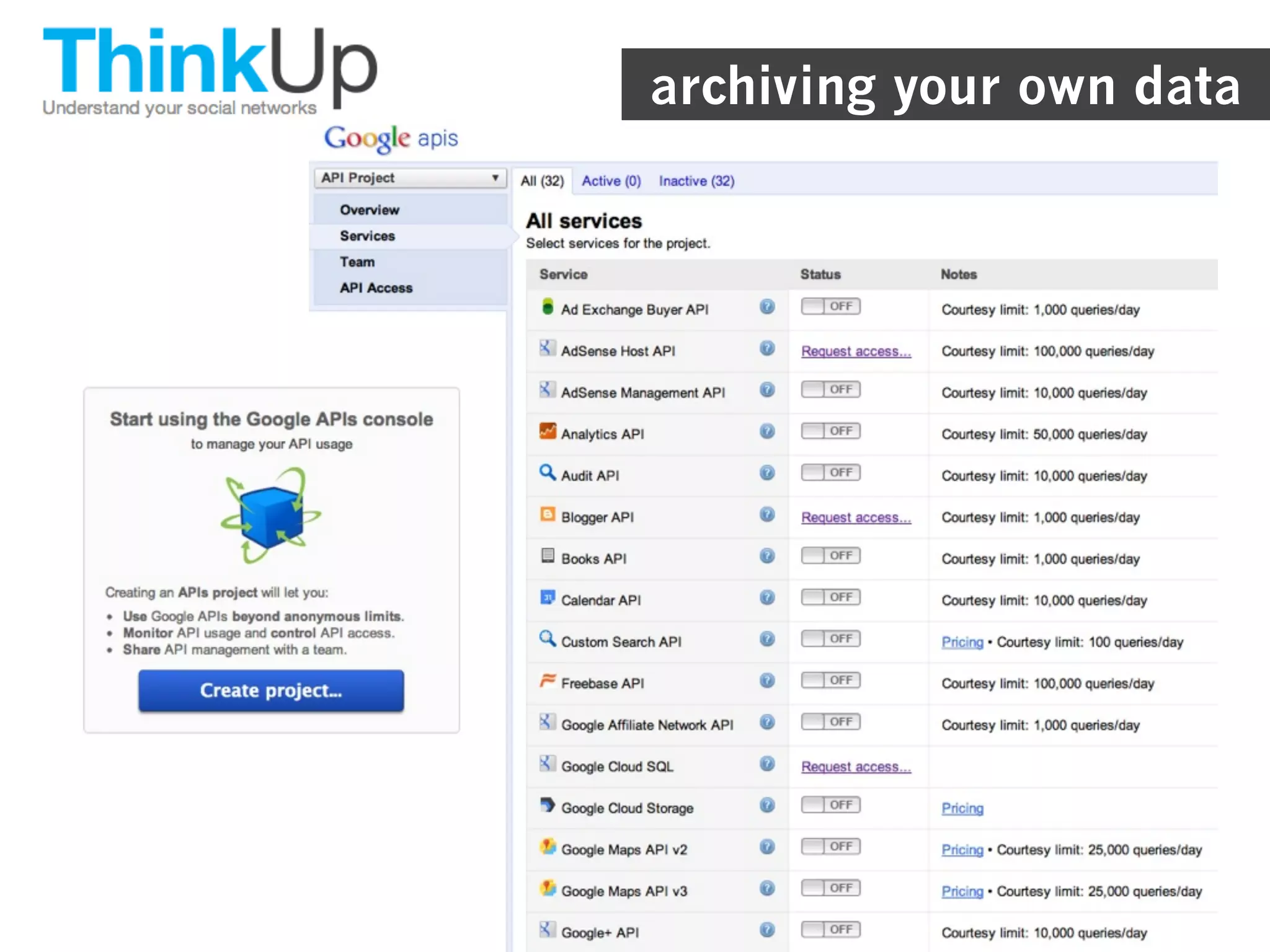
archiving your own data
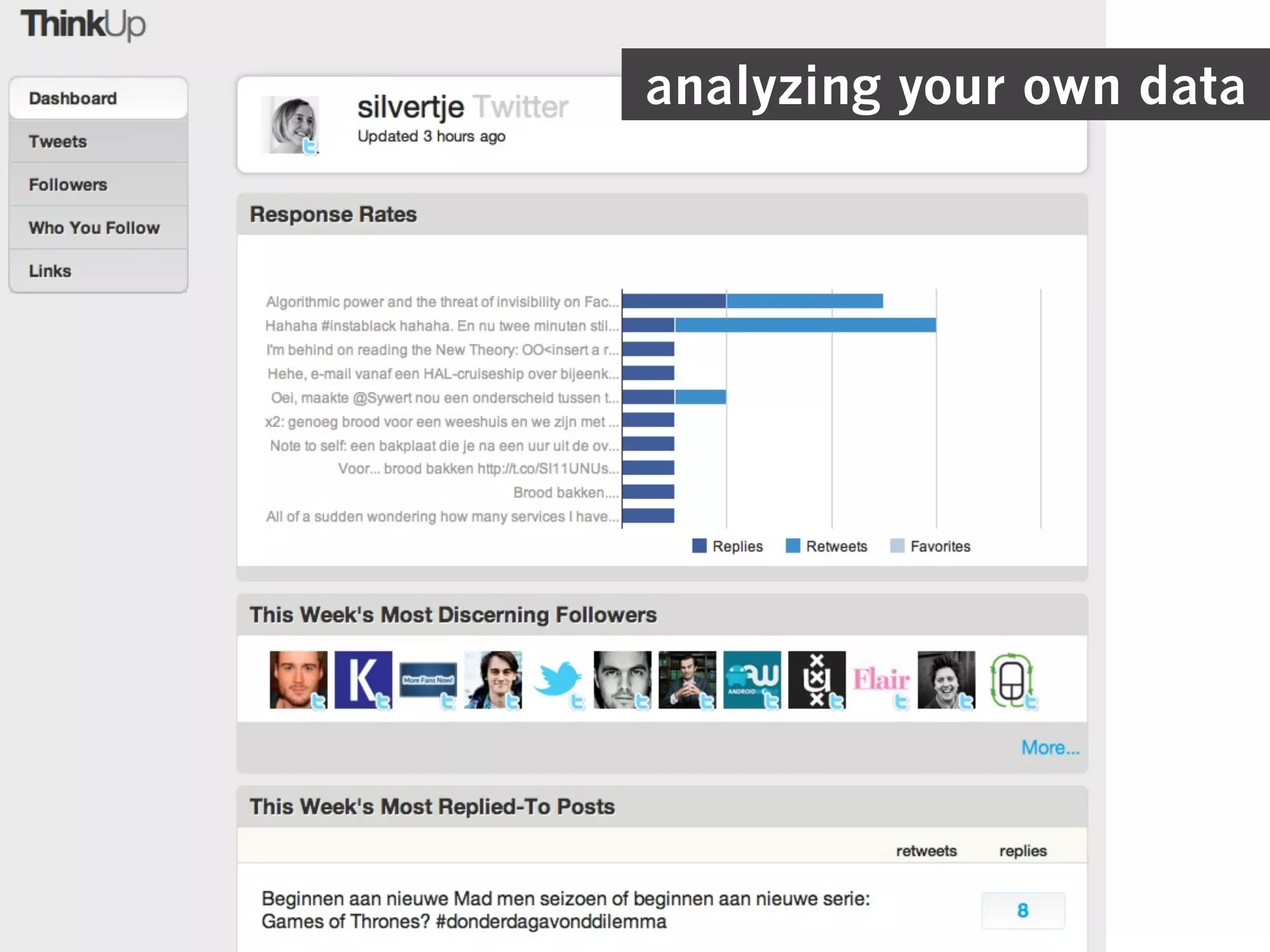
analyzing your own data
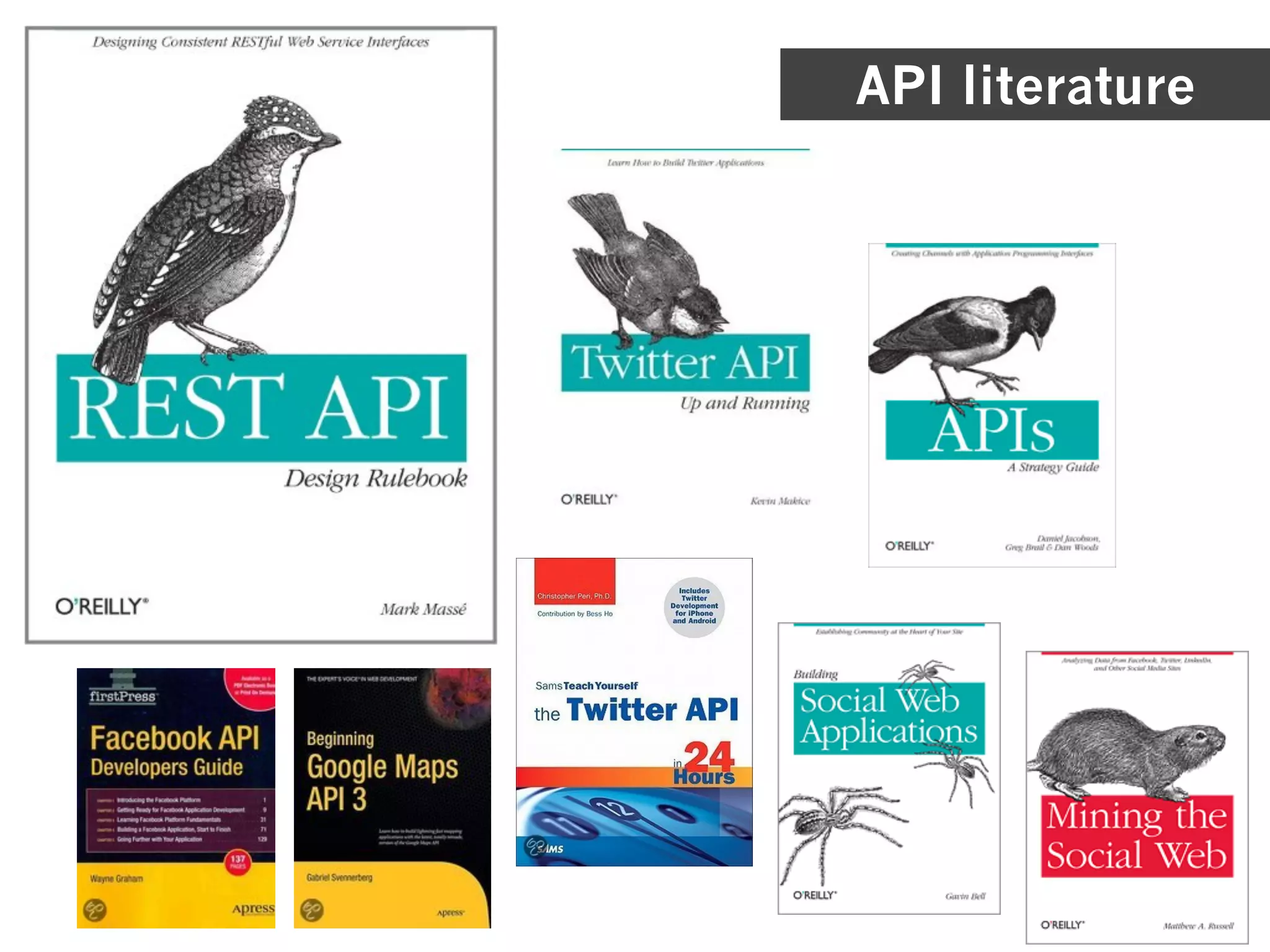
API literature
API literature

In relation to user interface/programming interface:
Cramer and Fuller 2008

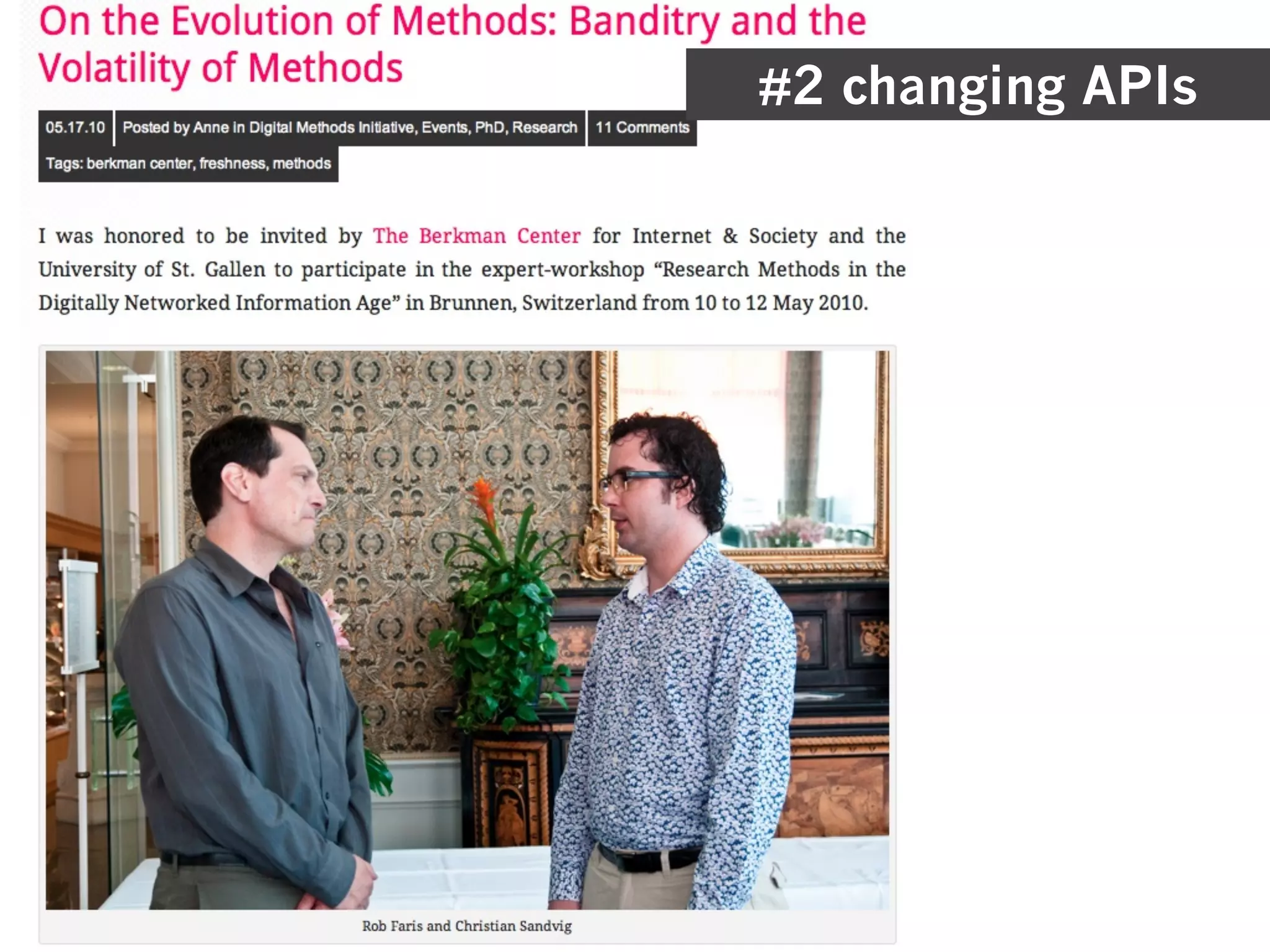
In relation to the volatility of methods: Helmond and
Sandvig 2010

In relation to proprietary API calls: Berry 2011

In relation to Big Data: boyd and Crawford 2011

In relation to data gathering skills: Manovich 2011

In relation to scraping: Marres and Weltevrede 2012
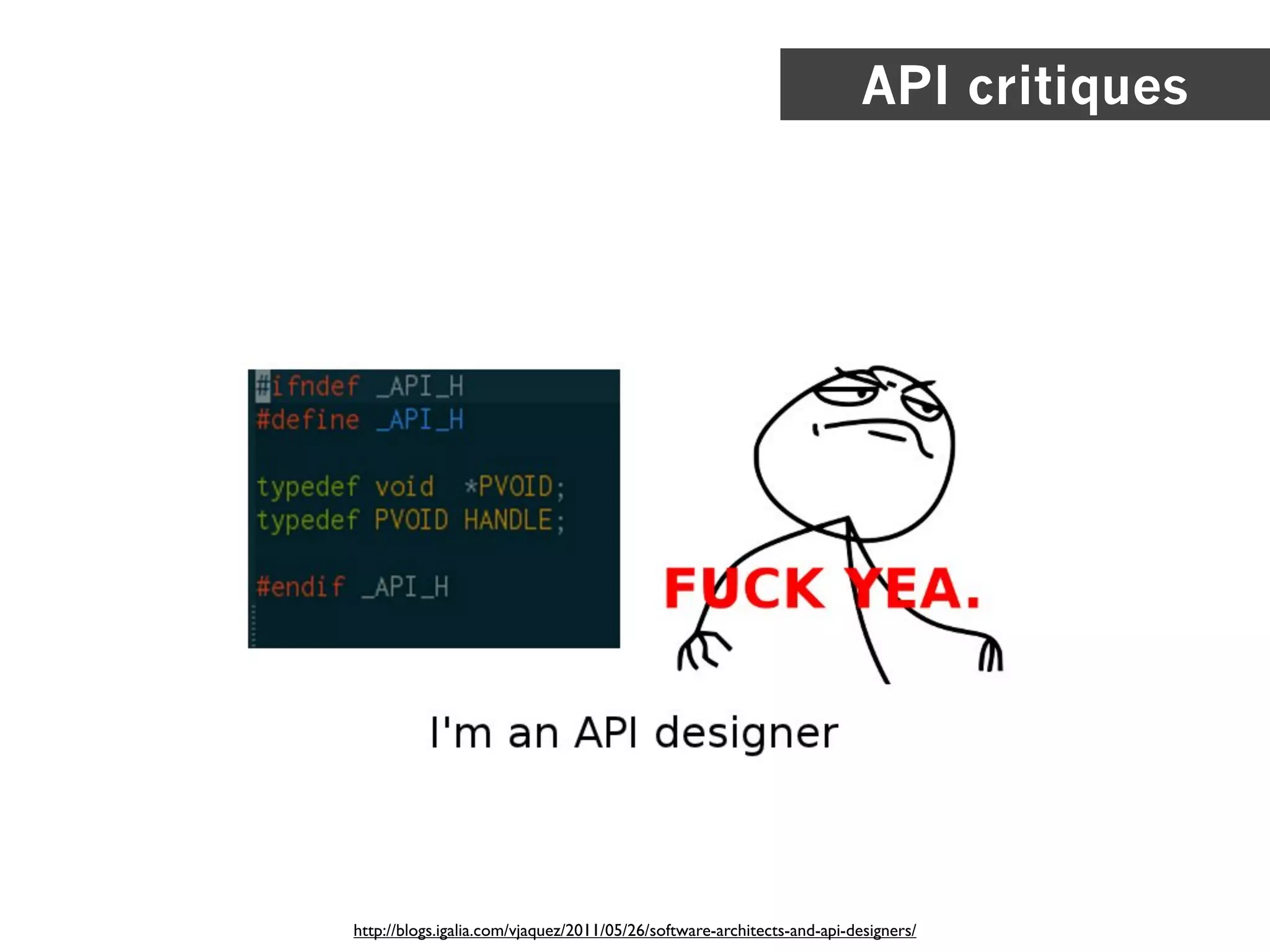
API critiques


http://blogs.igalia.com/vjaquez/2011/05/26/software-architects-and-api-designers/
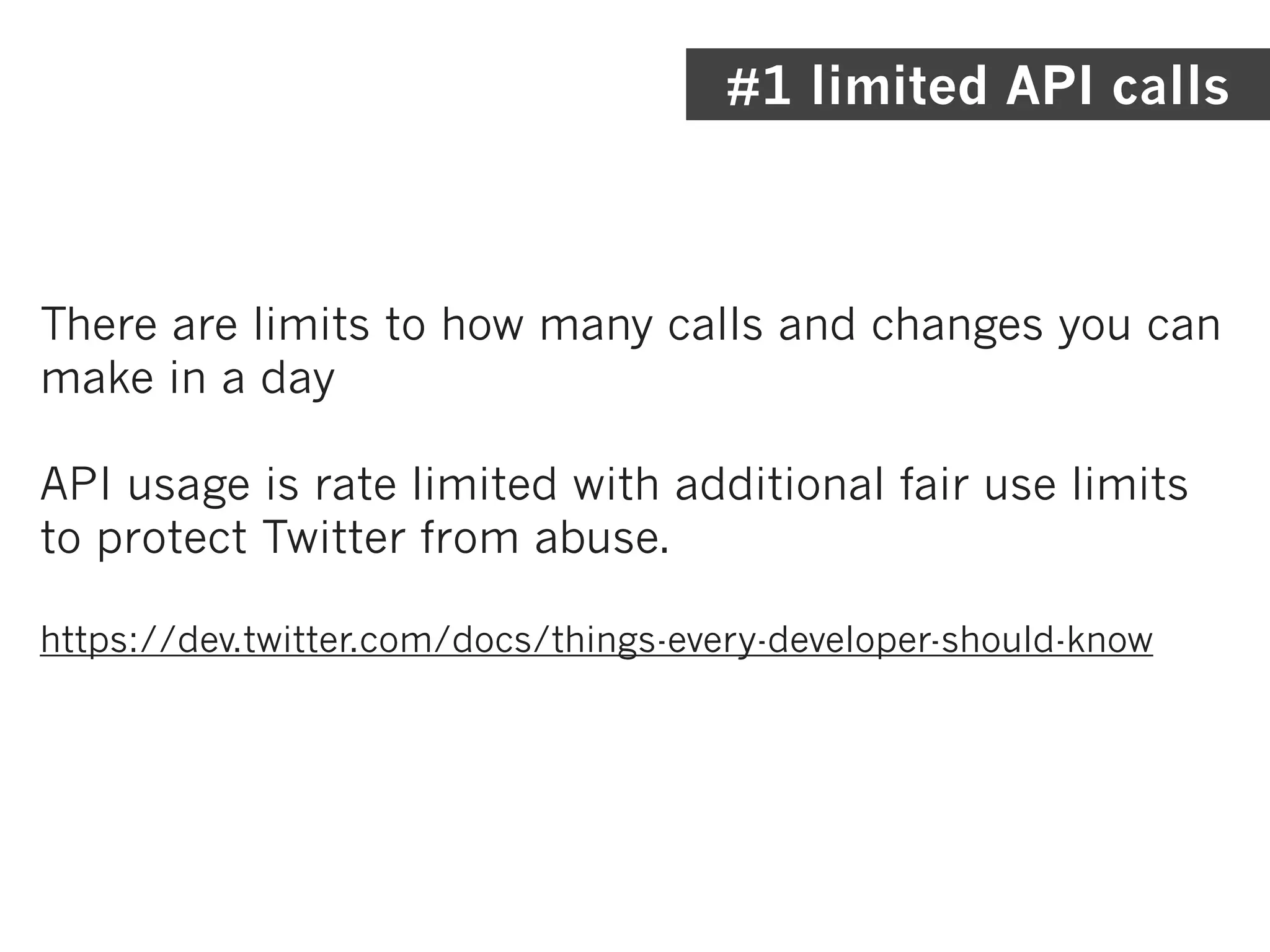
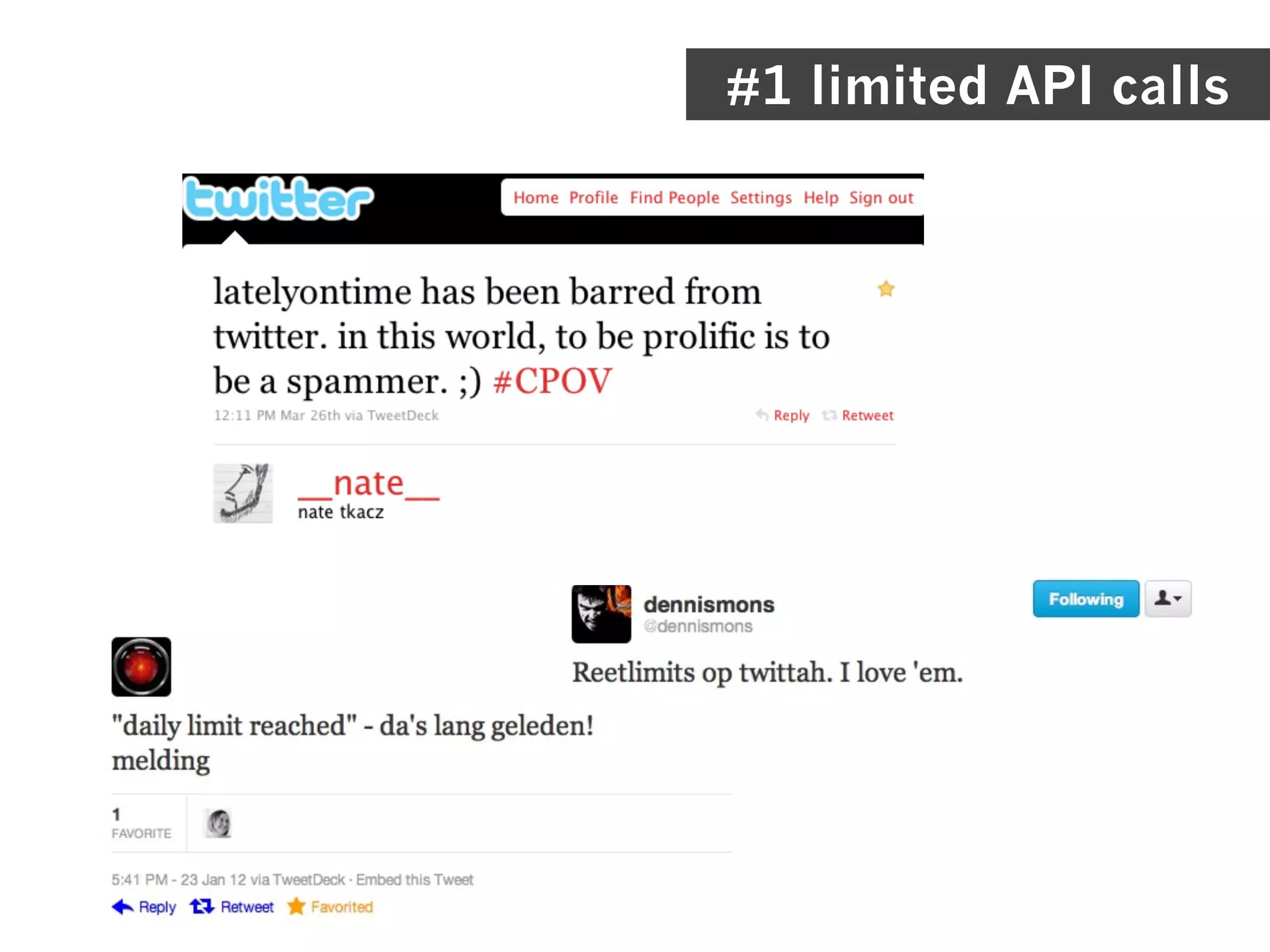
#1 limited API calls


There are limits to how many calls and changes you can
make in a day

API usage is rate limited with additional fair use limits
to protect Twitter from abuse.

https://dev.twitter.com/docs/things-every-developer-should-know
#1 limited API calls
#2 changing APIs
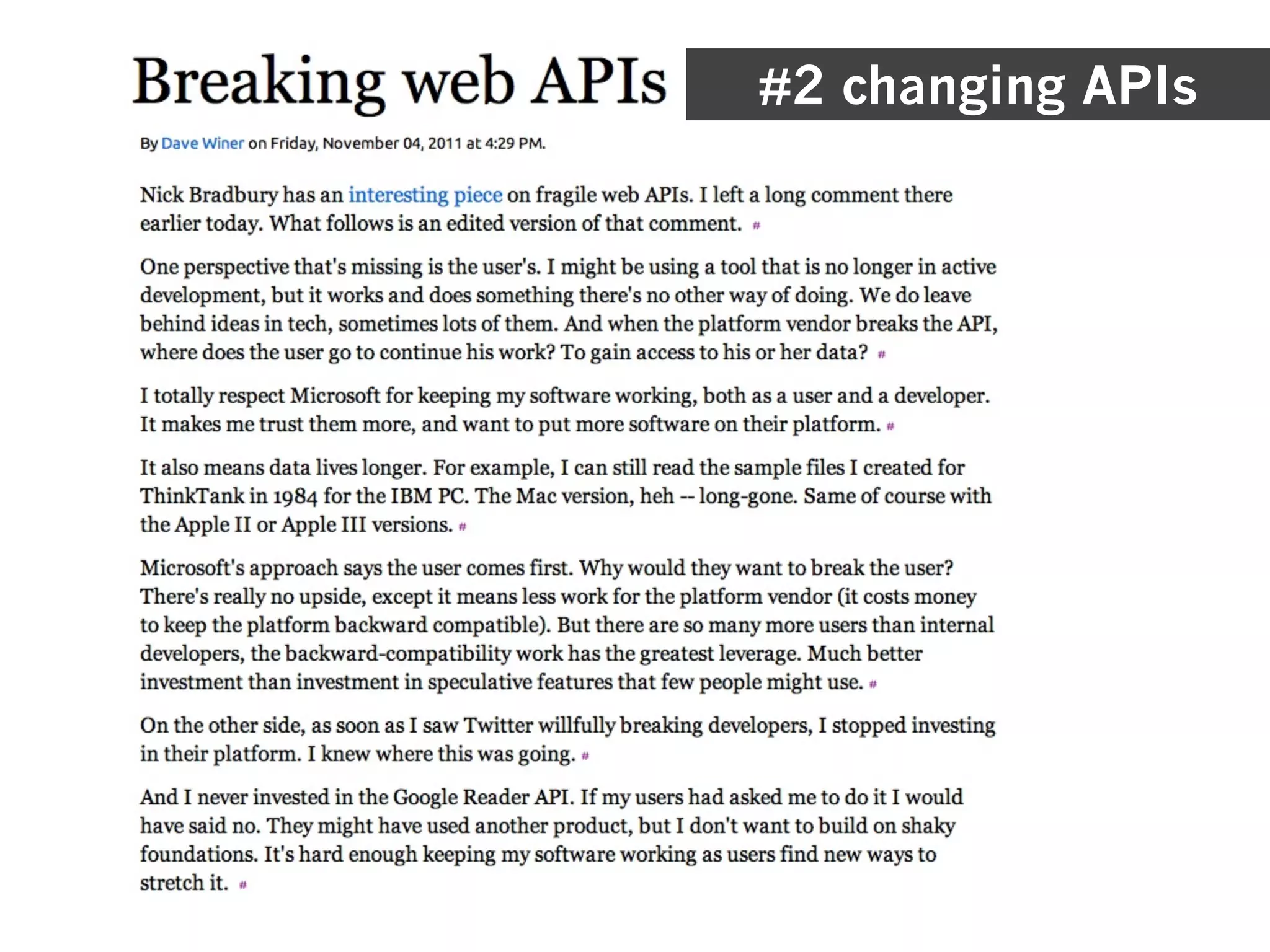
#2 changing APIs
#2 changing APIs
#2 changing APIs
#2 changing APIs


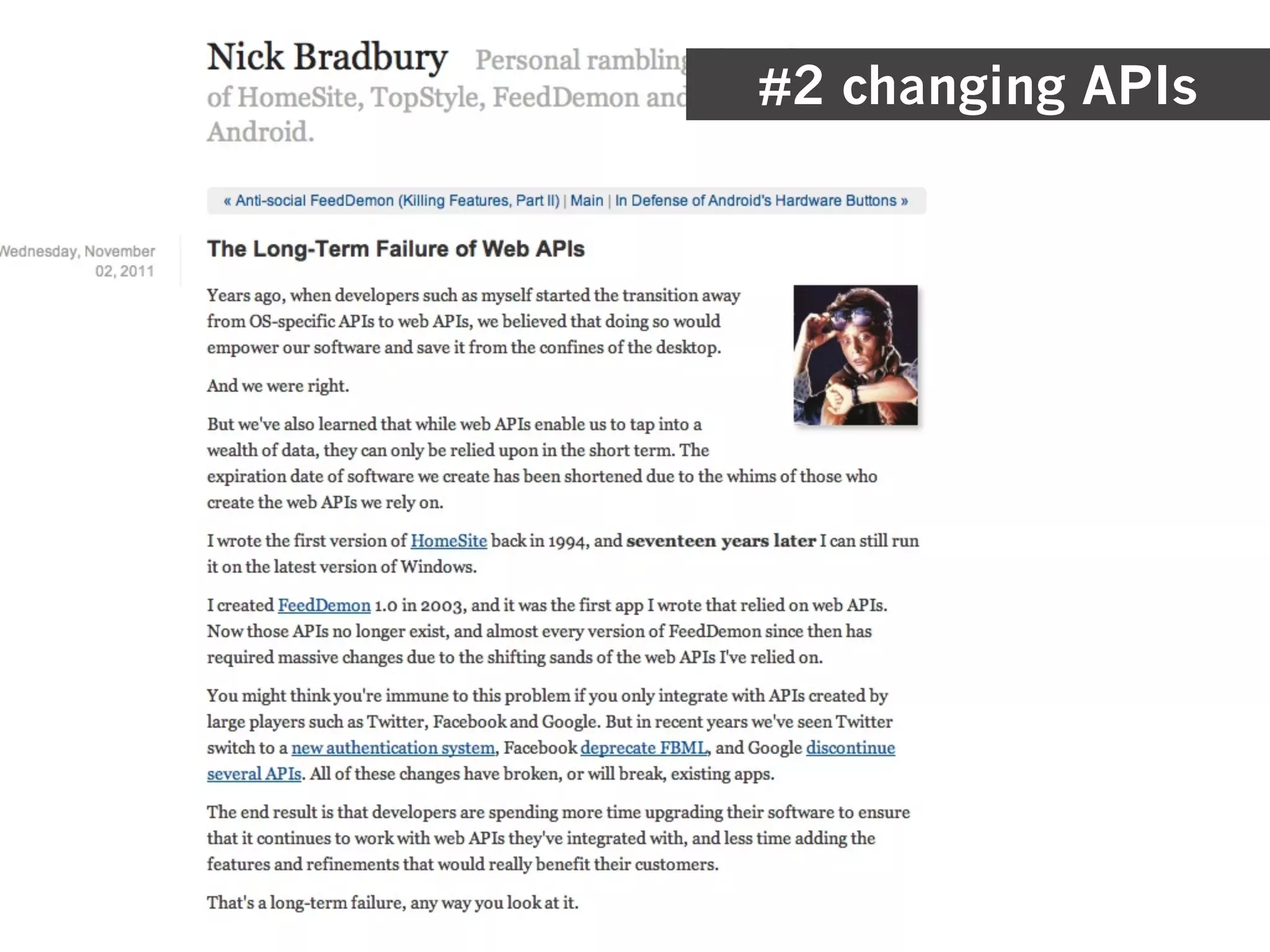
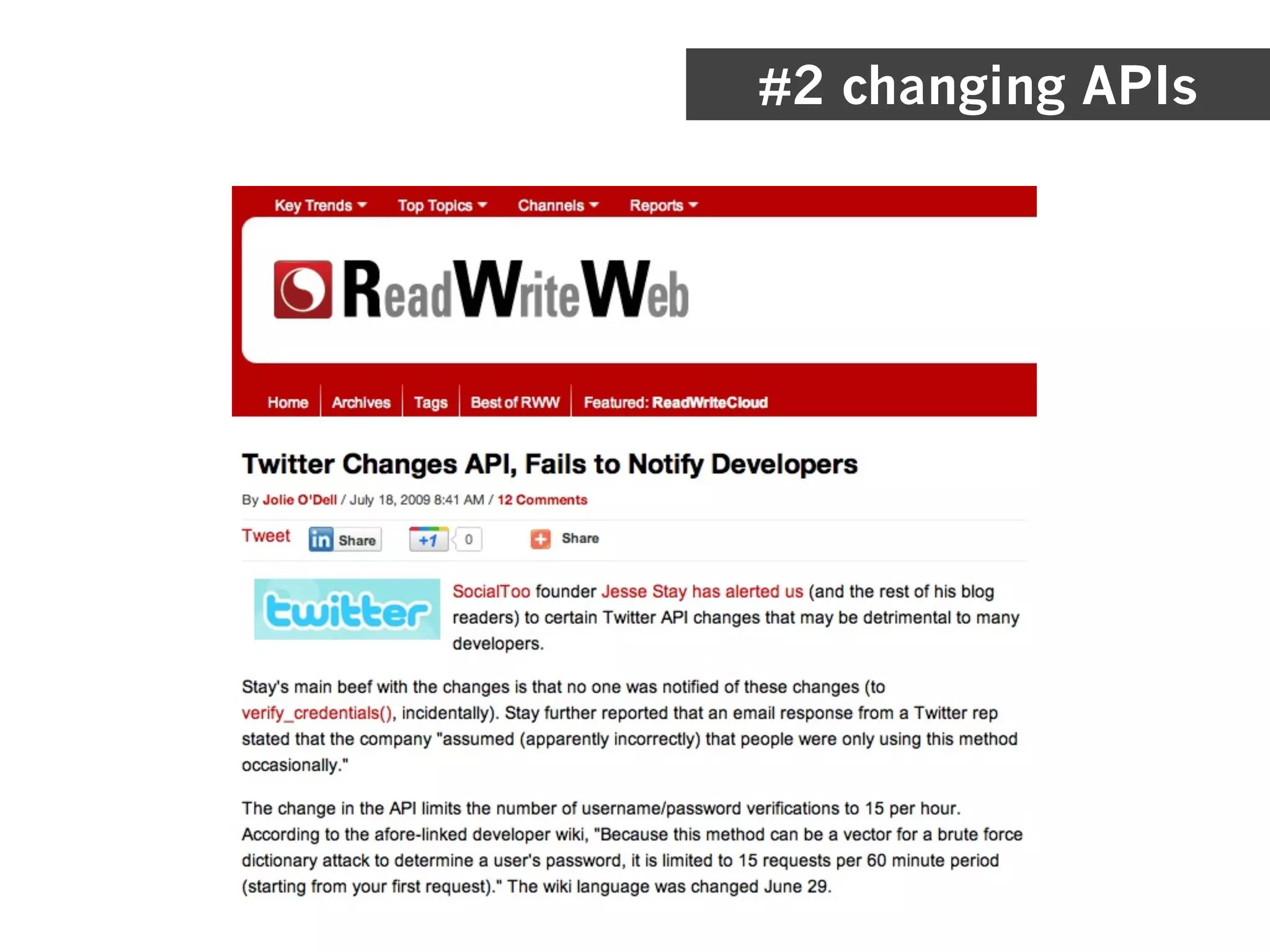
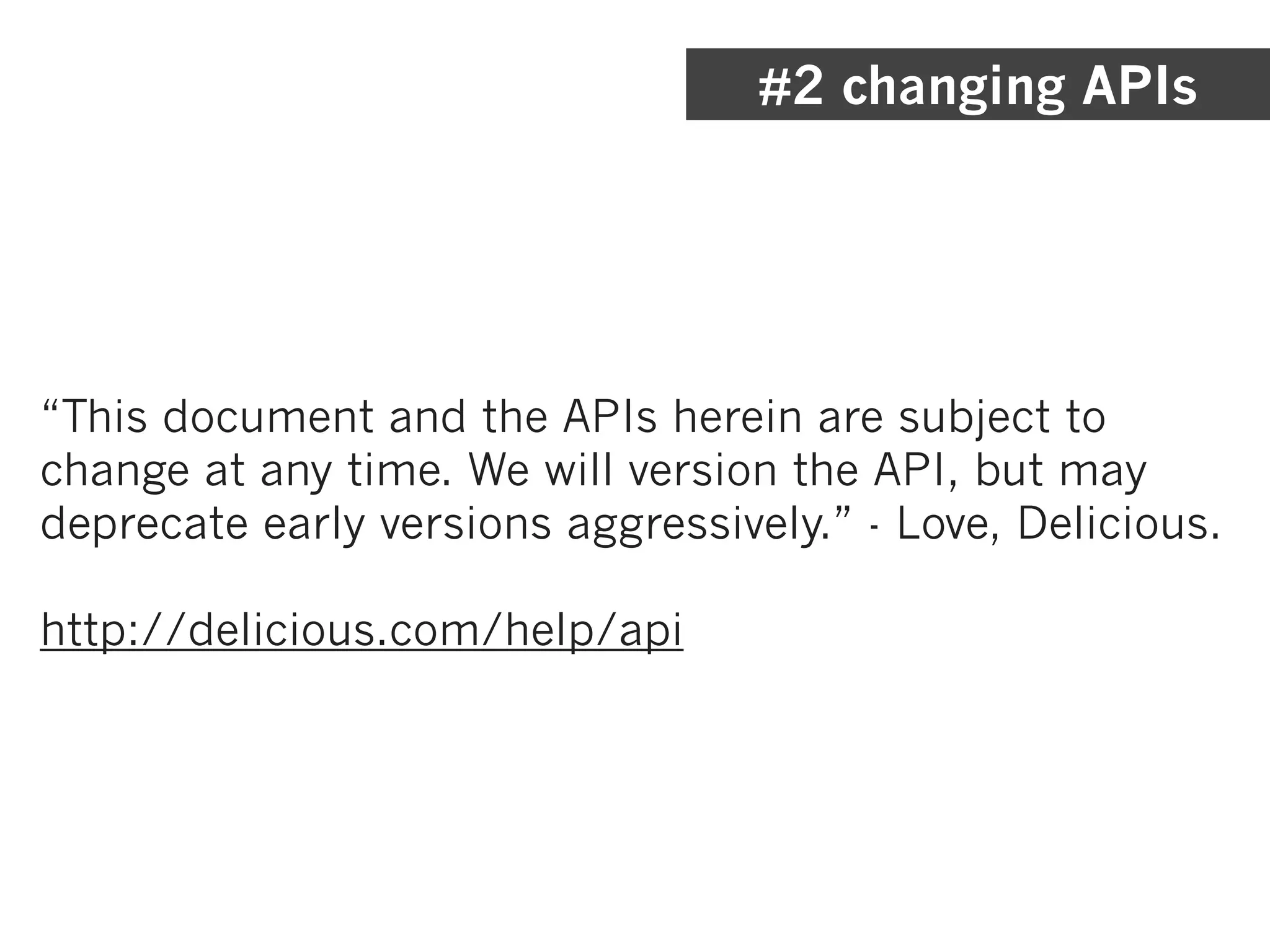
“This document and the APIs herein are subject to
change at any time. We will version the API, but may
deprecate early versions aggressively.” - Love, Delicious.

http://delicious.com/help/api
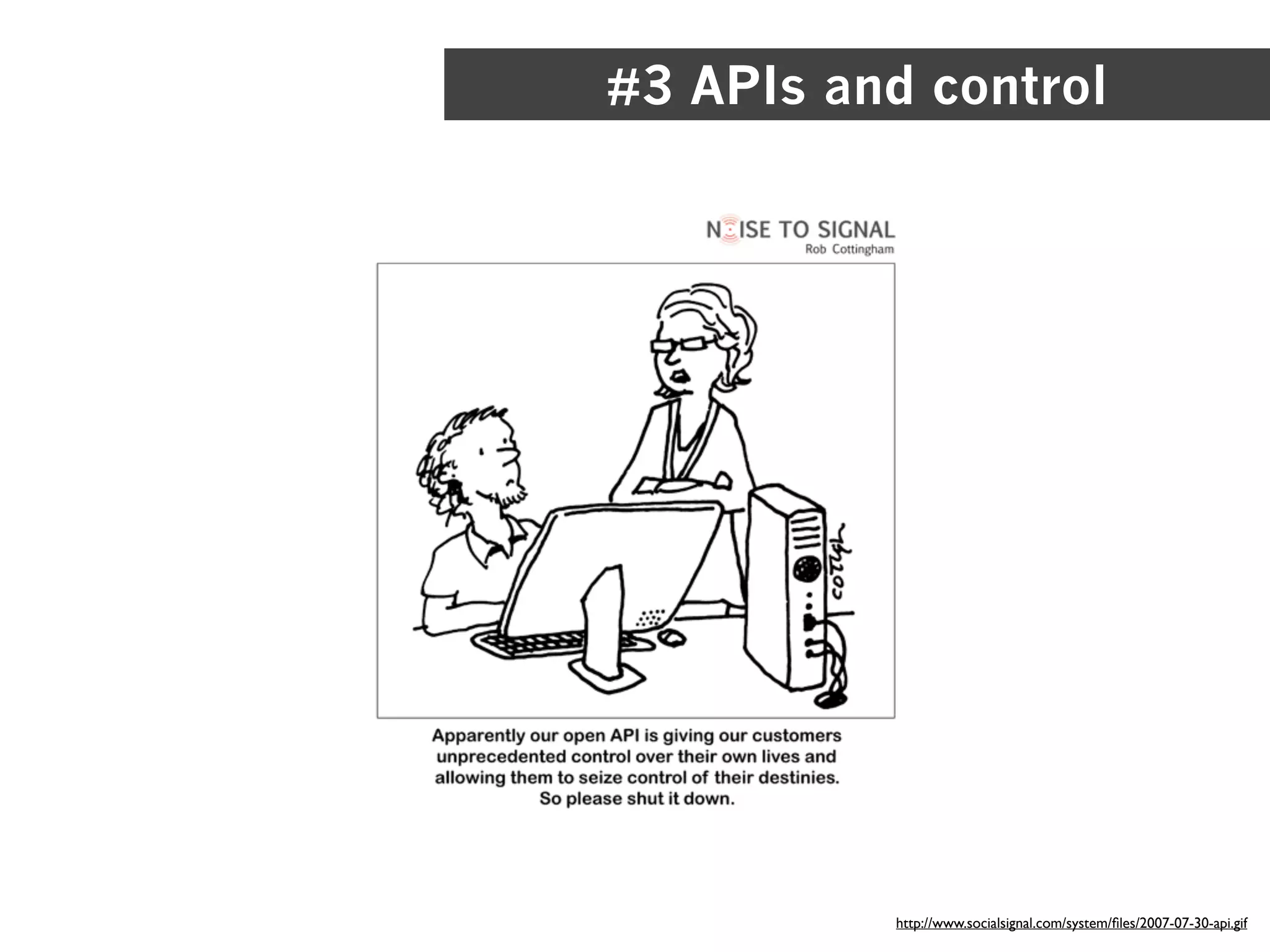
#3 APIs and control


          http://www.socialsignal.com/system/files/2007-07-30-api.gif
#4 APIs and access


“Register for a free API key and get 133% more
queries/day.” Topsy
#4 APIs and access


Twitter Inc. makes a fraction of its material available to
the public through its APIs. The ‘firehose’ theoretically
contains all public tweets ever posted and explicitly
excludes any tweet that a user chose to make private or
‘protected.’ Yet, some publicly accessible tweets are
also missing from the firehose. Although a handful of
companies and startups have access to the firehose,
very few researchers have this level of access. (boyd
and Crawford 2011)
# 5 ethics: APIs “versus” scraping

There are different data gathering methods: The API is
the polite way of gathering data and scraping could be
considered the impolite way of harnessing data: “You
can arrange digital research methods on a spectrum of
niceness. On the one hand you use the industry-
provided API. On the other you scrape Facebook for all
it is worth.”(Helmond & Sandvig 2010)

Scrapers stand in complex relations to API’s -
compared against the industry provided (limited) APIs,
scrapers may be viewed as the less polite variant of
data collection and in some cases may works against
copyright, terms of service, and “trespass to chattels”.
(Marres & Weltevrede 2012)
kthxbai!
                         anne@digitalmethods.net


www.digitalmethods.net
•   http://thinkupapp.com/
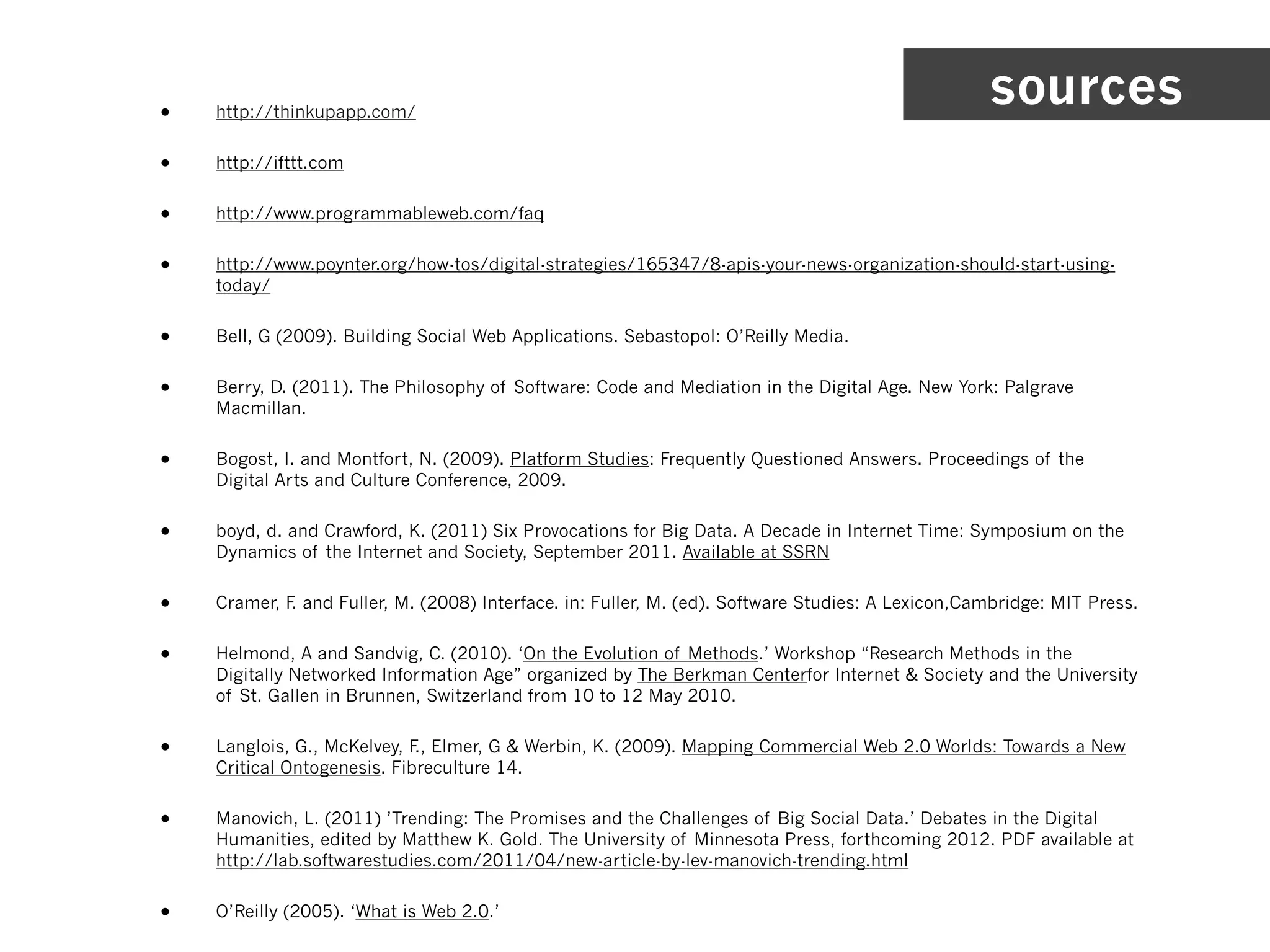
                                                                                                  sources
•   http://ifttt.com


•   http://www.programmableweb.com/faq


•   http://www.poynter.org/how-tos/digital-strategies/165347/8-apis-your-news-organization-should-start-using-
    today/


•   Bell, G (2009). Building Social Web Applications. Sebastopol: O’Reilly Media.


•   Berry, D. (2011). The Philosophy of Software: Code and Mediation in the Digital Age. New York: Palgrave
    Macmillan.


•   Bogost, I. and Montfort, N. (2009). Platform Studies: Frequently Questioned Answers. Proceedings of the
    Digital Arts and Culture Conference, 2009.


•   boyd, d. and Crawford, K. (2011) Six Provocations for Big Data. A Decade in Internet Time: Symposium on the
    Dynamics of the Internet and Society, September 2011. Available at SSRN


•   Cramer, F and Fuller, M. (2008) Interface. in: Fuller, M. (ed). Software Studies: A Lexicon,Cambridge: MIT Press.
             .


•   Helmond, A and Sandvig, C. (2010). ‘On the Evolution of Methods.’ Workshop “Research Methods in the
    Digitally Networked Information Age” organized by The Berkman Centerfor Internet & Society and the University
    of St. Gallen in Brunnen, Switzerland from 10 to 12 May 2010.


•   Langlois, G., McKelvey, F Elmer, G & Werbin, K. (2009). Mapping Commercial Web 2.0 Worlds: Towards a New
                             .,
    Critical Ontogenesis. Fibreculture 14.


•   Manovich, L. (2011) ’Trending: The Promises and the Challenges of Big Social Data.’ Debates in the Digital
    Humanities, edited by Matthew K. Gold. The University of Minnesota Press, forthcoming 2012. PDF available at
    http://lab.softwarestudies.com/2011/04/new-article-by-lev-manovich-trending.html


•   O’Reilly (2005). ‘What is Web 2.0.’

Setup API Introductie

  • 1.
    API Introductie De API-Koning,SETUP Utrecht, 12 April 2012 , Anne Helmond www.digitalmethods.net
  • 2.
    API introduction An applicationprogramming interface (API) is a source code based specification intended to be used as an interface by software components to communicate with each other. An API may include specifications for routines, data structures,object classes, and variables. (Wikipedia)
  • 3.
    API Application Programming Interface “thisrefers to a set of tools that developers can use to access structured data.” (boyd and Crawford) “Machine-facing interfaces for your application” p. 331 “software interface to your website” p. 332 “weaving the Guardian into the fabric of the Web” p. 331
  • 4.
    Web API /web service When used in the context of web development, an API is typically a defined set of Hypertext Transfer Protocol (HTTP) request messages, along with a definition of the structure of response messages, which is usually in an Extensible Markup Language (XML) or JavaScript Object Notation (JSON) format. While "Web API" is virtually a synonym for web service, the recent trend (so-called Web 2.0) has been moving away from Simple Object Access Protocol (SOAP) based services towards more direct Representational State Transfer (REST) style communications.[5] Web APIs allow the combination of multiple services into new applications known as mashups.[6] - (Wikipedia)
  • 5.
    The web asplatform Historically, some types of software like desktop operating systems have been called 'platforms' because through their APIs they provide the foundation on which other programs are built. The phrase 'web as platform' refers to fact that as web sites start providing their own APIs, they too are becoming a platform on which other programs can be built. (Programmableweb)
  • 6.
    Programmable web Definitionally, a“platform” is a system that can be reprogrammed and therefore customized by outside developers—users—and in that way, adapted to countless needs and niches that the platform’s original developers could not have possibly contemplated, much less had time to accommodate. [T]he key term in the definition of platform is ‘programmed’. If you can program it, then it’s a platform. If you can’t, then it’s not. - Marc Andreessen
  • 7.
    APIs and Web2.0 A Platform Beats an Application Every Time - O’Reilly 2005
  • 8.
  • 9.
  • 10.
  • 11.
  • 12.
  • 13.
  • 14.
  • 15.
  • 16.
  • 17.
  • 18.
    IFTT: combining cloudservices an interface for programming the application programming interface
  • 19.
  • 20.
    request your owndata (limited) through API calls
  • 21.
  • 22.
  • 23.
  • 24.
  • 25.
    API literature In relationto user interface/programming interface: Cramer and Fuller 2008 In relation to the volatility of methods: Helmond and Sandvig 2010 In relation to proprietary API calls: Berry 2011 In relation to Big Data: boyd and Crawford 2011 In relation to data gathering skills: Manovich 2011 In relation to scraping: Marres and Weltevrede 2012
  • 26.
  • 27.
    #1 limited APIcalls There are limits to how many calls and changes you can make in a day API usage is rate limited with additional fair use limits to protect Twitter from abuse. https://dev.twitter.com/docs/things-every-developer-should-know
  • 28.
  • 29.
  • 30.
  • 31.
  • 32.
  • 33.
    #2 changing APIs “Thisdocument and the APIs herein are subject to change at any time. We will version the API, but may deprecate early versions aggressively.” - Love, Delicious. http://delicious.com/help/api
  • 34.
    #3 APIs andcontrol http://www.socialsignal.com/system/files/2007-07-30-api.gif
  • 35.
    #4 APIs andaccess “Register for a free API key and get 133% more queries/day.” Topsy
  • 36.
    #4 APIs andaccess Twitter Inc. makes a fraction of its material available to the public through its APIs. The ‘firehose’ theoretically contains all public tweets ever posted and explicitly excludes any tweet that a user chose to make private or ‘protected.’ Yet, some publicly accessible tweets are also missing from the firehose. Although a handful of companies and startups have access to the firehose, very few researchers have this level of access. (boyd and Crawford 2011)
  • 37.
    # 5 ethics:APIs “versus” scraping There are different data gathering methods: The API is the polite way of gathering data and scraping could be considered the impolite way of harnessing data: “You can arrange digital research methods on a spectrum of niceness. On the one hand you use the industry- provided API. On the other you scrape Facebook for all it is worth.”(Helmond & Sandvig 2010) Scrapers stand in complex relations to API’s - compared against the industry provided (limited) APIs, scrapers may be viewed as the less polite variant of data collection and in some cases may works against copyright, terms of service, and “trespass to chattels”. (Marres & Weltevrede 2012)
  • 38.
    kthxbai! anne@digitalmethods.net www.digitalmethods.net
  • 39.
    http://thinkupapp.com/ sources • http://ifttt.com • http://www.programmableweb.com/faq • http://www.poynter.org/how-tos/digital-strategies/165347/8-apis-your-news-organization-should-start-using- today/ • Bell, G (2009). Building Social Web Applications. Sebastopol: O’Reilly Media. • Berry, D. (2011). The Philosophy of Software: Code and Mediation in the Digital Age. New York: Palgrave Macmillan. • Bogost, I. and Montfort, N. (2009). Platform Studies: Frequently Questioned Answers. Proceedings of the Digital Arts and Culture Conference, 2009. • boyd, d. and Crawford, K. (2011) Six Provocations for Big Data. A Decade in Internet Time: Symposium on the Dynamics of the Internet and Society, September 2011. Available at SSRN • Cramer, F and Fuller, M. (2008) Interface. in: Fuller, M. (ed). Software Studies: A Lexicon,Cambridge: MIT Press. . • Helmond, A and Sandvig, C. (2010). ‘On the Evolution of Methods.’ Workshop “Research Methods in the Digitally Networked Information Age” organized by The Berkman Centerfor Internet & Society and the University of St. Gallen in Brunnen, Switzerland from 10 to 12 May 2010. • Langlois, G., McKelvey, F Elmer, G & Werbin, K. (2009). Mapping Commercial Web 2.0 Worlds: Towards a New ., Critical Ontogenesis. Fibreculture 14. • Manovich, L. (2011) ’Trending: The Promises and the Challenges of Big Social Data.’ Debates in the Digital Humanities, edited by Matthew K. Gold. The University of Minnesota Press, forthcoming 2012. PDF available at http://lab.softwarestudies.com/2011/04/new-article-by-lev-manovich-trending.html • O’Reilly (2005). ‘What is Web 2.0.’