ENVIRONMENTAL EVOLUTION
What is Environmental Evolution
Environmental means concerned with the protection of the
natural world of land, sea, air, plants, and animals.
Evolution is possible when there is variation in the genetic
makeup among organisms that affects their traits. Then, if certain
individuals in a population reproduce more successfully than others
so that their traits become more common within the population,
the result is evolutionary change.
Company team
Introduction
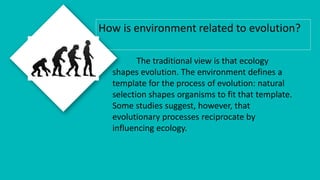
The traditional view is that ecology
shapes evolution. The environment defines a
template for the process of evolution: natural
selection shapes organisms to fit that template.
Some studies suggest, however, that
evolutionary processes reciprocate by
influencing ecology.
How is environment related to evolution?
Environmental Evolution
What is evolution
environmental
science?
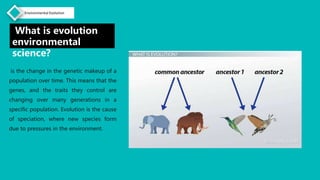
is the change in the genetic makeup of a
population over time. This means that the
genes, and the traits they control are
changing over many generations in a
specific population. Evolution is the cause
of speciation, where new species form
due to pressures in the environment.
Environmrntal evolution
Environmental evolution
examples
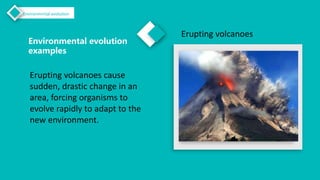
Erupting volcanoes
Erupting volcanoes cause
sudden, drastic change in an
area, forcing organisms to
evolve rapidly to adapt to the
new environment.
Environmrntal evolution
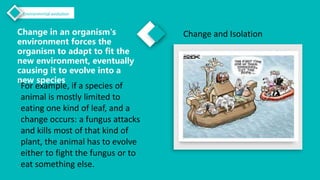
Change in an organism's
environment forces the
organism to adapt to fit the
new environment, eventually
causing it to evolve into a
new species
Change and Isolation
For example, if a species of
animal is mostly limited to
eating one kind of leaf, and a
change occurs: a fungus attacks
and kills most of that kind of
plant, the animal has to evolve
either to fight the fungus or to
eat something else.
Environmental
Evolution
microevolution
Microevolutionary processes
are changes in allele frequencies
in a population over time. n add
it to the actual.
macroevolution
Macroevolution, on the other
hand, refers to change at or
above the level of the species.
Two general classes of evolutionary change
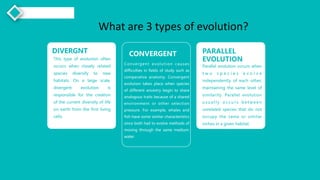
DIVERGNT
This type of evolution often
occurs when closely related
species diversify to new
habitats. On a large scale,
divergent evolution is
responsible for the creation
of the current diversity of life
on earth from the first living
cells.
CONVERGENT
Convergent evolution causes
difficulties in fields of study such as
comparative anatomy. Convergent
evolution takes place when species
of different ancestry begin to share
analogous traits because of a shared
environment or other selection
pressure. For example, whales and
fish have some similar characteristics
since both had to evolve methods of
moving through the same medium:
water.
PARALLEL
EVOLUTION
Parallel evolution occurs when
t w o s p e c i e s e v o l v e
independently of each other,
maintaining the same level of
similarity. Parallel evolution
u su a l l y o cc u r s be t we e n
unrelated species that do not
occupy the same or similar
niches in a given habitat.
What are 3 types of evolution?
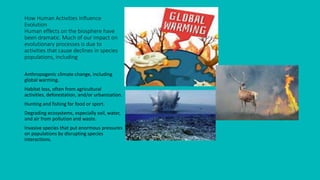
How Human Activities Influence
Evolution
Human effects on the biosphere have
been dramatic. Much of our impact on
evolutionary processes is due to
activities that cause declines in species
populations, including
Anthropogenic climate change, including
global warming.
Habitat loss, often from agricultural
activities, deforestation, and/or urbanization.
Hunting and fishing for food or sport.
Degrading ecosystems, especially soil, water,
and air from pollution and waste.
Invasive species that put enormous pressures
on populations by disrupting species
interactions.
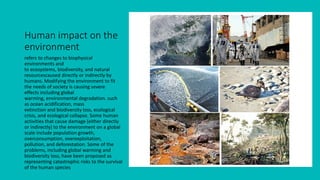
Human impact on the
environment
refers to changes to biophysical
environments and
to ecosystems, biodiversity, and natural
resourcescaused directly or indirectly by
humans. Modifying the environment to fit
the needs of society is causing severe
effects including global
warming, environmental degradation. such
as ocean acidification, mass
extinction and biodiversity loss, ecological
crisis, and ecological collapse. Some human
activities that cause damage (either directly
or indirectly) to the environment on a global
scale include population growth,
overconsumption, overexploitation,
pollution, and deforestation. Some of the
problems, including global warming and
biodiversity loss, have been proposed as
representing catastrophic risks to the survival
of the human species
What will the environment be like in the
future?
• Future changes are expected to include a warmer atmosphere, a
warmer and more acidic ocean, higher sea levels, and larger changes
in precipitation patterns. The extent of future climate change
depends on what we do now to reduce greenhouse gas emissions.
• GROUP 5
• ESCALONA, MARWIN
• FORONDA, MARC RAMIL
• GACAYAN, JAY JAY
• HORTIZUELA, JANELLA MARIE

ENVIRONMENTAL-EVOLUTION-1.pptx

  • 1.
  • 2.
    What is EnvironmentalEvolution Environmental means concerned with the protection of the natural world of land, sea, air, plants, and animals. Evolution is possible when there is variation in the genetic makeup among organisms that affects their traits. Then, if certain individuals in a population reproduce more successfully than others so that their traits become more common within the population, the result is evolutionary change.
  • 3.
    Company team Introduction The traditionalview is that ecology shapes evolution. The environment defines a template for the process of evolution: natural selection shapes organisms to fit that template. Some studies suggest, however, that evolutionary processes reciprocate by influencing ecology. How is environment related to evolution?
  • 4.
    Environmental Evolution What isevolution environmental science? is the change in the genetic makeup of a population over time. This means that the genes, and the traits they control are changing over many generations in a specific population. Evolution is the cause of speciation, where new species form due to pressures in the environment.
  • 5.
    Environmrntal evolution Environmental evolution examples Eruptingvolcanoes Erupting volcanoes cause sudden, drastic change in an area, forcing organisms to evolve rapidly to adapt to the new environment.
  • 6.
    Environmrntal evolution Change inan organism's environment forces the organism to adapt to fit the new environment, eventually causing it to evolve into a new species Change and Isolation For example, if a species of animal is mostly limited to eating one kind of leaf, and a change occurs: a fungus attacks and kills most of that kind of plant, the animal has to evolve either to fight the fungus or to eat something else.
  • 7.
    Environmental Evolution microevolution Microevolutionary processes are changesin allele frequencies in a population over time. n add it to the actual. macroevolution Macroevolution, on the other hand, refers to change at or above the level of the species. Two general classes of evolutionary change
  • 8.
    DIVERGNT This type ofevolution often occurs when closely related species diversify to new habitats. On a large scale, divergent evolution is responsible for the creation of the current diversity of life on earth from the first living cells. CONVERGENT Convergent evolution causes difficulties in fields of study such as comparative anatomy. Convergent evolution takes place when species of different ancestry begin to share analogous traits because of a shared environment or other selection pressure. For example, whales and fish have some similar characteristics since both had to evolve methods of moving through the same medium: water. PARALLEL EVOLUTION Parallel evolution occurs when t w o s p e c i e s e v o l v e independently of each other, maintaining the same level of similarity. Parallel evolution u su a l l y o cc u r s be t we e n unrelated species that do not occupy the same or similar niches in a given habitat. What are 3 types of evolution?
  • 9.
    How Human ActivitiesInfluence Evolution Human effects on the biosphere have been dramatic. Much of our impact on evolutionary processes is due to activities that cause declines in species populations, including Anthropogenic climate change, including global warming. Habitat loss, often from agricultural activities, deforestation, and/or urbanization. Hunting and fishing for food or sport. Degrading ecosystems, especially soil, water, and air from pollution and waste. Invasive species that put enormous pressures on populations by disrupting species interactions.
  • 10.
    Human impact onthe environment refers to changes to biophysical environments and to ecosystems, biodiversity, and natural resourcescaused directly or indirectly by humans. Modifying the environment to fit the needs of society is causing severe effects including global warming, environmental degradation. such as ocean acidification, mass extinction and biodiversity loss, ecological crisis, and ecological collapse. Some human activities that cause damage (either directly or indirectly) to the environment on a global scale include population growth, overconsumption, overexploitation, pollution, and deforestation. Some of the problems, including global warming and biodiversity loss, have been proposed as representing catastrophic risks to the survival of the human species
  • 11.
    What will theenvironment be like in the future? • Future changes are expected to include a warmer atmosphere, a warmer and more acidic ocean, higher sea levels, and larger changes in precipitation patterns. The extent of future climate change depends on what we do now to reduce greenhouse gas emissions.
  • 12.
    • GROUP 5 •ESCALONA, MARWIN • FORONDA, MARC RAMIL • GACAYAN, JAY JAY • HORTIZUELA, JANELLA MARIE