ENVIRONMENTAL POLICY
IN INDIA
Presented By:
Pavan Kumar Meena
Vaibhav Mohare
Yuvraj Kashyap
Objective :
• To critically discuss some environmental policies & acts , in force
,in India.
1. Forest Conservation Act, 1980
2. National Protection Act, 1986
3. National Environment Policy, 2006
4. Air (Prevention And Control Of Pollution),1981
• To discuss the prevention methods of pollution.
Forest (Conservation) Act, 1980
(Ministry of Environment and Forest)
• Came into force on 25 October 1980
• To provide for the conservation of forests
OBJECTIVES
No State Government or any authority shall make, except with the prior approval of the
Central Government:
• Any forest land or any portion thereof may be used for any non-
forest purpose.
• Any forest land or any portion thereof may be assigned by way of
lease or otherwise to any private person or to any authority,
corporation, agency or any other organization not owned, managed
or controlled by Government
Offences in Reserved Forests :
• No person is allowed to set fire or clearings
• Cattles are not permitted
• No permission to collect any forests products;
Protected forests
• No permission to do anything with trees which are
mentioned in Act.
PENALTY
• Whoever contravenes and abets the contraventions
of any of the provisions, shall be punishable with
imprisonment; which may be extend to 15 days.
The Environment (Protection) Act 1986
• Environmental protection is a practice of protecting the
environment, on individual, organizational or governmental levels, for
the benefit of the natural environment and (or)humans.
• Protection of the environment is needed due to various human
activities.
The Bhopal gas tragedy, Dec 1984.
(Ministry of Environment and Forest)
PREVENTION AND CONTROL
• To appoint environment officers to check environmental
pollution
• Establishing environmental laboratories
• Laying down standards for emission or discharge of
environmental pollutants from various sources
whatsoever
• Restriction of areas in which any industries, operations or processes shall
not be carried out or shall be carried out subject to certain safeguards
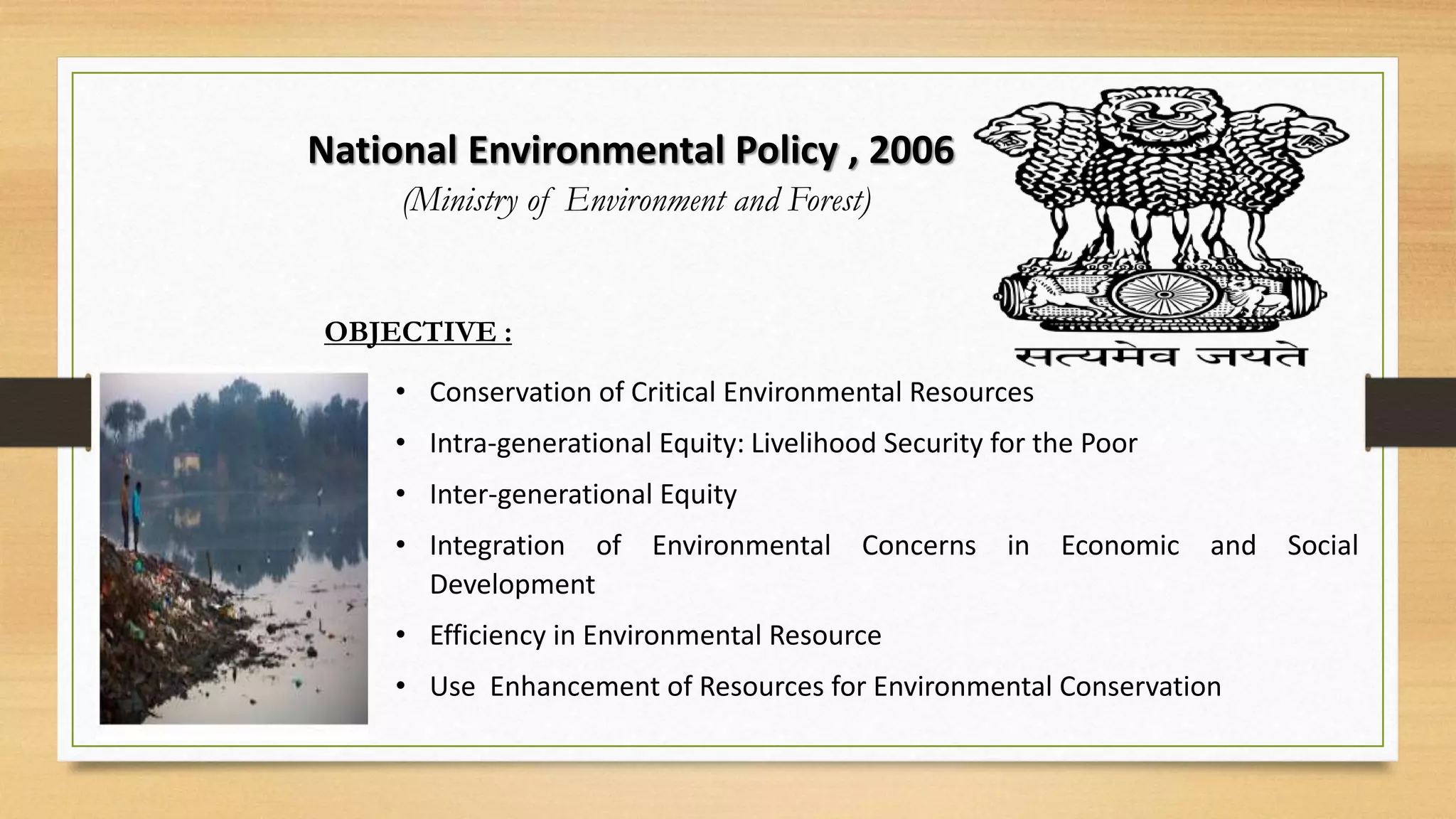
National Environmental Policy , 2006
(Ministry of Environment and Forest)
• Conservation of Critical Environmental Resources
• Intra-generational Equity: Livelihood Security for the Poor
• Inter-generational Equity
• Integration of Environmental Concerns in Economic and Social
Development
• Efficiency in Environmental Resource
• Use Enhancement of Resources for Environmental Conservation
OBJECTIVE :
PENALTY “POLLUTER’S PAY’’
• In Fault Based Liability a party is held liable if it breaches a preexisting legal
duty, for example, an environmental standard.
• Strict liability imposes an obligation to compensate the victim for harm
resulting from actions or failure to take action, which may not necessarily
constitute a breach of any law or duty of care.
AIR (PREVENTION AND CONTROL OF POLLUTION) ACT, 1981
OBJECTIVE :
• The presence in air, above certain limit of various pollutant released
in air through industrial emission and from certain human activities
should be controlled through government interventions.
• Establishment of Central Pollution Control Board (CPCB)
(Ministry of Environment and Forest)
Functions of CPCB :
• To improve the quality of air and to prevent, control or abate air
pollution in the country
• Advise the Central Government on any matter concerning the
improvement of the quality of air and the prevention, control or
abatement of air pollution.
• Coordinate the activities of the State Boards and resolve
disputes among them.
• Plan and cause to be executed a nation-wide programme for
the prevention, control or abatement of air pollution.
Air Quality Index
Source: CPCB; India
PENALTY :
• Imprisonment of 1 year and 6 months and fine. For
continuing failure, fine up to Rs. 5000 per violation
• If violation continues beyond one year, imprisonment
can be increased from 2 years up to 7 years with fine.
Conclusion :
By awareness amongst the citizen and sustainable practices can bring change. There is a need
to find ways to minimal exploit of environment and gaining best use of it. There are so many
easy ways to become more sustainable. We are all creatures of habit, and changing our
behavior takes some time. Small steps are key, and once we will find how easy each is, we will
be surprised how quickly we can make a positive difference in protecting our environment for
our family and our planet.
In spite of having various policies and acts for the conservation of environment , it is in danger.
Due to moral hazard among the people, various commercial practices are exploiting the
environment. Water Pollution, Air pollution , and Soil pollution are the major problem of the
era. There is an urgent need to change this scenario.
Environmental policies in india

Environmental policies in india

  • 1.
    ENVIRONMENTAL POLICY IN INDIA PresentedBy: Pavan Kumar Meena Vaibhav Mohare Yuvraj Kashyap
  • 2.
    Objective : • Tocritically discuss some environmental policies & acts , in force ,in India. 1. Forest Conservation Act, 1980 2. National Protection Act, 1986 3. National Environment Policy, 2006 4. Air (Prevention And Control Of Pollution),1981 • To discuss the prevention methods of pollution.
  • 3.
    Forest (Conservation) Act,1980 (Ministry of Environment and Forest) • Came into force on 25 October 1980 • To provide for the conservation of forests
  • 4.
    OBJECTIVES No State Governmentor any authority shall make, except with the prior approval of the Central Government: • Any forest land or any portion thereof may be used for any non- forest purpose. • Any forest land or any portion thereof may be assigned by way of lease or otherwise to any private person or to any authority, corporation, agency or any other organization not owned, managed or controlled by Government
  • 5.
    Offences in ReservedForests : • No person is allowed to set fire or clearings • Cattles are not permitted • No permission to collect any forests products; Protected forests • No permission to do anything with trees which are mentioned in Act.
  • 6.
    PENALTY • Whoever contravenesand abets the contraventions of any of the provisions, shall be punishable with imprisonment; which may be extend to 15 days.
  • 7.
    The Environment (Protection)Act 1986 • Environmental protection is a practice of protecting the environment, on individual, organizational or governmental levels, for the benefit of the natural environment and (or)humans. • Protection of the environment is needed due to various human activities. The Bhopal gas tragedy, Dec 1984. (Ministry of Environment and Forest)
  • 10.
    PREVENTION AND CONTROL •To appoint environment officers to check environmental pollution • Establishing environmental laboratories • Laying down standards for emission or discharge of environmental pollutants from various sources whatsoever • Restriction of areas in which any industries, operations or processes shall not be carried out or shall be carried out subject to certain safeguards
  • 12.
    National Environmental Policy, 2006 (Ministry of Environment and Forest) • Conservation of Critical Environmental Resources • Intra-generational Equity: Livelihood Security for the Poor • Inter-generational Equity • Integration of Environmental Concerns in Economic and Social Development • Efficiency in Environmental Resource • Use Enhancement of Resources for Environmental Conservation OBJECTIVE :
  • 13.
    PENALTY “POLLUTER’S PAY’’ •In Fault Based Liability a party is held liable if it breaches a preexisting legal duty, for example, an environmental standard. • Strict liability imposes an obligation to compensate the victim for harm resulting from actions or failure to take action, which may not necessarily constitute a breach of any law or duty of care.
  • 14.
    AIR (PREVENTION ANDCONTROL OF POLLUTION) ACT, 1981 OBJECTIVE : • The presence in air, above certain limit of various pollutant released in air through industrial emission and from certain human activities should be controlled through government interventions. • Establishment of Central Pollution Control Board (CPCB) (Ministry of Environment and Forest)
  • 15.
    Functions of CPCB: • To improve the quality of air and to prevent, control or abate air pollution in the country • Advise the Central Government on any matter concerning the improvement of the quality of air and the prevention, control or abatement of air pollution. • Coordinate the activities of the State Boards and resolve disputes among them. • Plan and cause to be executed a nation-wide programme for the prevention, control or abatement of air pollution.
  • 16.
  • 17.
    PENALTY : • Imprisonmentof 1 year and 6 months and fine. For continuing failure, fine up to Rs. 5000 per violation • If violation continues beyond one year, imprisonment can be increased from 2 years up to 7 years with fine.
  • 18.
    Conclusion : By awarenessamongst the citizen and sustainable practices can bring change. There is a need to find ways to minimal exploit of environment and gaining best use of it. There are so many easy ways to become more sustainable. We are all creatures of habit, and changing our behavior takes some time. Small steps are key, and once we will find how easy each is, we will be surprised how quickly we can make a positive difference in protecting our environment for our family and our planet. In spite of having various policies and acts for the conservation of environment , it is in danger. Due to moral hazard among the people, various commercial practices are exploiting the environment. Water Pollution, Air pollution , and Soil pollution are the major problem of the era. There is an urgent need to change this scenario.