ENVIRONMENTAL
AUDIT
PRESENTED TO:
DR.DISHA THAKUR
Presented by:
Saksham Chaudhary (18202610048)
Harish Kumar (18202610027)
Himanshu Mehta (18202610028)
TABLE OF CONTENTS:-
• INTRODUCTION
• TYPES OF ENVIRONMENTAL AUDIT
• ENVIRONMENTAL AUDIT PROCESS
• OBJECTIVES OF ENVIRONMENTAL AUDIT
• PORBLUMS ENCOUNTERED DURING AUDIT
• AUDIT PROGRAMMES IN INDIA
• CASE STUDY
ENVIRONMENTAL AUDIT
Environmental audit is a management tool comprising a systematic,
documented periodic and objective evaluation of an organization performing
functions of production within the mandated regulatory requirements.
For the impact of industries, and their product on natural resources and
environmental quality it is necessary to have “ Environmental Audit” to
ensure sustainable industrial developments.
Purpose of Environmental Audit
The obvious advantages of environmental auditing is to help safeguard the environment
and to substantiate compliance with local, regional and national laws and regulations,
and with the company policy and standards. The environmental audit studies serve the
following three basic purposes.
1. Compilation of the complete information on the operation of the industrial facility
and its potential sources of pollution through technical inspection.
2. Evaluation of the conditions surrounding the industrial facility in order to estimate
possible impacts which may be caused and suggested measures for such situations.
3. Preparation and implementation of action plans for better control of the environment
and environmentally related industrial activities, including further developmental
activities of the areas.
Areas of Environmental Auditing
Material management, saving and alternatives
Energy management and savings
Water management and economy of use
Waste generation, management and disposal
Noise reduction, evaluation and control(internal and external)
Categories of Environmental Auditing
Material Audit
Energy Audit
Water Audit
Health and Safety Audit
Environmental Quality Audit
Waste Management Audit
Engineering Audit
Compliance Audit
Types of Environmental Audit
There are three types of environmental audit for different goals.
1. Environmental compliance audit
2. Environmental Management audit
3. Functional environmental audit
Environmental
compliance
audit
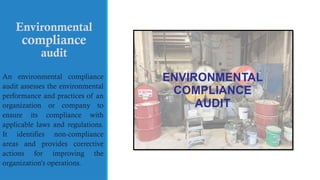
An environmental compliance
audit assesses the environmental
performance and practices of an
organization or company to
ensure its compliance with
applicable laws and regulations.
It identifies non-compliance
areas and provides corrective
actions for improving the
organization’s operations.
Environmental compliance audit –
Benefits:
Helps in ensuring compliance with laws.
Reduces risk / costs with non-compliance.
Gap between promises and results.
Pollution & waste reducing, conserving resources.
Helps in improving Environmental Performance.
Environmental
Management
Audit
The environmental management audit
helps the organization or company
understand how it is performing on its
own environmental performance
standards.
EMS auditing not only improves a
company's general environmental
compliance and performance but also
provides:
• A process for using pollution-control
practices to achieve EMS objectives.
• More efficient use of scarce
environmental resources.
Environmental Management Audit –
Benefits:
• Ensuring legislative compliance.
• Reducing environmental impacts.
• Reducing waste, water and energy costs (annual savings are typically greater
than our fee for the audit)
• Improving relations with stakeholders.
• Health & Safety
Functional
Environmental
Audit
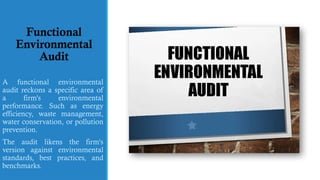
A functional environmental
audit reckons a specific area of
a firm's environmental
performance. Such as energy
efficiency, waste management,
water conservation, or pollution
prevention.
The audit likens the firm's
version against environmental
standards, best practices, and
benchmarks.
Environmental auditing in Civil Engineering
•Construction Site Audits
•Material Selection Audits
•Energy Efficiency Audits
Construction
Site Audits
1. Monitor construction
practices.

2. Identify potential
environmental risks.
3. Ensure compliance with
safety and environmental
regulations.
Material Selection Audits
Evaluate the environmental impact of construction materials.
Optimize material choices for sustainability.
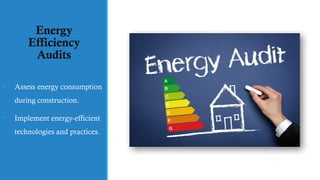
Energy
Efficiency
Audits
• Assess energy consumption
during construction.
• Implement energy-efficient
technologies and practices.
Objectives of Environmental Audit
1. An environmental audit programme which is designed and implemented properly
can enhance an industry’s environmental performance.
2. Monitoring the scale of optimum utilization of the resources and evaluating the
company at national and international level.
3. To suggest for using alternative energy for the conservation of energy resources.
4. Evaluation of waste water quality and determination of waste water characteristics
and their effects on the living system.
5. Maintenance of labour/ occupational health and medicine.
6. Proper documentation of environmental compliance status.
7. To help minimizer the waste through modern cleaner technologies.
Advantage
• Preparation of Environmental management plan
• Assessment of environmental input and risks
• Identifying areas of strength and weakness for improvements.
• Evaluation of pollution control
• Assuring safety of plant, environment and human beings
• Enhancement of loss prevention, manpower development and marketing
• Budgeting for pollution control, waste prevention, reduction, recycling and reuse.
Problems Encountered During Audit
Problems which the audit team may face are variable with respect to facility. However
what is expected and needs attention are:
1. Prior history of the site
2. Age of relevant equipment
3. Lack of records related to the relevant equipment
4. Attitude of concerned personnel on site towards audit studies
5. Responses of the concerned management for implementation of corrective measures.
Audit Programmes in India
The environment audit programmes were initiated in early ninety's. The Central
Pollution Control Board initiated a study in 18 major polluting industries in 1991-
92. At the same time a paper on “Outline of Environmental Audits was prepared
by MOEF and circulated for comments. This process resulted into issuing a
gazette notification on March 13, 1992 through which submission of the
Environmental Audit Report has been made mandatory. The term Audit Report
was later changed to “Statement” through a revised notification of April 22, 1993.
The industries are supposed to submit their Auditing Statements to the concerned
Boards on or before Sept. 30 every year beginning 1993.
Case Study
Environmental Audit of Sugar Factory:
A study was done on Kumbhi Kasari Factory, Kolhapur by Rao T.B , Sonal Chonde, Pallavi
Bhosale, Jadhav A.S. and Raut P.D. Department of environmental Science, Shivaji University,
Kolhapur
The sugar industry plays a very important role in India’s national economy. As all stages of
sugar production are water intensive and discharging wastewater containing high level of oil,
suspended solids, organic matter and chemicals and therefore the sugar industry is one of the
most water polluting industries. Therefore conducting “Environmental Audit” in a sugar factory
is no longer an option but a sound precaution and a proactive measure in today’s heavily
regulated environment.
Case Study
The environmental audit conducted at Kumbhi- Kasari Sugar Factory will be effective
to reduce energy consumption of the water and use bio gases as fuel. It saves the
power and improved environmental protection for sustainable industrial operations.
The environmental audit plays an important role to have check on pollution control.
Further studies on environmental audit with references to various types of the
industries are needed in order to study various process, activities and their positive or
negative impact on the environment.
THANK YOU

ENVIRONMENTAL AUDIT on eia report (1).pptx

  • 1.
    ENVIRONMENTAL AUDIT PRESENTED TO: DR.DISHA THAKUR Presentedby: Saksham Chaudhary (18202610048) Harish Kumar (18202610027) Himanshu Mehta (18202610028)
  • 2.
    TABLE OF CONTENTS:- •INTRODUCTION • TYPES OF ENVIRONMENTAL AUDIT • ENVIRONMENTAL AUDIT PROCESS • OBJECTIVES OF ENVIRONMENTAL AUDIT • PORBLUMS ENCOUNTERED DURING AUDIT • AUDIT PROGRAMMES IN INDIA • CASE STUDY
  • 3.
    ENVIRONMENTAL AUDIT Environmental auditis a management tool comprising a systematic, documented periodic and objective evaluation of an organization performing functions of production within the mandated regulatory requirements. For the impact of industries, and their product on natural resources and environmental quality it is necessary to have “ Environmental Audit” to ensure sustainable industrial developments.
  • 4.
    Purpose of EnvironmentalAudit The obvious advantages of environmental auditing is to help safeguard the environment and to substantiate compliance with local, regional and national laws and regulations, and with the company policy and standards. The environmental audit studies serve the following three basic purposes. 1. Compilation of the complete information on the operation of the industrial facility and its potential sources of pollution through technical inspection. 2. Evaluation of the conditions surrounding the industrial facility in order to estimate possible impacts which may be caused and suggested measures for such situations. 3. Preparation and implementation of action plans for better control of the environment and environmentally related industrial activities, including further developmental activities of the areas.
  • 5.
    Areas of EnvironmentalAuditing Material management, saving and alternatives Energy management and savings Water management and economy of use Waste generation, management and disposal Noise reduction, evaluation and control(internal and external)
  • 6.
    Categories of EnvironmentalAuditing Material Audit Energy Audit Water Audit Health and Safety Audit Environmental Quality Audit Waste Management Audit Engineering Audit Compliance Audit
  • 8.
    Types of EnvironmentalAudit There are three types of environmental audit for different goals. 1. Environmental compliance audit 2. Environmental Management audit 3. Functional environmental audit
  • 9.
    Environmental compliance audit An environmental compliance auditassesses the environmental performance and practices of an organization or company to ensure its compliance with applicable laws and regulations. It identifies non-compliance areas and provides corrective actions for improving the organization’s operations.
  • 10.
    Environmental compliance audit– Benefits: Helps in ensuring compliance with laws. Reduces risk / costs with non-compliance. Gap between promises and results. Pollution & waste reducing, conserving resources. Helps in improving Environmental Performance.
  • 11.
    Environmental Management Audit The environmental managementaudit helps the organization or company understand how it is performing on its own environmental performance standards. EMS auditing not only improves a company's general environmental compliance and performance but also provides: • A process for using pollution-control practices to achieve EMS objectives. • More efficient use of scarce environmental resources.
  • 12.
    Environmental Management Audit– Benefits: • Ensuring legislative compliance. • Reducing environmental impacts. • Reducing waste, water and energy costs (annual savings are typically greater than our fee for the audit) • Improving relations with stakeholders. • Health & Safety
  • 13.
    Functional Environmental Audit A functional environmental auditreckons a specific area of a firm's environmental performance. Such as energy efficiency, waste management, water conservation, or pollution prevention. The audit likens the firm's version against environmental standards, best practices, and benchmarks.
  • 14.
    Environmental auditing inCivil Engineering •Construction Site Audits •Material Selection Audits •Energy Efficiency Audits
  • 15.
    Construction Site Audits 1. Monitorconstruction practices. 2. Identify potential environmental risks. 3. Ensure compliance with safety and environmental regulations.
  • 16.
    Material Selection Audits Evaluatethe environmental impact of construction materials. Optimize material choices for sustainability.
  • 17.
    Energy Efficiency Audits • Assess energyconsumption during construction. • Implement energy-efficient technologies and practices.
  • 21.
    Objectives of EnvironmentalAudit 1. An environmental audit programme which is designed and implemented properly can enhance an industry’s environmental performance. 2. Monitoring the scale of optimum utilization of the resources and evaluating the company at national and international level. 3. To suggest for using alternative energy for the conservation of energy resources. 4. Evaluation of waste water quality and determination of waste water characteristics and their effects on the living system. 5. Maintenance of labour/ occupational health and medicine. 6. Proper documentation of environmental compliance status. 7. To help minimizer the waste through modern cleaner technologies.
  • 22.
    Advantage • Preparation ofEnvironmental management plan • Assessment of environmental input and risks • Identifying areas of strength and weakness for improvements. • Evaluation of pollution control • Assuring safety of plant, environment and human beings • Enhancement of loss prevention, manpower development and marketing • Budgeting for pollution control, waste prevention, reduction, recycling and reuse.
  • 23.
    Problems Encountered DuringAudit Problems which the audit team may face are variable with respect to facility. However what is expected and needs attention are: 1. Prior history of the site 2. Age of relevant equipment 3. Lack of records related to the relevant equipment 4. Attitude of concerned personnel on site towards audit studies 5. Responses of the concerned management for implementation of corrective measures.
  • 26.
    Audit Programmes inIndia The environment audit programmes were initiated in early ninety's. The Central Pollution Control Board initiated a study in 18 major polluting industries in 1991- 92. At the same time a paper on “Outline of Environmental Audits was prepared by MOEF and circulated for comments. This process resulted into issuing a gazette notification on March 13, 1992 through which submission of the Environmental Audit Report has been made mandatory. The term Audit Report was later changed to “Statement” through a revised notification of April 22, 1993. The industries are supposed to submit their Auditing Statements to the concerned Boards on or before Sept. 30 every year beginning 1993.
  • 27.
    Case Study Environmental Auditof Sugar Factory: A study was done on Kumbhi Kasari Factory, Kolhapur by Rao T.B , Sonal Chonde, Pallavi Bhosale, Jadhav A.S. and Raut P.D. Department of environmental Science, Shivaji University, Kolhapur The sugar industry plays a very important role in India’s national economy. As all stages of sugar production are water intensive and discharging wastewater containing high level of oil, suspended solids, organic matter and chemicals and therefore the sugar industry is one of the most water polluting industries. Therefore conducting “Environmental Audit” in a sugar factory is no longer an option but a sound precaution and a proactive measure in today’s heavily regulated environment.
  • 28.
    Case Study The environmentalaudit conducted at Kumbhi- Kasari Sugar Factory will be effective to reduce energy consumption of the water and use bio gases as fuel. It saves the power and improved environmental protection for sustainable industrial operations. The environmental audit plays an important role to have check on pollution control. Further studies on environmental audit with references to various types of the industries are needed in order to study various process, activities and their positive or negative impact on the environment.
  • 29.