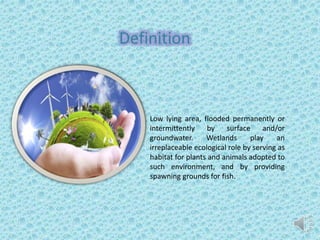
Wetlands are low-lying areas that are permanently or intermittently flooded by surface or groundwater. They play an irreplaceable ecological role by serving as habitat for adapted plants and animals, and providing spawning grounds for fish.
Low lying area,flooded permanently or
intermittently by surface and/or
groundwater. Wetlands play an
irreplaceable ecological role by serving as
habitat for plants and animals adopted to
such environment, and by providing
spawning grounds for fish.
Life/Environment Interaction
All lifethat has survived must have adapted to conditions of its
environment. Temperature, light, humidity, soil nutrients, etc., all influence
any species, within any environment. However life in turn modifies, in
various forms, its conditions. Some long term modifications along the
history of our planet have been significant, such as the incorporation of
oxygen to the atmosphere. This process consisted in the breakdown of
carbon dioxide by anaerobic microorganisms that used the carbon in their
metabolism and released the oxygen to the atmosphere. This led to the
existence of oxygen-based plant and animal life, the great oxygenation
event. Other interactions are more immediate and simple, such as the
smoothing effect that forests have on the temperature cycle, compared to
neighboring unforested areas.[citation needed]
5.
Related Studies
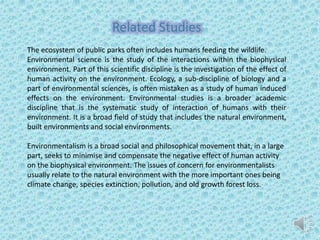
The ecosystemof public parks often includes humans feeding the wildlife.
Environmental science is the study of the interactions within the biophysical
environment. Part of this scientific discipline is the investigation of the effect of
human activity on the environment. Ecology, a sub-discipline of biology and a
part of environmental sciences, is often mistaken as a study of human induced
effects on the environment. Environmental studies is a broader academic
discipline that is the systematic study of interaction of humans with their
environment. It is a broad field of study that includes the natural environment,
built environments and social environments.
Environmentalism is a broad social and philosophical movement that, in a large
part, seeks to minimise and compensate the negative effect of human activity
on the biophysical environment. The issues of concern for environmentalists
usually relate to the natural environment with the more important ones being
climate change, species extinction, pollution, and old growth forest loss.
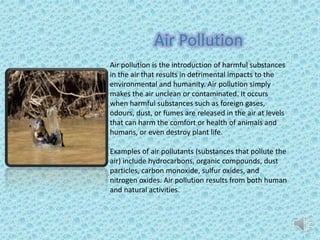
Air Pollution
Air pollutionis the introduction of harmful substances
in the air that results in detrimental impacts to the
environmental and humanity. Air pollution simply
makes the air unclean or contaminated. It occurs
when harmful substances such as foreign gases,
odours, dust, or fumes are released in the air at levels
that can harm the comfort or health of animals and
humans, or even destroy plant life.
Examples of air pollutants (substances that pollute the
air) include hydrocarbons, organic compounds, dust
particles, carbon monoxide, sulfur oxides, and
nitrogen oxides. Air pollution results from both human
and natural activities.
9.
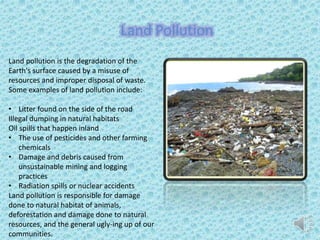
Land pollution isthe degradation of the
Earth's surface caused by a misuse of
resources and improper disposal of waste.
Some examples of land pollution include:
• Litter found on the side of the road
Illegal dumping in natural habitats
Oil spills that happen inland
• The use of pesticides and other farming
chemicals
• Damage and debris caused from
unsustainable mining and logging
practices
• Radiation spills or nuclear accidents
Land pollution is responsible for damage
done to natural habitat of animals,
deforestation and damage done to natural
resources, and the general ugly-ing up of our
communities.
Land Pollution
10.
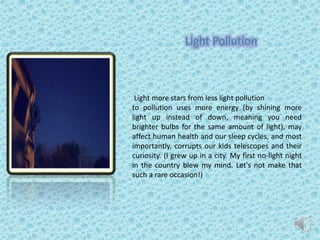
Light Pollution
Light morestars from less light pollution
to pollution uses more energy (by shining more
light up instead of down, meaning you need
brighter bulbs for the same amount of light), may
affect human health and our sleep cycles, and most
importantly, corrupts our kids telescopes and their
curiosity. (I grew up in a city. My first no-light night
in the country blew my mind. Let's not make that
such a rare occasion!)
11.
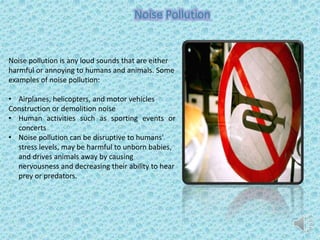
Noise Pollution
Noise pollutionis any loud sounds that are either
harmful or annoying to humans and animals. Some
examples of noise pollution:
• Airplanes, helicopters, and motor vehicles
Construction or demolition noise
• Human activities such as sporting events or
concerts
• Noise pollution can be disruptive to humans'
stress levels, may be harmful to unborn babies,
and drives animals away by causing
nervousness and decreasing their ability to hear
prey or predators.
12.
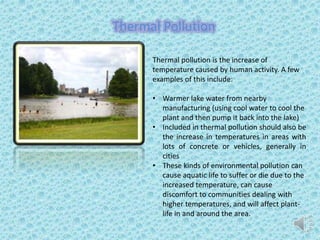
Thermal pollution isthe increase of
temperature caused by human activity. A few
examples of this include:
• Warmer lake water from nearby
manufacturing (using cool water to cool the
plant and then pump it back into the lake)
• Included in thermal pollution should also be
the increase in temperatures in areas with
lots of concrete or vehicles, generally in
cities
• These kinds of environmental pollution can
cause aquatic life to suffer or die due to the
increased temperature, can cause
discomfort to communities dealing with
higher temperatures, and will affect plant-
life in and around the area.
Thermal Pollution
13.
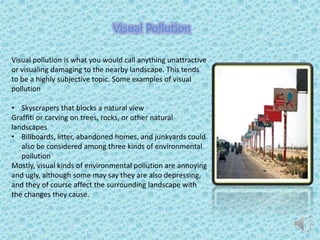
Visual pollution iswhat you would call anything unattractive
or visualing damaging to the nearby landscape. This tends
to be a highly subjective topic. Some examples of visual
pollution
• Skyscrapers that blocks a natural view
Graffiti or carving on trees, rocks, or other natural
landscapes
• Billboards, litter, abandoned homes, and junkyards could
also be considered among three kinds of environmental
pollution
Mostly, visual kinds of environmental pollution are annoying
and ugly, although some may say they are also depressing,
and they of course affect the surrounding landscape with
the changes they cause.
Visual Pollution
14.
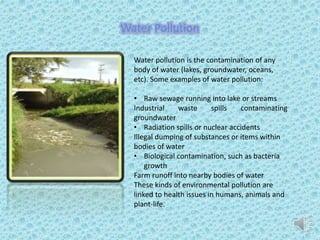
Water pollution isthe contamination of any
body of water (lakes, groundwater, oceans,
etc). Some examples of water pollution:
• Raw sewage running into lake or streams
Industrial waste spills contaminating
groundwater
• Radiation spills or nuclear accidents
Illegal dumping of substances or items within
bodies of water
• Biological contamination, such as bacteria
growth
Farm runoff into nearby bodies of water
These kinds of environmental pollution are
linked to health issues in humans, animals and
plant-life.
Water Pollution


![Life/Environment Interaction
All life that has survived must have adapted to conditions of its
environment. Temperature, light, humidity, soil nutrients, etc., all influence
any species, within any environment. However life in turn modifies, in
various forms, its conditions. Some long term modifications along the
history of our planet have been significant, such as the incorporation of
oxygen to the atmosphere. This process consisted in the breakdown of
carbon dioxide by anaerobic microorganisms that used the carbon in their
metabolism and released the oxygen to the atmosphere. This led to the
existence of oxygen-based plant and animal life, the great oxygenation
event. Other interactions are more immediate and simple, such as the
smoothing effect that forests have on the temperature cycle, compared to
neighboring unforested areas.[citation needed]](https://image.slidesharecdn.com/amandeepkaur-160926061814/85/ENVIRONMENT-4-320.jpg)