Civil Engineering Department
Subject : Environmental
Engineering
Topic : Characteristics of sound and its
measurements
Name : Zala surpalsinh. I
Enroll No : 150600106063
Characteristics of sound
• 1.Frequency (f) :
• Number of vibrations (cycles) made in one
second is called frequency of sound.
• Unit of frequency is Hertz.
• 1 Hz = 1 cycle per second.
• The sound of human speech is in the range of
300 Hz to 3000 Hz.
• 2. Time period (T) :
• The time taken by the vibrating particle to
complete one vibration ( forth and back ) is called
time period.
• It is the time period between successive peaks or
troughs of the oscillations.
• T = 1/f
• 3. Intensity ( I ) :
• Amount of sound energy received per second
from the source of sound per unit area
perpendicular to the direction of wave is called
intensity of sound.
• I = W/A = sound power / unit area perpendicularr
• unit is watt/m² .
• 4. Wavelength : The distance travelled by the
sound wave during one time period is known as
wavelength.
• It is the distance between two adjacent crests or
troughs of pressure.
• 5. Sound power :
• it is the sound energy transferred per second
from the source to the air.
• 6. Sound pressure :
• It is the amount of air pressure fluctuation
created by the source.
• we hear sound pressure as ‘ loudness '.
• Sound pressure is expressed in pascals (Pa).
• 1 Pa = 1 N/m² (in SI unit)
• in absolute system, unit of sound pressure is
dynes/cm².
• A healthy young person can hear sound
pressures as low as 2*10^-5 Pa.
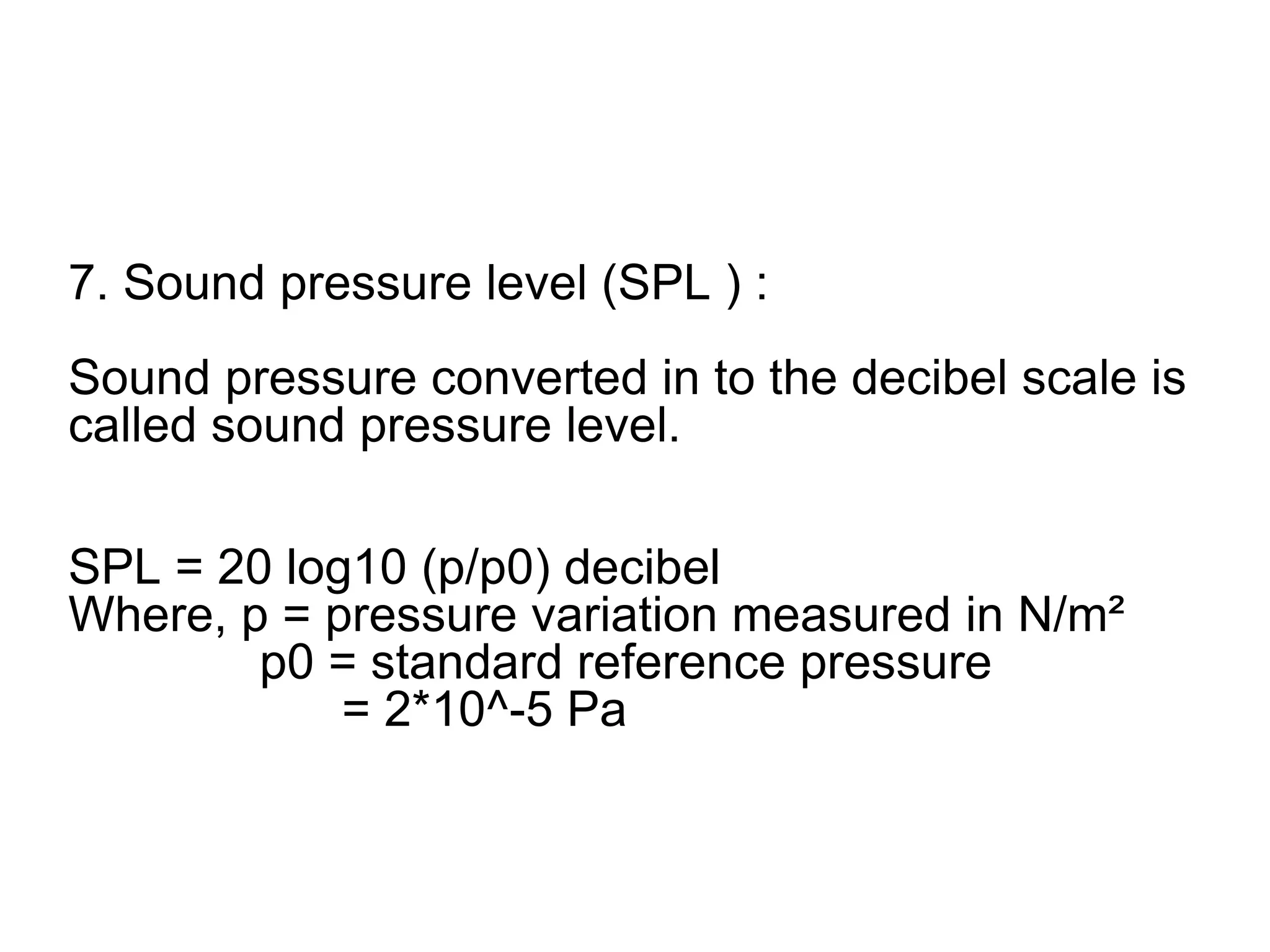
7. Sound pressure level (SPL ) :
Sound pressure converted in to the decibel scale is
called sound pressure level.
SPL = 20 log10 (p/p0) decibel
Where, p = pressure variation measured in N/m²
p0 = standard reference pressure
= 2*10^-5 Pa
• 8. Amplitude of wave (A) :
• The amplitude of wave is the height of the peak
or depth of the trough measured from zero
pressure line.
Measurement of sound
The amount of sound energy received per second
from the source of sound, per unit area perpendicular
to the direction of wave is called intensity of sound.
The intensity of sound is expressed in watt/m².
The value of reference intensity is 10^-12 watt/m².
• decibel (dB) = 10 log10 (I/Io)
• where, I = measured intensity
• Io = reference intensity = 10^-12 W/m².
• not only, loudness is determines the harmfullness of the
sound but the frequency and pitch of sound is also
responsible for this.
• if a person hears two sounds of same sound pressure but
different frequencies, one sound may appear louder than
the other. This happens because we hear high frequency
noise much better than low frequency noise.
• To take the pitch or frequency of sound in to the account,
a modified scale is used now a days that is decibel-A,
expressed as dBA.
Permissible ambient noise
levels in india
Zone
AZoneA
Thank you

Environmental Engineering

  • 1.
    Civil Engineering Department Subject: Environmental Engineering Topic : Characteristics of sound and its measurements Name : Zala surpalsinh. I Enroll No : 150600106063
  • 2.
    Characteristics of sound •1.Frequency (f) : • Number of vibrations (cycles) made in one second is called frequency of sound. • Unit of frequency is Hertz. • 1 Hz = 1 cycle per second. • The sound of human speech is in the range of 300 Hz to 3000 Hz.
  • 3.
    • 2. Timeperiod (T) : • The time taken by the vibrating particle to complete one vibration ( forth and back ) is called time period. • It is the time period between successive peaks or troughs of the oscillations. • T = 1/f
  • 4.
    • 3. Intensity( I ) : • Amount of sound energy received per second from the source of sound per unit area perpendicular to the direction of wave is called intensity of sound. • I = W/A = sound power / unit area perpendicularr • unit is watt/m² .
  • 5.
    • 4. Wavelength: The distance travelled by the sound wave during one time period is known as wavelength. • It is the distance between two adjacent crests or troughs of pressure. • 5. Sound power : • it is the sound energy transferred per second from the source to the air.
  • 6.
    • 6. Soundpressure : • It is the amount of air pressure fluctuation created by the source. • we hear sound pressure as ‘ loudness '. • Sound pressure is expressed in pascals (Pa). • 1 Pa = 1 N/m² (in SI unit) • in absolute system, unit of sound pressure is dynes/cm². • A healthy young person can hear sound pressures as low as 2*10^-5 Pa.
  • 7.
    7. Sound pressurelevel (SPL ) : Sound pressure converted in to the decibel scale is called sound pressure level. SPL = 20 log10 (p/p0) decibel Where, p = pressure variation measured in N/m² p0 = standard reference pressure = 2*10^-5 Pa
  • 8.
    • 8. Amplitudeof wave (A) : • The amplitude of wave is the height of the peak or depth of the trough measured from zero pressure line.
  • 9.
    Measurement of sound Theamount of sound energy received per second from the source of sound, per unit area perpendicular to the direction of wave is called intensity of sound. The intensity of sound is expressed in watt/m². The value of reference intensity is 10^-12 watt/m².
  • 10.
    • decibel (dB)= 10 log10 (I/Io) • where, I = measured intensity • Io = reference intensity = 10^-12 W/m². • not only, loudness is determines the harmfullness of the sound but the frequency and pitch of sound is also responsible for this. • if a person hears two sounds of same sound pressure but different frequencies, one sound may appear louder than the other. This happens because we hear high frequency noise much better than low frequency noise. • To take the pitch or frequency of sound in to the account, a modified scale is used now a days that is decibel-A, expressed as dBA.
  • 11.
  • 12.