Resource Conflicts
-Extraction, Access and Control System
Vinay
Natural Resource Management
Guru Gobind Singh Indraprastha University
Content
1) What is resource conflict?
2) Various stages of conflict
3) Why do conflicts arises?
4) What are the various components in resource conflict?
5) Who are the various actors in conflict?
6) How to handle these resource conflict?
7) Different ways to handle the conflicts
8) Examples
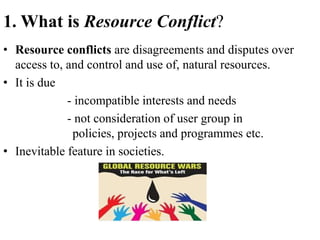
1. What is Resource Conflict?
• Resource conflicts are disagreements and disputes over
access to, and control and use of, natural resources.
• It is due
- incompatible interests and needs
- not consideration of user group in
policies, projects and programmes etc.
• Inevitable feature in societies.
2. Various Stages of Conflicts
Misunderstanding
Extreme Behaviour
Crises
Unbearable
Mistrust
Avoiding
3. Why do conflict arises?
a) Growing competition over natural resources
# Factors responsible for this
- Demographic changes (e.g. population growth, migration & urbanization)
- Market Pressure (e.g. Commercialization, privatization, integration of economies )
- Environmental Changes (e.g. Flood, Droughts, Wildlife migration)
# Other conditions influence how access to resources could become
contested
i) Scarcity of resources
ii) The extent to which it is shared by two or other groups
iii) The relative power of those group
iv) The degree of dependence on particular resource Contd.
b) Structural causes of Conflicts
# arises due to two kind of laws applied in an area i.e. Customary law
and State law
# Both these laws are organized differently. Former is local and other is
national state law
# “Right to land” commonly affected.
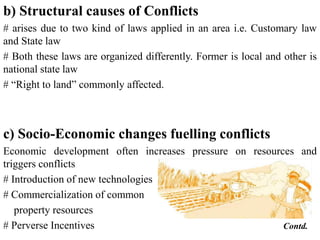
c) Socio-Economic changes fuelling conflicts
Economic development often increases pressure on resources and
triggers conflicts
# Introduction of new technologies
# Commercialization of common
property resources
# Perverse Incentives Contd.
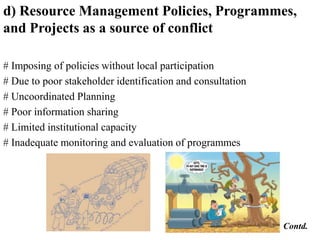
d) Resource Management Policies, Programmes,
and Projects as a source of conflict
# Imposing of policies without local participation
# Due to poor stakeholder identification and consultation
# Uncoordinated Planning
# Poor information sharing
# Limited institutional capacity
# Inadequate monitoring and evaluation of programmes
Contd.
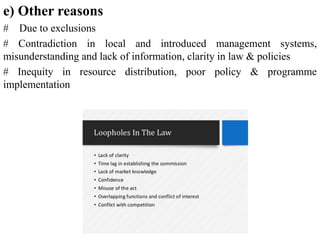
e) Other reasons
# Due to exclusions
# Contradiction in local and introduced management systems,
misunderstanding and lack of information, clarity in law & policies
# Inequity in resource distribution, poor policy & programme
implementation
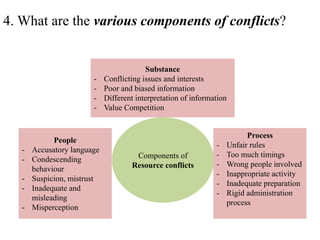
4. What are the various components of conflicts?
Components of
Resource conflicts
Substance
- Conflicting issues and interests
- Poor and biased information
- Different interpretation of information
- Value Competition
People
- Accusatory language
- Condescending
behaviour
- Suspicion, mistrust
- Inadequate and
misleading
- Misperception
Process
- Unfair rules
- Too much timings
- Wrong people involved
- Inappropriate activity
- Inadequate preparation
- Rigid administration
process
5. Who are the various actors in conflicts?
• Neighbouring community
• Villagers
• Community based organizations- Panchayats
• Domestic and multilateral barrier
• Government, & Non-Govt. organization
• International development agencies e.g. Greenpeace
6. How to handle these resource conflicts?
# Mode of conflicts
- Formal, Informal and Violent/Peaceful
# Different systems to handle conflicts
a) Customary action
- Negotiation, Mediation, Arbitration
b) National Legal Systems
- Judicial, Regulation, Adjudication
c) Alternate System development
- Joint decision making, Negotiating
7. Different ways to handle the conflicts
• Avoidance: acting in ways to keep a conflict becoming
public knowledge
• Mediating: using third party to facilitate the negotiation
process. Mediator should not impose a solution
• Arbitration: submitting a conflicts to a mutually agreeable
state.
• Coercion: Threatening or using force to impose one’s will.
• Adjudication: Adjudication is the legal process by which
an arbiter or judge reviews evidence and argumentation,
including legal reasoning set forth by opposing parties or
litigants to come to a decision which determines rights and
obligations between the parties involved.
• Negotiating : Voluntary process in which parties reach
agreement through mutual consensus.
8. Examples:
 Water Resources conflict: Indus River conflict between
India and Pakistan, Brahmaputra River conflict between
India and China, Kaveri River conflict between Tamil Nadu
and Karnataka
 Land Conflicts: India’s land conflict with Pakistan &
China, and Southern India’s Farmer conflict over copper
smelter run by Vedanta Resources and bullet train with state
govt.
 Forest resource conflicts: Illegal forestry activities and
poor governance in tropical forested regions. E.g. Poaching
 Man and Animal Conflicts
Natural Resource Conflicts.pptx

Natural Resource Conflicts.pptx

  • 1.
    Resource Conflicts -Extraction, Accessand Control System Vinay Natural Resource Management Guru Gobind Singh Indraprastha University
  • 2.
    Content 1) What isresource conflict? 2) Various stages of conflict 3) Why do conflicts arises? 4) What are the various components in resource conflict? 5) Who are the various actors in conflict? 6) How to handle these resource conflict? 7) Different ways to handle the conflicts 8) Examples
  • 3.
    1. What isResource Conflict? • Resource conflicts are disagreements and disputes over access to, and control and use of, natural resources. • It is due - incompatible interests and needs - not consideration of user group in policies, projects and programmes etc. • Inevitable feature in societies.
  • 4.
    2. Various Stagesof Conflicts Misunderstanding Extreme Behaviour Crises Unbearable Mistrust Avoiding
  • 5.
    3. Why doconflict arises? a) Growing competition over natural resources # Factors responsible for this - Demographic changes (e.g. population growth, migration & urbanization) - Market Pressure (e.g. Commercialization, privatization, integration of economies ) - Environmental Changes (e.g. Flood, Droughts, Wildlife migration) # Other conditions influence how access to resources could become contested i) Scarcity of resources ii) The extent to which it is shared by two or other groups iii) The relative power of those group iv) The degree of dependence on particular resource Contd.
  • 6.
    b) Structural causesof Conflicts # arises due to two kind of laws applied in an area i.e. Customary law and State law # Both these laws are organized differently. Former is local and other is national state law # “Right to land” commonly affected. c) Socio-Economic changes fuelling conflicts Economic development often increases pressure on resources and triggers conflicts # Introduction of new technologies # Commercialization of common property resources # Perverse Incentives Contd.
  • 7.
    d) Resource ManagementPolicies, Programmes, and Projects as a source of conflict # Imposing of policies without local participation # Due to poor stakeholder identification and consultation # Uncoordinated Planning # Poor information sharing # Limited institutional capacity # Inadequate monitoring and evaluation of programmes Contd.
  • 8.
    e) Other reasons #Due to exclusions # Contradiction in local and introduced management systems, misunderstanding and lack of information, clarity in law & policies # Inequity in resource distribution, poor policy & programme implementation
  • 9.
    4. What arethe various components of conflicts? Components of Resource conflicts Substance - Conflicting issues and interests - Poor and biased information - Different interpretation of information - Value Competition People - Accusatory language - Condescending behaviour - Suspicion, mistrust - Inadequate and misleading - Misperception Process - Unfair rules - Too much timings - Wrong people involved - Inappropriate activity - Inadequate preparation - Rigid administration process
  • 10.
    5. Who arethe various actors in conflicts? • Neighbouring community • Villagers • Community based organizations- Panchayats • Domestic and multilateral barrier • Government, & Non-Govt. organization • International development agencies e.g. Greenpeace
  • 11.
    6. How tohandle these resource conflicts? # Mode of conflicts - Formal, Informal and Violent/Peaceful # Different systems to handle conflicts a) Customary action - Negotiation, Mediation, Arbitration b) National Legal Systems - Judicial, Regulation, Adjudication c) Alternate System development - Joint decision making, Negotiating
  • 12.
    7. Different waysto handle the conflicts • Avoidance: acting in ways to keep a conflict becoming public knowledge • Mediating: using third party to facilitate the negotiation process. Mediator should not impose a solution • Arbitration: submitting a conflicts to a mutually agreeable state.
  • 13.
    • Coercion: Threateningor using force to impose one’s will. • Adjudication: Adjudication is the legal process by which an arbiter or judge reviews evidence and argumentation, including legal reasoning set forth by opposing parties or litigants to come to a decision which determines rights and obligations between the parties involved. • Negotiating : Voluntary process in which parties reach agreement through mutual consensus.
  • 14.
    8. Examples:  WaterResources conflict: Indus River conflict between India and Pakistan, Brahmaputra River conflict between India and China, Kaveri River conflict between Tamil Nadu and Karnataka  Land Conflicts: India’s land conflict with Pakistan & China, and Southern India’s Farmer conflict over copper smelter run by Vedanta Resources and bullet train with state govt.  Forest resource conflicts: Illegal forestry activities and poor governance in tropical forested regions. E.g. Poaching  Man and Animal Conflicts