How to use technology to differentiate
instruction and meet the needs of students from
diverse backgrounds.
 Differentiated Instruction is an older concept that
evolved from educational theorists, particularly
followers of the constructivist theory, that states
students have different learning styles that need
to be met in order to learn.
 Universal Design for Learning is a newer concept
that evolved from special education instruction. It
involves a personalized instruction that meets
the needs of an individual not a blanket
characteristic of the student.
 GAME plan is an acronym for goals, action,
monitor, and evaluate/extend
 Goals-there are 3 important parts to the goal
1. Outcome…What am I supposed to learn from this?
2. Flexibility…How am I supposed to learn this?
3. Purpose… Why am I supposed to learn this?
 Action- the action is where the instruction is
individualized. How does the student best
learn? What tools do they need?
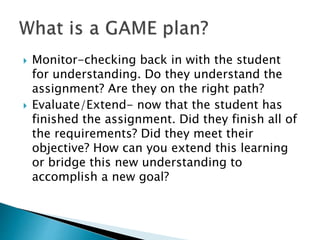
 Monitor-checking back in with the student
for understanding. Do they understand the
assignment? Are they on the right path?
 Monitor-checking back in with the student
for understanding. Do they understand the
assignment? Are they on the right path?
 Evaluate/Extend- now that the student has
finished the assignment. Did they finish all of
the requirements? Did they meet their
objective? How can you extend this learning
or bridge this new understanding to
accomplish a new goal?
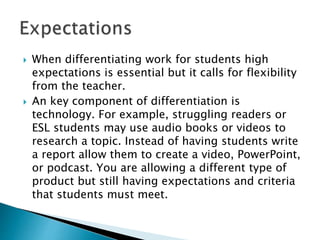
 When differentiating work for students high
expectations is essential but it calls for flexibility
from the teacher.
 An key component of differentiation is
technology. For example, struggling readers or
ESL students may use audio books or videos to
research a topic. Instead of having students write
a report allow them to create a video, PowerPoint,
or podcast. You are allowing a different type of
product but still having expectations and criteria
that students must meet.
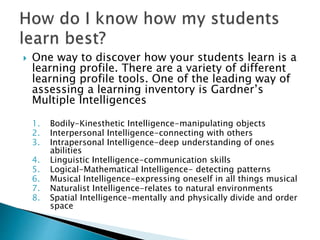
 One way to discover how your students learn is a
learning profile. There are a variety of different
learning profile tools. One of the leading way of
assessing a learning inventory is Gardner’s
Multiple Intelligences
1. Bodily-Kinesthetic Intelligence-manipulating objects
2. Interpersonal Intelligence-connecting with others
3. Intrapersonal Intelligence-deep understanding of ones
abilities
4. Linguistic Intelligence-communication skills
5. Logical-Mathematical Intelligence- detecting patterns
6. Musical Intelligence-expressing oneself in all things musical
7. Naturalist Intelligence-relates to natural environments
8. Spatial Intelligence-mentally and physically divide and order
space
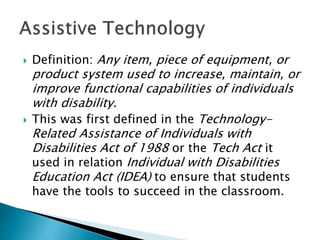
 Definition: Any item, piece of equipment, or
product system used to increase, maintain, or
improve functional capabilities of individuals
with disability.
 This was first defined in the Technology-
Related Assistance of Individuals with
Disabilities Act of 1988 or the Tech Act it
used in relation Individual with Disabilities
Education Act (IDEA) to ensure that students
have the tools to succeed in the classroom.
 Assistive Technology range from low tech devices
such as clothes pins and paper clips to high tech
devices such as software programs and
computerized voice outputs.
 Mid Level assistive technology such as cd players,
word processors, and even smartphones, are
being used daily. Studies show that they are in
use by more people than ever with “more than
20% of U.S. adults live with some form of
disability, according to a September 2015 report
released by the U.S. Centers for Disease Control
and Prevention.”(Kirkpatrick, 2016)
 A major concern for students with students
needing assistive technology is “equitable
access”.
 Equitable access may be a problem for a
variety of reasons. One reason is that
students from disadvantaged socio-economic
statuses may simply not have the device, but
the major problem seems to be access to
reliable, affordable internet services.
 When using assistive technology and technology
based projects one needs to understand the
culture of your student body. In some cultures,
oral communication is held in high regard, so the
written works may not be as respected. In others,
intrinsic student motivation may not be
expected, they may be expected to be a passive
learner receiving the lessons instead. So it is
important to understand your class and make
sure that they understand your method and
purpose as well.
 Cennamo, K., Ross, J. D., & Ertmer, P. A.
(2010). Technology integration for
meaningful classroom use: A standards-
based approach. Belmont, CA: Wadsworth.
 Kirkpatrick, K. (2016). Existing technologies
can assist the disabled. Communications of
the ACM Commun. ACM, 59(4), 16-18.

Learning

  • 1.
    How to usetechnology to differentiate instruction and meet the needs of students from diverse backgrounds.
  • 2.
     Differentiated Instructionis an older concept that evolved from educational theorists, particularly followers of the constructivist theory, that states students have different learning styles that need to be met in order to learn.  Universal Design for Learning is a newer concept that evolved from special education instruction. It involves a personalized instruction that meets the needs of an individual not a blanket characteristic of the student.
  • 3.
     GAME planis an acronym for goals, action, monitor, and evaluate/extend  Goals-there are 3 important parts to the goal 1. Outcome…What am I supposed to learn from this? 2. Flexibility…How am I supposed to learn this? 3. Purpose… Why am I supposed to learn this?  Action- the action is where the instruction is individualized. How does the student best learn? What tools do they need?  Monitor-checking back in with the student for understanding. Do they understand the assignment? Are they on the right path?
  • 4.
     Monitor-checking backin with the student for understanding. Do they understand the assignment? Are they on the right path?  Evaluate/Extend- now that the student has finished the assignment. Did they finish all of the requirements? Did they meet their objective? How can you extend this learning or bridge this new understanding to accomplish a new goal?
  • 5.
     When differentiatingwork for students high expectations is essential but it calls for flexibility from the teacher.  An key component of differentiation is technology. For example, struggling readers or ESL students may use audio books or videos to research a topic. Instead of having students write a report allow them to create a video, PowerPoint, or podcast. You are allowing a different type of product but still having expectations and criteria that students must meet.
  • 6.
     One wayto discover how your students learn is a learning profile. There are a variety of different learning profile tools. One of the leading way of assessing a learning inventory is Gardner’s Multiple Intelligences 1. Bodily-Kinesthetic Intelligence-manipulating objects 2. Interpersonal Intelligence-connecting with others 3. Intrapersonal Intelligence-deep understanding of ones abilities 4. Linguistic Intelligence-communication skills 5. Logical-Mathematical Intelligence- detecting patterns 6. Musical Intelligence-expressing oneself in all things musical 7. Naturalist Intelligence-relates to natural environments 8. Spatial Intelligence-mentally and physically divide and order space
  • 7.
     Definition: Anyitem, piece of equipment, or product system used to increase, maintain, or improve functional capabilities of individuals with disability.  This was first defined in the Technology- Related Assistance of Individuals with Disabilities Act of 1988 or the Tech Act it used in relation Individual with Disabilities Education Act (IDEA) to ensure that students have the tools to succeed in the classroom.
  • 8.
     Assistive Technologyrange from low tech devices such as clothes pins and paper clips to high tech devices such as software programs and computerized voice outputs.  Mid Level assistive technology such as cd players, word processors, and even smartphones, are being used daily. Studies show that they are in use by more people than ever with “more than 20% of U.S. adults live with some form of disability, according to a September 2015 report released by the U.S. Centers for Disease Control and Prevention.”(Kirkpatrick, 2016)
  • 9.
     A majorconcern for students with students needing assistive technology is “equitable access”.  Equitable access may be a problem for a variety of reasons. One reason is that students from disadvantaged socio-economic statuses may simply not have the device, but the major problem seems to be access to reliable, affordable internet services.
  • 10.
     When usingassistive technology and technology based projects one needs to understand the culture of your student body. In some cultures, oral communication is held in high regard, so the written works may not be as respected. In others, intrinsic student motivation may not be expected, they may be expected to be a passive learner receiving the lessons instead. So it is important to understand your class and make sure that they understand your method and purpose as well.
  • 11.
     Cennamo, K.,Ross, J. D., & Ertmer, P. A. (2010). Technology integration for meaningful classroom use: A standards- based approach. Belmont, CA: Wadsworth.  Kirkpatrick, K. (2016). Existing technologies can assist the disabled. Communications of the ACM Commun. ACM, 59(4), 16-18.