Cambridge IGCSE
Environmental Management
2024-2026
Overview of the IGCSE exam
Learners taking Cambridge IGCSE Environmental
Management must complete two written papers.
• Paper 1 Theory consists of two sections. Section A
contains short-answer and structured questions.
Section B contains short-answer and extended
response questions based on source material.
• Paper 2 Management in context contains short-
answer, data processing and analysis and extended
response questions based on source material.
Learners must answer all questions on each paper. There
is no coursework.
Overview of the IGCSE exam
Assessment objectives
To achieve success in their course, learners must
demonstrate three different types of skill.
– AO1 Knowledge and understanding.
• display factual knowledge about the syllabus topics
• demonstrate that they understand the concepts.
– AO2 Information handling and analysis.
• process and analyze unfamiliar information
• perform mathematical calculations on data
• draw supported conclusions.
– AO3 Investigation skills and making judgements.
• plan and carry out investigations
• draw conclusions from their results
• also evaluate their methods.
Why do we need to
Manage Resources?
If you have
all the resources on the planet,
HOW do you manage them?
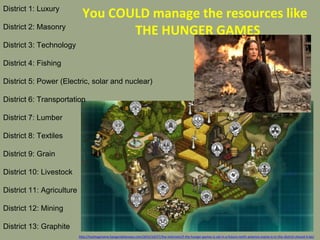
District 1: Luxury
District 2: Masonry
District 3: Technology
District 4: Fishing
District 5: Power (Electric, solar and nuclear)
District 6: Transportation
District 7: Lumber
District 8: Textiles
District 9: Grain
District 10: Livestock
District 11: Agriculture
District 12: Mining
District 13: Graphite
You COULD manage the resources like
THE HUNGER GAMES
http://hashtagmaine.bangordailynews.com/2015/10/27/the-internets/if-the-hunger-games-is-set-in-a-future-north-america-maine-is-in-this-district-should-it-be/
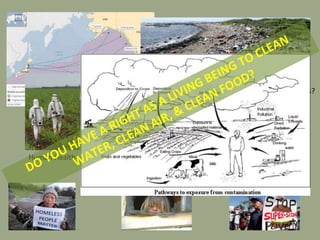
Why is it so complicated?
Social
Economic
Political
Environmental
Human Health
Cultural, Science, Religion, others?
Poverty, Supply & Demand, Opportunity, Local & Global Economies, others?
Local, State, National & International Laws, Acquisitions/Wars, others?
Social Justice, Cancer, Viruses, Pesticides, others?
Animal Welfare, Agriculture, Pesticide Availability,
others?
SUPERWEEDS
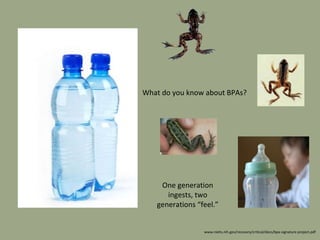
What do you know about BPAs?
One generation
ingests, two
generations “feel.”
www.niehs.nih.gov/recovery/critical/docs/bpa-signature-project.pdf
Bisphenol A
(BPA)
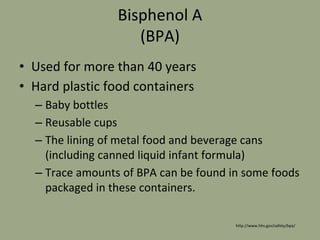
• Used for more than 40 years
• Hard plastic food containers
– Baby bottles
– Reusable cups
– The lining of metal food and beverage cans
(including canned liquid infant formula)
– Trace amounts of BPA can be found in some foods
packaged in these containers.
http://www.hhs.gov/safety/bpa/
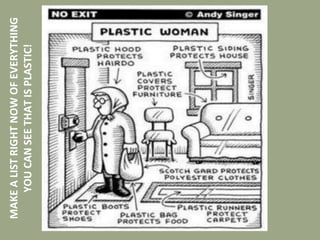
MAKE
A
LIST
RIGHT
NOW
OF
EVERYTHING
YOU
CAN
SEE
THAT
IS
PLASTIC!
Environmental Management Defined
Environmental management (noun):
(a) manipulation of the physical or social
environment of a person or group;
(b) management of human impact on the
environment, especially with the intention of
preserving natural resources.
OED (2013)
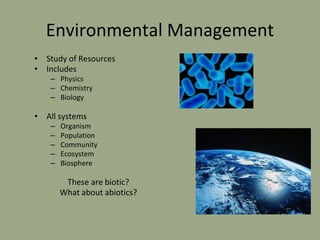
Environmental Management
• Study of Resources
• Includes
– Physics
– Chemistry
– Biology
• All systems
– Organism
– Population
– Community
– Ecosystem
– Biosphere
These are biotic?
What about abiotics?
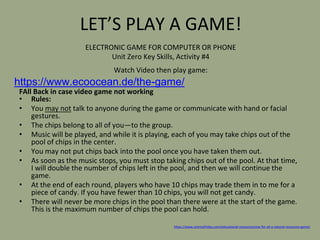
LET’S PLAY A GAME!
FAll Back in case video game not working
• Rules:
• You may not talk to anyone during the game or communicate with hand or facial
gestures.
• The chips belong to all of you—to the group.
• Music will be played, and while it is playing, each of you may take chips out of the
pool of chips in the center.
• You may not put chips back into the pool once you have taken them out.
• As soon as the music stops, you must stop taking chips out of the pool. At that time,
I will double the number of chips left in the pool, and then we will continue the
game.
• At the end of each round, players who have 10 chips may trade them in to me for a
piece of candy. If you have fewer than 10 chips, you will not get candy.
• There will never be more chips in the pool than there were at the start of the game.
This is the maximum number of chips the pool can hold.
https://www.sciencefriday.com/educational-resources/one-for-all-a-natural-resources-game/
ELECTRONIC GAME FOR COMPUTER OR PHONE
Unit Zero Key Skills, Activity #4
Watch Video then play game:
https://www.ecoocean.de/the-game/
What is Science?
Science is based on “knowledge” or “skill”
Debate of what science is: Is it mathematical?
Who has the knowledge?
• Scientist? Laymen?
• Does it depend on what the general population believes?
• Does science change?
How is that knowledge verified?
Scientific Method: Francis Bacon (1561-1626)
“Baconian Method”
PseudoScience
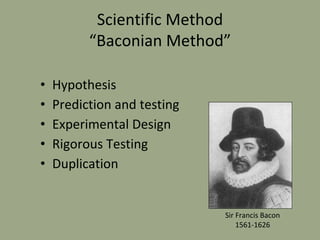
Scientific Method
“Baconian Method”
• Hypothesis
• Prediction and testing
• Experimental Design
• Rigorous Testing
• Duplication
Sir Francis Bacon
1561-1626
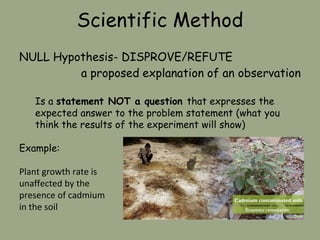
Scientific Method
NULL Hypothesis- DISPROVE/REFUTE
a proposed explanation of an observation
Is a statement NOT a question that expresses the
expected answer to the problem statement (what you
think the results of the experiment will show)
Example:
Plant growth rate is
unaffected by the
presence of cadmium
in the soil
Scientific Method
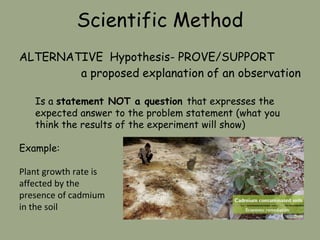
ALTERNATIVE Hypothesis- PROVE/SUPPORT
a proposed explanation of an observation
Is a statement NOT a question that expresses the
expected answer to the problem statement (what you
think the results of the experiment will show)
Example:
Plant growth rate is
affected by the
presence of cadmium
in the soil
Scientific Method
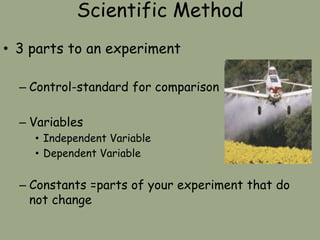
• 3 parts to an experiment
– Control-standard for comparison
– Variables
• Independent Variable
• Dependent Variable
– Constants =parts of your experiment that do
not change
Scientific Method
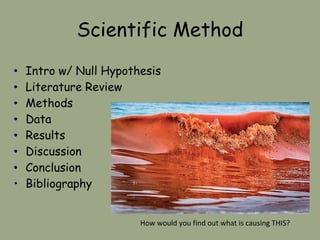
• Intro w/ Null Hypothesis
• Literature Review
• Methods
• Data
• Results
• Discussion
• Conclusion
• Bibliography
How would you find out what is causing THIS?
Scientific Method
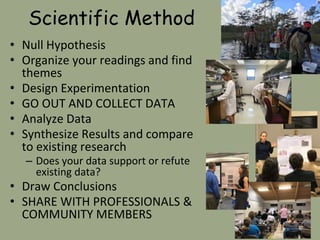
• Null Hypothesis
• Organize your readings and find
themes
• Design Experimentation
• GO OUT AND COLLECT DATA
• Analyze Data
• Synthesize Results and compare
to existing research
– Does your data support or refute
existing data?
• Draw Conclusions
• SHARE WITH PROFESSIONALS &
COMMUNITY MEMBERS
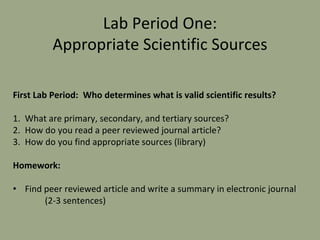
Lab Period One:
Appropriate Scientific Sources
First Lab Period: Who determines what is valid scientific results?
1. What are primary, secondary, and tertiary sources?
2. How do you read a peer reviewed journal article?
3. How do you find appropriate sources (library)
Homework:
• Find peer reviewed article and write a summary in electronic journal
(2-3 sentences)
How do you discern between good
and poorly performed science?
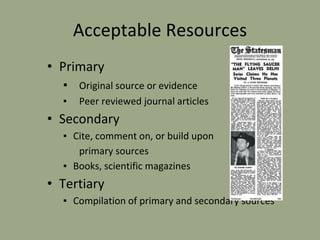
Acceptable Resources
• Primary
▪ Original source or evidence
▪ Peer reviewed journal articles
• Secondary
▪ Cite, comment on, or build upon
primary sources
▪ Books, scientific magazines
• Tertiary
▪ Compilation of primary and secondary sources
How you do discern acceptable resources?
• In a small group check the resources on your
desk.
• Which are acceptable for scientific research?
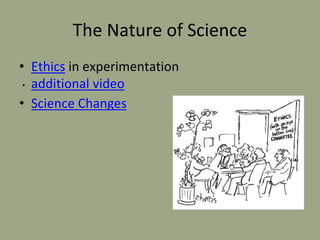
The Nature of Science
• Ethics in experimentation
• additional video
• Science Changes

ENV management - Introduction Powerpoint

  • 1.
  • 2.
    Overview of theIGCSE exam Learners taking Cambridge IGCSE Environmental Management must complete two written papers. • Paper 1 Theory consists of two sections. Section A contains short-answer and structured questions. Section B contains short-answer and extended response questions based on source material. • Paper 2 Management in context contains short- answer, data processing and analysis and extended response questions based on source material. Learners must answer all questions on each paper. There is no coursework.
  • 3.
    Overview of theIGCSE exam Assessment objectives To achieve success in their course, learners must demonstrate three different types of skill. – AO1 Knowledge and understanding. • display factual knowledge about the syllabus topics • demonstrate that they understand the concepts. – AO2 Information handling and analysis. • process and analyze unfamiliar information • perform mathematical calculations on data • draw supported conclusions. – AO3 Investigation skills and making judgements. • plan and carry out investigations • draw conclusions from their results • also evaluate their methods.
  • 4.
    Why do weneed to Manage Resources?
  • 5.
    If you have allthe resources on the planet, HOW do you manage them?
  • 6.
    District 1: Luxury District2: Masonry District 3: Technology District 4: Fishing District 5: Power (Electric, solar and nuclear) District 6: Transportation District 7: Lumber District 8: Textiles District 9: Grain District 10: Livestock District 11: Agriculture District 12: Mining District 13: Graphite You COULD manage the resources like THE HUNGER GAMES http://hashtagmaine.bangordailynews.com/2015/10/27/the-internets/if-the-hunger-games-is-set-in-a-future-north-america-maine-is-in-this-district-should-it-be/
  • 7.
    Why is itso complicated? Social Economic Political Environmental Human Health Cultural, Science, Religion, others? Poverty, Supply & Demand, Opportunity, Local & Global Economies, others? Local, State, National & International Laws, Acquisitions/Wars, others? Social Justice, Cancer, Viruses, Pesticides, others? Animal Welfare, Agriculture, Pesticide Availability, others? SUPERWEEDS
  • 8.
    What do youknow about BPAs? One generation ingests, two generations “feel.” www.niehs.nih.gov/recovery/critical/docs/bpa-signature-project.pdf
  • 9.
    Bisphenol A (BPA) • Usedfor more than 40 years • Hard plastic food containers – Baby bottles – Reusable cups – The lining of metal food and beverage cans (including canned liquid infant formula) – Trace amounts of BPA can be found in some foods packaged in these containers. http://www.hhs.gov/safety/bpa/
  • 10.
  • 11.
    Environmental Management Defined Environmentalmanagement (noun): (a) manipulation of the physical or social environment of a person or group; (b) management of human impact on the environment, especially with the intention of preserving natural resources. OED (2013)
  • 12.
    Environmental Management • Studyof Resources • Includes – Physics – Chemistry – Biology • All systems – Organism – Population – Community – Ecosystem – Biosphere These are biotic? What about abiotics?
  • 13.
    LET’S PLAY AGAME! FAll Back in case video game not working • Rules: • You may not talk to anyone during the game or communicate with hand or facial gestures. • The chips belong to all of you—to the group. • Music will be played, and while it is playing, each of you may take chips out of the pool of chips in the center. • You may not put chips back into the pool once you have taken them out. • As soon as the music stops, you must stop taking chips out of the pool. At that time, I will double the number of chips left in the pool, and then we will continue the game. • At the end of each round, players who have 10 chips may trade them in to me for a piece of candy. If you have fewer than 10 chips, you will not get candy. • There will never be more chips in the pool than there were at the start of the game. This is the maximum number of chips the pool can hold. https://www.sciencefriday.com/educational-resources/one-for-all-a-natural-resources-game/ ELECTRONIC GAME FOR COMPUTER OR PHONE Unit Zero Key Skills, Activity #4 Watch Video then play game: https://www.ecoocean.de/the-game/
  • 14.
    What is Science? Scienceis based on “knowledge” or “skill” Debate of what science is: Is it mathematical? Who has the knowledge? • Scientist? Laymen? • Does it depend on what the general population believes? • Does science change? How is that knowledge verified? Scientific Method: Francis Bacon (1561-1626) “Baconian Method” PseudoScience
  • 15.
    Scientific Method “Baconian Method” •Hypothesis • Prediction and testing • Experimental Design • Rigorous Testing • Duplication Sir Francis Bacon 1561-1626
  • 16.
    Scientific Method NULL Hypothesis-DISPROVE/REFUTE a proposed explanation of an observation Is a statement NOT a question that expresses the expected answer to the problem statement (what you think the results of the experiment will show) Example: Plant growth rate is unaffected by the presence of cadmium in the soil
  • 17.
    Scientific Method ALTERNATIVE Hypothesis-PROVE/SUPPORT a proposed explanation of an observation Is a statement NOT a question that expresses the expected answer to the problem statement (what you think the results of the experiment will show) Example: Plant growth rate is affected by the presence of cadmium in the soil
  • 18.
    Scientific Method • 3parts to an experiment – Control-standard for comparison – Variables • Independent Variable • Dependent Variable – Constants =parts of your experiment that do not change
  • 19.
    Scientific Method • Introw/ Null Hypothesis • Literature Review • Methods • Data • Results • Discussion • Conclusion • Bibliography How would you find out what is causing THIS?
  • 20.
    Scientific Method • NullHypothesis • Organize your readings and find themes • Design Experimentation • GO OUT AND COLLECT DATA • Analyze Data • Synthesize Results and compare to existing research – Does your data support or refute existing data? • Draw Conclusions • SHARE WITH PROFESSIONALS & COMMUNITY MEMBERS
  • 21.
    Lab Period One: AppropriateScientific Sources First Lab Period: Who determines what is valid scientific results? 1. What are primary, secondary, and tertiary sources? 2. How do you read a peer reviewed journal article? 3. How do you find appropriate sources (library) Homework: • Find peer reviewed article and write a summary in electronic journal (2-3 sentences)
  • 22.
    How do youdiscern between good and poorly performed science?
  • 23.
    Acceptable Resources • Primary ▪Original source or evidence ▪ Peer reviewed journal articles • Secondary ▪ Cite, comment on, or build upon primary sources ▪ Books, scientific magazines • Tertiary ▪ Compilation of primary and secondary sources
  • 24.
    How you dodiscern acceptable resources? • In a small group check the resources on your desk. • Which are acceptable for scientific research?
  • 25.
    The Nature ofScience • Ethics in experimentation • additional video • Science Changes