ENV 3001 Final Exam_Summer 2015.pdf
ENV 3001 Name:___________________
Final Exam Date: June 18, 2015
1. a b c d e f _____________
2. a b c d e f _____________
3. a b c d e f _____________
4. a b c d e f _____________
5. a b c d e f _____________
6. a b c d e f _____________
7. a b c d e f _____________
8. a b c d e f _____________
9. a b c d e f _____________
10. a b c d e f _____________
11. a b c d e f _____________
12. a b c d e f _____________
13. a b c d e f _____________
14. a b c d e f _____________
15. a b c d e f _____________
16. a b c d e f _____________
17. a b c d e f _____________
18. a b c d e f _____________
19. a b c d e f _____________
20. a b c d e f _____________
21. a b c d e f _____________
22. a b c d e f _____________
23. a b c d e f _____________
24. a b c d e f _____________
25. a b c d e f _____________
26. a b c d e f _____________
27. a b c d e f _____________
28. a b c d e f _____________
29. a b c d e f _____________
30. a b c d e f _____________
31. a b c d e f _____________
32. a b c d e f _____________
33. a b c d e f _____________
34. a b c d e f _____________
35. a b c d e f _____________
Answer all questions in the space provided and transfer your
answers to the answer sheet.
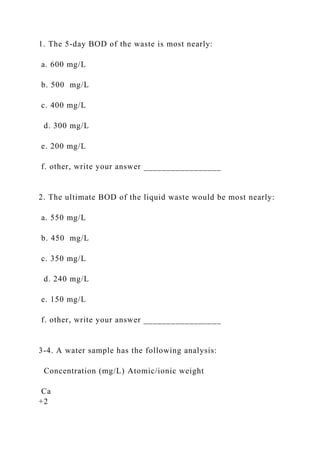
1-2. The dilution factor P of an unseeded mixture of liquid
wastewater is 0.03. The initial DO of the
mixture is 10.0 mg/L. After 5 days, DO has dropped to 1.0
mg/L.
Assuming: Reaction rate constant k = 0.22 day
-1
.
1. The 5-day BOD of the waste is most nearly:
a. 600 mg/L
b. 500 mg/L
c. 400 mg/L
d. 300 mg/L
e. 200 mg/L
f. other, write your answer _________________
2. The ultimate BOD of the liquid waste would be most nearly:
a. 550 mg/L
b. 450 mg/L
c. 350 mg/L
d. 240 mg/L
e. 150 mg/L
f. other, write your answer _________________
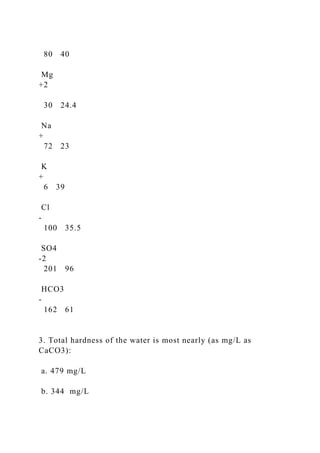
3-4. A water sample has the following analysis:
Concentration (mg/L) Atomic/ionic weight
Ca
+2
80 40
Mg
+2
30 24.4
Na
+
72 23
K
+
6 39
Cl
-
100 35.5
SO4
-2
201 96
HCO3
-
162 61
3. Total hardness of the water is most nearly (as mg/L as
CaCO3):
a. 479 mg/L
b. 344 mg/L
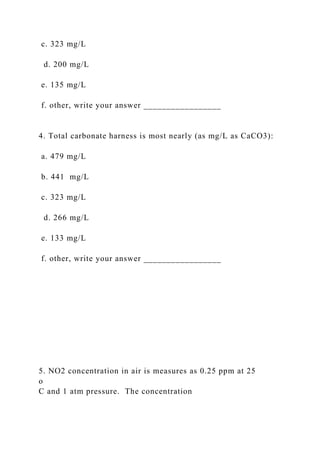
c. 323 mg/L
d. 200 mg/L
e. 135 mg/L
f. other, write your answer _________________
4. Total carbonate harness is most nearly (as mg/L as CaCO3):
a. 479 mg/L
b. 441 mg/L
c. 323 mg/L
d. 266 mg/L
e. 133 mg/L
f. other, write your answer _________________
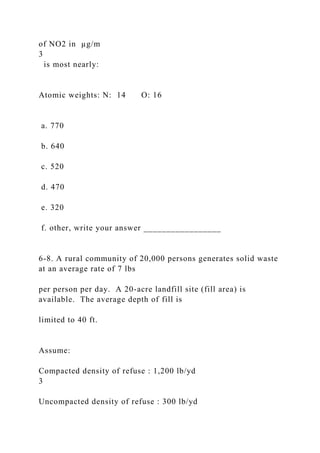
5. NO2 concentration in air is measures as 0.25 ppm at 25
o
C and 1 atm pressure. The concentration
of NO2 in µg/m
3
is most nearly:
Atomic weights: N: 14 O: 16
a. 770
b. 640
c. 520
d. 470
e. 320
f. other, write your answer _________________
6-8. A rural community of 20,000 persons generates solid waste
at an average rate of 7 lbs
per person per day. A 20-acre landfill site (fill area) is
available. The average depth of fill is
limited to 40 ft.
Assume:
Compacted density of refuse : 1,200 lb/yd
3
Uncompacted density of refuse : 300 lb/yd
3
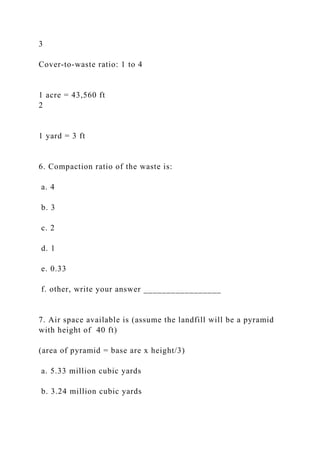
Cover-to-waste ratio: 1 to 4
1 acre = 43,560 ft
2
1 yard = 3 ft
6. Compaction ratio of the waste is:
a. 4
b. 3
c. 2
d. 1
e. 0.33
f. other, write your answer _________________
7. Air space available is (assume the landfill will be a pyramid
with height of 40 ft)
(area of pyramid = base are x height/3)
a. 5.33 million cubic yards
b. 3.24 million cubic yards
c. 2.12 million cubic yards
d. 1.35 million cubic yards
e. 0.43 million cubic yards
f. other, write your answer _________________
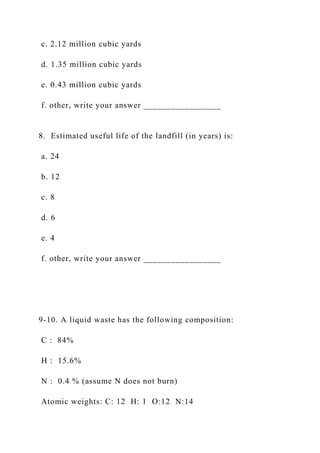
8. Estimated useful life of the landfill (in years) is:
a. 24
b. 12
c. 8
d. 6
e. 4
f. other, write your answer _________________
9-10. A liquid waste has the following composition:
C : 84%
H : 15.6%
N : 0.4 % (assume N does not burn)
Atomic weights: C: 12 H: 1 O:12 N:14
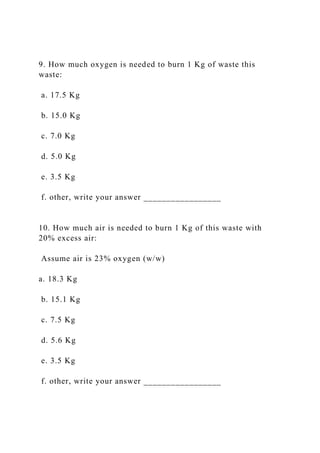
9. How much oxygen is needed to burn 1 Kg of waste this
waste:
a. 17.5 Kg
b. 15.0 Kg
c. 7.0 Kg
d. 5.0 Kg
e. 3.5 Kg
f. other, write your answer _________________
10. How much air is needed to burn 1 Kg of this waste with
20% excess air:
Assume air is 23% oxygen (w/w)
a. 18.3 Kg
b. 15.1 Kg
c. 7.5 Kg
d. 5.6 Kg
e. 3.5 Kg
f. other, write your answer _________________
11-14. The concentration of a solution is given as: 0.03 N
Al2(SO4) 3
Atomic weights: Al: 27, S : 32, Ca: 40, C : 12,
O : 16
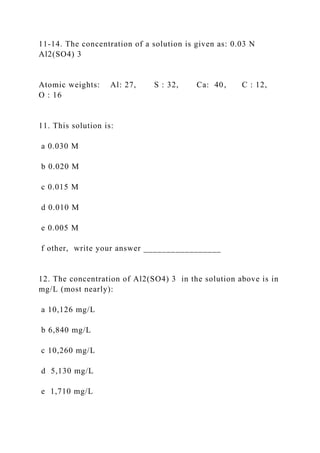
11. This solution is:
a 0.030 M
b 0.020 M
c 0.015 M
d 0.010 M
e 0.005 M
f other, write your answer _________________
12. The concentration of Al2(SO4) 3 in the solution above is in
mg/L (most nearly):
a 10,126 mg/L
b 6,840 mg/L
c 10,260 mg/L
d 5,130 mg/L
e 1,710 mg/L
f other, write your answer _________________
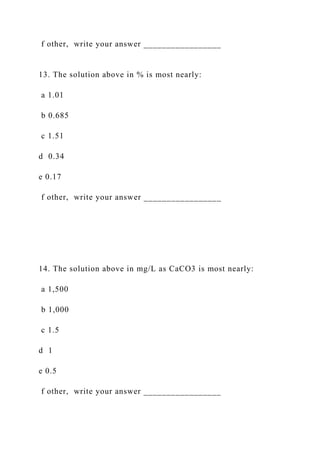
13. The solution above in % is most nearly:
a 1.01
b 0.685
c 1.51
d 0.34
e 0.17
f other, write your answer _________________
14. The solution above in mg/L as CaCO3 is most nearly:
a 1,500
b 1,000
c 1.5
d 1
e 0.5
f other, write your answer _________________
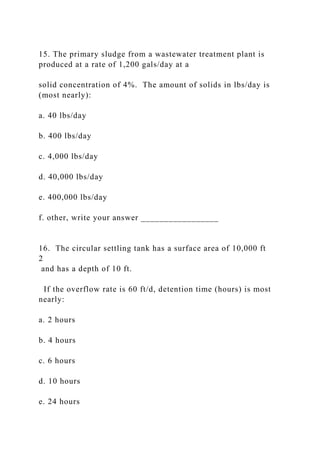
15. The primary sludge from a wastewater treatment plant is
produced at a rate of 1,200 gals/day at a
solid concentration of 4%. The amount of solids in lbs/day is
(most nearly):
a. 40 lbs/day
b. 400 lbs/day
c. 4,000 lbs/day
d. 40,000 lbs/day
e. 400,000 lbs/day
f. other, write your answer _________________
16. The circular settling tank has a surface area of 10,000 ft
2
and has a depth of 10 ft.
If the overflow rate is 60 ft/d, detention time (hours) is most
nearly:
a. 2 hours
b. 4 hours
c. 6 hours
d. 10 hours
e. 24 hours
f. other, write your answer _________________
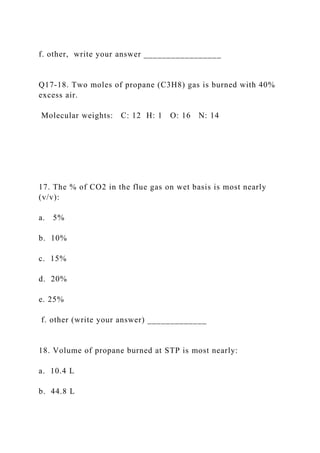
Q17-18. Two moles of propane (C3H8) gas is burned with 40%
excess air.
Molecular weights: C: 12 H: 1 O: 16 N: 14
17. The % of CO2 in the flue gas on wet basis is most nearly
(v/v):
a. 5%
b. 10%
c. 15%
d. 20%
e. 25%
f. other (write your answer) _____________
18. Volume of propane burned at STP is most nearly:
a. 10.4 L
b. 44.8 L
c. 22.4 L
d. 50.2 L
e. 56.2 L
f. other (write your answer) _____________
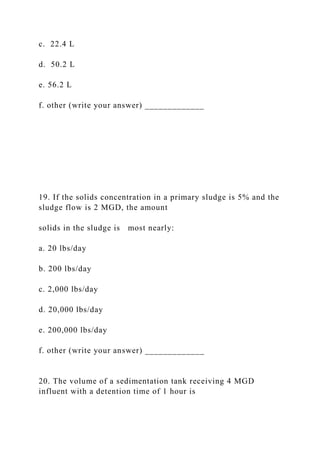
19. If the solids concentration in a primary sludge is 5% and the
sludge flow is 2 MGD, the amount
solids in the sludge is most nearly:
a. 20 lbs/day
b. 200 lbs/day
c. 2,000 lbs/day
d. 20,000 lbs/day
e. 200,000 lbs/day
f. other (write your answer) _____________
20. The volume of a sedimentation tank receiving 4 MGD
influent with a detention time of 1 hour is
most nearly:
a. 40 gallons
b. 96 gallons
c. 4,000,000 gallons
d. 96,000,000 gallons
e. 40,000,000 gallons
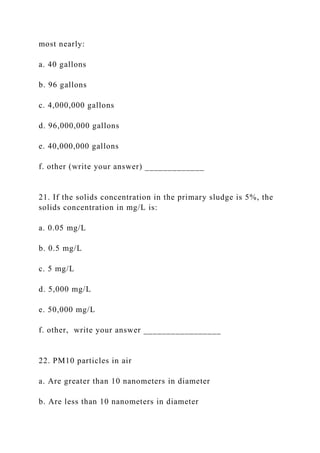
f. other (write your answer) _____________
21. If the solids concentration in the primary sludge is 5%, the
solids concentration in mg/L is:
a. 0.05 mg/L
b. 0.5 mg/L
c. 5 mg/L
d. 5,000 mg/L
e. 50,000 mg/L
f. other, write your answer _________________
22. PM10 particles in air
a. Are greater than 10 nanometers in diameter
b. Are less than 10 nanometers in diameter
c. Are between 2.5 and 10 nanometers in diameter
d. Are greater than 10 microns in diameter
e. Have an average diameter of 10 microns in diameter
f. Are less than 10 microns in diameter
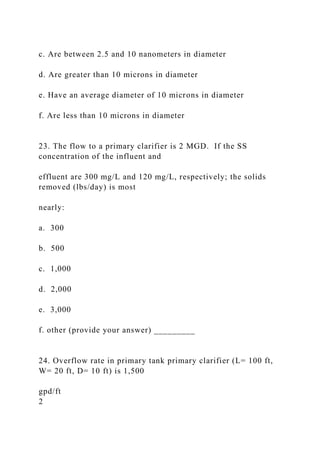
23. The flow to a primary clarifier is 2 MGD. If the SS
concentration of the influent and
effluent are 300 mg/L and 120 mg/L, respectively; the solids
removed (lbs/day) is most
nearly:
a. 300
b. 500
c. 1,000
d. 2,000
e. 3,000
f. other (provide your answer) _________
24. Overflow rate in primary tank primary clarifier (L= 100 ft,
W= 20 ft, D= 10 ft) is 1,500
gpd/ft
2
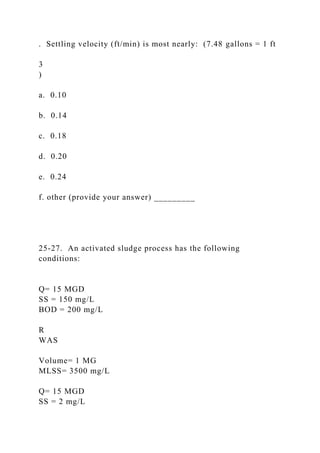
. Settling velocity (ft/min) is most nearly: (7.48 gallons = 1 ft
3
)
a. 0.10
b. 0.14
c. 0.18
d. 0.20
e. 0.24
f. other (provide your answer) _________
25-27. An activated sludge process has the following
conditions:
Q= 15 MGD
SS = 150 mg/L
BOD = 200 mg/L
R
WAS
Volume= 1 MG
MLSS= 3500 mg/L
Q= 15 MGD
SS = 2 mg/L
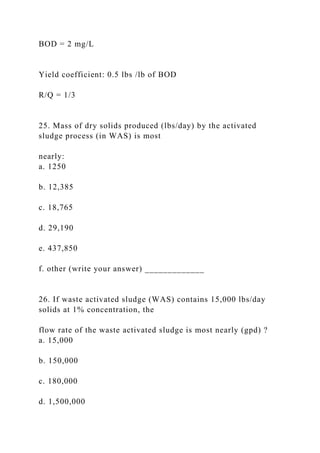
BOD = 2 mg/L
Yield coefficient: 0.5 lbs /lb of BOD
R/Q = 1/3
25. Mass of dry solids produced (lbs/day) by the activated
sludge process (in WAS) is most
nearly:
a. 1250
b. 12,385
c. 18,765
d. 29,190
e. 437,850
f. other (write your answer) _____________
26. If waste activated sludge (WAS) contains 15,000 lbs/day
solids at 1% concentration, the
flow rate of the waste activated sludge is most nearly (gpd) ?
a. 15,000
b. 150,000
c. 180,000
d. 1,500,000
e. 1,800,000
f. other (write your answer) _____________
27. If the solids concentration is to be increased from 1% to 6%
by a thickener, the volume
reduction by the thickener (%) is most nearly?
(assume sludge has similar density as water)
a. 17
b. 33
c. 50
d. 75
e. 83
f. other (write your answer) _____________
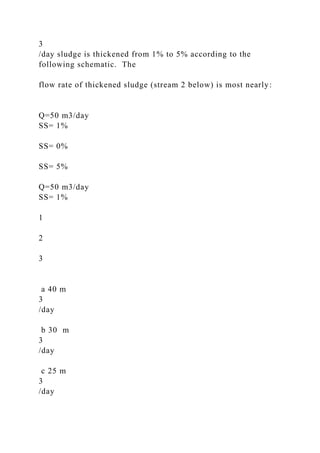
28. 50 m
3
/day sludge is thickened from 1% to 5% according to the
following schematic. The
flow rate of thickened sludge (stream 2 below) is most nearly:
Q=50 m3/day
SS= 1%
SS= 0%
SS= 5%
Q=50 m3/day
SS= 1%
1
2
3
a 40 m
3
/day
b 30 m
3
/day
c 25 m
3
/day
d 20 m
3
/day
e 10 m
3
/day
e other, write your answer _________________
29-31. Referring to the following bar graph of ionic
constituents, where the concentrations are
expressed as mg/L as CaCO3:
Ca+2 Mg+2 Na+
HCO3
- SO4
-2 Cl2
0 120 260
370
0 150
310
29. Total hardness is (as mg/L as CaCO3):
a 370
b 310
c 260
d 150
e 120
e other, write your answer _________________
30. Referring to the above figure, total carbonate hardness is (as
mg/L as CaCO3):
a 370
b 310
c 260
d 150
e 120
e other, write your answer _________________
31. Referring to the above figure, total noncarbonate hardness is
(as mg/L as CaCO3):
a 310
b 260
c 150
d 120
e 110
e other, write your answer _________________
32. 6 MGD of wastewater with a dissolved oxygen
concentration of 0.9 mg/L is discharged to a
river flowing at 40 ft
3
/sec. The river initially is saturated with oxygen. The
saturation DO
is 11.30 mg/L. The oxygen content of the river (mg/L)
immediately after mixing is most
nearly: (conversion factor: 7.48 gal= 1 ft
3
)
a 11.30
b 9. 34
c 9.00
d 8.85
e 7.24
e other, write your answer _________________
33-35. For the following oxygen sag curve:
0 5 10 15 20 25
10
8
6
4
2
0
D
O
(
m
g/
L)
Time (mg/L)
33. Initial DO deficit is most nearly
a 9 mg/L
b 6 mg/L
c 3 mg/L
d 1 mg/L
e 0 mg/L
e other, write your answer _________________
34. Referring to the figure above, critical deficit is most nearly
a 9 mg/L
b 8 mg/L
c 6 mg/L
d 3 mg/L
e 1 mg/L
e other, write your answer _________________
35. Referring to the figure above, after 20 days, DO deficit is
most nearly
a 9 mg/L
b 6 mg/L
c 3 mg/L
d 1 mg/L
e about 0.05 mg/L (nearly zero)
e other, write your answer _________________
__MACOSX/._ENV 3001 Final Exam_Summer 2015.pdf
ENV 3001 Formula sheet.pdf
__MACOSX/._ENV 3001 Formula sheet.pdf

ENV 3001 Final Exam_Summer 2015.pdfENV 3001 Name_.docx

  • 1.
    ENV 3001 FinalExam_Summer 2015.pdf ENV 3001 Name:___________________ Final Exam Date: June 18, 2015 1. a b c d e f _____________ 2. a b c d e f _____________ 3. a b c d e f _____________ 4. a b c d e f _____________ 5. a b c d e f _____________ 6. a b c d e f _____________ 7. a b c d e f _____________ 8. a b c d e f _____________ 9. a b c d e f _____________ 10. a b c d e f _____________ 11. a b c d e f _____________
  • 2.
    12. a bc d e f _____________ 13. a b c d e f _____________ 14. a b c d e f _____________ 15. a b c d e f _____________ 16. a b c d e f _____________ 17. a b c d e f _____________ 18. a b c d e f _____________ 19. a b c d e f _____________ 20. a b c d e f _____________ 21. a b c d e f _____________ 22. a b c d e f _____________ 23. a b c d e f _____________ 24. a b c d e f _____________ 25. a b c d e f _____________ 26. a b c d e f _____________ 27. a b c d e f _____________ 28. a b c d e f _____________
  • 3.
    29. a bc d e f _____________ 30. a b c d e f _____________ 31. a b c d e f _____________ 32. a b c d e f _____________ 33. a b c d e f _____________ 34. a b c d e f _____________ 35. a b c d e f _____________ Answer all questions in the space provided and transfer your answers to the answer sheet. 1-2. The dilution factor P of an unseeded mixture of liquid wastewater is 0.03. The initial DO of the mixture is 10.0 mg/L. After 5 days, DO has dropped to 1.0 mg/L. Assuming: Reaction rate constant k = 0.22 day -1 .
  • 4.
    1. The 5-dayBOD of the waste is most nearly: a. 600 mg/L b. 500 mg/L c. 400 mg/L d. 300 mg/L e. 200 mg/L f. other, write your answer _________________ 2. The ultimate BOD of the liquid waste would be most nearly: a. 550 mg/L b. 450 mg/L c. 350 mg/L d. 240 mg/L e. 150 mg/L f. other, write your answer _________________ 3-4. A water sample has the following analysis: Concentration (mg/L) Atomic/ionic weight Ca +2
  • 5.
    80 40 Mg +2 30 24.4 Na + 7223 K + 6 39 Cl - 100 35.5 SO4 -2 201 96 HCO3 - 162 61 3. Total hardness of the water is most nearly (as mg/L as CaCO3): a. 479 mg/L b. 344 mg/L
  • 6.
    c. 323 mg/L d.200 mg/L e. 135 mg/L f. other, write your answer _________________ 4. Total carbonate harness is most nearly (as mg/L as CaCO3): a. 479 mg/L b. 441 mg/L c. 323 mg/L d. 266 mg/L e. 133 mg/L f. other, write your answer _________________ 5. NO2 concentration in air is measures as 0.25 ppm at 25 o C and 1 atm pressure. The concentration
  • 7.
    of NO2 inµg/m 3 is most nearly: Atomic weights: N: 14 O: 16 a. 770 b. 640 c. 520 d. 470 e. 320 f. other, write your answer _________________ 6-8. A rural community of 20,000 persons generates solid waste at an average rate of 7 lbs per person per day. A 20-acre landfill site (fill area) is available. The average depth of fill is limited to 40 ft. Assume: Compacted density of refuse : 1,200 lb/yd 3 Uncompacted density of refuse : 300 lb/yd
  • 8.
    3 Cover-to-waste ratio: 1to 4 1 acre = 43,560 ft 2 1 yard = 3 ft 6. Compaction ratio of the waste is: a. 4 b. 3 c. 2 d. 1 e. 0.33 f. other, write your answer _________________ 7. Air space available is (assume the landfill will be a pyramid with height of 40 ft) (area of pyramid = base are x height/3) a. 5.33 million cubic yards b. 3.24 million cubic yards
  • 9.
    c. 2.12 millioncubic yards d. 1.35 million cubic yards e. 0.43 million cubic yards f. other, write your answer _________________ 8. Estimated useful life of the landfill (in years) is: a. 24 b. 12 c. 8 d. 6 e. 4 f. other, write your answer _________________ 9-10. A liquid waste has the following composition: C : 84% H : 15.6% N : 0.4 % (assume N does not burn) Atomic weights: C: 12 H: 1 O:12 N:14
  • 10.
    9. How muchoxygen is needed to burn 1 Kg of waste this waste: a. 17.5 Kg b. 15.0 Kg c. 7.0 Kg d. 5.0 Kg e. 3.5 Kg f. other, write your answer _________________ 10. How much air is needed to burn 1 Kg of this waste with 20% excess air: Assume air is 23% oxygen (w/w) a. 18.3 Kg b. 15.1 Kg c. 7.5 Kg d. 5.6 Kg e. 3.5 Kg f. other, write your answer _________________
  • 11.
    11-14. The concentrationof a solution is given as: 0.03 N Al2(SO4) 3 Atomic weights: Al: 27, S : 32, Ca: 40, C : 12, O : 16 11. This solution is: a 0.030 M b 0.020 M c 0.015 M d 0.010 M e 0.005 M f other, write your answer _________________ 12. The concentration of Al2(SO4) 3 in the solution above is in mg/L (most nearly): a 10,126 mg/L b 6,840 mg/L c 10,260 mg/L d 5,130 mg/L e 1,710 mg/L
  • 12.
    f other, writeyour answer _________________ 13. The solution above in % is most nearly: a 1.01 b 0.685 c 1.51 d 0.34 e 0.17 f other, write your answer _________________ 14. The solution above in mg/L as CaCO3 is most nearly: a 1,500 b 1,000 c 1.5 d 1 e 0.5 f other, write your answer _________________
  • 13.
    15. The primarysludge from a wastewater treatment plant is produced at a rate of 1,200 gals/day at a solid concentration of 4%. The amount of solids in lbs/day is (most nearly): a. 40 lbs/day b. 400 lbs/day c. 4,000 lbs/day d. 40,000 lbs/day e. 400,000 lbs/day f. other, write your answer _________________ 16. The circular settling tank has a surface area of 10,000 ft 2 and has a depth of 10 ft. If the overflow rate is 60 ft/d, detention time (hours) is most nearly: a. 2 hours b. 4 hours c. 6 hours d. 10 hours e. 24 hours
  • 14.
    f. other, writeyour answer _________________ Q17-18. Two moles of propane (C3H8) gas is burned with 40% excess air. Molecular weights: C: 12 H: 1 O: 16 N: 14 17. The % of CO2 in the flue gas on wet basis is most nearly (v/v): a. 5% b. 10% c. 15% d. 20% e. 25% f. other (write your answer) _____________ 18. Volume of propane burned at STP is most nearly: a. 10.4 L b. 44.8 L
  • 15.
    c. 22.4 L d.50.2 L e. 56.2 L f. other (write your answer) _____________ 19. If the solids concentration in a primary sludge is 5% and the sludge flow is 2 MGD, the amount solids in the sludge is most nearly: a. 20 lbs/day b. 200 lbs/day c. 2,000 lbs/day d. 20,000 lbs/day e. 200,000 lbs/day f. other (write your answer) _____________ 20. The volume of a sedimentation tank receiving 4 MGD influent with a detention time of 1 hour is
  • 16.
    most nearly: a. 40gallons b. 96 gallons c. 4,000,000 gallons d. 96,000,000 gallons e. 40,000,000 gallons f. other (write your answer) _____________ 21. If the solids concentration in the primary sludge is 5%, the solids concentration in mg/L is: a. 0.05 mg/L b. 0.5 mg/L c. 5 mg/L d. 5,000 mg/L e. 50,000 mg/L f. other, write your answer _________________ 22. PM10 particles in air a. Are greater than 10 nanometers in diameter b. Are less than 10 nanometers in diameter
  • 17.
    c. Are between2.5 and 10 nanometers in diameter d. Are greater than 10 microns in diameter e. Have an average diameter of 10 microns in diameter f. Are less than 10 microns in diameter 23. The flow to a primary clarifier is 2 MGD. If the SS concentration of the influent and effluent are 300 mg/L and 120 mg/L, respectively; the solids removed (lbs/day) is most nearly: a. 300 b. 500 c. 1,000 d. 2,000 e. 3,000 f. other (provide your answer) _________ 24. Overflow rate in primary tank primary clarifier (L= 100 ft, W= 20 ft, D= 10 ft) is 1,500 gpd/ft 2
  • 18.
    . Settling velocity(ft/min) is most nearly: (7.48 gallons = 1 ft 3 ) a. 0.10 b. 0.14 c. 0.18 d. 0.20 e. 0.24 f. other (provide your answer) _________ 25-27. An activated sludge process has the following conditions: Q= 15 MGD SS = 150 mg/L BOD = 200 mg/L R WAS Volume= 1 MG MLSS= 3500 mg/L Q= 15 MGD SS = 2 mg/L
  • 19.
    BOD = 2mg/L Yield coefficient: 0.5 lbs /lb of BOD R/Q = 1/3 25. Mass of dry solids produced (lbs/day) by the activated sludge process (in WAS) is most nearly: a. 1250 b. 12,385 c. 18,765 d. 29,190 e. 437,850 f. other (write your answer) _____________ 26. If waste activated sludge (WAS) contains 15,000 lbs/day solids at 1% concentration, the flow rate of the waste activated sludge is most nearly (gpd) ? a. 15,000 b. 150,000 c. 180,000 d. 1,500,000
  • 20.
    e. 1,800,000 f. other(write your answer) _____________ 27. If the solids concentration is to be increased from 1% to 6% by a thickener, the volume reduction by the thickener (%) is most nearly? (assume sludge has similar density as water) a. 17 b. 33 c. 50 d. 75 e. 83 f. other (write your answer) _____________ 28. 50 m
  • 21.
    3 /day sludge isthickened from 1% to 5% according to the following schematic. The flow rate of thickened sludge (stream 2 below) is most nearly: Q=50 m3/day SS= 1% SS= 0% SS= 5% Q=50 m3/day SS= 1% 1 2 3 a 40 m 3 /day b 30 m 3 /day c 25 m 3 /day
  • 22.
    d 20 m 3 /day e10 m 3 /day e other, write your answer _________________ 29-31. Referring to the following bar graph of ionic constituents, where the concentrations are expressed as mg/L as CaCO3: Ca+2 Mg+2 Na+ HCO3 - SO4 -2 Cl2 0 120 260 370 0 150 310 29. Total hardness is (as mg/L as CaCO3): a 370
  • 23.
    b 310 c 260 d150 e 120 e other, write your answer _________________ 30. Referring to the above figure, total carbonate hardness is (as mg/L as CaCO3): a 370 b 310 c 260 d 150 e 120 e other, write your answer _________________ 31. Referring to the above figure, total noncarbonate hardness is (as mg/L as CaCO3):
  • 24.
    a 310 b 260 c150 d 120 e 110 e other, write your answer _________________ 32. 6 MGD of wastewater with a dissolved oxygen concentration of 0.9 mg/L is discharged to a river flowing at 40 ft 3 /sec. The river initially is saturated with oxygen. The saturation DO is 11.30 mg/L. The oxygen content of the river (mg/L) immediately after mixing is most nearly: (conversion factor: 7.48 gal= 1 ft 3 ) a 11.30 b 9. 34 c 9.00 d 8.85
  • 25.
    e 7.24 e other,write your answer _________________ 33-35. For the following oxygen sag curve: 0 5 10 15 20 25 10 8 6 4 2 0 D O ( m g/ L) Time (mg/L) 33. Initial DO deficit is most nearly
  • 26.
    a 9 mg/L b6 mg/L c 3 mg/L d 1 mg/L e 0 mg/L e other, write your answer _________________ 34. Referring to the figure above, critical deficit is most nearly a 9 mg/L b 8 mg/L c 6 mg/L d 3 mg/L e 1 mg/L e other, write your answer _________________ 35. Referring to the figure above, after 20 days, DO deficit is most nearly a 9 mg/L
  • 27.
    b 6 mg/L c3 mg/L d 1 mg/L e about 0.05 mg/L (nearly zero) e other, write your answer _________________ __MACOSX/._ENV 3001 Final Exam_Summer 2015.pdf ENV 3001 Formula sheet.pdf __MACOSX/._ENV 3001 Formula sheet.pdf