A Monte Carlo Approach to the Calculation of the Critical Mass
PHY 492 - Brandon Ewert - Michigan State University
(Dated: May 4, 2015)
Background: The critical mass for a fissionable material is, by nature, far too dangerous to
determine experimentally. Estimations can be done by solving the Diffusion Equation, though
solving it with non-spherical boundary conditions can be a nightmare. Our method offers a more
general approach, apt for any shape of sample. The calculation has historical roots in the Manhattan
Project and holds importance in modern reactor physics. Purpose: Use computational physics
to determine the general functional dependence of critical mass on sample purity, sample shape,
mean free path of a neutron in the sample, and average number of neutrons liberated per fission.
Methods: The Monte Carlo Method will be used to calculate the ratio of induced fissions to
spontaneous fissions, and the mass of the substance will modulated until the ratio exceeds one, which
is indicative of a sustained chain reaction. This process is repeated for various input parameters to
plot their effects. Results: Spherical samples offer the lowest critical mass of the shapes tested.
The critical diameter of a spherical sample is almost exactly that of a neutrons mean free path in
the sample. Critical mass is exponentially dependent on both the percent purity of the sample, as
well as the number of neutrons released per fission. An accurate value of critical mass was obtained
for U235 given accepted input values. Conclusions: The Monte Carlo method is well suited for
this calculation, and allows much room for modification and further investigation. Our model, with
its numerous assumptions, proves accurate and effective in capturing trends of critical mass with
various input parameters.
I. INTRODUCTION
The Monte Carlo Method, with its exact roots lost
in the fog of history, found its niche in the early stages
of the Manhattan Project. The method was very well-
suited for the calculation of the critical mass of Uranium,
and, for better or for worse, helped propel the world into
the nuclear age. With the only real alternative being
physical experiment, the Monte Carlo Method ushered
in a new era of computational science that is currently
an inseparable companion to experiment and theory in
many fields of science.
Its basis of operation is to simulate many possible out-
comes of a known occurrence using random numbers as
input. We then average the outcomes and compile the
data. As much fun as it would be to do the calculations
by hand, we will resort to using Python in the interest of
time. All plots and figures are done in Mathematica.
Before we dive into the theory of our calculation, it
is necessary to define the factors that will affect critical
mass.Number of neutrons per fission - Each time a
nucleus fissions (decays into fragments), it releases free
neutrons that can hit other nuclei and cause them to
fission, thus igniting a chain reaction. The more neutrons
released per fission, the higher the potential for criticality
(a cascading chain reaction) for a given mass. Purity
- Certainly, the less pure your sample, the more of it
you expect to need to sustain a chain reaction. For our
purposes, the exact species of impurities in our sample is
unimportant. By impurities, we simply mean atoms that
cannot be induced to fission. Shape - Not all shapes are
created equal in the context of chain reactions. Generally,
it is expected that relatively flat shapes will permit too
many neutrons to escape the sample, rather than ping-
pong between fissionable nuclei and induce more fissions.
To keep the critical mass low, we want to keep the shape
as compact as possible Temperature - Though we won’t
be investigating the effect of temperature on the critical
mass, it is important in determining fission cross-sections
of nuclei (how big of a target a neutron sees). Mean free
path of a neutron - many factors determine the mean
free path of a neutron (on average, how far a neutron
travels in a sample before it collides with a nucleus). It
is most directly tied to the nucleus cross-section, and is
generally on the order of a few centimeters. The larger
the mean free path, the larger the critical mass must be.
II. THEORY
Spontaneous fissions occur constantly in all radioactive
elements. The neutrons released from these fissions have
the ability to induce fissions in other nuclei, accelerat-
ing the rate of decay of the sample. At a critical size of
a sample, the number of spontaneous fissions equals the
number of induced fissions, meaning that for every decay,
a neutron from that decay sustains a constant rate of de-
cay throughout the sample. If any more decays were
to be induced, the number of neutrons roaming in the
sample would increase exponentially over time, as, on
average more than one fission is induced per decay. This
ratio of induced to spontaneous decays is known as the
survivalfraction (F), and is the key quantity we want
to calculate. If it is greater than or equal to one, we have
attained critical mass of a sample, which can release enor-
mous amounts of energy. If it is any lower, the sample
will decay, but so slowly that the energy generated may
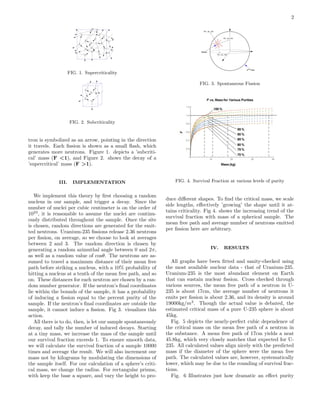
only make the sample warm to the touch. Figures 1. and
2. illustrates the effect of the sample size on the reaction
of the neutrons with nuclei in the sample. Each neu-
2
FIG. 1. Supercriticality
FIG. 2. Subcriticality
tron is symbolized as an arrow, pointing in the direction
it travels. Each fission is shown as a small flash, which
generates more neutrons. Figure 1. depicts a ’subcriti-
cal’ mass (F <1), and Figure 2. shows the decay of a
’supercritical’ mass (F >1).
III. IMPLEMENTATION
We implement this theory by first choosing a random
nucleus in our sample, and trigger a decay. Since the
number of nuclei per cubic centimeter is on the order of
1023
, it is reasonable to assume the nuclei are continu-
ously distributed throughout the sample. Once the site
is chosen, random directions are generated for the emit-
ted neutrons. Uranium-235 fissions release 2.36 neutrons
per fission, on average, so we choose to look at averages
between 2 and 3. The random direction is chosen by
generating a random azimuthal angle between 0 and 2π,
as well as a random value of cosθ. The neutrons are as-
sumed to travel a maximum distance of their mean free
path before striking a nucleus, with a 10% probability of
hitting a nucleus at a tenth of the mean free path, and so
on. These distances for each neutron are chosen by a ran-
dom number generator. If the neutron’s final coordinates
lie within the bounds of the sample, it has a probability
of inducing a fission equal to the percent purity of the
sample. If the neutron’s final coordinates are outside the
sample, it cannot induce a fission. Fig 3. visualizes this
action.
All there is to do, then, is let our sample spontaneously
decay, and tally the number of induced decays. Starting
at a tiny mass, we increase the mass of the sample until
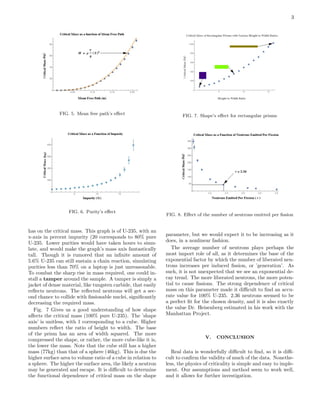
our survival fraction exceeds 1. To ensure smooth data,
we will calculate the survival fraction of a sample 10000
times and average the result. We will also increment our
mass not by kilograms by modulating the dimensions of
the sample itself. For our calculation of a sphere’s criti-
cal mass, we change the radius. For rectangular prisms,
with keep the base a square, and vary the height to pro-
FIG. 3. Spontaneous Fission
FIG. 4. Survival Fraction at various levels of purity
duce different shapes. To find the critical mass, we scale
side lengths, effectively ’growing’ the shape until it at-
tains criticality. Fig 4. shows the increasing trend of the
survival fraction with mass of a spherical sample. The
mean free path and average number of neutrons emitted
per fission here are arbitrary.
IV. RESULTS
All graphs have been fitted and sanity-checked using
the most available nuclear data - that of Uranium-235.
Uranium-235 is the most abundant element on Earth
that can sustain nuclear fission. Cross checked through
various sources, the mean free path of a neutron in U-
235 is about 17cm, the average number of neutrons it
emits per fission is about 2.36, and its density is around
19000kg/m3
. Though the actual value is debated, the
estimated critical mass of a pure U-235 sphere is about
45kg.
Fig. 5 depicts the nearly-perfect cubic dependence of
the critical mass on the mean free path of a neutron in
the substance. A mean free path of 17cm yields a neat
45.8kg, which very closely matches that expected for U-
235. All calculated values align nicely with the predicted
mass if the diameter of the sphere were the mean free
path. The calculated values are, however, systematically
lower, which may be due to the rounding of survival frac-
tions.
Fig. 6 Illustrates just how dramatic an effect purity
3
FIG. 5. Mean free path’s effect
FIG. 6. Purity’s effect
has on the critical mass. This graph is of U-235, with an
x-axis in percent impurity (20 corresponds to 80% pure
U-235. Lower purities would have taken hours to simu-
late, and would make the graph’s mass axis fantastically
tall. Though it is rumored that an infinite amount of
5.6% U-235 can still sustain a chain reaction, simulating
purities less than 70% on a laptop is just unreasonable.
To combat the sharp rise in mass required, one could in-
stall a tamper around the sample. A tamper is simply a
jacket of dense material, like tungsten carbide, that easily
reflects neutrons. The reflected neutrons will get a sec-
ond chance to collide with fissionable nuclei, significantly
decreasing the required mass.
Fig. 7 Gives us a good understanding of how shape
affects the critical mass (100% pure U-235). The ’shape
axis’ is unitless, with 1 corresponding to a cube. Higher
numbers reflect the ratio of height to width. The base
of the prism has an area of width squared. The more
compressed the shape, or rather, the more cube-like it is,
the lower the mass. Note that the cube still has a higher
mass (77kg) than that of a sphere (46kg). This is due the
higher surface area to volume ratio of a cube in relation to
a sphere. The higher the surface area, the likely a neutron
may be generated and escape. It is difficult to determine
the functional dependence of critical mass on the shape
FIG. 7. Shape’s effect for rectangular prisms
FIG. 8. Effect of the number of neutrons emitted per fission
parameter, but we would expect it to be increasing as it
does, in a nonlinear fashion.
The average number of neutrons plays perhaps the
most import role of all, as it determines the base of the
exponential factor by which the number of liberated neu-
trons increases per induced fission, or ’generation’. As
such, it is not unexpected that we see an exponential de-
cay trend. The more liberated neutrons, the more poten-
tial to cause fissions. The strong dependence of critical
mass on this parameter made it difficult to find an accu-
rate value for 100% U-235. 2.36 neutrons seemed to be
a perfect fit for the chosen density, and it is also exactly
the value Dr. Heisenberg estimated in his work with the
Manhattan Project.
V. CONCLUSION
Real data is wonderfully difficult to find, so it is diffi-
cult to confirm the validity of much of the data. Nonethe-
less, the physics of criticality is simple and easy to imple-
ment. Our assumptions and method seem to work well,
and it allows for further investigation.
4
VI. REFERENCES
[1] R. Roberts, R. Meyer, L. Hafstad, P. Wang, Further
Observations on the Splitting of Uranium and Thorium,
Phys. Rev. 55 (1939) 510.
[2] Bernstein, J. Hitlers Uranium Club: The Secret Recordings
at Farm Hall ; Copernicus Books, New York (2001)
[3] Reed, B.C. The Physics of the Manhattan Project ;
Springer (2011)
[4] Ehrlich, Robert, Simulation of a Chain Reaction ; MISN-
0-356 (2002)

PHY 492 Final Paper

  • 1.
    A Monte CarloApproach to the Calculation of the Critical Mass PHY 492 - Brandon Ewert - Michigan State University (Dated: May 4, 2015) Background: The critical mass for a fissionable material is, by nature, far too dangerous to determine experimentally. Estimations can be done by solving the Diffusion Equation, though solving it with non-spherical boundary conditions can be a nightmare. Our method offers a more general approach, apt for any shape of sample. The calculation has historical roots in the Manhattan Project and holds importance in modern reactor physics. Purpose: Use computational physics to determine the general functional dependence of critical mass on sample purity, sample shape, mean free path of a neutron in the sample, and average number of neutrons liberated per fission. Methods: The Monte Carlo Method will be used to calculate the ratio of induced fissions to spontaneous fissions, and the mass of the substance will modulated until the ratio exceeds one, which is indicative of a sustained chain reaction. This process is repeated for various input parameters to plot their effects. Results: Spherical samples offer the lowest critical mass of the shapes tested. The critical diameter of a spherical sample is almost exactly that of a neutrons mean free path in the sample. Critical mass is exponentially dependent on both the percent purity of the sample, as well as the number of neutrons released per fission. An accurate value of critical mass was obtained for U235 given accepted input values. Conclusions: The Monte Carlo method is well suited for this calculation, and allows much room for modification and further investigation. Our model, with its numerous assumptions, proves accurate and effective in capturing trends of critical mass with various input parameters. I. INTRODUCTION The Monte Carlo Method, with its exact roots lost in the fog of history, found its niche in the early stages of the Manhattan Project. The method was very well- suited for the calculation of the critical mass of Uranium, and, for better or for worse, helped propel the world into the nuclear age. With the only real alternative being physical experiment, the Monte Carlo Method ushered in a new era of computational science that is currently an inseparable companion to experiment and theory in many fields of science. Its basis of operation is to simulate many possible out- comes of a known occurrence using random numbers as input. We then average the outcomes and compile the data. As much fun as it would be to do the calculations by hand, we will resort to using Python in the interest of time. All plots and figures are done in Mathematica. Before we dive into the theory of our calculation, it is necessary to define the factors that will affect critical mass.Number of neutrons per fission - Each time a nucleus fissions (decays into fragments), it releases free neutrons that can hit other nuclei and cause them to fission, thus igniting a chain reaction. The more neutrons released per fission, the higher the potential for criticality (a cascading chain reaction) for a given mass. Purity - Certainly, the less pure your sample, the more of it you expect to need to sustain a chain reaction. For our purposes, the exact species of impurities in our sample is unimportant. By impurities, we simply mean atoms that cannot be induced to fission. Shape - Not all shapes are created equal in the context of chain reactions. Generally, it is expected that relatively flat shapes will permit too many neutrons to escape the sample, rather than ping- pong between fissionable nuclei and induce more fissions. To keep the critical mass low, we want to keep the shape as compact as possible Temperature - Though we won’t be investigating the effect of temperature on the critical mass, it is important in determining fission cross-sections of nuclei (how big of a target a neutron sees). Mean free path of a neutron - many factors determine the mean free path of a neutron (on average, how far a neutron travels in a sample before it collides with a nucleus). It is most directly tied to the nucleus cross-section, and is generally on the order of a few centimeters. The larger the mean free path, the larger the critical mass must be. II. THEORY Spontaneous fissions occur constantly in all radioactive elements. The neutrons released from these fissions have the ability to induce fissions in other nuclei, accelerat- ing the rate of decay of the sample. At a critical size of a sample, the number of spontaneous fissions equals the number of induced fissions, meaning that for every decay, a neutron from that decay sustains a constant rate of de- cay throughout the sample. If any more decays were to be induced, the number of neutrons roaming in the sample would increase exponentially over time, as, on average more than one fission is induced per decay. This ratio of induced to spontaneous decays is known as the survivalfraction (F), and is the key quantity we want to calculate. If it is greater than or equal to one, we have attained critical mass of a sample, which can release enor- mous amounts of energy. If it is any lower, the sample will decay, but so slowly that the energy generated may only make the sample warm to the touch. Figures 1. and 2. illustrates the effect of the sample size on the reaction of the neutrons with nuclei in the sample. Each neu-
  • 2.
    2 FIG. 1. Supercriticality FIG.2. Subcriticality tron is symbolized as an arrow, pointing in the direction it travels. Each fission is shown as a small flash, which generates more neutrons. Figure 1. depicts a ’subcriti- cal’ mass (F <1), and Figure 2. shows the decay of a ’supercritical’ mass (F >1). III. IMPLEMENTATION We implement this theory by first choosing a random nucleus in our sample, and trigger a decay. Since the number of nuclei per cubic centimeter is on the order of 1023 , it is reasonable to assume the nuclei are continu- ously distributed throughout the sample. Once the site is chosen, random directions are generated for the emit- ted neutrons. Uranium-235 fissions release 2.36 neutrons per fission, on average, so we choose to look at averages between 2 and 3. The random direction is chosen by generating a random azimuthal angle between 0 and 2π, as well as a random value of cosθ. The neutrons are as- sumed to travel a maximum distance of their mean free path before striking a nucleus, with a 10% probability of hitting a nucleus at a tenth of the mean free path, and so on. These distances for each neutron are chosen by a ran- dom number generator. If the neutron’s final coordinates lie within the bounds of the sample, it has a probability of inducing a fission equal to the percent purity of the sample. If the neutron’s final coordinates are outside the sample, it cannot induce a fission. Fig 3. visualizes this action. All there is to do, then, is let our sample spontaneously decay, and tally the number of induced decays. Starting at a tiny mass, we increase the mass of the sample until our survival fraction exceeds 1. To ensure smooth data, we will calculate the survival fraction of a sample 10000 times and average the result. We will also increment our mass not by kilograms by modulating the dimensions of the sample itself. For our calculation of a sphere’s criti- cal mass, we change the radius. For rectangular prisms, with keep the base a square, and vary the height to pro- FIG. 3. Spontaneous Fission FIG. 4. Survival Fraction at various levels of purity duce different shapes. To find the critical mass, we scale side lengths, effectively ’growing’ the shape until it at- tains criticality. Fig 4. shows the increasing trend of the survival fraction with mass of a spherical sample. The mean free path and average number of neutrons emitted per fission here are arbitrary. IV. RESULTS All graphs have been fitted and sanity-checked using the most available nuclear data - that of Uranium-235. Uranium-235 is the most abundant element on Earth that can sustain nuclear fission. Cross checked through various sources, the mean free path of a neutron in U- 235 is about 17cm, the average number of neutrons it emits per fission is about 2.36, and its density is around 19000kg/m3 . Though the actual value is debated, the estimated critical mass of a pure U-235 sphere is about 45kg. Fig. 5 depicts the nearly-perfect cubic dependence of the critical mass on the mean free path of a neutron in the substance. A mean free path of 17cm yields a neat 45.8kg, which very closely matches that expected for U- 235. All calculated values align nicely with the predicted mass if the diameter of the sphere were the mean free path. The calculated values are, however, systematically lower, which may be due to the rounding of survival frac- tions. Fig. 6 Illustrates just how dramatic an effect purity
  • 3.
    3 FIG. 5. Meanfree path’s effect FIG. 6. Purity’s effect has on the critical mass. This graph is of U-235, with an x-axis in percent impurity (20 corresponds to 80% pure U-235. Lower purities would have taken hours to simu- late, and would make the graph’s mass axis fantastically tall. Though it is rumored that an infinite amount of 5.6% U-235 can still sustain a chain reaction, simulating purities less than 70% on a laptop is just unreasonable. To combat the sharp rise in mass required, one could in- stall a tamper around the sample. A tamper is simply a jacket of dense material, like tungsten carbide, that easily reflects neutrons. The reflected neutrons will get a sec- ond chance to collide with fissionable nuclei, significantly decreasing the required mass. Fig. 7 Gives us a good understanding of how shape affects the critical mass (100% pure U-235). The ’shape axis’ is unitless, with 1 corresponding to a cube. Higher numbers reflect the ratio of height to width. The base of the prism has an area of width squared. The more compressed the shape, or rather, the more cube-like it is, the lower the mass. Note that the cube still has a higher mass (77kg) than that of a sphere (46kg). This is due the higher surface area to volume ratio of a cube in relation to a sphere. The higher the surface area, the likely a neutron may be generated and escape. It is difficult to determine the functional dependence of critical mass on the shape FIG. 7. Shape’s effect for rectangular prisms FIG. 8. Effect of the number of neutrons emitted per fission parameter, but we would expect it to be increasing as it does, in a nonlinear fashion. The average number of neutrons plays perhaps the most import role of all, as it determines the base of the exponential factor by which the number of liberated neu- trons increases per induced fission, or ’generation’. As such, it is not unexpected that we see an exponential de- cay trend. The more liberated neutrons, the more poten- tial to cause fissions. The strong dependence of critical mass on this parameter made it difficult to find an accu- rate value for 100% U-235. 2.36 neutrons seemed to be a perfect fit for the chosen density, and it is also exactly the value Dr. Heisenberg estimated in his work with the Manhattan Project. V. CONCLUSION Real data is wonderfully difficult to find, so it is diffi- cult to confirm the validity of much of the data. Nonethe- less, the physics of criticality is simple and easy to imple- ment. Our assumptions and method seem to work well, and it allows for further investigation.
  • 4.
    4 VI. REFERENCES [1] R.Roberts, R. Meyer, L. Hafstad, P. Wang, Further Observations on the Splitting of Uranium and Thorium, Phys. Rev. 55 (1939) 510. [2] Bernstein, J. Hitlers Uranium Club: The Secret Recordings at Farm Hall ; Copernicus Books, New York (2001) [3] Reed, B.C. The Physics of the Manhattan Project ; Springer (2011) [4] Ehrlich, Robert, Simulation of a Chain Reaction ; MISN- 0-356 (2002)