Small Business
                        Entrepreneurs
                    Characteristics and
                       Competencies


                            Chapter 03

McGraw-Hill/Irwin    Copyright © 2011 by the McGraw-Hill Companies, Inc. All rights reserved.
What is an entrepreneur?
 Is “entrepreneurship” innate? Or
  learned? Or both?
 Are there certain personality
  characteristics? Or not?
 Do entrepreneurs seek risk? Or are they
  risk-averse?
 What descriptors would we assign to
  “entrepreneur?”

                                        3-2
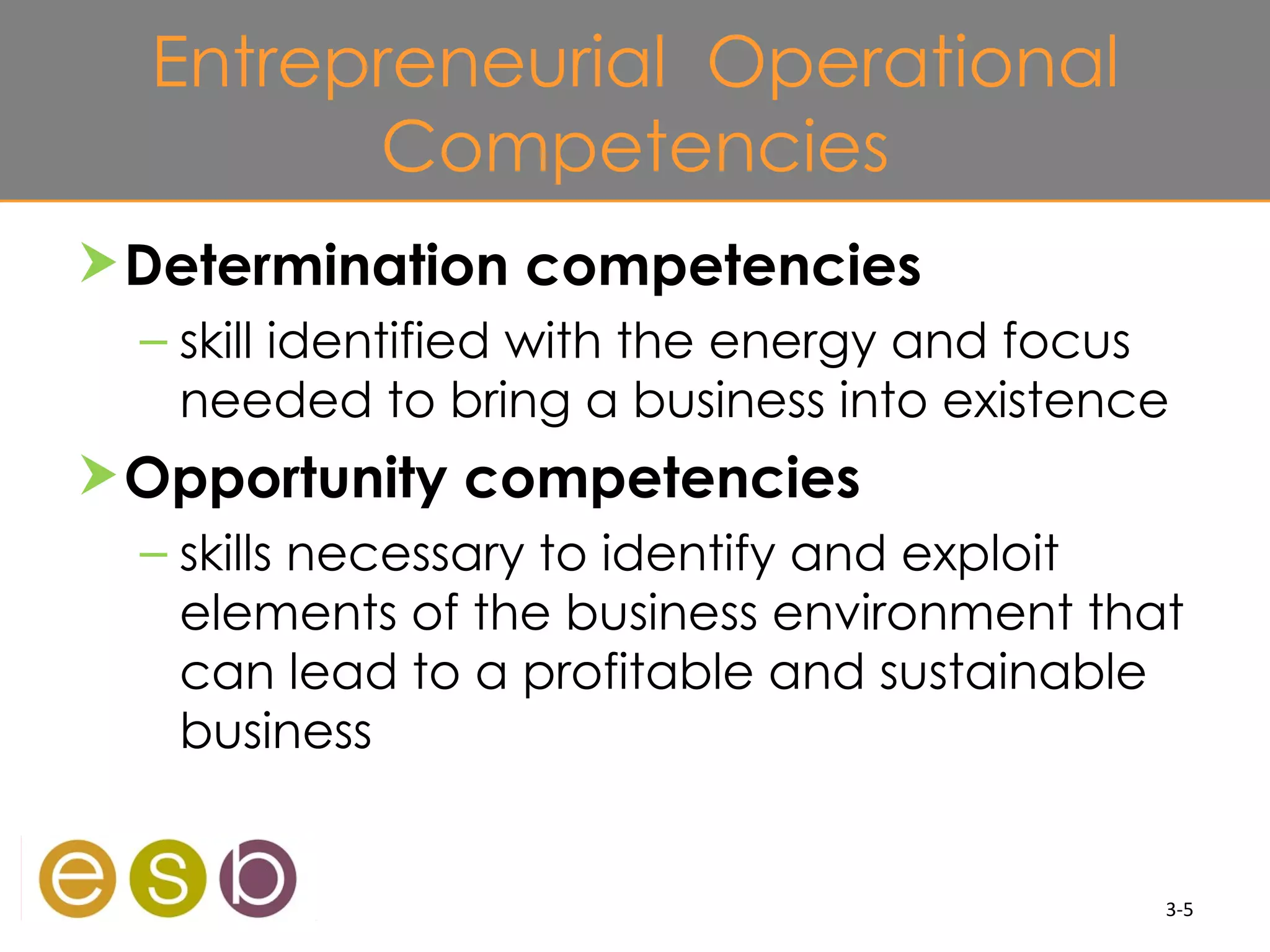
Entrepreneurial Operational
        Competencies
 Key business functions
  – activities common to all businesses
  – sales, operations, accounting, finance,
    and human resources
 Industry-specific knowledge
  – activities, skills, and knowledge, specific to
    businesses in an industry


                                                3-3
Entrepreneurial Operational
        Competencies
 Resource competencies
  – the ability or skill of the entrepreneur at
    finding expendable components
    necessary to the operation of the business
  – Time, information, location, financing, raw
    materials, expertise


                                              3-4
Entrepreneurial Operational
        Competencies
 Determination competencies
  – skill identified with the energy and focus
    needed to bring a business into existence
 Opportunity competencies
  – skills necessary to identify and exploit
    elements of the business environment that
    can lead to a profitable and sustainable
    business


                                             3-5
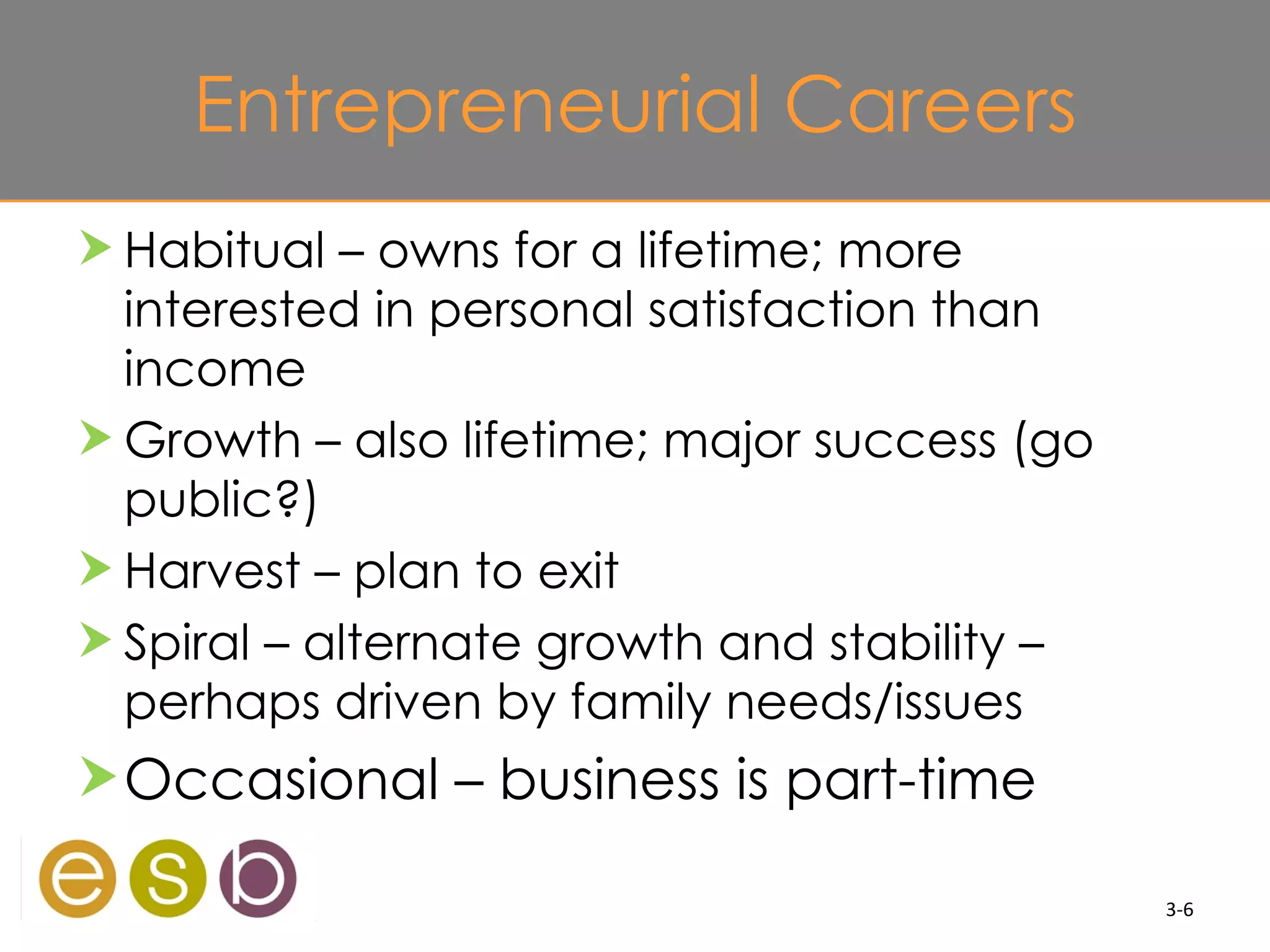
Entrepreneurial Careers
 Habitual – owns for a lifetime; more
  interested in personal satisfaction than
  income
 Growth – also lifetime; major success (go
  public?)
 Harvest – plan to exit
 Spiral – alternate growth and stability –
  perhaps driven by family needs/issues
 Occasional – business is part-time

                                              3-6
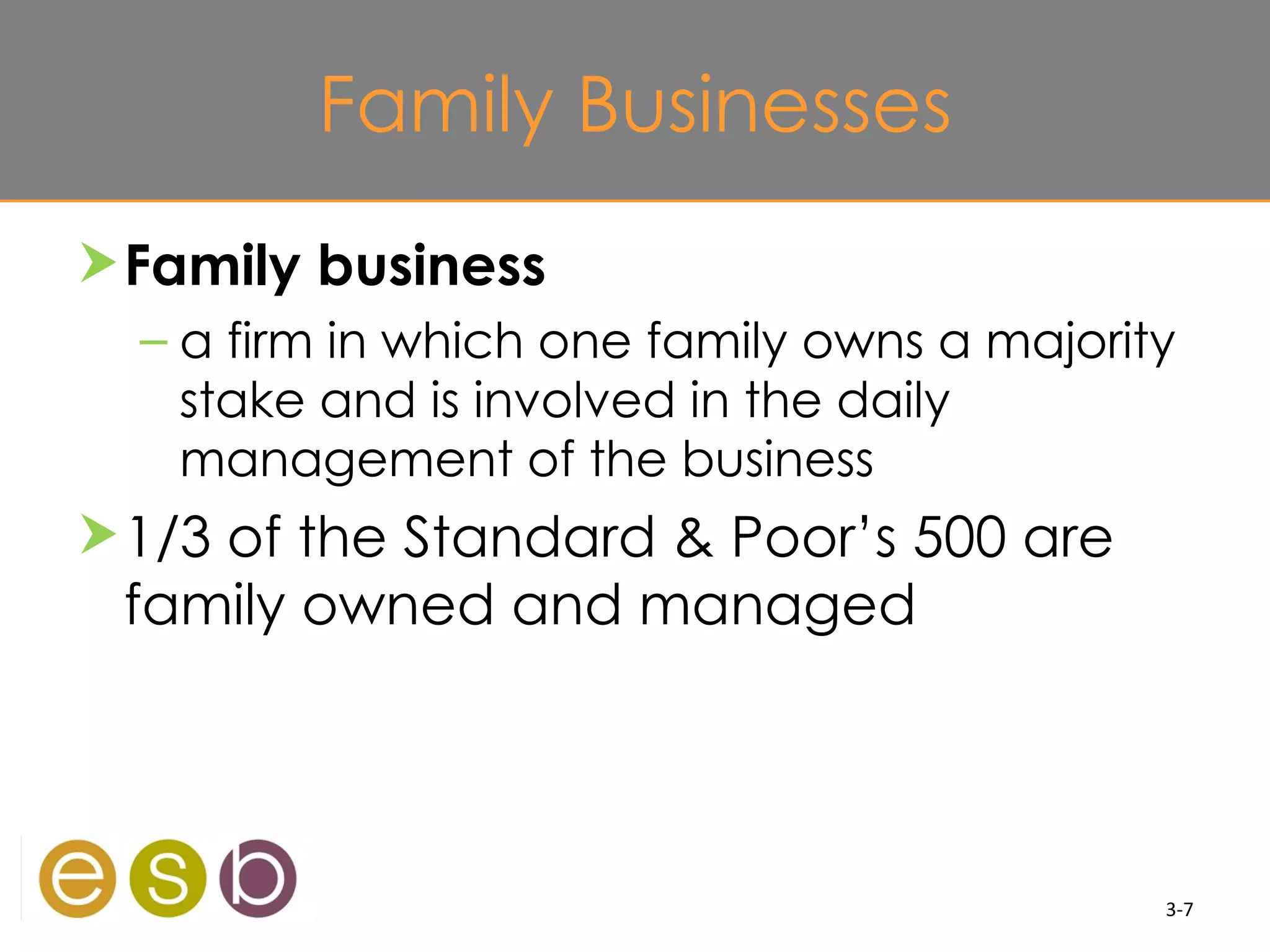
Family Businesses
 Family business
  – a firm in which one family owns a majority
    stake and is involved in the daily
    management of the business
 1/3 of the Standard & Poor’s 500 are
  family owned and managed


                                             3-7
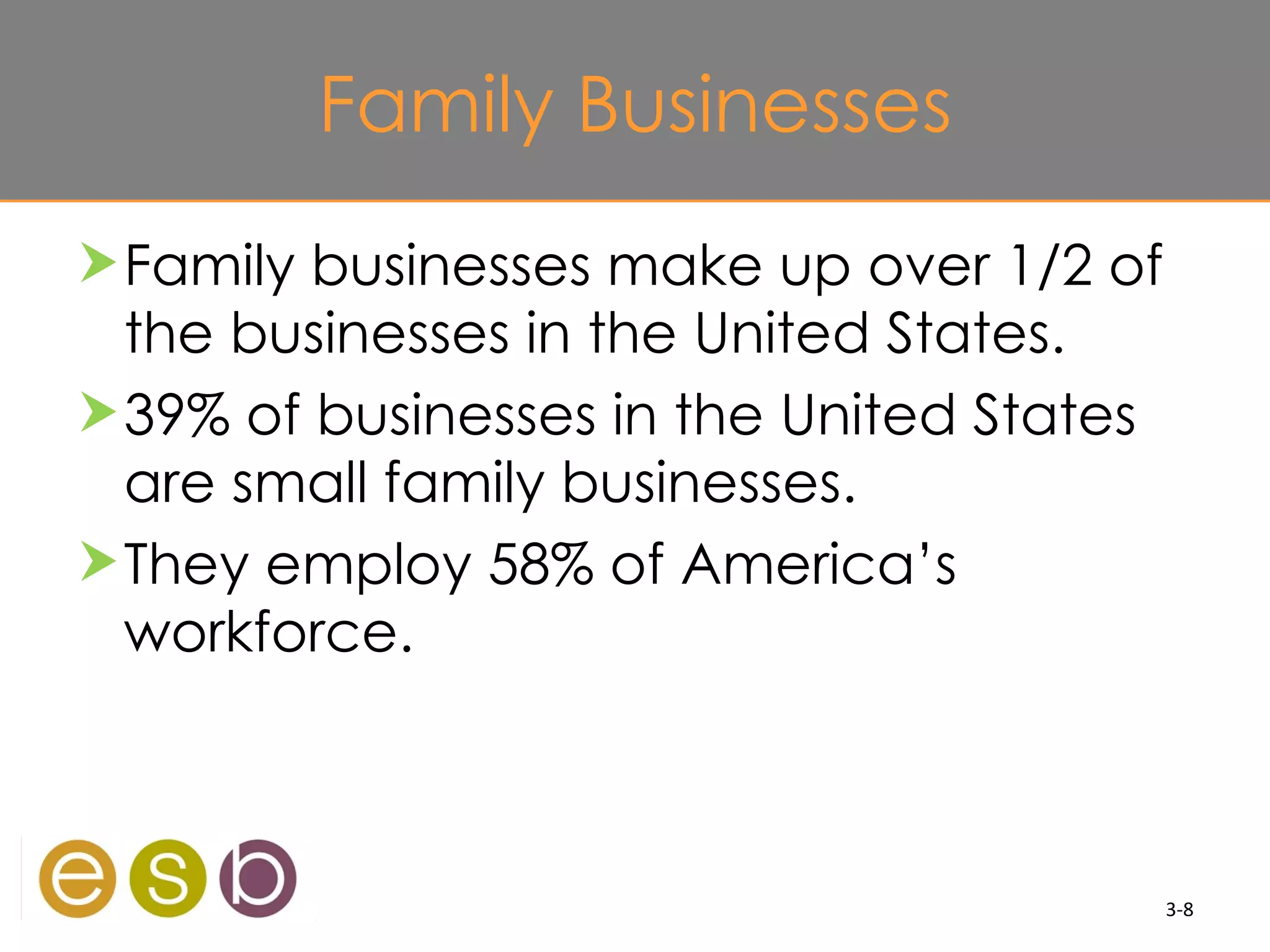
Family Businesses
 Family businesses make up over 1/2 of
  the businesses in the United States.
 39% of businesses in the United States
  are small family businesses.
 They employ 58% of America’s
  workforce.


                                           3-8
Family Business Challenges
 Role conflict
  – the kind of problem that arises when
    people have multiple responsibilities, such
    as parent and boss, and the different
    responsibilities make different demands
    on them
  – Whenever possible, make decisions based
    on business necessities.


                                             3-9
Family Business Challenges
 Succession
  – the process of intergenerational transfer
    of a business
  – Lack of clear transition plan is the death
    knell


                                                 3-10
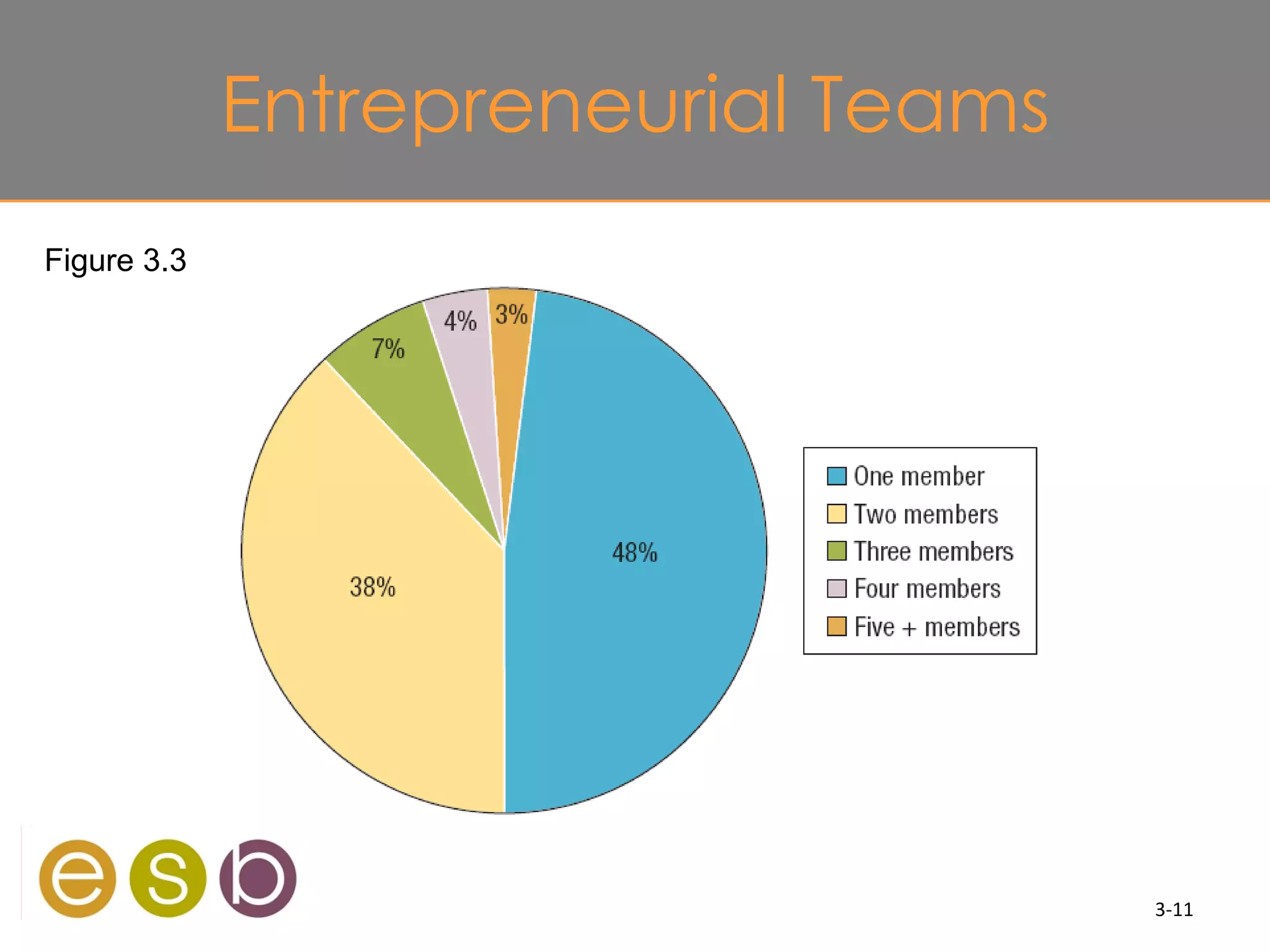
Entrepreneurial Teams
Figure 3.3


                                     3-11
Entrepreneurial Teams
 Majority of new businesses have a
  team of two or more co-owners
 Most teams are family related
 More than half of teams are spouses or
  life partners working together


                                      3-12
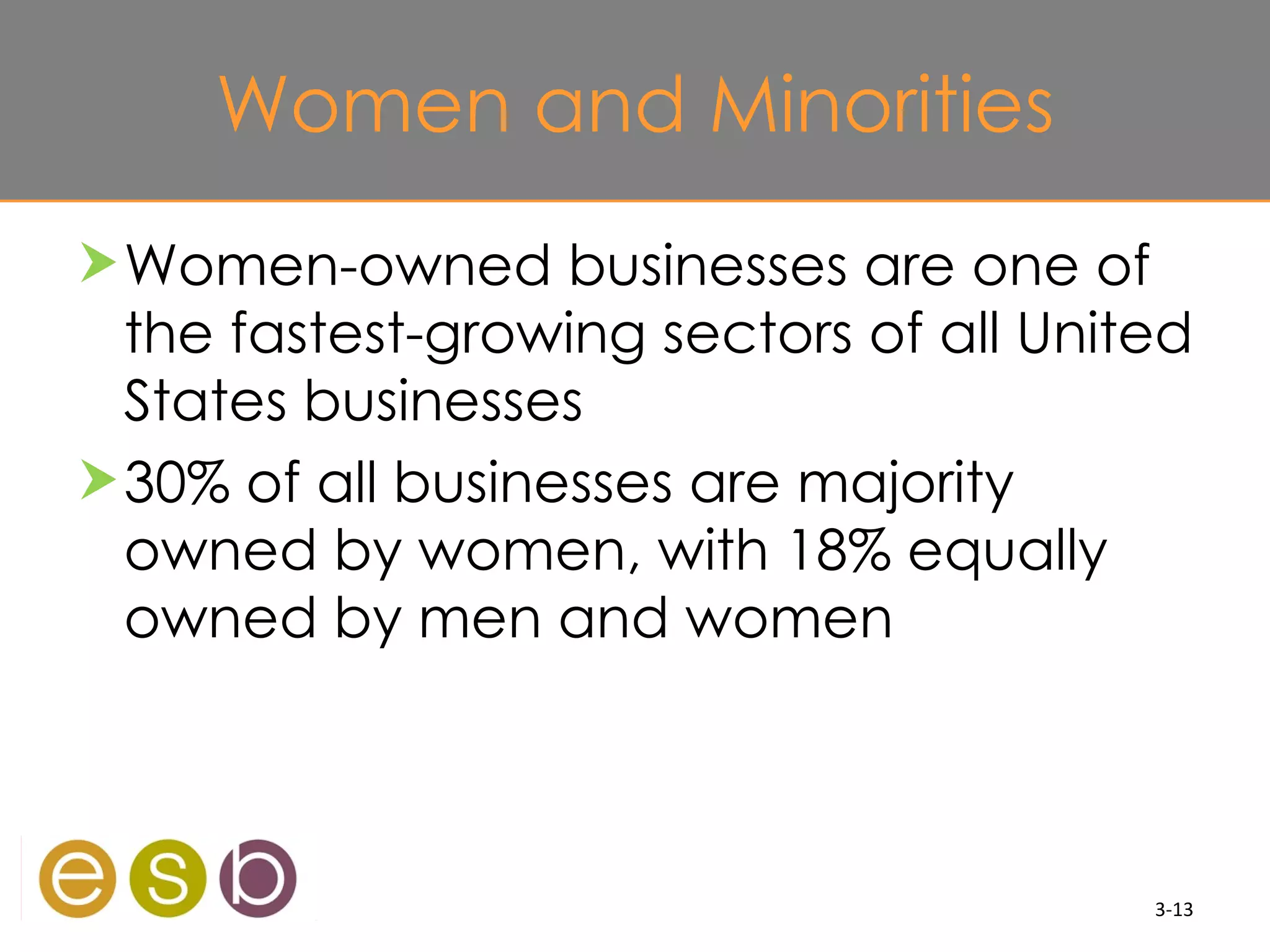
Women and Minorities
 Women-owned businesses are one of
  the fastest-growing sectors of all United
  States businesses
 30% of all businesses are majority
  owned by women, with 18% equally
  owned by men and women


                                         3-13
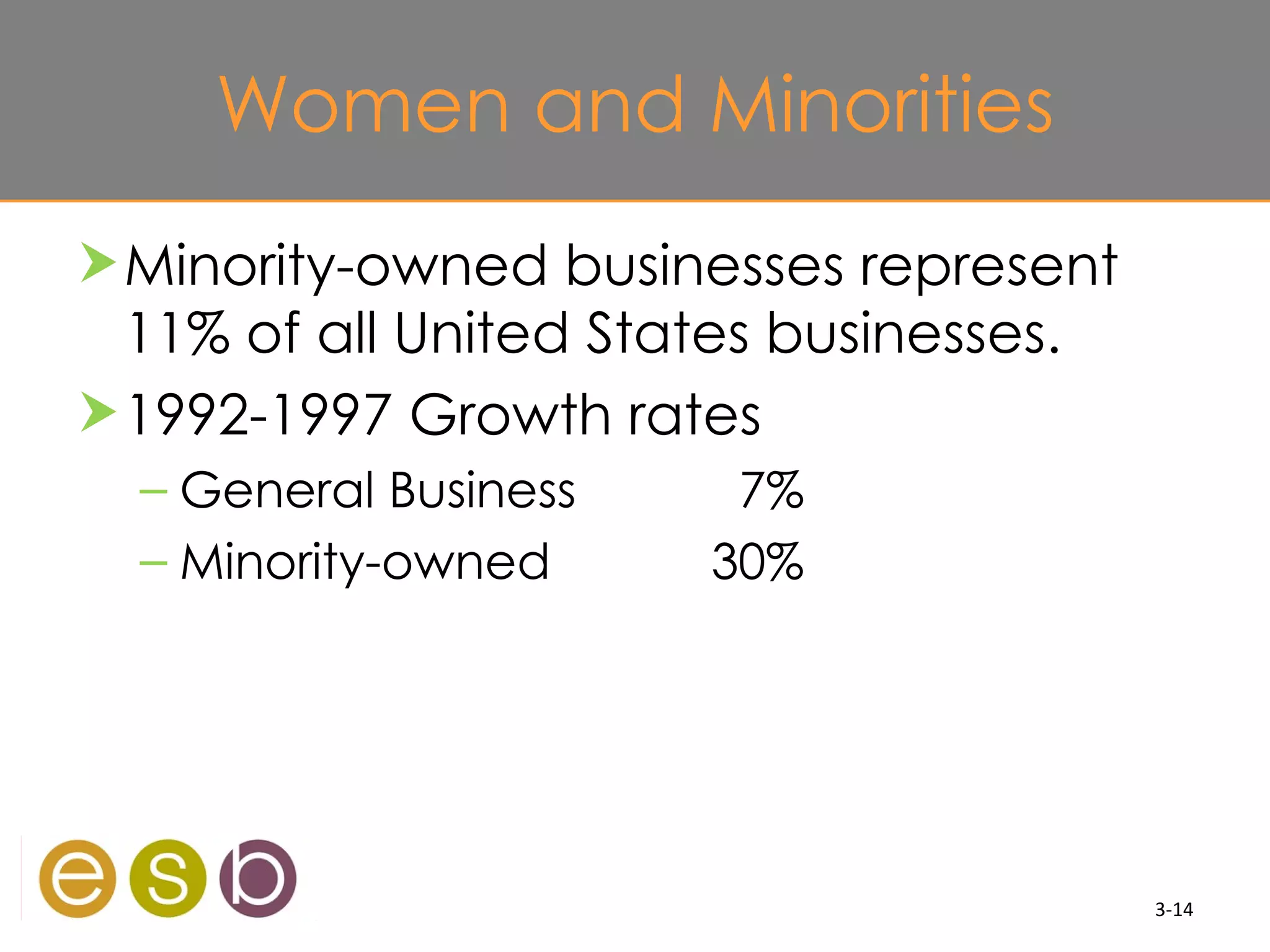
Women and Minorities
 Minority-owned businesses represent
  11% of all United States businesses.
 1992-1997 Growth rates
  – General Business    7%
  – Minority-owned     30%


                                         3-14
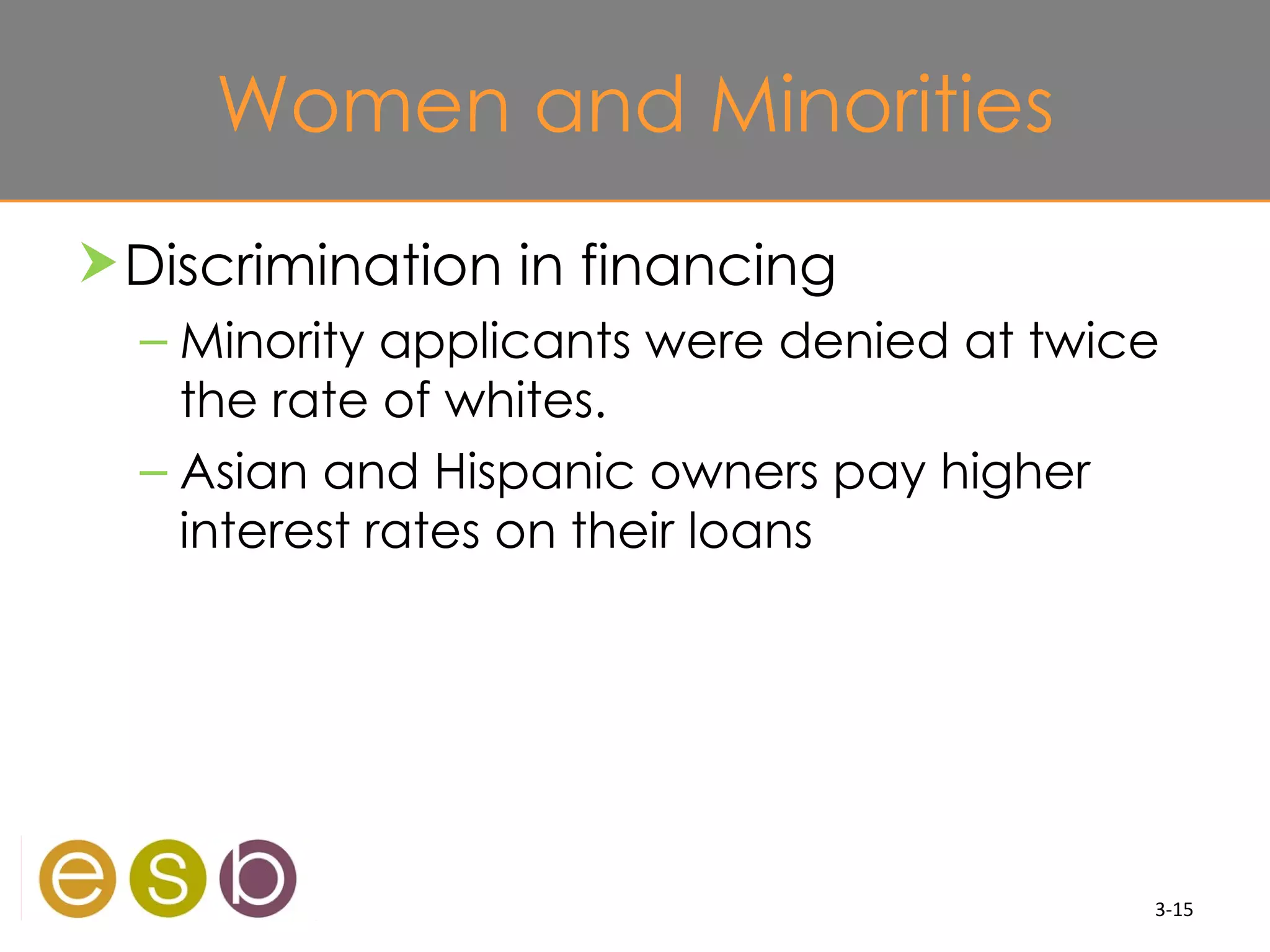
Women and Minorities
 Discrimination in financing
  – Minority applicants were denied at twice
    the rate of whites.
  – Asian and Hispanic owners pay higher
    interest rates on their loans


                                           3-15
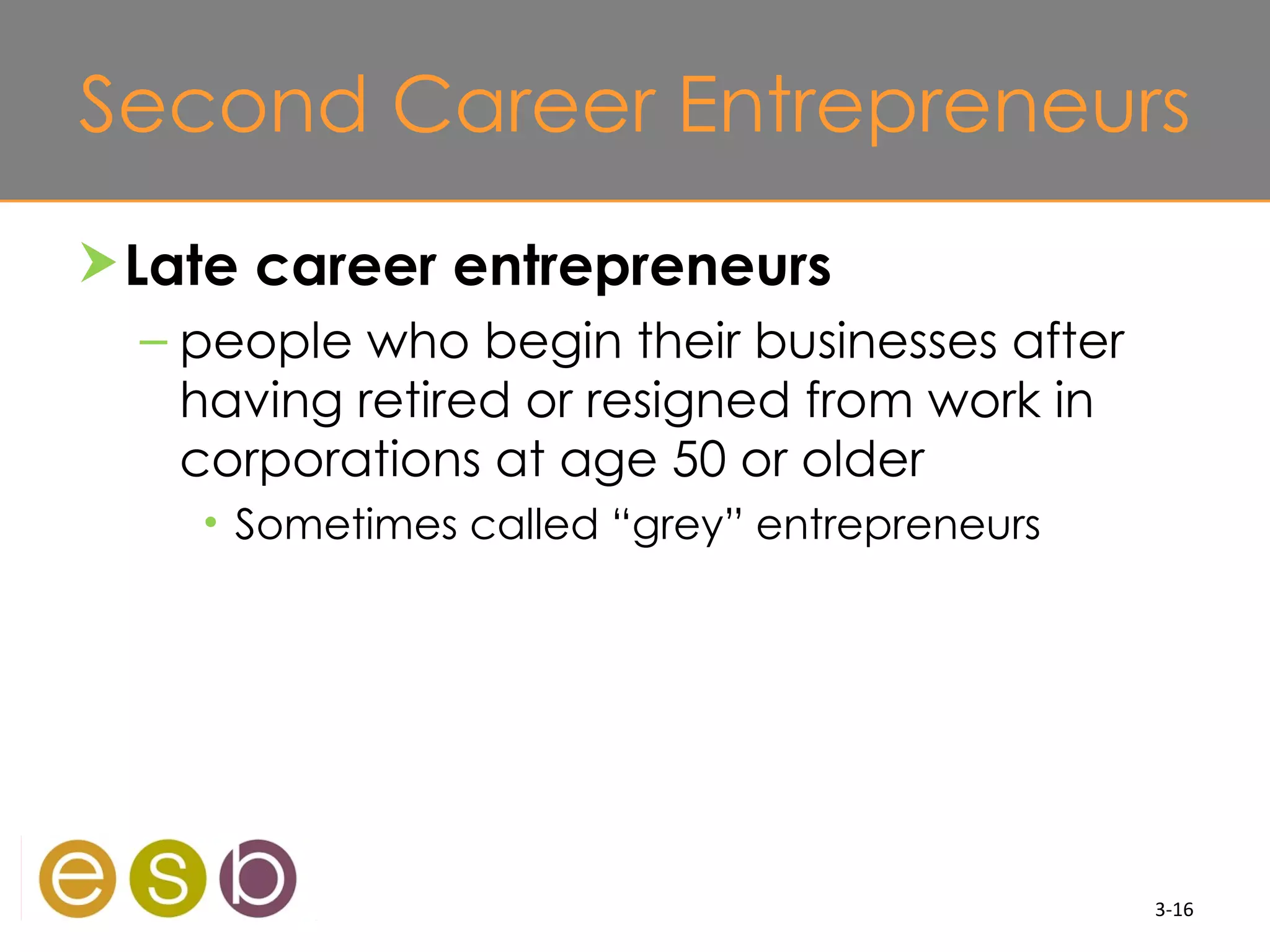
Second Career Entrepreneurs
 Late career entrepreneurs
  – people who begin their businesses after
    having retired or resigned from work in
    corporations at age 50 or older
    • Sometimes called “grey” entrepreneurs


                                              3-16

Chap003 revised(2)

  • 1.
    Small Business Entrepreneurs Characteristics and Competencies Chapter 03 McGraw-Hill/Irwin Copyright © 2011 by the McGraw-Hill Companies, Inc. All rights reserved.
  • 2.
    What is anentrepreneur?  Is “entrepreneurship” innate? Or learned? Or both?  Are there certain personality characteristics? Or not?  Do entrepreneurs seek risk? Or are they risk-averse?  What descriptors would we assign to “entrepreneur?” 3-2
  • 3.
    Entrepreneurial Operational Competencies  Key business functions – activities common to all businesses – sales, operations, accounting, finance, and human resources  Industry-specific knowledge – activities, skills, and knowledge, specific to businesses in an industry 3-3
  • 4.
    Entrepreneurial Operational Competencies  Resource competencies – the ability or skill of the entrepreneur at finding expendable components necessary to the operation of the business – Time, information, location, financing, raw materials, expertise 3-4
  • 5.
    Entrepreneurial Operational Competencies  Determination competencies – skill identified with the energy and focus needed to bring a business into existence  Opportunity competencies – skills necessary to identify and exploit elements of the business environment that can lead to a profitable and sustainable business 3-5
  • 6.
    Entrepreneurial Careers  Habitual– owns for a lifetime; more interested in personal satisfaction than income  Growth – also lifetime; major success (go public?)  Harvest – plan to exit  Spiral – alternate growth and stability – perhaps driven by family needs/issues  Occasional – business is part-time 3-6
  • 7.
    Family Businesses  Familybusiness – a firm in which one family owns a majority stake and is involved in the daily management of the business  1/3 of the Standard & Poor’s 500 are family owned and managed 3-7
  • 8.
    Family Businesses  Familybusinesses make up over 1/2 of the businesses in the United States.  39% of businesses in the United States are small family businesses.  They employ 58% of America’s workforce. 3-8
  • 9.
    Family Business Challenges Role conflict – the kind of problem that arises when people have multiple responsibilities, such as parent and boss, and the different responsibilities make different demands on them – Whenever possible, make decisions based on business necessities. 3-9
  • 10.
    Family Business Challenges Succession – the process of intergenerational transfer of a business – Lack of clear transition plan is the death knell 3-10
  • 11.
  • 12.
    Entrepreneurial Teams  Majorityof new businesses have a team of two or more co-owners  Most teams are family related  More than half of teams are spouses or life partners working together 3-12
  • 13.
    Women and Minorities Women-owned businesses are one of the fastest-growing sectors of all United States businesses  30% of all businesses are majority owned by women, with 18% equally owned by men and women 3-13
  • 14.
    Women and Minorities Minority-owned businesses represent 11% of all United States businesses.  1992-1997 Growth rates – General Business 7% – Minority-owned 30% 3-14
  • 15.
    Women and Minorities Discrimination in financing – Minority applicants were denied at twice the rate of whites. – Asian and Hispanic owners pay higher interest rates on their loans 3-15
  • 16.
    Second Career Entrepreneurs Late career entrepreneurs – people who begin their businesses after having retired or resigned from work in corporations at age 50 or older • Sometimes called “grey” entrepreneurs 3-16

Editor's Notes

  • #4 Some functions are common to businesses. But every industry has it’s own set of skills necessary to be successful. A doctor’s office and a car mechanic both involve scheduling, selling a service, both have accounting and billing needs, both require employees. But the skills to be a successful doctor or successful mechanic are very different.
  • #5 There are some types of competencies which are skills, but not the mechanic or doctor’s skills needed to provide the specific service of the business.
  • #6 These competencies are essential to success for entrepreneurs. Starting a new company takes much in terms of time, effort, and focus in order to become successful.
  • #8 Family businesses have all the facets of normal entrepreneurial firms but also have the emotional drama inherent in a family.
  • #11 One problem seen in successful family owned businesses is that the second generation may not be as passionate about, or as capable of, running the family business. Many children who grow up with parents running a successful family business do not desire to work the weekends and late nights which were required to make the business successful. Another issue is who is the successor? And where does that leave a child who chooses not to work in the family business? These issues will also be discusses later in the book. Answer is taking a professional approach Only 5% of entrepreneurs can rely on family members to take over
  • #16 While there are Government Set-asides for minority and women-owned firms, often these firms do not know they exist. It is often helpful to network with other minority or female entrepreneurs and get advice on which banks were more helpful to them.
  • #17 If starting a business late in life, it is essential to keep the money you have already amassed, safe. Keep in mind, if you lose all your money in this venture, you will not have as much time to rebuild your personal security.