WHAT IS ENTREPRENEURSHIP?
1
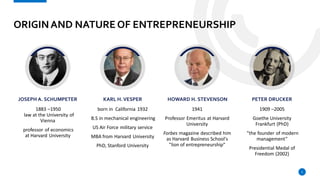
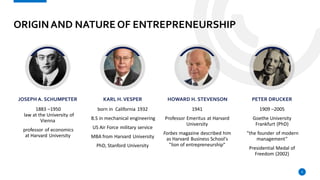
ORIGINAND NATURE OF ENTREPRENEURSHIP
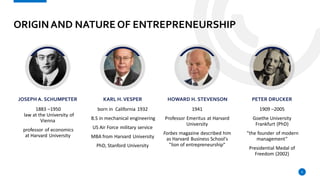
JOSEPH A. SCHUMPETER
1883 –1950
law at the University of
Vienna
professor of economics
at Harvard University
KARL H.VESPER
born in California 1932
B.S in mechanical engineering
US Air Force military service
MBA from Harvard University
PhD, Stanford University
HOWARD H. STEVENSON
1941
Professor Emeritus at Harvard
University
Forbes magazine described him
as Harvard Business School's
"lion of entrepreneurship"
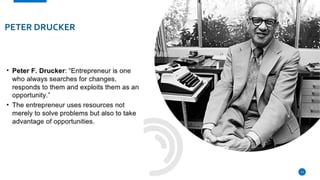
PETER DRUCKER
1909 –2005
Goethe University
Frankfurt (PhD)
”the founder of modern
management”
Presidential Medal of
Freedom (2002)
2
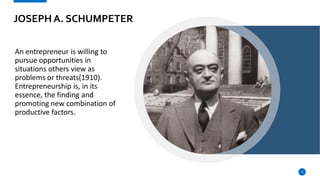
JOSEPH A. SCHUMPETER
An entrepreneur is willing to
pursue opportunities in
situations others view as
problems or threats(1910).
Entrepreneurship is, in its
essence, the finding and
promoting new combination of
productive factors.
3
4
5
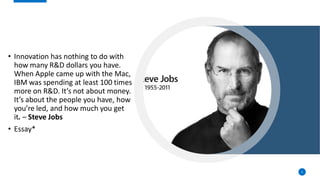
• Innovation has nothing to do with
how many R&D dollars you have.
When Apple came up with the Mac,
IBM was spending at least 100 times
more on R&D. It’s not about money.
It’s about the people you have, how
you’re led, and how much you get
it. – Steve Jobs
• Essay*
ORIGINAND NATURE OF ENTREPRENEURSHIP
JOSEPH A. SCHUMPETER
1883 –1950
law at the University of
Vienna
professor of economics
at Harvard University
KARL H.VESPER
born in California 1932
B.S in mechanical engineering
US Air Force military service
MBA from Harvard University
PhD, Stanford University
HOWARD H. STEVENSON
1941
Professor Emeritus at Harvard
University
Forbes magazine described him
as Harvard Business School's
"lion of entrepreneurship"
PETER DRUCKER
1909 –2005
Goethe University
Frankfurt (PhD)
”the founder of modern
management”
Presidential Medal of
Freedom (2002)
6
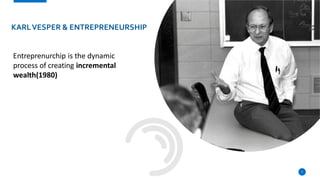
KARLVESPER & ENTREPRENEURSHIP
7
Entreprenurchip is the dynamic
process of creating incremental
wealth(1980)
8
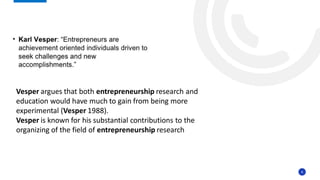
Vesper argues that both entrepreneurship research and
education would have much to gain from being more
experimental (Vesper 1988).
Vesper is known for his substantial contributions to the
organizing of the field of entrepreneurship research
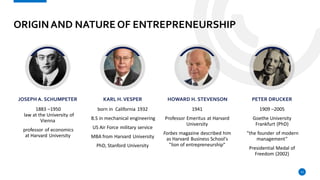
ORIGINAND NATURE OF ENTREPRENEURSHIP
JOSEPH A. SCHUMPETER
1883 –1950
law at the University of
Vienna
professor of economics
at Harvard University
KARL H.VESPER
born in California 1932
B.S in mechanical engineering
US Air Force military service
MBA from Harvard University
PhD, Stanford University
HOWARD H. STEVENSON
1941
Professor Emeritus at Harvard
University
Forbes magazine described him
as Harvard Business School's
"lion of entrepreneurship"
PETER DRUCKER
1909 –2005
Goethe University
Frankfurt (PhD)
”the founder of modern
management”
Presidential Medal of
Freedom (2002)
9
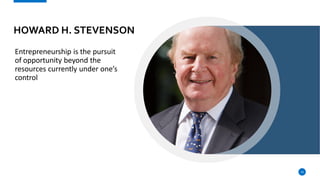
HOWARD H. STEVENSON
Entrepreneurship is the pursuit
of opportunity beyond the
resources currently under one’s
control
10
11
• Every time you want to make any important decision, there are two
possible courses of action. You can look at the array of choices that
present themselves, pick the best available option and try to make it fit.
Or, you can do what the true entrepreneur does: Figure out the best
conceivable option and then make it available.-Burgstone
BURGSTONE PUTS:
ORIGINAND NATURE OF ENTREPRENEURSHIP
JOSEPH A. SCHUMPETER
1883 –1950
law at the University of
Vienna
professor of economics
at Harvard University
KARL H.VESPER
born in California 1932
B.S in mechanical engineering
US Air Force military service
MBA from Harvard University
PhD, Stanford University
HOWARD H. STEVENSON
1941
Professor Emeritus at Harvard
University
Forbes magazine described him
as Harvard Business School's
"lion of entrepreneurship"
PETER DRUCKER
1909 –2005
Goethe University
Frankfurt (PhD)
”the founder of modern
management”
Presidential Medal of
Freedom (2002)
12
PETER DRUCKER
13
14
Entrepreneurship is the process of starting one’s own
new and small business. It is also the process of
innovation and new venture creation through four
major dimension- individual, organizational,
environmental, process-aided by collaborative
networks in government, education and institutions.
15
16
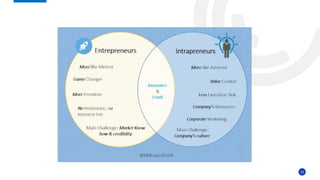
• Intrapreneurship is a system which allows an employee to act like an
entrepreneur within an organization.
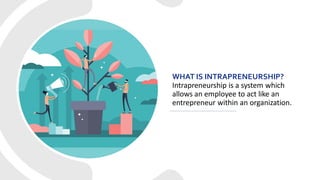
WHAT IS INTRAPRENEURSHIP?
Intrapreneurship is a system which
allows an employee to act like an
entrepreneur within an organization.
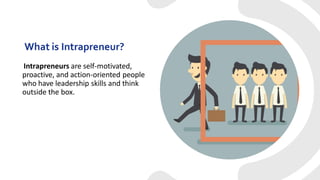
What is Intrapreneur?
Intrapreneurs are self-motivated,
proactive, and action-oriented people
who have leadership skills and think
outside the box.
19
HOW BECOME ENTREPRENEUR?
7 Steps to Becoming an Entrepreneur
20
21
• Entrepreneurship is a broad term, and you can be an entrepreneur in
just about any area. However, you will have to pick a field to work in
and business to start. Find a business that won’t only be successful,
but is something that you are passionate about. Entrepreneurship is
hard work, so you want to focus your attention on something you
care about.
STEP 1: FINDTHE RIGHT BUSINESS FORYOU
22
• You don’t need to have any type of formal education to be an
entrepreneur, but that doesn’t mean you should ignore education
entirely. If you want to start a tech company, experience in business,
computer programming and marketing could all be valuable. Also, some
industries will likely require some type of education, such as your own
accounting or law firm.
STEP 2: DETERMINE IFYOU SHOULD GETAN EDUCATION
23
• Before you begin your business, you need to have a business plan. A
business plan lays out any objectives you have as well as your strategy
for achieving those objectives. This plan is important for getting
investors on board, as well as measuring how successful your business
is.
STEP 3: PLANYOUR BUSINESS
24
• Not every business appeals to everyone. The age, gender, income, race
and culture of your target group will play a large role in determining
where you open up shop – or if you even need to have a physical
address for business. Research which group fits your business model
best, and then gear everything to attract that demographic.
STEP 4: FINDYOURTARGETGROUP/AUDIENCE
STEP 5: NETWORK
While networking is important in all fields, it may be most
important for entrepreneurs. Networking is how you meet
other people that might have skills you can use in your
business. You can also find potential investors through
networking to help get your business model off the ground.
Your network can also support your business once you open,
helping send new customers your way.
25
26
• Consumers want products, but they don’t always know which product
to pick. Your job as an entrepreneur is to convince people that whatever
you’re selling is the best option available. You’ll have to find out what
makes your product unique and then sell it based off the value it adds.
STEP 6: SELLYOUR IDEA
27
• You should be focused on marketing before, during and after you start
your business. You may have the best restaurant in the city, but nobody
will visit if they don't know it exists. Marketing is tricky, but if you should
be able to focus your marketing efforts on your target audience. For
example, millennials may be more likely to see an ad on social media
than on a billboard downtown.
STEP 7: MARKET
GLOBAL ENTREPRENEURSHIPMONITOR
HTTPS://WWW.GEMCONSORTIUM.ORG/
THANK YOU FOR
YOUR
ATTENTION
SONIA TAHERI
1399

Entrepreneurship

  • 1.
  • 2.
    ORIGINAND NATURE OFENTREPRENEURSHIP JOSEPH A. SCHUMPETER 1883 –1950 law at the University of Vienna professor of economics at Harvard University KARL H.VESPER born in California 1932 B.S in mechanical engineering US Air Force military service MBA from Harvard University PhD, Stanford University HOWARD H. STEVENSON 1941 Professor Emeritus at Harvard University Forbes magazine described him as Harvard Business School's "lion of entrepreneurship" PETER DRUCKER 1909 –2005 Goethe University Frankfurt (PhD) ”the founder of modern management” Presidential Medal of Freedom (2002) 2
  • 3.
    JOSEPH A. SCHUMPETER Anentrepreneur is willing to pursue opportunities in situations others view as problems or threats(1910). Entrepreneurship is, in its essence, the finding and promoting new combination of productive factors. 3
  • 4.
  • 5.
    5 • Innovation hasnothing to do with how many R&D dollars you have. When Apple came up with the Mac, IBM was spending at least 100 times more on R&D. It’s not about money. It’s about the people you have, how you’re led, and how much you get it. – Steve Jobs • Essay*
  • 6.
    ORIGINAND NATURE OFENTREPRENEURSHIP JOSEPH A. SCHUMPETER 1883 –1950 law at the University of Vienna professor of economics at Harvard University KARL H.VESPER born in California 1932 B.S in mechanical engineering US Air Force military service MBA from Harvard University PhD, Stanford University HOWARD H. STEVENSON 1941 Professor Emeritus at Harvard University Forbes magazine described him as Harvard Business School's "lion of entrepreneurship" PETER DRUCKER 1909 –2005 Goethe University Frankfurt (PhD) ”the founder of modern management” Presidential Medal of Freedom (2002) 6
  • 7.
    KARLVESPER & ENTREPRENEURSHIP 7 Entreprenurchipis the dynamic process of creating incremental wealth(1980)
  • 8.
    8 Vesper argues thatboth entrepreneurship research and education would have much to gain from being more experimental (Vesper 1988). Vesper is known for his substantial contributions to the organizing of the field of entrepreneurship research
  • 9.
    ORIGINAND NATURE OFENTREPRENEURSHIP JOSEPH A. SCHUMPETER 1883 –1950 law at the University of Vienna professor of economics at Harvard University KARL H.VESPER born in California 1932 B.S in mechanical engineering US Air Force military service MBA from Harvard University PhD, Stanford University HOWARD H. STEVENSON 1941 Professor Emeritus at Harvard University Forbes magazine described him as Harvard Business School's "lion of entrepreneurship" PETER DRUCKER 1909 –2005 Goethe University Frankfurt (PhD) ”the founder of modern management” Presidential Medal of Freedom (2002) 9
  • 10.
    HOWARD H. STEVENSON Entrepreneurshipis the pursuit of opportunity beyond the resources currently under one’s control 10
  • 11.
    11 • Every timeyou want to make any important decision, there are two possible courses of action. You can look at the array of choices that present themselves, pick the best available option and try to make it fit. Or, you can do what the true entrepreneur does: Figure out the best conceivable option and then make it available.-Burgstone BURGSTONE PUTS:
  • 12.
    ORIGINAND NATURE OFENTREPRENEURSHIP JOSEPH A. SCHUMPETER 1883 –1950 law at the University of Vienna professor of economics at Harvard University KARL H.VESPER born in California 1932 B.S in mechanical engineering US Air Force military service MBA from Harvard University PhD, Stanford University HOWARD H. STEVENSON 1941 Professor Emeritus at Harvard University Forbes magazine described him as Harvard Business School's "lion of entrepreneurship" PETER DRUCKER 1909 –2005 Goethe University Frankfurt (PhD) ”the founder of modern management” Presidential Medal of Freedom (2002) 12
  • 13.
  • 14.
    14 Entrepreneurship is theprocess of starting one’s own new and small business. It is also the process of innovation and new venture creation through four major dimension- individual, organizational, environmental, process-aided by collaborative networks in government, education and institutions.
  • 15.
  • 16.
    16 • Intrapreneurship isa system which allows an employee to act like an entrepreneur within an organization. WHAT IS INTRAPRENEURSHIP?
  • 17.
    WHAT IS INTRAPRENEURSHIP? Intrapreneurshipis a system which allows an employee to act like an entrepreneur within an organization.
  • 18.
    What is Intrapreneur? Intrapreneursare self-motivated, proactive, and action-oriented people who have leadership skills and think outside the box.
  • 19.
  • 20.
    HOW BECOME ENTREPRENEUR? 7Steps to Becoming an Entrepreneur 20
  • 21.
    21 • Entrepreneurship isa broad term, and you can be an entrepreneur in just about any area. However, you will have to pick a field to work in and business to start. Find a business that won’t only be successful, but is something that you are passionate about. Entrepreneurship is hard work, so you want to focus your attention on something you care about. STEP 1: FINDTHE RIGHT BUSINESS FORYOU
  • 22.
    22 • You don’tneed to have any type of formal education to be an entrepreneur, but that doesn’t mean you should ignore education entirely. If you want to start a tech company, experience in business, computer programming and marketing could all be valuable. Also, some industries will likely require some type of education, such as your own accounting or law firm. STEP 2: DETERMINE IFYOU SHOULD GETAN EDUCATION
  • 23.
    23 • Before youbegin your business, you need to have a business plan. A business plan lays out any objectives you have as well as your strategy for achieving those objectives. This plan is important for getting investors on board, as well as measuring how successful your business is. STEP 3: PLANYOUR BUSINESS
  • 24.
    24 • Not everybusiness appeals to everyone. The age, gender, income, race and culture of your target group will play a large role in determining where you open up shop – or if you even need to have a physical address for business. Research which group fits your business model best, and then gear everything to attract that demographic. STEP 4: FINDYOURTARGETGROUP/AUDIENCE
  • 25.
    STEP 5: NETWORK Whilenetworking is important in all fields, it may be most important for entrepreneurs. Networking is how you meet other people that might have skills you can use in your business. You can also find potential investors through networking to help get your business model off the ground. Your network can also support your business once you open, helping send new customers your way. 25
  • 26.
    26 • Consumers wantproducts, but they don’t always know which product to pick. Your job as an entrepreneur is to convince people that whatever you’re selling is the best option available. You’ll have to find out what makes your product unique and then sell it based off the value it adds. STEP 6: SELLYOUR IDEA
  • 27.
    27 • You shouldbe focused on marketing before, during and after you start your business. You may have the best restaurant in the city, but nobody will visit if they don't know it exists. Marketing is tricky, but if you should be able to focus your marketing efforts on your target audience. For example, millennials may be more likely to see an ad on social media than on a billboard downtown. STEP 7: MARKET
  • 28.
  • 29.