





ENTREPRENEURSHIP
PRESENTED
BY
LINDA KWANDA NGWENYA
AGENDA
ENTREPRENEURSHIP
ENTREPRENEURS
CHARACTERISTICS
IMPORTANCE
ENTREPRENEURSHIP
The concept of entrepreneurship has a wide range of meanings.
Entrepreneurship is the act of being an entrepreneur, which can be defined as "one who undertakes
innovations, finance and business acumen in an effort to transform innovations into economic goods“
 It is more than mere creation of business
 Entrepreneurship is a process of innovation and new venture creation through four
major dimensions – individual, organizational, environmental and process.
 The entrepreneurship process is aided by collaborative networks in government,
education and institutions.
ENTREPRENEUR
The word entrepreneur originates from the French word, entreprendre, which means "to undertake( to
begin something)." In a business context, it means to start a business. The Merriam-Webster Dictionary
presents the definition of an entrepreneur as one who organizes, manages, and assumes the risks of a
business or enterprise.
An innovator of business enterprise who recognizes opportunities to introduce a new product, a
new process or an improved organization, and who raises the necessary money, assembles the
factors for production and organizes an operation to exploit the opportunity.
It is the process of creating something new either it may be product or idea.
Entrepreneur is an innovative person who maximizes his profits by following new strategies or
venturing into new products or services.
An entrepreneur is one who always searches for change, responds to it, and exploits it as an
opportunity.
On the one extreme an entrepreneur is a person of very high aptitude who pioneers change,
possessing characteristics found in only a very small fraction of the population.
Finally gaining monetary and personal satisfaction and freedom to do what you want.
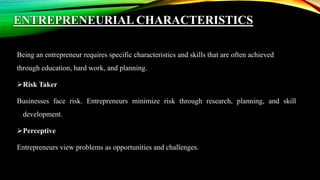
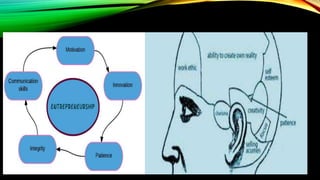
ENTREPRENEURIAL CHARACTERISTICS
Being an entrepreneur requires specific characteristics and skills that are often achieved
through education, hard work, and planning.
Risk Taker
Businesses face risk. Entrepreneurs minimize risk through research, planning, and skill
development.
Perceptive
Entrepreneurs view problems as opportunities and challenges.
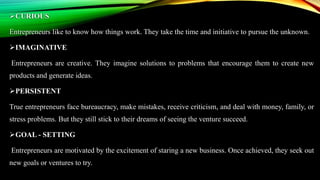
CURIOUS
Entrepreneurs like to know how things work. They take the time and initiative to pursue the unknown.
IMAGINATIVE
Entrepreneurs are creative. They imagine solutions to problems that encourage them to create new
products and generate ideas.
PERSISTENT
True entrepreneurs face bureaucracy, make mistakes, receive criticism, and deal with money, family, or
stress problems. But they still stick to their dreams of seeing the venture succeed.
GOAL - SETTING
Entrepreneurs are motivated by the excitement of staring a new business. Once achieved, they seek out
new goals or ventures to try.
HARDWORKING
Entrepreneurs need a great deal of energy to see a venture start and succeed. Yet they are not
deterred by the long hours to achieve their goal.
SELF – CONFIDENT
Entrepreneurs believe in themselves. Their self-confidence takes care of any doubts they may
have.
INDEPENDENT
An entrepreneur’s desire for control and the ability to make decisions often makes it difficult for
them to work in a controlled environment.
OTHER CHARACTERISTICS
Confident
Enthusiastic
Not afraid to make decisions
Determined
Entrepreneurs know:
What they want
Where to get the best information.
Entrepreneurs can:
See opportunities that others can’t see
Take on a challenge rather than always opting for the safe path
Plan for different possible outcomes
IMPORTANCE
It turns innovation and new ideas into demand
It is vital part of one’s nation economy
It provides employment to huge mass of people
Creates wealth for nation and for individuals as well
Entrepreneurship provides self sufficiency
Through Entrepreneurship, it contributes towards research and development
The crux motive of entrepreneurship is to transform the dreams into a profitable truth.
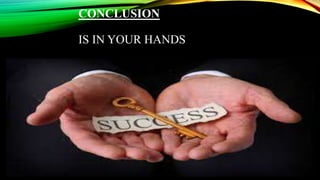
CONCLUSION
IS IN YOUR HANDS
I WISH YOU ALL THE BEST
REFERENCES
Basit,A. ( 2011) THINK LIKE AN ENTREPRENEUR, Karachi: SAB
Huey,P. (2014) ENTREPRENEURSHIP,
Kazi,A. ( 2012) ENTREPRENEURSHIP, Nawabshah: Sukkur IBA
Rathi,M. ( 2013) ENTREPRENEURSHIP IN AGRICULTURE, Greater Noida: BHEL

My entrepreneurship

  • 1.
  • 2.
  • 3.
    ENTREPRENEURSHIP The concept ofentrepreneurship has a wide range of meanings. Entrepreneurship is the act of being an entrepreneur, which can be defined as "one who undertakes innovations, finance and business acumen in an effort to transform innovations into economic goods“  It is more than mere creation of business  Entrepreneurship is a process of innovation and new venture creation through four major dimensions – individual, organizational, environmental and process.  The entrepreneurship process is aided by collaborative networks in government, education and institutions.
  • 6.
    ENTREPRENEUR The word entrepreneuroriginates from the French word, entreprendre, which means "to undertake( to begin something)." In a business context, it means to start a business. The Merriam-Webster Dictionary presents the definition of an entrepreneur as one who organizes, manages, and assumes the risks of a business or enterprise. An innovator of business enterprise who recognizes opportunities to introduce a new product, a new process or an improved organization, and who raises the necessary money, assembles the factors for production and organizes an operation to exploit the opportunity. It is the process of creating something new either it may be product or idea.
  • 7.
    Entrepreneur is aninnovative person who maximizes his profits by following new strategies or venturing into new products or services. An entrepreneur is one who always searches for change, responds to it, and exploits it as an opportunity. On the one extreme an entrepreneur is a person of very high aptitude who pioneers change, possessing characteristics found in only a very small fraction of the population. Finally gaining monetary and personal satisfaction and freedom to do what you want.
  • 9.
    ENTREPRENEURIAL CHARACTERISTICS Being anentrepreneur requires specific characteristics and skills that are often achieved through education, hard work, and planning. Risk Taker Businesses face risk. Entrepreneurs minimize risk through research, planning, and skill development. Perceptive Entrepreneurs view problems as opportunities and challenges.
  • 11.
    CURIOUS Entrepreneurs like toknow how things work. They take the time and initiative to pursue the unknown. IMAGINATIVE Entrepreneurs are creative. They imagine solutions to problems that encourage them to create new products and generate ideas. PERSISTENT True entrepreneurs face bureaucracy, make mistakes, receive criticism, and deal with money, family, or stress problems. But they still stick to their dreams of seeing the venture succeed. GOAL - SETTING Entrepreneurs are motivated by the excitement of staring a new business. Once achieved, they seek out new goals or ventures to try.
  • 12.
    HARDWORKING Entrepreneurs need agreat deal of energy to see a venture start and succeed. Yet they are not deterred by the long hours to achieve their goal. SELF – CONFIDENT Entrepreneurs believe in themselves. Their self-confidence takes care of any doubts they may have. INDEPENDENT An entrepreneur’s desire for control and the ability to make decisions often makes it difficult for them to work in a controlled environment.
  • 13.
    OTHER CHARACTERISTICS Confident Enthusiastic Not afraidto make decisions Determined Entrepreneurs know: What they want Where to get the best information.
  • 14.
    Entrepreneurs can: See opportunitiesthat others can’t see Take on a challenge rather than always opting for the safe path Plan for different possible outcomes
  • 16.
    IMPORTANCE It turns innovationand new ideas into demand It is vital part of one’s nation economy It provides employment to huge mass of people Creates wealth for nation and for individuals as well Entrepreneurship provides self sufficiency Through Entrepreneurship, it contributes towards research and development The crux motive of entrepreneurship is to transform the dreams into a profitable truth.
  • 17.
  • 18.
    I WISH YOUALL THE BEST
  • 19.
    REFERENCES Basit,A. ( 2011)THINK LIKE AN ENTREPRENEUR, Karachi: SAB Huey,P. (2014) ENTREPRENEURSHIP, Kazi,A. ( 2012) ENTREPRENEURSHIP, Nawabshah: Sukkur IBA Rathi,M. ( 2013) ENTREPRENEURSHIP IN AGRICULTURE, Greater Noida: BHEL