Entrepreneur Skill for New Venture Creation 2010


    http://www.iamaceo.com


    Entrepreneur Skill
    for New Venture
    Creation


                             SANIL SUBHASH CHANDRA BOSE

                             Entrepreneur & Strategy Consultant

                             http://www.iamaceo.com


    Sanil
    7/13/2010


1
Entrepreneur Skill for New Venture Creation 2010


Table of Contents
Introduction ............................................................................................................................................ 3
Venturing your business Idea ................................................................................................................. 3
   Elevator pitching techniques .............................................................................................................. 3
   My Approach....................................................................................................................................... 3
Critical evaluation of business proposal ................................................................................................. 4
   Importance of Plan B .......................................................................................................................... 5
Skills required for an entrepreneur to start new venture ...................................................................... 6
Conclusion ............................................................................................................................................... 7
Bibliography ............................................................................................................................................ 7


          2
Entrepreneur Skill for New Venture Creation 2010

Introduction
Contemplating through the life of an entrepreneur, the three days classes of new venture
creations changed the mindset of entrepreneur to more of plan thoroughly and execute model. I
have been into entrepreneurship for 4.5 years co-founding two companies back in India. The first
company provides mobile value added services and the second company provides digital
marketing solutions. During my entrepreneurship career we were in the model of execute the
business idea and do market validation later during the execution. Though our model worked
well for us, it was quite risky. Time and again we changed the business plans and models during
the execution phase. But during the course I realised the importance of being planned for the
execution. By better planning it will help in alleviating the anticipated risk associated with the
business. But this cannot be applied to all types of business. For instance if we are doing e-
commerce business it is not a very good idea to do market research and validation prior to start
the business. Also it is not a good idea to follow Porters theories for competitive strategy. If we
are doing internet business, it is very important to change and adopts new things very fast. So it
is not a good idea to analyse everything and execute afterwards, Porters five force theory is in a
way wrong for internet business.


Venturing your business Idea
Elevator pitching techniques
The elevator pitching techniques I adopted during my ventures were more of starting with
problem identification story, recognising market potential and size, then we talk about the sales
we did so far during the first two minutes. But during the course I came to see that we have to
show customer perceived value during the initial two minutes along with market potential and
size.

My Approach
During my entrepreneurial journey, I pitched my business ideas to several angel investors. What I
did it was a different story altogether. Over and again I found from my experience that it is very
good to have an advisor or sneezers who talks and introduce you to the investors. The best
advisors for getting an investment are chartered accountants. There are some reasons for this;
first reason is, they know the right investors who are willing to invest and their interests secondly
they can act as sneezers or otherwise advocate for us who can influence investor’s decision.

This approach worked well for angel investors, but for pitching to venture capital firms my
strategy might not work. The three days course stimulated my mindset to think critically about

        3
Entrepreneur Skill for New Venture Creation 2010
the new venture. There might be issues finding right chartered accountants, there are lots of
cultural difference from my home country hence this may pose issues for funding.

When I started entrepreneurship career I had the passion to do something differently from
others. Most of the students who graduated were hired by some multinational companies and I
had the passion to do something different. I always thought that passion is more important than
preparedness. By the word passion what I meant was the motivation of the entrepreneur to build
the business. According to Elsbach and Kramer’s (2003) there is direct evidence about VC’s
considering passion for their investment decision. In India most of the business angels consider
passion as a criterion for investment decision. But when I approached to venture capital firms for
funding I realised that for funding the major decision was according to the preparedness rather
than passion. From the guest lecture Alan talked about reverse engineering the business, he was
talking about doing the sales first and coming back to prepare business plans. When he was
saying about reverse engineering I felt that he was coming from the notion of passion of
entrepreneurs. A study conducted by Xiao-Ping Chen, Xin Yao & Suresh Kotha (2009) revealed
that preparedness not passion positively impacted VC firm’s investment decision. I feel that it
again depend upon the personal choice of VC firm’s and cultural difference between different
countries.

Another aspect about funding is about pre-seed money taken from relatives to bootstrap the
business. I have seen quite few entrepreneurs back in India who got funded from their relative’s.
I thought of raising pre-seed funding from the relatives several times for bootstrapping the
business. The discussion about taking pre-seed funding from relatives in the course actually
construes my mind about taking into consideration the risk associated with the venture. The
learning from the discussion was helpful in opening my mind for not taking pre-seed fund from
the relatives in future unless they are ready to take the risk associated or they are ready to accept
a loss.


Critical evaluation of business proposal
After attending new venture course, I am sceptic about the customer offering of my product that
we are going to launch in October 2010. Initially we identified an opportunity for English
vocabulary improving market when we were preparing for GMAT we faced with a situation to
improve our language skills mainly vocabulary. The idea recognition was through studying
primary research to the people who were preparing the test. We suggested a solution using
contextual learning methodology to the primary users. They were impressed with the solution to

          4
Entrepreneur Skill for New Venture Creation 2010
improve vocabulary service. Our revenue model was monthly subscription model, but over time
the business model evolved and the solution we are proposing is thinking about affiliate sales
through Amazon. User can purchase Amazon book from the application and read it from the
application. Though we started tool to improve the English language skill, it evolved as e-book
reader that has the facility of improving English language. In the current application users can
subscribe the application free of cost, but they can only read free books available. But for reading
other book the user should purchase book from the shelf, which is essentially Amazon books.
This change in the revenue model happened after analysing the customer value proposition.
Initially the application was identifying the vocabulary market, mainly the people who were
preparing for tests like GMAT, GRE, IELTS, TOEFL etc.

After working on business proposal of Fabrica, I felt that the business proposal I prepared has
lots of problems in its execution. The customer offering from others view point may not be the
same as the innovator. We also felt the conflicting arguments in the business plans we worked on
the Fabrica case. In this case, I would like to review critically my business plans with some other's
view point that may change my perception and business models.

The business plan is not essential for a startup if you are not going for a funding instead, a
financial planning is very essential for the business to survive (Julian E. Lange, 2007). It is just
because, control is the main thing for an entrepreneur to practise to make the company
successful. Initially we also started with no business plan, but eventually we prepared business
plan to raise investments.

Importance of Plan B
This is one of the important lessons I learned over the period of the new venture course and
group work. We crafted a business plan so detailed it's a work of art so we will stick on the plan.
But I learned from my experience that business plan will evolve during the execution. As John
Mullins and Randy Komisar explain in Getting to Plan B, new businesses are fraught with
uncertainty. To succeed, we must change the plan in real time as the inevitable challenges arise.
In fact, studies show that entrepreneurs who stick slavishly to their Plan A stand a greater chance
of failing-and that many successful businesses barely resemble their founders' original idea.
Throughout the course I was thinking about plan B for my new business which I am planning to
start. Thinking about plan B open up new opportunity for my business by giving free subscription
to my application, but a revenue model got changed to offer book selling and review of the
books on the application. To make the venture success it is very good to think about alternative
plan during the execution of plan A.

      5
Entrepreneur Skill for New Venture Creation 2010

Skills required for an entrepreneur to start new venture
During my past experience with entrepreneurship I understood that life blood of business is the
cash. I also faced with issues of finding and maintain
                                              maintaining good human resource in the company.
But throughout the course it was ap
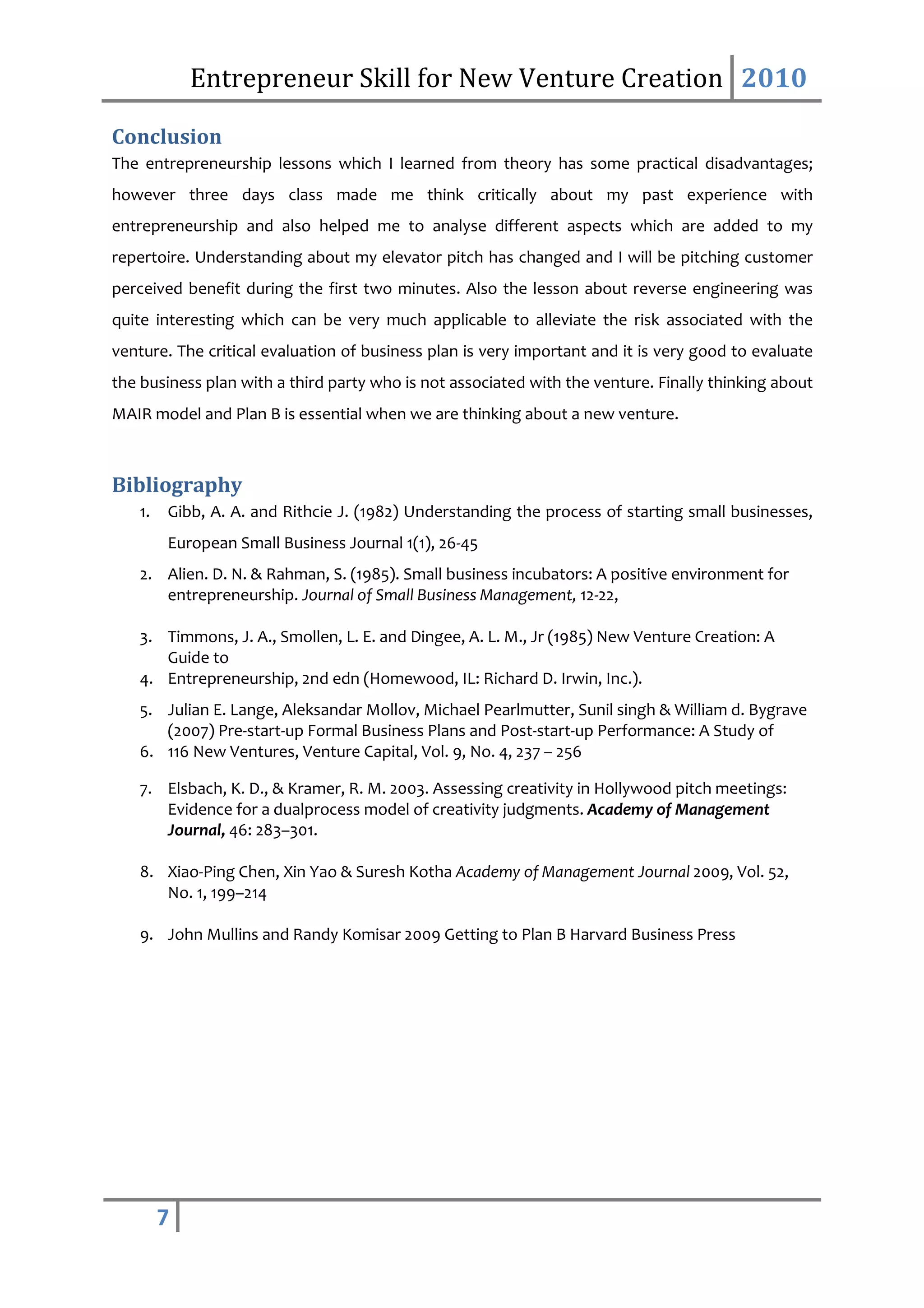
                                 apparent that motivation, ability, idea and resources can make
a venture success. According to Gibb and Ritchie (1982) (MAIR model), basic success ingredients
                                                                    ,
for a new start up are, motivation, ability and skills, idea in relation to market and resources. This
model is a very interesting model for me; however reflecting back to my own experience and
from my interview with entrepreneur I have seen that ability and experience is not the primary
constraints for a successful venture. If that experience was the one of the essential, then I am
sceptical about the success of Larry Page and Sergey Brin, founders of google. According to my
view I will rank lowest for skills and ability. Experience in starting a business can be taught
conceptually (Timmons et al., 1985) I started my ventures while I was doing graduation in
                              1985).                tures
engineering during the college days. All we have was motivation and resource in terms of a good
     eering                                                           source
team we started the business and reached a stage of growing company. But a we moved the
                                                                         as
next stage we required experienced people on the board to expand our business. At that time
                       experienced
we stepped down our roles to hire and employ more experienced people. It was positive move
             wn
which requires lots of attitude to accept that role change. This kind of attitude is necessary to
make a venture successful.

Negotiation,          influencing       and
networking skills are necessary for all
entrepreneurs to sustain in the
competitive          environment.       The
influencing skills are essential to
maintain good team, founders of the
company may require to influence
     ny
talented human resource to sustain
in   the     team.     There    might   be
situations     where      the    company
doesn’t generate much revenue but
                   ch revenue,
may anticipate good revenue over a
period of time. In this case it is necessary to maintain the core human resource in the team
employee retention is always a problem for startup. Reflecting on my personal experience what
 mployee
we did was, we offered employee stock option plan and included the core resources in crafting
strategy and long-term vision. This mechanism was very successful for us.
                  term

      6
Entrepreneur Skill for New Venture Creation 2010

Conclusion
The entrepreneurship lessons which I learned from theory has some practical disadvantages;
however three days class made me think critically about my past experience with
entrepreneurship and also helped me to analyse different aspects which are added to my
repertoire. Understanding about my elevator pitch has changed and I will be pitching customer
perceived benefit during the first two minutes. Also the lesson about reverse engineering was
quite interesting which can be very much applicable to alleviate the risk associated with the
venture. The critical evaluation of business plan is very important and it is very good to evaluate
the business plan with a third party who is not associated with the venture. Finally thinking about
MAIR model and Plan B is essential when we are thinking about a new venture.


Bibliography
   1.   Gibb, A. A. and Rithcie J. (1982) Understanding the process of starting small businesses,
        European Small Business Journal 1(1), 26-45
   2. Alien. D. N. & Rahman, S. (1985). Small business incubators: A positive environment for
      entrepreneurship. Journal of Small Business Management, 12-22,

   3. Timmons, J. A., Smollen, L. E. and Dingee, A. L. M., Jr (1985) New Venture Creation: A
      Guide to
   4. Entrepreneurship, 2nd edn (Homewood, IL: Richard D. Irwin, Inc.).
   5. Julian E. Lange, Aleksandar Mollov, Michael Pearlmutter, Sunil singh & William d. Bygrave
      (2007) Pre-start-up Formal Business Plans and Post-start-up Performance: A Study of
   6. 116 New Ventures, Venture Capital, Vol. 9, No. 4, 237 – 256

   7. Elsbach, K. D., & Kramer, R. M. 2003. Assessing creativity in Hollywood pitch meetings:
      Evidence for a dualprocess model of creativity judgments. Academy of Management
      Journal, 46: 283–301.

   8. Xiao-Ping Chen, Xin Yao & Suresh Kotha Academy of Management Journal 2009, Vol. 52,
      No. 1, 199–214

   9. John Mullins and Randy Komisar 2009 Getting to Plan B Harvard Business Press


        7

Entrepreneurs skills for new venture creation

  • 1.
    Entrepreneur Skill forNew Venture Creation 2010 http://www.iamaceo.com Entrepreneur Skill for New Venture Creation SANIL SUBHASH CHANDRA BOSE Entrepreneur & Strategy Consultant http://www.iamaceo.com Sanil 7/13/2010 1
  • 2.
    Entrepreneur Skill forNew Venture Creation 2010 Table of Contents Introduction ............................................................................................................................................ 3 Venturing your business Idea ................................................................................................................. 3 Elevator pitching techniques .............................................................................................................. 3 My Approach....................................................................................................................................... 3 Critical evaluation of business proposal ................................................................................................. 4 Importance of Plan B .......................................................................................................................... 5 Skills required for an entrepreneur to start new venture ...................................................................... 6 Conclusion ............................................................................................................................................... 7 Bibliography ............................................................................................................................................ 7 2
  • 3.
    Entrepreneur Skill forNew Venture Creation 2010 Introduction Contemplating through the life of an entrepreneur, the three days classes of new venture creations changed the mindset of entrepreneur to more of plan thoroughly and execute model. I have been into entrepreneurship for 4.5 years co-founding two companies back in India. The first company provides mobile value added services and the second company provides digital marketing solutions. During my entrepreneurship career we were in the model of execute the business idea and do market validation later during the execution. Though our model worked well for us, it was quite risky. Time and again we changed the business plans and models during the execution phase. But during the course I realised the importance of being planned for the execution. By better planning it will help in alleviating the anticipated risk associated with the business. But this cannot be applied to all types of business. For instance if we are doing e- commerce business it is not a very good idea to do market research and validation prior to start the business. Also it is not a good idea to follow Porters theories for competitive strategy. If we are doing internet business, it is very important to change and adopts new things very fast. So it is not a good idea to analyse everything and execute afterwards, Porters five force theory is in a way wrong for internet business. Venturing your business Idea Elevator pitching techniques The elevator pitching techniques I adopted during my ventures were more of starting with problem identification story, recognising market potential and size, then we talk about the sales we did so far during the first two minutes. But during the course I came to see that we have to show customer perceived value during the initial two minutes along with market potential and size. My Approach During my entrepreneurial journey, I pitched my business ideas to several angel investors. What I did it was a different story altogether. Over and again I found from my experience that it is very good to have an advisor or sneezers who talks and introduce you to the investors. The best advisors for getting an investment are chartered accountants. There are some reasons for this; first reason is, they know the right investors who are willing to invest and their interests secondly they can act as sneezers or otherwise advocate for us who can influence investor’s decision. This approach worked well for angel investors, but for pitching to venture capital firms my strategy might not work. The three days course stimulated my mindset to think critically about 3
  • 4.
    Entrepreneur Skill forNew Venture Creation 2010 the new venture. There might be issues finding right chartered accountants, there are lots of cultural difference from my home country hence this may pose issues for funding. When I started entrepreneurship career I had the passion to do something differently from others. Most of the students who graduated were hired by some multinational companies and I had the passion to do something different. I always thought that passion is more important than preparedness. By the word passion what I meant was the motivation of the entrepreneur to build the business. According to Elsbach and Kramer’s (2003) there is direct evidence about VC’s considering passion for their investment decision. In India most of the business angels consider passion as a criterion for investment decision. But when I approached to venture capital firms for funding I realised that for funding the major decision was according to the preparedness rather than passion. From the guest lecture Alan talked about reverse engineering the business, he was talking about doing the sales first and coming back to prepare business plans. When he was saying about reverse engineering I felt that he was coming from the notion of passion of entrepreneurs. A study conducted by Xiao-Ping Chen, Xin Yao & Suresh Kotha (2009) revealed that preparedness not passion positively impacted VC firm’s investment decision. I feel that it again depend upon the personal choice of VC firm’s and cultural difference between different countries. Another aspect about funding is about pre-seed money taken from relatives to bootstrap the business. I have seen quite few entrepreneurs back in India who got funded from their relative’s. I thought of raising pre-seed funding from the relatives several times for bootstrapping the business. The discussion about taking pre-seed funding from relatives in the course actually construes my mind about taking into consideration the risk associated with the venture. The learning from the discussion was helpful in opening my mind for not taking pre-seed fund from the relatives in future unless they are ready to take the risk associated or they are ready to accept a loss. Critical evaluation of business proposal After attending new venture course, I am sceptic about the customer offering of my product that we are going to launch in October 2010. Initially we identified an opportunity for English vocabulary improving market when we were preparing for GMAT we faced with a situation to improve our language skills mainly vocabulary. The idea recognition was through studying primary research to the people who were preparing the test. We suggested a solution using contextual learning methodology to the primary users. They were impressed with the solution to 4
  • 5.
    Entrepreneur Skill forNew Venture Creation 2010 improve vocabulary service. Our revenue model was monthly subscription model, but over time the business model evolved and the solution we are proposing is thinking about affiliate sales through Amazon. User can purchase Amazon book from the application and read it from the application. Though we started tool to improve the English language skill, it evolved as e-book reader that has the facility of improving English language. In the current application users can subscribe the application free of cost, but they can only read free books available. But for reading other book the user should purchase book from the shelf, which is essentially Amazon books. This change in the revenue model happened after analysing the customer value proposition. Initially the application was identifying the vocabulary market, mainly the people who were preparing for tests like GMAT, GRE, IELTS, TOEFL etc. After working on business proposal of Fabrica, I felt that the business proposal I prepared has lots of problems in its execution. The customer offering from others view point may not be the same as the innovator. We also felt the conflicting arguments in the business plans we worked on the Fabrica case. In this case, I would like to review critically my business plans with some other's view point that may change my perception and business models. The business plan is not essential for a startup if you are not going for a funding instead, a financial planning is very essential for the business to survive (Julian E. Lange, 2007). It is just because, control is the main thing for an entrepreneur to practise to make the company successful. Initially we also started with no business plan, but eventually we prepared business plan to raise investments. Importance of Plan B This is one of the important lessons I learned over the period of the new venture course and group work. We crafted a business plan so detailed it's a work of art so we will stick on the plan. But I learned from my experience that business plan will evolve during the execution. As John Mullins and Randy Komisar explain in Getting to Plan B, new businesses are fraught with uncertainty. To succeed, we must change the plan in real time as the inevitable challenges arise. In fact, studies show that entrepreneurs who stick slavishly to their Plan A stand a greater chance of failing-and that many successful businesses barely resemble their founders' original idea. Throughout the course I was thinking about plan B for my new business which I am planning to start. Thinking about plan B open up new opportunity for my business by giving free subscription to my application, but a revenue model got changed to offer book selling and review of the books on the application. To make the venture success it is very good to think about alternative plan during the execution of plan A. 5
  • 6.
    Entrepreneur Skill forNew Venture Creation 2010 Skills required for an entrepreneur to start new venture During my past experience with entrepreneurship I understood that life blood of business is the cash. I also faced with issues of finding and maintain maintaining good human resource in the company. But throughout the course it was ap apparent that motivation, ability, idea and resources can make a venture success. According to Gibb and Ritchie (1982) (MAIR model), basic success ingredients , for a new start up are, motivation, ability and skills, idea in relation to market and resources. This model is a very interesting model for me; however reflecting back to my own experience and from my interview with entrepreneur I have seen that ability and experience is not the primary constraints for a successful venture. If that experience was the one of the essential, then I am sceptical about the success of Larry Page and Sergey Brin, founders of google. According to my view I will rank lowest for skills and ability. Experience in starting a business can be taught conceptually (Timmons et al., 1985) I started my ventures while I was doing graduation in 1985). tures engineering during the college days. All we have was motivation and resource in terms of a good eering source team we started the business and reached a stage of growing company. But a we moved the as next stage we required experienced people on the board to expand our business. At that time experienced we stepped down our roles to hire and employ more experienced people. It was positive move wn which requires lots of attitude to accept that role change. This kind of attitude is necessary to make a venture successful. Negotiation, influencing and networking skills are necessary for all entrepreneurs to sustain in the competitive environment. The influencing skills are essential to maintain good team, founders of the company may require to influence ny talented human resource to sustain in the team. There might be situations where the company doesn’t generate much revenue but ch revenue, may anticipate good revenue over a period of time. In this case it is necessary to maintain the core human resource in the team employee retention is always a problem for startup. Reflecting on my personal experience what mployee we did was, we offered employee stock option plan and included the core resources in crafting strategy and long-term vision. This mechanism was very successful for us. term 6
  • 7.
    Entrepreneur Skill forNew Venture Creation 2010 Conclusion The entrepreneurship lessons which I learned from theory has some practical disadvantages; however three days class made me think critically about my past experience with entrepreneurship and also helped me to analyse different aspects which are added to my repertoire. Understanding about my elevator pitch has changed and I will be pitching customer perceived benefit during the first two minutes. Also the lesson about reverse engineering was quite interesting which can be very much applicable to alleviate the risk associated with the venture. The critical evaluation of business plan is very important and it is very good to evaluate the business plan with a third party who is not associated with the venture. Finally thinking about MAIR model and Plan B is essential when we are thinking about a new venture. Bibliography 1. Gibb, A. A. and Rithcie J. (1982) Understanding the process of starting small businesses, European Small Business Journal 1(1), 26-45 2. Alien. D. N. & Rahman, S. (1985). Small business incubators: A positive environment for entrepreneurship. Journal of Small Business Management, 12-22, 3. Timmons, J. A., Smollen, L. E. and Dingee, A. L. M., Jr (1985) New Venture Creation: A Guide to 4. Entrepreneurship, 2nd edn (Homewood, IL: Richard D. Irwin, Inc.). 5. Julian E. Lange, Aleksandar Mollov, Michael Pearlmutter, Sunil singh & William d. Bygrave (2007) Pre-start-up Formal Business Plans and Post-start-up Performance: A Study of 6. 116 New Ventures, Venture Capital, Vol. 9, No. 4, 237 – 256 7. Elsbach, K. D., & Kramer, R. M. 2003. Assessing creativity in Hollywood pitch meetings: Evidence for a dualprocess model of creativity judgments. Academy of Management Journal, 46: 283–301. 8. Xiao-Ping Chen, Xin Yao & Suresh Kotha Academy of Management Journal 2009, Vol. 52, No. 1, 199–214 9. John Mullins and Randy Komisar 2009 Getting to Plan B Harvard Business Press 7