- ESC ONET -  European Science Communication Network Public Science on the Web Marta Entradas Kostas  Dimopoulos Dubrovnik, Croatia July 27 July  2010
Presentation Overview The unique case of online science Types of public science websites  Website Construction Characteristics of public science websites Essential elements of online communication Exercise Objective To study the use of the internet in science communication with the public. Topics 1 2 5 3 4
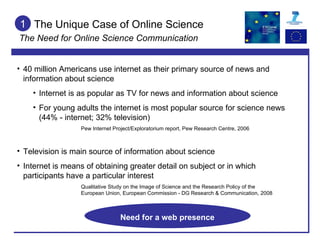
1 40 million Americans use internet as their primary source of news and information about science Internet is as popular as TV for news and information about science For young adults the internet is most popular source for science news (44% - internet; 32% television) Pew Internet Project/Exploratorium report, Pew Research Centre, 2006 Television is main source of information about science Internet is means of obtaining greater detail on subject or in which participants have a particular interest Qualitative Study on the Image of Science and the Research Policy of the  European Union, European Commission - DG Research & Communication, 2008 The Unique Case of Online Science The Need for Online Science Communication Need for a web presence
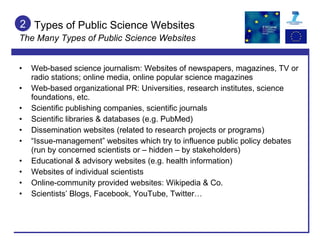
Types of Public Science Websites The Many Types of Public Science Websites Web-based science journalism: Websites of newspapers, magazines, TV or radio stations; online media, online popular science magazines Web-based organizational PR: Universities, research institutes, science foundations, etc. Scientific publishing companies, scientific journals Scientific libraries & databases (e.g. PubMed) Dissemination websites (related to research projects or programs) “ Issue-management” websites which try to influence public policy debates (run by concerned scientists or – hidden – by stakeholders) Educational & advisory websites (e.g. health information) Websites of individual scientists Online-community provided websites: Wikipedia & Co. Scientists’ Blogs, Facebook, YouTube, Twitter… 2
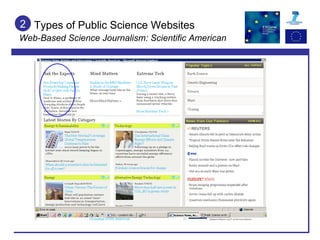
Types of Public Science Websites Web-Based Science Journalism: Scientific American 2
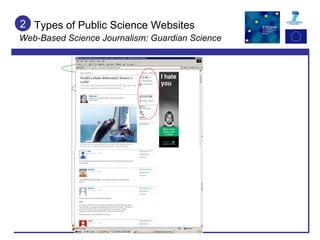
Types of Public Science Websites Web-Based Science Journalism: Guardian Science 2
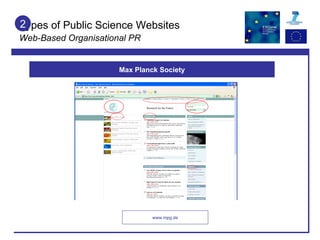
Types of Public Science Websites Web-Based Organisational PR 2 www.mpg.de Max Planck Society
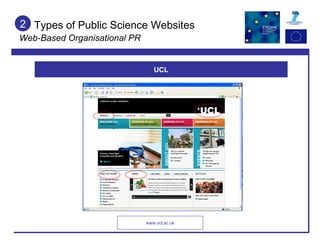
Types of Public Science Websites Web-Based Organisational PR 2 UCL www.ucl.ac.uk
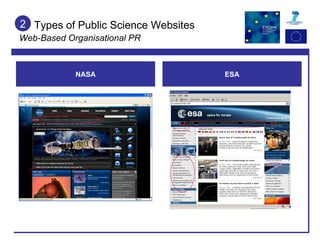
Types of Public Science Websites Web-Based Organisational PR 2 NASA ESA
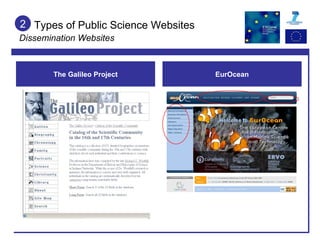
Types of Public Science Websites Dissemination Websites 2 The Galileo Project EurOcean
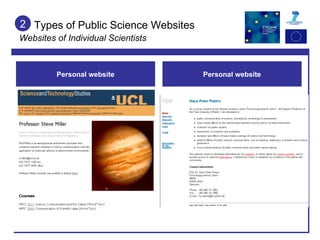
Types of Public Science Websites Websites of Individual Scientists 2 Personal website Personal website
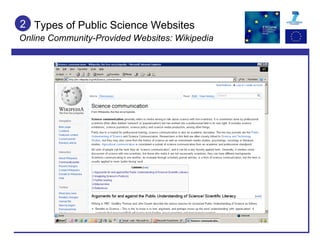
Types of Public Science Websites Online Community-Provided Websites: Wikipedia 2
2 Types of Public Science Websites Where Scientists are Likely to be Directly Involved Organizational websites (University, research center, scientific association, museum…) Part of an organizational website (institute, department, project, course, personal page…) “ Independent” project websites (e.g. ESConet…) “ Independent” conference websites “ Independent” personal website of scientists “ Online CV” Personal page with a “mission” Contact with students… Scientists’ blogs, Facebook, Wikipedia, YouTube, Twitter… 1 2 3 4 5 6 Corporate Design, Content Management, Organizational regulation, Communication department, Scientists as content provider Individual initiative, creativity, preferences, responsibility
2 Types of Public Science Websites Where Scientists are Likely to be Directly Involved Example 1: Conference website Example 3: Online lectures  Example 2: Scientist’s Blog]
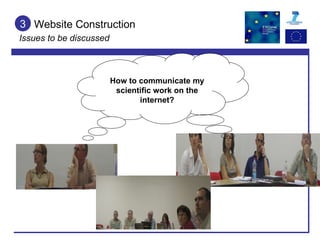
3 How to communicate my scientific work on the internet? Website Construction Issues to be discussed
Website Construction Issues to be discussed 3 Who is your audience? (Who are you trying to reach / communicate with?) E.g. scientific community, media, schools, general public… What kind of website do you want to develop?  E.g. internal, external, both? How should the website be organised?  Style  Structure Content How to include interactivity/allow a two-way communication? What are the essential elements of public websites? (e.g. objectivity, navigation, authority…) Make your page Useful Easily navigable Accessible Interactive
3 the ‘principal relationships that exist between the organisation and its many shareholders’; public relations (PR) is ‘the art and science of developing meaningful relationships the public necessary to continue the work of an organisation’; one-way, asymmetrical communication has failed science; a two-way symmetrical approach produces better long-term relationships with: taxpayers, media, shareholders, regulators, leaders, doners; it emphasises transparency, negotiation, compromise, mutual accommodation; it moves from deficit to dialogue models of communication. Borchelt, R.B. 2008. Public relations in science: Managing the trust portfolio. IN: Bucchi and Trench (eds). Handbook of Public Communication of Science and Technology. Oxon: Routledge. Website Construction Websites are part of “the trust portfolio”
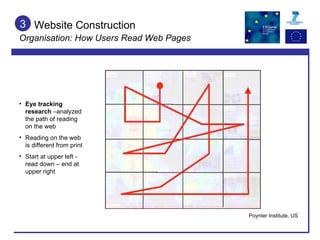
Website Construction Organisation: How Users Read Web Pages 3 Poynter Institute, US Eye tracking research  –analyzed the path of reading on the web Reading on the web is different from print Start at upper left - read down – end at upper right
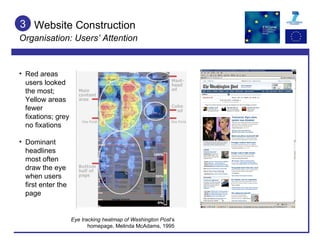
Website Construction Organisation: Users’ Attention 3 Eye tracking heatmap of Washington Post ’s homepage, Melinda McAdams, 1995 Red areas users looked the most; Yellow areas fewer fixations; grey no fixations Dominant headlines most often draw the eye when users first enter the page
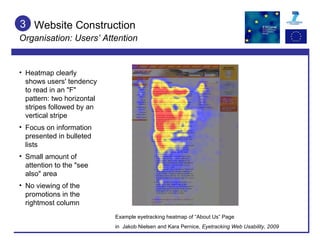
Website Construction Organisation: Users’ Attention 3 Example eyetracking heatmap of “About Us” Page  in  Jakob Nielsen and Kara Pernice,  E yetracking Web Usability, 2009 Heatmap clearly shows users' tendency to read in an "F" pattern: two horizontal stripes followed by an vertical stripe Focus on information presented in bulleted lists Small amount of attention to the "see also" area No viewing of the promotions in the rightmost column
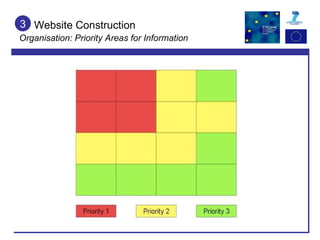
Website Construction Organisation: Priority Areas for Information 3
Website Construction  Implications for the web design 3 People rarely read word by word, instead they SCAN the page, a s a result: Meaningful sub-headings One idea per paragraph The inverted pyramid style (starting with the conclusion) – based on the idea that “users don’t scroll”. Highlight key words
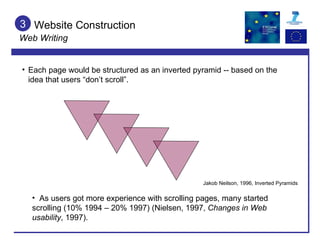
Website Construction  Web Writing 3 Each page would be structured as an inverted pyramid -- based on the idea that users “don’t scroll”. Jakob Neilson, 1996, Inverted Pyramids As users got more experience with scrolling pages, many started scrolling (10% 1994 – 20% 1997) (Nielsen, 1997,  Changes in Web usability , 1997).
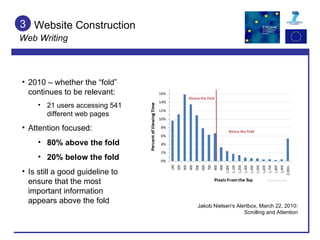
Website Construction  Web Writing 3 2010 – whether the “fold” continues to be relevant: 21 users accessing 541 different web pages Attention focused: 80% above the fold 20% below the fold Is still a good guideline to ensure that the most important information appears above the fold  Jakob Nielsen's Alertbox, March 22, 2010: Scrolling and Attention
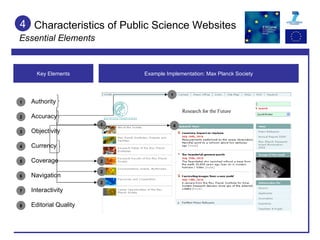
Characteristics of Public Science Websites  Essential Elements Authority Accuracy Objectivity Currency Coverage Navigation Interactivity Editorial Quality 4 Example Implementation: Max Planck Society Key Elements 1 2 3 4 5 6 7 8 1 1 2 2 2 4
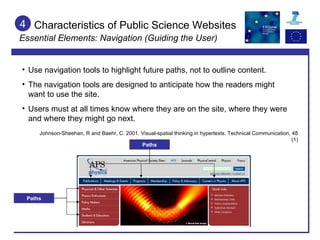
Characteristics of Public Science Websites Essential Elements: Navigation (Guiding the User) 4 Use navigation tools to highlight future paths, not to outline content. The navigation tools are designed to anticipate how the readers might want to use the site. Users must at all times know where they are on the site, where they were and where they might go next. Johnson-Sheehan, R and Baehr, C. 2001. Visual-spatial thinking in hypertexts. Technical Communication, 48 (1) Paths Paths
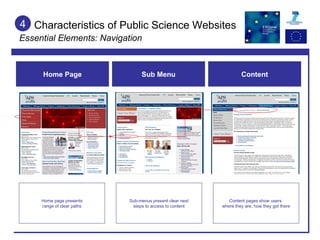
Characteristics of Public Science Websites  Essential Elements: Navigation 4 Home Page Sub Menu Content Home page presents range of clear paths Sub-menus present clear next steps to access to content Content pages show users  where they are, how they got there
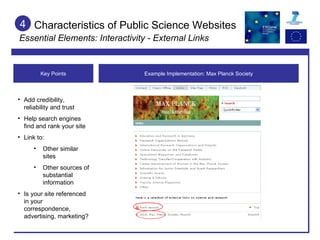
Characteristics of Public Science Websites Essential Elements: Interactivity - External Links 4 Example Implementation: Max Planck Society Key Points Add credibility, reliability and trust Help search engines find and rank your site Link to: Other similar sites Other sources of substantial information Is your site referenced in your correspondence, advertising, marketing?
Characteristics of Public Science Websites Essential Elements: Forms of Interactivity 4 To ensure your site allows for two-way communication, include interactive elements Email address (to specific people) Emails alerts Newsletters Forums and message boards Surveys, polls Podcasts Search facilities Blogs Social networking websites
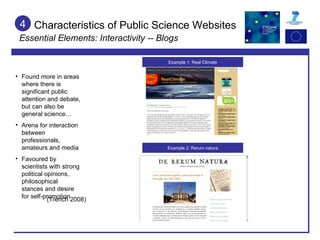
Characteristics of Public Science Websites Essential Elements: Interactivity -- Blogs 4 Found more in areas where there is significant public attention and debate, but can also be general science… Arena for interaction between professionals, amateurs and media Favoured by scientists with strong political opinions, philosophical stances and desire for self-promotion Example 2: Rerum natura Example 1: Real Climate (Trench 2008)
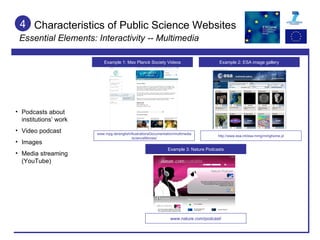
Characteristics of Public Science Websites Essential Elements: Interactivity -- Multimedia 4 Podcasts about institutions’ work Video podcast Images Media streaming (YouTube) Example 1: Max Planck Society Videos Example 3: Nature Podcasts Example 2: ESA image gallery www.nature.com/podcast/ www.mpg.de/english/illustrationsDocumentation/multimedia/scienceMovies/ http://www.esa.int/esa-mmg/mmghome.pl
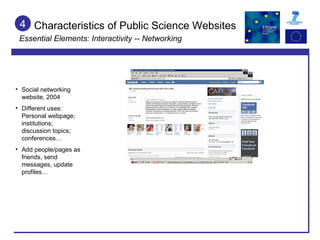
4 Social networking website, 2004 Different uses: Personal webpage; institutions; discussion topics; conferences…  Add people/pages as friends, send messages, update profiles… Characteristics of Public Science Websites Essential Elements: Interactivity -- Networking
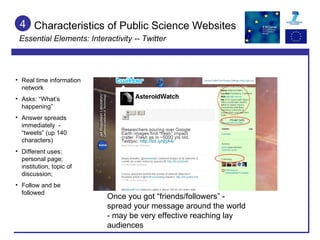
4 Real time information network  Asks: “What’s happening”  Answer spreads immediately  - “tweets” (up 140 characters) Different uses: personal page; institution, topic of discussion;  Follow and be followed  Characteristics of Public Science Websites Essential Elements: Interactivity -- Twitter Once you got “friends/followers” - spread your message around the world - may be very effective reaching lay audiences
4 Spend one second per line of text Read the left side more than the right side Read more frequently short paragraphs and introductory paragraphs Are encouraged to read by excerpts The first words of headlines are crucial Look at a minimum of five headlines on a homepage Poynter Institute eye-track research. http://www.poynterextra.org/eyetrack2004/history.htm Characteristics of Public Science Websites Essential Elements: Editorial Content
Exercise 5 Trainees are divided into groups of four Trainees must develop a concept for a new website for a scientific topic, institution or initiative The group must design their homepage on PowerPoint: Audience and aims Authority, accuracy, objectivity, currency, coverage, navigation, interactivity, editorial quality Each group will give a ten-minute presentation of their site to the workshop
Tomorrow’s timetable - current version 6 8:30 - 9:30 Feedback on media interviews 10:00 - 12:00 Public science on web - prepare websites 12:00 - 12:45 Presentation of websites 12:45 - 1:30 Farewells or …
Tomorrow’s timetable -  alternative  version 6 8:30 - 11:00 Public science on web - prepare websites (inc. coffee break) 11:00 - 12:00 Feedback on media interviews 12:00 - 12:45 Presentation of websites 12:45 - 1:30 Farewells You choose

Entradas & Dimopoulos: Public science on the web

  • 1.
    - ESC ONET- European Science Communication Network Public Science on the Web Marta Entradas Kostas Dimopoulos Dubrovnik, Croatia July 27 July 2010
  • 2.
    Presentation Overview Theunique case of online science Types of public science websites Website Construction Characteristics of public science websites Essential elements of online communication Exercise Objective To study the use of the internet in science communication with the public. Topics 1 2 5 3 4
  • 3.
    1 40 millionAmericans use internet as their primary source of news and information about science Internet is as popular as TV for news and information about science For young adults the internet is most popular source for science news (44% - internet; 32% television) Pew Internet Project/Exploratorium report, Pew Research Centre, 2006 Television is main source of information about science Internet is means of obtaining greater detail on subject or in which participants have a particular interest Qualitative Study on the Image of Science and the Research Policy of the European Union, European Commission - DG Research & Communication, 2008 The Unique Case of Online Science The Need for Online Science Communication Need for a web presence
  • 4.
    Types of PublicScience Websites The Many Types of Public Science Websites Web-based science journalism: Websites of newspapers, magazines, TV or radio stations; online media, online popular science magazines Web-based organizational PR: Universities, research institutes, science foundations, etc. Scientific publishing companies, scientific journals Scientific libraries & databases (e.g. PubMed) Dissemination websites (related to research projects or programs) “ Issue-management” websites which try to influence public policy debates (run by concerned scientists or – hidden – by stakeholders) Educational & advisory websites (e.g. health information) Websites of individual scientists Online-community provided websites: Wikipedia & Co. Scientists’ Blogs, Facebook, YouTube, Twitter… 2
  • 5.
    Types of PublicScience Websites Web-Based Science Journalism: Scientific American 2
  • 6.
    Types of PublicScience Websites Web-Based Science Journalism: Guardian Science 2
  • 7.
    Types of PublicScience Websites Web-Based Organisational PR 2 www.mpg.de Max Planck Society
  • 8.
    Types of PublicScience Websites Web-Based Organisational PR 2 UCL www.ucl.ac.uk
  • 9.
    Types of PublicScience Websites Web-Based Organisational PR 2 NASA ESA
  • 10.
    Types of PublicScience Websites Dissemination Websites 2 The Galileo Project EurOcean
  • 11.
    Types of PublicScience Websites Websites of Individual Scientists 2 Personal website Personal website
  • 12.
    Types of PublicScience Websites Online Community-Provided Websites: Wikipedia 2
  • 13.
    2 Types ofPublic Science Websites Where Scientists are Likely to be Directly Involved Organizational websites (University, research center, scientific association, museum…) Part of an organizational website (institute, department, project, course, personal page…) “ Independent” project websites (e.g. ESConet…) “ Independent” conference websites “ Independent” personal website of scientists “ Online CV” Personal page with a “mission” Contact with students… Scientists’ blogs, Facebook, Wikipedia, YouTube, Twitter… 1 2 3 4 5 6 Corporate Design, Content Management, Organizational regulation, Communication department, Scientists as content provider Individual initiative, creativity, preferences, responsibility
  • 14.
    2 Types ofPublic Science Websites Where Scientists are Likely to be Directly Involved Example 1: Conference website Example 3: Online lectures Example 2: Scientist’s Blog]
  • 15.
    3 How tocommunicate my scientific work on the internet? Website Construction Issues to be discussed
  • 16.
    Website Construction Issuesto be discussed 3 Who is your audience? (Who are you trying to reach / communicate with?) E.g. scientific community, media, schools, general public… What kind of website do you want to develop? E.g. internal, external, both? How should the website be organised? Style Structure Content How to include interactivity/allow a two-way communication? What are the essential elements of public websites? (e.g. objectivity, navigation, authority…) Make your page Useful Easily navigable Accessible Interactive
  • 17.
    3 the ‘principalrelationships that exist between the organisation and its many shareholders’; public relations (PR) is ‘the art and science of developing meaningful relationships the public necessary to continue the work of an organisation’; one-way, asymmetrical communication has failed science; a two-way symmetrical approach produces better long-term relationships with: taxpayers, media, shareholders, regulators, leaders, doners; it emphasises transparency, negotiation, compromise, mutual accommodation; it moves from deficit to dialogue models of communication. Borchelt, R.B. 2008. Public relations in science: Managing the trust portfolio. IN: Bucchi and Trench (eds). Handbook of Public Communication of Science and Technology. Oxon: Routledge. Website Construction Websites are part of “the trust portfolio”
  • 18.
    Website Construction Organisation:How Users Read Web Pages 3 Poynter Institute, US Eye tracking research –analyzed the path of reading on the web Reading on the web is different from print Start at upper left - read down – end at upper right
  • 19.
    Website Construction Organisation:Users’ Attention 3 Eye tracking heatmap of Washington Post ’s homepage, Melinda McAdams, 1995 Red areas users looked the most; Yellow areas fewer fixations; grey no fixations Dominant headlines most often draw the eye when users first enter the page
  • 20.
    Website Construction Organisation:Users’ Attention 3 Example eyetracking heatmap of “About Us” Page in Jakob Nielsen and Kara Pernice, E yetracking Web Usability, 2009 Heatmap clearly shows users' tendency to read in an "F" pattern: two horizontal stripes followed by an vertical stripe Focus on information presented in bulleted lists Small amount of attention to the "see also" area No viewing of the promotions in the rightmost column
  • 21.
    Website Construction Organisation:Priority Areas for Information 3
  • 22.
    Website Construction Implications for the web design 3 People rarely read word by word, instead they SCAN the page, a s a result: Meaningful sub-headings One idea per paragraph The inverted pyramid style (starting with the conclusion) – based on the idea that “users don’t scroll”. Highlight key words
  • 23.
    Website Construction Web Writing 3 Each page would be structured as an inverted pyramid -- based on the idea that users “don’t scroll”. Jakob Neilson, 1996, Inverted Pyramids As users got more experience with scrolling pages, many started scrolling (10% 1994 – 20% 1997) (Nielsen, 1997, Changes in Web usability , 1997).
  • 24.
    Website Construction Web Writing 3 2010 – whether the “fold” continues to be relevant: 21 users accessing 541 different web pages Attention focused: 80% above the fold 20% below the fold Is still a good guideline to ensure that the most important information appears above the fold Jakob Nielsen's Alertbox, March 22, 2010: Scrolling and Attention
  • 25.
    Characteristics of PublicScience Websites Essential Elements Authority Accuracy Objectivity Currency Coverage Navigation Interactivity Editorial Quality 4 Example Implementation: Max Planck Society Key Elements 1 2 3 4 5 6 7 8 1 1 2 2 2 4
  • 26.
    Characteristics of PublicScience Websites Essential Elements: Navigation (Guiding the User) 4 Use navigation tools to highlight future paths, not to outline content. The navigation tools are designed to anticipate how the readers might want to use the site. Users must at all times know where they are on the site, where they were and where they might go next. Johnson-Sheehan, R and Baehr, C. 2001. Visual-spatial thinking in hypertexts. Technical Communication, 48 (1) Paths Paths
  • 27.
    Characteristics of PublicScience Websites Essential Elements: Navigation 4 Home Page Sub Menu Content Home page presents range of clear paths Sub-menus present clear next steps to access to content Content pages show users where they are, how they got there
  • 28.
    Characteristics of PublicScience Websites Essential Elements: Interactivity - External Links 4 Example Implementation: Max Planck Society Key Points Add credibility, reliability and trust Help search engines find and rank your site Link to: Other similar sites Other sources of substantial information Is your site referenced in your correspondence, advertising, marketing?
  • 29.
    Characteristics of PublicScience Websites Essential Elements: Forms of Interactivity 4 To ensure your site allows for two-way communication, include interactive elements Email address (to specific people) Emails alerts Newsletters Forums and message boards Surveys, polls Podcasts Search facilities Blogs Social networking websites
  • 30.
    Characteristics of PublicScience Websites Essential Elements: Interactivity -- Blogs 4 Found more in areas where there is significant public attention and debate, but can also be general science… Arena for interaction between professionals, amateurs and media Favoured by scientists with strong political opinions, philosophical stances and desire for self-promotion Example 2: Rerum natura Example 1: Real Climate (Trench 2008)
  • 31.
    Characteristics of PublicScience Websites Essential Elements: Interactivity -- Multimedia 4 Podcasts about institutions’ work Video podcast Images Media streaming (YouTube) Example 1: Max Planck Society Videos Example 3: Nature Podcasts Example 2: ESA image gallery www.nature.com/podcast/ www.mpg.de/english/illustrationsDocumentation/multimedia/scienceMovies/ http://www.esa.int/esa-mmg/mmghome.pl
  • 32.
    4 Social networkingwebsite, 2004 Different uses: Personal webpage; institutions; discussion topics; conferences… Add people/pages as friends, send messages, update profiles… Characteristics of Public Science Websites Essential Elements: Interactivity -- Networking
  • 33.
    4 Real timeinformation network Asks: “What’s happening” Answer spreads immediately - “tweets” (up 140 characters) Different uses: personal page; institution, topic of discussion; Follow and be followed Characteristics of Public Science Websites Essential Elements: Interactivity -- Twitter Once you got “friends/followers” - spread your message around the world - may be very effective reaching lay audiences
  • 34.
    4 Spend onesecond per line of text Read the left side more than the right side Read more frequently short paragraphs and introductory paragraphs Are encouraged to read by excerpts The first words of headlines are crucial Look at a minimum of five headlines on a homepage Poynter Institute eye-track research. http://www.poynterextra.org/eyetrack2004/history.htm Characteristics of Public Science Websites Essential Elements: Editorial Content
  • 35.
    Exercise 5 Traineesare divided into groups of four Trainees must develop a concept for a new website for a scientific topic, institution or initiative The group must design their homepage on PowerPoint: Audience and aims Authority, accuracy, objectivity, currency, coverage, navigation, interactivity, editorial quality Each group will give a ten-minute presentation of their site to the workshop
  • 36.
    Tomorrow’s timetable -current version 6 8:30 - 9:30 Feedback on media interviews 10:00 - 12:00 Public science on web - prepare websites 12:00 - 12:45 Presentation of websites 12:45 - 1:30 Farewells or …
  • 37.
    Tomorrow’s timetable - alternative version 6 8:30 - 11:00 Public science on web - prepare websites (inc. coffee break) 11:00 - 12:00 Feedback on media interviews 12:00 - 12:45 Presentation of websites 12:45 - 1:30 Farewells You choose