Distilled wisdom from the coalface:Our lessons implementing ScrumClarus 26 May 2011
“Yeah, we do Agile”Doing Agile versus Being AgileDoing = following the process, executing the mechanics without understanding the philosophyBeing = using the philosophy to become the best product development & management organization in your marketThe right thinking is needed to get there. This is why it is hard.
Why Scrum?Accessible, well-defined, established way to start on your Agile journeyClearly defined roles (and only three of them)Clear process (you are either doing Scrum or not)Well established community (over 60,000 CSM’s worldwide)Established support bodiesScrum works But being brave enough to change your business is hard…
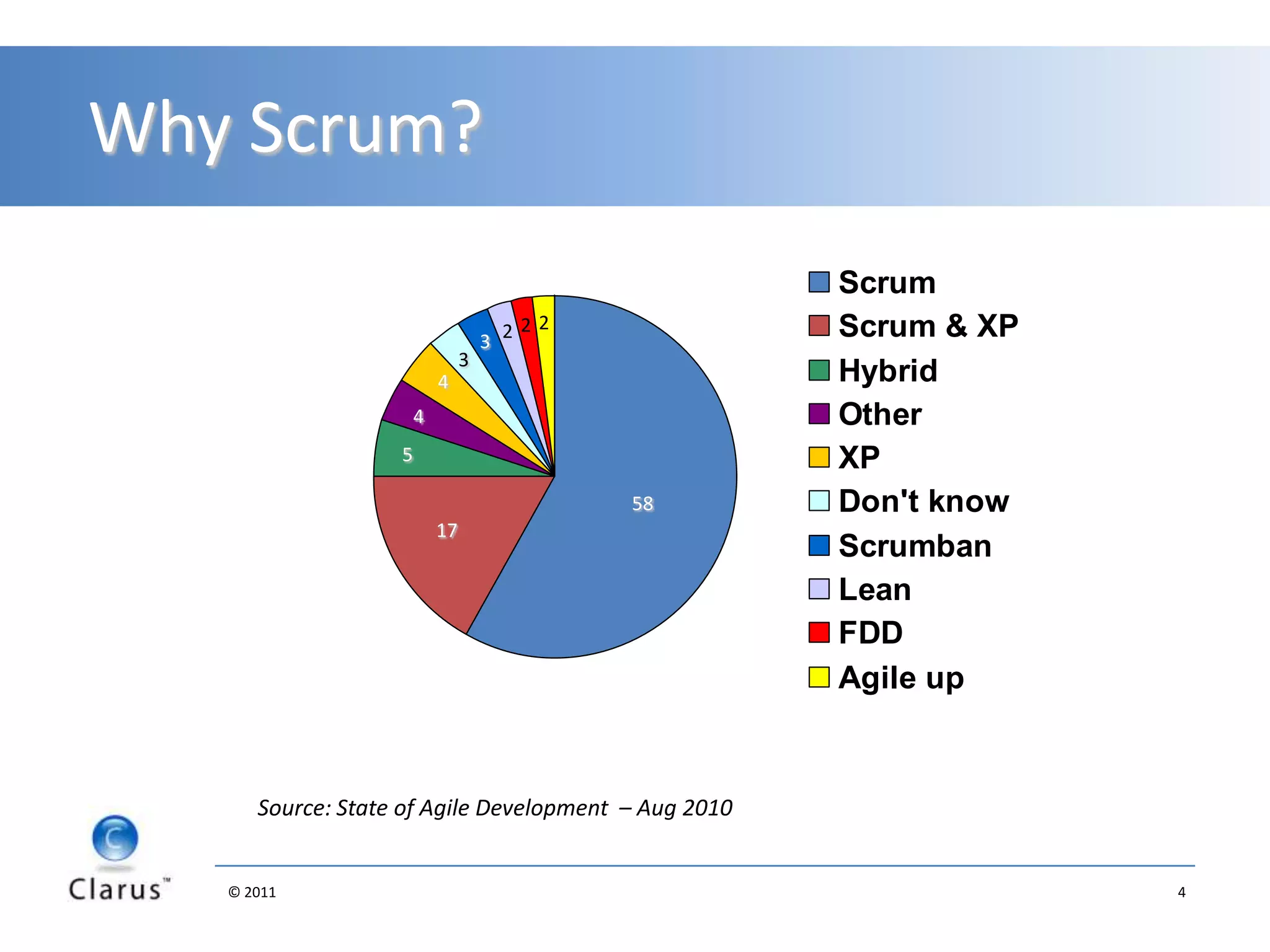
Why Scrum?222334455817Source: State of Agile Development  – Aug 2010
TonightOur experience implementing Scrum across over a dozen New Zealand companies
Corporates to SME’s
Varying cultures, businesses, needs
Various challenges – it is always differentAbout UsFounded 2006
Christchurch HQ and (new) Auckland branch
Agile, Business Analysis, Testing, Development, Project Management
Official and exclusive business partner of Scrum Foundation (Dr Jeff Sutherland – co-creator of Scrum)
Edwin has worked with Jeff Sutherland, Ken Schwaber, Gabrielle Benefield, Jens Ostergaard and Kane Mar 1. Scrum is simple, implementing it is hardImplementing Scrum 		implementing a frameworkImplementing Scrum = business changeScrum will highlight every deficiency and impediment that the enterprise has so the enterprise can fix them and change into the best product development and management organization in its market. – Ken Schwaber, co-inventor of Scrum
Why is implementing Scrum hard?People – we are Complex creatures …Change – looking in the mirror and facing the truth is hardBusiness – why are we here again? And what are we doing? And what is really important?
Why it’s hard: PeopleSoftware is a social process -  it is all about peoplePeople form groups and groups establish normsScrum starts small but challenges accepted norms, rules, rituals and culturesBehaviour and culture - ARRGHH!Huh? How I act impacts productivity? But I am an engineer – we are what we are!
Why it’s hard: PeoplePeople are often not used to holding each other accountablechallenging each otherhaving the freedom to define the “how”making their own estimatesmaking and keeping commitmentsClare will talk more on people
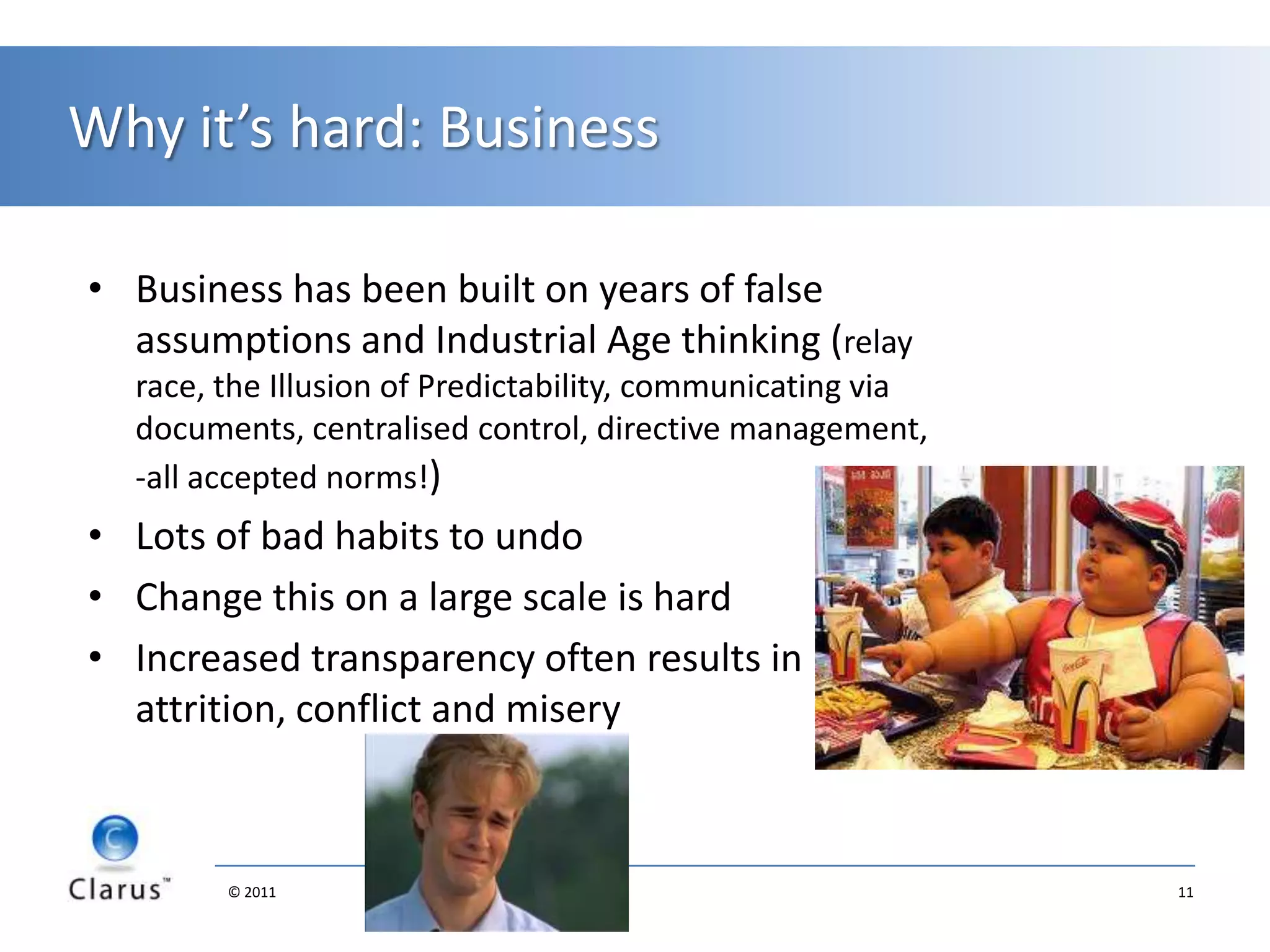
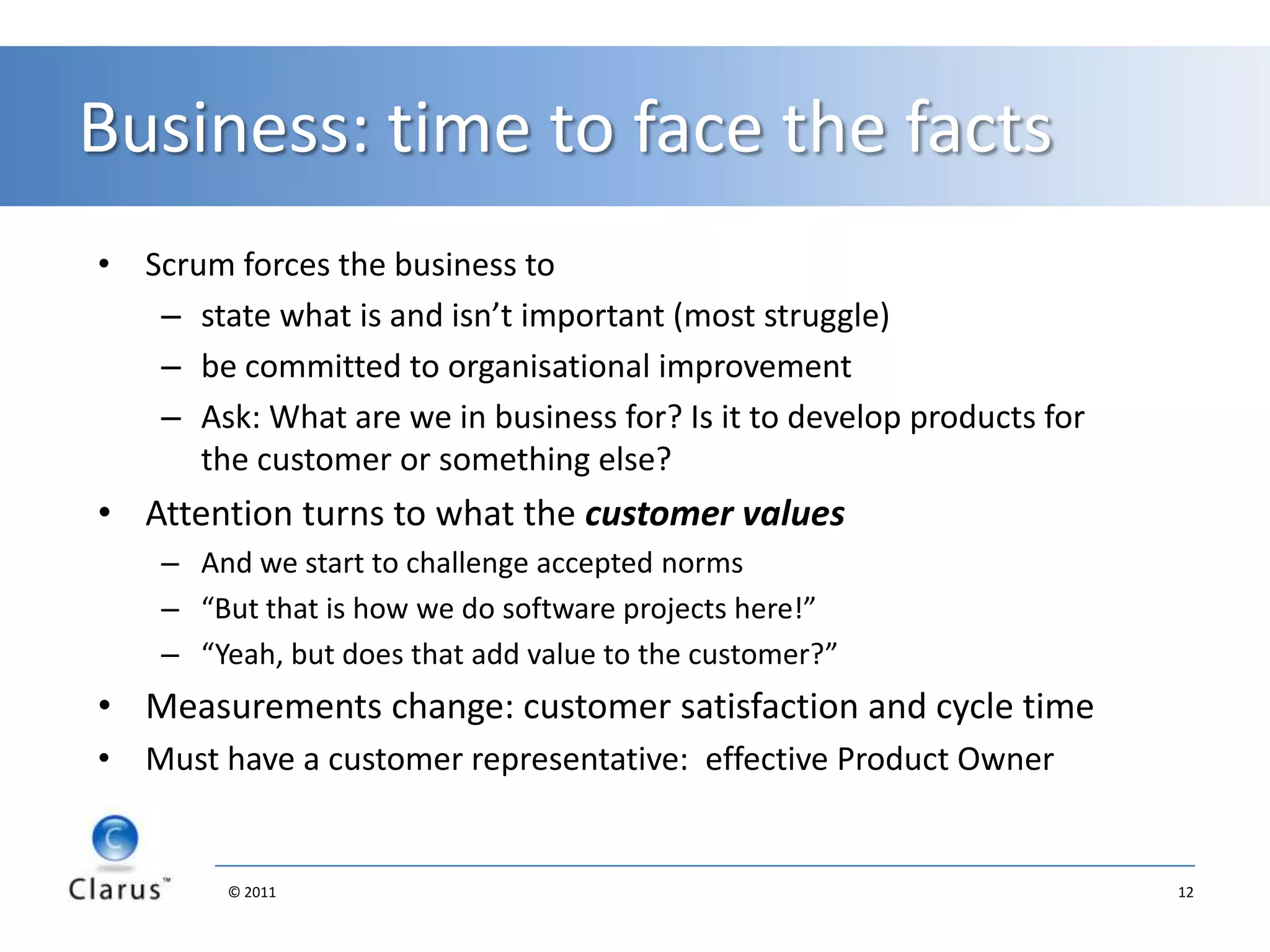
Why it’s hard: BusinessBusiness has been built on years of false assumptions and Industrial Age thinking (relay race, the Illusion of Predictability, communicating via documents, centralised control, directive management,  -all accepted norms!)Lots of bad habits to undoChange this on a large scale is hardIncreased transparency often results in attrition, conflict and misery
Business: time to face the factsScrum forces the business tostate what is and isn’t important (most struggle)be committed to organisational improvementAsk: What are we in business for? Is it to develop products for the customer or something else?Attention turns to what the customer valuesAnd we start to challenge accepted norms“But that is how we do software projects here!”“Yeah, but does that add value to the customer?”Measurements change: customer satisfaction and cycle timeMust have a customer representative:  effective Product Owner
Example: time to face the factsWe know that only 7% of human communication is the message contentWe know that the remaining 93% is based on the body language, context and voice toneSo why do we try to communicate via the 7%?Email, documents, requirements documents, Gantt charts & memosSeriously - are we insane?
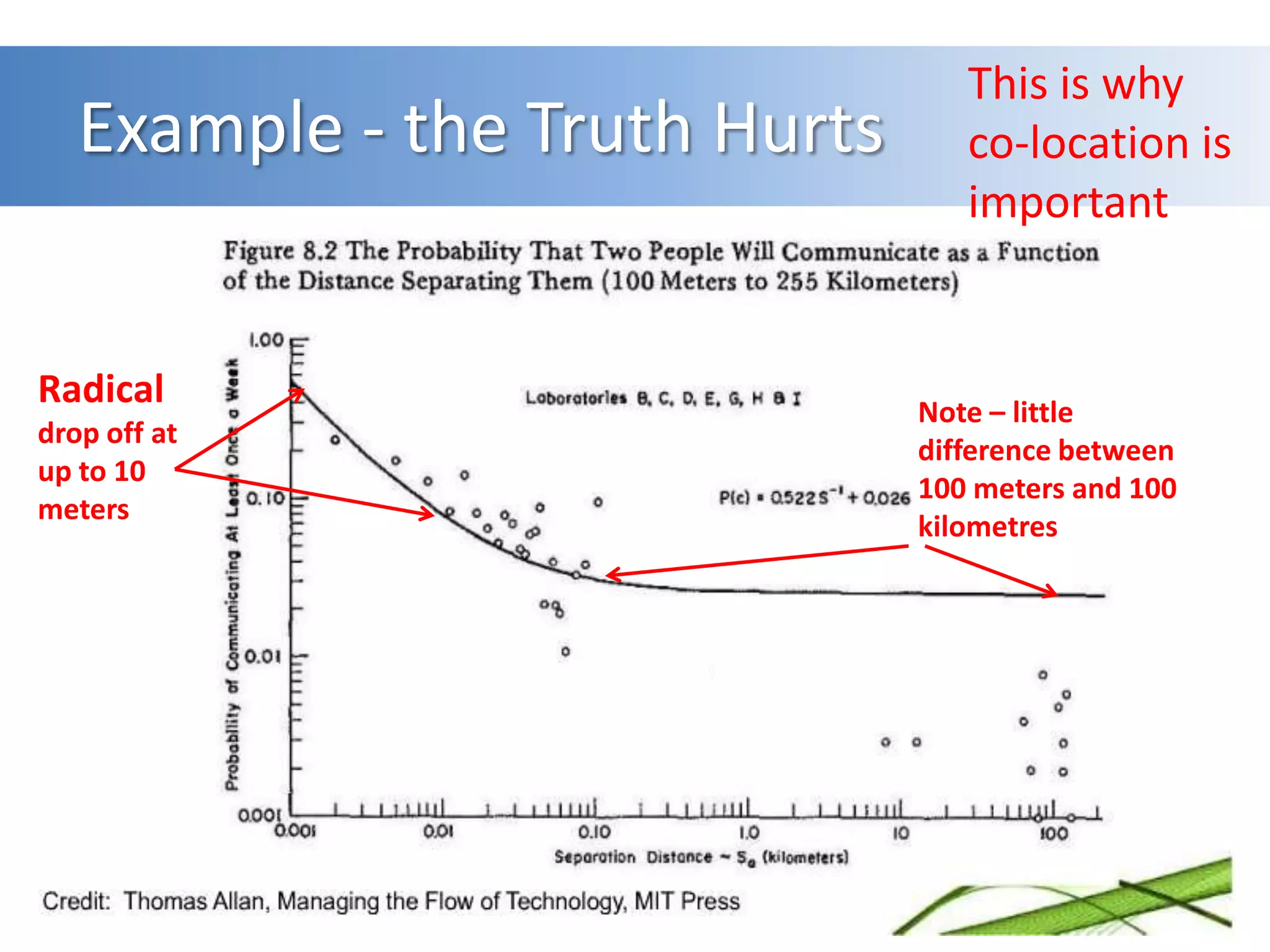
Example - the Truth HurtsThis is why co-location is importantRadical drop off at up to 10 metersNote – little difference between 100 meters and 100 kilometres
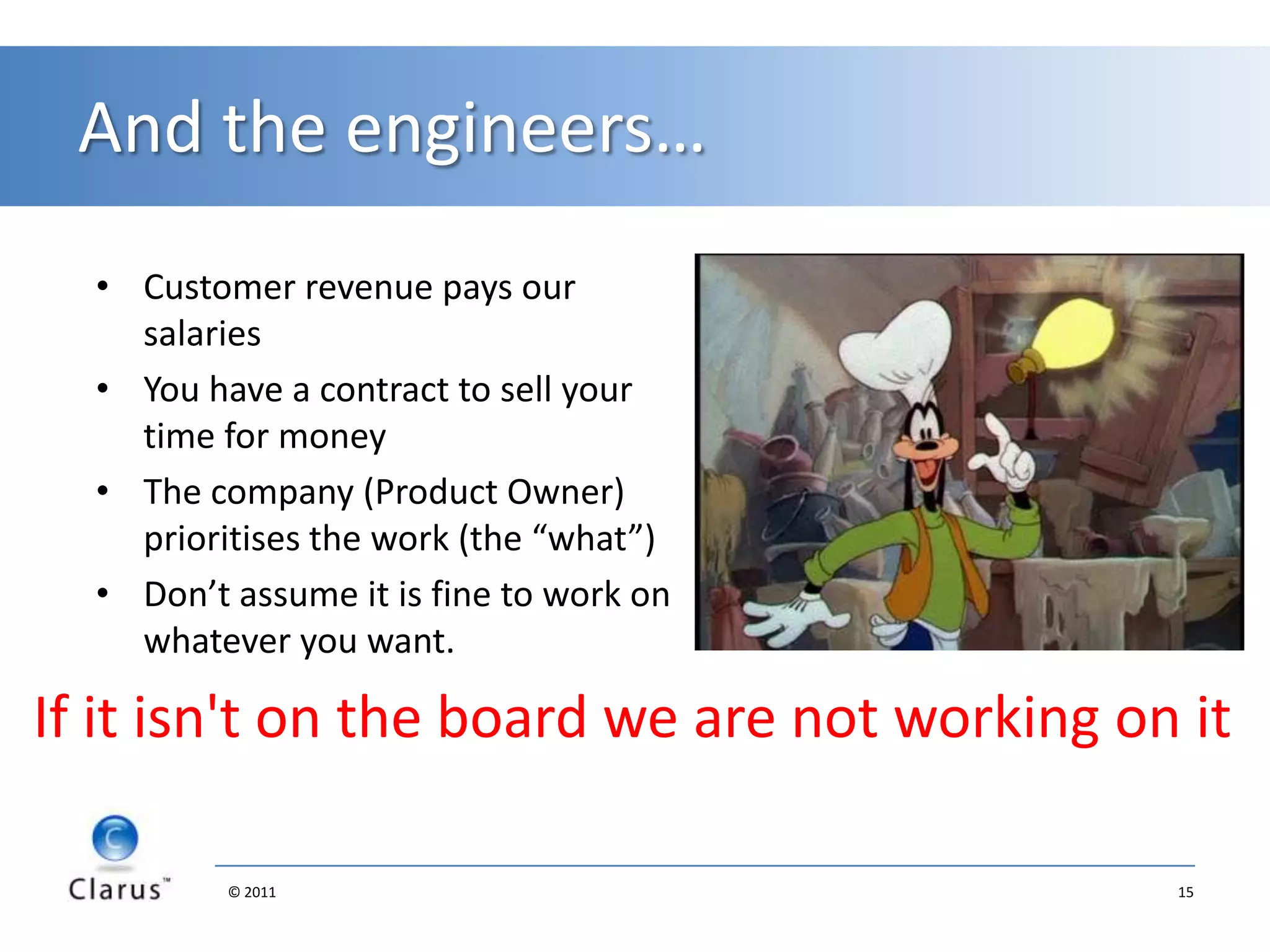
And the engineers…Customer revenue pays our salariesYou have a contract to sell your time for moneyThe company (Product Owner) prioritises the work (the “what”)Don’t assume it is fine to work on whatever you want.If it isn't on the board we are not working on it
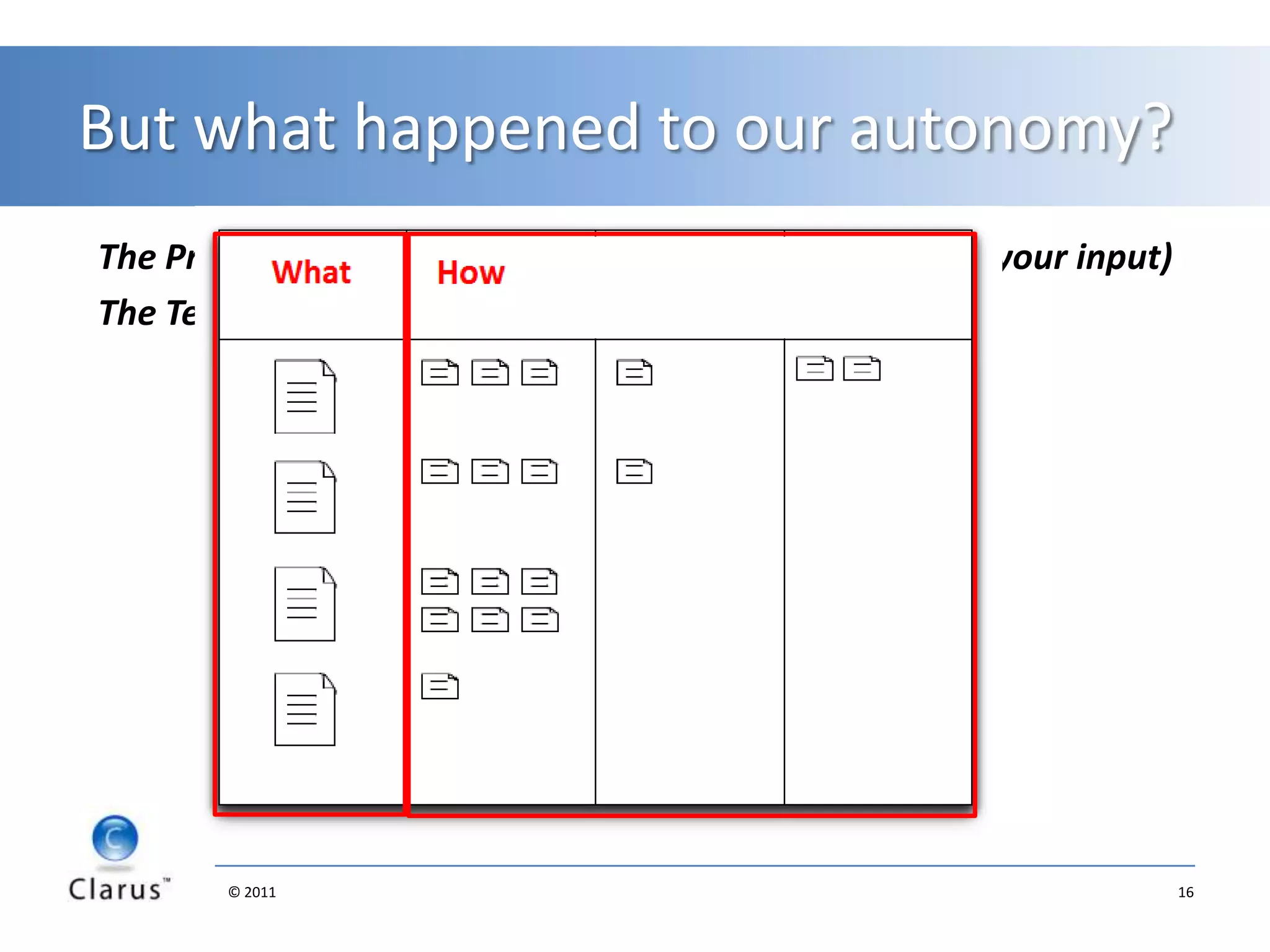
The Product Owner (business) decides “the what” (with your input)The Team decides “the how”But what happened to our autonomy?
2. The Product Owner roleIMHO the most important role in Scrum – vital for successCommonly the most poorly implemented role in ScrumMost implementations have eitherno/ineffective Product OwnerProduct Owner that doesn’t understand their roleThe Business decides what it wants and prioritisesThe Business and Team select the work for the Sprint.The Team figures our “the how” (the Sprint Backlog)The Business then needs to support minimal change, disruption and interferenceTypically most businesses struggle to do this as they have years of bad habits to undo first
2. The Product Owner roleLack of product owner results inGoing really fast to the wrong placeTeam perceiving a lack of skin in the game from businessLack of direction,  vision and purposeLack of understanding of the customerTypically, the first thing we address = the Product OwnerLack of quality Product Ownership = one of the biggest issues in Scrum world
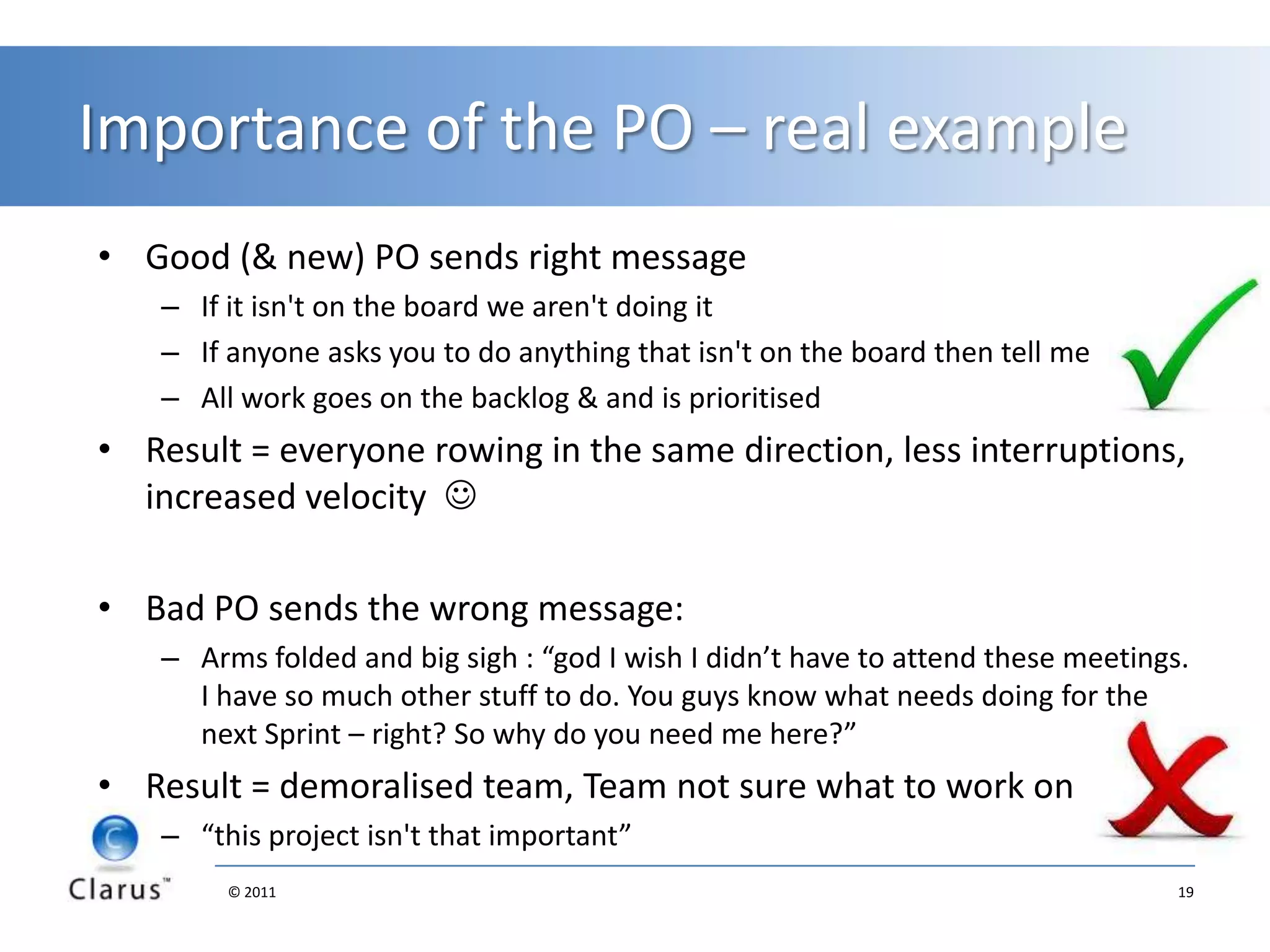
Good (& new) PO sends right messageIf it isn't on the board we aren't doing itIf anyone asks you to do anything that isn't on the board then tell meAll work goes on the backlog & and is prioritisedResult = everyone rowing in the same direction, less interruptions, increased velocity  Bad PO sends the wrong message:Arms folded and big sigh : “god I wish I didn’t have to attend these meetings. I have so much other stuff to do. You guys know what needs doing for the next Sprint – right? So why do you need me here?”Result = demoralised team, Team not sure what to work on“this project isn't that important”Importance of the PO – real example
3.  People“Individuals and Interactions over processes and tools ”- Agile Manifesto“Knowledge workers are volunteers”- Mary Poppendiek True motivation—autonomy, mastery, and purpose- Daniel Pink, Drive
3. People!Culture ChangeBreaking negative cyclesLearning new skills
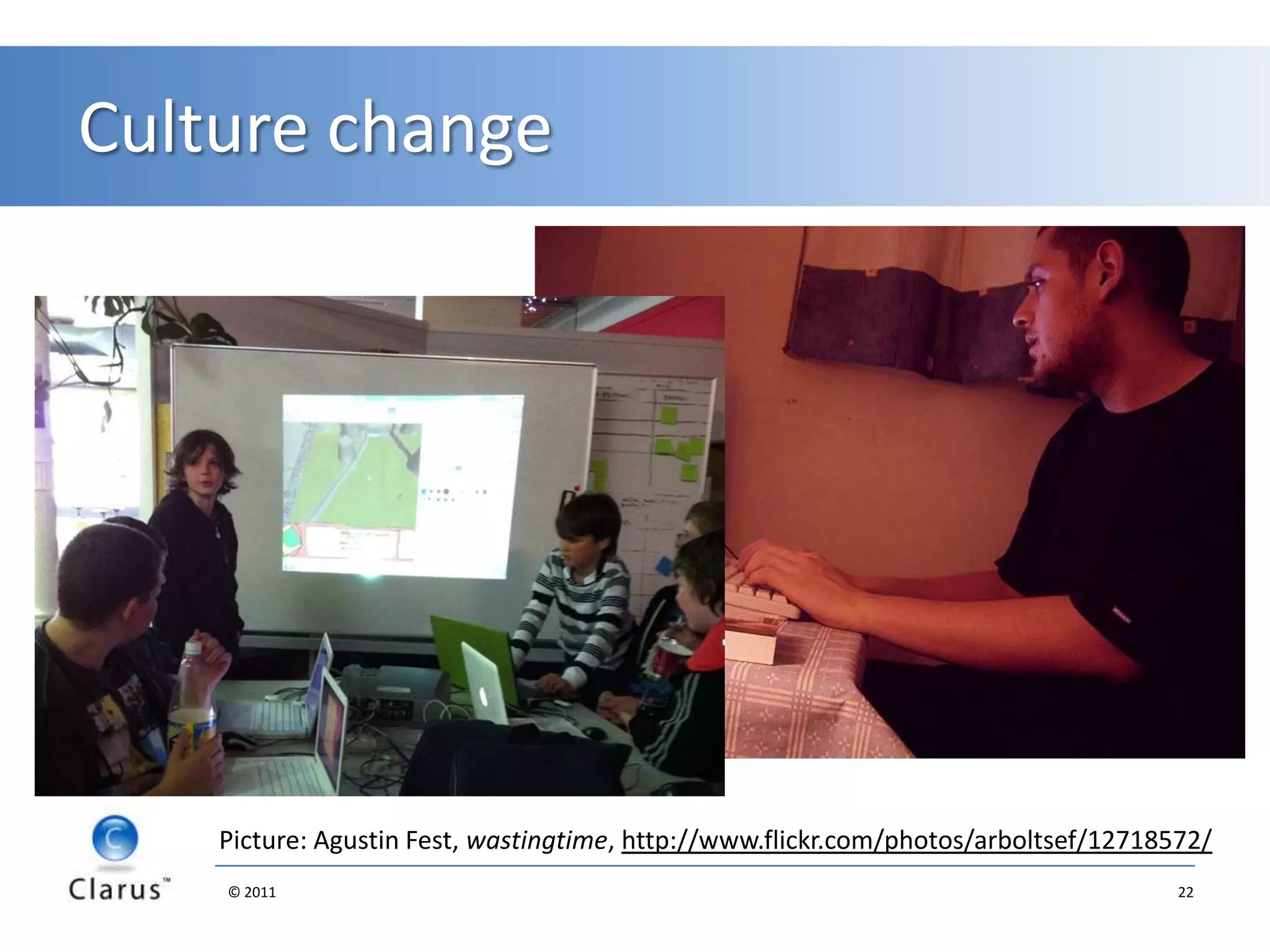
Culture changePicture: Agustin Fest, wastingtime, http://www.flickr.com/photos/arboltsef/12718572/
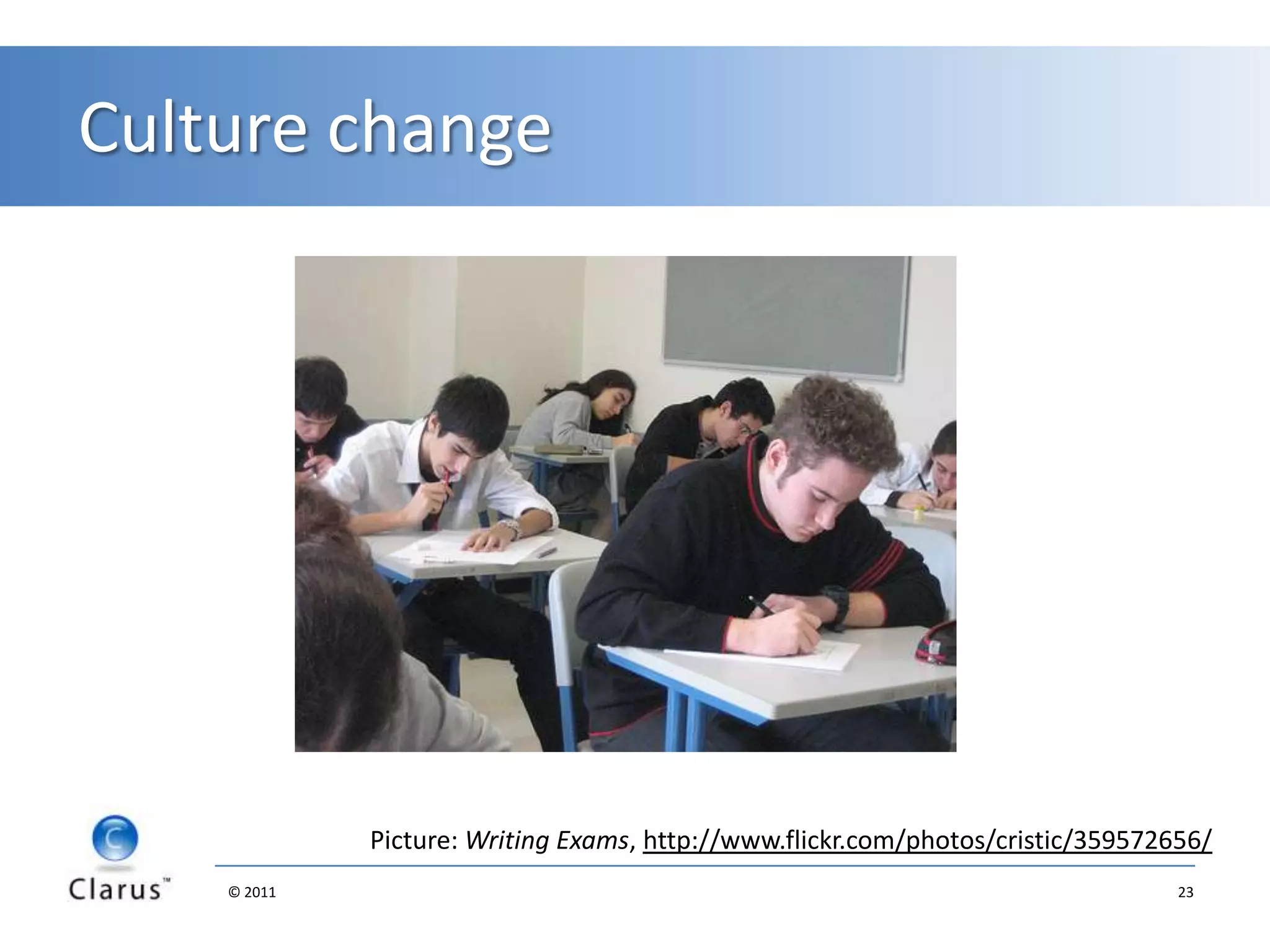
Culture changePicture: Writing Exams, http://www.flickr.com/photos/cristic/359572656/
Agile world viewConsensusCollaborationTeam workBut what have I achieved?
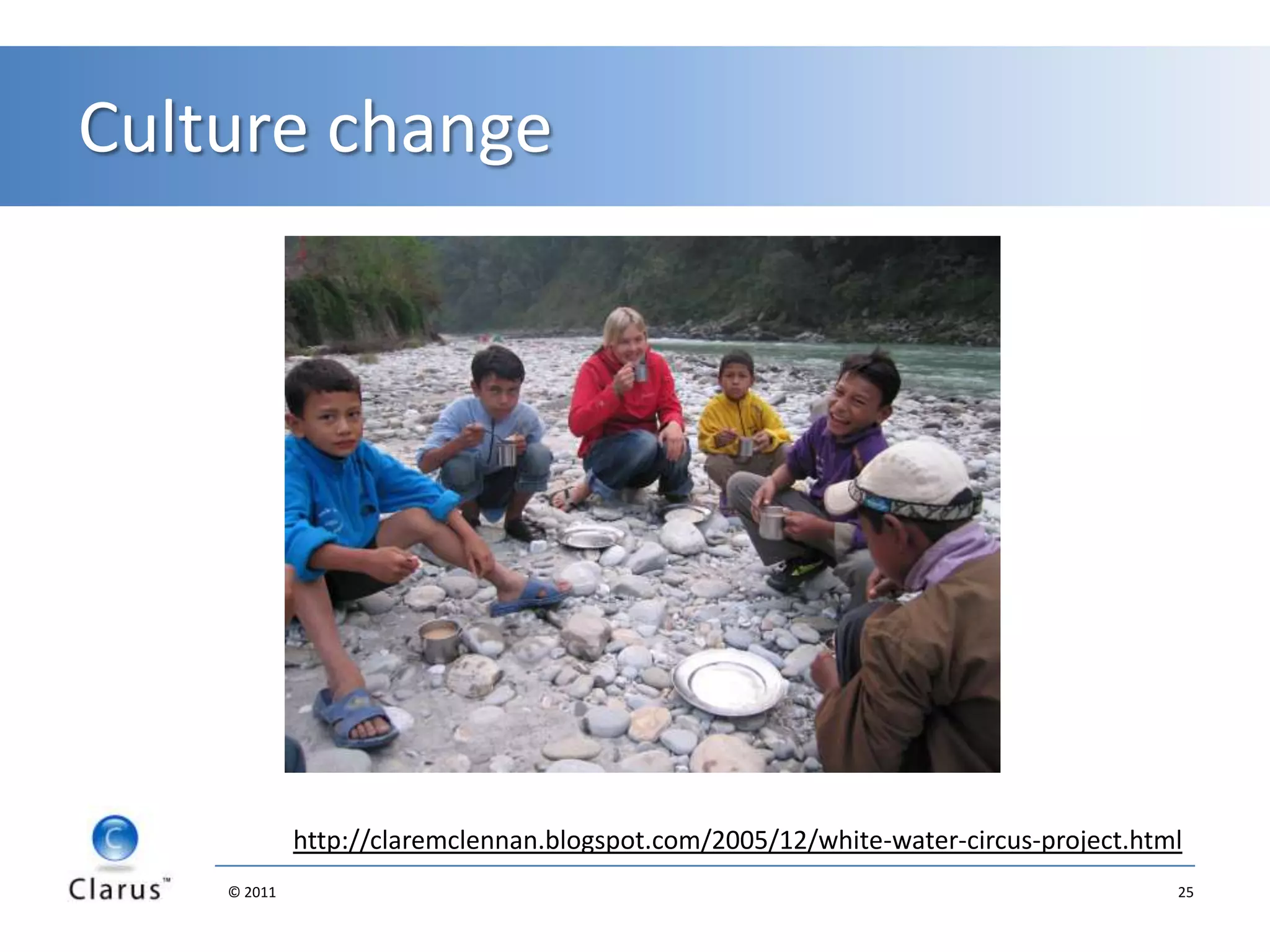
Culture changehttp://claremclennan.blogspot.com/2005/12/white-water-circus-project.html
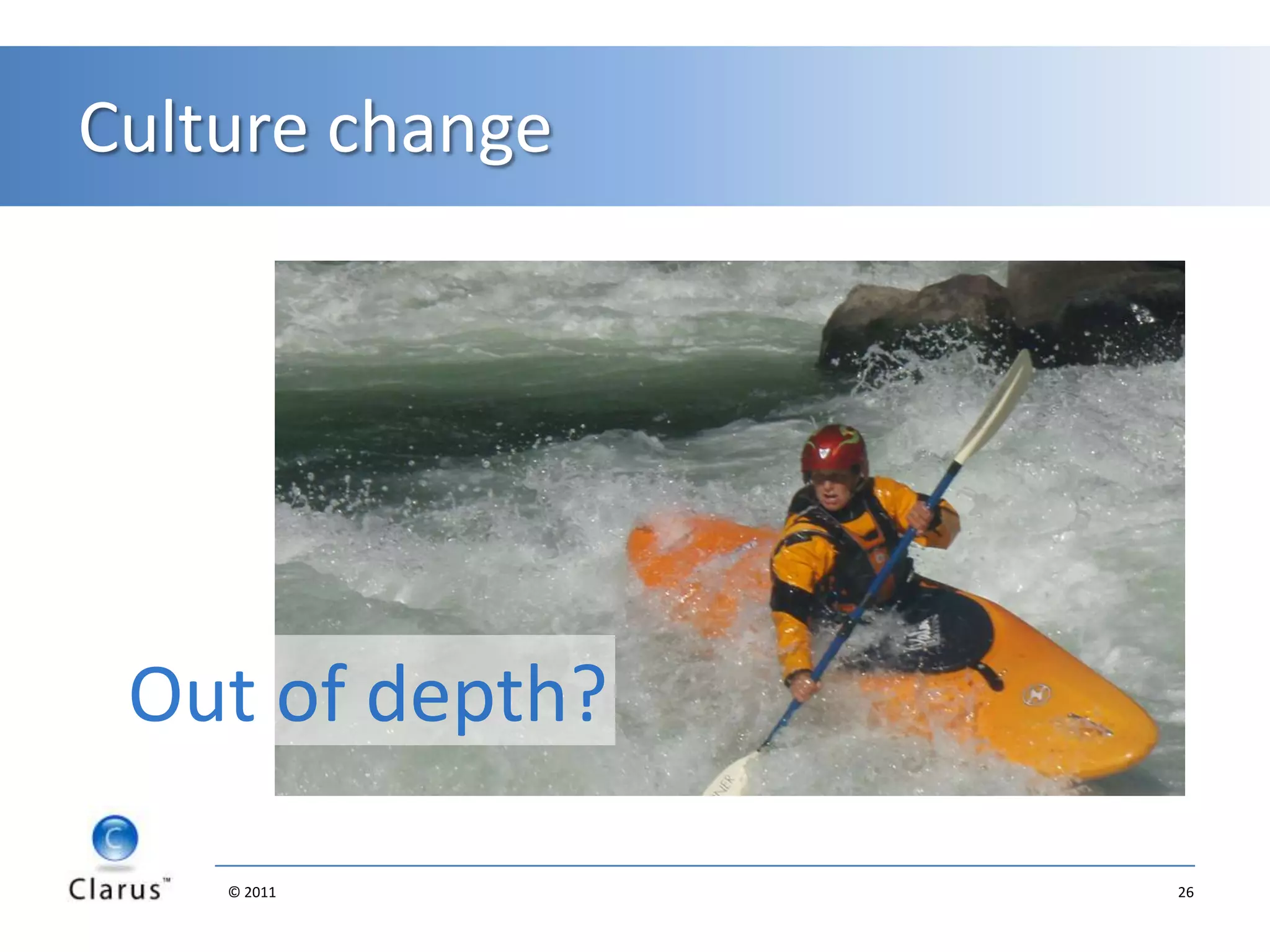
Culture changeOut of depth?
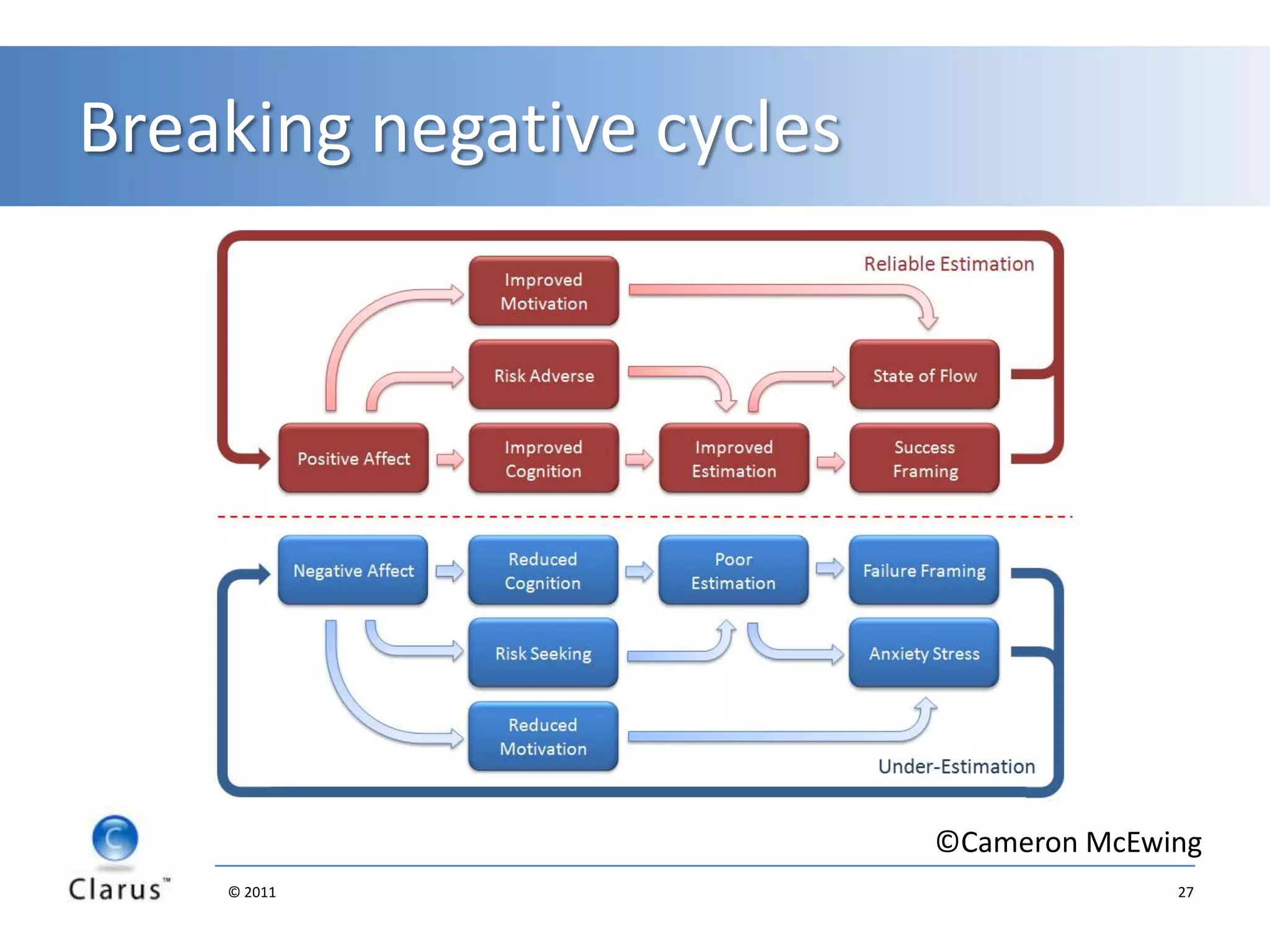
Breaking negative cycles©Cameron McEwing
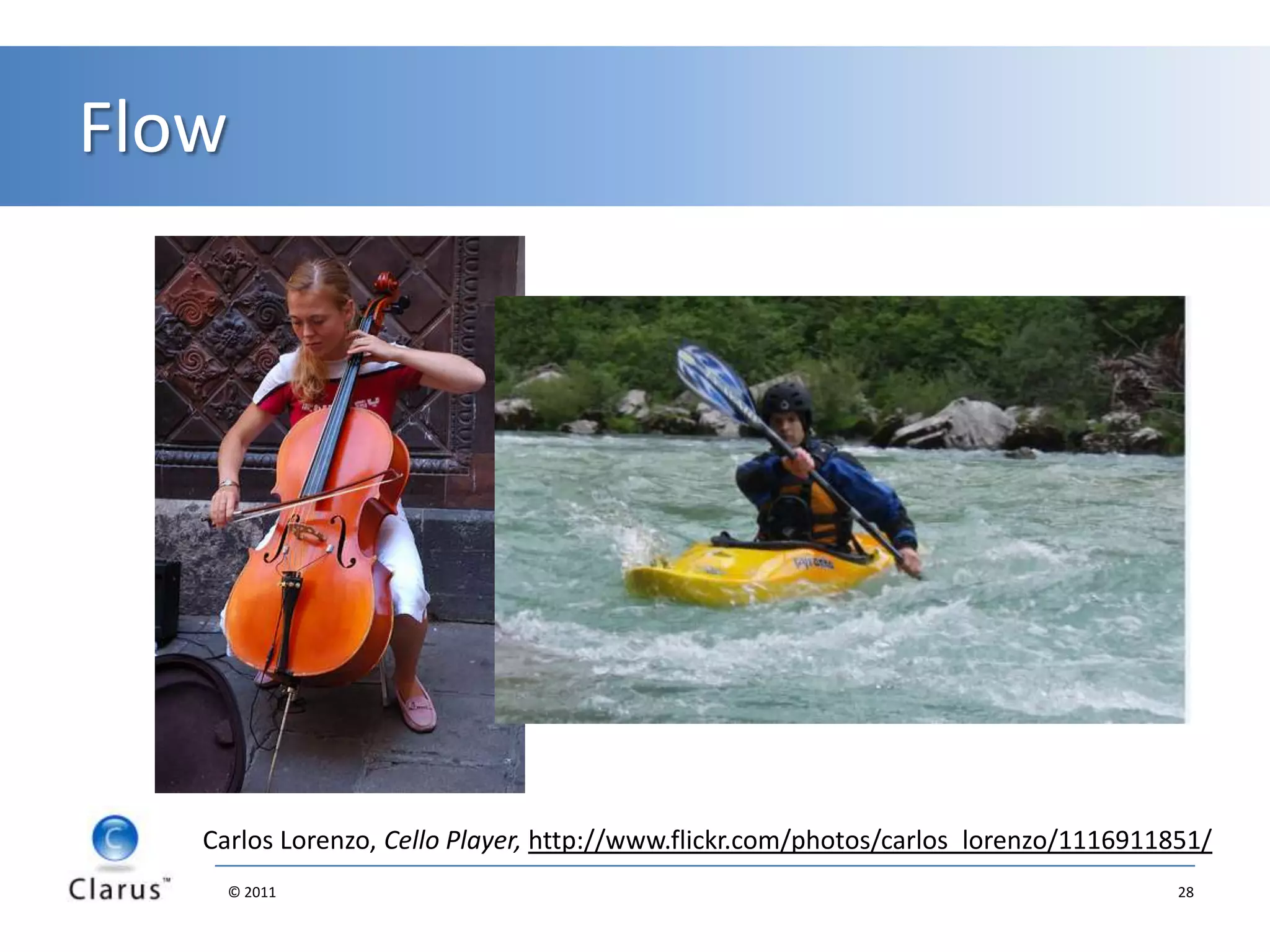
FlowCarlos Lorenzo, Cello Player,http://www.flickr.com/photos/carlos_lorenzo/1116911851/
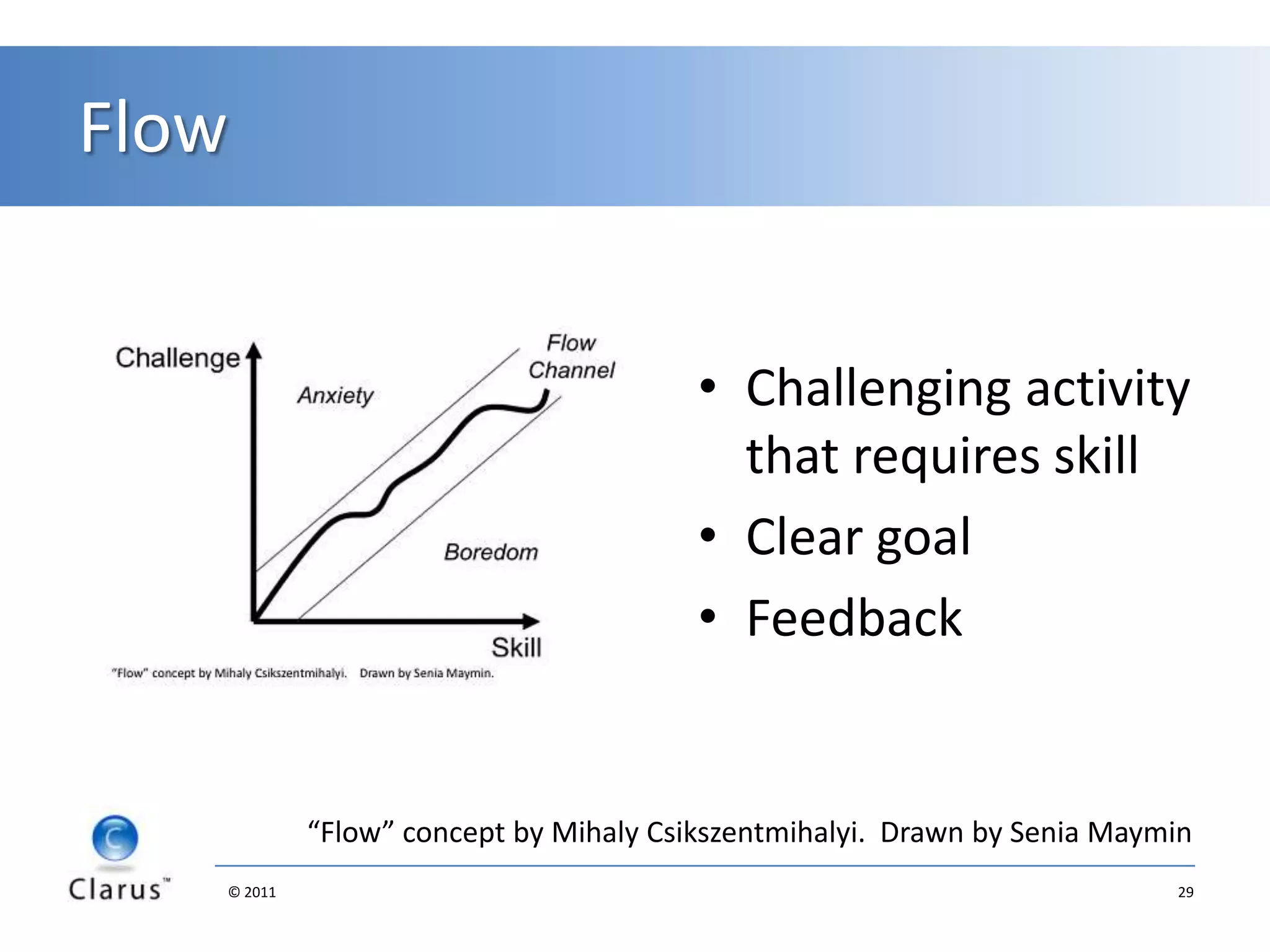
FlowChallenging activity that requires skill
Clear goal
Feedback“Flow” concept by MihalyCsikszentmihalyi.  Drawn by SeniaMaymin
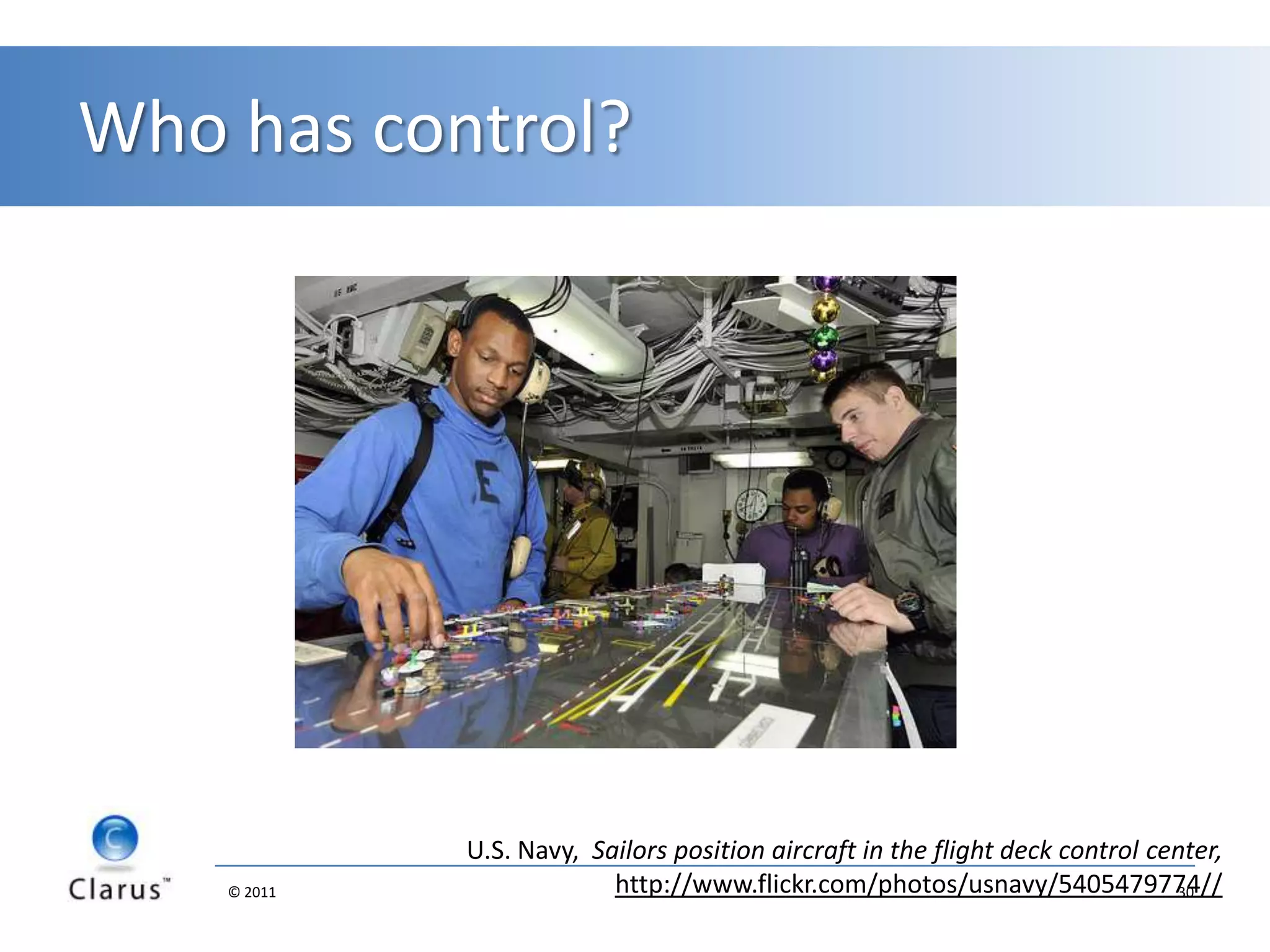
Who has control?U.S. Navy,  Sailors position aircraft in the flight deck control center, http://www.flickr.com/photos/usnavy/5405479774//
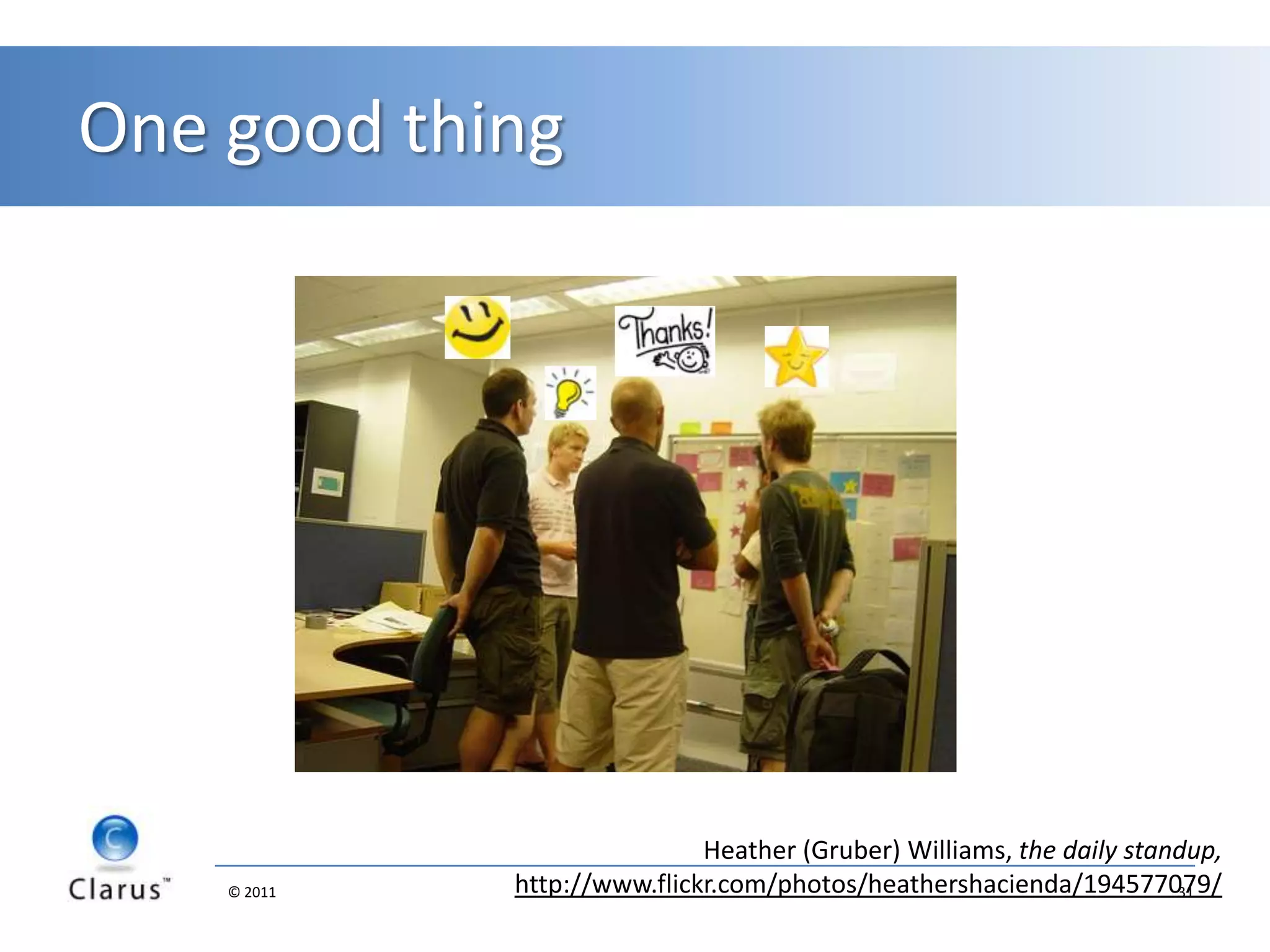
One good thingHeather (Gruber) Williams, the daily standup, http://www.flickr.com/photos/heathershacienda/194577079/
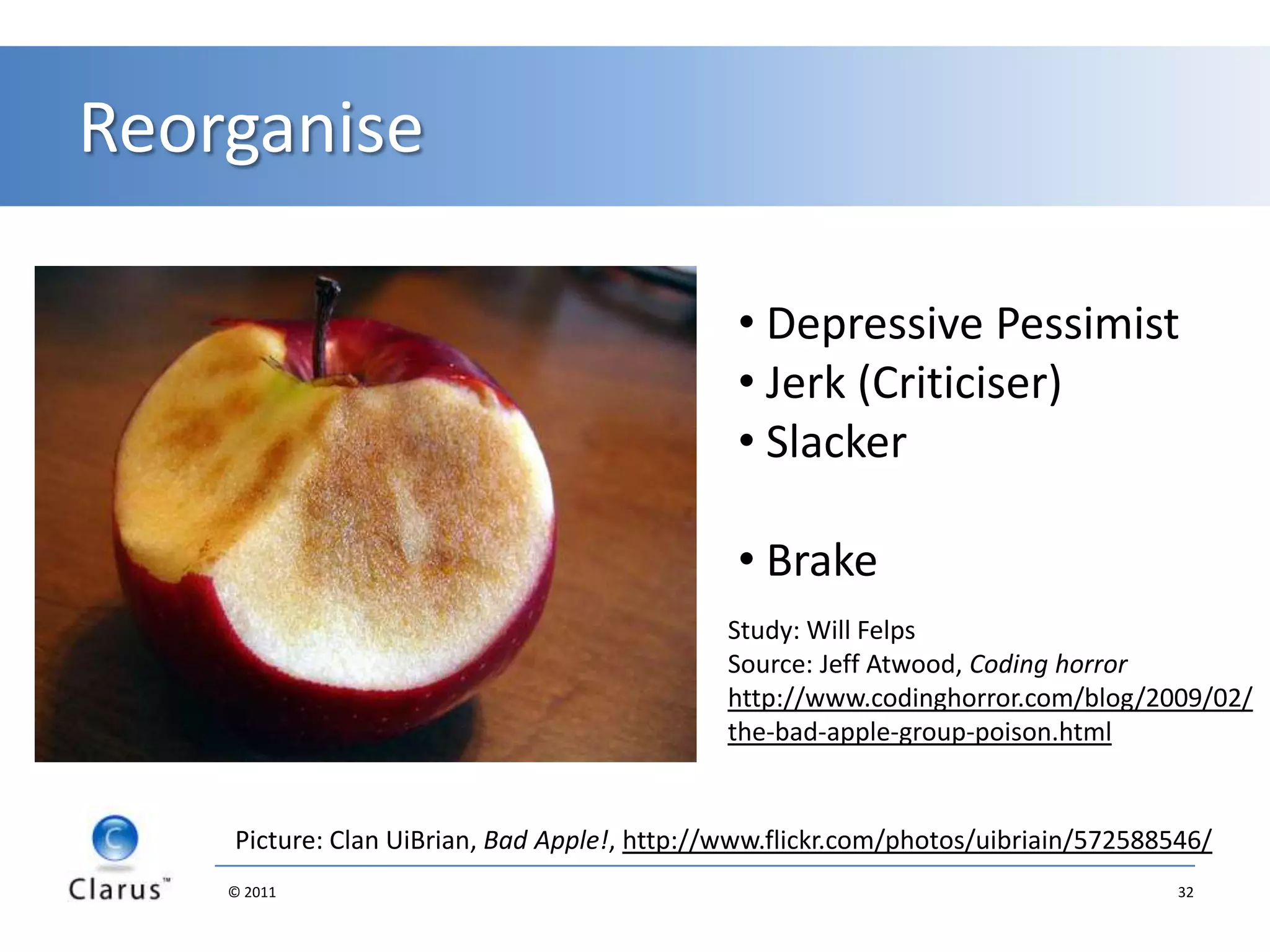
Reorganise Depressive Pessimist
 Jerk (Criticiser)
 Slacker
 BrakeStudy: Will FelpsSource: Jeff Atwood, Coding horror http://www.codinghorror.com/blog/2009/02/the-bad-apple-group-poison.htmlPicture:Clan UiBrian, Bad Apple!, http://www.flickr.com/photos/uibriain/572588546/
Clare’s lesson“But you’re wrong, you’ve forgotten about...”“Absolutely, I agree with most of what you are saying.   However there is one point I’d like to discuss more...”
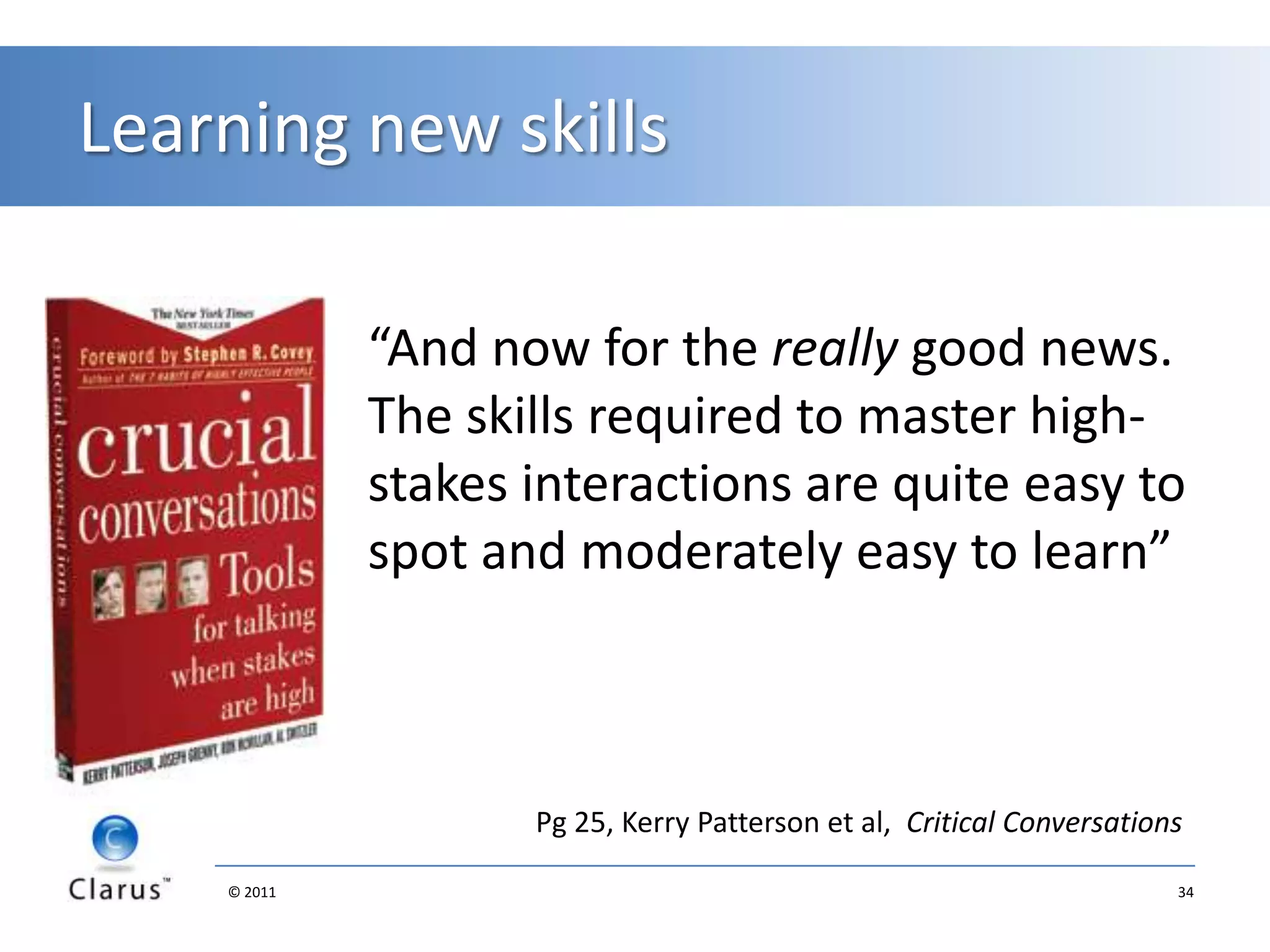
Learning new skills“And now for the really good news.   The skills required to master high-stakes interactions are quite easy to spot and moderately easy to learn”Pg 25, Kerry Patterson et al,  Critical Conversations
Dialogue skills are learnableSilence and violenceSuckers choiceVictim – It’s not my faultMutual PurposeAppreciative EnquiryParaphrasing
4. The changing role of managementPeople don't set out to fail each day - they set out to succeed Successful managers create an environment for success, empower their people and then stand aside Servant leadershipDefine the "what" not the "how"Accept that people don't work for money, they work for AMPAutonomy, Mastery, PurposeThe world is changing and Gen-Y are helping challenge the status quoManage them as you would a team of volunteers

Christchurch Agile Professionals Network Presentation: Lessons Learned Implementing Scrum

  • 1.
    Distilled wisdom fromthe coalface:Our lessons implementing ScrumClarus 26 May 2011
  • 2.
    “Yeah, we doAgile”Doing Agile versus Being AgileDoing = following the process, executing the mechanics without understanding the philosophyBeing = using the philosophy to become the best product development & management organization in your marketThe right thinking is needed to get there. This is why it is hard.
  • 3.
    Why Scrum?Accessible, well-defined,established way to start on your Agile journeyClearly defined roles (and only three of them)Clear process (you are either doing Scrum or not)Well established community (over 60,000 CSM’s worldwide)Established support bodiesScrum works But being brave enough to change your business is hard…
  • 4.
    Why Scrum?222334455817Source: Stateof Agile Development – Aug 2010
  • 5.
    TonightOur experience implementingScrum across over a dozen New Zealand companies
  • 6.
  • 7.
  • 8.
    Various challenges –it is always differentAbout UsFounded 2006
  • 9.
    Christchurch HQ and(new) Auckland branch
  • 10.
    Agile, Business Analysis,Testing, Development, Project Management
  • 11.
    Official and exclusivebusiness partner of Scrum Foundation (Dr Jeff Sutherland – co-creator of Scrum)
  • 12.
    Edwin has workedwith Jeff Sutherland, Ken Schwaber, Gabrielle Benefield, Jens Ostergaard and Kane Mar 1. Scrum is simple, implementing it is hardImplementing Scrum implementing a frameworkImplementing Scrum = business changeScrum will highlight every deficiency and impediment that the enterprise has so the enterprise can fix them and change into the best product development and management organization in its market. – Ken Schwaber, co-inventor of Scrum
  • 13.
    Why is implementingScrum hard?People – we are Complex creatures …Change – looking in the mirror and facing the truth is hardBusiness – why are we here again? And what are we doing? And what is really important?
  • 14.
    Why it’s hard:PeopleSoftware is a social process - it is all about peoplePeople form groups and groups establish normsScrum starts small but challenges accepted norms, rules, rituals and culturesBehaviour and culture - ARRGHH!Huh? How I act impacts productivity? But I am an engineer – we are what we are!
  • 15.
    Why it’s hard:PeoplePeople are often not used to holding each other accountablechallenging each otherhaving the freedom to define the “how”making their own estimatesmaking and keeping commitmentsClare will talk more on people
  • 16.
    Why it’s hard:BusinessBusiness has been built on years of false assumptions and Industrial Age thinking (relay race, the Illusion of Predictability, communicating via documents, centralised control, directive management, -all accepted norms!)Lots of bad habits to undoChange this on a large scale is hardIncreased transparency often results in attrition, conflict and misery
  • 17.
    Business: time toface the factsScrum forces the business tostate what is and isn’t important (most struggle)be committed to organisational improvementAsk: What are we in business for? Is it to develop products for the customer or something else?Attention turns to what the customer valuesAnd we start to challenge accepted norms“But that is how we do software projects here!”“Yeah, but does that add value to the customer?”Measurements change: customer satisfaction and cycle timeMust have a customer representative: effective Product Owner
  • 18.
    Example: time toface the factsWe know that only 7% of human communication is the message contentWe know that the remaining 93% is based on the body language, context and voice toneSo why do we try to communicate via the 7%?Email, documents, requirements documents, Gantt charts & memosSeriously - are we insane?
  • 19.
    Example - theTruth HurtsThis is why co-location is importantRadical drop off at up to 10 metersNote – little difference between 100 meters and 100 kilometres
  • 20.
    And the engineers…Customerrevenue pays our salariesYou have a contract to sell your time for moneyThe company (Product Owner) prioritises the work (the “what”)Don’t assume it is fine to work on whatever you want.If it isn't on the board we are not working on it
  • 21.
    The Product Owner(business) decides “the what” (with your input)The Team decides “the how”But what happened to our autonomy?
  • 22.
    2. The ProductOwner roleIMHO the most important role in Scrum – vital for successCommonly the most poorly implemented role in ScrumMost implementations have eitherno/ineffective Product OwnerProduct Owner that doesn’t understand their roleThe Business decides what it wants and prioritisesThe Business and Team select the work for the Sprint.The Team figures our “the how” (the Sprint Backlog)The Business then needs to support minimal change, disruption and interferenceTypically most businesses struggle to do this as they have years of bad habits to undo first
  • 23.
    2. The ProductOwner roleLack of product owner results inGoing really fast to the wrong placeTeam perceiving a lack of skin in the game from businessLack of direction, vision and purposeLack of understanding of the customerTypically, the first thing we address = the Product OwnerLack of quality Product Ownership = one of the biggest issues in Scrum world
  • 24.
    Good (& new)PO sends right messageIf it isn't on the board we aren't doing itIf anyone asks you to do anything that isn't on the board then tell meAll work goes on the backlog & and is prioritisedResult = everyone rowing in the same direction, less interruptions, increased velocity Bad PO sends the wrong message:Arms folded and big sigh : “god I wish I didn’t have to attend these meetings. I have so much other stuff to do. You guys know what needs doing for the next Sprint – right? So why do you need me here?”Result = demoralised team, Team not sure what to work on“this project isn't that important”Importance of the PO – real example
  • 25.
    3. People“Individualsand Interactions over processes and tools ”- Agile Manifesto“Knowledge workers are volunteers”- Mary Poppendiek True motivation—autonomy, mastery, and purpose- Daniel Pink, Drive
  • 26.
    3. People!Culture ChangeBreakingnegative cyclesLearning new skills
  • 27.
    Culture changePicture: AgustinFest, wastingtime, http://www.flickr.com/photos/arboltsef/12718572/
  • 28.
    Culture changePicture: WritingExams, http://www.flickr.com/photos/cristic/359572656/
  • 29.
    Agile world viewConsensusCollaborationTeamworkBut what have I achieved?
  • 30.
  • 31.
  • 32.
  • 33.
    FlowCarlos Lorenzo, CelloPlayer,http://www.flickr.com/photos/carlos_lorenzo/1116911851/
  • 34.
  • 35.
  • 36.
    Feedback“Flow” concept byMihalyCsikszentmihalyi. Drawn by SeniaMaymin
  • 37.
    Who has control?U.S.Navy, Sailors position aircraft in the flight deck control center, http://www.flickr.com/photos/usnavy/5405479774//
  • 38.
    One good thingHeather(Gruber) Williams, the daily standup, http://www.flickr.com/photos/heathershacienda/194577079/
  • 39.
  • 40.
  • 41.
  • 42.
    BrakeStudy: WillFelpsSource: Jeff Atwood, Coding horror http://www.codinghorror.com/blog/2009/02/the-bad-apple-group-poison.htmlPicture:Clan UiBrian, Bad Apple!, http://www.flickr.com/photos/uibriain/572588546/
  • 43.
    Clare’s lesson“But you’rewrong, you’ve forgotten about...”“Absolutely, I agree with most of what you are saying. However there is one point I’d like to discuss more...”
  • 44.
    Learning new skills“Andnow for the really good news. The skills required to master high-stakes interactions are quite easy to spot and moderately easy to learn”Pg 25, Kerry Patterson et al, Critical Conversations
  • 45.
    Dialogue skills arelearnableSilence and violenceSuckers choiceVictim – It’s not my faultMutual PurposeAppreciative EnquiryParaphrasing
  • 46.
    4. The changingrole of managementPeople don't set out to fail each day - they set out to succeed Successful managers create an environment for success, empower their people and then stand aside Servant leadershipDefine the "what" not the "how"Accept that people don't work for money, they work for AMPAutonomy, Mastery, PurposeThe world is changing and Gen-Y are helping challenge the status quoManage them as you would a team of volunteers
  • 47.
    Servant LeadershipCreate ahighly fertile environment that nurtures successallows constrained failureharnesses multiple perspectives to problem solvingRemoves impediments to the teams progressenvironmentbureaucracyinterruptions and distractionsexecutive communicationorganisational and cultural change
  • 48.
  • 49.
    6. Governance &AccountabilityHow to get things done with no powerTransparency is the keyOrganisational impediments stuff the governance group can help us resolveput the facts on the tablelet the executives make the decisionsInclude HR (culture, people), marketing, R & D, IT, support etc…
  • 50.
    7. Benefits ofScrumOften sold (bought?) on productivity gainsReal benefits are:Increase visibility`Empirical data provides visibility and increased predictabilityIncreased predictabilityIncreased qualityEngaged staffHowever don’t forget – attrition is common at first
  • 51.
    8. From thehorses mouth:“While all the books on Scrum tell you this, you don't really appreciate how powerful the process is until you do it. We used to have the standard weekly one hour one-on-one meeting, which frankly has about 1% as useful as the communication we now get from Scrum daily.” “The best thing about using Scrum is knowing exactly where we are at and what we are doing as a team. We can now rectify issues and see results immediately thanks to Scrum's feedback.”
  • 52.
    Transitioning to beingAgile is hardIterative, incremental development is much harder than waterfall development; everything that was hard in waterfall engineering practices now has to be done every iteration, and this is incredibly hard. It is not impossible, but has to be worked toward over time.The role of an enterprise’s management changes from telling people what to do to leading and helping everyone do their best to achieve goals.Source: Ken Schwaber, Scrum is Hard and Disruptive, 2006
  • 53.
    Transitioning to beingAgile is hardScrum is not a methodology that needs enhancing. That is how we got into trouble in the first place, thinking that the problem was not having a perfect methodology. Effort centres on the changes in the enterprise that are needed.Whenever an enterprise modifies or only partially implements Scrum, it is hiding or obscuring one or more dysfunctionalities that restrict its competence in product development and management.The focus of using Scrum is the change from old habits to new ways of doing business. Scrum is not implemented or rolled-out as a process; it is used to foment change.Source: Ken Schwaber, Scrum is Hard and Disruptive, 2006
  • 54.
    ...but worth itIam indebted to you, Agile & <company name> - I find IT fun again. I was seriously investigating making a career change and had dabbled in lecturing last year; the way the BA role was going at <old job> and other corporates, it just wasn't fun or rewarding. This is the most fun and job satisfaction I've had for at least 7 years. I like how we can all cross over into each other's domain at any time, if that's what it takes to get something done. You've put together a great team that knows how to deliver but still enjoys themselves every step of the way.You have left us (and me personally) with a small revolution in the way we work here. Agile is just what we need here to re-build our teams and re-focus this company. Thank you.
  • 55.
    Questions?Don’t forget upcomingtraining:Certified Scrum Product Owner - Christchurch 25 & 26 July
  • 56.
    Certified Scrum Master- Christchurch 11 & 12 Aug AlsoCertified Scrum Master - Auckland 08 & 09 Aug
  • 57.
    Certified Scrum Master- Wellington 15 & 16 Aug About ClarusWe improve the business of ITConsulting – delivering outcomesMentored Learning (injecting our IP into your via business training with mentoring)Project ResourcingCertified Scrum TrainingProject Quality AssuranceProject & Technology AuditIT ManagementBusiness ContinuityAgile Adoption & CoachingBusiness AnalysisSoftware TestingProject ManagementSoftware Development & Architecture

Editor's Notes

  • #22 Agile manifesto, “people over process”There are better outcomes for knowledge workers and their output if we put them in control – Pink .
  • #26 Consensus
  • #30 Check-sent-me-high. Employee engagement.Individuals perceptions which are important here – not the actual difficulty
  • #32 1:5 ratio, From Gratitude
  • #36 Stone walling