9/20/2015 Enterprise Service Bus
http://www.oracle.com/technetwork/articles/soa/ind­soa­esb­1967705.html 1/10
Application Development
Framework
Application Express
Big Data
Business Intelligence
Cloud Computing
Communications
Database Performance &
Availability
Data Warehousing
Database
.NET
Dynamic Scripting Languages
Embedded
Digital Experience
Enterprise Architecture
Enterprise Management
Identity & Security
Java
Linux
Mobile
Service­Oriented Architecture
Solaris
SQL & PL/SQL
Systems ­ All Articles
Virtualization
Write for OTN
Earn money and promote your
technical skills by writing a
technical article for Oracle
Technology Network.
Learn more
Stay Connected
OTN Architect Community
       
Enterprise Service Bus
by Jürgen Kress, Berthold Maier, Hajo Normann, Danilo Schmeidel, Guido Schmutz, Bernd Trops, Clemens Utschig­
Utschig, Torsten Winterberg
Answers to some of the most important questions surrounding the term "enterprise service bus" using
concrete examples, so that the areas of application that can be deemed "correct" for ESBs can be clarified.
Part of the Industrial SOA article series
July 2013
Introduction
Everyone seems to need to use an enterprise service bus (ESB) nowadays, but there is much confusion about its actual benefit and the various
concepts this term entails. This uncertainty is revealed in statements like, "Help! My boss says we need an ESB," or "Why do I need an ESB at all?
Can't I achieve the same thing with BPEL or BPMN?" or even "We can do everything ourselves in language X." This article is an attempt to answer
some of the most important questions surrounding this term using concrete examples, so that the areas of application that can be deemed "correct"
for ESBs can be clarified:
What exactly is the definition of an ESB? Is it a product or an architecture pattern?
What are some practical uses for an ESB?
Do I need an ESB to build an SOA platform?
Which requirements do I need to satisfy?
Which criteria can I use to select the ESB that is most suitable for my needs?
Defining the ESB
An accepted definition for this term has yet to be firmly established that is most likely caused by a lack of industry standards, whereas standards like
BPEL and BPMN 2.0 exist for process engines and other components. The term “Enterprise Service Bus” was coined by Gartner in 2002, and further
introduced by the analyst Roy Schulte to describe a category of software products that he observed were available on the market at that time. Ten
years later, there is still very little agreement on what exactly an ESB is or what it should deliver. There are different definitions depending on the
manufacturer or source. Among other things, an ESB is defined as:
"A style of integration architecture that allows communication via a common communication bus that consists of a variety of point­to­point
connections between providers and users of services."
"An infrastructure that a company uses for integrating services in the application landscape."
"An architecture pattern that enables interoperability between heterogeneous environments, using service orientation." (Figure 1)
Oracle Technology Network Articles Service­Oriented Architecture
Products Solutions Downloads Store Support Training Partners About OTN
Sign In/Register Help Country Communities I am a... I want to... Search
9/20/2015 Enterprise Service Bus
http://www.oracle.com/technetwork/articles/soa/ind­soa­esb­1967705.html 2/10
Figure 1: The ESB architecture pattern is divided into these main system architectures
The ESBs that are available in today's market essentially differ in terms of the architecture of their systems. As shown in the preceding figure, they
are mostly based on the following architectures:
Extended Message­Oriented Middleware (MOM)
These systems correspond to the original definition of ESB and typically distribute multiple nodes across the network, using a MOM infrastructure to
support reliable messaging and event­driven processing among the nodes. Although the ESB nodes communicate using a proprietary protocol,
service endpoints don't need to be aware of the MOM. Services can be exposed using a WSDL or other protocols.
Extended Integration Brokers
Over the last five years, traditional integration broker vendors have been adding support for Web services and repositioning their products as ESBs.
These systems are more standards­compliant than they once were but still tend to be more proprietary than most ESBs. They also tend to provide a
very centralized solution in which all messages pass through a centralized broker.
Extended Application Servers
A number of ESB vendors use a Java EE application server as the basis for their ESB products. These products are typically stronger in terms of
service creation and composition than they are in legacy integration. They tend to be rather centralized, although they do support distributed nodes.
Endpoint­Based Plug­In Channels
A few ESB vendors support an extremely distributed model that implements service mediation at the service endpoint, and supports heterogeneous
communications using a channel plug­in architecture
Mediation Agents
Although these products don't technically qualify as ESBs because a service platform is provided, more than one vendor has been known to label this
type of product as such. Mediation agents can be centralized or distributed and support service mediation. There are also related product categories
that implement parts of ESBs but are not officially marketed as ESBs by manufacturers [REF­1]:
XML Gateway
XML gateways are hardware appliances that primarily support service mediation, which is one of the key features of ESBs. In fact, XML gateways
often support service mediation capabilities that ESBs do not or cannot support, such as transformation acceleration and the decryption and
encryption of XML documents. However, XML gateways do not provide a service platform, a feature that is typically associated with ESBs.
Message­Oriented Middleware (MOM)
Message­oriented middleware is middleware that is based on the asynchronous sending and receiving of messages to offer looser coupling between
applications. The format of the messages is not defined, although, in practice, XML has become established as the preferred format. A MOM product
usually supports communication via message queuing and publish/subscribe. There is usually no provision for the transformation of messages in the
MOM, and an application's interface to the message­oriented middleware is relatively complex and not well standardized. A MOM can be used as the
basis for reliable message forwarding by an ESB.
Integration Brokers (EAI)
Some developers of traditional EAI tools are now positioning their products as ESBs. These products are often complex and proprietary and typically
based on a hub­and­spoke architecture. The broker acts as the central message exchange (hub) around which the senders and recipients (spokes)
are arranged radially. Connections to the broker are made via adapter ports that support the required message format.
Business Process Management Systems (BPMS)
Some ESB developers view service orchestration and automated business process management (BPEL, BPMN) as ESB characteristics, while others
consider service buses to be a separate product that belongs to the BPMS category. This is especially the case when business aspects are
9/20/2015 Enterprise Service Bus
http://www.oracle.com/technetwork/articles/soa/ind­soa­esb­1967705.html 3/10
expressed in process models or the category of an "Orchestration Engine," when technical integration processes can be expressed as a long process
chain that calls services in a distinct order.
Application Servers
Many ESB platforms offer a service platform for building and hosting services. In this case, the ESB is also an application server. Many application
servers provide containers for operating services and also offer a restricted capability for message processing and policy enforcement. Application
server adapters support the integration of legacy systems through technologies such as Java EE Connector Architecture (JCA). In most cases, an
application server only supports a few protocols, and a precise separation of ESB and application servers is difficult. Many developers require an
application server as the basis for their ESB.
API Gateways
Companies and organizations aim to expose access to a subset of their key services and data to business partners and customers in an easy­to­use,
standardized manner in the form of an API. This implies distinct security, performance, integration concerns that can then be addressed by API
gateways. They encompass features for threat protection to ensure Quality of Service. They are not an ESB but do provide a certain overlap in terms
of features. Examples for such shared features are transformations
and routings.
A general rule of thumb to note is that when services are exposed to the outside world, an API gateway is a tool to be considered. It is positioned
outside of the Intranet, typically in the DMZ. It manages only the subset of services that is communicating with external parties.
An ESB is used for service virtualization, typically manage a much larger set of services, and is positioned inside the Intranet.
When Should an ESB be Used?
Are there best practices to determine when the implementation of an ESB is worthwhile? The use of an ESB is worth considering when three or more
applications or services need to be integrated. A simple point­to­point integration is significantly easier and much more cost­effective when
connecting two applications. An ESB can also be worthwhile if services are going to be incorporated from external service providers over which the
company has no control. The ESB can then be used to monitor the service level agreements that the external provider guarantees. The impact of the
adjustments to service contracts can further be kept to a minimum, as the ESB continues to provide a stable interface while making the necessary
changes to the messages.
If many different protocols, such as HTTP, SOAP, and FTP, are to be used and standardized to one protocol like SOAP, the ESB can perform the
necessary protocol transformation. If services are to be consistently incorporated into an architecture to be able to receive, process, and produce
messages, then the use of ESB is also suitable. This is also applicable if a collection of pre­defined components and adapters need to be accessed,
which allows various protocols and legacy applications to be integrated in a standardized fashion. If messages need to be reliably and securely
processed, the ESB can simplify the implementation of transactional message flows between two heterogeneous transactional data sources.
Using an ESB can become problematic if large volumes of data need to be sent via the bus as a large number of individual messages. ESBs should
never replace traditional data integration like ETL tools. Data replication from one database to another can be resolved more efficiently using data
integration, as it would only burden the ESB unnecessarily.
An ESB should support stateless message flows if long­term business processes are to be implemented. Long­running business processes are
stateful and can best be implemented using BPEL and/or BPMN. These are not usually available via the ESB, but rather via a business process
management
system (BPMS).
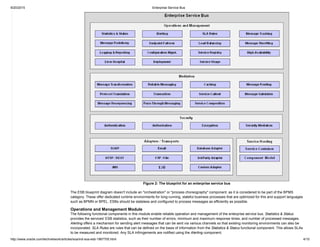
ESB Blueprint
Due to the lack of standardization, the ESB market is rather confusing. There are many products that claim to be ESBs but offer quite different
solutions and are based on different architectures. To allow for more effective evaluation of ESB products, the various functions that are assigned to
an ESB have been arranged into a blueprint (Figure 2).
9/20/2015 Enterprise Service Bus
http://www.oracle.com/technetwork/articles/soa/ind­soa­esb­1967705.html 4/10
Figure 2: The blueprint for an enterprise service bus
The ESB blueprint diagram doesn't include an "orchestration" or "process choreography" component, as it is considered to be part of the BPMS
category. These offer dedicated runtime environments for long­running, stateful business processes that are optimized for this and support languages
such as BPMN or BPEL. ESBs should be stateless and configured to process messages as efficiently as possible.
Operations and Management Module
The following functional components in this module enable reliable operation and management of the enterprise service bus. Statistics & Status
provides the services' ESB statistics, such as their number of errors, minimum and maximum response times, and number of processed messages.
Alerting offers a mechanism for sending alert messages that can be sent via various channels so that existing monitoring environments can also be
incorporated. SLA Rules are rules that can be defined on the basis of information from the Statistics & Status functional component. This allows SLAs
to be measured and monitored. Any SLA infringements are notified using the Alerting component.
9/20/2015 Enterprise Service Bus
http://www.oracle.com/technetwork/articles/soa/ind­soa­esb­1967705.html 5/10
Message Tracking provides the option of easily tracking messages within the ESB, and should be activated whenever required so as to minimize any
associated overhead. Message Redelivery ensures that messages that aren't processed immediately are automatically resent after a pre­defined
period of time. The number of attempts and the interval between them can be configured. This component is primarily suitable for technical errors
that only last a certain length of time, such as temporary network outages. Endpoint Failover enables the option of specifying an alternate service
provider that is automatically called whenever the primary service provider is not available.
Load Balancing allows several service endpoints to be listed for one logical service provider endpoint. It uses redundant service implementations that
are called alternately for each request according to a defined strategy, which can be round­robin or according to message priority or load
dependency.
Message Throttling makes it possible to define a maximum number of messages per unit of time for a service endpoint that should be sent to the
service provider. It prevents the service provider from being overloaded at peak times by buffering messages that lie over the threshold in a queue in
the ESB. Message Throttling can also support message priorities so that messages of higher priority are always processed first. Logging & Reporting
allows messages to be logged and then easily displayed at a later time. It can also provide functional auditing.
Configuration Management enables secure configuration adjustments to the ESB on an operational system, while constantly upholding the integrity
of the configuration. Artifacts and attributes can be adapted and replaced during operation. A history of the changes can also be kept so that an ESB
service can be rolled back to an earlier status at any time. Service Registry offers the option of registering and managing services on the ESB. High
Availability ensures that the services provided by the ESB are failsafe, regardless of the status of the server on which it is operated.
The Error Hospital is the destination for the messages that can't be processed after multiple redelivery attempts, where they can be viewed, corrected
if necessary, and reprocessed. Deployment offers the option of installing services automatically on the ESB. Environment­specific parameters such
as endpoint URIs are typically overridable by this component. Service Usage allows the use of services to be logged and charged to the user.
Mediation Module
The mediation module contains the functional components that are used to implement the message flow of an ESB service. Message Routing allows
messages to be forwarded to a particular service endpoint depending on their content. The criteria for forwarding may originate from the message
body or the message header, if the protocol used or the message format supports a header area that is independent of the message body.
Routing based on headers can be an attractive option to improve service performance and scalability, as direct access to the header is more efficient
than parsing the routing information from the body. This is of particular consequence for larger messages.
Message Transformation enables conversion from one message format to another that is applicable to text and binary messages as well as XML
formats. In addition, there is also the option of converting from text, such as the CSV format, to XML and vice versa. XML transformations use the
well­known standard XSLT, which enables declarative descriptions of transformations and has graphical resources with drag­and­drop functionality
for creation purposes.
A major drawback of XSLT transformations is a high memory usage if large documents are being processed, which may restrict the scalability of a
solution. It is preferable if the ESB offers transformation options that support XML streaming, such as via XQuery.
Service Callout offers the option of accessing other services within a message flow in the ESB, such as to enhance a message. A service may be a
Web service but the ESB can conceivably enable program code that's installed locally on the ESB to be called directly, such as a Java class method.
Reliable Messaging is the support of reliable message transfer using queuing or WS* standards, such as WS­ReliableMessaging.
Protocol Translation means the possibility of switching from a certain communication protocol to a different one without any programming effort, such
as from TCP/IP to HTTP. Message Validation ensure that messages are valid. In the case of XML, this means that the message contains well­
defined XML and corresponds to a certain XML schema or WSDL. However, the ESB can also offer other validation means, such as Schematron or a
rules engine.
Message Exchange Pattern (MEP) is the support of message exchange patterns, such as synchronous and asynchronous request/reply, one­way
call, and publish/subscribe. Result Cache provides the option of saving results from a service call in a cache, so that each subsequent call returning
9/20/2015 Enterprise Service Bus
http://www.oracle.com/technetwork/articles/soa/ind­soa­esb­1967705.html 6/10
the same result can be answered from the cache without calling the service again. This particularly applicable if the data is static or requires sporadic
or infrequent changes. Potentially expensive operations, such as accessing a legacy system, can be reduced significantly.
Transaction allows ESBs offer transactional integrity through message processing. The persistent queues that the ESB uses to support Reliable
Messaging generally work as transactional data sources, and can therefore participate in heterogeneous transactions. In addition, the ESB can offer
a distributed transaction manager that can coordinate distributed transactions via heterogeneous data sources using the two­phase commit protocol.
Message Resequencing allows a flow of messages that belong together but aren't in the correct order to be resequenced. In a message­oriented
solution with parallel processing of messages, the sequence in which the messages enter the ESB can be lost. Message Resequencing can be
incorporated into the message flow If the sequence is of import for the service provider. A resequencer contains an internal buffer that processes the
messages until the complete sequence is available and can be sent.
Pass­Through Messaging provides efficient forwarding of messages by the ESB. This is useful if the ESB is to be used for service virtualization and
the messages are forwarded from the service consumer to the service provider unchanged. In this case, it is applicable if the ESB doesn't touch the
message and simply passes it on as is.
Security Module
This module supports both the transport­level and message­level security using a number of components. Authentication authenticates service
consumers when they access the service in the ESB and verifies ESB authentication for the service provider. Authorization provides an authorization
system for services that can often be configured via XACML to be assigned to users or roles.
Security Mediation provides support for interactions that communicate outside of security domains by converting credentials from one domain to the
corresponding credentials of the other domain. Encryption/Decryption supports the encryption and decryption of the content of a message.
Adapters/Transport Module
This module includes adapters for connecting services that are provided by the ESB via the Service Hosting module. The ESB can be assumed to
provide a set of adapters from the ground up, and also has the option for customers or third­party developers to develop additional adapters for
customer­specific requirements.
Service Hosting Module
This module allows services to be installed and operated directly on the ESB and is usually required if the ESB is based on an application server.
Service Container provides one or more containers in which the services are installed and service lifecycles managed. It offers the service access to
technical cross­sectional functions, such as transactions and security.
The Component Model provides an abstract component model, such as Java EJB, Java Spring Framework, or Microsoft COM+, on the basis on
which the services are created.
Scenarios for the Practical Use of an ESB
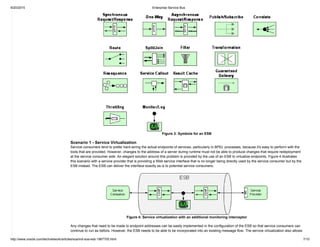
The symbols shown in Figure 3 are used to graphically describe the various scenarios without needing to refer to products and tools. The symbols
have been taken from [1] and further added to, in accordance with ESB functionalities.
9/20/2015 Enterprise Service Bus
http://www.oracle.com/technetwork/articles/soa/ind­soa­esb­1967705.html 7/10
Figure 3: Symbols for an ESB
Scenario 1 ­ Service Virtualization
Service consumers tend to prefer hard­wiring the actual endpoints of services, particularly in BPEL processes, because it's easy to perform with the
tools that are provided. However, changes to the address of a server during runtime must not be able to produce changes that require redeployment
at the service consumer side. An elegant solution around this problem is provided by the use of an ESB to virtualize endpoints. Figure 4 illustrates
this scenario with a service provider that is providing a Web service interface that is no longer being directly used by the service consumer but by the
ESB instead. The ESB can deliver the interface exactly as is to potential service consumers.
Figure 4: Service virtualization with an additional monitoring interceptor
Any changes that need to be made to endpoint addresses can be easily implemented in the configuration of the ESB so that service consumers can
continue to run as before. However, the ESB needs to be able to be incorporated into an existing message flow. The service virtualization also allows
9/20/2015 Enterprise Service Bus
http://www.oracle.com/technetwork/articles/soa/ind­soa­esb­1967705.html 8/10
the use of the ESB's monitoring functions that extend to service statistics, so that SLA compliance can be checked and the appropriate actions
configured if noncompliant. Service virtualization can be performed if the service provider makes a change to the service contract but doesn't want to
impact the service consumer. In this case, a simple transformation of the exchanged messages can resolve the issue.
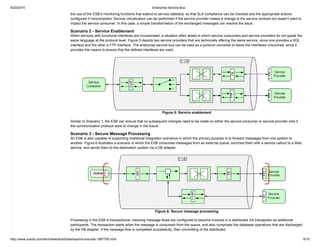
Scenario 2 ­ Service Enablement
When services with functional interfaces are incorporated, a situation often arises in which service consumers and service providers do not speak the
same language at the protocol level. Figure 5 depicts two service providers that are technically offering the same service, since one provides a SQL
interface and the other a FTP interface. The enterprise service bus can be used as a protocol converter to leave the interfaces untouched, since it
provides the means to ensure that the defined interfaces are used.
Figure 5: Service enablement
Similar to Scenario 1, the ESB can ensure that no subsequent changes need to be made on either the service consumer or service provider side if
the communication protocol were to change in the future.
Scenario 3 ­ Secure Message Processing
An ESB is also capable of supporting traditional integration scenarios in which the primary purpose is to forward messages from one system to
another. Figure 6 illustrates a scenario in which the ESB consumes messages from an external queue, enriches them with a service callout to a Web
service, and sends them to the destination system via a DB adapter.
Figure 6: Secure message processing
Processing in the ESB is transactional, meaning message flows are configured to become involved in a distributed XA transaction as additional
participants. The transaction starts when the message is consumed from the queue, and also comprises the database operations that are discharged
by the DB adapter. If the message flow is completed successfully, then committing of the distributed
9/20/2015 Enterprise Service Bus
http://www.oracle.com/technetwork/articles/soa/ind­soa­esb­1967705.html 9/10
transaction follows.
Scenario 4 ­ Service Versioning
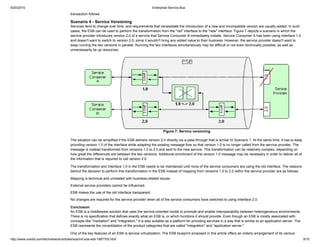
Services tend to change over time, and requirements that necessitate the introduction of a new and incompatible version are usually added. In such
cases, the ESB can be used to perform the transformation from the "old" interface to the "new" interface. Figure 7 depicts a scenario in which the
service provider introduces version 2.0 of a service that Service Consumer B immediately installs. Service Consumer A has been using Interface 1.0
and doesn't want to switch to version 2.0, since it wouldn't bring any added value to their business. However, the service provider doesn't want to
keep running the two versions in parallel. Running the two interfaces simultaneously may be difficult or not even technically possible, as well as
unnecessarily tie up resources.
Figure 7: Service versioning
The situation can be simplified if the ESB delivers version 2.0 directly via a pass­through that is similar to Scenario 1. At the same time, it has to keep
providing version 1.0 of the interface while adapting the existing message flow so that version 1.0 is no longer called from the service provider. The
message is instead transformed from versions 1.0 to 2.0 and sent to the new service. This transformation can be relatively complex, depending on
how great the differences are between the two versions. Additional enrichment of the version 1.0 message may be necessary in order to deliver all of
the information that is required to call version 2.0.
The transformation and Interface 1.0 in the ESB needs to be maintained until none of the service consumers are using the old interface. The reasons
behind the decision to perform this transformation in the ESB instead of mapping from versions 1.0 to 2.0 within the service provider are as follows:
Mapping is technical and unrelated with business­related issues.
External service providers cannot be influenced.
ESB makes the use of the old interface transparent.
No changes are required for the service provider when all of the service consumers have switched to using Interface 2.0.
Conclusion
An ESB is a middleware solution that uses the service­oriented model to promote and enable interoperability between heterogeneous environments.
There is no specification that defines exactly what an ESB is, or which functions it should provide. Even though an ESB is mostly associated with
concepts like "mediation" and "integration," it is also suitable as a platform for providing services in a way that is similar to an application server. The
ESB represents the consolidation of the product categories that are called "integration" and "application server."
One of the key features of an ESB is service virtualization. The ESB blueprint proposed in this article offers an orderly arrangement of its various
9/20/2015 Enterprise Service Bus
http://www.oracle.com/technetwork/articles/soa/ind­soa­esb­1967705.html 10/10
functionalities and forms the basis for evaluating
ESB products.
Takeaways
An enterprise service bus should be considered as an architecture style or pattern and not as
a product.
There is no definition or specification for the ESB and therefore no standard.
An ESB can help achieve looser coupling between systems.
A service on an ESB is stateless. Long­term processes do not belong to an ESB, but are supported in BPM systems in languages like BPEL and
BPMN.
Care should be taken when an ESB is "misused" for batch processing, as performance can be negatively affected.
References
[REF­1] Anne Thomas Manes: "Enterprise Service Bus: A Definition," Burton Group
      E­mail this page      Printer View
ORACLE CLOUD
Learn About Oracle Cloud
Computing
Get a Free Trial
Learn About DaaS
Learn About SaaS
Learn About PaaS
Learn About IaaS
Learn About Private Cloud
Learn About Managed Cloud
JAVA
Learn About Java
Download Java for Consumers
Download Java for Developers
Java Resources for Developers
Java Cloud Service
Java Magazine
CUSTOMERS AND EVENTS
Explore and Read Customer
Stories
All Oracle Events
Oracle OpenWorld
JavaOne
E­MAIL SUBSCRIPTIONS
Subscribe to Oracle
Communications
Subscription Center
COMMUNITIES
Blogs
Discussion Forums
Wikis
Oracle ACEs
User Groups
Social Media Channels
SERVICES AND STORE
Log In to My Oracle Support
Training and Certification
Become a Partner
Find a Partner Solution
Purchase from the Oracle Store
CONTACT AND CHAT
Phone: +1.800.633.0738 
Global Contacts
Oracle Support
Partner Support
 
Subscribe Careers Contact Us Site Maps Legal Notices Terms of Use Privacy  Cookie Preferences Oracle Mobile

Enterprise service bus