Creativity and Innovation
Unit 1
B.B.M. VII Semester.
Concept of Creativity
Creativity is a mental process involving the
generation of new ideas or the concepts, or
new association of the creative mind between
existing ideas or concepts.
Creativity takes place when the person takes a
new solution to a problem that is faced with.
It is a process of imagination on the problems
or facts, and the ability to find new ideas to the
problems which has commercial value.
• Donald F Kuratko- Creativity is the generation
of ideas that result in improved efficiency or
effectiveness of a system.
• Van Grunddy- Creativity is the process for
bringing something new, unusual, or original
into being which may be a product, a method,
a system or an idea.
• Thomas w. Zimmerer and N.M. Scarborough-
Creativity is the ability to develop new ideas
and to discover new ways of looking at
problems and opportunities.
• Thus, creativity is the result of free, unbiased
and unconventional thinking. It is based on
mental vision, imagination and observations.
It does not take anything for granted. It
questions routine ways od doing things. It
generates new ideas from unconscious
segment of the mind. Creativity is some
mysterious and rare talent reserved for a
selected mind. It is a distinctive way of looking
at things illogically.
• Creativity helps not only in doing different
things but also in doing the things differently.
Innovation
• Innovation is doing something differently. It
means something new that has not been done
before. It could be thoughts of as a new idea
for a certain type of product or service leading
to the dynamic growth of business and creation
of profit for the innovative business . It can be
describe as an improvement of an existing idea
which makes the idea profitable.
• Innovation is a ongoing process, ranging from
organizational decision making, generation of
new idea to its implementation phase.
• Innovation is a specific action of entrepreneur, It
is the implementation of the new ideas on a
product , service, process or system to exploit the
opportunity for wealth creation.
• Innovation is a process that entrepreneurs have
the opportunity to make their ideas become
marketable. This means that they have to
contribute to accelerating change. Entrepreneurs
combine creative ideas with market opportunities
and actively pursuing an entrepreneurial
opportunity to reality with the launch of the
business.
• ENTREPRENEURSHIP
• Derived from French word Entreprendre hi h ea s „to
u de take‟.
• Richard Cantillon: Entrepreneurs are non-fixed income earners
who pay known costs of production but earn uncertain incomes.
• Jean-Baptiste Say: An entrepreneur is an economic agent who
unites all means of production- land of one, the labour of another
and the capital of yet another and thus produces a product. By
selling the product in the market he pays rent of land, wages to
labour, interest on capital and what remains is his profit. He shifts
economic resources out of an area of lower and into an area of
higher productivity and greater yield.
• David McClelland: An entrepreneur is a person with a high need for
achievement [N- Ach]. He is energetic and a moderate risk taker.
• Peter Drucker: An entrepreneur searches for change, responds to it
and exploits opportunities. Innovation is a specific tool of an
entrepreneur hence an effective entrepreneur converts a source
into a resource.
• Ronald May: An Entrepreneur is someone who commercializes his
or her innovation.
• CREATIVITY, INNOVATION AND ENTREPRENEURS
• Creativity is thinking new things, and innovation
is doing new things. Creativity is the ability to
develop new ideas and to discover new ways of
looking at problems and opportunities.
• Innovation is the ability to apply creative
solutions to those problems and opportunities in
order to enhance people‟s lives or to enrich
society. Entrepreneurship = creativity +
innovation
• CREATIVITY, INNOVATION AND ENTREPRENEURS
• Creativity is the ability to develop new ideas and to discover new ways of
looking at problems and opportunities.
• Innovation is the ability to apply creative solutions to those problems and
opportunities in order to enhance people‟s lives or to enrich society.
Entrepreneurship is the result of a disciplined, systematic process of
applying creativity and innovation to needs and opportunities in the
marketplace.
• Entrepreneurs are those who marry their creative ideas with the
purposeful action and structure of a business. Researchers believe that
entrepreneurs succeed by thinking and doing new things or old things in
new ways.
• SUMMARY AND CONCLUSION
• The change that entrepreneurs bring about is through creativity and
innovation. Therefore, it is not surprising to see that entrepreneurs are
among the more creative and innovative players of organizational change.
Creativity requires someone (like an entrepreneur) to add value in the
marketplace through the innovation process. From the idea generation to
the successful product development and launch, innovation is the seed-
bed for change. Charged with the coordination of the innovation process
are the entrepreneurs. It is the job of the entrepreneurs to be creative in
identifying the gap in the market and innovate a product to fill this gap.
• Critical thinking
• Critical thinking is self-guided, self-disciplined
thinking which attempts to reason at the highest
level of quality in a fair-minded way. People who
think critically consistently attempt to live
rationally, reasonably, empathically.
• Critical thinking includes the component skills of
analyzing arguments, making inferences using
inductive or deductive reasoning, judging or
evaluating, and making decisions or solving
problems. Background knowledge is a necessary
but not a sufficient condition for enabling critical
thought within a given subject.
• Critical thinking involves both cognitive skills and
dispositions. These dispositions, which can be seen as
attitudes or habits of mind, include open- and fair-
mindedness, inquisitiveness, flexibility, a propensity to
seek reason, a desire to be well informed, and a
respect for and willingness to entertain diverse
viewpoints.
• Empirical research suggests that people begin
developing critical thinking competencies at a very
young age. Although adults often exhibit deficient
reasoning, in theory all people can be taught to think
critically. Instructors are urged to provide explicit
instruction in critical thinking, to teach how to transfer
to new contexts, and to use cooperative or
collaborative learning methods and constructivist
approaches that place students at the center of the
learning process.
• CREATIVE THINKING
• Okpara (2000). It is the art of generating solution to problems by the
force of imagination and reasoning. It is an activity of the mind seeking
to fi d a s e to so e of life’s uestio s.
• In a dynamic and changing world, the challenges of man are also not
static. They take on new forms and require a deep creative thinking
app oa h. It is e essa y to k o that e li e i a thi ke ’s o ld.
• Every idea is a product of thinking and every product is the
a ifestatio of idea aked i a thi ke ’s i d. These a e people ho
see problems as opportunities to improve and do something new or
something better, people who keep these two vital questions on their
i d. “What a I do to ake thi gs ette , o hat a I do to ake
better things? This is the product of thinking. In making things better,
the goals are usually to improve productivity And efficiency, achieve
speed, enhanced comfort and convenience, influence returns
positively, and so much more. While in making better things, thinking
can produce various alternative leading making better things, thinking
can produce various alterative leading to the evolution of a completely
new idea, new production processes, or a total departure from the
conventional.
• Whatever the goal, thinking is an
indispensable tool in the life of all successful
entrepreneurs. The celebrated discoveries of
man are not accidents. The minds of
men/women were engaged in creative
thinking to deliver the visible products we
enjoy today. Name them: Bill Gate and the
computer, Graham Bell and the telephone,
Michael Faraday and electricity, Isaac Newton
and physical law of science, the Wight
brothers and Aeroplane
CRITICAL THINKING CREATIVE THINKING
Critical thinking is convergent,
Critical thinking seeks to assess
worth or validity in something
that exists
Critical thinking is carried on by
applying accepted principles.
Critical thinking is generative in
purpose
Critical thinking is selective,
Creative thinking is divergent
Creative thinking tries to create
something new
Creative thinking is carried on by
violating accepted principles,
Critical thinking is analytical in
purpose.
Creative thinking is not selective
End of unit 1
Creativity and Innovations
Creativity Unit 2
VII Semester B.B.M.
Role of Creativity
• 1. Employed knowledge skills of entrepreneur
• 2. Encourage innovative ways of thinking
• 3. Generating excellent new ideas
• 4. Solving problems
• 5, Diversification of business
• 6. Product planning and development
• 7. Development of marketing information system
• 8. Synergetic combination of resources and
innovative idea
• 9. Motivation
Components of Creativity
• Expertise – a well-developed base of knowledge
(mental building blocks) – gives you more to work with.
• Imaginative Thinking Skills – Allows you to see
things in new ways, recognize patterns and make
connections – explore in a new way.
• A Venturesome Personality – a risk taker that
looks for new experiences and is willing to overcome
obstacles
• Intrinsic Motivation – driven by more than external
pressures – likes the challenge and satisfaction of
difficult work and finding new ways to solve problems.
• A Creative Environment – Ability to work with
others and an environment that sparks support and
creative ideas.
Creativity Techniques
• Problem Reversal
• Looking at the problem or issue from a
different perspective, you know what your
desire outcome is. so you formulate your idea
and your solutions working from the opposite.
For example Charles Thompson explored
usto er ser i e a d said If you are deali g
with customer service issues, list all the ways
you ould ake usto er ser i e ad he
suggest that your idea’s ill the i pro e
your service.
• Forced Analogy
• This technique takes a fixed element such as the product or
some idea related to the product and forces it and compares
it to the attributes of another unrelated object or element. It
is also called forced relationship meaning the action of making
an association between two unlike things in order to obtain
new insights. There are five steps on processes for forced
analogy:
– Isolate and list the elements of the problem.
– Find and establish possible relationships or connection
between the elements.
– Record the relationships in an orderly form.
– Analyze the resulting relationships to find new ideas or
patterns.
– Develop new ideas from this pattern.
Mind Mapping
• Mind mapping technique was developed and
made famous by Tony Buzan.
• A mind map is a diagram used to represent
words, ideas, tasks, or other items linked to
and arranged around a central key word or
idea.
• Mind maps are used to generate, visualize,
structure, and classify ideas, and as an aid to
studying and organizing information, solving
problems, making decisions, and writing.
• Brainstorming
• It is a group creativity technique by which
efforts are made to find a conclusion for a
specific problem by gathering a list of ideas
spontaneously contributed by its members.
The term was popularized by Alex Faickney
Osborn in the 1953 book Applied Imagination.
• Peters, Hisrich and Shepherd (2008) suggest that
when using brainstorming, 4 rules must be adhered
to:
– No criticism is allowed by anyone in the group
especially negative comments.
– Freewheeling is encouraged because as the idea is
wilder, it becomes better.
– Quantity of ideas is desired. The greater the
number of ideas, the greater the likelihood of the
emergence of the useful ideas.
– Combinations and improvements of ideas are
encouraged because ideas of others can be used
to produce other new ideas.
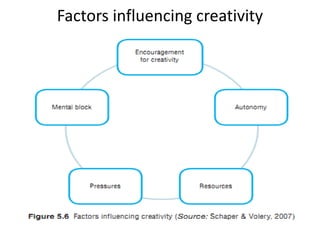
Factors influencing creativity
• Encouragement for creativity (Amabile et al 1996)
• Organizational encouragement- Encouraging of risk taking and idea
generation at all levels Fair supportive evaluation of new ideas,
Reward and recognition of creativity, collaborative idea flow and
participatory decision making
• Supervisory encouragement - Goal clarity and clarity of problem
definition, open interactions, support for team work and ideas,
• Work group encouragement Diversity of team members
background, mutual openness to ideas, constructive challenging of
ideas, shared commitment
• Autonomy - Autonomy in day to day conduct of work, sense of
ownership and control over work and ideas.
• Resources -Adequacy of allocation indicating importance, time
• Pressures - Excessive work load pressure, challenge due to intrinsic
nature
• Organizational impediments -Internal strife, conservatism, rigid
and formal management structures
• Factors at individual level
• Age – creativity decreases with age unless individual is
intentionally creative
• I tellige e- certain level required for certain
measures of creativity only.
• Perso ality- high valuation of aesthetic qualities in
experiences, interests, attraction to complexity,
independence of judgment, autonomy, intuition , self
confidence, ability to resolve conflicting traits in self and
belief that self is creative
• Dispositio s- high level of intrinsic motivation,
follow intrinsic interests, free from evaluations and
constraints
• Capa ilities -Insight is a result of integration of
previously learned behaviors potential
• Processes influencing creativity
Associative process is involved in divergent thinking and
problem solving
• Cognitive flexibility-process by which obvious patterns of
thinking are discarded and new higher order rules are
adopted
• I tri sic oti atio –process where people feel
motivated by interest, challenge and satisfaction of work itself
• Creative thinking is capacity to put existing ideas in new
combinations and is facilitated by diversity of experience and
learning
• Divergent thinking –process by which one extrapolates
many possible answers to an initial stimulus or target data
• Intuition of flash intelligence- flash of a recognition that
problem is solved
• Flo - when person is fully immersed in what is being
done and has a feeling of energized focus, shows full
involvement and success and excludes other stimuli
Creativity & Innovations
Unit 3
Creative Process
VII Semester B.B.M.
Creativity as a process
• Creativity is the act of turning new and imaginative ideas into
reality. Creativity is characterized by the ability to perceive the
world in new ways, to find hidden patterns, to make
connections between seemingly unrelated phenomena, and to
generate solutions. Creativity involves two processes: thinking,
then producing. If you have ideas ut do t a t o the , ou
are imaginative but not creative.
• Some believe that creativity is something accidentally that
occurs because of a pleasant event and it cannot be formed or
create an idea in mind by different ways and organizational
changes but the one thing that will spark ideas or words in the
mind. Creativity generally has go through different steps to find
a new ideas. It can be capturing information, analyze and
synthesize information to provide a solution to the problem.
Test the solution to observe for its success, if required it may be
refined which means to get the best solution. Finally supply the
creative ideas or thoughts.
Creativity Process
Knowledge Accumulation
• This phase focuses more on the study of the
background for the subject matter which requires
extensive reading, discussion with experts,
practitioners, academicians, researchers in the
field, attending workshops and seminars.
• This exploration exposes and helps entrepreneurs
to have a better understanding on the subject
matter.
Incubation
• In the incubation stage, an individual will immerse
oneself by allowing the subconscious mind to muse or
ponder on the information gathered.
• The individual may not be directly involved in the
creative task. Incubation may be induced by engaging
i rela i g a ti ities su h as pai ti g, editati g or
playing sports or board games.
• The rationale is that new ideas or new insight often
emerge when one is busy doing something unrelated
to the matter
Ideas
According to Davenport and Prusak (2000), ideas are free.
Ideas to innovate can come from various sources as
mentioned by Drucker (1986):
• The unexpected sources—sources of innovation might
be derived from unexpected success, unexpected
failure or unexpected events which trigger ideas and
creativity in firms.
• The incongruity—the uneasiness of customers in
dealing with their daily lives could give firms ideas to
create something new for the customers. For example,
paying bills on the Internet.
• Process need—opportunity is the source of innovation.
Ideas could be derived from the market information.
• Changes in industry or market changes that
caught everyone unawares—the effect of
globalization that has an impact on the industry.
• Demographic changes—population change is one
of the innovation sources in meeting consumers
needs.
• Changes in perception, mood and meaning—
trend and lifestyles are among the sources of
innovation under this source of innovation.
• New , scientific and non-scientific knowledge—
knowledge-based innovation is based on this
source— is unique as the competitors could have
a hard time to imitate the innovation.
Evaluation and Implementation
• In this phase, a person transforms the idea into a
workable solution.
• The process of evaluation and implementation
requires continuous development and
assessment so that a raw idea can be
conceptualized, modelled, strategized, refined,
reworked, improved, adjusted to make it
practical, affordable, viable and acceptable to the
customers and stake holders.
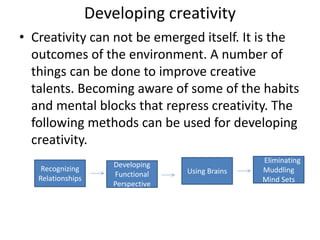
Developing creativity
• Creativity can not be emerged itself. It is the
outcomes of the environment. A number of
things can be done to improve creative
talents. Becoming aware of some of the habits
and mental blocks that repress creativity. The
following methods can be used for developing
creativity.
Recognizing
Relationships
Developing
Functional
Perspective
Using Brains
Eliminating
Muddling
Mind Sets
• 1. Recognizing Relationships
• Creative people see new and different
relationships among objects, process,
materials, technologies and people. To
improve the creativity, it helps to look for
different or unorthodox relationships among
the elements and people. Creative people
have develop a talent for recognizing a new
and different relationship. These relationships
often lead to visions that results in new ideas,
products and services.
• Developing Functional Perspective
• The principle of perceiving helps to develop a
functional perspective towards things and
people. A creative person tends to view things
and people in terms of how they can be used
to satisfy need and to help complete a
peoject. For example the home maker who
can not find a screw driver often will use a
butter knife to tighten a loose screw, or the
cereal manufacturer will add fruit to his
product to create a new product line that
appeals to a health-conscious market.
• 3. Using Brains
• Creativity development requires the use of
brains. Ever since, split brain studies were
conducted in the 1950s and 1960s, experts on
creativity, innovations, and self development
have emphasised the importance of developing
the skills associated with both hemispheres of
the brain.
• Right brain hemisphere understands an
analogies, imagines things and synthesizes
information's .
• Left brain hemisphere helps the person to
analyze, verbalized and used rational approaches
to problem solving.
• 4. Eliminating Muddling Mind sets
• A number of mental habits block or impede
creative thinking. It has been estimated that
adults use only 2 to 10 % of their creative
potential. Some common mental habits that
obstruct creativity and innovation are
either/or thi ki g, se urit hu ti g,
stereotyping, and probability thinking. These
habits tend to muddle creative thought
processes and different thought process must
be used to enhance creative thinking.
• either/or thinking A false dilemma (also
called false dichotomy, false binary, black-and-
white thinking
• security hunting, to make right decision
minimizing the risks on innovations
• stereotyping, can limit a persons perception
of real entities
• probability thinking. Theory to make decision
may distort reality .
Creative Climate
• Creative climate can be seen as various aspects of the
psychological atmosphere in a team and the surrounding
organizational environment. The creative climate often conveys
expectations about which behaviors and attitudes that are
acceptable.
• Ekvall (1996) who regard creative climate as an attribute of the
organizations, a conglomerate of attitudes, feelings, and
behavior which characterizes life in organizations, and exists
independently of the perceptions and understandings of the
members of the organization.
• It is conceived as an organizational reality in an 'objectivistic'
sense and therefore is not identical to organizational culture
(Ismail, et al. 2003).
• The creative climate encourages people to generate new ideas
and helps the organization to grow and increase its efficiency
and at the same time it enables members to generate and
implement creative ideas more effectively.
Creative Climate
• Characteristics of a creative climate:
– A trustful management that does not over control the personnel
– Open channels of communication among all business members
– Considerable contact and communication with outsiders
– A large variety of personality types
– A willingness to accept change
– An enjoyment in experimenting with new ideas
– Little fear of negative consequences for making a mistake
– The selection and promotion of employees on the basis of merit
– The use of techniques that encourage ideas, including suggestion
systems and brainstorming
– Sufficient financial, managerial, human, and time resources for
accomplishing goals
Swedish researcher Göran Ekvall developinitally identified10
Climate Dimensions, later on that affected creativity in
organizations..
Later on The Situational Outlook Questionnaire(SOQ) was used to
assess the creative climate. The SOQ is one of the few climate
assessments that has been extensively researched and therefore,
has ample evidence of reliability, validity and utility. The extensive
research (Isaksen, Lauer, Ekvall & Britz, 2001; Isaksen & Lauer, 2002;
Isaksen & Ekvall, 2010). The SOQ measures nine key dimensions of
the climate for change, innovation and creativity (eight positively
correlated, and one negatively correlated).
Challenge/Involv
ement
The degree to which people are involved in daily operations,
long term goals, and visions. High Challenge/Involvement
implies better levels of engagement, commitment, and
motivation.
Freedom
The degree of independence shown by the people in the
organization. High levels of Freedom imply more perceived
autonomy and ability for individual discretion.
Trust/Openness
The emotional safety in relationships. In high Trust/Openness
situations people feel more comfortable sharing ideas and
being frank and honest with each other.
Idea-Time
The amount of time people can, and do, use for elaborating
new ideas. When Idea-Time is high people can explore and
develop new ideas that may not have been included in the
original task.
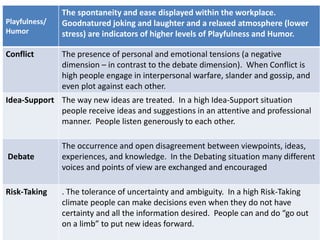
Playfulness/
Humor
The spontaneity and ease displayed within the workplace.
Goodnatured joking and laughter and a relaxed atmosphere (lower
stress) are indicators of higher levels of Playfulness and Humor.
Conflict The presence of personal and emotional tensions (a negative
dimension – in contrast to the debate dimension). When Conflict is
high people engage in interpersonal warfare, slander and gossip, and
even plot against each other.
Idea-Support The way new ideas are treated. In a high Idea-Support situation
people receive ideas and suggestions in an attentive and professional
manner. People listen generously to each other.
Debate
The occurrence and open disagreement between viewpoints, ideas,
experiences, and knowledge. In the Debating situation many different
voices and points of view are exchanged and encouraged
Risk-Taking . The tolerance of uncertainty and ambiguity. In a high Risk-Taking
climate people can make decisions even when they do not have
ertai t a d all the i for atio desired. People a a d do go out
o a li to put e ideas for ard.
Thank you
End of Unit 3
Creativity and Innovation
Innovation Unit 4
B.B.M. VII Semester
Innovation
• Innovation:
– Is the process by which entrepreneurs convert
opportunities into marketable ideas.
– Is a combination of the vision to create a good
idea and the perseverance and dedication to
remain with the concept through implementation.
– Is a key function in the entrepreneurial process.
– Is the specific function of entrepreneurship.
Innovations and related terms
• "Invention is the "creation of a product or introduction of a process
for the first time." Thomas Edison was an inventor.
• Innovation happens when someone "improves on or makes a
significant contribution" to something that has already been
invented. Steve Jobs was an innovator.
• Although invention and innovation both refer to the introduction of
something new, there is a difference between them in the fields of
technology and business. An invention is a novel product, device,
process, or concept. Although innovation is also defined as a new
product, concept or process, in the vocabulary of business and
technology, it is defined as the introduction of newer and better
solutions that meet new requirements or existing market needs.
Therefore, the main difference between invention and innovation is
that invention involves creating something entirely new whereas
innovation involves improving an existing product or concept.
• Growth
• Growth refers to a positive change in size, and/or
maturation, often over a period of time. Growth
can occur as a stage of maturation or a process
toward fullness or fulfillment.
• Creativity is the act of turning new and imaginative
ideas into reality. Creativity is characterized by the
ability to perceive the world in new ways, to find
hidden patterns, to make connections between
seemingly unrelated phenomena, and to generate
solutions. Creativity involves two processes:
thinking, then producing. If you have ideas but
do ’t a t o the , you are i agi ative ut ot
creative.
• Design is the creation of a plan or convention
for the construction of an object, system or
measurable human interaction (as in
architectural blueprints, engineering drawings,
business processes, circuit diagrams, and
sewing patterns).
• Exploitation-The action or fact of treating
someone unfairly in order to benefit from
their work: 'the exploitation of migrant
workers' ... 'Many are drawing the conclusion
that the oppression and exploitation they face
are a result of the system itself.'
• Change
• It is alter, vary, modify mean to make or become
different. change implies making either an essential
difference often amounting to a loss of original
identity or a substitution of one thing for another,
failure.
• Entrepreneurship is the willingness to take risks
and develop, organize and manage a business
venture in a competitive global marketplace that is
constantly evolving.
• The capacity and willingness to develop, organize
and manage a business venture along with any of
its risks in order to make a profit. The most obvious
example of entrepreneurship is the starting of new
businesses.
• Customers
• A customer is an individual or business that
purchases the goods or services produced by a
business. A party that receives or consumes
products (goods or services) and has the
ability to choose between different products
and suppliers.
• Knowledge and society
• The social theory of a knowledge society explains
how knowledge is fundamental to the politics,
economics, and culture of modern society. Associated
ideas include the knowledge economy created by
economists and the learning society created by
educators. Knowledge is a commodity to be traded
for economic prosperity
• A new society formed as a result of the
contemporary societal change pushed by
technological innovation and institutional
transformation, which is not only about technological
innovations, but also about human beings, their
personal growth and their individual creativity,
experience and participation in the generation
Drivers of Innovation
• Emerging Technologies
• The technologies that are perceived as capable of changing
the status quo. Emerging technologies are characterized by
radical novelty, relatively fast growth, coherence,
prominent impact, and uncertainty and ambiguity. In other
words, an emerging technology can be defined as "a
radically novel and relatively fast growing technology
characterized by a certain degree of coherence persisting
over time and with the potential to exert a considerable
impact on the socio-economic domain.
• It is also an important aspect as it shapes the business
operations in the long run business. Technology includes
inventions, discoveries and new and better techniques of
converting the resources in to final product. Technology
helps in performing the operations in much better and
cheaper way. The customer expects higher specifications,
so it can maintain only new technologies.
• Competitor Actions
• Globalization has increased the competition,
and introduce new ideas, technologies,
innovations, techniques etc... are the main
parts of business competition. New
competitors make more trebles for other
companies, because they introduce new
technology, ideas, innovations and customer
satisfied goods and services with reasonable
price. The existing companies also introduce
new technologies to maintained their
competitive strength in the market.
• New ideas from customers
• Customer are the focal point of the business. The
customer feedback about the product or service
is a major tools for creating new ideas on product
or services. Every company introduce new
products, with new technology, attractive
packing, adopting attractive schemes, offers etc...
Day to day every customers looking for a new
technology and high quality products, so the
company update there thinking, technology,
otherwise they cannot competent with others.
• Strategic partners and employees,
• strategic partners are those with whom the company
establish a commercial relationship, usually formalized by one
or more business contracts. Due to the strategic relationship
with the co-partners the company may have to introduce
innovations in technologies. Some times the high skill
employees are also source of creativity and innovations in
organizations.
• The level of confidence and strength of the employees will
boost up moral of employees and are more committed
person or group is very important of a company. The
employee has no morale or they are not committed their job,
the company going in down words. The employees are
satisfied with their both company and job, which will make a
positive energy
•
Emerging changes in the environment
The business environment in which firms operate lies outside themselves. It
is their external environment, which is always changing. The change in
outside environment had direct impact on the process of creativity and
innovations of the organization. Some changes are so dramatic that
everybody notices them, but others may not be due to ignorance. Changes
are in many forms and create new challenges. For an industry as a whole, it
may well be that:
• Customers' needs and requirements change. They look for new, better and
cheaper products.
• New technologies become established. These encourage new firms to
enter the industry with better products and cheaper ways of doing things.
• Employees' skills need revising to take advantage of new technologies.
• New laws are passed that require changes in how businesses operate eg
minimum wage, restrictions in working hours and tougher health and
safety requirements.
• Pressure groups start to take a greater interest in the industry's activities.
• For individual firms within an industry, the external business environment
also includes their competitors, who may: introduce new, superior
methods of production, change the ways in which they compete for
business, their target markets, find new ways of attracting key employees.
Creativity and Innovation
Types, Sources and Principles of
Innovation
Unit 5
B.B.M. VII Semester
Types of innovation
• Sources of innovation –
• Source 1: The Unexpected occurrence
• A success, failure or event that is unplanned for is a
clue that the world is changing and that an opportunity
is available. These tend to pop up around what
everybody knows about a particular product, industry
o se i e. It’s ot e essa y to o pletely u de sta d
why the world is changing, just that it is and how it can
be exploited.
• Example: You carefully tailor a product towards a
particular market segment. Despite the careful
planning, it fails. The failure may belie that the market
is changing beneath you — and your failure may tip
you off to this change before your competitors realize
it.
• Source 2: Incongruity
• The gap et ee hat ought to e a d hat
a tually is is a i itatio to i o ate. Su h
opportunities are usually qualitative rather than
ua titati e, so they do ’t sho up i the u e s.
Incongruities are usually visible to people within an
industry, but they have learned to live with them and
so ignore them.
• Example: Drucker uses the example of shipping before
the roll-on, roll-off ship and the container ship. The
assumed problem was that shipping was slow and
inefficient, so people made faster and more efficient
ships. This made the real problem (congestion at
docks) even worse. There was a gap between reality
a d people’s assu ptio s a out eality.
• Source 3: The process needs
• This is the opportunity that perfects a process
which already exists, replaces a link which is
weak or redesigns an old process around
newly available knowledge. Occasionally it
makes a process possible via a missing link.
• Example: Dropbox.com. Everything about the
process of creating an electronic document is
precise except sharing it. You spend all that
time editing it, cleaning it and spell checking
it, only to not have the most recent version.
Dropbox.com (and other competitors)
expedites this process.
• Source 4: Changing industry and market structures.
• The status uo ithi a i dust y see s
permanent but is actually quite brittle. These
opportunities are valuable because they are visible to
people outside of a particular industry and because
they force everyone within the industry to redefine
their business or perish.
• Example: Drucker uses the example of the auto
industry transitioning from a luxury industry to a
mass market. Different participants in the market
reacted differently, but the ones that survived acted.
For instance, Rolls Royce actually made cars that
were more difficult to use and expensive; aiming to
hold the luxury market rather than compete in the
mass market.
• Source 5: Demographic change
• The magic here is pairing the knowledge of
demographic with an understanding of what they
mean. This requires getting out and talking to the
people that are a part of the market being
affected by demographic change.
• Example: Drucker uses the example of the baby
boom and Melville shoes. Melville realized that
baby boomers were about to become teenagers
and so made shoes that reflected the values of
teenagers (fashionable and relatively inexpensive
but not high quality). By the time its competitors
began copying it, its target market was entering
adulthood, so it switched again.
• Source 6: Changes in perception.
• Whether or not one sees the glass as half full or
half empty is extremely important in
determining what one wants.
• Example: Drucker uses the example of food.
Once upon a time, he says, the wealthy dined
while the working fed. Now everyone dines and
feeds on different days of the week. People
view food as both an art and as a necessity,
explaining the popularity of gourmet cooking
shows with people who eat microwave dinners.
• Source 7: Knowledge based innovation
• This is the superstar of innovation (what most of
us picture when we think of the word) and in
D u ke ’s view the riskiest. In essence it is
creating new knowledge by applying two
separate forms of knowledge.
• Example: Google and the search engine. The
knowledge (PageRank) based on citation theory
was applied to the Internet and then used to
create a product, a search engine that functioned
more effectively than the search engines that
existed at the time.
Principles of Innovations
Potential entrepreneurs need to realize that
innovation principles exists. These principles can be
learned and- when combined with opportunity- can
enable individuals to innovate. The major
motivation principles areas follows.
• Be action oriented- Innovators always must be
active and searching for new ideas, opportunities,
or sources of innovations.
• Make the product, process or service simple or
understandable- People must readily understand
how the innovation works.
• Make the product, process or service customer
based- Innovators always must keep the customer
in mind. The more and innovator has the end user
in mind, the greater the chance the concept will
be accepted and used.
• Start small – Innovators should not attempt a
project or development on a magnificent scale.
They should begin small and then build and
develop , allowing for planned growth and proper
expansion in the right manner and at the right
time.
• Aim high- Innovators should aim high for success
by seeking niche in the market place.
• Try/ Test/Revise- Innovators always follow the
rule of try, test and revise. This helps work out
any flaws in the products, process or service.
• Learn from failures- Innovation does not
guarantee success. More important failures
often give rise to innovations.
• Follow a milestone schedule – Every innovator
should fallow a schedule that indicates milestone
accomplishments. Although the project may run
ahead or behind schedule, it still is important to
have a schedule in order to plan and evaluate the
project.
• Reward heroic activity- This principle applies more
to those involved in seeking and motivating other to
innovate. Innovative activity should be rewarded
and given the proper amount of respect. This also
means tolerating and , to a limited degree,
accepting failures as a means of accomplish
innovation. Innovative work must be viewed as a
heroic activity that will reveal new horizons for the
enterprise.
• Work, work, work- This is a simple but accurate
exhortation with which to conclude the innovation
principles. It takes work- not genius or mystery- to
innovate successfully.
• .
Creativity and Innovations
Product Innovation-Unit 6
VII Semester B.B.M.
Concept and nature of Product Innovation
• The introduction of a new product, or a significant
qualitative change in an existing product is said to be
product innovation.
• Product innovations may be tangible manufactured goods,
intangible services, or a combination of the two. Examples
of recent tangible product innovations that have had a
very significant impact on the way people live and work
are personal computers, mobile phones, and microwave
ovens. Intangible products that complement these types
of physical equipment include the various pieces of
computer software needed to control flows of information
through these devices, leading to the delivery of
information, the supply of communication services, or the
arrival of a correctly heated dinner.
• Established organizations typically have a portfolio of
products that must be incrementally improved or
adjust as problems are identified in service or as new
requirements emerge. It is important that they also
work on additions to the product families. One of the
main activities of the product design team is the work
it performs on next generation products or new
models of products. They may also work on design on
radical new products or new core products that
expand the portfolio significantly and often involved
radically new process to create them. These new
core products ideally offer the organization the
possibility of major increase in revenue and growth,
which can also create the potential of a temporary
monopoly in the market. The product development
process for organizations(Cooper,200).
• Product innovation is about making beneficial
change to physical products. Related terms that
are often used interchangeably include
products design, research and development,
and new product development(NPD). Each of
these terms offers a particular perspective on
the degree of changes to products. The degree
of change can include the following
(wheelwright& Clark, 1992).
• Incremental improvements
• Additions to product families
• Next generation products
• New core products.
• 1. Ideation
• 2. Preliminary investigation
• 3. Derailed investigation
• 4. Development
• 5. Testing and validation
• 6. Market launch and full production.
• Each of these steps involves interaction with
customers, who may participate in idea
generation and feature recognition. Key
performance criteria in the design process
revolve around the following
• Time to market
• Product cost
• Customer benefit delivery
• Development costs.
• These criteria can be traded off against one
another. For example, development costs can be
traded against time to market, customer benefit
can be traded against product costs, and so on.
Design methods for product innovation
• Three design methods have been established
themselves as providing a management
system for effective product innovation: phase
review, stage gate and product and cycle time
excellence(PACE).
• PHASE REVIEW
• This method divides the product development life cycle
into a series of distinct phases. Each phase comprise a
body of work that, once completed and reviewed, is
handed over to next phase. No attention is paid to what
may or may not happen in the subsequent phases, mainly
because of a lack of expertise or exclusive focus on the
tasks in the current phase. The phase review method is a
sequential rather than concurrent product design process;
that is, each phase is executed and completed before the
next phase can begin. Phases typically are carried different
functions or departments within the organization. All tasks,
decisions, and tradeoff are made slowly in the context of
the phase being executed. A significant criticism of this
approach is the poor coordination between phases, which
can result in significant delays and rework.
• STAGE GATE
• The stage gate method is concurrent product
design process that follow a predetermined life
cycle from concept generation to market launch.
The stages is this method are primarily cross
functional. Stage gates appear at the end of each
stage, where a design review take place. Each
stage gate reviews the agreed deliverables for
completion at the end of the stage, a checklist of
the criteria agreed for each stage and a decision
about how to proceed from a particular stage.
This method identifies a number of roles for
people involved in the process, including
gatekeeper, who are typically senior managers.
• PACE
• The pace method is concerned primarily with developing
product development strategies. The method links product
strategy with the overall strategy and the vision of the
organization. A key feature is deploying the voice of the
customer throughout the product design process. Strategies are
divided into six product strategies thrusts : expansion,
innovation , strategic balance, platform strategy, product line
strategy, and competitive strategy.
• Product innovation methods and process are one element in an
organizations mission to create value for customer. Too often
functional groups within organization have focused exclusively
on the NPD process in their department as an end in itself rather
than taking a broader business perspective.
• To interact with different function management designs teams
in a more holistic perspective in the design process. This broad
perspective can encourage design teams to engage in new core
product development , that is to develop products that are
radically different from what already exists in the organization.
Creativity and Innovations
Process Innovation-Unit 7
VII Semester B.B.M.
Concept and nature of Process Innovation
• Process innovation can be viewed as the
introduction of a new or significantly improved
method for the production or delivery of output that
adds value to the organization. The term process
refers to an interrelated set of activities designed to
transform inputs into a specified out put for the
customer. It implies a strong emphasis of how work
is done within an organizations rather than what an
organization does. Process relate to all operation
activities by which value is offered to the end
customer, such as the acquisition of raw materials,
manufacturing, logistics, and after sales service.
• In the 1970s and 1980s process innovation gave
Japanese industries a competitive advantage that
allowed them to dominate some global markets
with cars and electronic goods. Similarly , process
innovation has allowed organizations such as Dell
and Zara to gain competitive advantage by
providing higher quality products, delivered faster
and more efficiently to the market than by the
competition. By concentrating on the means by
which they transform inputs such as raw materials
into output such as products, organizations have
gained efficiencies and have added value to their
outputs. Process innovation allows some
organization to compete by having a more
efficient value chain than their competitions have.
• Organizations can improve their efficiency and value of
their processes with a vast array of different enablers.
Although the use of these enablers is contingent on the
organizational context, many offer the potential for
enhanced process performance.
• The application of technology such as robotics,
enterprise resource planning system, and sensor
technologies can changed the process by reducing the
cost or variation of its output, improving safety, or
reducing the throughput time of the process .
• The application of certain human resources practice can
improve the quality of the process enhance the
motivation, and allow increased complexity through
greater flexibility. Similarly , as the raw material input to
the process is altered, costs can be reduced or
performance parameters improved.
Approaches to process Innovations
• A number of common approaches to process
innovation have emerged through the work of
operation and quality management
movements over the past twenty years.
Although these may not be applicable to all
organizations, they can stimulate the
innovation process. The more common
approaches include just-in- time, total quality
management, lean manufacturing, supply
chain management, and enterprise resource
planning,
• Just-in-time
• This approach originated in Japan and was
originally designed to improve high volume
production by reducing set up times and othe r
forms of inefficiency such as high inventory.
Improvement is achieved through coordination
of the flows of materials through a process
show that the right materials arrives in the
correct location just as it is needed.
• Total quality management
• It seeks to improve the quality of an organizations
output by eliminating defects, that is, by systems
that present defects from occurring in the first
place. Management. It also engage all employees
in the effort towards continuous improvement. It
focus on all aspects of organizational quality
rather than just manufacturing quality and
encompasses the entire organization. The
approaches is characterized by the development
of standards such as ISO 9000 and accreditation
of organization to these standards by
accreditation bodies.
Lean Manufacturing
This approach seeks to reduce all forms of wastage
across the total organizational system in order to
increase value. It identifies seven forms of waste:
transportation, inventory, motion, waiting line ,
over production, unnecessary processing, and
defective products. This approach encourages
organization to identify and remove waste that
reduces value within their processes by using
techniques such as continuous improvement, pool
systems, total quality, flexibility, waste minimization
, and integrated supply chain.
• Supply chain management
• This approach focuses on managing flow of
materials and information across the entire value
chain, from supplier to customer. This encourages
organization to enhance integration with
suppliers and customers and establish longer –
term relations. It also enhances processes by
reducing overall cost and increasing value added
and responsiveness to the end customer.
• Enterprise resource planning
• This approach integrates all information and
processes of an organization into one holistic
system. This usually realize on large software
system that facilitate the identification and
planning of all necessary resources and
activities across the organization in order to
deliver the product or service to the customer.
Such system help identify the bottle necks and
aste ith the o ga izatio ’s p o esses a d
support the work of other approaches such as
supply chain management, just in time , and
lean manufacturing.
Product and Process Innovation
• P odu t a d p o ess i o atio a e o eptually diffe e t
• P odu t i o atio is ased o eeti g usto e s’
preferences by designing a new or considerably improved
product, whereas process innovation is being closer to
operation and supply chain management is built upon
effi ie y a d p odu t’s quality.
• Product i o atio e a les fi s to a hie e o petiti e
ad a tage y diffe e tiati g thei p odu ts o a ge of
products from competition , whereas with process
i o atio , fi s i p o e thei effi ie y.
• Product innovations are market driven, while process
i o atio a e de i ed y effi ie y a d p odu t’s uality
considerations.
• If the competitive environment fosters highly
diffe e tiated products, then product innovation
should e fa o ed. Co e sely, fo fi s i p i e
driven competition environments, the degree of
process innovation is much more relevant than
product innovation.
END OF UNIT 7
1
CREATIVITY AND INNOVATION
Unit 8
Service and Other Innovation
Concept and nature:
Service innovation is about making changes to a
products that cannot be touched or seen.(i.e.
intangible products ). Services are often associated
with work , play & recreation etc.
Examples of this type of Service include banking,
recreation, hospitals, government, entertainment,
retail stores, & education. This Services involve
intangible products, have a high degree of customer
interaction & are usually activated on the demand of
the customer. Others define Service in terms of
performance, where client & provider co-produce
value.
2
Service and Other Innovation
There are 3 types of service operation or innovation:
Quasi-manufacturing:
(eg: warehouse, testing labs, recycling)
Mixed services:
(eg: banks, insurance, retailers)
Pure services:
(eg: hospitals, schools)
Services can clearly involve products that form an
extended part of the product life cycle, from initial
sales to end-of-life recycling & disposal. Service
industries in areas such as finance, food, education,
transportation, health, & government make up most
3
Service and Other Innovation
organization in an economy. These organization also
need to innovate continuously so they can increase
levels of the service to their customers.
A key attribute of a service is very high level of
interaction with the end consumer or customers.
4
Service and Other Innovation
• Incremental and radical innovations :
The definition of innovation does not refer to the
size & scope of the change to the product, process, or
service. For example, introducing color television in
the mid-1960s was clearly a major or radical change
to the established black-&-white TV market.
Innovation can be classified as either
radical innovation or Incremental innovation .
Radical innovation : Radical innovation is about
making major changes in something established. It
focus is significant in relation to this issue. A change
can represent a Radical innovation when viewed at a
technological level, but the impact may be only
5
Service and Other Innovation
Incremental when viewed at an organizational level.
The term Radical often refers to the level of the
contribution made to the efficiency or revenue of the
organization (McLaughlin ,1999).
For example , by introducing the flat screen
television, manufacturers Radically increased the
demand for such products. We can visualize radical
innovations as a step change in some measure of
growth such as revenue or efficiency. Most of the
organization engage in some form of radical
innovation over their life time.
Radical innovation helps to destroy the threaten in
the existing market & create the next great wave .
6
Service and Other Innovation
• Incremental innovations : Incremental innovations
is using fewer resources which consist of smaller
activities, making them easier to mange than their
larger counterparts. Incremental innovations such
as increasing television speaker power or screen
size often lead to small changes in growth.
Although radical innovations often make
headlines, most organizations spread the risk
associated with the innovation by also looking for
small or Incremental innovations to their product,
process, or service. Incremental innovations is less
ambitious in its scope & offers less potential for
returns for the organizations. It is less risk associated
too. 7
Service and Other Innovation
• Other classifications – Disruptive innovation :
• Disruptive innovation often occurs because new
sciences & technology are introduced or applied to
a new market that offers the potential to exceed
the existing limits of technology. Many companies
watch out for outcome of this type of technology, &
from this they choose potential winners that are
quickly adopted for new product & services.
Research laboratories usually are the source
of Disruptive technologies. The main function of the
Disruptive technology is just like any innovation
which can add value for the customers that will
encourage to purchase the products & services over
& over from same organization. 8
Service and Other Innovation
• Other classifications – Disruptive innovation :
There are many examples of Disruptive technology
introduced in recent years, including following:
• Data storage disk
• Digital photography
• Digital media (music & video
• Text messaging & mobile phone
• The internet & world wide web (www)
9
Creativity and Innovation
Financial Support for Innovation
Unit 9
Need for financial support for innovation
Financing is extremely important for innovation and growth, in particular
at the seed and early stages of business development. Access to finance is
a central issue for both innovative entrepreneurs and policy makers.
Entrepreneurial start-ups and small and medium-sized enterprises (SMEs)
face financial constraints largely because of their inherent riskiness and
weaknesses. Evidence shows that innovative SMEs in the euro area
considered access to finance one of their most pressing problems
following the sovereign debt crisis in 2011. ( economic and financial
problems caused by the (perceived) inability of a country to pay its public
debt.
They also suffer from resource constraints, insufficient collateral, and lack
of a track record. The quality of a business plan, in terms of due diligence,
can be a very influential factor in funding decisions.
• Why companies need financing?
• For start-ups or growing companies, as well as those facing a
ajo ha ge, fi a i g is o e of the key usi ess issues. •
New capital is needed e.g. for
• 1. Financing of product development
• 2. Financing of market penetration
• 3. Financing of investments
• . Wo ki g apital fi a i g to se u e ope ati e continuity
• . Mai tai i g li uidity to e a le to o e daily pay e ts
• During their start-up, growth and expansion stages, the
companies are often faced with the fact that the incoming
cash flow is not sufficient for the operations.
• The o pa y's u ulati e ash flo is egati e.
• The ti e eeded fo tu i g the o pa y s ash flo
positive varies considerably
• A long product development stage and slow market
penetration prolong the negative cash flow period.
• The o pa y a ha e a egati e ash flo fo yea s, a
situation that is typical in high- tech branches.
Operative financing
• To bridge the deficit in operative financing, the
company has the following choice of available measures:
• 1. to e su e that the li uidity pla i g has ee
appropriate
• 2. to make the clients pay their invoices on time by
offering, for example, discounts for rapid payments
• 3. to intensify the collection of sales receivables
• . to delay the pay e ts to supplie s ithi thei te s
of payment
• 5. to maximize the sales margins to cut indirect costs
Financing
instrument
Key features in financing Remarks
Bank loan
Used as one of the most common tools for
access to finance, It needs collateral or
guarantees in exchange for loans.
Obligation to repay as debt
Grant, subsidy
Used as seed funding for innovative start-
ups at the seed and early stage: small
business innovation research in the U.S.A,
the U.K. and the Netherlands; feed-in-tariffs
in Denmark and Germany: OSEO funding in
France; Innovation Investment Fund in the
United Kingdom.
Complements market
failures, financing at seed and
initial stage
Business angel
Financing source at early riskier stage and
provides financing, advice and mentoring
on business management. Tends to invest
in the form of groups and networks, e.g.
Tech Coast Angels and Common ANGELS in
the United States, Seraphim Fund in the
United Kingdom.
Financing at start-up and
early stage
Venture
capital
Tends increasingly to invest at later, less risky growth
stage. Referred to as patient capital owing to the
lengthy time span (10-12 years) for investing,
maturing and finally exiting, e.g. Pre-seed Fund
and Innovation Investment Fund in Australia, Yozma
Fund in Israel, Seed Fund Vera in Finland, Scottish Co-
investment Fund in the United Kingdom.
Financing at later
expansion stage
Corporate
venturing
Used by large firms to invest in innovative start-ups
with a view to improving corporate competitiveness
with either strategic or financial objectives.
Strategic motive
Crowd
funding
A collective funding tool via the Internet which makes
it easier for small businesses to raise capital at the seed
and early stages.
Potential for fraud
Tax
incentive
A broad range of tax incentives for R&D and
entrepreneurial investments in most countries,
e.g. Enterprise Investment Scheme in the United
Kingdom, tax relief on the wealth tax (ISF) in France,
Business Expansion Scheme in Ireland.
Indirect, non-
discriminatory
Sources of venture capital
• Venture capital firms( Registered investing
incorporated body) investing in start-up
companies and new businesses
• Private capital investors ( private individuals)
searching for later-stage buyouts
• Angel investors looking for investment
opportunities
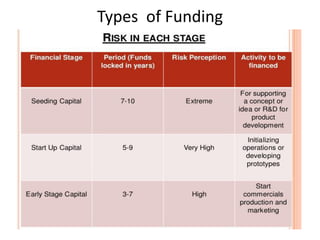
Types of Funding
Venture capital in Nepal
• Venture Capital (VC) can be a feasible option for
collateral free capital. VC basically is a business
financing where investors provide to startups and SMEs
money that have long-term growth potential. Such
money from VC is as equity, not loan.
• In Nepal, the growing number of startup companies in
the recent years has led to the increase in venture
funding activities. Currently, Biruwa Advisors, iCapital,
True North Associates, Business Oxygen, Beed
Management, Dolma Impact Fund, Gazzab Social
Ventures and Udhyami Impact Fund are some
organizations trying to create a space of venture capital
in the country and providing startups with much
needed investments.
• Need of legal framework
Despite the immense investment possibilities, absence of
legal framework is holding back VC initiatives in Nepal. The
legal provisions related to venture capital are mentioned in
article 8 of the Bill to Amend and Integrate Laws Related to
Foreign Direct Investment. According to the provision, the
foreign investors can start venture capital firms in the
ou t y a d i est i Nepali sta tups. “Ho e e , o su h
provision related to VC is mentioned in the Companies Act,
2063," says Abhay Paudel who is a Chartered Accountant
and has been raising VC issues.
• Experts suggest the government and policy makers to first
have clarity on the concept of VC before formulating rules
and regulations. “Autho ities the sel es ha e o p ope
understanding about the VC funding concept. It is very
important to study this subject in order to bring proper
regulations and implement them effectively," stresses
iCapital Managing Director Shrestha.
Angel investment
• An estimated £850 million per annum is invested by angels
annually in the UK, making them a really significant source
of fu di g fo the UK s sta tups.
• An angel investor is someone who puts their own finance
into the growth of a small business at an early stage, also
potentially contributing their advice and business
experience. They might be a wealthy, well-connected
i di idual ho s take a pe so al liki g to othe s p odu t.
A group of angel investors who club together to fund
sta tups, o e e a f ie d o e e of you fa ily ho s
decided to put some money in business.
• Angels make their own decision about the investment, and
in return for providing personal equity they take shares in
the business. The amount they invest is flexible – it could
be a small amount to get you off the ground, or a larger
amount. While they can provide insight and advice about
the business.
Venture capital
• The firms are made of professional investors,
and their money comes from a variety of
sources – corporations and individuals, private
and public pension funds, foundations.
• Those who invest money in venture capital
fu ds a e alled li ited pa t e s ; those
managing the fund and working with
i di idual o pa ies a e alled ge e al
pa t e s , a d these a e the people ho o k
with the startup to ensure that its developing
• The job of venture capital firms is to find businesses
with high growth potential. The firm take shares and
have a say in the future of the company and its
running, and in exchange for their involvement venture
capitalist firms expect a high return on investment.
After a period of time, often years, the venture
capitalists sell shares in the company back to the
owners or through an initial public offering, hopefully
making much more that what they put in.
• Venture capital usually deals with very large amounts
of money – rather than seed funding, it can be multi-
million deals. And while more and more startups are
winning venture capitalism investment, with the sums
involved and the risk of investing in a startup,
businesses a bit further down the line might be more
likely to gain the trust and money of venture capitalists
Difference between Angle investors and
Venture capital
• Angel investors invest their own money in your company
when you are in very early stage. A VC fund, on the other
hand, consists of Limited Partners and General Partners.
General Partners act as fund managers and raise money
from Limited Partners.
• Angel investments usually less than VC. Its investments
generally range from a few hundred thousand dollars to
millions of dollars and more.
• Angel investors invest in early-stage of businesses, while
VC firms generally more unwilling to invest in expansion of
business.
• Angel investors, their motivations is to help less
experienced businesses within their sector, while the VC
firms is to find the best businesses, help them, and then
make a lot of money.
Government support of innovation
• The government support for innovation refers to
the different types of support provided by the
government institutions to foster and accelerate
the growth of agriculture, industrial, and service
sector, thereby helping to increase production,
productivity and value of the product or service
offered in the market for consumption. It also
refers to formulation of policies, provide different
nature of support, regulate and facilitate to
develop manufacturing and service enterprises.
The following are the special support by
government for innovation in different sectors of
econmy.
• Policies and incentives
• A sound and supportive policy environment is
a pre requisite for creating sound innovation
environment in different sectors of economy.
It facilitate, influence and motivate the
investors to make investment in creativity and
innovation inside the organization.
• Early stage research
• One of the best roles for government is to
support basic and early-stage research that
stimulates the creation of new fields and new
knowledge. What many people forget is that
freewheeling Silicon Valley filled with
entrepreneurs was made possible by large
defense funding for research and
development that led to the semiconductor
that led to nearly everything else.
• Promote Free Markets, Tax Incentives and Patent
Protections
• The government can play an important role in several
ways. First, by promoting free markets and free-trade
agreements which encourage more innovation and the
faster adoption of the best ideas. Second, by providing
tax incentives for the longer-term, bigger bets required
for new technologies. By making the R&D tax credit
permanent we could avoid the "on again, off again"
situation that creates uncertainty. And third, by
protecting intellectual property rights with strong
patent, trademark and copyright systems. These
systems provide a reliable safeguard for our
innovations driven by research and development
investments and serve to protect our products and
solutions.
• Establish a Framework and Get Out of the Way
• Innovation is hard enough without having the government
getting directly involved. For example, while companies are
happy to accept research and development tax credits,
Instead, the government should cultivate an economic and
business climate that rewards innovation—such as lower
income-tax rates—and limit the regulatory hurdles that can
impede a new product or process improvement.
• While the patent system is an essential cornerstone of the
business framework, it needs continuous reform to ensure
that its benefits are not outweighed by the incremental
costs of filing, renewing and enforcing patents and that
existing patent portfolios are not minefields that stifle
innovation. In particular, I think we should:
• Review the types of innovation that are patent-worthy
rather than business-as-usual; and
• Even Regulatory Challenges Can Spur
Innovation
• The old saying is that "necessity is the mother
of invention," and to some extent any new
challenges or changes can spur innovation. For
example, the unprecedented level of new
regulations in the financial industry is creating
challenges that will need to be addressed with
innovative solutions. These regulations mean
many companies will need to rethink how
they operate, and that disruption creates
opportunity.
Non-government support of innovation.
• In Nepal different types of non government
organization are active in supporting the Nepalese
society to foster and accelerate the economic
development of Nepal.
• Different types of non government organization such
as INGO, NGO, FNCCI, international donor agencies etc
are active in Nepal. Their main functions is to carry on
the different development oriented activities to
compliments the government policies and programs.
• The following are the special support by non
government organizations for innovation in different
sectors of economy.
• Supporting Innovation through Pilot Projects:
• NGO have the advantage of selecting
particular places for innovative projects and
specify in advance the length of time which
they will be supporting the project .NGOs can
also be pilots for larger government projects
by virtue of their ability to act more quickly
than the government bureaucracy.
• Development and Operation of
Infrastructure:
• FNCCI, NGOs and Community-based
organizations can develop, building material
supply centers and other community-based
economic enterprises. In many cases, they will
cooperate with governmental agencies for
partnership funding and technical assistance
or advice.
• Facilitating Communication:
• NGOs use interpersonal methods of communication,
and study the right entry points whereby they gain the
trust of the people they seek to benefit. They would
also have a good idea of the feasibility of the projects
they take up. The significance of this role to the
government is that NGOs can communicate to the
policy-making levels of government, information bout
the lives, capabilities, attitudes and cultural
characteristics of people at the local level.
• NGOs can facilitate communication upward from
people to the government and downward from the
government to the people.. NGOs are also in a unique
position to share information horizontally, networking
between other organizations doing similar work.
• Technical Assistance and Training:
• Training institutions and NGOs can develop a
technical assistance and training capacity and
use this to assist the young entrepreneur for
innovation and creativity in their organization.
• Research, Monitoring and Evaluation:
• Innovative activities need to be carefully
documented and shared - effective
participatory monitoring would permit the
sharing of results with the people themselves
as well as with the project staff.
The End
Good Luck
Today, most managers assume that innovation is supposed to be done constantly, by everyone in the
company, on every area of the company, while using new Web based tools to help it happen. Does this
conventional wisdom really make sense? Or do the experiences of companies reveal something
different?
To find the answers, a team of researchers spent three years studying the process of innovation in 13
global companies: Mars, BP, Sara Lee, IBM, Best Buy, BBC, Whirlpool, BT, Roche Diagnostics, GSK,
Thomson Reuters, UBS, and Royal Bank of Scotland. In "The 5 Myths of Innovation," in the Winter 2011
MIT Sloan Management Review, the team - Julian Birkinshaw, Cyril Bouquet and J-L. Barsoux — reveal
their surprising findings. Birkinshaw is a professor of strategic and international management at London
Business School. Bouquet is a professor of strategy at IMD. Barsoux is a senior research fellow at IMD.
They discovered five persistent "myths" that haunt the innovation efforts of many companies.
Myth #1 is "the eureka moment."
According to this view, companies need to hire a bunch of insightful and contrarian (Through going)
thinkers, and provide them with a fertile environment, and lots of time and space, to come up with
bright ideas.
The reality is different. If you think of innovation as a chain of linked activities - from generating new
ideas through to commercializing them successfully - it is the latter stages of the process where
problems occur.
When managers in 123 companies were asked to evaluate how effective they were at each stage in the
innovation value chain, they indicated that, on average, they were good at generating new ideas, but
their performance dropped for every successive stage of the chain.
The "eureka" myth explains why so many companies are drawn to big brainstorming events, with names
such as ideation workshops and innovation jams. Such events can generate excitement and some useful
ideas. But it's not clear that they are the right way to build company-wide innovation capability.
The first problem is that companies underestimate the amount of work that is needed after the
workshop is completed. IBM's 2006 on-line Innovation Jam required a team of 60 researchers to sort
through the 30,000 posts received over a 72-hour period.
The second problem is that workshops can be dis-empowering if the organization fails to act on the
ideas generated. When people suggest ideas but receive no response, they become resentful and less
likely to contribute in the future.
So what should you do?
First, be very clear what problem you are trying to solve, and put on an ideation workshop only if you
believe that it is a lack of ideas that is holding you back.
Second, if you believe that an ideation workshop is the right approach, be prepared to invest a lot of
time and effort into the follow-up work.
Myth #2 is "build it and they will come."
The growth of on-line communities such as Facebook and LinkedIn can seduce us into assuming that
these new means of social interaction will also transform the way we get things done at work.
But for every on-line community that succeeds, many others fail. Some make a good start but then
enthusiasm wanes. Others fail to live up to their founders' hopes.
All the companies studied had figured out that the tools of Web 2.0 could be valuable in helping large
numbers of people get involved in an innovation process. Most had built on-line forum in which
employees could post their ideas, comment, and build on the ideas of others.
IBM used space on its corporate Intranet to launch the Innovation Jam mentioned earlier. The purpose
was to get employees, clients, and partners involved in an on-line debate about new business
opportunities. The Innovation Jam attracted 57,000 visitors and 30,000 posts. While IBM had success in
attracting interest, the overall story was much more mixed. Some on-line forums helped to galvanize
their company's innovation efforts. Others ended up underused.
What are the problems with developing online innovation forums? The first risk is that the forum
doesn't take off. It's usually quite straightforward to get people to check out a new site once or twice,
but they need a reason to keep coming back.
The second risk is that the ideas that get posted are off-topic, half-baked, or irrelevant. The notion that
the good ideas will be picked up by others and rise to the top rarely works out.
To avoid these problems, understand the types of interaction that occur in on-line forums, so that you
use them in the right way. If you are looking for creative, never-heard before ideas, and if you want
people to take responsibility for building on one another's ideas, then a face-to-face workshop is your
best bet. But if you are looking for a specific answer to a question, or if you want to generate a wide
variety of views about some existing ideas, then an on-line forum can be highly efficient.
Myth #3 is that "open innovation is the future."
"Open" innovation is the idea that companies should look for ways of tapping into and harnessing the
ideas that lie beyond their formal boundaries. Many companies are now embracing open innovation. For
example, the Danish toymaker LEGO has been leveraging customer ideas as a source of innovation for
years, and some new products are even labeled "created by LEGO fans."
The benefits of open innovation, in terms of providing a company with access to a vastly greater pool of
ideas, are obvious.
But the costs are also considerable, including practical challenges in resolving intellectual property
ownership issues, lack of trust on both sides of the fence, and the costs involved in building an open
innovation capability.
Another concern is the time it takes to do open innovation properly. Companies such as Procter &
Gamble, Intel, and LEGO have put an enormous amount of investment into building their own external
networks, and they are beginning to see a return, but you shouldn't underestimate the time and effort
involved.
Myth #4 is that "pay is paramount."
A dominant concern when organizations set out to grow their innovation capabilities is how to structure
rewards for ideas. A common refrain is that innovation involves discretionary effort on top of existing
responsibilities, so companies have to offer incentives so people will put in that extra effort.
While people are motivated by many factors, extrinsic rewards such as money are usually secondary
factors. The more powerful motivators are typically "social" factors, such as the recognition and status
that is conferred on those who do well, and "personal" factors, such as the intrinsic pleasure that some
work affords.
More specifically, there is evidence from psychology research that individuals view the offer of reward
for an enjoyable task as an attempt to control their behavior, which undermines their creative
performance. Parallel research in behavioral economics suggests that intrinsic motivation is especially
likely to suffer when the incentives are large.
All of which suggests that you don't need monetary rewards for innovation. Innovation is intrinsically
enjoyable, and it's easy to recognize and confer status on those who put their discretionary effort into it.
Myth #5 is that "bottom-up innovation is best."
There is a lot of enthusiasm for bottom-up activism or "intrapreneurship." The reasoning is
straightforward: Top executives are not close enough to the action to be able to come up with or
implement new ideas, so they need to push responsibility for innovation down into the organization.
There are plenty of examples of successful innovations that started out as below-the radar initiatives, or
as proposals that got rejected by top executives. Examples include Ericsson's mobile handset business,
Sony's PlayStation, and HP's printer business.
But, at some point, all these innovations were picked up and then prioritized by top management.
Successful innovations, in other words, need both bottom-up and top down effort.
This interplay between direction and empowerment is evident even in a declared bottom-up innovator
like Best Buy. The success of the retailer is strongly tied to the cumulative effect of continuous
experimentation and small bets at the level of individual stores.
Yet top management plays a significant role in channeling the collective creative energy toward desired
areas by framing the innovation challenge in terms of finding new and better ways to service customers
- hence removing the risks of random or ill focused innovation.
Innovation is the lifeblood of any large organization, but there are no quick fixes or one-size-fits-all
solutions. On-line tools, open innovation communities, and big collaborative forums all have their
limitations. None is always right or always wrong.
The best approach involves a deep understanding of the particular challenges a company is facing. By
thinking through the pros and cons of each element, companies can avoid making the wrong decision
based on the myths of innovation, and instead make successful innovation a reality.

Creativity and Innovation Full notes..pdf

  • 1.
    Creativity and Innovation Unit1 B.B.M. VII Semester.
  • 2.
    Concept of Creativity Creativityis a mental process involving the generation of new ideas or the concepts, or new association of the creative mind between existing ideas or concepts. Creativity takes place when the person takes a new solution to a problem that is faced with. It is a process of imagination on the problems or facts, and the ability to find new ideas to the problems which has commercial value.
  • 3.
    • Donald FKuratko- Creativity is the generation of ideas that result in improved efficiency or effectiveness of a system. • Van Grunddy- Creativity is the process for bringing something new, unusual, or original into being which may be a product, a method, a system or an idea. • Thomas w. Zimmerer and N.M. Scarborough- Creativity is the ability to develop new ideas and to discover new ways of looking at problems and opportunities.
  • 4.
    • Thus, creativityis the result of free, unbiased and unconventional thinking. It is based on mental vision, imagination and observations. It does not take anything for granted. It questions routine ways od doing things. It generates new ideas from unconscious segment of the mind. Creativity is some mysterious and rare talent reserved for a selected mind. It is a distinctive way of looking at things illogically. • Creativity helps not only in doing different things but also in doing the things differently.
  • 5.
    Innovation • Innovation isdoing something differently. It means something new that has not been done before. It could be thoughts of as a new idea for a certain type of product or service leading to the dynamic growth of business and creation of profit for the innovative business . It can be describe as an improvement of an existing idea which makes the idea profitable. • Innovation is a ongoing process, ranging from organizational decision making, generation of new idea to its implementation phase.
  • 7.
    • Innovation isa specific action of entrepreneur, It is the implementation of the new ideas on a product , service, process or system to exploit the opportunity for wealth creation. • Innovation is a process that entrepreneurs have the opportunity to make their ideas become marketable. This means that they have to contribute to accelerating change. Entrepreneurs combine creative ideas with market opportunities and actively pursuing an entrepreneurial opportunity to reality with the launch of the business.
  • 8.
    • ENTREPRENEURSHIP • Derivedfrom French word Entreprendre hi h ea s „to u de take‟. • Richard Cantillon: Entrepreneurs are non-fixed income earners who pay known costs of production but earn uncertain incomes. • Jean-Baptiste Say: An entrepreneur is an economic agent who unites all means of production- land of one, the labour of another and the capital of yet another and thus produces a product. By selling the product in the market he pays rent of land, wages to labour, interest on capital and what remains is his profit. He shifts economic resources out of an area of lower and into an area of higher productivity and greater yield. • David McClelland: An entrepreneur is a person with a high need for achievement [N- Ach]. He is energetic and a moderate risk taker. • Peter Drucker: An entrepreneur searches for change, responds to it and exploits opportunities. Innovation is a specific tool of an entrepreneur hence an effective entrepreneur converts a source into a resource. • Ronald May: An Entrepreneur is someone who commercializes his or her innovation.
  • 9.
    • CREATIVITY, INNOVATIONAND ENTREPRENEURS • Creativity is thinking new things, and innovation is doing new things. Creativity is the ability to develop new ideas and to discover new ways of looking at problems and opportunities. • Innovation is the ability to apply creative solutions to those problems and opportunities in order to enhance people‟s lives or to enrich society. Entrepreneurship = creativity + innovation
  • 10.
    • CREATIVITY, INNOVATIONAND ENTREPRENEURS • Creativity is the ability to develop new ideas and to discover new ways of looking at problems and opportunities. • Innovation is the ability to apply creative solutions to those problems and opportunities in order to enhance people‟s lives or to enrich society. Entrepreneurship is the result of a disciplined, systematic process of applying creativity and innovation to needs and opportunities in the marketplace. • Entrepreneurs are those who marry their creative ideas with the purposeful action and structure of a business. Researchers believe that entrepreneurs succeed by thinking and doing new things or old things in new ways. • SUMMARY AND CONCLUSION • The change that entrepreneurs bring about is through creativity and innovation. Therefore, it is not surprising to see that entrepreneurs are among the more creative and innovative players of organizational change. Creativity requires someone (like an entrepreneur) to add value in the marketplace through the innovation process. From the idea generation to the successful product development and launch, innovation is the seed- bed for change. Charged with the coordination of the innovation process are the entrepreneurs. It is the job of the entrepreneurs to be creative in identifying the gap in the market and innovate a product to fill this gap.
  • 11.
    • Critical thinking •Critical thinking is self-guided, self-disciplined thinking which attempts to reason at the highest level of quality in a fair-minded way. People who think critically consistently attempt to live rationally, reasonably, empathically. • Critical thinking includes the component skills of analyzing arguments, making inferences using inductive or deductive reasoning, judging or evaluating, and making decisions or solving problems. Background knowledge is a necessary but not a sufficient condition for enabling critical thought within a given subject.
  • 12.
    • Critical thinkinginvolves both cognitive skills and dispositions. These dispositions, which can be seen as attitudes or habits of mind, include open- and fair- mindedness, inquisitiveness, flexibility, a propensity to seek reason, a desire to be well informed, and a respect for and willingness to entertain diverse viewpoints. • Empirical research suggests that people begin developing critical thinking competencies at a very young age. Although adults often exhibit deficient reasoning, in theory all people can be taught to think critically. Instructors are urged to provide explicit instruction in critical thinking, to teach how to transfer to new contexts, and to use cooperative or collaborative learning methods and constructivist approaches that place students at the center of the learning process.
  • 13.
    • CREATIVE THINKING •Okpara (2000). It is the art of generating solution to problems by the force of imagination and reasoning. It is an activity of the mind seeking to fi d a s e to so e of life’s uestio s. • In a dynamic and changing world, the challenges of man are also not static. They take on new forms and require a deep creative thinking app oa h. It is e essa y to k o that e li e i a thi ke ’s o ld. • Every idea is a product of thinking and every product is the a ifestatio of idea aked i a thi ke ’s i d. These a e people ho see problems as opportunities to improve and do something new or something better, people who keep these two vital questions on their i d. “What a I do to ake thi gs ette , o hat a I do to ake better things? This is the product of thinking. In making things better, the goals are usually to improve productivity And efficiency, achieve speed, enhanced comfort and convenience, influence returns positively, and so much more. While in making better things, thinking can produce various alternative leading making better things, thinking can produce various alterative leading to the evolution of a completely new idea, new production processes, or a total departure from the conventional.
  • 14.
    • Whatever thegoal, thinking is an indispensable tool in the life of all successful entrepreneurs. The celebrated discoveries of man are not accidents. The minds of men/women were engaged in creative thinking to deliver the visible products we enjoy today. Name them: Bill Gate and the computer, Graham Bell and the telephone, Michael Faraday and electricity, Isaac Newton and physical law of science, the Wight brothers and Aeroplane
  • 15.
    CRITICAL THINKING CREATIVETHINKING Critical thinking is convergent, Critical thinking seeks to assess worth or validity in something that exists Critical thinking is carried on by applying accepted principles. Critical thinking is generative in purpose Critical thinking is selective, Creative thinking is divergent Creative thinking tries to create something new Creative thinking is carried on by violating accepted principles, Critical thinking is analytical in purpose. Creative thinking is not selective
  • 16.
  • 17.
    Creativity and Innovations CreativityUnit 2 VII Semester B.B.M.
  • 18.
    Role of Creativity •1. Employed knowledge skills of entrepreneur • 2. Encourage innovative ways of thinking • 3. Generating excellent new ideas • 4. Solving problems • 5, Diversification of business • 6. Product planning and development • 7. Development of marketing information system • 8. Synergetic combination of resources and innovative idea • 9. Motivation
  • 19.
    Components of Creativity •Expertise – a well-developed base of knowledge (mental building blocks) – gives you more to work with. • Imaginative Thinking Skills – Allows you to see things in new ways, recognize patterns and make connections – explore in a new way. • A Venturesome Personality – a risk taker that looks for new experiences and is willing to overcome obstacles • Intrinsic Motivation – driven by more than external pressures – likes the challenge and satisfaction of difficult work and finding new ways to solve problems. • A Creative Environment – Ability to work with others and an environment that sparks support and creative ideas.
  • 20.
    Creativity Techniques • ProblemReversal • Looking at the problem or issue from a different perspective, you know what your desire outcome is. so you formulate your idea and your solutions working from the opposite. For example Charles Thompson explored usto er ser i e a d said If you are deali g with customer service issues, list all the ways you ould ake usto er ser i e ad he suggest that your idea’s ill the i pro e your service.
  • 21.
    • Forced Analogy •This technique takes a fixed element such as the product or some idea related to the product and forces it and compares it to the attributes of another unrelated object or element. It is also called forced relationship meaning the action of making an association between two unlike things in order to obtain new insights. There are five steps on processes for forced analogy: – Isolate and list the elements of the problem. – Find and establish possible relationships or connection between the elements. – Record the relationships in an orderly form. – Analyze the resulting relationships to find new ideas or patterns. – Develop new ideas from this pattern.
  • 22.
    Mind Mapping • Mindmapping technique was developed and made famous by Tony Buzan. • A mind map is a diagram used to represent words, ideas, tasks, or other items linked to and arranged around a central key word or idea. • Mind maps are used to generate, visualize, structure, and classify ideas, and as an aid to studying and organizing information, solving problems, making decisions, and writing.
  • 24.
    • Brainstorming • Itis a group creativity technique by which efforts are made to find a conclusion for a specific problem by gathering a list of ideas spontaneously contributed by its members. The term was popularized by Alex Faickney Osborn in the 1953 book Applied Imagination.
  • 25.
    • Peters, Hisrichand Shepherd (2008) suggest that when using brainstorming, 4 rules must be adhered to: – No criticism is allowed by anyone in the group especially negative comments. – Freewheeling is encouraged because as the idea is wilder, it becomes better. – Quantity of ideas is desired. The greater the number of ideas, the greater the likelihood of the emergence of the useful ideas. – Combinations and improvements of ideas are encouraged because ideas of others can be used to produce other new ideas.
  • 26.
  • 27.
    • Encouragement forcreativity (Amabile et al 1996) • Organizational encouragement- Encouraging of risk taking and idea generation at all levels Fair supportive evaluation of new ideas, Reward and recognition of creativity, collaborative idea flow and participatory decision making • Supervisory encouragement - Goal clarity and clarity of problem definition, open interactions, support for team work and ideas, • Work group encouragement Diversity of team members background, mutual openness to ideas, constructive challenging of ideas, shared commitment • Autonomy - Autonomy in day to day conduct of work, sense of ownership and control over work and ideas. • Resources -Adequacy of allocation indicating importance, time • Pressures - Excessive work load pressure, challenge due to intrinsic nature • Organizational impediments -Internal strife, conservatism, rigid and formal management structures
  • 28.
    • Factors atindividual level • Age – creativity decreases with age unless individual is intentionally creative • I tellige e- certain level required for certain measures of creativity only. • Perso ality- high valuation of aesthetic qualities in experiences, interests, attraction to complexity, independence of judgment, autonomy, intuition , self confidence, ability to resolve conflicting traits in self and belief that self is creative • Dispositio s- high level of intrinsic motivation, follow intrinsic interests, free from evaluations and constraints • Capa ilities -Insight is a result of integration of previously learned behaviors potential
  • 29.
    • Processes influencingcreativity Associative process is involved in divergent thinking and problem solving • Cognitive flexibility-process by which obvious patterns of thinking are discarded and new higher order rules are adopted • I tri sic oti atio –process where people feel motivated by interest, challenge and satisfaction of work itself • Creative thinking is capacity to put existing ideas in new combinations and is facilitated by diversity of experience and learning • Divergent thinking –process by which one extrapolates many possible answers to an initial stimulus or target data • Intuition of flash intelligence- flash of a recognition that problem is solved • Flo - when person is fully immersed in what is being done and has a feeling of energized focus, shows full involvement and success and excludes other stimuli
  • 30.
    Creativity & Innovations Unit3 Creative Process VII Semester B.B.M.
  • 31.
    Creativity as aprocess • Creativity is the act of turning new and imaginative ideas into reality. Creativity is characterized by the ability to perceive the world in new ways, to find hidden patterns, to make connections between seemingly unrelated phenomena, and to generate solutions. Creativity involves two processes: thinking, then producing. If you have ideas ut do t a t o the , ou are imaginative but not creative. • Some believe that creativity is something accidentally that occurs because of a pleasant event and it cannot be formed or create an idea in mind by different ways and organizational changes but the one thing that will spark ideas or words in the mind. Creativity generally has go through different steps to find a new ideas. It can be capturing information, analyze and synthesize information to provide a solution to the problem. Test the solution to observe for its success, if required it may be refined which means to get the best solution. Finally supply the creative ideas or thoughts.
  • 32.
  • 33.
    Knowledge Accumulation • Thisphase focuses more on the study of the background for the subject matter which requires extensive reading, discussion with experts, practitioners, academicians, researchers in the field, attending workshops and seminars. • This exploration exposes and helps entrepreneurs to have a better understanding on the subject matter.
  • 34.
    Incubation • In theincubation stage, an individual will immerse oneself by allowing the subconscious mind to muse or ponder on the information gathered. • The individual may not be directly involved in the creative task. Incubation may be induced by engaging i rela i g a ti ities su h as pai ti g, editati g or playing sports or board games. • The rationale is that new ideas or new insight often emerge when one is busy doing something unrelated to the matter
  • 35.
    Ideas According to Davenportand Prusak (2000), ideas are free. Ideas to innovate can come from various sources as mentioned by Drucker (1986): • The unexpected sources—sources of innovation might be derived from unexpected success, unexpected failure or unexpected events which trigger ideas and creativity in firms. • The incongruity—the uneasiness of customers in dealing with their daily lives could give firms ideas to create something new for the customers. For example, paying bills on the Internet. • Process need—opportunity is the source of innovation. Ideas could be derived from the market information.
  • 36.
    • Changes inindustry or market changes that caught everyone unawares—the effect of globalization that has an impact on the industry. • Demographic changes—population change is one of the innovation sources in meeting consumers needs. • Changes in perception, mood and meaning— trend and lifestyles are among the sources of innovation under this source of innovation. • New , scientific and non-scientific knowledge— knowledge-based innovation is based on this source— is unique as the competitors could have a hard time to imitate the innovation.
  • 37.
    Evaluation and Implementation •In this phase, a person transforms the idea into a workable solution. • The process of evaluation and implementation requires continuous development and assessment so that a raw idea can be conceptualized, modelled, strategized, refined, reworked, improved, adjusted to make it practical, affordable, viable and acceptable to the customers and stake holders.
  • 38.
    Developing creativity • Creativitycan not be emerged itself. It is the outcomes of the environment. A number of things can be done to improve creative talents. Becoming aware of some of the habits and mental blocks that repress creativity. The following methods can be used for developing creativity. Recognizing Relationships Developing Functional Perspective Using Brains Eliminating Muddling Mind Sets
  • 39.
    • 1. RecognizingRelationships • Creative people see new and different relationships among objects, process, materials, technologies and people. To improve the creativity, it helps to look for different or unorthodox relationships among the elements and people. Creative people have develop a talent for recognizing a new and different relationship. These relationships often lead to visions that results in new ideas, products and services.
  • 40.
    • Developing FunctionalPerspective • The principle of perceiving helps to develop a functional perspective towards things and people. A creative person tends to view things and people in terms of how they can be used to satisfy need and to help complete a peoject. For example the home maker who can not find a screw driver often will use a butter knife to tighten a loose screw, or the cereal manufacturer will add fruit to his product to create a new product line that appeals to a health-conscious market.
  • 41.
    • 3. UsingBrains • Creativity development requires the use of brains. Ever since, split brain studies were conducted in the 1950s and 1960s, experts on creativity, innovations, and self development have emphasised the importance of developing the skills associated with both hemispheres of the brain. • Right brain hemisphere understands an analogies, imagines things and synthesizes information's . • Left brain hemisphere helps the person to analyze, verbalized and used rational approaches to problem solving.
  • 42.
    • 4. EliminatingMuddling Mind sets • A number of mental habits block or impede creative thinking. It has been estimated that adults use only 2 to 10 % of their creative potential. Some common mental habits that obstruct creativity and innovation are either/or thi ki g, se urit hu ti g, stereotyping, and probability thinking. These habits tend to muddle creative thought processes and different thought process must be used to enhance creative thinking.
  • 43.
    • either/or thinkingA false dilemma (also called false dichotomy, false binary, black-and- white thinking • security hunting, to make right decision minimizing the risks on innovations • stereotyping, can limit a persons perception of real entities • probability thinking. Theory to make decision may distort reality .
  • 44.
    Creative Climate • Creativeclimate can be seen as various aspects of the psychological atmosphere in a team and the surrounding organizational environment. The creative climate often conveys expectations about which behaviors and attitudes that are acceptable. • Ekvall (1996) who regard creative climate as an attribute of the organizations, a conglomerate of attitudes, feelings, and behavior which characterizes life in organizations, and exists independently of the perceptions and understandings of the members of the organization. • It is conceived as an organizational reality in an 'objectivistic' sense and therefore is not identical to organizational culture (Ismail, et al. 2003). • The creative climate encourages people to generate new ideas and helps the organization to grow and increase its efficiency and at the same time it enables members to generate and implement creative ideas more effectively.
  • 45.
    Creative Climate • Characteristicsof a creative climate: – A trustful management that does not over control the personnel – Open channels of communication among all business members – Considerable contact and communication with outsiders – A large variety of personality types – A willingness to accept change – An enjoyment in experimenting with new ideas – Little fear of negative consequences for making a mistake – The selection and promotion of employees on the basis of merit – The use of techniques that encourage ideas, including suggestion systems and brainstorming – Sufficient financial, managerial, human, and time resources for accomplishing goals
  • 46.
    Swedish researcher GöranEkvall developinitally identified10 Climate Dimensions, later on that affected creativity in organizations.. Later on The Situational Outlook Questionnaire(SOQ) was used to assess the creative climate. The SOQ is one of the few climate assessments that has been extensively researched and therefore, has ample evidence of reliability, validity and utility. The extensive research (Isaksen, Lauer, Ekvall & Britz, 2001; Isaksen & Lauer, 2002; Isaksen & Ekvall, 2010). The SOQ measures nine key dimensions of the climate for change, innovation and creativity (eight positively correlated, and one negatively correlated).
  • 47.
    Challenge/Involv ement The degree towhich people are involved in daily operations, long term goals, and visions. High Challenge/Involvement implies better levels of engagement, commitment, and motivation. Freedom The degree of independence shown by the people in the organization. High levels of Freedom imply more perceived autonomy and ability for individual discretion. Trust/Openness The emotional safety in relationships. In high Trust/Openness situations people feel more comfortable sharing ideas and being frank and honest with each other. Idea-Time The amount of time people can, and do, use for elaborating new ideas. When Idea-Time is high people can explore and develop new ideas that may not have been included in the original task.
  • 48.
    Playfulness/ Humor The spontaneity andease displayed within the workplace. Goodnatured joking and laughter and a relaxed atmosphere (lower stress) are indicators of higher levels of Playfulness and Humor. Conflict The presence of personal and emotional tensions (a negative dimension – in contrast to the debate dimension). When Conflict is high people engage in interpersonal warfare, slander and gossip, and even plot against each other. Idea-Support The way new ideas are treated. In a high Idea-Support situation people receive ideas and suggestions in an attentive and professional manner. People listen generously to each other. Debate The occurrence and open disagreement between viewpoints, ideas, experiences, and knowledge. In the Debating situation many different voices and points of view are exchanged and encouraged Risk-Taking . The tolerance of uncertainty and ambiguity. In a high Risk-Taking climate people can make decisions even when they do not have ertai t a d all the i for atio desired. People a a d do go out o a li to put e ideas for ard.
  • 49.
  • 50.
    Creativity and Innovation InnovationUnit 4 B.B.M. VII Semester
  • 51.
    Innovation • Innovation: – Isthe process by which entrepreneurs convert opportunities into marketable ideas. – Is a combination of the vision to create a good idea and the perseverance and dedication to remain with the concept through implementation. – Is a key function in the entrepreneurial process. – Is the specific function of entrepreneurship.
  • 52.
    Innovations and relatedterms • "Invention is the "creation of a product or introduction of a process for the first time." Thomas Edison was an inventor. • Innovation happens when someone "improves on or makes a significant contribution" to something that has already been invented. Steve Jobs was an innovator. • Although invention and innovation both refer to the introduction of something new, there is a difference between them in the fields of technology and business. An invention is a novel product, device, process, or concept. Although innovation is also defined as a new product, concept or process, in the vocabulary of business and technology, it is defined as the introduction of newer and better solutions that meet new requirements or existing market needs. Therefore, the main difference between invention and innovation is that invention involves creating something entirely new whereas innovation involves improving an existing product or concept.
  • 53.
    • Growth • Growthrefers to a positive change in size, and/or maturation, often over a period of time. Growth can occur as a stage of maturation or a process toward fullness or fulfillment. • Creativity is the act of turning new and imaginative ideas into reality. Creativity is characterized by the ability to perceive the world in new ways, to find hidden patterns, to make connections between seemingly unrelated phenomena, and to generate solutions. Creativity involves two processes: thinking, then producing. If you have ideas but do ’t a t o the , you are i agi ative ut ot creative.
  • 54.
    • Design isthe creation of a plan or convention for the construction of an object, system or measurable human interaction (as in architectural blueprints, engineering drawings, business processes, circuit diagrams, and sewing patterns). • Exploitation-The action or fact of treating someone unfairly in order to benefit from their work: 'the exploitation of migrant workers' ... 'Many are drawing the conclusion that the oppression and exploitation they face are a result of the system itself.'
  • 55.
    • Change • Itis alter, vary, modify mean to make or become different. change implies making either an essential difference often amounting to a loss of original identity or a substitution of one thing for another, failure. • Entrepreneurship is the willingness to take risks and develop, organize and manage a business venture in a competitive global marketplace that is constantly evolving. • The capacity and willingness to develop, organize and manage a business venture along with any of its risks in order to make a profit. The most obvious example of entrepreneurship is the starting of new businesses.
  • 56.
    • Customers • Acustomer is an individual or business that purchases the goods or services produced by a business. A party that receives or consumes products (goods or services) and has the ability to choose between different products and suppliers.
  • 57.
    • Knowledge andsociety • The social theory of a knowledge society explains how knowledge is fundamental to the politics, economics, and culture of modern society. Associated ideas include the knowledge economy created by economists and the learning society created by educators. Knowledge is a commodity to be traded for economic prosperity • A new society formed as a result of the contemporary societal change pushed by technological innovation and institutional transformation, which is not only about technological innovations, but also about human beings, their personal growth and their individual creativity, experience and participation in the generation
  • 58.
    Drivers of Innovation •Emerging Technologies • The technologies that are perceived as capable of changing the status quo. Emerging technologies are characterized by radical novelty, relatively fast growth, coherence, prominent impact, and uncertainty and ambiguity. In other words, an emerging technology can be defined as "a radically novel and relatively fast growing technology characterized by a certain degree of coherence persisting over time and with the potential to exert a considerable impact on the socio-economic domain. • It is also an important aspect as it shapes the business operations in the long run business. Technology includes inventions, discoveries and new and better techniques of converting the resources in to final product. Technology helps in performing the operations in much better and cheaper way. The customer expects higher specifications, so it can maintain only new technologies.
  • 59.
    • Competitor Actions •Globalization has increased the competition, and introduce new ideas, technologies, innovations, techniques etc... are the main parts of business competition. New competitors make more trebles for other companies, because they introduce new technology, ideas, innovations and customer satisfied goods and services with reasonable price. The existing companies also introduce new technologies to maintained their competitive strength in the market.
  • 60.
    • New ideasfrom customers • Customer are the focal point of the business. The customer feedback about the product or service is a major tools for creating new ideas on product or services. Every company introduce new products, with new technology, attractive packing, adopting attractive schemes, offers etc... Day to day every customers looking for a new technology and high quality products, so the company update there thinking, technology, otherwise they cannot competent with others.
  • 61.
    • Strategic partnersand employees, • strategic partners are those with whom the company establish a commercial relationship, usually formalized by one or more business contracts. Due to the strategic relationship with the co-partners the company may have to introduce innovations in technologies. Some times the high skill employees are also source of creativity and innovations in organizations. • The level of confidence and strength of the employees will boost up moral of employees and are more committed person or group is very important of a company. The employee has no morale or they are not committed their job, the company going in down words. The employees are satisfied with their both company and job, which will make a positive energy •
  • 62.
    Emerging changes inthe environment The business environment in which firms operate lies outside themselves. It is their external environment, which is always changing. The change in outside environment had direct impact on the process of creativity and innovations of the organization. Some changes are so dramatic that everybody notices them, but others may not be due to ignorance. Changes are in many forms and create new challenges. For an industry as a whole, it may well be that: • Customers' needs and requirements change. They look for new, better and cheaper products. • New technologies become established. These encourage new firms to enter the industry with better products and cheaper ways of doing things. • Employees' skills need revising to take advantage of new technologies. • New laws are passed that require changes in how businesses operate eg minimum wage, restrictions in working hours and tougher health and safety requirements. • Pressure groups start to take a greater interest in the industry's activities. • For individual firms within an industry, the external business environment also includes their competitors, who may: introduce new, superior methods of production, change the ways in which they compete for business, their target markets, find new ways of attracting key employees.
  • 63.
    Creativity and Innovation Types,Sources and Principles of Innovation Unit 5 B.B.M. VII Semester
  • 64.
  • 66.
    • Sources ofinnovation – • Source 1: The Unexpected occurrence • A success, failure or event that is unplanned for is a clue that the world is changing and that an opportunity is available. These tend to pop up around what everybody knows about a particular product, industry o se i e. It’s ot e essa y to o pletely u de sta d why the world is changing, just that it is and how it can be exploited. • Example: You carefully tailor a product towards a particular market segment. Despite the careful planning, it fails. The failure may belie that the market is changing beneath you — and your failure may tip you off to this change before your competitors realize it.
  • 67.
    • Source 2:Incongruity • The gap et ee hat ought to e a d hat a tually is is a i itatio to i o ate. Su h opportunities are usually qualitative rather than ua titati e, so they do ’t sho up i the u e s. Incongruities are usually visible to people within an industry, but they have learned to live with them and so ignore them. • Example: Drucker uses the example of shipping before the roll-on, roll-off ship and the container ship. The assumed problem was that shipping was slow and inefficient, so people made faster and more efficient ships. This made the real problem (congestion at docks) even worse. There was a gap between reality a d people’s assu ptio s a out eality.
  • 68.
    • Source 3:The process needs • This is the opportunity that perfects a process which already exists, replaces a link which is weak or redesigns an old process around newly available knowledge. Occasionally it makes a process possible via a missing link. • Example: Dropbox.com. Everything about the process of creating an electronic document is precise except sharing it. You spend all that time editing it, cleaning it and spell checking it, only to not have the most recent version. Dropbox.com (and other competitors) expedites this process.
  • 69.
    • Source 4:Changing industry and market structures. • The status uo ithi a i dust y see s permanent but is actually quite brittle. These opportunities are valuable because they are visible to people outside of a particular industry and because they force everyone within the industry to redefine their business or perish. • Example: Drucker uses the example of the auto industry transitioning from a luxury industry to a mass market. Different participants in the market reacted differently, but the ones that survived acted. For instance, Rolls Royce actually made cars that were more difficult to use and expensive; aiming to hold the luxury market rather than compete in the mass market.
  • 70.
    • Source 5:Demographic change • The magic here is pairing the knowledge of demographic with an understanding of what they mean. This requires getting out and talking to the people that are a part of the market being affected by demographic change. • Example: Drucker uses the example of the baby boom and Melville shoes. Melville realized that baby boomers were about to become teenagers and so made shoes that reflected the values of teenagers (fashionable and relatively inexpensive but not high quality). By the time its competitors began copying it, its target market was entering adulthood, so it switched again.
  • 71.
    • Source 6:Changes in perception. • Whether or not one sees the glass as half full or half empty is extremely important in determining what one wants. • Example: Drucker uses the example of food. Once upon a time, he says, the wealthy dined while the working fed. Now everyone dines and feeds on different days of the week. People view food as both an art and as a necessity, explaining the popularity of gourmet cooking shows with people who eat microwave dinners.
  • 72.
    • Source 7:Knowledge based innovation • This is the superstar of innovation (what most of us picture when we think of the word) and in D u ke ’s view the riskiest. In essence it is creating new knowledge by applying two separate forms of knowledge. • Example: Google and the search engine. The knowledge (PageRank) based on citation theory was applied to the Internet and then used to create a product, a search engine that functioned more effectively than the search engines that existed at the time.
  • 73.
    Principles of Innovations Potentialentrepreneurs need to realize that innovation principles exists. These principles can be learned and- when combined with opportunity- can enable individuals to innovate. The major motivation principles areas follows. • Be action oriented- Innovators always must be active and searching for new ideas, opportunities, or sources of innovations. • Make the product, process or service simple or understandable- People must readily understand how the innovation works.
  • 74.
    • Make theproduct, process or service customer based- Innovators always must keep the customer in mind. The more and innovator has the end user in mind, the greater the chance the concept will be accepted and used. • Start small – Innovators should not attempt a project or development on a magnificent scale. They should begin small and then build and develop , allowing for planned growth and proper expansion in the right manner and at the right time. • Aim high- Innovators should aim high for success by seeking niche in the market place.
  • 75.
    • Try/ Test/Revise-Innovators always follow the rule of try, test and revise. This helps work out any flaws in the products, process or service. • Learn from failures- Innovation does not guarantee success. More important failures often give rise to innovations. • Follow a milestone schedule – Every innovator should fallow a schedule that indicates milestone accomplishments. Although the project may run ahead or behind schedule, it still is important to have a schedule in order to plan and evaluate the project.
  • 76.
    • Reward heroicactivity- This principle applies more to those involved in seeking and motivating other to innovate. Innovative activity should be rewarded and given the proper amount of respect. This also means tolerating and , to a limited degree, accepting failures as a means of accomplish innovation. Innovative work must be viewed as a heroic activity that will reveal new horizons for the enterprise. • Work, work, work- This is a simple but accurate exhortation with which to conclude the innovation principles. It takes work- not genius or mystery- to innovate successfully.
  • 77.
  • 78.
    Creativity and Innovations ProductInnovation-Unit 6 VII Semester B.B.M.
  • 79.
    Concept and natureof Product Innovation • The introduction of a new product, or a significant qualitative change in an existing product is said to be product innovation. • Product innovations may be tangible manufactured goods, intangible services, or a combination of the two. Examples of recent tangible product innovations that have had a very significant impact on the way people live and work are personal computers, mobile phones, and microwave ovens. Intangible products that complement these types of physical equipment include the various pieces of computer software needed to control flows of information through these devices, leading to the delivery of information, the supply of communication services, or the arrival of a correctly heated dinner.
  • 80.
    • Established organizationstypically have a portfolio of products that must be incrementally improved or adjust as problems are identified in service or as new requirements emerge. It is important that they also work on additions to the product families. One of the main activities of the product design team is the work it performs on next generation products or new models of products. They may also work on design on radical new products or new core products that expand the portfolio significantly and often involved radically new process to create them. These new core products ideally offer the organization the possibility of major increase in revenue and growth, which can also create the potential of a temporary monopoly in the market. The product development process for organizations(Cooper,200).
  • 81.
    • Product innovationis about making beneficial change to physical products. Related terms that are often used interchangeably include products design, research and development, and new product development(NPD). Each of these terms offers a particular perspective on the degree of changes to products. The degree of change can include the following (wheelwright& Clark, 1992). • Incremental improvements • Additions to product families • Next generation products • New core products.
  • 82.
    • 1. Ideation •2. Preliminary investigation • 3. Derailed investigation • 4. Development • 5. Testing and validation • 6. Market launch and full production. • Each of these steps involves interaction with customers, who may participate in idea generation and feature recognition. Key performance criteria in the design process revolve around the following
  • 83.
    • Time tomarket • Product cost • Customer benefit delivery • Development costs. • These criteria can be traded off against one another. For example, development costs can be traded against time to market, customer benefit can be traded against product costs, and so on.
  • 84.
    Design methods forproduct innovation • Three design methods have been established themselves as providing a management system for effective product innovation: phase review, stage gate and product and cycle time excellence(PACE).
  • 85.
    • PHASE REVIEW •This method divides the product development life cycle into a series of distinct phases. Each phase comprise a body of work that, once completed and reviewed, is handed over to next phase. No attention is paid to what may or may not happen in the subsequent phases, mainly because of a lack of expertise or exclusive focus on the tasks in the current phase. The phase review method is a sequential rather than concurrent product design process; that is, each phase is executed and completed before the next phase can begin. Phases typically are carried different functions or departments within the organization. All tasks, decisions, and tradeoff are made slowly in the context of the phase being executed. A significant criticism of this approach is the poor coordination between phases, which can result in significant delays and rework.
  • 86.
    • STAGE GATE •The stage gate method is concurrent product design process that follow a predetermined life cycle from concept generation to market launch. The stages is this method are primarily cross functional. Stage gates appear at the end of each stage, where a design review take place. Each stage gate reviews the agreed deliverables for completion at the end of the stage, a checklist of the criteria agreed for each stage and a decision about how to proceed from a particular stage. This method identifies a number of roles for people involved in the process, including gatekeeper, who are typically senior managers.
  • 87.
    • PACE • Thepace method is concerned primarily with developing product development strategies. The method links product strategy with the overall strategy and the vision of the organization. A key feature is deploying the voice of the customer throughout the product design process. Strategies are divided into six product strategies thrusts : expansion, innovation , strategic balance, platform strategy, product line strategy, and competitive strategy. • Product innovation methods and process are one element in an organizations mission to create value for customer. Too often functional groups within organization have focused exclusively on the NPD process in their department as an end in itself rather than taking a broader business perspective. • To interact with different function management designs teams in a more holistic perspective in the design process. This broad perspective can encourage design teams to engage in new core product development , that is to develop products that are radically different from what already exists in the organization.
  • 88.
    Creativity and Innovations ProcessInnovation-Unit 7 VII Semester B.B.M.
  • 89.
    Concept and natureof Process Innovation • Process innovation can be viewed as the introduction of a new or significantly improved method for the production or delivery of output that adds value to the organization. The term process refers to an interrelated set of activities designed to transform inputs into a specified out put for the customer. It implies a strong emphasis of how work is done within an organizations rather than what an organization does. Process relate to all operation activities by which value is offered to the end customer, such as the acquisition of raw materials, manufacturing, logistics, and after sales service.
  • 90.
    • In the1970s and 1980s process innovation gave Japanese industries a competitive advantage that allowed them to dominate some global markets with cars and electronic goods. Similarly , process innovation has allowed organizations such as Dell and Zara to gain competitive advantage by providing higher quality products, delivered faster and more efficiently to the market than by the competition. By concentrating on the means by which they transform inputs such as raw materials into output such as products, organizations have gained efficiencies and have added value to their outputs. Process innovation allows some organization to compete by having a more efficient value chain than their competitions have.
  • 91.
    • Organizations canimprove their efficiency and value of their processes with a vast array of different enablers. Although the use of these enablers is contingent on the organizational context, many offer the potential for enhanced process performance. • The application of technology such as robotics, enterprise resource planning system, and sensor technologies can changed the process by reducing the cost or variation of its output, improving safety, or reducing the throughput time of the process . • The application of certain human resources practice can improve the quality of the process enhance the motivation, and allow increased complexity through greater flexibility. Similarly , as the raw material input to the process is altered, costs can be reduced or performance parameters improved.
  • 92.
    Approaches to processInnovations • A number of common approaches to process innovation have emerged through the work of operation and quality management movements over the past twenty years. Although these may not be applicable to all organizations, they can stimulate the innovation process. The more common approaches include just-in- time, total quality management, lean manufacturing, supply chain management, and enterprise resource planning,
  • 93.
    • Just-in-time • Thisapproach originated in Japan and was originally designed to improve high volume production by reducing set up times and othe r forms of inefficiency such as high inventory. Improvement is achieved through coordination of the flows of materials through a process show that the right materials arrives in the correct location just as it is needed.
  • 94.
    • Total qualitymanagement • It seeks to improve the quality of an organizations output by eliminating defects, that is, by systems that present defects from occurring in the first place. Management. It also engage all employees in the effort towards continuous improvement. It focus on all aspects of organizational quality rather than just manufacturing quality and encompasses the entire organization. The approaches is characterized by the development of standards such as ISO 9000 and accreditation of organization to these standards by accreditation bodies.
  • 95.
    Lean Manufacturing This approachseeks to reduce all forms of wastage across the total organizational system in order to increase value. It identifies seven forms of waste: transportation, inventory, motion, waiting line , over production, unnecessary processing, and defective products. This approach encourages organization to identify and remove waste that reduces value within their processes by using techniques such as continuous improvement, pool systems, total quality, flexibility, waste minimization , and integrated supply chain.
  • 96.
    • Supply chainmanagement • This approach focuses on managing flow of materials and information across the entire value chain, from supplier to customer. This encourages organization to enhance integration with suppliers and customers and establish longer – term relations. It also enhances processes by reducing overall cost and increasing value added and responsiveness to the end customer.
  • 97.
    • Enterprise resourceplanning • This approach integrates all information and processes of an organization into one holistic system. This usually realize on large software system that facilitate the identification and planning of all necessary resources and activities across the organization in order to deliver the product or service to the customer. Such system help identify the bottle necks and aste ith the o ga izatio ’s p o esses a d support the work of other approaches such as supply chain management, just in time , and lean manufacturing.
  • 98.
    Product and ProcessInnovation • P odu t a d p o ess i o atio a e o eptually diffe e t • P odu t i o atio is ased o eeti g usto e s’ preferences by designing a new or considerably improved product, whereas process innovation is being closer to operation and supply chain management is built upon effi ie y a d p odu t’s quality. • Product i o atio e a les fi s to a hie e o petiti e ad a tage y diffe e tiati g thei p odu ts o a ge of products from competition , whereas with process i o atio , fi s i p o e thei effi ie y. • Product innovations are market driven, while process i o atio a e de i ed y effi ie y a d p odu t’s uality considerations.
  • 99.
    • If thecompetitive environment fosters highly diffe e tiated products, then product innovation should e fa o ed. Co e sely, fo fi s i p i e driven competition environments, the degree of process innovation is much more relevant than product innovation.
  • 100.
  • 101.
    1 CREATIVITY AND INNOVATION Unit8 Service and Other Innovation
  • 102.
    Service and OtherInnovation Concept and nature: Service innovation is about making changes to a products that cannot be touched or seen.(i.e. intangible products ). Services are often associated with work , play & recreation etc. Examples of this type of Service include banking, recreation, hospitals, government, entertainment, retail stores, & education. This Services involve intangible products, have a high degree of customer interaction & are usually activated on the demand of the customer. Others define Service in terms of performance, where client & provider co-produce value. 2
  • 103.
    Service and OtherInnovation There are 3 types of service operation or innovation: Quasi-manufacturing: (eg: warehouse, testing labs, recycling) Mixed services: (eg: banks, insurance, retailers) Pure services: (eg: hospitals, schools) Services can clearly involve products that form an extended part of the product life cycle, from initial sales to end-of-life recycling & disposal. Service industries in areas such as finance, food, education, transportation, health, & government make up most 3
  • 104.
    Service and OtherInnovation organization in an economy. These organization also need to innovate continuously so they can increase levels of the service to their customers. A key attribute of a service is very high level of interaction with the end consumer or customers. 4
  • 105.
    Service and OtherInnovation • Incremental and radical innovations : The definition of innovation does not refer to the size & scope of the change to the product, process, or service. For example, introducing color television in the mid-1960s was clearly a major or radical change to the established black-&-white TV market. Innovation can be classified as either radical innovation or Incremental innovation . Radical innovation : Radical innovation is about making major changes in something established. It focus is significant in relation to this issue. A change can represent a Radical innovation when viewed at a technological level, but the impact may be only 5
  • 106.
    Service and OtherInnovation Incremental when viewed at an organizational level. The term Radical often refers to the level of the contribution made to the efficiency or revenue of the organization (McLaughlin ,1999). For example , by introducing the flat screen television, manufacturers Radically increased the demand for such products. We can visualize radical innovations as a step change in some measure of growth such as revenue or efficiency. Most of the organization engage in some form of radical innovation over their life time. Radical innovation helps to destroy the threaten in the existing market & create the next great wave . 6
  • 107.
    Service and OtherInnovation • Incremental innovations : Incremental innovations is using fewer resources which consist of smaller activities, making them easier to mange than their larger counterparts. Incremental innovations such as increasing television speaker power or screen size often lead to small changes in growth. Although radical innovations often make headlines, most organizations spread the risk associated with the innovation by also looking for small or Incremental innovations to their product, process, or service. Incremental innovations is less ambitious in its scope & offers less potential for returns for the organizations. It is less risk associated too. 7
  • 108.
    Service and OtherInnovation • Other classifications – Disruptive innovation : • Disruptive innovation often occurs because new sciences & technology are introduced or applied to a new market that offers the potential to exceed the existing limits of technology. Many companies watch out for outcome of this type of technology, & from this they choose potential winners that are quickly adopted for new product & services. Research laboratories usually are the source of Disruptive technologies. The main function of the Disruptive technology is just like any innovation which can add value for the customers that will encourage to purchase the products & services over & over from same organization. 8
  • 109.
    Service and OtherInnovation • Other classifications – Disruptive innovation : There are many examples of Disruptive technology introduced in recent years, including following: • Data storage disk • Digital photography • Digital media (music & video • Text messaging & mobile phone • The internet & world wide web (www) 9
  • 110.
    Creativity and Innovation FinancialSupport for Innovation Unit 9
  • 111.
    Need for financialsupport for innovation Financing is extremely important for innovation and growth, in particular at the seed and early stages of business development. Access to finance is a central issue for both innovative entrepreneurs and policy makers. Entrepreneurial start-ups and small and medium-sized enterprises (SMEs) face financial constraints largely because of their inherent riskiness and weaknesses. Evidence shows that innovative SMEs in the euro area considered access to finance one of their most pressing problems following the sovereign debt crisis in 2011. ( economic and financial problems caused by the (perceived) inability of a country to pay its public debt. They also suffer from resource constraints, insufficient collateral, and lack of a track record. The quality of a business plan, in terms of due diligence, can be a very influential factor in funding decisions.
  • 112.
    • Why companiesneed financing? • For start-ups or growing companies, as well as those facing a ajo ha ge, fi a i g is o e of the key usi ess issues. • New capital is needed e.g. for • 1. Financing of product development • 2. Financing of market penetration • 3. Financing of investments • . Wo ki g apital fi a i g to se u e ope ati e continuity • . Mai tai i g li uidity to e a le to o e daily pay e ts • During their start-up, growth and expansion stages, the companies are often faced with the fact that the incoming cash flow is not sufficient for the operations. • The o pa y's u ulati e ash flo is egati e. • The ti e eeded fo tu i g the o pa y s ash flo positive varies considerably
  • 113.
    • A longproduct development stage and slow market penetration prolong the negative cash flow period. • The o pa y a ha e a egati e ash flo fo yea s, a situation that is typical in high- tech branches. Operative financing • To bridge the deficit in operative financing, the company has the following choice of available measures: • 1. to e su e that the li uidity pla i g has ee appropriate • 2. to make the clients pay their invoices on time by offering, for example, discounts for rapid payments • 3. to intensify the collection of sales receivables • . to delay the pay e ts to supplie s ithi thei te s of payment • 5. to maximize the sales margins to cut indirect costs
  • 114.
    Financing instrument Key features infinancing Remarks Bank loan Used as one of the most common tools for access to finance, It needs collateral or guarantees in exchange for loans. Obligation to repay as debt Grant, subsidy Used as seed funding for innovative start- ups at the seed and early stage: small business innovation research in the U.S.A, the U.K. and the Netherlands; feed-in-tariffs in Denmark and Germany: OSEO funding in France; Innovation Investment Fund in the United Kingdom. Complements market failures, financing at seed and initial stage Business angel Financing source at early riskier stage and provides financing, advice and mentoring on business management. Tends to invest in the form of groups and networks, e.g. Tech Coast Angels and Common ANGELS in the United States, Seraphim Fund in the United Kingdom. Financing at start-up and early stage
  • 115.
    Venture capital Tends increasingly toinvest at later, less risky growth stage. Referred to as patient capital owing to the lengthy time span (10-12 years) for investing, maturing and finally exiting, e.g. Pre-seed Fund and Innovation Investment Fund in Australia, Yozma Fund in Israel, Seed Fund Vera in Finland, Scottish Co- investment Fund in the United Kingdom. Financing at later expansion stage Corporate venturing Used by large firms to invest in innovative start-ups with a view to improving corporate competitiveness with either strategic or financial objectives. Strategic motive Crowd funding A collective funding tool via the Internet which makes it easier for small businesses to raise capital at the seed and early stages. Potential for fraud Tax incentive A broad range of tax incentives for R&D and entrepreneurial investments in most countries, e.g. Enterprise Investment Scheme in the United Kingdom, tax relief on the wealth tax (ISF) in France, Business Expansion Scheme in Ireland. Indirect, non- discriminatory
  • 119.
    Sources of venturecapital • Venture capital firms( Registered investing incorporated body) investing in start-up companies and new businesses • Private capital investors ( private individuals) searching for later-stage buyouts • Angel investors looking for investment opportunities
  • 120.
  • 126.
    Venture capital inNepal • Venture Capital (VC) can be a feasible option for collateral free capital. VC basically is a business financing where investors provide to startups and SMEs money that have long-term growth potential. Such money from VC is as equity, not loan. • In Nepal, the growing number of startup companies in the recent years has led to the increase in venture funding activities. Currently, Biruwa Advisors, iCapital, True North Associates, Business Oxygen, Beed Management, Dolma Impact Fund, Gazzab Social Ventures and Udhyami Impact Fund are some organizations trying to create a space of venture capital in the country and providing startups with much needed investments.
  • 127.
    • Need oflegal framework Despite the immense investment possibilities, absence of legal framework is holding back VC initiatives in Nepal. The legal provisions related to venture capital are mentioned in article 8 of the Bill to Amend and Integrate Laws Related to Foreign Direct Investment. According to the provision, the foreign investors can start venture capital firms in the ou t y a d i est i Nepali sta tups. “Ho e e , o su h provision related to VC is mentioned in the Companies Act, 2063," says Abhay Paudel who is a Chartered Accountant and has been raising VC issues. • Experts suggest the government and policy makers to first have clarity on the concept of VC before formulating rules and regulations. “Autho ities the sel es ha e o p ope understanding about the VC funding concept. It is very important to study this subject in order to bring proper regulations and implement them effectively," stresses iCapital Managing Director Shrestha.
  • 128.
    Angel investment • Anestimated £850 million per annum is invested by angels annually in the UK, making them a really significant source of fu di g fo the UK s sta tups. • An angel investor is someone who puts their own finance into the growth of a small business at an early stage, also potentially contributing their advice and business experience. They might be a wealthy, well-connected i di idual ho s take a pe so al liki g to othe s p odu t. A group of angel investors who club together to fund sta tups, o e e a f ie d o e e of you fa ily ho s decided to put some money in business. • Angels make their own decision about the investment, and in return for providing personal equity they take shares in the business. The amount they invest is flexible – it could be a small amount to get you off the ground, or a larger amount. While they can provide insight and advice about the business.
  • 129.
    Venture capital • Thefirms are made of professional investors, and their money comes from a variety of sources – corporations and individuals, private and public pension funds, foundations. • Those who invest money in venture capital fu ds a e alled li ited pa t e s ; those managing the fund and working with i di idual o pa ies a e alled ge e al pa t e s , a d these a e the people ho o k with the startup to ensure that its developing
  • 130.
    • The jobof venture capital firms is to find businesses with high growth potential. The firm take shares and have a say in the future of the company and its running, and in exchange for their involvement venture capitalist firms expect a high return on investment. After a period of time, often years, the venture capitalists sell shares in the company back to the owners or through an initial public offering, hopefully making much more that what they put in. • Venture capital usually deals with very large amounts of money – rather than seed funding, it can be multi- million deals. And while more and more startups are winning venture capitalism investment, with the sums involved and the risk of investing in a startup, businesses a bit further down the line might be more likely to gain the trust and money of venture capitalists
  • 131.
    Difference between Angleinvestors and Venture capital • Angel investors invest their own money in your company when you are in very early stage. A VC fund, on the other hand, consists of Limited Partners and General Partners. General Partners act as fund managers and raise money from Limited Partners. • Angel investments usually less than VC. Its investments generally range from a few hundred thousand dollars to millions of dollars and more. • Angel investors invest in early-stage of businesses, while VC firms generally more unwilling to invest in expansion of business. • Angel investors, their motivations is to help less experienced businesses within their sector, while the VC firms is to find the best businesses, help them, and then make a lot of money.
  • 132.
    Government support ofinnovation • The government support for innovation refers to the different types of support provided by the government institutions to foster and accelerate the growth of agriculture, industrial, and service sector, thereby helping to increase production, productivity and value of the product or service offered in the market for consumption. It also refers to formulation of policies, provide different nature of support, regulate and facilitate to develop manufacturing and service enterprises. The following are the special support by government for innovation in different sectors of econmy.
  • 133.
    • Policies andincentives • A sound and supportive policy environment is a pre requisite for creating sound innovation environment in different sectors of economy. It facilitate, influence and motivate the investors to make investment in creativity and innovation inside the organization.
  • 134.
    • Early stageresearch • One of the best roles for government is to support basic and early-stage research that stimulates the creation of new fields and new knowledge. What many people forget is that freewheeling Silicon Valley filled with entrepreneurs was made possible by large defense funding for research and development that led to the semiconductor that led to nearly everything else.
  • 135.
    • Promote FreeMarkets, Tax Incentives and Patent Protections • The government can play an important role in several ways. First, by promoting free markets and free-trade agreements which encourage more innovation and the faster adoption of the best ideas. Second, by providing tax incentives for the longer-term, bigger bets required for new technologies. By making the R&D tax credit permanent we could avoid the "on again, off again" situation that creates uncertainty. And third, by protecting intellectual property rights with strong patent, trademark and copyright systems. These systems provide a reliable safeguard for our innovations driven by research and development investments and serve to protect our products and solutions.
  • 136.
    • Establish aFramework and Get Out of the Way • Innovation is hard enough without having the government getting directly involved. For example, while companies are happy to accept research and development tax credits, Instead, the government should cultivate an economic and business climate that rewards innovation—such as lower income-tax rates—and limit the regulatory hurdles that can impede a new product or process improvement. • While the patent system is an essential cornerstone of the business framework, it needs continuous reform to ensure that its benefits are not outweighed by the incremental costs of filing, renewing and enforcing patents and that existing patent portfolios are not minefields that stifle innovation. In particular, I think we should: • Review the types of innovation that are patent-worthy rather than business-as-usual; and
  • 137.
    • Even RegulatoryChallenges Can Spur Innovation • The old saying is that "necessity is the mother of invention," and to some extent any new challenges or changes can spur innovation. For example, the unprecedented level of new regulations in the financial industry is creating challenges that will need to be addressed with innovative solutions. These regulations mean many companies will need to rethink how they operate, and that disruption creates opportunity.
  • 138.
    Non-government support ofinnovation. • In Nepal different types of non government organization are active in supporting the Nepalese society to foster and accelerate the economic development of Nepal. • Different types of non government organization such as INGO, NGO, FNCCI, international donor agencies etc are active in Nepal. Their main functions is to carry on the different development oriented activities to compliments the government policies and programs. • The following are the special support by non government organizations for innovation in different sectors of economy.
  • 139.
    • Supporting Innovationthrough Pilot Projects: • NGO have the advantage of selecting particular places for innovative projects and specify in advance the length of time which they will be supporting the project .NGOs can also be pilots for larger government projects by virtue of their ability to act more quickly than the government bureaucracy.
  • 140.
    • Development andOperation of Infrastructure: • FNCCI, NGOs and Community-based organizations can develop, building material supply centers and other community-based economic enterprises. In many cases, they will cooperate with governmental agencies for partnership funding and technical assistance or advice.
  • 141.
    • Facilitating Communication: •NGOs use interpersonal methods of communication, and study the right entry points whereby they gain the trust of the people they seek to benefit. They would also have a good idea of the feasibility of the projects they take up. The significance of this role to the government is that NGOs can communicate to the policy-making levels of government, information bout the lives, capabilities, attitudes and cultural characteristics of people at the local level. • NGOs can facilitate communication upward from people to the government and downward from the government to the people.. NGOs are also in a unique position to share information horizontally, networking between other organizations doing similar work.
  • 142.
    • Technical Assistanceand Training: • Training institutions and NGOs can develop a technical assistance and training capacity and use this to assist the young entrepreneur for innovation and creativity in their organization. • Research, Monitoring and Evaluation: • Innovative activities need to be carefully documented and shared - effective participatory monitoring would permit the sharing of results with the people themselves as well as with the project staff.
  • 143.
  • 144.
    Today, most managersassume that innovation is supposed to be done constantly, by everyone in the company, on every area of the company, while using new Web based tools to help it happen. Does this conventional wisdom really make sense? Or do the experiences of companies reveal something different? To find the answers, a team of researchers spent three years studying the process of innovation in 13 global companies: Mars, BP, Sara Lee, IBM, Best Buy, BBC, Whirlpool, BT, Roche Diagnostics, GSK, Thomson Reuters, UBS, and Royal Bank of Scotland. In "The 5 Myths of Innovation," in the Winter 2011 MIT Sloan Management Review, the team - Julian Birkinshaw, Cyril Bouquet and J-L. Barsoux — reveal their surprising findings. Birkinshaw is a professor of strategic and international management at London Business School. Bouquet is a professor of strategy at IMD. Barsoux is a senior research fellow at IMD. They discovered five persistent "myths" that haunt the innovation efforts of many companies. Myth #1 is "the eureka moment." According to this view, companies need to hire a bunch of insightful and contrarian (Through going) thinkers, and provide them with a fertile environment, and lots of time and space, to come up with bright ideas. The reality is different. If you think of innovation as a chain of linked activities - from generating new ideas through to commercializing them successfully - it is the latter stages of the process where problems occur. When managers in 123 companies were asked to evaluate how effective they were at each stage in the innovation value chain, they indicated that, on average, they were good at generating new ideas, but their performance dropped for every successive stage of the chain. The "eureka" myth explains why so many companies are drawn to big brainstorming events, with names such as ideation workshops and innovation jams. Such events can generate excitement and some useful ideas. But it's not clear that they are the right way to build company-wide innovation capability. The first problem is that companies underestimate the amount of work that is needed after the workshop is completed. IBM's 2006 on-line Innovation Jam required a team of 60 researchers to sort through the 30,000 posts received over a 72-hour period. The second problem is that workshops can be dis-empowering if the organization fails to act on the ideas generated. When people suggest ideas but receive no response, they become resentful and less likely to contribute in the future. So what should you do? First, be very clear what problem you are trying to solve, and put on an ideation workshop only if you believe that it is a lack of ideas that is holding you back. Second, if you believe that an ideation workshop is the right approach, be prepared to invest a lot of time and effort into the follow-up work. Myth #2 is "build it and they will come." The growth of on-line communities such as Facebook and LinkedIn can seduce us into assuming that these new means of social interaction will also transform the way we get things done at work. But for every on-line community that succeeds, many others fail. Some make a good start but then enthusiasm wanes. Others fail to live up to their founders' hopes. All the companies studied had figured out that the tools of Web 2.0 could be valuable in helping large numbers of people get involved in an innovation process. Most had built on-line forum in which employees could post their ideas, comment, and build on the ideas of others. IBM used space on its corporate Intranet to launch the Innovation Jam mentioned earlier. The purpose was to get employees, clients, and partners involved in an on-line debate about new business opportunities. The Innovation Jam attracted 57,000 visitors and 30,000 posts. While IBM had success in
  • 145.
    attracting interest, theoverall story was much more mixed. Some on-line forums helped to galvanize their company's innovation efforts. Others ended up underused. What are the problems with developing online innovation forums? The first risk is that the forum doesn't take off. It's usually quite straightforward to get people to check out a new site once or twice, but they need a reason to keep coming back. The second risk is that the ideas that get posted are off-topic, half-baked, or irrelevant. The notion that the good ideas will be picked up by others and rise to the top rarely works out. To avoid these problems, understand the types of interaction that occur in on-line forums, so that you use them in the right way. If you are looking for creative, never-heard before ideas, and if you want people to take responsibility for building on one another's ideas, then a face-to-face workshop is your best bet. But if you are looking for a specific answer to a question, or if you want to generate a wide variety of views about some existing ideas, then an on-line forum can be highly efficient. Myth #3 is that "open innovation is the future." "Open" innovation is the idea that companies should look for ways of tapping into and harnessing the ideas that lie beyond their formal boundaries. Many companies are now embracing open innovation. For example, the Danish toymaker LEGO has been leveraging customer ideas as a source of innovation for years, and some new products are even labeled "created by LEGO fans." The benefits of open innovation, in terms of providing a company with access to a vastly greater pool of ideas, are obvious. But the costs are also considerable, including practical challenges in resolving intellectual property ownership issues, lack of trust on both sides of the fence, and the costs involved in building an open innovation capability. Another concern is the time it takes to do open innovation properly. Companies such as Procter & Gamble, Intel, and LEGO have put an enormous amount of investment into building their own external networks, and they are beginning to see a return, but you shouldn't underestimate the time and effort involved. Myth #4 is that "pay is paramount." A dominant concern when organizations set out to grow their innovation capabilities is how to structure rewards for ideas. A common refrain is that innovation involves discretionary effort on top of existing responsibilities, so companies have to offer incentives so people will put in that extra effort. While people are motivated by many factors, extrinsic rewards such as money are usually secondary factors. The more powerful motivators are typically "social" factors, such as the recognition and status that is conferred on those who do well, and "personal" factors, such as the intrinsic pleasure that some work affords. More specifically, there is evidence from psychology research that individuals view the offer of reward for an enjoyable task as an attempt to control their behavior, which undermines their creative performance. Parallel research in behavioral economics suggests that intrinsic motivation is especially likely to suffer when the incentives are large. All of which suggests that you don't need monetary rewards for innovation. Innovation is intrinsically enjoyable, and it's easy to recognize and confer status on those who put their discretionary effort into it. Myth #5 is that "bottom-up innovation is best." There is a lot of enthusiasm for bottom-up activism or "intrapreneurship." The reasoning is straightforward: Top executives are not close enough to the action to be able to come up with or implement new ideas, so they need to push responsibility for innovation down into the organization. There are plenty of examples of successful innovations that started out as below-the radar initiatives, or as proposals that got rejected by top executives. Examples include Ericsson's mobile handset business, Sony's PlayStation, and HP's printer business.
  • 146.
    But, at somepoint, all these innovations were picked up and then prioritized by top management. Successful innovations, in other words, need both bottom-up and top down effort. This interplay between direction and empowerment is evident even in a declared bottom-up innovator like Best Buy. The success of the retailer is strongly tied to the cumulative effect of continuous experimentation and small bets at the level of individual stores. Yet top management plays a significant role in channeling the collective creative energy toward desired areas by framing the innovation challenge in terms of finding new and better ways to service customers - hence removing the risks of random or ill focused innovation. Innovation is the lifeblood of any large organization, but there are no quick fixes or one-size-fits-all solutions. On-line tools, open innovation communities, and big collaborative forums all have their limitations. None is always right or always wrong. The best approach involves a deep understanding of the particular challenges a company is facing. By thinking through the pros and cons of each element, companies can avoid making the wrong decision based on the myths of innovation, and instead make successful innovation a reality.