Enlightened Despots
Definition: (underline)
It is a form of absolute monarchy or
 despotism in which rulers were influenced
 by enlightenment
Main features (copy this )
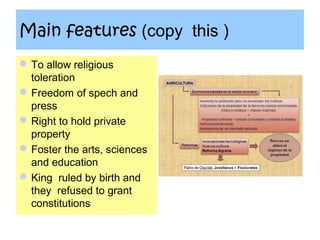
 To allow religious
  toleration
 Freedom of spech and
  press
 Right to hold private
  property
 Foster the arts, sciences
  and education
 King ruled by birth and
  they refused to grant
  constitutions
More characteristics (copy this)
 Reformist politics such
  as:
 Rationalization of the
  administration of State
 Liberation of the
  production and trade
 Modernitation of the
  agriculture
 Educational reform
 Manofacturing
  developments
Effects of the Enlightenment

England
   Civil war and establishment of a limited
    monarchy
   Anger in the colonies because they are treated
    differently than "mother England"
France
   No immediate change but seething discontent
    that will lead to revolution
Other countries
   Attempts to adopt Enlightenment principles
Enlightened Despots
Frederick II of Prussia (r. 1740-
 1786)
   Rebelled against father
   Later developed finest army
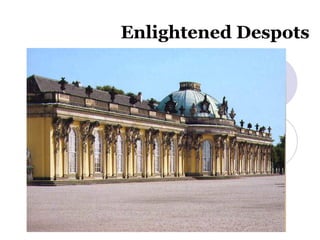
   Built Sans Souci (Potsdam)
   Invited Voltaire to the court
Enlightened Despots
Catherine the Great of
 Russia (r. 1762-1796)
   German born wife of Czar Peter
    III
   Controlled government after
    Peter III’s accidental(?) death
   Increased European culture in
    Russia
   Peasant Reforms
   Territorial Expansion
   Corresponded with Diderot
Enlightened Despots
Gustav III of Sweden (r.
 1771-1792)
   Forced Parliament to accept
    new constitution
   Stimulated literature


Charles III of Spain (r.
 1759-1788)
   Bourbon family
   Improved life for Spanish
   Suppressed Jesuits
Maria Theresa and Joseph II of Austria
(r. 1740-1780)

16 children
Built Schönbrunn
Economic reforms
Limited power of the Pope
Reduced power of the lords
Joseph abolished serfdom
Poland divided
Enlightened Despots vs. Absolute Rulers

  Focused(insistió) on   Reluctant to
   improving country       change

                          Economic
  Economic reform         disasters

                          Dictated
  Sought advise
Independence War
The American Revolution:
 Organized, popular
  opposition to an unjust
  government
 British government not
  acting in the interest of the
  people
 Protests, riots, crowd
  action used to defend an
  emerging common interest
    English in origin, but
     adopted by American
     colonists
No Taxation without
Representation!

 Colonists were not
  represented in
  Parliament, therefore
  shouldn’t be taxed
 Riots and protests as
  popular forms of social
  contract theory
 Spread via newspapers,
  pamphlets and
  broadsides
 Created an organized,
  slowly unified popular
  movement
State Constitutions
                  Republicanism.
                  Most had strong governors
                   with veto power.
                  Most had bicameral
                   legislatures.
                  Property required for voting.
                  Some had universal white
                   male suffrage.
                  Most had bills of rights.
                  Many had a continuation of
                   state-established religions
                   while others disestablished
                   religion.
Failure of Revolution:
                     Counter-revolutionary in
                      many ways
                     A device for establishing
                      a virtuous republican
                      government over a
                      population of less than
                      virtuous people.
                     The voice of the people
                      replaced by representative
                      democracy
                     Right to vote guaranteed
                      to select few
                     African slaves, women,
                      native Americans and
                      some poor whites failed to
                      secure the freedoms and
                      liberties that they had
                      fought and died for.
On July 4, 1776 they drafted
(ratificaron) the Declaration of
Independence (copy)
 It was written by
  Thomas Jefferson
 This statement
  expressed the
  principles of that
  revolution
 The right of all
  persons to liberty
 Pursuit of Happiness
 Defense of
  “inalienable rights”
The Constitution (copy this)
 The text ensured:
 The separation and the
  balance of the powers
 Executive
 Legislative
 Judicial
 Established a republican form
  of the government
 Its state would have federal
  structure
 It guaranteed rights and
  freedoms (religion, life,
  property,liberty
 The federal government was
  responsable for foreign
  affairs,defense,finance and
  currency
WAR OF SUCCESION
              In 1700, Charles II, the
               last Spanish monarch of
               the House of Habsburg,
               died without issue
              He bequeaths his
               possessions to Philip,
               grandson of his half-
               sisterand King Louis XIV
               of France.
              The war was centered in
               Spain and West-Central
               Europe 
              The war was concluded by
               the treaties of Utrecht
               (1713) and Rastatt (1714).
               As a result, Philip V
               remained King of Spain
               but was removed from the
               French line of succession,
               averting a union of the
               two kingdoms. The
               Austrians gained most of
               the Spanish territories in
Nueva Planta decrees
                  These acts constituted
                   the first realization of
                   Spain as a centralized
                   country.
                  Courts were abolished
                   except Castilla
                  Court cases could only
                   be presented and
                   argued in Castilian .
                  Abolishing the
                   Parliament
                  The viceroy is replaced
                   by a General Master.
                  A new territorial
                   organitation appear
Territorial uniformism
 The territory was
  divided into provinces
  ruled by a governor
  called General Captain
 Courts were created
  to control Justice
 Sheriffs were
  nominated to rule the
  towns
 Taxex were collected
  by intendants
The bourbon Reformism
 There were cimportants
  followers of the
  Enlightenment such as
  Marques de la Ensenada,
  Floridablanca…
 Tne conservatism of the
  intellectual classes and
  the importance of the
  catholic church made it
  difficult for the
  Enlightenment ideas to
  become widespread
Esquilache´s riot
 It happened in Madrid in
  1776
 Esquilache prohibited the
  wearing of long coats
  and broad-cap hats
  because there were too
  many crimes,so
  imposed wearing shorter
  coats
 It is believed that the riot
  was instigated by
  conservatives and the
  increase in the price of
  wheat
The growth of XVII
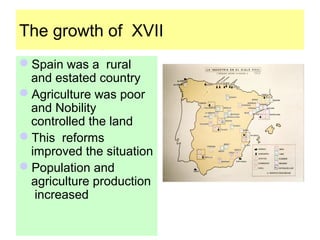
Spain was a rural
 and estated country
Agriculture was poor
 and Nobility
 controlled the land
This reforms
 improved the situation
Population and
 agriculture production
  increased
Reforms
 The liberation of trade
  allowed for the spread of
  commercial companies
 Crown manofacures
  were created
 Private manofactures
  were protected
 Duties protected our
  products
 Problems : Nobody
  wanted to change the
  agricultural structure

Enlightened despots 2012 borbones 2012

  • 1.
  • 2.
    Definition: (underline) It isa form of absolute monarchy or despotism in which rulers were influenced by enlightenment
  • 3.
    Main features (copythis )  To allow religious toleration  Freedom of spech and press  Right to hold private property  Foster the arts, sciences and education  King ruled by birth and they refused to grant constitutions
  • 4.
    More characteristics (copythis)  Reformist politics such as:  Rationalization of the administration of State  Liberation of the production and trade  Modernitation of the agriculture  Educational reform  Manofacturing developments
  • 5.
    Effects of theEnlightenment England  Civil war and establishment of a limited monarchy  Anger in the colonies because they are treated differently than "mother England" France  No immediate change but seething discontent that will lead to revolution Other countries  Attempts to adopt Enlightenment principles
  • 6.
    Enlightened Despots Frederick IIof Prussia (r. 1740- 1786)  Rebelled against father  Later developed finest army  Built Sans Souci (Potsdam)  Invited Voltaire to the court
  • 7.
    Enlightened Despots Catherine theGreat of Russia (r. 1762-1796)  German born wife of Czar Peter III  Controlled government after Peter III’s accidental(?) death  Increased European culture in Russia  Peasant Reforms  Territorial Expansion  Corresponded with Diderot
  • 8.
    Enlightened Despots Gustav IIIof Sweden (r. 1771-1792)  Forced Parliament to accept new constitution  Stimulated literature Charles III of Spain (r. 1759-1788)  Bourbon family  Improved life for Spanish  Suppressed Jesuits
  • 9.
    Maria Theresa andJoseph II of Austria (r. 1740-1780) 16 children Built Schönbrunn Economic reforms Limited power of the Pope Reduced power of the lords Joseph abolished serfdom Poland divided
  • 10.
    Enlightened Despots vs.Absolute Rulers Focused(insistió) on Reluctant to improving country change Economic Economic reform disasters Dictated Sought advise
  • 11.
    Independence War The AmericanRevolution:  Organized, popular opposition to an unjust government  British government not acting in the interest of the people  Protests, riots, crowd action used to defend an emerging common interest  English in origin, but adopted by American colonists
  • 12.
    No Taxation without Representation! Colonists were not represented in Parliament, therefore shouldn’t be taxed  Riots and protests as popular forms of social contract theory  Spread via newspapers, pamphlets and broadsides  Created an organized, slowly unified popular movement
  • 13.
    State Constitutions  Republicanism.  Most had strong governors with veto power.  Most had bicameral legislatures.  Property required for voting.  Some had universal white male suffrage.  Most had bills of rights.  Many had a continuation of state-established religions while others disestablished religion.
  • 14.
    Failure of Revolution:  Counter-revolutionary in many ways  A device for establishing a virtuous republican government over a population of less than virtuous people.  The voice of the people replaced by representative democracy  Right to vote guaranteed to select few  African slaves, women, native Americans and some poor whites failed to secure the freedoms and liberties that they had fought and died for.
  • 15.
    On July 4,1776 they drafted (ratificaron) the Declaration of Independence (copy)  It was written by Thomas Jefferson  This statement expressed the principles of that revolution  The right of all persons to liberty  Pursuit of Happiness  Defense of “inalienable rights”
  • 16.
    The Constitution (copythis)  The text ensured:  The separation and the balance of the powers  Executive  Legislative  Judicial  Established a republican form of the government  Its state would have federal structure  It guaranteed rights and freedoms (religion, life, property,liberty  The federal government was responsable for foreign affairs,defense,finance and currency
  • 17.
    WAR OF SUCCESION  In 1700, Charles II, the last Spanish monarch of the House of Habsburg, died without issue  He bequeaths his possessions to Philip, grandson of his half- sisterand King Louis XIV of France.  The war was centered in Spain and West-Central Europe   The war was concluded by the treaties of Utrecht (1713) and Rastatt (1714). As a result, Philip V remained King of Spain but was removed from the French line of succession, averting a union of the two kingdoms. The Austrians gained most of the Spanish territories in
  • 18.
    Nueva Planta decrees  These acts constituted the first realization of Spain as a centralized country.  Courts were abolished except Castilla  Court cases could only be presented and argued in Castilian .  Abolishing the Parliament  The viceroy is replaced by a General Master.  A new territorial organitation appear
  • 19.
    Territorial uniformism  Theterritory was divided into provinces ruled by a governor called General Captain  Courts were created to control Justice  Sheriffs were nominated to rule the towns  Taxex were collected by intendants
  • 20.
    The bourbon Reformism There were cimportants followers of the Enlightenment such as Marques de la Ensenada, Floridablanca…  Tne conservatism of the intellectual classes and the importance of the catholic church made it difficult for the Enlightenment ideas to become widespread
  • 21.
    Esquilache´s riot  Ithappened in Madrid in 1776  Esquilache prohibited the wearing of long coats and broad-cap hats because there were too many crimes,so imposed wearing shorter coats  It is believed that the riot was instigated by conservatives and the increase in the price of wheat
  • 22.
    The growth ofXVII Spain was a rural and estated country Agriculture was poor and Nobility controlled the land This reforms improved the situation Population and agriculture production increased
  • 23.
    Reforms  The liberationof trade allowed for the spread of commercial companies  Crown manofacures were created  Private manofactures were protected  Duties protected our products  Problems : Nobody wanted to change the agricultural structure